

TNT (Trinitrotoluene) Market Summary:
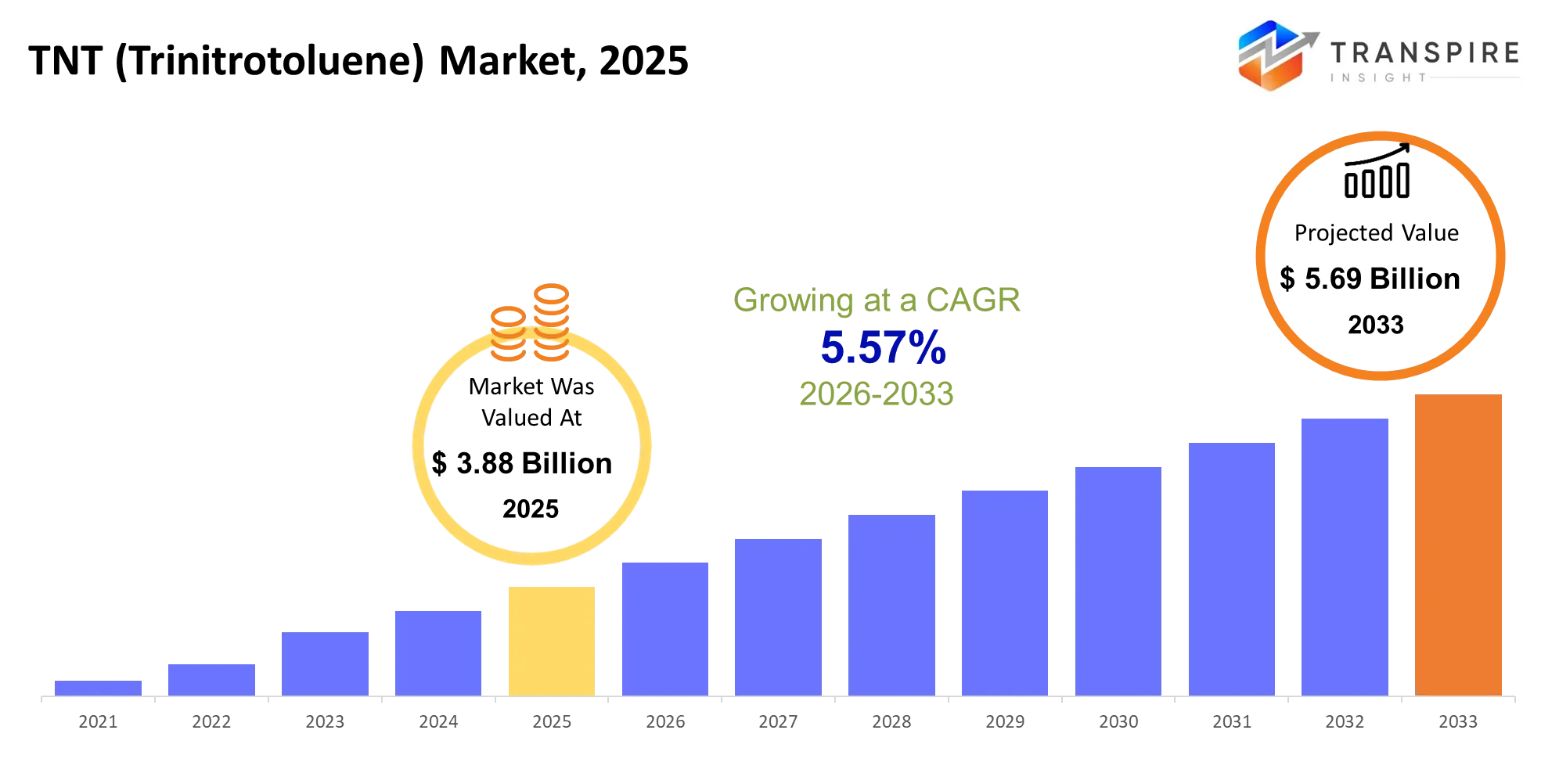
As per Transpire Insight Analysis, The TNT (Trinitrotoluene) Market size is estimated at USD 3.88 billion in 2025 and is anticipated to reach USD 5.69 billion by 2033, growing at a CAGR of 5.57% from 2026 to 2033.
The TNT market around the world supports make defense equipment, supply ammunition, run mining projects and carry out blasting jobs in factories. Over the years, the TNT market has moved more towards making things inside each country and buying safer energy materials from safer places. New demands for defence gear changes in politics around the world and the wish to not rely on a few foreign suppliers have pushed governments and makers to build supply chains. A big change in the TNT market is that more money is being put into factories that make defence goods and energy materials next to where ammunition is made. At the same time, new mining projects and new roads and bridges keep helping factories use more energy materials. These changes in the TNT market are making companies buy plants, sign long‑term deals and build stronger local factories, which keeps the TNT market growing.
TNT (Trinitrotoluene) Market Size & Forecast:
- Market Size 2025: USD 3.88 Billion
- Expected Market Value (2033): USD 5.69 Billion
- Forecast CAGR (2026–2033): 5.57%
- Leading Region in 2025: Asia Pacific
- Fastest Growing Region: Middle East & Africa
- Key Company Profiles: Chemring Group, BAE Systems, Rheinmetall, Northrop Grumman, General Dynamics, Solar Industries India, NOF Corporation, Orica, Dyno Nobel, Austin Powder, EPC Groupe, AEL Mining Services, MAXAM, Explosia, Pravisani
Key Market Insights
market is moving towards being connected with the supply chain of defence procurement and industrial explosives.
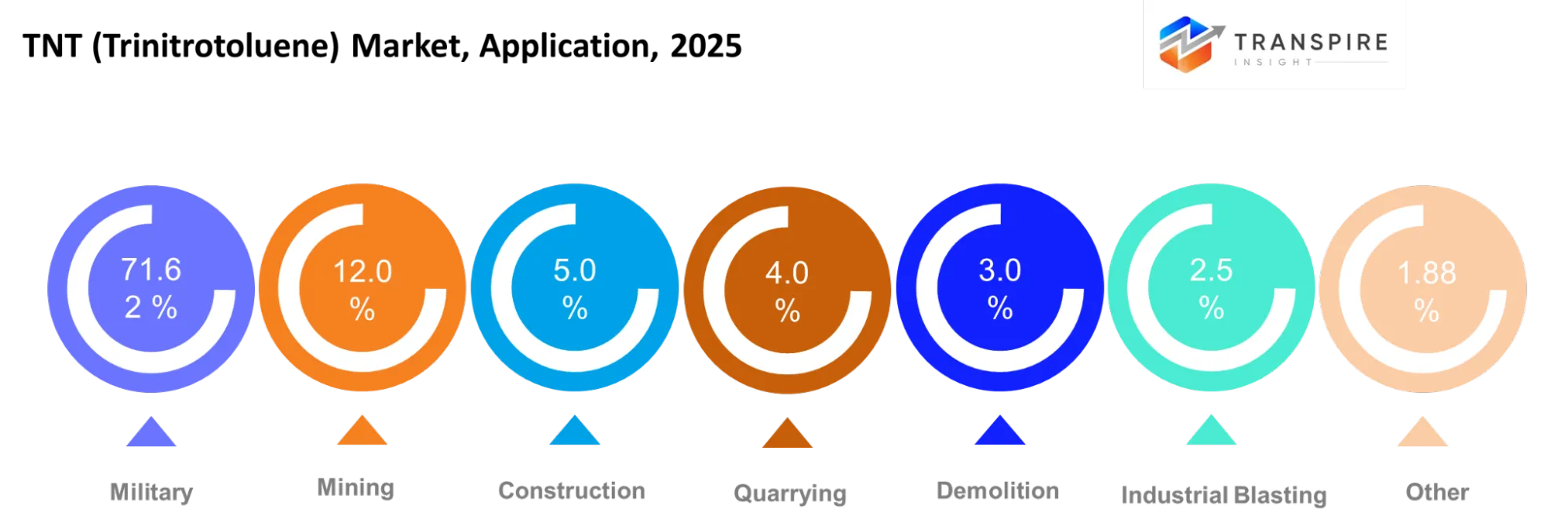
- The military segment accounted for 71.62% of the application segment of the market owing to the significance of the defence procurement process and munitions.
- Mining stood at 12.0% of the application share of the market, while 5.88% CAGR in terms of the mining industry indicated increasing interest in mineral exploration activities.
- The construction segment constituted 5.0% and was bolstered by the existence of various infrastructure development projects that require blasting services.
- The quarries took 4.0% of the market because it correlated with the aggregates, cement, and construction material sector.
- The demolition process made up 3.0% of the market, owing to controlled demolition and redevelopments related to the construction industry.
- Industrial blasting accounted for 2.5% as industrial activity continued utilising energetic materials.
What are the Key Drivers, Restraints, and Opportunities in the TNT (Trinitrotoluene) Market?
Drivers
The growth of programs related to procurement and ammunition replenishment is one of the main drivers for the TNT market. Uncertainty in geopolitics and the requirement to enhance defence capabilities have made countries invest in reliable sources of explosive materials, which has increased the significance of long-term supplier deals and local production. Mining and mineral extraction projects are another driver of demand for explosives, especially in areas developing in the resource industry.
Restraints
Strict environmental policies, rules for handling hazardous materials, and compliance with high manufacturing costs will remain a restraint for market growth. The production of TNT requires industrial plants that comply with all the safety measures and necessary permits. Such restrictions lead to higher investments and complicate market entry for small manufacturers.
Opportunities
The opportunity to invest in local manufacture of defence equipment is a good one. Nations looking to decrease their reliance on foreign suppliers are now favouring local industries. For instance, the Adani Defence & Aerospace of India has decided to invest in a missile manufacturing ecosystem that even includes TNT manufacture. Such investments can help enhance manufacturing opportunities in the region.
|
Driver |
Relative Impact on Growth (%) |
Geographic Relevance |
Impact Timeline |
Demand Strength |
Growth Mechanism |
Key Beneficiaries |
Major Constraint |
|
Rising Military and Defence Ammunition Procurement |
30% |
North America, Europe, Asia Pacific |
Short-term |
High |
Defence procurement supports demand for established explosive materials. |
Defence contractors, TNT manufacturers, ammunition suppliers. |
Strict export controls and procurement restrictions. |
|
Expansion of Defence Manufacturing Capacity |
25% |
Europe, North America |
Medium-term |
High |
Manufacturing investments strengthen industrial supply capabilities. |
Explosives manufacturers, defence industrial groups, government suppliers. |
High capital requirements and lengthy facility approvals. |
|
Military Stockpile Replenishment and Strategic Preparedness |
20% |
North America, Europe, Asia Pacific |
Short-term |
High |
Inventory replenishment sustains government procurement demand. |
Defence agencies, ammunition manufacturers, approved suppliers. |
Budget limitations and changing procurement priorities. |
|
Growth in Mining, Quarrying and Industrial Blasting |
15% |
Asia Pacific, Latin America, Africa |
Medium-term |
Medium |
Industrial expansion supports demand for specialized blasting materials. |
Mining companies, explosives suppliers, industrial contractors. |
Alternative explosives and stringent safety regulations. |
|
Supply Chain Resilience and Manufacturing Modernization |
10% |
Europe, North America, Asia Pacific |
Long-term |
Medium |
Domestic sourcing initiatives encourage production investments. |
Chemical manufacturers, defence suppliers, technology providers. |
Raw material shortages and environmental compliance costs. |
|
Total |
100% |
— |
— |
— |
— |
— |
— |
What Has the Impact of Artificial Intelligence Been on the TNT (Trinitrotoluene) Market?
Artificial intelligence technologies have been impacting the international TNT market primarily through the development of supporting technologies for industrial manufacturing, quality control, equipment monitoring, and supply chain management processes. While AI is not directly changing the nature of TNT itself, the implementation of these technologies in the industrial systems associated with TNT has been helping to enhance visibility and resource management in manufacturing. The application of automation and machine-learning technologies could be useful in the monitoring of equipment condition, spotting unusual production trends, and quality documentation. Predictive maintenance solutions could analyse past performance of the equipment to identify maintenance needs before failures could negatively impact manufacturing facility operations. The use of historical demand data and market analysis could enhance production planning and management of supply chain risks. Moreover, digital monitoring technologies would enhance safety oversight by allowing us to spot unusual operation patterns. The deployment of these technologies requires high financial costs to build a digital infrastructure, ensure cybersecurity and train the workforce. Lack of reliable data could impair the analysis. For that reason, AI should be considered as an operational technology rather than a driver of TNT consumption.
Instance
In December 2025, MxD and the U.S. Army DEVCOM Armaments Centre. MxD carried out two pilot programs at Picatinny Arsenal in New Jersey concerning TNT manufacture. The pilot programs include innovative use of sensors, computer vision using AI, and digital twins in order to monitor manufacturing, retain knowledge of manufacturing, and ensure safety for the workers. This shows the increasing importance of digital technologies and AI in the modernisation of TNT manufacturing. https://www.mxdusa.org/project/modernizing-munitions-manufacturing-when-the-experts-retire-who-will-prepare-the-tnt/
Key Market Trends:
The international industry for TNT production is becoming increasingly regional and more secure as defence manufacturing independence has been growing in government priority.
- The government has moved from focusing on foreign supply sources to increasing national energetic materials manufacturing capabilities.
- There has been an increase in defence manufacturing companies' use of long-term purchasing contracts as a means to ensure consistent supplies.
- There has been an increasing incorporation of technological solutions for digital monitoring and predictive maintenance of equipment by industrial factories.
- Investment in defence on a regional level has fostered collaboration between energetic materials manufacturers, engineering firms, and ammunition producers.
- Supply chain management has become more significant as manufacturing companies try to get a better understanding of their raw material acquisition risk.
- Workforce training and industrial safety management have been getting more attention from companies.
TNT (Trinitrotoluene) Market Segmentation
By application
military applications hold the biggest market share of 71.62%, thereby making defence manufacturing and government procurement the most significant demand-generating factors in the market. On the contrary, mining accounts for 12.0%, construction accounts for 5.0%, quarrying for 4.0%, demolition for 3.0%, industrial blasting for 2.5%, and other applications account for 1.88%. Mining applications have recorded the biggest CAGR projections of 5.88%, owing to growth in mining activities. This shows the significance of demand from defence requirements, alongside that from other specific industries.
By form
the market offers cast, pressed, granulated, solid, liquid/molten TNT, composite, and other forms of TNT. Various forms of TNT cater to various requirements in terms of product specifications as per customer qualification, regulations, and industrial application.
By grade
The market consists of military grade, industrial grade, commercial grade, high purity grade, standard grade, speciality grade, among others. The needs of military and industrial users will determine purchasing needs, while consistency, compliance, and quality certifications still need to be considered.
By end user
The market involves defence, mining, construction, quarrying, demolition, industrial manufacturing, and governments. The procurement activities by the defence will still be closely linked with the military end use, whereas the mining and construction customers will be part of the broader industrial demand base.
By distribution channel
The market uses direct supply, procurement by governments, industrial distributors, defence contractors, mining, speciality chemicals, among others. The procurement process is dependent on authorisation from the customer, regulation, the qualification of the supplier, and the purchaser.
What are the Key Use Cases Driving the TNT (Trinitrotoluene) Market?
The military and defence usage is the use case for market demand for TNT. Defence purchases and manufacturing of ammunition are some of the major drivers for the consumption of TNT products. This is backed by the government policies which ensure that there are proper reserves of military supplies and improved defence capabilities. Industrial uses in mining, quarries and the construction industry is another application of TNT where specific blasting needs for mineral extraction and industrial projects are present. Emerging opportunities in the market are due to the growing investment in regional manufacturing of defence equipment, industrial supply chains and increased mineral exploration activities.
|
Report Metrics |
Details |
|
Market size value in 2025 |
USD 3.88 Billion |
|
Market size value in 2026 |
USD 4.10 Billion |
|
Revenue forecast in 2033 |
USD 5.69 Billion |
|
Growth rate |
CAGR of 5.57% from 2026 to 2033 |
|
Base year |
2025 |
|
Historical data |
2021 - 2024 |
|
Forecast period |
2026 - 2033 |
|
Report coverage |
Revenue forecast, competitive landscape, growth factors, and trends |
|
Regional scope |
United States; Canada; Mexico; United Kingdom; Germany; France; Italy; Spain; Denmark; Sweden; Norway; China; Japan; India; Australia; South Korea; Thailand; Brazil; Argentina; South Africa; Saudi Arabia; United Arab Emirates |
|
Key company profiled |
Chemring Group, BAE Systems, Rheinmetall, Northrop Grumman, General Dynamics, Solar Industries India, NOF Corporation, Orica, Dyno Nobel, Austin Powder, EPC Groupe, AEL Mining Services, MAXAM, Explosia, Pravisani |
|
Customization scope |
Free report customization (country, regional & segment scope). Avail customized purchase options to meet your exact research needs. |
|
Report Segmentation |
Application (Military, Mining, Construction, Quarrying, Demolition, Industrial Blasting, Other); Form (Cast TNT, Pressed TNT, Granulated TNT, Solid TNT, Liquid/Molten TNT, Composite Formulations, Other); Grade (Military Grade, Industrial Grade, Commercial Grade, High-Purity Grade, Standard Grade, Specialty Grade, Other); End User (Defense, Mining, Construction, Quarrying, Demolition, Industrial Manufacturing, Government); Distribution (Direct Supply, Government Procurement, Industrial Distributors, Defense Contractors, Mining Suppliers, Specialty Chemical Suppliers, Other) |
Which Regions are Driving the TNT (Trinitrotoluene) Market Growth?
North America
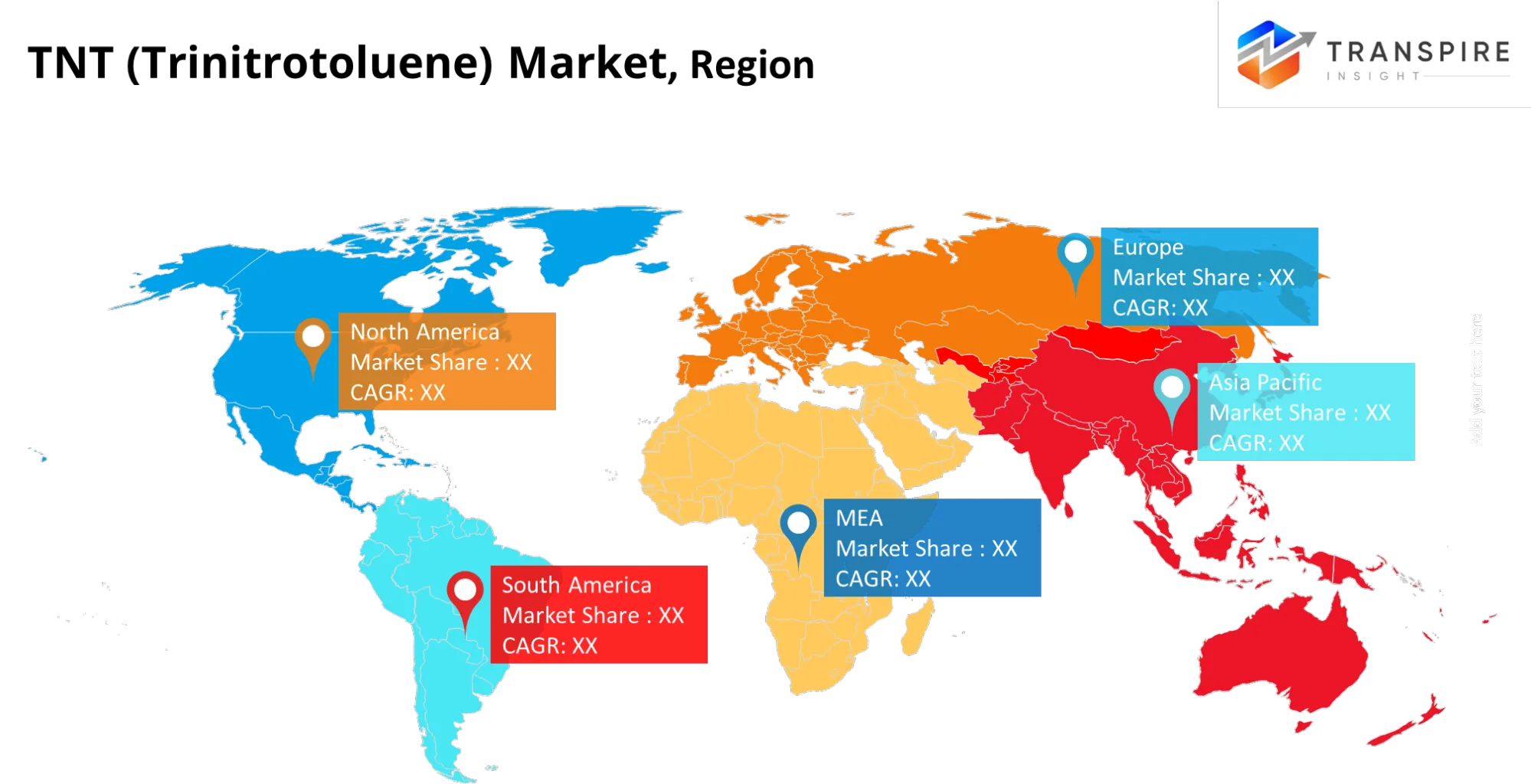
North America constitutes 22.8% of the market. This is attributed to defence procurements, established infrastructure of military manufacturers, and mining operations. It is becoming increasingly concerned about less reliance on external energetic material suppliers. This, coupled with defence manufacturing investments in addition to the defence ammunition supply chain, strengthens the industrial position.
In June 2026, at the TNT Facility in Graham, KY, USA, the U.S. Army signed a contract modification with REPKON USA–Defence for the design, construction, and commissioning of a TNT manufacturing plant in Graham, Kentucky. The investment will help restore the capability of TNT manufacturing in the country and support the US defence ammunition supply chain. https://www.highergov.com/contract/W519TC25D0003-W519TC25F0015/
Europe
The Europe region accounts for 17.6% of the market. This is driven by defence modernisation and ammunition supply chain security. It has increasingly become concerned about strengthening the local manufacturing base and reducing dependence on a limited number of external suppliers. Poland-based Nitro-Chem is one of the key manufacturers in this region. Investments made in production capacity expansion are some of the major industry changes.
In March 2026, Nitro-Chem and PROZAP Polish company Nitro-Chem signed an agreement with PROZAP to design a second TNT manufacturing plant at its Bydgoszcz site. The project aims to increase production capacity to meet growing demand from international defence customers.
Asia Pacific
The Asia Pacific region leads the world in terms of TNT production, as it holds a market share of 46.02%, owing to its defence manufacturing facilities, mining operations, and infrastructure projects. The region includes China, India, and South Korea, which make contributions to its industrial as well as defence manufacturing sectors. Increased investments in its indigenous defence manufacturing sector have been making its supply chains more capable.
In July 2026, Adani Defence & Aerospace began its large-scale defence manufacturing project in Shivpuri, Madhya Pradesh, India. The plant will manufacture TNT and composite propellants along with missiles. The investment will help strengthen India's domestic defence supply chain and increase indigenous energetic materials manufacturing capabilities in the Asia Pacific region. https://www.adani.com/newsroom/media-releases/adani-defence-and-aerospace-to-invest-2500-crore-in-south-asias-largest-private-sector
Who are the Key Players in the TNT (Trinitrotoluene) Marketand how do they Compete?
The TNT market around the world comprises traditional defence manufacturers and companies that produce industrial explosives. Some of the companies that operate in various parts of the energetic materials and explosives industry are Nitro-Chem, Solar Industries India Limited, Hanwha Corporation, MAXAM, and Orica. Nitro-Chem is focused on its supply contracts and relationships with international customers thanks to its well-established manufacturing base in Europe. Solar Industries India builds its competitive position through defence manufacturing and expansion into industrial explosives. Hanwha Corporation uses its experience in the defence sector and manufacturing of industrial explosives, while MAXAM is engaged in explosives for specialised markets. Orica and Dyno Nobel are distinguished by their mining explosives services and digital technologies as well as customer base, while other competitors like Austin Powder and EPC Groupe specialise in industrial explosives and regional markets.
TNT (Trinitrotoluene) Marketcompanies
- Chemring Group
- BAE Systems
- Rheinmetall
- Northrop Grumman
- General Dynamics
- Solar Industries India
- NOF Corporation
- Orica
- Dyno Nobel
- Austin Powder
- EPC Groupe
- AEL Mining Services
- MAXAM
- Explosia
- Pravisani
|
Company |
Est. Revenue Share Range |
Key Offerings |
Strategic Positioning (5–10 words) |
Geographic Strength |
Technology Focus (5–10 words) |
|
Nitro-Chem S.A. |
Not publicly disclosed |
TNT, military explosives, explosive fills |
Established international TNT manufacturing and defence exports |
Europe, North America |
Military-grade energetic materials and quality assurance |
|
SBL Energy Limited |
Not publicly disclosed |
TNT, industrial explosives, defence explosives |
Export-oriented manufacturing and domestic capacity expansion |
Asia Pacific, India |
TNT manufacturing and industrial explosives production |
|
Munitions India Limited |
Not publicly disclosed |
TNT, ammunition, military explosive products |
Government-backed defence manufacturing and domestic procurement |
Asia Pacific, India |
Military explosives and ammunition manufacturing |
|
Pakistan Ordnance Factories |
Not publicly disclosed |
TNT, ammunition, defence explosives |
State-supported defence production and regional supply |
Asia Pacific, South Asia |
Military energetics and ammunition production capabilities |
|
MICCO |
Not publicly disclosed |
TNT, industrial explosives, blasting materials |
Regional explosives supplier with domestic market strength |
Asia Pacific, Southeast Asia |
Industrial explosives and energetic-material manufacturing |
|
NORINCO |
Not publicly disclosed |
Military explosives, ammunition, energetic materials |
Large-scale integrated defence manufacturing and supply |
Asia Pacific, China |
Defence energetics and integrated ammunition technologies |
|
Explosia a.s. |
Not publicly disclosed |
Military explosives, industrial explosives, energetic materials |
European specialist in defence and explosives manufacturing |
Europe, Central Europe |
Advanced energetic materials and explosives research |
|
Solar Industries India Limited |
Not publicly disclosed |
Defence explosives, industrial explosives, energetic materials |
Defence diversification and integrated manufacturing capabilities |
Asia Pacific, Middle East, Africa |
Advanced energetic materials and defence manufacturing |
|
Orica Limited |
Not publicly disclosed |
TNT-based boosters, Pentex boosters, blasting solutions |
mining explosives distribution and service integration |
Asia Pacific, North America, Latin America |
Electronic blasting systems and integrated mining technologies |
|
Dyno Nobel |
Not publicly disclosed |
TROJAN boosters, pentolite boosters, mining explosives |
Mining-focused explosives solutions and established distribution |
North America, Australia, Asia Pacific |
Electronic initiation systems and blasting technologies |
Recent Development News
In March 2026, Nitro-Chem laid out plans for the development of a new TNT production plant in collaboration with Prozap, which is a subsidiary of Grupa Azoty. The expansion is part of initiatives to enhance the manufacturing capacity of Europe and ensure supply chain security in the region. https://www.reuters.com/business/aerospace-defense/polish-explosives-maker-start-work-new-tnt-line-2026-03-13/
In July 2026, Adani Defence & Aerospace invested in a missile manufacturing ecosystem in Shivpuri, Madhya Pradesh, including TNT production among other defence manufacturing facilities. This was a major development in India’s private defence manufacturing ecosystem. https://www.adani.com/newsroom/media-releases/adani-defence-and-aerospace-to-invest-2500-crore-in-south-asias-largest-private-sector
What Strategic Insights Define the Future of the TNT (Trinitrotoluene) Market?
The future of the TNT market will be more and more dependent on defence supply chain security, regional manufacturing investments, and the capability of existing suppliers to respond to the changing procurement needs. The military use will continue to be the main demand driver, whereas the mining sector will offer a growth opportunity. One hidden threat is the dependence of the industry on a small number of qualified manufacturers, which might result in supply disruption during times of high procurement. Environmental compliance costs and hazardous material manufacturing regulations may impact future investments. However, domestic defence manufacturing projects in Asia Pacific and Europe will create opportunities for expansion. Companies should focus on regulatory compliance, supplier reliability, manufacturing robustness, and digital management.
Application
- Military
- Mining
- Construction
- Quarrying
- Demolition
- Industrial Blasting
- Other
Form
- Cast TNT
- Pressed TNT
- Granulated TNT
- Solid TNT
- Liquid/Molten TNT
- Composite Formulations
- Other
Grade
- Military Grade
- Industrial Grade
- Commercial Grade
- High-Purity Grade
- Standard Grade
- Specialty Grade
- Other
End User
- Defense
- Mining
- Construction
- Quarrying
- Demolition
- Industrial Manufacturing
- Government
Distribution
- Direct Supply
- Government Procurement
- Industrial Distributors
- Defense Contractors
- Mining Suppliers
- Specialty Chemical Suppliers
- Other
By Regional Analysis
North America
- US
- Canada
- Mexico
Europe
- Germany
- UK
- France
- Italy
- Spain
- Russia
- Rest of Europe
Asia Pacific
- China
- Japan
- India
- South Korea
- Australia
- Rest of Asia Pacific
South America
- Brazil
- Argentina
- Rest of South America
Middle East & Africa
- UAE
- Saudi Arabia
- Qatar
- South Africa
- Rest of the Middle East & Africa
Frequently Asked Questions
Find quick answers to common questions.
The TNT (trinitrotoluene) market size was valued at USD 3.88 billion in 2025 and is poised to reach 5.69 billion by 2033, expanding at a 5.57% CAGR.
Key segments for the TNT (trinitrotoluene) market are Application (Military, Mining, Construction, Quarrying, Demolition, Industrial Blasting, Other); Form (Cast TNT, Pressed TNT, Granulated TNT, Solid TNT, Liquid/Molten TNT, Composite Formulations, Other); Grade (Military Grade, Industrial Grade, Commercial Grade, High-Purity Grade, Standard Grade, Specialty Grade, Other); End User (Defense, Mining, Construction, Quarrying, Demolition, Industrial Manufacturing, Government); Distribution (Direct Supply, Government Procurement, Industrial Distributors, Defense Contractors, Mining Suppliers, Specialty Chemical Suppliers, Other)
Growth is primarily driven by increasing demand from the defense sector, expanding mining and quarrying activities, rising infrastructure development, and growing industrial blasting requirements. Investments in military modernization and increased demand for explosives in large-scale mining projects further support market growth.
The market is led by major manufacturers including Chemring Group, BAE Systems, Rheinmetall, Northrop Grumman, General Dynamics, Solar Industries India, NOF Corporation, Orica, Dyno Nobel, Austin Powder, EPC Groupe, AEL Mining Services, MAXAM, Explosia, Pravisani
The Asia Pacific region leads the market for TNT with a share of 46.02% due to high demand from the mining, construction, quarrying, and defence industries. The increase in mining operations, industrial blasting needs, and the presence of explosives manufacturing plants in the region add to its market position.
Market opportunities in the TNT market include growing demand from mining and quarrying applications, accelerating infrastructure development, modernisation of defence forces, and increased focus on investments into industrial explosives manufacturing. Other market opportunities involve increased mining capacity in emerging countries and the development of safe explosives handling technologies.
- Chemring Group
- BAE Systems
- Rheinmetall
- Northrop Grumman
- General Dynamics
- Solar Industries India
- NOF Corporation
- Orica
- Dyno Nobel
- Austin Powder
- EPC Groupe
- AEL Mining Services
- MAXAM
- Explosia
- Pravisani
About the Authors

Pankaj Ghogare Patil
I am Pankaj Ghogare Patil, a Senior Research Analyst at Transpire Insight, specializing in the Pharmaceutical, Chemicals & Materials, Healthcare IT, and Biotechnology industry. My expertise lies in conducting comprehensive market research, analyzing industry trends, evaluating competitive landscapes, and translating complex data into actionable insights. At Transpire Insight, I closely follow emerging technologies, regulatory developments, and market innovations to create accurate, well-researched, and informative content that helps businesses and professionals make informed decisions. I am committed to producing credible, evidence-based articles that reflect industry best practices while making technical topics accessible and valuable for a broad audience.

Chakradhar Khansole
Chakradhar serves as the Research Director at Transpire Insight, bringing over 8 years of experience in technology, innovation, and strategic market intelligence. He specializes in transforming complex market data into actionable business insights that enable organizations to make informed, growth-oriented decisions. Recognized for his strategic vision and analytical expertise, Chakradhar leads high-impact research initiatives, delivering comprehensive market assessments, competitive intelligence, and forward-looking industry analysis.
Recently Published Reports
-
May 2026
Healthcare Polymer Packaging Market
Healthcare Polymer Packaging Market Size, Share & Analysis Report By Packaging Type (Syringes, IV Bottles and Pouches, Clamshells, Blisters, Bottles & Jars, Containers, Tubes, IV Parental Packaging, Others), By Type (Regulated, Non-regulated), By Polymer Type (LDPE (Low-Density Polyethylene), HDPE (High-Density Polyethylene), Homo-polymer (Homo), Random Copolymer (Random), Block Copolymer (Block), PET, Polystyrene, Polyvinyl Chloride, Polyamide/EVOH, Others), and Geography (North America, Europe, Asia-Pacific, Middle East and Africa, South and Central America), 2021 - 2031
-
Apr 2026
Hydrophilic Tape (Waterstop) Market
Hydrophilic Tape (Waterstop) Market Size, Share & Analysis Report By Type (Bentonite-Based Hydrophilic Tape, Rubber-Based Hydrophilic Tape), By Application (Residential Buildings, Commercial Buildings, Infrastructure Projects), and Geography (North America, Europe, Asia-Pacific, Middle East and Africa, South and Central America), 2021 - 2031
-
Apr 2026
Metalens Market
Metalens Market Size, Share & Analysis Report By Type (Visible Light Metalens, and Infrared Metalens), By Application (Consumer Electronics, Automotive Electronics, Industrial, Medical, and Others), and Geography (North America, Europe, Asia-Pacific, Middle East and Africa, South and Central America), 2021 - 2031
-
Apr 2026
PBT Resin Market
PBT Resin Market Size, Share & Analysis Report By Type (Reinforced PBT Resin, Unreinforced PBT Resin), By Processing Method (Injection Molding, Extrusion, Blow Molding, Others), By End-User (Automotive, Electrical & Electronics, Consumer Appliances, Industrial Machinery, Medical Devices, Packaging, Others), and Geography (North America, Europe, Asia-Pacific, Middle East and Africa, South and Central America), 2021 - 2031