

Factory Automation And Industrial Controls Market Summary:
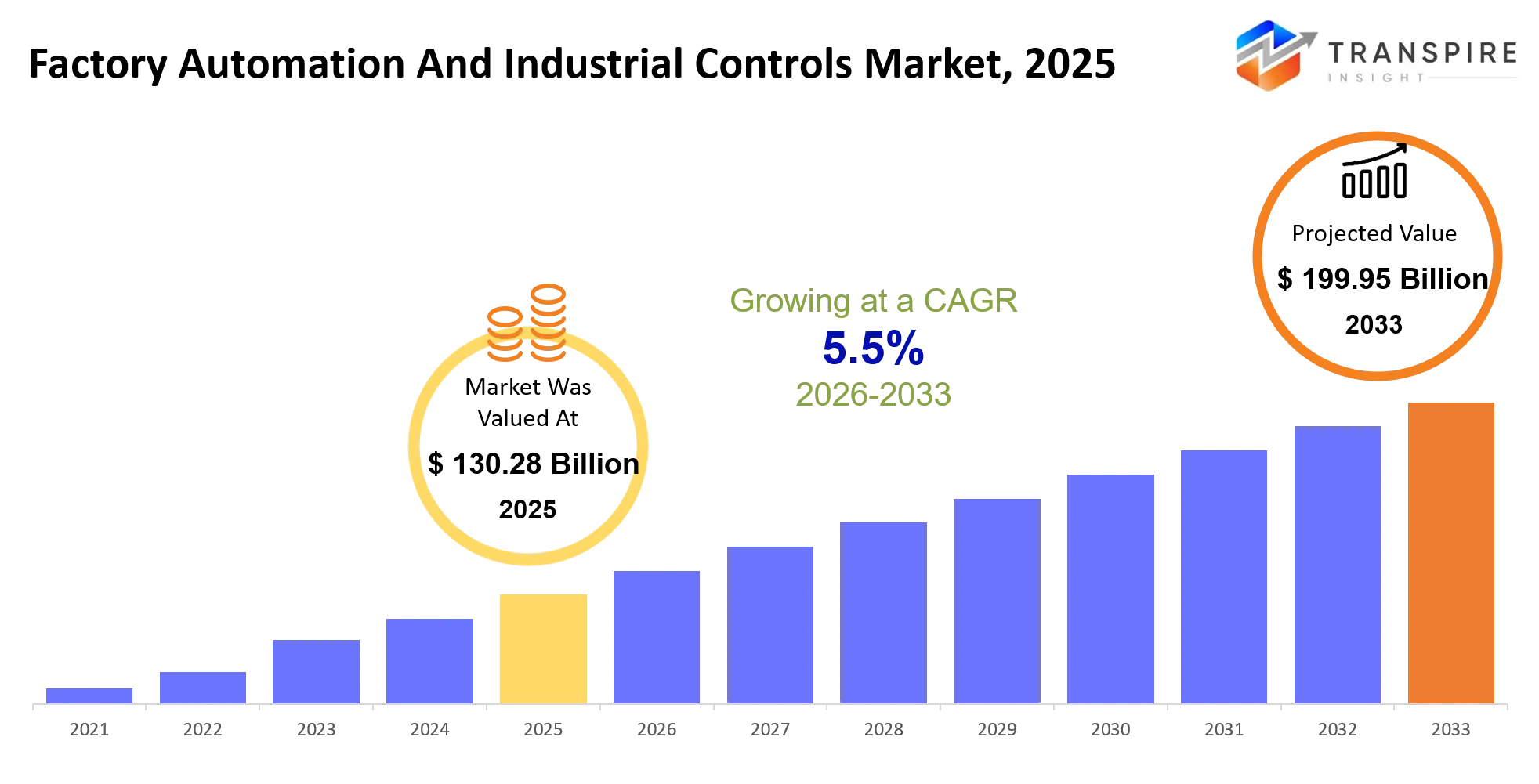
As per Transpire Insight Analysis, the Factory Automation And Industrial Controls Market size is estimated at USD 130.28 billion in 2025 and is anticipated to reach USD 199.95 billion by 2033, growing at a CAGR of 5.5% from 2026 to 2033.
The factory automation and industrial controls market supports manufacturers run production lines with accuracy same results and better control. Programmable logic controllers, distributed control systems, supervisory control and data acquisition platforms and industrial robots help with tasks that go from machine operation to checking quality and moving materials. Over the past three to five years, manufacturers have started to move from separate automation tools towards connected production environments that bring together data, software and smart control. The lack of workers, the need to cut down on production downtime and the need to maintain product quality have made this change happen faster. The growth of vehicle, electronics and semiconductor manufacturing has also led to a need for flexible production systems. A big change is the joining of automation with artificial intelligence, industrial IoT and digital twins. These tools help manufacturers spot problems before they happen, make use of machines and change production more smoothly, which pushes companies to spend on new automation systems.
Factory Automation And Industrial Controls Market Size & Forecast:
- Market Size 2025: USD 130.28 Billion
- Expected Market Value (2033): USD 199.95 Billion
- Forecast CAGR (2026–2033): 5.5%
- Leading Region in 2025: Asia Pacific
- Fastest Growing Region: Middle East & Africa
- Key Company Profiles: Siemens, Rockwell Automation, Schneider Electric, ABB, Honeywell, Emerson, Mitsubishi Electric, Omron, Yokogawa, FANUC, Bosch Rexroth, Keyence, Beckhoff, Fuji Electric, Hitach
Key Market Insights:
The trends in the industry are moving towards interconnected factories, more flexible automation, and smarter production controls. Businesses are utilising the combination of control systems, robots, and artificial intelligence to increase efficiency.
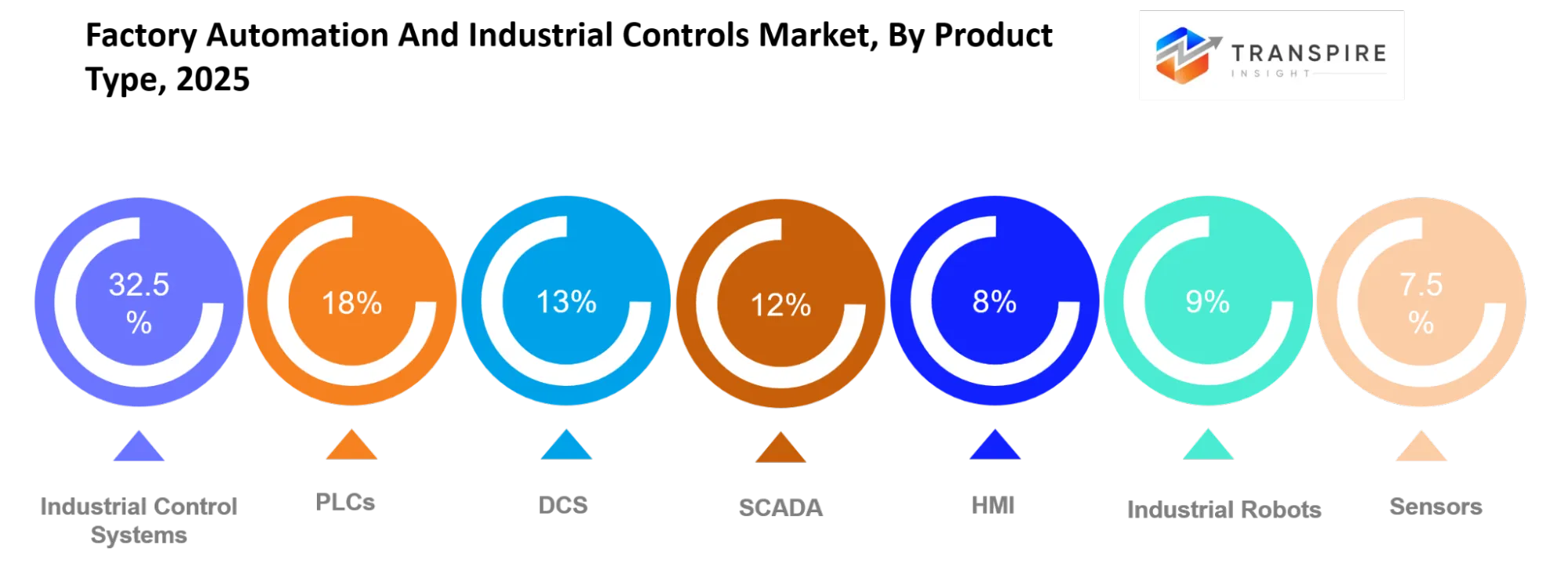
- Industrial Control Systems have a market share of 32.5%, while Siemens and ABB continue developing integrated automation technologies for connected manufacturing.
- Programmable Logic Controllers (PLCs) constitute 18%, while suppliers continue developing controller connectivity for flexible production processes.
- DCS holds 13% of the market, as Honeywell and Emerson continue developing process monitoring and control systems.
- SCADA systems occupy a 12% share due to the adoption of connected technology for monitoring and analysis to speed up error detection.
- HMIs occupy 8% of the market for visualisation technologies that make it easy to monitor equipment performance and to make the right decisions.
- Industrial Robots account for 9% of the market and are expected to grow at a CAGR of 11.9% due to innovations by ABB, FANUC, and KUKA.
- Industrial Sensors constitute 5% of the market, as manufacturers are increasingly adopting sensor networks for monitoring and predictive maintenance.
What are the Key Drivers, Restraints, and Opportunities in the Factory Automation And Industrial Controls Market?
Drivers
The increasing automation of production lines on the part of manufacturers is due to labour-related limitations, variations in product quality, and expensive production disruptions. The need to automate production has increased even further because automotive manufacturers and producers of electronics and semiconductors are dealing with intricate production processes and strict deadlines. Automation helps to streamline the process, while robots are responsible for handling tedious work
Restraints
Higher costs incurred during initial installation represent the other challenge, especially among smaller and medium-sized manufacturers. Equipment acquisition is not the only cost that matters; integration, software licenses, security, training, and maintenance costs are also involved in the budgeting process. The existence of legacy equipment makes the process harder since the old control systems might not work effectively with new systems. This could lead to increased time spent in the installation process and delay the returns on investment.
Opportunities
The opportunity comes in the form of upgrading old plants instead of replacing all machinery. The application of edge computing, industrial internet of things, digital twins and predictive maintenance using AI will bring intelligence to the already existing manufacturing plants. For instance, a manufacturer may install sensors on machines in order to detect vibrations and schedule maintenance even before any breakdown happens. Industrial development in Asia Pacific and modernisation in the Middle East will also create opportunities for suppliers of automation systems.
What Has the Impact of artificial intelligence on the Factory Automation And Industrial Controls Market?
AI is revolutionising factory automation through the capacity of machines and control systems to process production data, detect patterns and make rapid decisions based on that. In quality control, an AI machine vision can check products for surface defects, assembly mistakes and dimensional discrepancies. This will allow companies to detect flaws sooner and minimise the number of faulty items going further into production. Another area where AI models have a lot of potential is predictive maintenance. By processing information on vibrations, temperature, pressure, and motor performance, AI algorithms can detect when equipment starts deteriorating. This allows maintenance personnel to schedule maintenance work to prevent unexpected breakdowns and production stoppages. In the case of industrial robotics, AI vision and motion planning allow robots to cope with changing locations of products and increased diversity of tasks. There are some obstacles to the implementation of AI solutions in manufacturing. AI technologies require costly sensors, high-quality industrial data, expertise and compatibility with the current control system. Inaccurate forecasts or untested models can lead to improper maintenance and production decisions.
Instance
In November 2025, Rockwell Automation revealed its incorporation of NVIDIA Nemotron Nano, which is an AI generative model, into FactoryTalk Design Studio processes. The move will help boost the use of AI in industrial engineering, decision-making, and automation processes.
Key Market Trends:
The market for factory automation and industrial control is moving away from static automation of individual machines to flexible and connected manufacturing through software. Organisations are focusing on systems that enhance visibility, increase efficiency and minimise human intervention in the process
- Industrial robots are developing from just programmed movements to those involving machine vision and planning of an intelligent kind for flexible operations.
- Through connected sensors and machines, production performance is being monitored more broadly, and teams can act more quickly on issues.
- Virtual replicas of the production lines are being applied to the testing of production line layout and adjustments before their application in actual operation.
- Production-related time-sensitive data processing is performed locally for control purposes, reducing the use of remote data processing solutions.
- With the increased connection of factory networks, the security aspect is becoming an integral part of the automation plans and system maintenance. Producers need production equipment capable of adjusting to the diversity of products, their reduced lots, and customer demands.
Factory Automation And Industrial Controls Market Segmentation
By Component
The industrial control system accounts for the largest market share in the components market at 32.5%, which can be attributed to its importance in controlling machines and ensuring constant production processes. The programmable logic control systems account for 18%, the distributed control systems for 13%, and the supervisory control and data acquisition systems for 12%. The human-machine interfaces have a share of 8%, the industrial robots for 9%, the sensors for 5%, and other components for 2.5%. The industrial robots segment is the fastest-growing component segment with an expected CAGR of 11.9%. This growth is attributed to the need for automation, flexible production, and labour shortages, among others.
By Control Type
This industry consists of programmable control, distributed control, supervisory control, motion control, safety control, process control, and many other control types. Programmable control allows repeatable actions of machines, while distributed control is useful for complicated industrial processes that require coordination of monitoring in multiple units. Supervisory control provides information about the state of equipment and processes, but motion control allows positioning and motion of machinery in an automated way. Safety control can help control risks, while process control allows controlling parameters such as temperature, pressure, and flow. The increasing requirement to interconnect various control types is fostering the demand for platforms. Future growth opportunities will revolve around communication between existing control technologies and new technologies.
By Applications
Primary applications include the automobile industry, food & beverage, chemicals, pharmaceuticals, electronics, oil & gas, and metals & mining industries. For automation to be used in the manufacture of automobiles and electronics, they apply for tasks of assembly, material handling, and inspection. In the manufacturing of foods and drugs, there must be an automatic control of the environment. The chemical and oil and gas production facilities use automation through industrial controls to monitor performance.
By Technologies
The technologies include robotics, artificial intelligence, industrial IoT, machine vision, digital twin, edge computing and predictive analysis. Robotics is a technology that makes automation possible. On the other hand, machine vision will allow manufacturers to find defective products. The Industrial IoT ensures continuous monitoring, while the digital twin simulates the production process. Predictive Analysis helps to solve problems associated with equipment performance.
By End User
Manufacturing, process industries, discrete industries, utilities, logistics, warehousing and infrastructure are all covered under this industry. Automation is employed by manufacturing companies in order to improve their productivity and maintain consistency in production, and process industries need to monitor and control. Automation is employed by utilities in order to manage equipment and infrastructure, whereas logistics and warehousing use automation to move materials. There is an increased demand for efficiency from end-users.
By Deployment
The market comprises on-premise, cloud, edge, hybrid, centralised, distributed, remote, and other deployment types. On-premise solutions are still relevant for facilities that need direct control over important processes, while cloud deployment is beneficial in case of data analysis and remote access. Edge computing ensures quicker processing near industrial machines, while hybrid deployment unites benefits of both local and cloud solutions. Centralised and distributed deployment address various monitoring needs. Further development of solutions would be driven by their cybersecurity, connectivity, response time, and integration costs.
By Enterprise size
The market consists of large enterprises, SMEs, midsize companies, startups, multinational corporations, government organisations, OEMs, and other firms. Large enterprises and multinational companies tend to apply an integrated automation system at multiple facilities, while SMEs can choose a modular automation solution for step-by-step implementation. Startups can integrate the technology into operations from scratch, while OEMs can integrate control systems into industrial equipment. Government organisations can apply automation solutions in case of infrastructure and industrial projects. The ability of solutions to scale up, installation cost, and support will be important for any business.
What are the Key Use Cases Driving the Factory Automation And Industrial Controls Market?
Industrial control systems are a use case for factory automation as they are used to control machines, monitor production processes and ensure process consistency. PLCs are used for repetitive machine control, whereas SCADA and HMI are used by the operator to monitor machine performance, check alarms and deal with production issues. Industrial robots are used by automotive and electronics companies for assembly, material handling, welding, and inspection. Automated control is used by food and beverage companies for processing and packaging and by chemical and pharmaceutical firms for controlling operating conditions. New applications include AI-assisted vision inspection, predictive maintenance, production planning using digital twins, and autonomous material handling.
|
Report Metrics |
Details |
|
Market size value in 2025 |
USD 130.28 Billion |
|
Market size value in 2026 |
USD 137.44 Billion |
|
Revenue forecast in 2033 |
USD 199.95 Billion |
|
Growth rate |
CAGR of 5.5% from 2026 to 2033 |
|
Base year |
2025 |
|
Historical data |
2021 - 2024 |
|
Forecast period |
2026 - 2033 |
|
Report coverage |
Revenue forecast, competitive landscape, growth factors, and trends |
|
Regional scope |
United States; Canada; Mexico; United Kingdom; Germany; France; Italy; Spain; Denmark; Sweden; Norway; China; Japan; India; Australia; South Korea; Thailand; Brazil; Argentina; South Africa; Saudi Arabia; United Arab Emirates |
|
Key company profiled |
Siemens, Rockwell Automation, Schneider Electric, ABB, Honeywell, Emerson, Mitsubishi Electric, Omron, Yokogawa, FANUC, Bosch Rexroth, Keyence, Beckhoff, Fuji Electric, Hitachi |
|
Customization scope |
Free report customization (country, regional & segment scope). Avail customized purchase options to meet your exact research needs. |
|
Report Segmentation |
By Component (Industrial Control Systems, PLCs, DCS, SCADA, HMI, Industrial Robots, Sensors, Others); By Control Type (Programmable, Distributed, Supervisory, Motion, Safety, Process, Machine, Others); By Application (Automotive, Food & Beverage, Chemicals, Pharmaceuticals, Electronics, Oil & Gas, Metals & Mining, Others); By Technology (Robotics, AI, IoT, Machine Vision, Digital Twin, Edge Computing, Predictive Analytics, Others); By End User (Manufacturing, Process Industries, Discrete Industries, Utilities, Logistics, Warehousing, Infrastructure, Others); By Deployment (On-premise, Cloud, Edge, Hybrid, Centralized, Distributed, Remote, Others); By Enterprise Size (Large Enterprises, SMEs, Mid-sized, Startups, Multinationals, Government, OEMs, Others) |
Which Regions are Driving the Factory Automation And Industrial Controls Market Growth?
North America
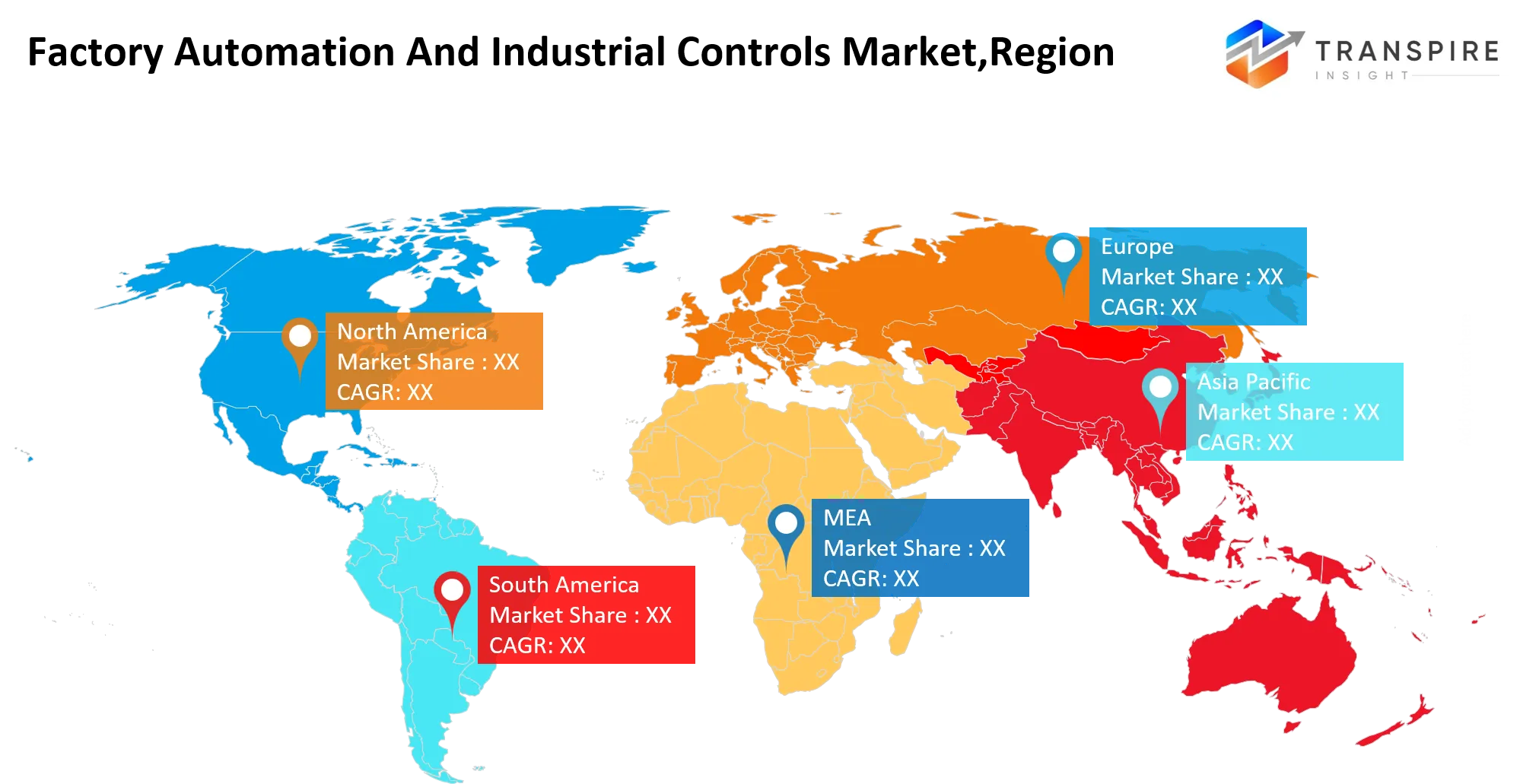
North America holds 22% of the market and is driven by the modernisation of industries through investments in manufacturing and the use of digital manufacturing technology. There is modernisation of existing factories to increase production efficiency, deal with labour shortages, and make the supply chain more resilient. The technology ecosystem in North America is also supportive of the incorporation of industrial software, artificial intelligence, machine vision, and cybersecurity into manufacturing processes. This presents opportunities for suppliers of modernisation solutions for existing production processes. In October 2025, Rockwell Automation introduced its new control system, called the ControlLogix 5590 controller, which is expected to enhance industrial controls, safety, security, and integration. It is a clear indication of how the region has been working on upgrading factory automation systems.
Europe
Europe constitutes 25% of the market and is driven by the existence of an established engineering industry, automotive manufacturing, energy efficiency, and industrial productivity. There is investment in precision automation, process optimisation, and connected manufacturing to maintain competitiveness amid cost management. The demand is fueled by industrial machinery, automotive suppliers, pharmaceuticals, and specialised manufacturing. Opportunities exist for control system providers in the region in the modernisation of existing factories and equipment In June 2026, Siemens and Koenig & Bauer have strengthened their collaboration towards creating software-defined machine architecture, using modular software components and open IT architectures. The goal of the initiative is to make industrial machines more flexible and adaptable, and therefore adopt factory automation and control technologies in the region.
Asia Pacific
The Asia Pacific region is leading in terms of market share, accounting for 44.1%, with a well-developed manufacturing sector and electronics, automotive and industrial machinery manufacturing capabilities. Smart factory and manufacturing investments have prompted the use of connected control systems, robotics and inspection automation. The Asia Pacific region provides demand from China, Japan, South Korea and India, where different sources can be found, such as electronics manufacturing and growing industrial capacity.
In March 2025, Mitsubishi Electric launched its new factory automation business headquarters in Suzhou, China. The initiative is an effort by the company to meet rising demands in factory automation technology in the Asia Pacific region.
https://www.mitsubishielectric.com/en/pr/2025/0319/
Who are the Key Players in the Factory Automation And Industrial Controls Market and how do they compete?
Competition in factory automation and industrial controls is based on the reliability of the products, system integration, software expertise, technical support services, and the possibility of upgrading the current facilities. Competing companies in this market include Siemens, ABB, Rockwell Automation, Schneider Electric, Honeywell, Mitsubishi Electric, Emerson, FANUC and Yokogawa. The competition is carried out not by the means of setting prices for equipment but through systematisation of the control systems, robotics, industrial software, etc. in automation technology. Siemens operates in the fields of industrial automation, engineering software and digital manufacturing to provide its clients with an opportunity to integrate their production systems with simulation and analysis tools. Schneider Electric offers its services in the form of industrial automation, energy management and control connectivity solutions. In turn, Honeywell and Emerson are engaged in the sphere of process automation and operations reliability, while Mitsubishi Electric and FANUC are improving the competition in the field of factory controls and robots.
Factory Automation And Industrial Controls Market companies
- Siemens
- Rockwell Automation
- Schneider Electric
- ABB
- Honeywell
- Emerson
- Mitsubishi Electric
- Omron
- Yokogawa
- FANUC
- Bosch Rexroth
- Keyence
- Beckhoff
- Fuji Electric
- Hitachi
Recent Development News
In March 2026, the companies announced their collaboration to incorporate the NVIDIA Omniverse libraries into ABB's RobotStudio software. The partnership seeks to enhance the process of transitioning from virtual robot training and simulation to practical manufacturing applications.
In July 2025, the company completed the acquisition of ebm-papst's industrial drive technology unit. The acquisition has enhanced its range of intelligent drives and mechatronic systems that are used in autonomous industrial transport.
What Strategic Insights Define the Future of the Factory Automation And Industrial Controls Market?
The future of the factory automation and industrial controls market will be less about putting up machines and more about linking machines and production data together in operating systems. The rise of industrial robotics, AI-based inspection and predictive maintenance could provide an opportunity for manufacturers looking for measurable productivity and equipment reliability gains. The ability to incorporate new digital features with legacy control infrastructure compatibility could give suppliers an edge, especially when it comes to manufacturers who cannot afford to swap out their whole production line. One of the dangers that could lie hidden is the increasing complexity of cybersecurity and integration as factory equipment that used to function independently now gets connected. A breach in the critical control infrastructure could cause operational issues and negate all the benefits of automation investments. The other opportunity would be found in modular automation, which gives smaller manufacturers a chance to integrate robotics and intelligent monitoring step-by-step. Companies need to focus on interoperable platforms, security by design and ROI targets. They also need to validate AI's performance in the real operating environment.
By Component
- Industrial Control Systems
- PLCs
- DCS
- SCADA
- HMI
- Industrial Robots
- Sensors
- Others
By Control Type
- Programmable
- Distributed
- Supervisory
- Motion
- Safety
- Process
- Machine
- Others
By Application
- Automotive
- Food & Beverage
- Chemicals
- Pharmaceuticals
- Electronics
- Oil & Gas
- Metals & Mining
- Others
By Technology
- Robotics
- AI
- IoT
- Machine Vision
- Digital Twin
- Edge Computing
- Predictive Analytics
- Others
By End User
- Manufacturing
- Process Industries
- Discrete Industries
- Utilities
- Logistics
- Warehousing
- Infrastructure
- Others
By Deployment
- On-premise
- Cloud
- Edge
- Hybrid
- Centralized
- Distributed
- Remote
- Others
By Enterprise Size
- Large Enterprises
- SMEs
- Mid-sized
- Startups
- Multinationals
- Government
- OEMs
- Others
Frequently Asked Questions
Find quick answers to common questions.
The factory automation and industrial controls market size was valued at USD 130.28 billion in 2025 and is poised to reach USD 199.95 billion by 2033, expanding at a 5.5% CAGR
Key segments for the factory automation and industrial controls market are By Component (Industrial Control Systems, PLCs, DCS, SCADA, HMI, Industrial Robots, Sensors, Others); By Control Type (Programmable, Distributed, Supervisory, Motion, Safety, Process, Machine, Others); By Application (Automotive, Food & Beverage, Chemicals, Pharmaceuticals, Electronics, Oil & Gas, Metals & Mining, Others); By Technology (Robotics, AI, IoT, Machine Vision, Digital Twin, Edge Computing, Predictive Analytics, Others); By End User (Manufacturing, Process Industries, Discrete Industries, Utilities, Logistics, Warehousing, Infrastructure, Others); By Deployment (On-premise, Cloud, Edge, Hybrid, Centralized, Distributed, Remote, Others); By Enterprise Size (Large Enterprises, SMEs, Mid-sized, Startups, Multinationals, Government, OEMs, Others)
Growth is primarily driven by increased labor costs, greater use of industrial robots, development in AI and IoT technologies, and the need for better quality products and decreased manufacturing errors.
The market is led by major manufacturers including Siemens, Rockwell Automation, Schneider Electric, ABB, Honeywell, Emerson, Mitsubishi Electric, Omron, Yokogawa, FANUC, Bosch Rexroth, Keyence, Beckhoff, Fuji Electric, and Hitachi
The Asia Pacific region holds a major share of 44.1% in the factory automation and industrial control market due to the growth of industries and manufacturing processes in China, Japan, India, and South Korea.
Opportunities in the market for factory automation and industrial controls include the demand for smart factories, the increased use of artificial intelligence-driven automation and robots, increased investments in the Industrial Internet of Things (IIoT), and modernisation of manufacturing plants for greater efficiency.
- Siemens
- Rockwell Automation
- Schneider Electric
- ABB
- Honeywell
- Emerson
- Mitsubishi Electric
- Omron
- Yokogawa
- FANUC
- Bosch Rexroth
- Keyence
- Beckhoff
- Fuji Electric
- Hitachi
About the Authors

Kartik bhong
I am Kartik Bhong, a Senior Research Analyst at Transpire Insight, specializing in the Packaging, Manufacturing, and Construction industry. My work focuses on analyzing market trends, emerging technologies, industry regulations, and competitive landscapes to deliver accurate, data-driven insights. I am passionate about transforming complex industry information into clear, practical content that helps businesses, professionals, and decision-makers stay informed and make confident strategic decisions. Through continuous research and a strong commitment to accuracy, I strive to create reliable, well-researched content that reflects the latest developments across these dynamic industries and supports the vision of Transpire Insight in delivering valuable market intelligence.

Chakradhar Khansole
Chakradhar serves as the Research Director at Transpire Insight, bringing over 8 years of experience in technology, innovation, and strategic market intelligence. He specializes in transforming complex market data into actionable business insights that enable organizations to make informed, growth-oriented decisions. Recognized for his strategic vision and analytical expertise, Chakradhar leads high-impact research initiatives, delivering comprehensive market assessments, competitive intelligence, and forward-looking industry analysis.
Recently Published Reports
-
Apr 2026
Handling and Lifting Equipment Market
Handling and Lifting Equipment Market Size, Share & Analysis Report By Product (Cranes and Hoists, Forklifts, Conveyor Systems, Aerial Work Platforms, Others), By Application (E-Commerce, Automotive and Railway, Food and Beverages, Aviation, Others), and Geography (North America, Europe, Asia-Pacific, Middle East and Africa, South and Central America), 2021 - 2031
-
Apr 2026
HVAC Equipment Market
HVAC Equipment Market Size, Share & Analysis Report By Heating Equipment Type (Boilers and Furnaces, Heat Pumps, and Unitary Heaters), By Ventilation Equipment (Air Handling Units, Humidifiers and Dehumidifiers, Air Filters, and Fan Coiling Units), By Air Conditioning Equipment (Unitary Air Conditioners, Room Air Conditioners, Packaged Terminal Air Conditioners, and Chillers), By End User (Commercial, Residential, Industrial, and others), and Geography (North America, Europe, Asia-Pacific, Middle East and Africa, South and Central America), 2021 – 2031
-
Apr 2026
Refrigeration Valves Market
Refrigeration Valves Market Size, Share & Analysis Report By Type (Solenoid Valves, Expansion Valves, Check Valves, Service Valves, Others), By Application (Commercial Refrigeration, Industrial Refrigeration, Transport Refrigeration, Residential Refrigeration, Air Conditioning Systems), By End User (Food and Beverage Industry, Pharmaceutical Industry, HVAC Industry, Chemical Industry, Others), and Geography (North America, Europe, Asia-Pacific, Middle East and Africa, South and Central America), 2021 – 2031
-
Apr 2026
E-Commerce Packaging Materials Market
E-Commerce Packaging Materials Market By Material Type (Corrugated Boxes, Paper & Paperboard, Foam & Cushioning Materials, Plastic Packaging, Flexible Packaging, Protective Packaging, Others), By Product(Primary Packaging, Secondary Packaging, Tertiary Packaging), By Packaging Function (Protective Packaging, Branding & Presentation Packaging, Transit & Logistic Packaging, Sustainable Packaging, Tamper Evidence Packaging), By End-User (Retail & Consumer Goods, Electronic Appliances, Food & Beverages, Healthcare & Pharmaceutical, Fashion & Apparel, Home & Furnishing, Others); By Industry Analysis, Size, Share, Growth, Trends, and Forecasts 2021-2033