
Telecom Internet of Things (IoT) Market Summary:
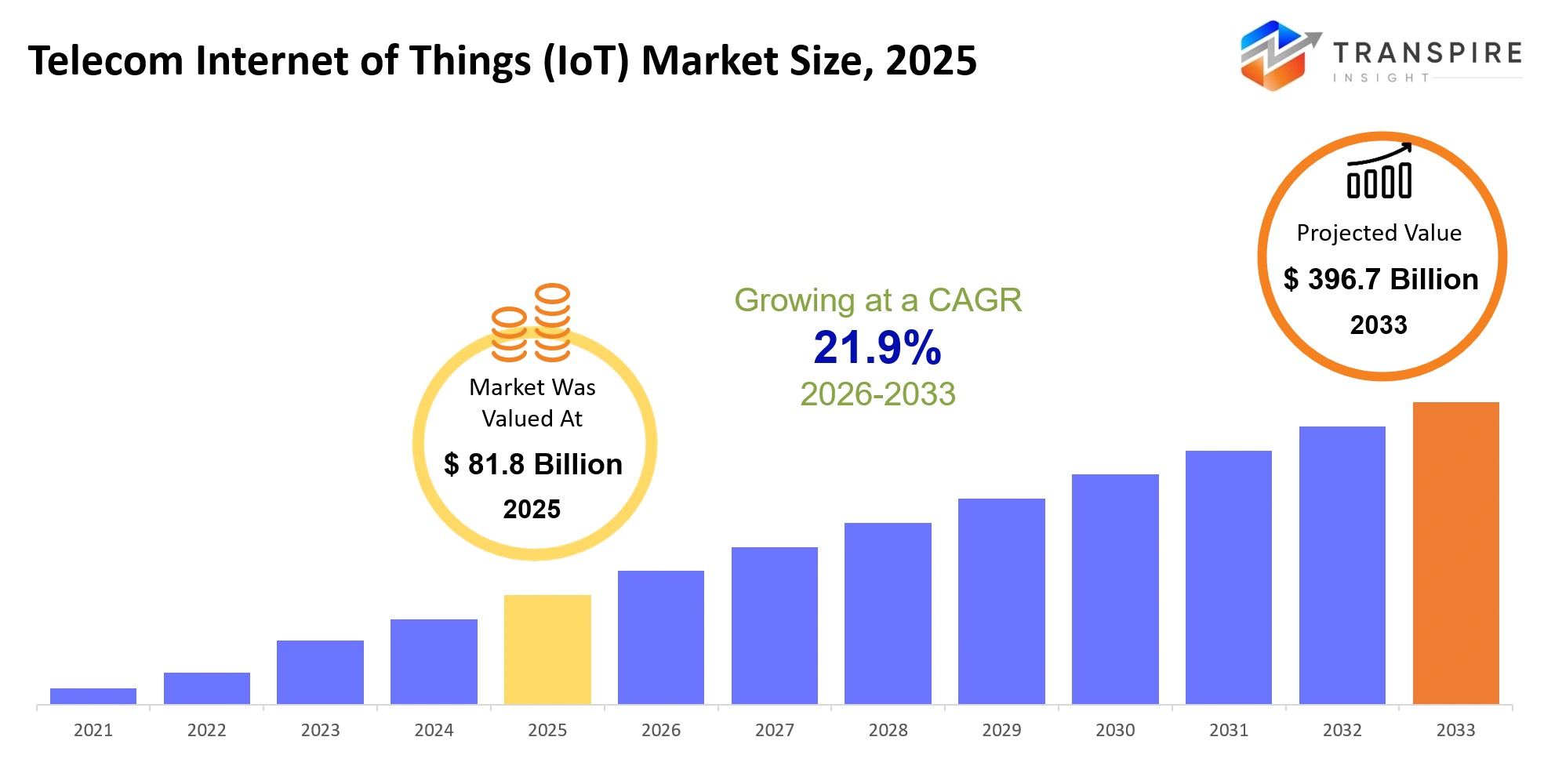
As per Transpire Insight Analysis, the Telecom Internet of Things (IoT) Market size is estimated at USD 81.8 Billion in 2025 and is anticipated to reach USD 396.7 Billion by 2033, growing at a CAGR of 21.9% from 2026 to 2033. Increasing as a result of growing deployment of 5G networks, use of smart devices, the automation of industries, and increasing need for real-time secure connectivity.
The Telecom Internet of Things market has become a part of how telecom companies connect, manage and watch over billions of smart devices in different industries. In the past few years, the market has moved from simple machine-to-machine connections to smart, fast IoT systems that use cloud platforms, edge computing and better network technologies. A big change has been the building of 5G networks, which allows faster and more dependable communication for devices that are connected.
At the same time, more cities are using smart city projects, more industries are using automation, and more people are watching assets from far away, which has made IoT spread around the world faster. These changes are making telecom companies offer connection services, make their networks work better and create extra services around IoT. As companies keep spending on changing how they do business with the tools the need for safe, big and real-time connected networks is going to help the market keep growing.
Telecom Internet of Things (IoT) Market Size & Forecast:
- Market Size 2025: USD 81.8 Billion
- Expected Market Value (2033): USD 396.7 Billion
- Forecast CAGR (2026–2033): 21.9%
- Leading Region in 2025: North America
- Fastest Growing Region: Asia Pacific
- Key Company Profiles: Ericsson, Nokia, Huawei, Cisco, Qualcomm, Vodafone, AT&T, Verizon, Deutsche Telekom, Orange, Telefónica, Sierra Wireless, Semtech, Vodafone Business, Ericsson Enterprise Wireless.
Key Market Insights:
The Telecom Internet of Things (IoT) market is progressing due to the growth of telecom companies moving past connectivity and providing an integrated IoT platform with device management and data-driven services. This growth is driven by 5G deployment, enterprise digitalisation, and intelligent connected infrastructure investments.
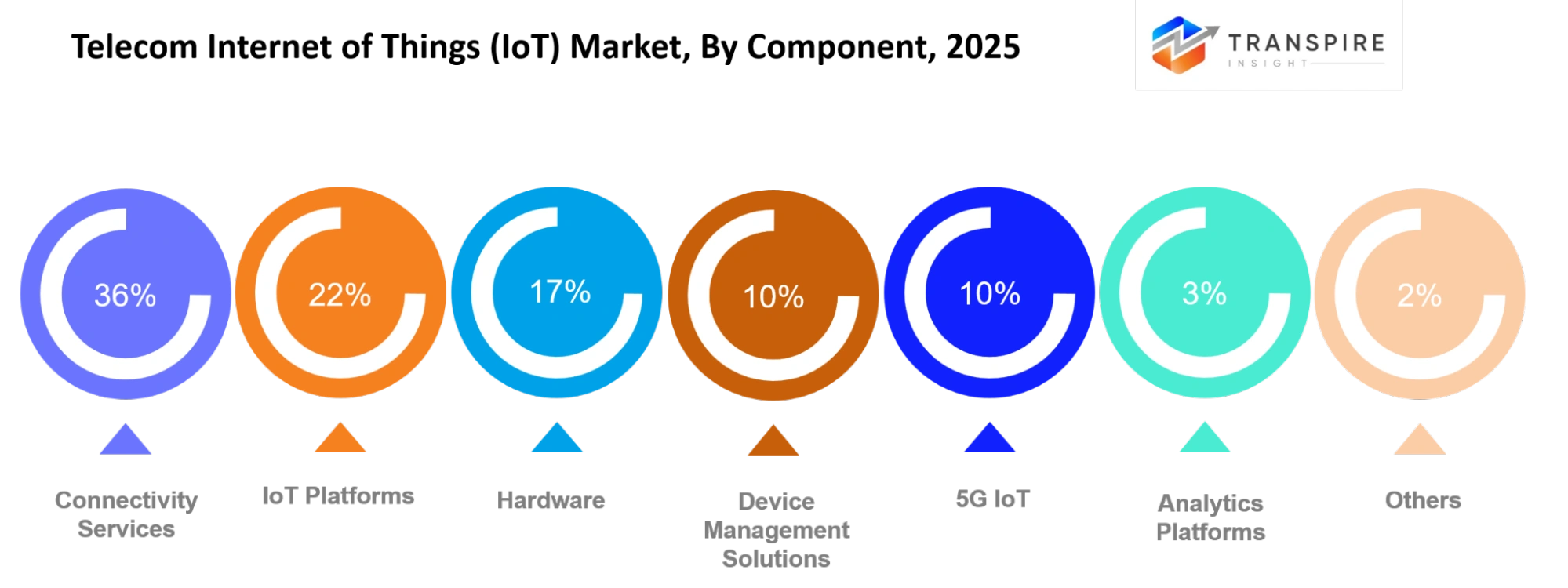
- Connectivity Services make up 36% of the market share due to their importance in enabling safe and reliable communications in connected IoT devices.
- IoT Platforms constitute 22% of the market as corporations increasingly turn to centralised platforms for managing their devices, applications, and data.
- Hardware makes up 17% of the total revenue owing to the rising deployment of sensors, gateways, and communication modules in different industries.
- Device Management Solutions make up 10% due to the introduction of advanced remote device management capabilities for telecom operators.
- 5G IoT makes up 10% of the market as well and has the highest CAGR of 22.1% due to the growing need for latency and bandwidth.
- Analytics Platforms make up 3% of the market as firms strive to improve operational efficiency through predictive insights.
- The rest of the 2% belongs to other solutions, which include niche IoT services for different industrial and business needs.
- Telecom operators collaborate more and more with cloud and technology providers in order to create end-to-end ecosystems combining connectivity, security, and analytics.
- Increasing use of AI for network management, edge computing, and private 5G networks affects how telecom operators work with enterprises on IoT.
What are the Key Drivers, Restraints, and Opportunities in the Telecom Internet of Things (IoT) Market?
Drivers
The expansion of the Telecom IoT market on a worldwide scale is driven by the increasing deployment of devices as well as the development of telecommunication systems. The deployment of 5G and increased spending on smart manufacturing, healthcare, smart cities, and industry have resulted in increased demand for IoT connectivity. Businesses looking to collect data in real-time and manage assets remotely are contributing towards the development of IoT services by the telecoms.
Restraints
Several issues have been limiting the growth of markets. The process of integrating IoT devices through varying network standards and platforms is not an easy task. Moreover, many companies are worried about cybersecurity, data privacy, and the extremely high costs associated with implementing such a system at scale. Such structural problems might cause delays in implementation, especially for smaller companies with limited budgets for technology.
Opportunities
opportunity available is the use of AI-enabled IoT, edge computing, and 5G private networks. Many industries like manufacturing, transport, utility companies, and logistics are using intelligent connected devices to increase efficiency and implement preventive maintenance. Moreover, the emerging markets are increasingly making investments in their digital infrastructure, thus creating ideal grounds for introducing IoT services by the telecom players.
What Has the Impact of Artificial Intelligence Been on the Telecom Internet of Things (IoT) Market?
The Telecom Internet of Things (IoT) market has been able to enhance its features and functions through the use of artificial intelligence technology. Artificial intelligence is applied by telecom operators to monitor network operation, analyse traffic trends and optimize bandwidth usage to ensure that there is efficient operation of the millions of IoT devices in the market. Artificial intelligence technology also helps in processing huge amounts of data that are generated from the IoT in real time to help firms optimise their resources.
Predictive analytics has also emerged as an added benefit of AI. With the use of predictive analytics, AI will be used to detect equipment failures and carry out maintenance activities. This will help the transport industry, manufacturing sector, the utility industry, and other sectors in reducing downtime and improving productivity. Security has also been enhanced through the identification of strange activities of devices and counteracting any threat to the connected networks. Integrating AI with the current infrastructure of the telecommunication IoT is not an easy task. Various companies need to upgrade their existing infrastructure, procure sophisticated computer systems, and have quality data for AI model creation. All these issues will hamper the process of implementing AI and IoT solutions in networks. However, technological advancements in AI will soon solve all these problems in the near future. In March 2025, Jio Platforms, along with AMD, Cisco, and Nokia, launched plans to create an Open Telecom AI Platform at Mobile World Congress 2025. The Open Telecom AI Platform would enable the integration of artificial intelligence technology into telecom networks to automate network management, enhance security, and provide optimised IoT connectivity services.
Key Market Trends:
The Telecom Internet of Things (IoT) market is experiencing growth as telecom companies merge connectivity capabilities with network intelligence and enterprise-oriented digital services. Investments made by companies in 5G, edge computing, and AI-driven platforms are transforming the deployment and management of devices in IoT.
- IoT offerings by telecom operators now include a comprehensive IoT ecosystem consisting of device management, analytics, and cloud services.
- The deployment of 5G-enabled IoT solutions has gained pace as businesses need applications with extremely low latency and high speed of connection.
- Adoption of edge computing has risen in organisations as they process the generated IoT data close to connected devices.
- Network automation driven by artificial intelligence has emerged as one of the trends in telecom, where prediction and optimisation are enabled by automated systems.
- Private 5G networks have been widely adopted by enterprises for enhanced data security, network reliability, and operational control.
- There has been an increase in collaboration between telecom companies and cloud service companies to provide enterprise customers with end-to-end IoT solutions.
- Secure IoT connectivity has emerged as another trend due to the growing emphasis of companies on cybersecurity and identity management.
Telecom Internet of Things (IoT) MarketSegmentation
By Component
Connectivity Services dominate the Telecom IoT market with a 36% market share owing to increasing efforts by telecom companies to ensure network accessibility for connected devices in different sectors. This market segment is fueled by the increasing requirement of secure and continuous communication solutions and connectivity services among businesses. IoT Platforms hold 22% of the market share owing to the provision of device and application management in a single place. Hardware contributes 17% in this market and is driven by the increasing installation of sensors, gateways, and communication modules. The share of Device Management Solutions is 10%, whereas Analytics Platforms and Others contribute 3% and 2%, respectively.
By Technology
The industry encompasses NB-IoT, LTE-M, 5G IoT, LoRaWAN, Sigfox, Wi-Fi IoT, Satellite IoT, and other network technologies. Of all these, 5G IoT accounts for the most rapidly growing segment at a CAGR of 22.1%, due to rising demands for ultra-low latency, greater bandwidth, and reliable real-time connectivity. Businesses are leveraging modern network technologies to achieve automated operations and intelligent solutions for industrial automation, connected cars, telemedicine, and smart infrastructure initiatives. On the other hand, LPWAN technologies like NB-IoT and LTE-M still hold strong traction for their cost-efficient connectivity needs.
By End User
Telecom service providers continue to be the major consumers of IoT technology through the provision of connectivity and digital services to corporate customers from various industries. Smart cities keep making efforts towards implementation of intelligent infrastructure, while the manufacturing industry adopts IoT solutions for better manufacturing process optimisation and asset tracking. Healthcare organisations are still expanding the use of remote patient monitoring and IoT-based medical devices, while transportation and logistics companies use IoT for optimisation of their fleets and management of assets.
By Application
Asset tracking is among the most common IoT applications since businesses are trying to have visibility into movements of their equipment and inventory. Smart metering has also been increasing in adoption within electricity, gas, and water distribution networks for purposes of improving their measurement and billing processes. Fleet management assists transport firms in improving their route efficiency and lowering their operational expenses, whereas connected infrastructure enables the development of smart cities.
By Deployment
Cloud deployment continues to remain popular because of its flexibility and easy compatibility with enterprise-level applications. On-site deployment is still regarded as one of the most important options available to enterprises that require managing their data. Hybrid deployment has become more and more popular by blending together the flexibility of cloud and the requirements for securing data on-site. Edge computing platforms have become relevant for enterprises as they allow processing data near the connected devices. SaaS versions of IoT platforms have become increasingly popular as well.
What are the Key Use Cases Driving the Telecom Internet of Things (IoT) Market?
The main use case propelling the Telecom IoT market forward is asset tracking enabled by high levels of penetration of Connectivity Services. Companies in logistics, manufacturing, and transport depend on constant connectivity to track their assets in real-time, thus ensuring better visibility and fewer losses. Other use cases like smart metering, fleet management, connected infrastructure, and predictive maintenance are contributing to the development of the Telecom IoT market space. Utilities, health care organisations, and industrial companies are implementing IoT solutions for the purpose of automation and better resource management.
Emerging use cases like smart buildings, Industrial IoT, and remote monitoring powered by AI are offering fresh opportunities for growth with the use of 5G networks and edge computing.
|
Report Metrics |
Details |
|
Market size value in 2025 |
USD 81.8 Billion |
|
Market size value in 2026 |
USD 99.2 Billion |
|
Revenue forecast in 2033 |
USD 396.7 Billion |
|
Growth rate |
CAGR of 21.9% from 2026 to 2033 |
|
Base year |
2025 |
|
Historical data |
2021 - 2024 |
|
Forecast period |
2026 - 2033 |
|
Report coverage |
Revenue forecast, competitive landscape, growth factors, and trends |
|
Regional scope |
United States; Canada; Mexico; United Kingdom; Germany; France; Italy; Spain; Denmark; Sweden; Norway; China; Japan; India; Australia; South Korea; Thailand; Brazil; Argentina; South Africa; Saudi Arabia; United Arab Emirates |
|
Key company profiled |
Ericsson, Nokia, Huawei, Cisco, Qualcomm, Vodafone, AT&T, Verizon, Deutsche Telekom, Orange, Telefónica, Sierra Wireless, Semtech, Vodafone Business, Ericsson Enterprise Wireless. |
|
Customization scope |
Free report customization (country, regional & segment scope). Avail customized purchase options to meet your exact research needs. |
|
Report Segmentation |
By Component (Hardware, Software, Connectivity Services, IoT Platforms, Edge Computing Solutions, Device Management Solutions, Analytics Platforms, Others); By Network Technology (NB-IoT, LTE-M, 5G IoT, LoRaWAN, Sigfox, Wi-Fi IoT, Satellite IoT, Others); By End User (Telecom Operators, Smart Cities, Manufacturing, Healthcare, Transportation, Utilities, Agriculture, Others); By Application (Asset Tracking, Smart Metering, Fleet Management, Connected Infrastructure, Predictive Maintenance, Smart Buildings, Industrial IoT, Others); By Deployment (Cloud-based, On-premise, Hybrid, Edge-enabled, SaaS Platforms, Others). |
Which Regions are Driving the Telecom Internet of Things (IoT) Market Growth?
North America
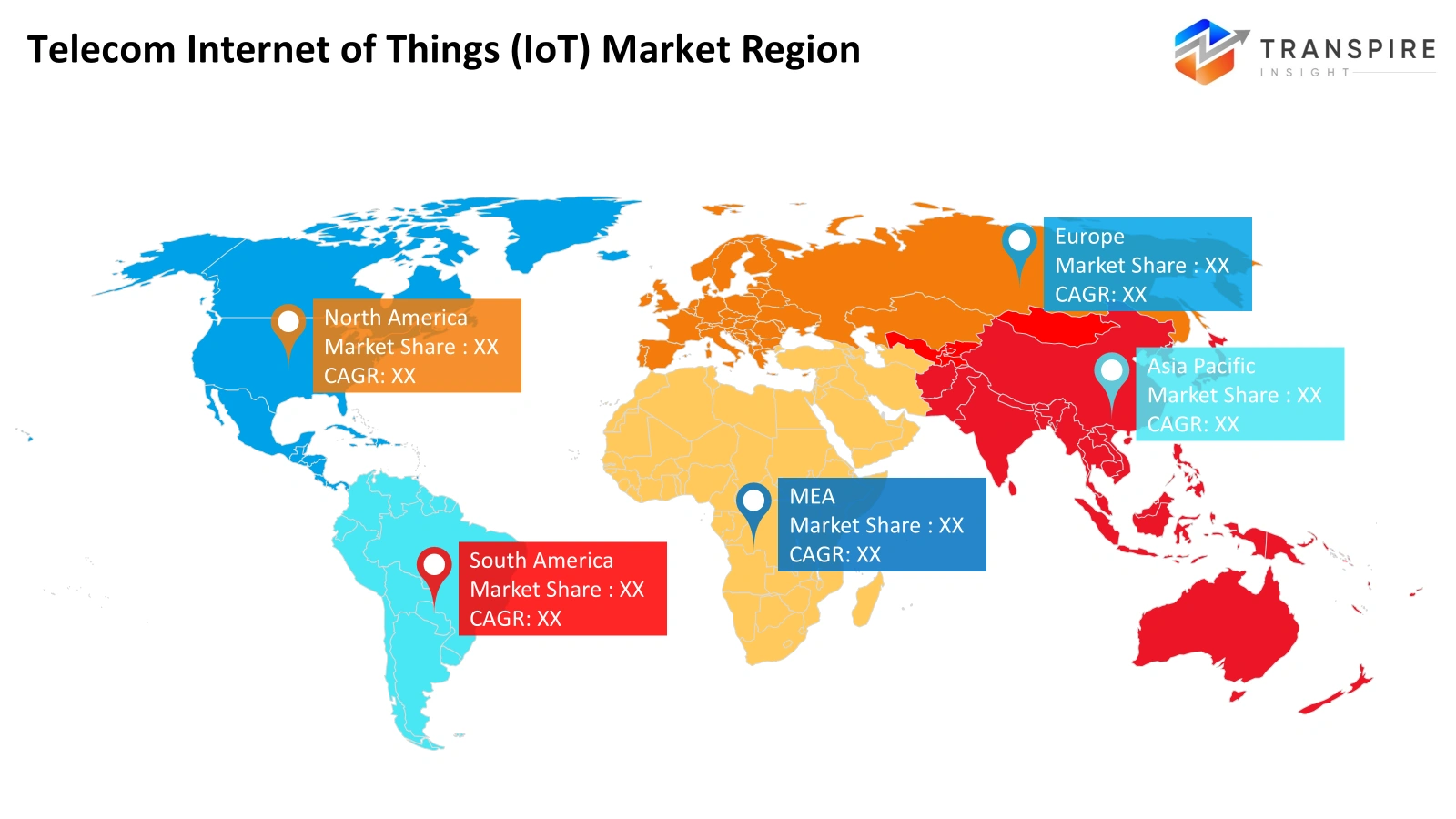
The Telecom IoT industry is dominated by North America, which holds 38% of the market share owing to the continent's well-developed telecom infrastructure and early adoption of 5G networks as well as corporate investment in connectivity. There is a continued expansion of Telecom IoT services in industries such as manufacturing, healthcare, logistics, and smart cities by Telecom operators across the continent. Governmental programs aimed at building digital infrastructure and the presence of large technology players help solidify the leading position. This ensures continuous innovation in telecom IoT solutions.In March 2025, T-Mobile US collaborated with NVIDIA, Cisco Systems, Cerberus Capital Management, and Mitre for creating AI-enabled wireless network features that improve Telecom IoT, Autonomous systems, and enterprise network connection services over 5G networks
Europe
Europe has a 25% share in the market and grows steadily due to its strong regulatory environment and industrial digitalisation, as well as its approach to safe connected networks. Europe pays more attention to sustainable infrastructure, smart utilities, and automation compared to North America. European Telecom providers collaborate with manufacturing, transport, and energy companies to increase IoT deployment in various industries. Stable investments in digital transformation ensure sustainable market growth in Europe.
Asia Pacific
The Asia Pacific region accounts for 31% of the market share and is the fastest-growing region with a CAGR of 23.2%. The development of 5G infrastructure, growth in investments in smart cities, and the growing use of connected devices in countries such as China, India, Japan, and Southeast Asia are the major factors driving the growth of the region. Growing industrial automation, government initiatives in digitalisation, and telecommunication networks are presenting new opportunities for businesses. With rising adoption of enterprise IoT, Asia Pacific will increasingly become more relevant in the coming years.
Who are the Key Players in the Telecom Internet of Things (IoT) Marketand how do they Compete?
The competitive forces in the Telecom Internet of Things (IoT) market are characterised by firms providing network connectivity, cloud platform, security and analysis capabilities as part of their IoT suite of offerings. Unlike before, where competition was only around connectivity, players today are using platform capability, specific applications to various industries and managed services as means to differentiate themselves in order to aid enterprise digitalisation efforts.
Leading companies such as Cisco Systems, Ericsson, Nokia, Huawei, Vodafone, AT&T, Verizon, Telefónica, Orange Business, and Qualcomm are gaining market presence through consistent technological innovation and partnership approaches. For instance, Cisco is focusing on secure networking and industrial IoT offerings, and Ericsson and Nokia are adding to their 5G-based IoT portfolios to provide smart manufacturing, utility and transportation applications.
Telecom Internet of Things (IoT) Market companies
- Ericsson
- Nokia
- Huawei
- Cisco
- Qualcomm
- Vodafone
- AT&T
- Verizon
- Deutsche Telekom
- Orange
- Telefónica
- Sierra Wireless
- Semtech
- Vodafone Business
- Ericsson Enterprise Wireless
Recent Development News
In March 2026, Vodafone Idea (Vi) extended its strategic alliance with Ericsson in order to build network infrastructure and introduce cloud-native charging to upgrade postpaid services. This alliance should help improve the quality of networks and IoT connectivity throughout India.
Source: https://www.ericsson.com
What Strategic Insights Define the Future of the Telecom Internet of Things (IoT) Market?
The future growth of the Telecom IoT market globally would be influenced by the increased usage of 5G, edge computing, artificial intelligence, and cloud IoT platform services. With enterprises increasingly connecting more devices, the expectation is for telecom providers to expand beyond providing connectivity to deliver bundled solutions that encompass management, security, analytics, and automation services. The challenge that might affect long-term growth will be the growing difficulties with cybersecurity threat management in increasingly complex IoT infrastructures, with the continuous increase in the number of devices. There are numerous opportunities that come from increased investment in digital infrastructure in emerging markets where telecom providers can expand their enterprise IoT offerings. Therefore, enterprises must develop secure and scalable IoT ecosystems, build partnerships with cloud and technology vendors, and create industry-specific IoT solutions.
Key Segmentations are:
By Component
- Hardware
- Software
- Connectivity Services
- IoT Platforms
- Edge Computing Solutions
- Device Management Solutions
- Analytics Platform
By Network Technology
- NB-IoT
- LTE-M
- 5G IoT
- LoRaWAN
- Sigfox
- Wi-Fi IoT
- Satellite IoT
By End User
- Telecom Operators,
- Smart Cities
- Manufacturing
- Healthcare
- Transportation
- Utilities, Agriculture
By Application
- Asset Tracking
- Smart Metering
- Fleet Management
- Connected Infrastructure
- Predictive Maintenance
- Smart Buildings
- Industrial Io
By Deployment
- Cloud-based
- On-premise
- Hybrid
- Edge-enabled
- SaaS Platforms
Regional Outlook
North America
- United States
- Canada
- Mexico
Europe
- Germany
- United Kingdom
- France
- Spain
- Italy
- Rest of Europe
Asia Pacific
- Japan
- China
- Australia & New Zealand
- South Korea
- India
- Rest of Asia Pacific
South America
- Brazil
- Argentina
- Rest of South America
Middle East & Africa
- Saudi Arabia
- United Arab Emirates
- South Africa
- Rest of the Middle East & Africa
Frequently Asked Questions
Find quick answers to common questions.
The telecom internet of things (IoT) market size was valued at USD 81.8 billion in 2025 and is poised to reach USD 396.7 billion by 2033, expanding at a 21.9% CAGR.
Key segments for the telecom internet of things (IoT) market are By Component (Hardware, Software, Connectivity Services, IoT Platforms, Edge Computing Solutions, Device Management Solutions, Analytics Platforms, Others); By Network Technology (NB-IoT, LTE-M, 5G IoT, LoRaWAN, Sigfox, Wi-Fi IoT, Satellite IoT, Others); By End User (Telecom Operators, Smart Cities, Manufacturing, Healthcare, Transportation, Utilities, Agriculture, Others); By Application (Asset Tracking, Smart Metering, Fleet Management, Connected Infrastructure, Predictive Maintenance, Smart Buildings, Industrial IoT, Others); By Deployment (Cloud-based, On-premise, Hybrid, Edge-enabled, SaaS Platforms, Others).
Growth is primarily driven by rapid implementation of 5G, growth in use of connected devices, increasing need for smart cities and industrial Internet of Things (IoT), development in cloud and edge computing, and increased spending on digital transformation.
The market is led by major manufacturers including Ericsson, Nokia, Huawei, Cisco, Qualcomm, Vodafone, AT&T, Verizon, Deutsche Telekom, Orange, Telefónica, Sierra Wireless, Semtech, Vodafone Business, Ericsson Enterprise Wireless.
The North American region contributes 38% to the telecom IoT market owing to the proliferation of 5G network infrastructure, robust telecom infrastructure, extensive use of IoT among enterprises, and huge investments made by the prominent tech and telecom companies in the region.
Commercial opportunities in the telecommunication IoT market include increased IoT services through 5G technology, adoption of smart city initiatives, increased IoT usage in industries, demand for IoT-based healthcare systems, and edge computing and IoT applications powered by artificial intelligence.
- Ericsson
- Nokia
- Huawei
- Cisco
- Qualcomm
- Vodafone
- AT&T
- Verizon
- Deutsche Telekom
- Orange
- Telefónica
- Sierra Wireless
- Semtech
- Vodafone Business
- Ericsson Enterprise Wireless
About the Authors

Mayur Shinde
I am Mayur Shinde, a Senior Research Analyst at Transpire Insight, specializing in the Automotive & Transportation and Information & Communication Technology (ICT) Industry. My work focuses on analyzing emerging market trends, technological advancements, competitive landscapes, and industry developments to deliver accurate, data-driven insights. I am passionate about transforming complex market information into clear, actionable content that helps businesses, professionals, and decision-makers stay informed and make confident strategic decisions.

Chakradhar Khansole
Chakradhar serves as the Research Director at Transpire Insight, bringing over 8 years of experience in technology, innovation, and strategic market intelligence. He specializes in transforming complex market data into actionable business insights that enable organizations to make informed, growth-oriented decisions. Recognized for his strategic vision and analytical expertise, Chakradhar leads high-impact research initiatives, delivering comprehensive market assessments, competitive intelligence, and forward-looking industry analysis.
Recently Published Reports
-
Apr 2026
3D Optical Profiler Market
3D Optical Profiler Market Size, Share & Analysis Report By Type (Desktop 3D Optical Profiler, and Portable 3D Optical Profiler), By Technology (Confocal Technology, and White Light Interference), By End-Use Industry (Manufacturing, Research Institutions, Automotive, Aerospace and Defense, Medical Devices, and Other), and Geography (North America, Europe, Asia-Pacific, Middle East and Africa, South and Central America), 2021 - 2031
-
Apr 2026
Depth Sensor Market
Depth Sensor Market Size, Share & Analysis Report By Type (Infrared Depth Sensors, Time-of-Flight (ToF) Sensors, Stereo Vision Sensors, Structured Light Sensors, Ultrasonic Depth Sensors), By Application (Automotive, Robotics, Gaming, Consumer Electronics, Industrial Automation, Healthcare, Security & Surveillance, Others), By End Users (Automotive Manufacturers, Consumer Electronics Companies, Healthcare Providers, Industrial Companies, Security Agencies, Gaming Companies, Robotics Companies, Others), and Geography (North America, Europe, Asia-Pacific, Middle East and Africa, South and Central America), 2021 – 2031
-
Apr 2026
Digital Manufacturing Market
Digital Manufacturing Market Size, Share & Analysis Report By Component (Hardware, Software, and Services), By Technology (Robotics, 3D Printing, Internet of Things (IoT), and Others), By Application (Automotive and Transportation, Aerospace and Defense, Consumer Electronics, Industrial Machinery, and Others), By Process Type (Computer-Based Designing, Computer-Based Simulation, Computer 3D Visualization, Analytics, and Others), and Geography (North America, Europe, Asia-Pacific, Middle East and Africa, South and Central America), 2021 – 2031
-
Apr 2026
Digital Visa Services Market
Digital Visa Services Market Size, Share & Analysis Report By Type (Individual Travelers, Group Travelers), By Application (Tourism, Business Travel, Others), and Geography (North America, Europe, Asia-Pacific, Middle East and Africa, South and Central America), 2021 – 2031