
Tactical Communications Market Summary:
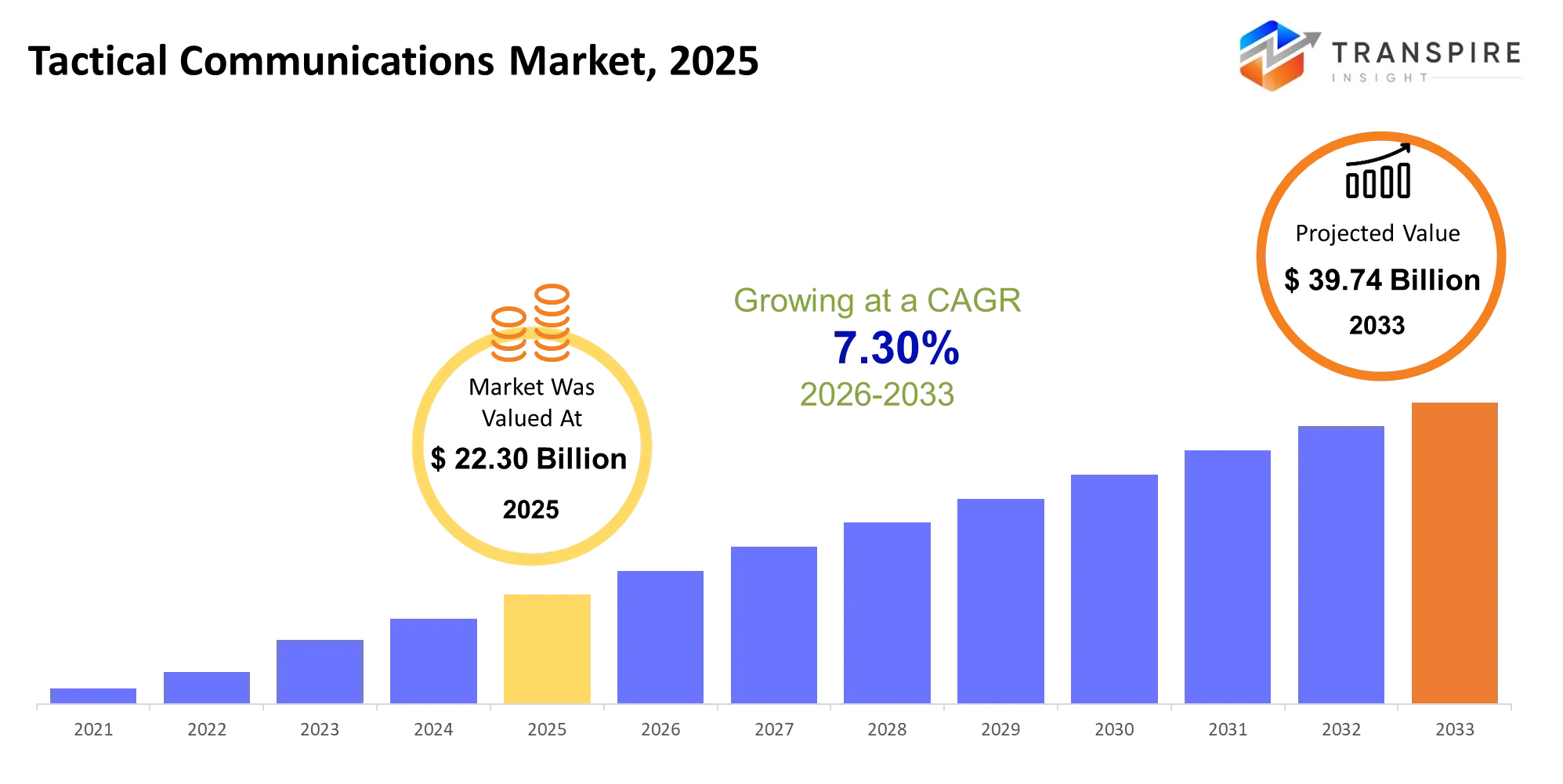
As per the Transpire Insight, The Tactical Communications Market size is estimated at USD 22.58 billion in 2025 and is anticipated to reach USD 39.74 billion by 2033, growing at a CAGR of 7.30% from 2026 to 2033.
The market for tactical communications provides secure voice, video, and data links to soldiers, vehicles, aircraft, command posts, and unmanned vehicles on the battlefield. Rather than simply replacing radios, buyers are creating unified battlefield networks that will broadcast sensor data, targeting information, and command across Land, Air, Sea, and Space platforms. Over the past three to five years, procurement trends have undergone a structural change from platform-specific, fixed-function, multi-band radios to interoperable, software-defined, edge-capable systems. The Russia-Ukraine conflict has shone a spotlight on the cost of degraded, jammed, and spoofed signals, which will drive investments in frequency-agile radios, satellite back-up infrastructure, and tactical mesh networks. This, in turn, will drive demand for multi-band terminals, encryption software, system management, and consulting. Trials of private 5G networks and software-defined radios will also enable increased broadband throughput while providing strategic fallback on HF, VHF, and UHF links in contested environments.
Tactical Communications Market Size & Forecast:
- Market Size 2025: USD 22.30 Billion
- Expected Market Value (2033): USD 39.74 Billion
- Forecast CAGR (2026–2033): 7.30%
- Leading Region in 2025: North America
- Fastest Growing Region: Asia-Pacific
- Key Company Profiles: L3Harris Technologies, Thales, BAE Systems, General Dynamics, Raytheon Technologies, Northrop Grumman, Leonardo, Elbit Systems, Rohde & Schwarz, Viasat, Collins Aerospace, Saab, Harris Corporation, Motorola Solutions, Silvus Technologies.
Key Tactical Communications Market Insights:
Tactical communications are evolving from a hardware-centric radio procurement to software-upgradable, multi-network architectures to maintain connectivity when mobile, congested, and electronically attacked. Secure radios, satellite reach, artificial intelligence-powered network control, and open interfaces are the most advantageous program access.
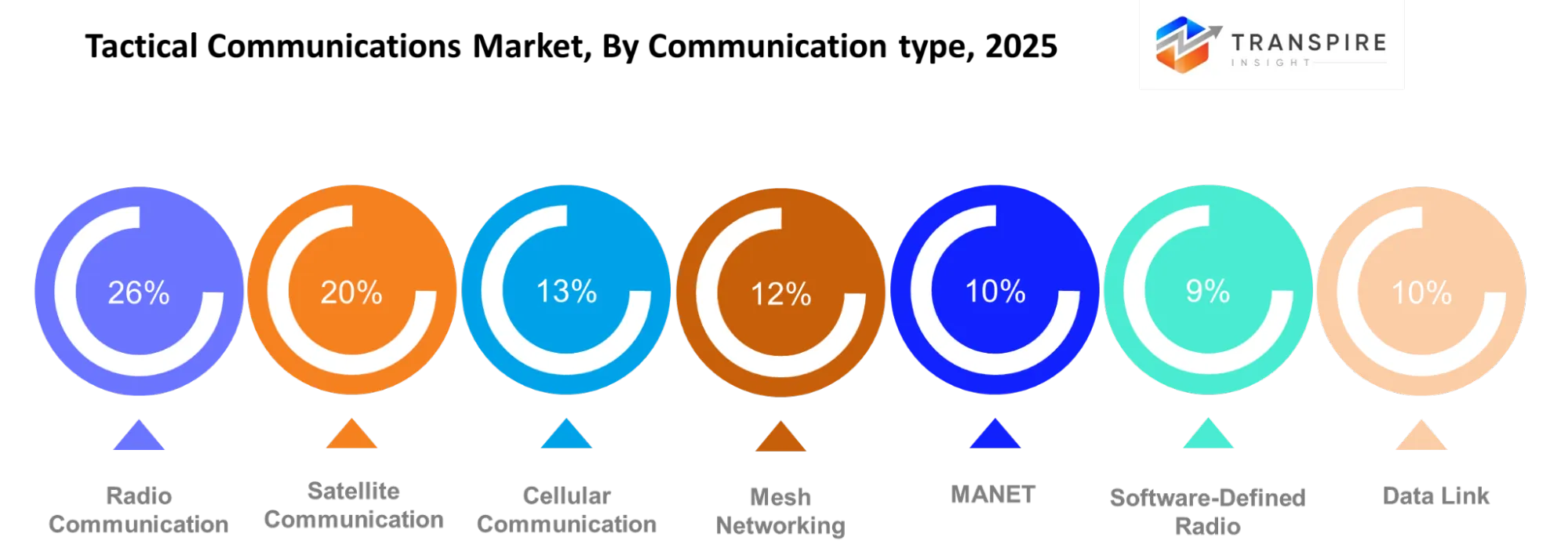
- Software-defined radio accounts for 31.60%, a technology that is seeing forces scale back multiband Falcon systems as they desire to upgrade the waveforms rather than replace the systems.
- Radio communication accounts for 26.00%, and Thales' high-data-rate HF platforms are designed for users who want to have long-range fallback connectivity.
- Satellite communication makes up 20.00%, while Viasat benefits as decentralised units create additional non-line-of-sight communication links.
- Cellular communication accounts for 13.00%, and private 5G deployments are shifting from lab trials to deployable command-post networks.
- Mesh networking takes 12.00%, with the mobile node network of the Silvus type enabling the self-healing of links within the troops, vehicles, and drones.
- MANET accounts for 10.00%, representing the need for peer-to-peer communications in the absence of, or when, the fixed infrastructure is damaged.
- Software-defined radio adds 9.00% to communication-mode demand, underscoring the preference for programmable spectrum agility in procurement.
- Data links account for 6.00% of the data, and BAE Systems and RTX are growing their Link 16/MIDS production for coalition air and naval interoperability.
- Tactical broadband is 4.00%, and its strategic importance will grow with the rise of bandwidth-intensive AI, ISR video, and unmanned systems.
What are the Key Drivers, Restraints, and Opportunities in the Tactical Communications Market?
Driver:
The principal growth driver is the modernisation of command-and-control networks for multi-domain operations. Forces now need to move high-volume intelligence, surveillance, and reconnaissance data, not only voice traffic between dismounted personnel, vehicles, drones, aircraft, and command centres. The trigger has been the demonstrated vulnerability of legacy communications to jamming, interception and congestion in recent conflicts. This increases procurement of software-defined radios, encrypted data links, satellite terminals, deployable network nodes and lifecycle software upgrades. Unlike legacy radios, SDRs can add waveforms and security functions through software, creating recurring revenue from upgrades, integration and sustainment. The U.S. Army’s Integrated Tactical Network modernisation and NATO’s focus on interoperable communications underline this shift.
Restraint:
Interoperability remains a structural constraint. Armed forces operate mixed fleets of legacy radios, proprietary waveforms, national encryption rules and ageing command systems. Integrating these assets requires certification, cyber accreditation and extensive field testing, lengthening procurement cycles and raising program cost. Highly secure systems also face export-control restrictions, which can limit addressable international sales.
Opportunity:
Software-defined 5G, SATCOM convergence and AI-enabled network management can create a more adaptive communications layer. Spectronn and the U.S. Army DEVCOM C5ISR Centre signed a CRADA focused on secure software-defined 5G and SATCOM convergence, illustrating how commercial communications technology is being adapted for tactical use. Such programs open opportunities for modular radios, edge networking and communications across allied forces. Procurement can favour upgradeable architectures because software and waveform changes extend hardware life, reduce replacement pressure and improve flexibility across land, air, maritime and unmanned platforms.
What Has the Impact of Artificial Intelligence Been on the Tactical Communications Market?
Artificial Intelligence AI is disrupting tactical communications, replacing manually configured networks with systems that can sense, prioritize, and adapt on the fly. When connected to an AI-enabled network-management software suite, the system monitors link quality, spectrum occupancy and interference, and levels of traffic demand. Based on that input, it recommends or self-optimises routes, frequencies, waveform parameters, transmit power, and bandwidth allocations to protect mission-essential traffic like real-time ISR video, targeting information, and emergency calls when capacity is limited.
Predictive algorithms can identify potential congestion, bad links, and suspected jamming before anyone has a communications black eye. They can also classify radio-frequency activity, distinguish likely interference from hostile electronic attack, and speed spectrum decisions. At the edge of the network, artificial intelligence minimizes the need to send every sensor stream back to a distant command centre, easing latency and network congestion. BAE Systems has announced a trial of an AI-enabled tactical communications suite, one of the efforts to optimize the flow of data and minimise end-user frustration.
In September 2026, Thales signed a memorandum of understanding to partner with BAE Systems Digital Intelligence alongside other industry experts to support the British Army's next-generation battlefield intelligence system under Project ZODIAC. This collaboration integrates digitalised intelligence, surveillance, target acquisition, and reconnaissance (ISTAR) with deployed data-fusion analysis to accelerate information processing and drastically reduce latency for tactical command decisions.
https://thedefensepost.com/2026/09/23/thales-bae-uk-zodiac/
Key Tactical Communications Market Trends:
Tactical communications are shifting from platform-specific radios to resilient, software-driven network ecosystems. The strategic transformation is from voice transmission to edge interoperability and connectivity for data management.
- There is a move away from static command posts and towards nodes that are mobile, characterised by survivability, dispersion and relocation.
- Single-link networks are becoming multi-path systems which include radio, SATCOM, cellular and terrestrial links to ensure continuity.
- Waveform and mission-function updates are now beginning to be possible for the hardware-centric radios without the need for complete equipment replacement.
- From a procurement preference to an operational requirement, interoperability has been put to the test with thousands of cross-network capabilities being tested during NATO exercises.
- Tactical 5G is developing from trial to integration with SATCOM and SDN to provide high-throughput connectivity to the edge.
- MANET (Mobile Ad hoc Network) architectures are becoming more significant because the units, vehicles, and unmanned systems need links between them that rely on no fixed infrastructure.
- AI is transforming network management from monitoring to proactively routing traffic, detecting anomalies, and making automatic spectrum decisions.
- Requirements are expanding to zero-trust access, identity, and supply-chain visibility in NATO.
- Increased emphasis is being placed on the use of modular systems, allowing defence organisations to add commercial technology while maintaining security and mission-specific controls.
Tactical Communications Market Segmentation
Communication Type:
Radio Communication is the largest component at 26.00% as it is a command and control voice and data layer for units beyond fixed communications infrastructure. Satellite Communication is 20.00%, providing still higher-data-rate beyond line-of-sight links. Cellular Communication 13.00% and Mesh Networking 12.00% allow higher data rates in a decentralised way.
Mobile Ad Hoc Network (MANET) 10.00%, Software-Defined Radio 9.00%, Data Link 6.00% and Tactical Broadband 4.00% show a slight shift to more networked and software-upgradeable architectures. 31.60% Software-Defined Radio in technology data supplied by sources and 12.40% 5G Tactical Networks Compound annual growth rate in technology data supplied by sources indicate programmable and high-throughput connectivity ahead.
Platform:
Land Forces remain central as dispersed formations require resilient, mobile communications across changing battlefield conditions. Naval Forces depend on long-range connectivity for maritime operations, while Air Forces require reliable links across airborne and command environments. Special Forces prioritise lightweight, secure and rapidly deployable systems for missions with limited infrastructure. Unmanned Systems are expanding communications requirements through drone-to-drone and drone-to-command connectivity. Meanwhile, Command Centres and Vehicles increasingly operate as mobile network nodes, linking personnel, sensors and platforms across distributed operations.
Frequency Band:
HF remains important as a fallback layer when conventional infrastructure is unavailable or disrupted, particularly across long-distance operations. VHF and UHF continue supporting tactical voice and short-range data because of established equipment fleets and interoperability requirements. L-Band and S-Band support mobile and satellite-oriented connectivity, while C-Band and X-Band address specialised high-reliability requirements. Ku/Ka-Band technologies are gaining importance for higher-capacity SATCOM and broadband applications, particularly where tactical forces require continuous beyond-line-of-sight connectivity.
Application:
Command & Control remains the operational anchor because commanders require continuous communication between distributed units, vehicles, and command posts. Intelligence & Surveillance applications increasingly connect sensors, drones, and communications networks to accelerate information transfer. Battlefield Communications support coordinated operations under disrupted conditions, while Situational Awareness depends on rapid sharing of location and mission data. Logistics applications use connected networks to coordinate movement and supplies, while Targeting and Emergency Response increasingly require low-latency communications for time-sensitive decisions and coordinated field actions.
Technology:
Software-Defined Radio is enabling more adaptable communications through programmable waveforms and upgradeable architectures, while AI-Enabled Communications increasingly supports network optimisation and predictive management. Encryption remains fundamental as tactical networks face cyber and electronic threats. Mesh Networks and Cognitive Radio technologies improve resilience by adapting connectivity and spectrum use. Tactical 5G Networks provide higher-capacity links, while SATCOM extends beyond-line-of-sight coverage. Edge Computing further strengthens tactical architectures by processing mission data closer to users, reducing dependence on distant infrastructure.
End User:
Defence Forces remain the principal users because modern operations require secure, resilient connectivity across land, maritime, airborne and unmanned assets. Homeland Security agencies increasingly adopt tactical networks for border and critical-infrastructure operations. Law Enforcement uses secure communications for coordinated field response, while Government Agencies require protected connectivity during sensitive operations. Emergency Services benefit from deployable networks when public infrastructure is damaged or overloaded. Border Security applications emphasise persistent field connectivity, while Special Operations require compact, encrypted and rapidly deployable systems for infrastructure-constrained missions.
What are the Key Use Cases Driving the Tactical Communications Market?
Command & Control is the core use case, supported by Radio Communication’s 26.00% share and the role of Software-Defined Radio. Units need voice and data that can survive movement, disruption and spectrum pressure, making resilient networking central to coordination.
Expanding applications include Intelligence & Surveillance, Battlefield Communications, Situational Awareness, Logistics and Targeting. MANET, Mesh Networking and Data Link architectures allow sensors, vehicles, command centres and unmanned systems to exchange information without depending on a fixed network.
Emerging use cases are centred on AI-enabled communications, tactical 5G, edge computing and satellite convergence. These capabilities can support autonomous operations, emergency response and communications restoration when infrastructure is degraded or denied.
|
Report Metrics |
Details |
|
Market size value in 2025 |
USD 22.58 Billion |
|
Market size value in 2026 |
USD 24.26 Billion |
|
Revenue forecast in 2033 |
USD 39.74 Billion |
|
Growth rate |
CAGR of 7.30% from 2026 to 2033 |
|
Base year |
2025 |
|
Historical data |
2021 - 2024 |
|
Forecast period |
2026 - 2033 |
|
Report coverage |
Revenue forecast, competitive landscape, growth factors, and trends |
|
Regional scope |
United States; Canada; Mexico; United Kingdom; Germany; France; Italy; Spain; Denmark; Sweden; Norway; China; Japan; India; Australia; South Korea; Thailand; Brazil; Argentina; South Africa; Saudi Arabia; United Arab Emirates |
|
Key companies profiled |
L3Harris Technologies, Thales, BAE Systems, General Dynamics, Raytheon Technologies, Northrop Grumman, Leonardo, Elbit Systems, Rohde & Schwarz, Viasat, Collins Aerospace, Saab, Harris Corporation, Motorola Solutions, Silvus Technologies. |
|
Customization scope |
Free report customisation (country, regional & segment scope). Available customised purchase options to meet your exact research needs. |
|
Report Segmentation |
Communication Type (Radio Communication, Satellite Communication, Cellular Communication, Mesh Networking, MANET, Software-Defined Radio, Data Link, Tactical Broadband); Platform (Land Forces, Naval Forces, Air Forces, Special Forces, Unmanned Systems, Command Centers, Vehicles); Frequency Band (HF, VHF, UHF, L-Band, S-Band, C-Band, X-Band, Ku/Ka-Band); Application (Command & Control, Intelligence & Surveillance, Battlefield Communications, Situational Awareness, Logistics, Targeting, Emergency Response); Technology (Software-Defined Radio, AI-Enabled Communications, Encryption, Mesh Networks, Cognitive Radio, 5G Tactical Networks, SATCOM, Edge Computing); End User (Defense Forces, Homeland Security, Law Enforcement, Government Agencies, Emergency Services, Border Security, Special Operations). |
Which Regions are Driving the Tactical Communications Market Growth?
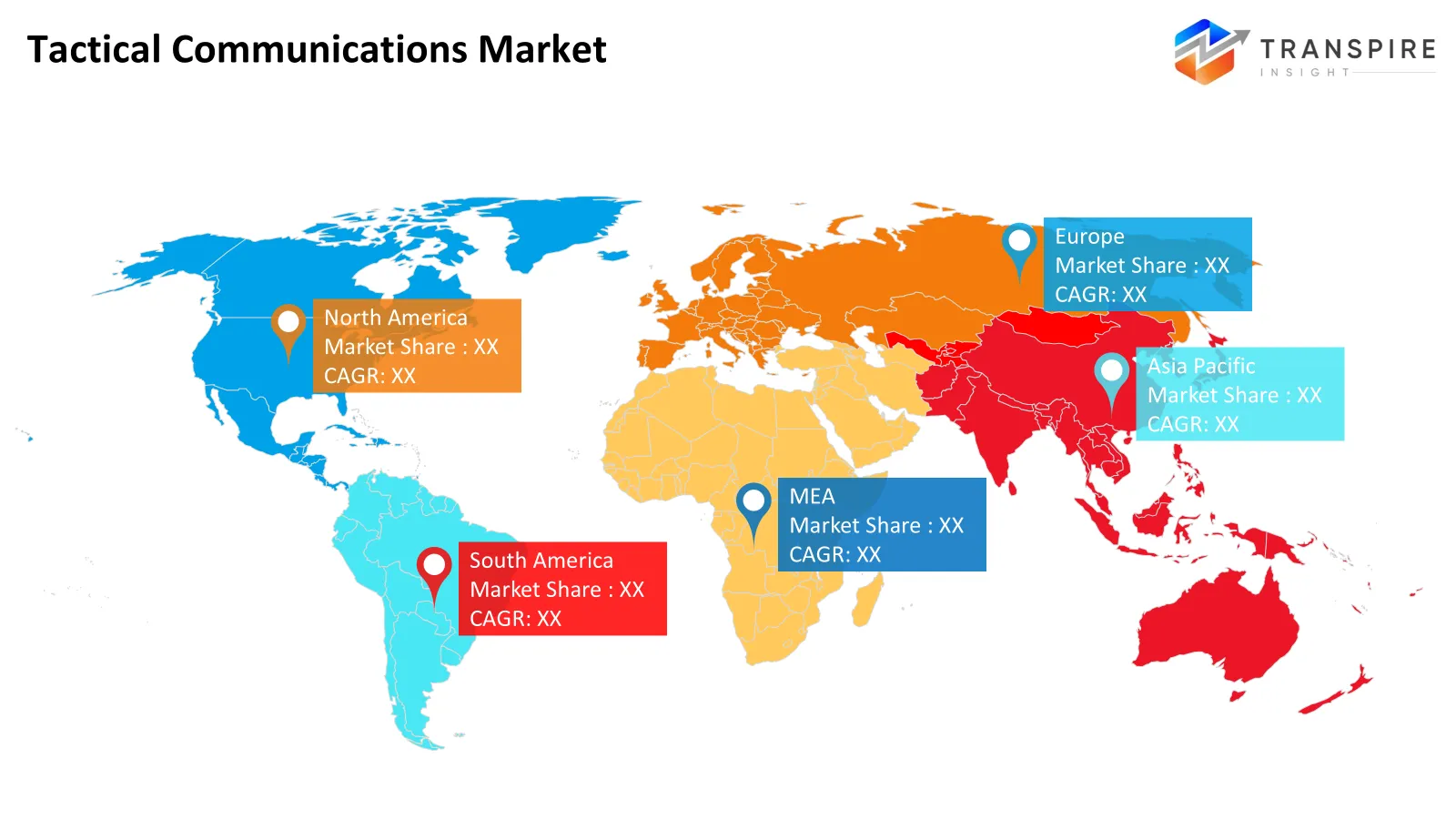
North America holds the largest market share, accounting for 39.50%, benefiting from large-scale modernisation programs spanning U.S. land, air, naval, and joint-force networks. North America benefits from mature defence budgets, established software-defined radio providers, and a large network of secure communications, satellite, and semiconductor suppliers. U.S. procurement is transitioning from platform-centric, standalone radios to emphasising robust communications for contested-spectrum environments. Full-rate production (FRP) procurement of handheld, manpack, and small-form-factor radios maintains the demand for replacements and network growth.
In June 2026, L3Harris Technologies secured $84 million in new delivery orders from the U.S. Army for its next-generation tactical manpack systems. Under this award, the company is supplying Falcon AN/PRC-158C manpack radios featuring Mobile Ad hoc NETworks (MANET) and highly resilient software-defined waveforms.
Europe rates at 27.00%, but it cannot be directly compared to Europe because of its different model, which is one of sovereignty, NATO interoperability, and cross-border industrial cooperation. Due to significant security concerns, the governments have moved away from disaggregated legacy systems and accelerated national modernisation initiatives. European Defence Fund underpins interoperable secure SDR and tactical networking initiatives, such as 5G tactical bubble trials. Multiple years of German, French, UK, and Polish modernisation provide stability rather than dependence on a single procurement agency.
In July 2026, Ericsson was selected for the UK Ministry of Defence's Tactical Communication Systems framework (RM6393). This contract, valued at up to £8 billion over eight years, integrates 3GPP-standardized 5G capabilities to deliver resilient, high-bandwidth tactical communications for multi-domain command and allied interoperability.
Asia Pacific is the fastest-growing region with a 23.00% share of the market and a compound annual growth rate of 8.70%, driven by innovative spend priorities on border surveillance, maritime security and Indo-Pacific interoperability. Countries including Japan, South Korea, India and Australia are building on their secure communications for joint exercises, unmanned platforms and distributed operations. Transitioning from radios to tactical 5G and integrated command networks increases the potential for growth for suppliers. Future requirements will be geared towards local manufacturing, spectrum-resilient radios, and interoperable systems that can operate in support of allied nations.
In February 2026, Mitsubishi Electric was awarded a strategic defence contract by the Japan Ministry of Defence to develop and manufacture a next-generation geostationary defence satellite communications system to succeed the Kirameki-2 platform.
https://www.mitsubishielectric.com/en/pr/2026/0206-b/
Who are the Key Players in the Tactical Communications Market, and how do they compete?
Competition is now around providing secure, interoperable, and upgradable networked ecosystems rather than just unit-radio pricing. L3Harris, Thales, BAE Systems, General Dynamics, RTX, Northrop Grumman, Leonardo, and Elbit Systems target long-term defence programs by combining radios, encryption, data links, integration, and sustainment.
L3Harris is deploying large-scale multiband SDRs and localising through export markets and a local partner network, including an ongoing Dutch program spanning vehicles, soldiers, naval assets, and aircraft. Thales' export-focused solutions include those for HF radios in Malaysia; BAE Systems offers NATO-compatible waveforms, protected radios, EW-resistant communications, and coalition data links; and the joint RTX and BAE Systems' Data Link Solutions team has won a USD 248M production contract for the MIDS JTRS for the U.S. Navy. Rohde & Schwarz focuses on protected communications and spectrum expertise; Viasat, resilient satellite communications; and Collins Aerospace, bringing new tactical networks into aircraft. Saab, Leonardo, and Elbit leverage regional defence relationships and platform integration; and Motorola Solutions looks for adjacency into public safety. Silvus Technologies wins in high-mobility mesh networking, including unmanned and distributed teams.
Key Players are:
- L3Harris Technologies
- Thales
- BAE Systems
- General Dynamics
- Raytheon Technologies
- Northrop Grumman
- Leonardo
- Elbit Systems
- Rohde & Schwarz
- Viasat
- Collins Aerospace
- Saab
- Harris Corporation
- Motorola Solutions
- Silvus Technologies
Recent Development News
- In September 2026, Base Camp Connect formed a strategic partnership with Marconi Technologies to deliver an integrated tactical communications solution for the Canadian Armed Forces. The collaboration combines deployable communications integration with RF transmission and command-and-control capabilities, supporting interoperable voice, data, radio, and computing in denied, disrupted, intermittent, and limited environments. https://basecampconnect.com/bcc-marconi-strategic-partnership/
- In June 2026, PDW entered into a definitive agreement to acquire Vanteon Corporation, adding more than 40 years of expertise in advanced communications, RF systems, software-defined radios, and embedded technologies. The acquisition is expected to expand PDW’s engineering capacity and strengthen integrated, resilient communications capabilities for unmanned systems operating at the tactical edge. https://www.prnewswire.com/news-releases/pdw-announces-agreement-to-acquire-vanteon-expanding-communications-expertise-and-engineering-capacity-302791682.html
What Strategic Insights Define the Future of the Tactical Communications Market?
The market is moving to hybrid tactical networks, where SDR, private 5G, LEO satellite links, mesh nodes, and edge computing are a single managed system. The risk, though, is not necessarily cyberattack: Instead, it is interoperability debt, where forces may acquire superior links only to discover they don't integrate with coalition partners or legacy command systems, delaying deployment, raising integration costs, and devaluing the new hardware. The opportunity lies in deploying sovereign, integrated "tactical connectivity stacks," combining spectrum management driven by AI, encrypted edge processing, and multi-bearer failover. European programs are supporting this transition through development of secure-SDR and 5G tactical-bubble standards.
In a strategic sense, vendors should invest in open, standards-compatible interfaces and demonstrate interoperability in the face of jamming, satellite shortfalls, and heterogeneous vendors. Market incumbents will likely profit by providing not only hardware but also software, orchestration, and lifecycle support, rather than selling tactical radios in isolation.
Key Segmentations are:
Communication Type
- Radio Communication
- Satellite Communication
- Cellular Communication
- Mesh Networking
- MANET
- Software-Defined Radio
- Data Link
- Tactical Broadband
Platform
- Land Forces
- Naval Forces
- Air Forces
- Special Forces
- Unmanned Systems
- Command Centers
- Vehicles
Frequency Band
- HF
- VHF
- UHF
- L-Band
- S-Band
- C-Band
- X-Band
- Ku/Ka-Band
Application
- Command & Control
- Intelligence & Surveillance
- Battlefield Communications
- Situational Awareness
- Logistics
- Targeting
- Emergency Response
Technology
- Software-Defined Radio
- AI-Enabled Communications
- Encryption
- Mesh Networks
- Cognitive Radio
- 5G Tactical Networks
- SATCOM
- Edge Computing
End User
- Defence Forces
- Homeland Security
- Law Enforcement
- Government Agencies
- Emergency Services
- Border Security
- Special Operations
By Regional Analysis
North America
- US
- Canada
- Mexico
Europe
- Germany
- UK
- France
- Italy
- Spain
- Russia
- Rest of Europe
Asia Pacific
- China
- Japan
- India
- South Korea
- Australia
- Rest of Asia Pacific
South America
- Brazil
- Argentina
- Rest of South America
Middle East & Africa
- UAE
- Saudi Arabia
- Qatar
- South Africa
- Rest of the Middle East & Africa
Frequently Asked Questions
Find quick answers to common questions.
The tactical communications market size was valued at USD 22.58 billion in 2025 and is poised to reach USD 39.74 billion by 2033, expanding at a 7.30% CAGR.
Key segments for the tactical communications market are Communication Type (Radio Communication, Satellite Communication, Cellular Communication, Mesh Networking, MANET, Software-Defined Radio, Data Link, Tactical Broadband); Platform (Land Forces, Naval Forces, Air Forces, Special Forces, Unmanned Systems, Command Centers, Vehicles); Frequency Band (HF, VHF, UHF, L-Band, S-Band, C-Band, X-Band, Ku/Ka-Band); Application (Command & Control, Intelligence & Surveillance, Battlefield Communications, Situational Awareness, Logistics, Targeting, Emergency Response); Technology (Software-Defined Radio, AI-Enabled Communications, Encryption, Mesh Networks, Cognitive Radio, 5G Tactical Networks, SATCOM, Edge Computing); End User (Defense Forces, Homeland Security, Law Enforcement, Government Agencies, Emergency Services, Border Security, Special Operations).
Growth is primarily driven by defence-network modernisation, adoption of software-defined radios and tactical 5G, demand for resilient MANET and SATCOM connectivity, increasing interoperability requirements among allied forces, AI-enabled network optimisation, and the need for secure communications in electronically contested and infrastructure-degraded environments.
The market is led by major manufacturers, including L3Harris Technologies, Thales, BAE Systems, General Dynamics, Raytheon Technologies, Northrop Grumman, Leonardo, Elbit Systems, Rohde & Schwarz, Viasat, Collins Aerospace, Saab, Harris Corporation, Motorola Solutions, Silvus Technologies.
North America holds 39.50% of the tactical communications market, supported by strong defence modernisation programs, established communications infrastructure, high military technology investment, advanced C5ISR capabilities, and continued development of software-defined, AI-enabled and interoperable tactical networks.
Commercial opportunities include AI-enabled network orchestration, software-defined 5G and SATCOM convergence, modular upgradeable radios, edge-computing systems, interoperable MANET platforms, and resilient multi-network communications for allied and emergency-response applications.
- L3Harris Technologies
- Thales
- BAE Systems
- General Dynamics
- Raytheon Technologies
- Northrop Grumman
- Leonardo
- Elbit Systems
- Rohde & Schwarz
- Viasat
- Collins Aerospace
- Saab
- Harris Corporation
- Motorola Solutions
- Silvus Technologies
About the Authors

Tejashri Dhatrak
I am Tejashri Dhatrak, a Senior Research Analyst at Transpire Insight, specializing in the Aerospace and Defence sector. My work focuses on analyzing industry trends, defence technologies, market developments, and emerging innovations that shape the global aerospace and security landscape. At Transpire Insight, I research complex topics, evaluate credible sources, and transform technical insights into accurate, well-structured, and easy-to-understand content for industry professionals and decision-makers. My goal is to provide reliable, research-backed information that helps readers stay informed about defence capabilities, aerospace advancements, strategic developments, and the evolving dynamics of the global defence ecosystem.

Chakradhar Khansole
Chakradhar serves as the Research Director at Transpire Insight, bringing over 8 years of experience in technology, innovation, and strategic market intelligence. He specializes in transforming complex market data into actionable business insights that enable organizations to make informed, growth-oriented decisions. Recognized for his strategic vision and analytical expertise, Chakradhar leads high-impact research initiatives, delivering comprehensive market assessments, competitive intelligence, and forward-looking industry analysis.
Recently Published Reports
-
Apr 2026
Aerospace Fluoropolymers Market
Aerospace Fluoropolymers Market Size, Share & Analysis Report By Type (PTFE, FEP, PFA, ETFE, and Others), By Application (Electrical Insulation, Seals & Gaskets, Coatings, and Others), By End User (Commercial Aviation, Military Aviation, General Aviation, and Others), and Geography (North America, Europe, Asia-Pacific, Middle East and Africa, South and Central America), 2021 - 2031
-
Apr 2026
Airborne SATCOM System Market
Airborne SATCOM System Market Size, Share & Analysis Report By Type (SATCOM Terminals, Transceivers, Airborne Radio, Modems and Routers, SATCOM Radomes, and Other), By Application (Government and Defense and Commercial), and Geography (North America, Europe, Asia-Pacific, Middle East and Africa, South and Central America), 2021 – 2031
-
Apr 2026
Ship Leasing Market
Ship Leasing Market Size, Share & Analysis Report By Vessel Type (Container Ships, Bulk Carriers, Tankers, and Specialized Vessels), By Lease Duration (Short-Term Lease (Less than 1 year), Medium-Term Lease (1-5 years), and Long-Term Lease (More than 5 years)), By Lease Type (Bareboat Charter, Time Charter, Financial Lease, and Others), By End-User Industry (Oil and Gas, Manufacturing and Industrial, Automotive, Agriculture and Food, Retail and Consumer Goods, and Others), and Geography (North America, Europe, Asia-Pacific, Middle East and Africa, South and Central America), 2021 – 2031
-
Apr 2026
Thread Rolling Dies Market
Thread Rolling Dies Market Size, Share & Analysis Report By Type (Flat Thread Rolling Dies, Circular (Cylindrical) Dies, Tangential Thread Rolling Dies, Planetary Thread Rolling Dies, and Other Types), By Material Type (High-Speed Steel (HSS), Carbide, Tool Steel, Alloy Steel, and Other Specialized Alloys), By Distribution Channel (Direct Sales, Distributors and Dealers, and Online Platforms), By Application (Automotive Industry, Aerospace and Defense, Construction and Infrastructure, Industrial Machinery, Electronics and Electrical Components, Medical Devices, and Fastener Production), and Geography (North America, Europe, Asia-Pacific, Middle East and Africa, South and Central America), 2021 – 2031
Our Clients