
Static Synchronous Compensator (STATCOM) Market Summary:
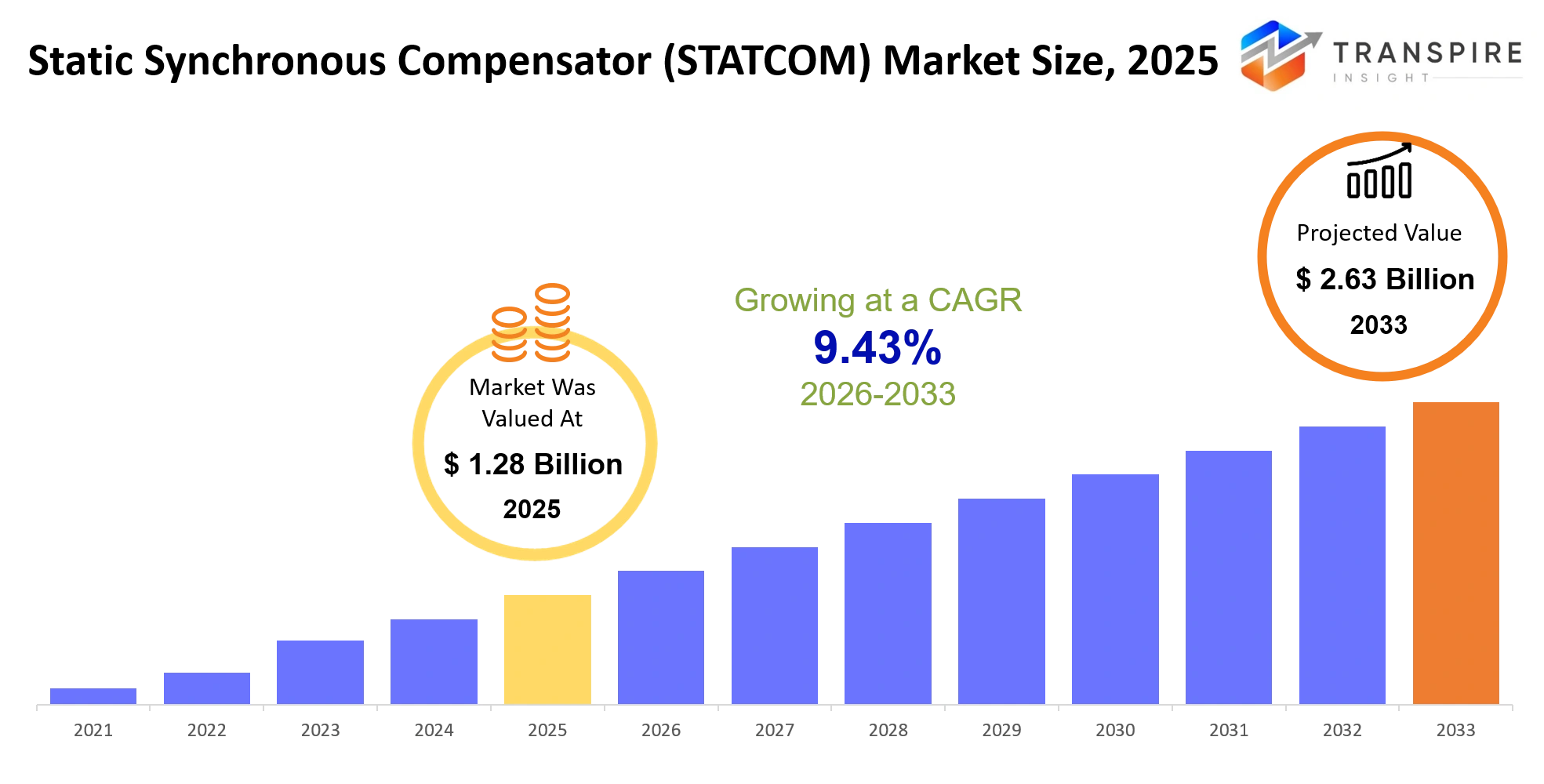
As per Transpire Insight Analysis, the Static Synchronous Compensator (STATCOM) Market size is estimated at USD 1.28 Billion in 2025 and is anticipated to reach USD 2.63 Billion by 2033, growing at a CAGR of 9.43% from 2026 to 2033. There is growth in the market owing to an increase in renewable energy projects, smart grids, and the need for secure and dependable power transmission.
The Static Synchronous Compensator STATCOM market is getting really important because people are using electricity, and we need to make sure the power grid is stable. Lots of companies that make electricity and run the power grid are buying STATCOM systems to keep the voltage right and make sure the power is quality. They also want to stop losing power when it is sent over distances.
In the past few years, people have started to like STATCOM systems that are controlled by computers and are big enough for utilities. This is because we are trying to make the power grid better and use clean energy. The fact that we are building a lot of solar and wind power projects has made it necessary to have systems that can regulate the voltage. As we get power from solar and wind and update the old power grid, we will need better STATCOM technology. This will help the people who run the power grid make it more reliable and work better. The STATCOM market is going to be important for a time because it helps with the power grid. The demand for STATCOM systems will keep going up because we need to keep the power grid working well.
Static Synchronous Compensator (STATCOM) Market Size & Forecast:
- Market Size 2025: USD 1.28 Billion
- Expected Market Value (2033): USD 2.63 Billion
- Forecast CAGR (2026–2033): 9.43%
- Leading Region in 2025: Asia Pacific
- Fastest Growing Region: North America
- Key Company Profiles: Hitachi Energy, Siemens Energy, GE Vernova, Mitsubishi Electric, ABB, NR Electric, Rongxin Power Electronic, Ingeteam, Hyosung Heavy Industries, Fuji Electric, Toshiba Energy Systems, Eaton, American Superconductor, Merus Power, Delta Electronics.
Key Market Insights:
The STATCOM market worldwide continues to change in view of the importance of reliability, renewable power generation, and digital power management by utility companies and industries. Changes in technology, formation of alliances, and development of power transmission networks will continue to influence competition in this market.
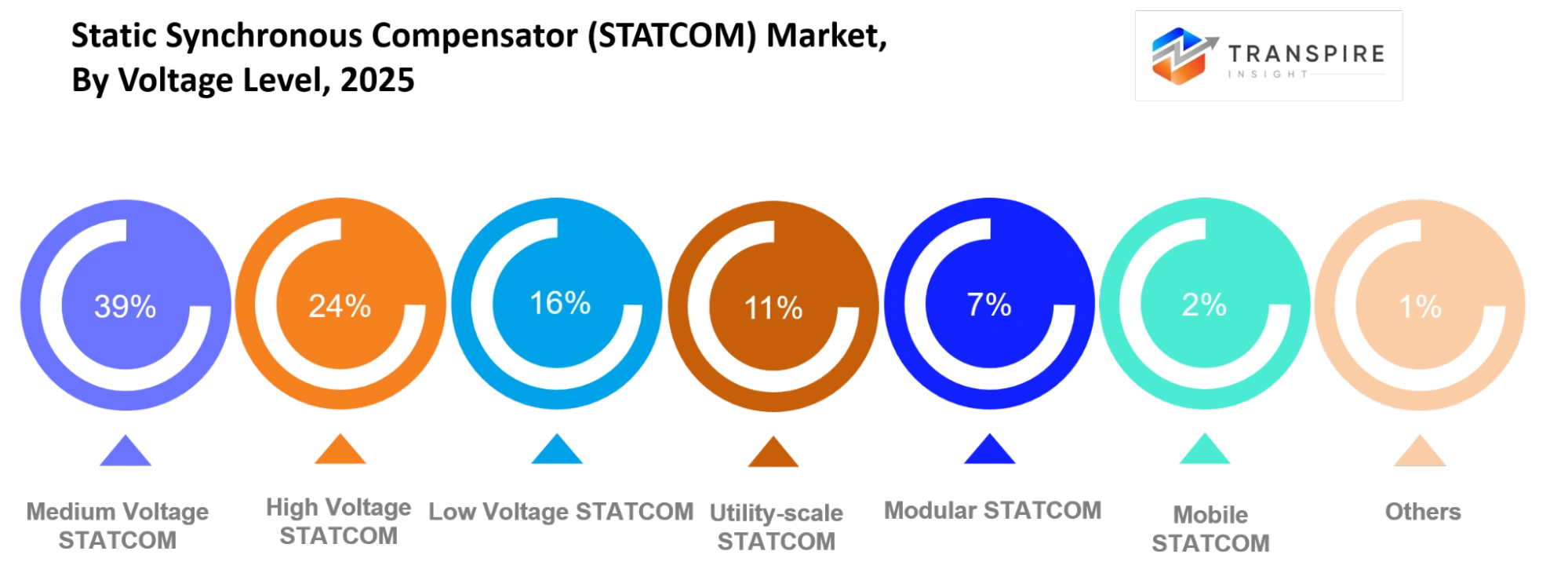
- Medium Voltage STATCOM dominates the market with 39% market share since the deployment of this technology has become common among utility companies and industries for voltage regulation.
- High Voltage STATCOM constitutes 24% of the market share, backed by spending on long-distance power transmission and substations of high capacity.
- Low Voltage STATCOM comprises 16% of the market and includes the development of space-efficient products for buildings, industrial sites, and distributed generation systems.
- Utility STATCOM makes up 11% of the market share and is expected to register the highest CAGR of 18.5% due to renewable energy installations and grid upgradation initiatives.
- Modular STATCOM forms 7% of the market and becomes popular due to its scalability, quick installation, and ease of maintenance.
- Mobile STATCOM forms 2% of the market and is becoming popular due to the use of this technology in grid assistance in case of maintenance work and restoration of the grid.
- The Others category consists of 1% of the market, which is required in customised power compensation applications.
What are the Key Drivers, Restraints, and Opportunities in the Static Synchronous Compensator (STATCOM) Market?
Drivers
The development of the STATCOM market is primarily influenced by the modernisation of power transmission and distribution grids. With electricity demand growing, together with renewables' capacity, the market needs advanced solutions for voltage regulation. Increased deployment of large solar and wind energy systems is boosting the uptake of STATCOMs, as such renewable sources produce fluctuations in the voltage that require constant compensation. This change has prompted investments into flexible power quality management equipment, increasing its uptake and future market expansion.
Restraints,
Though optimistic, the market still has challenges because of the substantial capital needed for the installation of STATCOMs. The difficulty of engineering, the long approval process of the project, and the difficulty in integrating them into the ageing grid systems are just some of the obstacles that need to be addressed.
Opportunities
There is a key opportunity available with regard to the growing scope of intelligent grids and digital substations. Investments in large-scale renewable energy projects and automation are increasing significantly, particularly in Asia Pacific and North America, leading to an increase in demand for intelligent STATCOM systems that feature remote monitoring and predictive maintenance features.
What Has the Impact of Artificial Intelligence Been on the Static Synchronous Compensator (STATCOM) Market?
The Static Synchronous Compensator STATCOM market is rapidly changing due to artificial intelligence, which brings efficiency and high-quality management to power systems. AI analytics is widely used now for voltage monitoring, equipment performance prediction, and reactive power compensation optimisation. Analysing the operational data in substations and transmission lines helps discover upcoming failures and reduces unexpected power losses and maintenance costs. Besides, using AI allows for automated decision-making when a STATCOM system reacts to changes in the conditions of the network due to renewable energy production and changing electricity consumption.
Predictive maintenance provided by artificial intelligence helps to detect wear patterns and schedule maintenance work only if necessary. This way, utilities are able not only to prolong the life cycle of their assets but also to reduce operating costs. Nevertheless, implementing AI in power infrastructure faces challenges such as the lack of updates in power systems and high implementation costs. Moreover, there are security issues related to the cybersecurity of power infrastructure in the case of AI application. However, investments in smart grids and digital substations will help in the rapid development of STATCOMs with AI. In May 2025, Utilidata, together with Southern California Edison (SCE) and the Incubatenergy Labs of EPRI, showcased their AI-powered Karman platform, which helps in managing the Distributed Energy Resource (DER). Using artificial intelligence, Karman helps in grid optimisation using prediction and decision-making in real time, thus allowing for advanced grid technology, including STATCOM, which is required for dynamic voltage regulation and grid stabilisation.
Key Market Trends:
In the Static Synchronous Compensator market for STATCOM, the industry is experiencing a move towards intelligent management of the grid, digitisation of monitoring processes, and renewable energy incorporation.
- Electric utilities and industrial customers are moving away from static reactive power compensation technologies in favour of smart, flexible compensation systems to boost power quality, grid resilience, and the shift to sustainable energy systems.
- There is a tendency among utility companies to upgrade their power systems by replacing existing static reactive power equipment with new digital STATCOM systems that provide fast voltage regulation.
- Another industry tendency that is becoming more popular is the increase in the amount of renewable energy, which is incorporated into power networks through STATCOM installations.
- New STATCOM technologies include scalable modular STATCOM installations that help deploy systems quicker and make upgrades easier in the future.
- Investment in smart grids encourages STATCOM companies to produce smart grid-compatible STATCOMs with monitoring, remote diagnostics and control features.
- Industrial facilities pay attention to improving power quality and are implementing STATCOM installations to prevent voltage sags and power disruptions.
- Utility-scale projects are getting more traction because of investments in transmission systems capable of handling renewable energy electricity generation.
Static Synchronous Compensator (STATCOM) Market Segmentation
By Voltage Level
The By Voltage Level category is dominated by Medium Voltage Static Synchronous Compensator(STATCOM), which constitutes 39% of the overall market share, owing to its widespread application in utility grids, industrial sites and renewable energy installations where constant voltage regulation is highly necessary. High Voltage STATCOM constitutes 24% of the market share, as the need for high-capacity STATCOM for transmission projects and extra high voltage substations keeps rising. Low Voltage STATCOM constitutes 16% of the market share, fueled by increasing installations in commercial and industrial settings. The Utility-scale STATCOM constitutes 11% of the market share, expected to grow at a CAGR of 18.5%. Modular Static Synchronous Compensator (STATCOM) makes up 7% of the market share.
By Application
The growth of this market is primarily attributed to Renewable Energy Integration, in which Static Synchronous Compensator (STATCOMs) provide voltage regulation against variations caused by the production of renewable energy like wind energy and solar energy. Growth is also evident in the Transmission Systems segment due to upgrades in the existing transmission system that will improve power reliability. The other key application area is Industrial Power Quality since industries need a constant power supply without interruptions. The growth of this market is also anticipated in the Railways, Data Centres, Oil & Gas, and Utilities segments.
By End User
Utilities lead the By End User market because transmission system operators keep on upgrading their grids and connecting renewable energy sources. Static Synchronous Compensator (STATCOM) solutions are being used by industrial facilities to increase equipment efficiency and lower production loss due to voltage fluctuations. Renewable energy companies are deploying more solutions to comply with changing grid standards, whereas rail transport, data centres, and oil & gas companies are making additional investments in STATCOM technology to ensure continuous power supply.
By Component
the Voltage Source Converter is at the heart of this section because it is the key technology used in compensating reactive power and controlling voltage. The need for high-quality Control Systems that automate the grid response and monitor it digitally is also increasing. For efficiency and longevity of equipment, Cooling Systems, Power Transformers, and Harmonic Filters will always be relevant. The growing use of Monitoring Systems is improving predictive maintenance, and other components are developing in unison with the smart grid.
By Distribution Channel
The main drivers are Direct Sales due to the customisation options available in such sales. EPC Contractors are very important because they incorporate Static Synchronous Compensator (STATCOM) systems into the grid infrastructure projects and renewable energy projects. The Power Equipment Suppliers will continue to expand their portfolios of products due to high demand, and OEM partners are extending their market reach with technological collaboration and localised manufacturing.
What are the Key Use Cases Driving the Static Synchronous Compensator (STATCOM) Market?
The main use case of static synchronous compensatorSTATCOM devices is integration into renewable energy sources, where they assist in stabilising voltage and enhancing grid performance. Such applications are directly associated with the prevalence of Medium Voltage STATCOM systems that are applied extensively in the utility power grid, solar and wind power plants to ensure proper power quality. Apart from renewables, STATCOM systems are also increasingly applied in transmission grids, heavy industry, rail transport, computing infrastructure, and oil and gas. In such industries, it is necessary to have fast voltage regulation to decrease power disturbances and achieve stable operations in energy-intensive environments. New areas of potential growth for STATCOM technology include modernisation of the utility grid, intelligent substations and digital power infrastructure. In the context of increasing utility capacity of renewable energy and implementing intelligent grid solutions, STATCOM devices become an integral part of advanced monitoring and automation systems.
|
Report Metrics |
Details |
|
Market size value in 2025 |
USD 1.28 Billion |
|
Market size value in 2026 |
USD 1.40 Billion |
|
Revenue forecast in 2033 |
USD 2.63 Billion |
|
Growth rate |
CAGR of 9.43% from 2026 to 2033 |
|
Base year |
2025 |
|
Historical data |
2021 - 2024 |
|
Forecast period |
2026 - 2033 |
|
Report coverage |
Revenue forecast, competitive landscape, growth factors, and trends |
|
Regional scope |
United States; Canada; Mexico; United Kingdom; Germany; France; Italy; Spain; Denmark; Sweden; Norway; China; Japan; India; Australia; South Korea; Thailand; Brazil; Argentina; South Africa; Saudi Arabia; United Arab Emirates |
|
Key company profiled |
Hitachi Energy, Siemens Energy, GE Vernova, Mitsubishi Electric, ABB, NR Electric, Rongxin Power Electronic, Ingeteam, Hyosung Heavy Industries, Fuji Electric, Toshiba Energy Systems, Eaton, American Superconductor, Merus Power, Delta Electronics. |
|
Customization scope |
Free report customization (country, regional & segment scope). Avail customized purchase options to meet your exact research needs. |
|
Report Segmentation |
By Voltage Level (Low Voltage STATCOM, Medium Voltage STATCOM, High Voltage STATCOM, Utility-scale STATCOM, Modular STATCOM, Mobile STATCOM, Others); By Application (Renewable Energy Integration, Transmission Systems, Industrial Power Quality, Railways, Data Centers, Oil & Gas, Utilities, Others); By End User (Utilities, Industrial Facilities, Renewable Energy Developers, Rail Operators, Data Centers, Oil & Gas Companies, Others); By Component (Voltage Source Converter, Control System, Cooling System, Power Transformer, Harmonic Filter, Monitoring System, Others); By Distribution Channel (Direct Sales, EPC Contractors, Power Equipment Suppliers, OEM Partners, Others). |
Which Regions are Driving the Static Synchronous Compensator (STATCOM) Market Growth?
North America
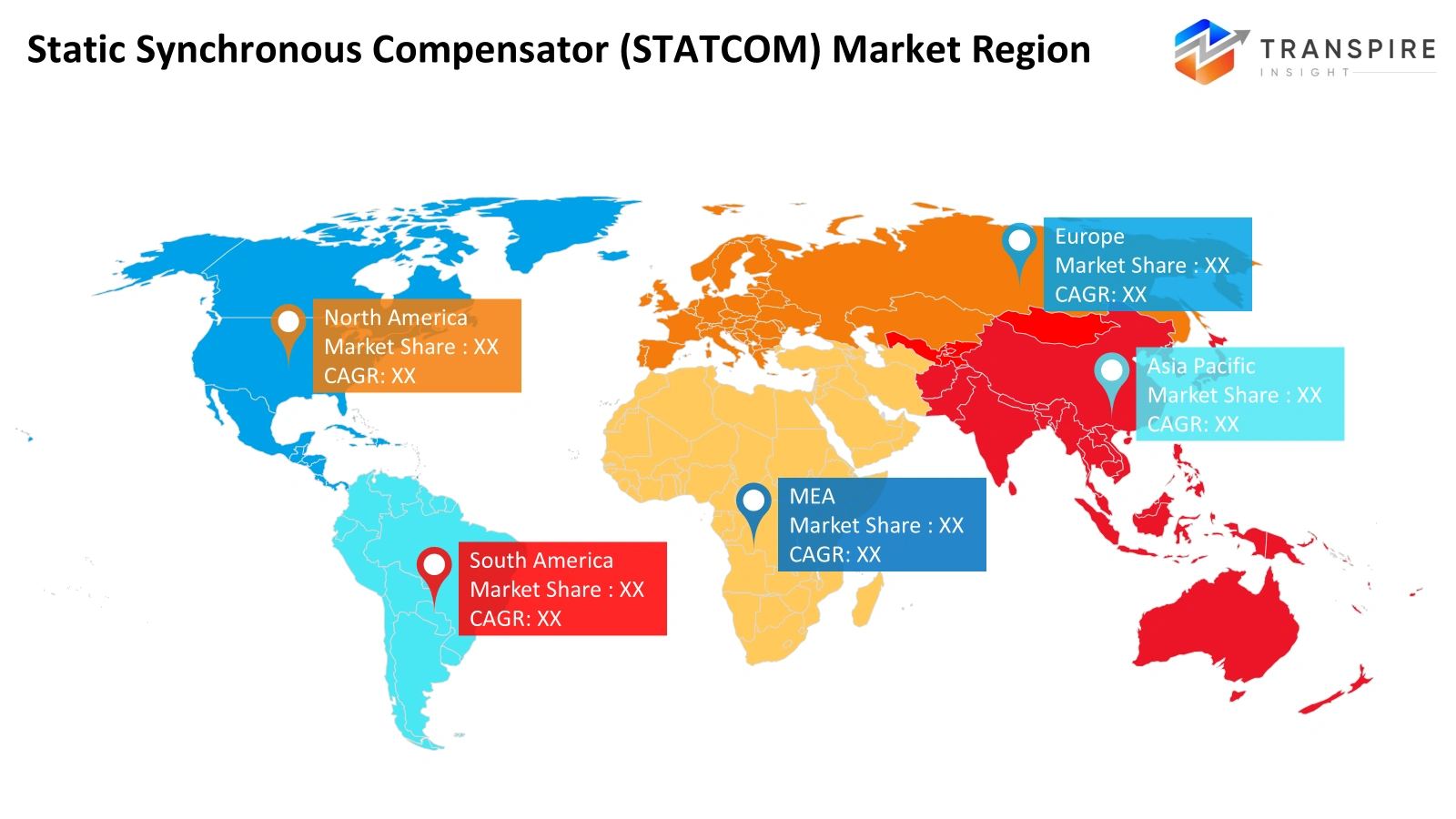
North America accounts for 24% of the share and is anticipated to witness the fastest growth with 17.8% CAGR throughout the forecast period. Fast-paced investments in smart grid technology, large-scale batteries, and renewable energy generation have been encouraging faster adoption of grid stabilisation solutions. The utilities are installing STATCOM systems to increase efficiency in the transmission of electricity and improve the resilience of the grid in the face of changing electricity demands. Infrastructure improvements and digital grid initiatives are likely to result in huge growth potential within the region.In April 2026, Hitachi Energy made a USD 10 million investment to build a Power Electronics Centre of Competence in Cary, North Carolina. The centre will improve the engineering, testing, and integration of next-generation power electronics technology solutions, including those that provide grid stabilisation based on the usage of STATCOM technology by utilities, renewable projects, and power infrastructure based on AI technologies in North America.
Europe
Europe holds 23% of the share owing to its strong commitment to renewable energy sources and energy reliability. Unlike the Asia-Pacific region, Europe is more concerned about modernising the existing transmission system and meeting the stringent targets of energy transition. Offshore wind farms, smart grids, and cross-border electricity connections have been boosting steady demand for STATCOM systems. The well-established utility systems and favourable regulations are keeping Europe in a stable position.In December 2024, Hitachi Energy received an order from Ørsted to use its Enhanced STATCOM (SVC Light® Enhanced) technology for the Hornsea 4 offshore wind farm project in the United Kingdom. This will be the first European offshore wind farm utilising Enhanced STATCOM technology that will provide improved voltage regulation and grid stabilisation together with 2.4 GW of renewable energy integration.
Asia Pacific
The Asia Pacific region holds the highest share in the STATCOM market at 44%, owing to huge investments in power transmission and renewable energy generation facilities. All countries in this region are increasing their solar and wind power and high-voltage transmission projects, and hence, there is a growing need for voltage regulating systems. The government-led initiatives of grid upgradation and the growing electricity consumption levels drive market growth. These dynamics have made Asia Pacific the most prominent region for STATCOM installations.In May 2025, Hitachi Energy and Transpower New Zealand launched Phase II of the North Island grid reinforcement project with a state-of-the-art SVC Light® STATCOM installed in the Ōtāhuhu substation in Auckland.
Who are the Key Players in the Static Synchronous Compensator (STATCOM) Marketand how do they Compete?
The competition in the international market for Static Synchronous Compensators (STATCOMs) results from innovations in technology, development of tailor-made power solutions, and entry into the renewable energy and power infrastructure projects segment that have high growth potential. The competitors in the market emphasise increasing system efficiency, improving digital monitoring systems, and building up their worldwide service networks.
The key market players include Hitachi Energy, Siemens Energy, GE Vernova, Mitsubishi Electric, and ABB. These companies engage in rivalry through the production of advanced STATCOM systems suitable for use in transmission systems, renewable energy projects, and industries. The rivalry involves innovating in products, integrating digital control systems, and providing comprehensive services in the product life cycle. Most of these companies grow regionally through partnering with utilities, EPC companies, and renewable energy firms. Innovators like NR Electric, Rongxin Power Electronic (RXPE), American Superconductor (AMSC), Hyosung Heavy Industries, and Ingeteam set themselves apart from other players using engineering skills, cost-effective options, and custom designs tailored to specific projects. Modular STATCOMs, artificial intelligence-based monitoring, and local production capabilities are some of the areas where companies are making investments in order to fulfil the ever-changing needs of customers.
Static Synchronous Compensator (STATCOM) Market companies
- Hitachi Energy
- Siemens Energy
- GE Vernova
- Mitsubishi Electric
- ABB
- NR Electric
- Rongxin Power Electronic
- Ingeteam
- Hyosung Heavy Industries
- Fuji Electric
- Toshiba Energy Systems
- Eaton
- American Superconductor
- Merus Power
- Delta Electronics
Recent Development News
In October 2025, Siemens Energy launched the world's first E-STATCOM setup at the Mehrum site in Germany. This system integrates voltage and frequency stabilisation, making the transmission system stable due to the shift from traditional power stations to renewable energy sources.
Source: https://www.siemens-energy.com
In March 2026, Hitachi and GE Vernova concluded a Memorandum of Understanding (MoU) in connection with the potential use of the BWRX-300 in Southeast Asia. Although the partnership emphasises advanced energy infrastructure, it emphasises the dedication of both organisations to developing the next-generation grid technology.
Source: https://www.hitachi.com
What Strategic Insights Define the Future of the Static Synchronous Compensator (STATCOM) Market?
The Static Synchronous Compensator (STATCOM) market will witness steady growth as utilities invest in developing their transmission infrastructure and increase their efforts toward incorporating renewable energy sources. Investments made by companies into smart grids, digital substations, and flexible infrastructure will continue to drive the demand for more sophisticated voltage regulating systems. Another not-so-obvious barrier for the industry will be the shortage of highly skilled specialists able to design, integrate, and maintain STATCOMs, potentially causing delays in project development in some markets. In addition, growing renewable energy projects in the utility scale and artificial intelligence-based platforms for managing electricity infrastructure will open new growth prospects for the equipment manufacturers and technology developers. Companies paying attention to modularity, monitoring systems, and partnerships with utilities and EPC firms will have a good chance to capture future market opportunities.
Key Segmentations are:
By Voltage Level
- Low Voltage STATCOM
- Medium Voltage STATCOM
- High Voltage STATCOM
- Utility-scale STATCOM
- Modular STATCOM,
- Mobile STATCOM
By Application
- Renewable Energy Integration
- Transmission Systems
- Industrial Power Quality
- Railways
- Data Centers
- Oil & Gas
- Utilities
By End User
- Utilities
- Industrial Facilities
- Renewable Energy Developers
- Rail Operators
- Data Centers
- Oil & Gas Companies
By Component
- Voltage Source Converter
- Control System
- Cooling System
- Power Transformer
- Harmonic Filter
- Monitoring System
By Distribution Channel
- Direct Sales
- EPC Contractors
- Power Equipment Suppliers
- OEM Partners
Regional Outlook
North America
- United States
- Canada
- Mexico
Europe
- Germany
- United Kingdom
- France
- Spain
- Italy
- Rest of Europe
Asia Pacific
- Japan
- China
- Australia & New Zealand
- South Korea
- India
- Rest of Asia Pacific
South America
- Brazil
- Argentina
- Rest of South America
Middle East & Africa
- Saudi Arabia
- United Arab Emirates
- South Africa
- Rest of the Middle East & Africa
Frequently Asked Questions
Find quick answers to common questions.
The static synchronous compensator (statcom) market size was valued at USD 1.28 billion in 2025 and is poised to reach USD 2.63 billion by 2033, expanding at a 9.43% CAGR.
Key segments for the static synchronous compensator (statcom) market are By Voltage Level (Low Voltage STATCOM, Medium Voltage STATCOM, High Voltage STATCOM, Utility-scale STATCOM, Modular STATCOM, Mobile STATCOM, Others); By Application (Renewable Energy Integration, Transmission Systems, Industrial Power Quality, Railways, Data Centers, Oil & Gas, Utilities, Others); By End User (Utilities, Industrial Facilities, Renewable Energy Developers, Rail Operators, Data Centers, Oil & Gas Companies, Others); By Component (Voltage Source Converter, Control System, Cooling System, Power Transformer, Harmonic Filter, Monitoring System, Others); By Distribution Channel (Direct Sales, EPC Contractors, Power Equipment Suppliers, OEM Partners, Others).
Growth is primarily driven by Increased use of renewable energy, increased investments in smart grid technology, increased need for stability and quality of power, increased transmission and distribution networks, and increased electricity consumption around the world.
The market is led by major manufacturers including Hitachi Energy, Siemens Energy, GE Vernova, Mitsubishi Electric, ABB, NR Electric, Rongxin Power Electronic, Ingeteam, Hyosung Heavy Industries, Fuji Electric, Toshiba Energy Systems, Eaton, American Superconductor, Merus Power, Delta Electronics.
The Asia Pacific region accounts for 44% share in the world's STATCOM market, owing to modernisation of the electricity grid infrastructure, growing energy from renewable sources, high investments in power transmission systems, and growing electricity demand in nations like China, India, and Japan.
The commercial opportunities in the STATCOM market include developing renewable energy projects, grid modernisation projects, improvements in the transmission and distribution systems, increasing need for industrial power quality, and investments in EV charging infrastructure.
- Hitachi Energy
- Siemens Energy
- GE Vernova
- Mitsubishi Electric
- ABB
- NR Electric
- Rongxin Power Electronic
- Ingeteam
- Hyosung Heavy Industries
- Fuji Electric
- Toshiba Energy Systems
- Eaton
- American Superconductor
- Merus Power
- Delta Electronics
About the Authors

Avinash Kumar
I’m Avinash Kumar, a Senior Research Analyst at Transpire Insight, with expertise in the Electronics and Semiconductor and Energy & Power industry. My work focuses on analyzing emerging technologies, market trends, industry developments, and innovation across these sectors. I specialize in transforming complex technical and market insights into clear, research-backed content that helps professionals, businesses, and decision-makers stay informed. Through continuous industry research and data-driven analysis, I strive to deliver accurate, reliable, and practical perspectives on the latest advancements shaping the semiconductor and energy landscape.

Chakradhar Khansole
Chakradhar serves as the Research Director at Transpire Insight, bringing over 8 years of experience in technology, innovation, and strategic market intelligence. He specializes in transforming complex market data into actionable business insights that enable organizations to make informed, growth-oriented decisions. Recognized for his strategic vision and analytical expertise, Chakradhar leads high-impact research initiatives, delivering comprehensive market assessments, competitive intelligence, and forward-looking industry analysis.
Recently Published Reports
-
Apr 2026
Active Power Filter Market
Active Power Filter Market Size, Share & Analysis Report By Type (Shunt Active Power Filters, Series Active Power Filter, Hybrid Active Power Filter), By Application (Harmonics Mitigation, Reactive Power Compensation, Voltage Regulation, Power Factor Correction), By Phase (Single Phase, Three Phase), By End-User Industry (Manufacturing, Healthcare, Commercial, Automotive, Oil and Gas, Others), and Geography (North America, Europe, Asia-Pacific, Middle East and Africa, South and Central America), 2021 - 2031
-
Apr 2026
Electrical Transformer Market
Electrical Transformer Market Size, Share & Analysis Report By Core (Closed, Shell, and Berry), By Insulation (Gas, Oil, Solid, Air, and Other), By Phase (Single, and Three), By Rating (100 MVA to 500 MVA, 501 MVA to 800 MVA, and 801 MVA to 1200 MVA), and Geography (North America, Europe, Asia-Pacific, Middle East and Africa, South and Central America), 2021 – 2031
-
Apr 2026
Hydraulic Piston Pumps Market
Hydraulic Piston Pumps Market Size, Share & Analysis Report By Type (Axial Piston Pumps, Radial Piston Pumps), By Operating Pressure (Low Pressure, Medium Pressure, High Pressure), By Application (Construction, Mining, Agriculture, Automotive, Oil & Gas, Industrial Machinery, Others), By End-User (OEMs, Aftermarket), and Geography (North America, Europe, Asia-Pacific, Middle East and Africa, South and Central America), 2021 – 2031
-
Apr 2026
Laboratory Gas Generators Market
Laboratory Gas Generators Market Size, Share & Analysis Report By Product (Nitrogen Gas Generator, Hydrogen Gas Generator, Zero Air Gas Generator, Purge Gas Generator, TOC Gas Generators, Others), By Application (Gas Chromatography, Liquid Chromatography-mass Spectrometry (LC-MS), Gas Analyzers, Others), By End-user (Life Science, Chemical & Petrochemical, Food & Beverage, Others), and Geography (North America, Europe, Asia-Pacific, Middle East and Africa, South and Central America), 2021 – 2031