
Spectrum and Signal Analyzers Market Summary:
According to Transpire Insight, a detailed research report on the market reflects that the IT and telecommunications application segment dominates the Spectrum and Signal Analyzers Market, accounting for approximately 34.5% of the total share worldwide in 2025. Keysight Technologies leads the market with a significant market presence and an estimated 15.2% market share, making it a leading contributor to market development, innovation, advanced spectrum and signal analyzer technologies, expanding product capabilities, and overall market growth dynamics.
Market Snapshot
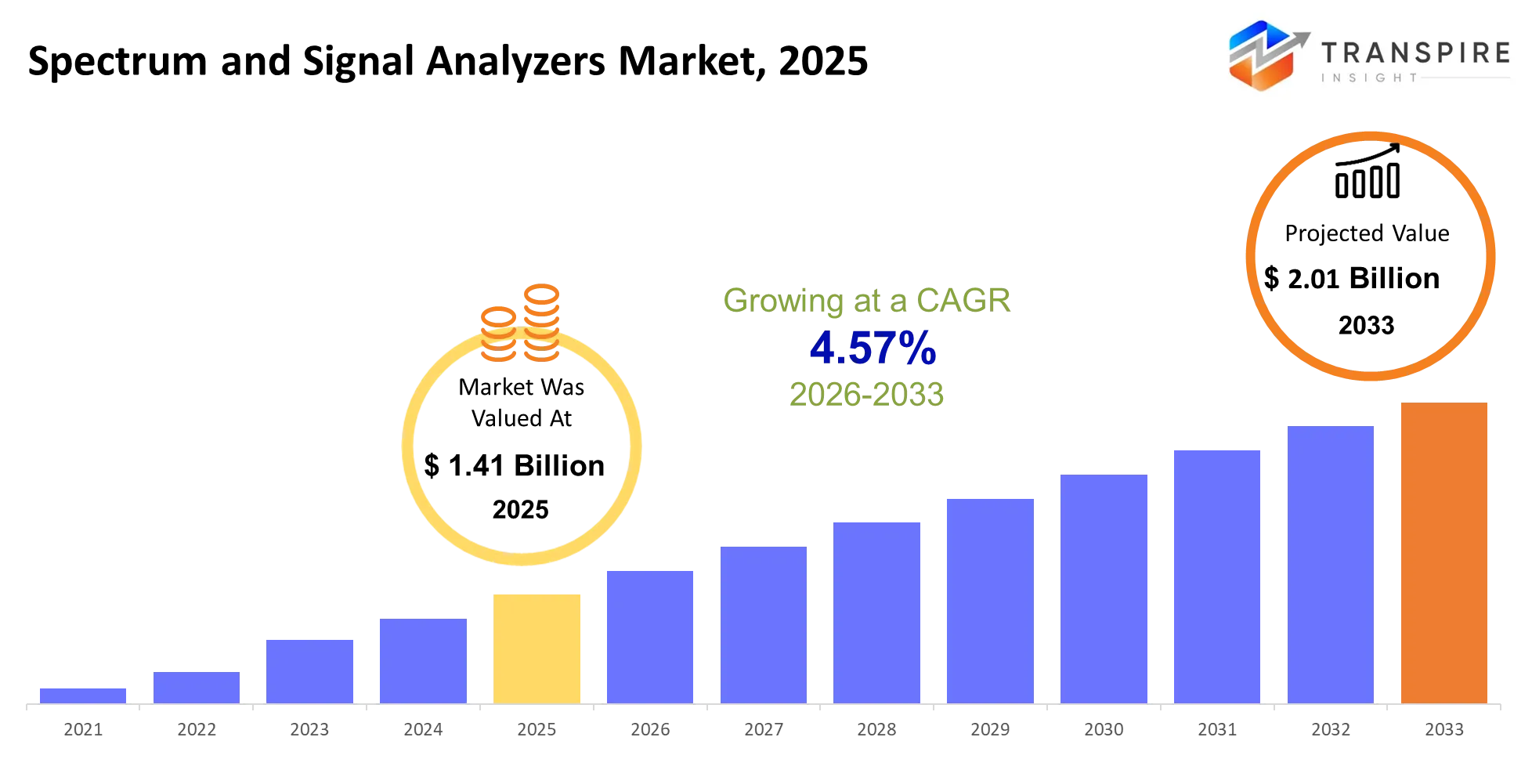
- Market Value (2025): USD 1.41 Billion.
- Expected Market Value (2026): USD 1.47 Billion.
- Estimated Market Value (2033): USD 2.01 Billion.
- Forecast CAGR (2026–2033): 4.57%
- Leading Region in 2025: North America
- Second-largest Region: Asia Pacific
- Fastest Growing Region: Europe
Introduction
The market for spectrum and signal analyzers comprises the revenues from manufacturing sales ("factory-gate" figures) and software services research of various test and measurement equipment. The devices used for detecting, measuring, and analyzing electrical, RF, or optical signals are referred to as spectrum analyzers and deliver readings such as power, frequency, bandwidth, amplitude, and modulation characteristics of a signal. Besides, it is worth noting that a spectrum analyzer measures the magnitude of the input signal concerning frequency in the predefined frequency range. A signal analyzer, on the other hand, is quite an advanced instrument incorporating spectrum analysis with vectoring making it possible to get magnitude as well as phase information on a signal. In the Spectrum and Signal Analyzers Market, advanced solutions are provided to conduct RF testing accurately and monitor the spectrum easily. It gives users the opportunity to find electromagnetic interference, emission of destructive signals, and the signals that do not belong to the communication system. In addition, using the signal quality assurance helps users to measure the characteristics of the signal and bandwidth of the system accurately. Fault detection gives engineers an opportunity to diagnose problems that occur with the equipment during operation. Moreover, portable and software-defined spectrum analyzers improve the effective mobility of engineers allowing them to perform repairs in a timely manner no matter where they are located in the field.
For instance:- The growing need for sophisticated RF measurements is propelling the rapid growth of the spectrum and signal analyzer market. Due to significant expenditures in satellite communications, semiconductor manufacturing, and 5G rollouts, Asia Pacific is leading the area in growth. Asia Pacific is the fastest-growing market, driven by nations like China and India.
Market Highlights: -
- North America is expected to grow at a rapid CAGR in the Spectrum and Signal Analyzers Market by holding almost 36% of the share during the forecast period.
- Asia Pacific is anticipated to hold almost 32% share of the Spectrum and Signal Analyzers Market over the predicted timeframe.
- Europe is anticipated to hold almost 20% share of the Spectrum and Signal Analyzers Market over the predicted timeframe.
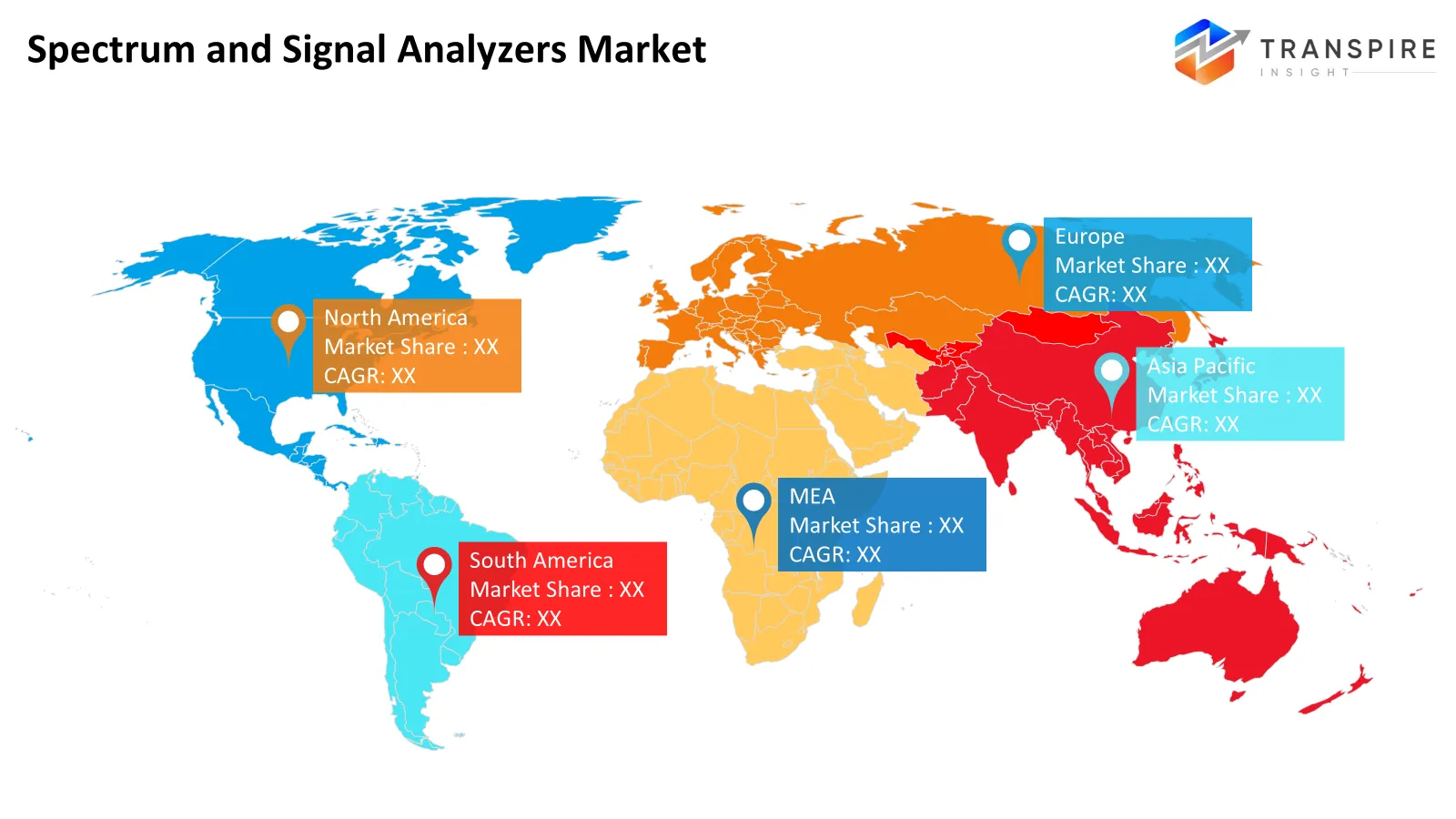
- By product type, the Benchtop Analyzers segment dominated the market and holds nearly 43% share in 2025 and is projected to grow at a substantial CAGR during the forecast period.
- By application, the Telecommunications segment dominated the market and holds nearly 32% share in 2025 and is projected to grow at a substantial CAGR during the forecast period.
- By end user, the Telecom Operators segment dominated the market and holds nearly 42% share in 2025 and is projected to grow at a substantial CAGR during the forecast period.
- Spectrum Allocations: Regulatory authorities in various parts of the world are responsible for allocating new wireless spectrum bands and managing them, which involves the implementation of strict monitoring regulations so that these bands do not interfere with one another. As a result, there is a growing need for sophisticated spectrum and signal analyzers in the areas of RF testing, spectrum monitoring, signal measurement, and interference detection.
How is Technology Driving Growth in the Spectrum and Signal Analyzers Market?
The market for spectrum and signal analyzers is witnessing considerable growth due to the fast spread of 5G networks and the steady evolution of 6G technologies, which lead to a need for advanced testing solutions that meet requirements for high frequencies, wide bandwidths, and complex network architecture. The integration of AI and ML leads to enhanced automated signal classification, interference detection, and measurement efficiency. The use of software-oriented measuring systems, portable analyzers, and small-sized handheld devices enables cost-reduced field measurements. Besides that, the rapid development of IoT, smart connectivity, and Industry 4.0 solutions leads to a growing level of spectrum congestion and a demand for continuous RF monitoring, quality assessment of signals, interference assessment, and efficient wireless communication systems.
|
Report Metrics |
Details |
|
Market size value in 2025 |
USD 1.41 Billion |
|
Market size value in 2026 |
USD 1.47 Billion |
|
Revenue forecast in 2033 |
USD 2.01 Billion |
|
Growth rate |
CAGR of 4.57% from 2026 to 2033 |
|
Base year |
2025 |
|
Historical data |
2021 - 2024 |
|
Forecast period |
2026 - 2033 |
|
Report coverage |
Revenue forecast, competitive landscape, growth factors, and trends |
|
Regional scope |
United States; Canada; Mexico; United Kingdom; Germany; France; Italy; Spain; Denmark; Sweden; Norway; China; Japan; India; Australia; South Korea; Thailand; Brazil; Argentina; South Africa; Saudi Arabia; United Arab Emirates |
|
Key company profiled |
Keysight Technologies, Rohde & Schwarz, Anritsu, Tektronix, Teledyne Technologies, VIAVI Solutions, National Instruments, Cobham, CRFS, Chroma ATE, GW Instek, Rigol Technologies, Aaronia, Giga-tronics, Signal Hound |
|
Customization scope |
Free report customization (country, regional & segment scope). Avail customized purchase options to meet your exact research needs. |
|
Report Segmentation |
By Product Type (Benchtop Analyzers, Portable Analyzers, Handheld Analyzers, Real-time Spectrum Analyzers, Vector Signal Analyzers, EMI/EMC Analyzers, Network Analyzers, Others); By Frequency Range (Below 3 GHz, 3–6 GHz, 6–18 GHz, 18–40 GHz, 40–50 GHz, Above 50 GHz, Others); By Technology (Swept-tuned, Superheterodyne, FFT-based, Real-time, Vector Signal Analysis, Digital Signal Processing, Others); By Application (Telecommunications, Aerospace & Defense, Electronics Manufacturing, Automotive, Healthcare, Research, Broadcasting, Others); By End User (Telecom Operators, Defense Organizations, Electronics Manufacturers, Automotive OEMs, Research Institutes, Universities, Government Agencies, Others) |
Market Drivers
The expansion of 5G networks, network densification, and the increasing need for efficient RF testing and measurement are all contributing factors to the growth of the Spectrum and Signal Analyzers Market. The deployment of IoT devices and smart city infrastructure is further aggravating the issue of spectrum congestion and the demand for effective interference detection and spectrum management. The developments in AI, software-defined technologies, automatic testing, and real-time analytics help in increasing the efficiency of measurements and signal monitoring. The ongoing modernization of aerospace and defense communication facilities, electronic warfare, and satellite communication technology, along with the growing need for high-frequency and wideband analyzers in these areas, is also a factor affecting the market. The rising popularity of portable and handheld analyzers is enabling flexible on-site RF testing and network diagnostics. Modern solutions in the market for spectrum analyzers and signal analyzers use numerous cutting-edge technologies for efficient radio frequency testing, signal supervision, and spectrum manipulation. Modern-day real-time spectrum analyzers are capable of registering complicated and fluctuating radio frequency conditions, thus allowing for successful identification of transient and inconsistent signals. Artificial intelligence and various automation technologies help to speed up the process of signal diagnosis, make measurement procedures simpler, improve the data analysis process, and facilitate abnormality recognition. Additionally, portable as well as handheld and software-defined spectrum analyzers provide additional opportunities to operate in the field and perform remote diagnostics and network testing. These solutions find their applications in telecommunications, aerospace and defense, semiconductor manufacturing and electronics domains, and in satellite systems.
For Instance: -
- The market for spectrum and signal analyzers is growing worldwide, according to Mordor Intelligence. North America has the biggest share due to significant industrial investments in defense, aerospace, and 5G infrastructures. Innovations in sophisticated radio frequency testing are being accelerated across the United States and Canada because of consistent public and private financing.
- The market for spectrum and signal analyzers is growing quickly worldwide due to defense investments and 5G rollouts. With targeted local investments in equipment diagnostics and grid stability, Russia offers a reduced regional share while managing particular financial restrictions and giving priority to affordable domestic monitoring options.
Restrain
The Spectrum and Signal Analyzers Market are confronted with issues such as expensive devices and their upkeep, difficulty of operational processes, and a lack of qualified RF specialists. The appearance of multifunctional test equipment may limit the usage of specific analyzers. Moreover, the rapid progress of wireless standards leads to technological obsolescence. In addition, small and mid-sized companies may not be able to buy modern spectrum analysis equipment and switch to less expensive alternative options because of their tight budget.
|
Driver |
Relative Impact on Growth (%) |
Geographic Relevance |
Impact Timeline |
Demand Strength |
Growth Mechanism |
Key Beneficiaries |
Major Constraint |
|
Driver 1: 5G/6G Network Expansion and High-Frequency Testing |
28% |
North America, Asia Pacific, Europe |
Medium-term |
High |
Enables wideband testing of complex wireless signals |
Test-equipment manufacturers, telecom operators, chipset vendors |
High equipment costs constrain smaller testing laboratories |
|
Driver 2: Aerospace & Defense Modernization and Electronic Warfare |
23% |
North America, Europe, Asia Pacific |
Long-term |
High |
Drives advanced RF surveillance, radar, and EW testing |
Defense contractors, analyzer manufacturers, government agencies |
Lengthy procurement cycles delay equipment deployment |
|
Driver 3: Semiconductor and Advanced Electronics Manufacturing |
19% |
Asia Pacific, North America, Europe |
Medium-term |
High |
Supports precise RF, mmWave, EMC, and chip validation |
Semiconductor firms, fabs, T&M vendors, electronics manufacturers |
Complex testing requires specialized engineering expertise |
|
Driver 4: Real-Time Spectrum Monitoring and Dynamic Spectrum Sharing |
16% |
North America, Europe, Asia Pacific |
Short-term |
High |
Increases demand for continuous interference detection |
Spectrum regulators, telecom operators, monitoring vendors |
Regulatory fragmentation complicates deployment standards |
|
Driver 5: Portable, Software-Defined and AI-Enabled Signal Analysis |
14% |
North America, Asia Pacific, Europe |
Medium-term |
Medium |
Improves field diagnostics, automation, and measurement flexibility |
Instrument vendors, field-service providers, network engineers |
Advanced software increases integration and training requirements |
Analysis of Prices and Consumer Behaviour
The spectrum analyzer market is mainly made up of benchtop analyzers (49.6% of the spectrum analyzer market in 2025; this is mainly due to the high demand in semiconductor laboratories, aerospace testing facilities, and telecommunications R&D facilities that require accurate measurements of signals). High-frequency analyzers with advanced capabilities for real-time signal processing are likely to be more expensive than basic analyzers because they are made using advanced technology. Basic spectrum analyzer sales will consist of around 36.8% of portable and handheld analyzers. The market is mainly driven by their capability of being used for a broad range of applications, such as field tests, network maintenance, interference detection, and on-field RF diagnosis. The telecommunications and defense industries held around 55.6% of the overall market of the basic spectrum analyzer in 2025, with the telecommunications industries making up 34.7% and aerospace and defense industries making up 20.9%. The most important factors in making purchase decisions were reliability, accuracy, portability, frequency range, and signal analysis capabilities.
|
Investment Factor |
Why It Matters to Investors |
Opportunity |
Investment Implication |
|
5G-Advanced and 6G Testing Infrastructure |
Expanding wireless complexity requires sophisticated RF measurement capabilities. |
Wideband, mmWave, sub-THz signal analysis platforms |
Medium-to-long-term investment potential |
|
Aerospace, Defense and Electronic Warfare Modernization |
Radar, EW, satellite communications require increasingly advanced spectrum intelligence. |
High-performance analyzers for defense and aerospace programs |
Long-term, technology-intensive opportunity |
|
Semiconductor and RF Component Validation |
Advanced chips require precise characterization across increasingly higher frequencies. |
Automated RF, mmWave and high-throughput semiconductor testing |
Strong industrial investment opportunity |
|
Real-Time Spectrum Monitoring |
Spectrum congestion increases demand for continuous interference identification. |
Portable RTSA, monitoring platforms and distributed sensing |
Short-to-medium-term commercialization opportunity |
|
Software-Defined and Modular Instrumentation |
Modular architectures reduce hardware duplication and improve test flexibility. |
PXI-based, software-configurable and automated measurement systems |
Scalable technology investment opportunity |
|
Emerging-Market Wireless Infrastructure |
Network expansion creates additional requirements for installation and field testing. |
Portable analyzers for telecom deployment and maintenance |
Regional expansion opportunity |
Who are the Key Players in the Spectrum and Signal Analyzers Market and how do they compete?
The competitiveness of the international market of spectrum analyzers and signal analyzers relies on the companies which manufacture technology-centered solutions, provide application-specific tools and organize supply channels worldwide. This means that while companies compete not merely based on the pricing, they also do so based on their measuring accuracy, range of frequencies they can work with, real-time signal measurement, software integration, portability of the equipment, and ability to do automatic testing which leads to the continuous development of new products and gives companies an opportunity to improve the efficiency of their activities in RF measurements, interference location, and monitoring of signals.
Thanks to the production of new modern spectrum analyzers, vector signal analyzers, and measurement devices based on software, Keysight Technologies strengthens its position on the market. Moreover, the release of high-quality RF test devices makes it possible for players in this field to position themselves differently.
Top Companies in the Spectrum and Signal Analyzers Market
- Keysight Technologies
- Rohde & Schwarz
- Anritsu
- Tektronix
- Teledyne Technologies
- VIAVI Solutions
- National Instruments
- Cobham
- CRFS
- Chroma ATE
- GW Instek
- Rigol Technologies
- Aaronia
- Giga-tronics
- Signal Hound
|
Company |
Est. Revenue Share Range |
Key Offerings |
Strategic Positioning |
Geographic Strength |
Technology Focus |
|
Keysight Technologies |
12–18% |
X-Series Signal Analyzers; FieldFox; PXI Analyzers; RTSA |
Premium RF testing and broad application leadership |
North America, Asia Pacific, Europe |
Wideband, 5G/6G, RTSA, PXI, software analytics |
|
Rohde & Schwarz |
11–16% |
FSW/FSWX; FSV; FPL; handheld analyzers |
High-performance RF and defense-oriented differentiation |
Europe, North America, Asia Pacific |
mmWave, phase noise, wideband analysis, 5G/6G |
|
Anritsu Corporation |
8–12% |
MS2850A; MS2840A; Spectrum Master; Field Master |
Wireless testing and portable RF specialization |
Asia Pacific, North America, Europe |
5G NR, FFT, wideband capture, mmWave |
|
Tektronix |
6–10% |
RSA500/600; RSA306B; SignalVu-PC |
Real-time analysis and portable instrumentation |
North America, Europe, Asia Pacific |
DPX, RTSA, vector analysis, EMI testing |
|
VIAVI Solutions |
5–8% |
OneAdvisor 800; CellAdvisor 5G; Interference Advisor |
Wireless field-testing and network-assurance specialization |
North America, Europe, Asia Pacific |
5G field analysis, interference detection, cloud workflows |
|
Advantest Corporation |
4–7% |
RF test systems; semiconductor test platforms; measurement solutions |
Semiconductor test integration and high-volume manufacturing |
Asia Pacific, North America, Europe |
RF semiconductor testing, automation, high-throughput measurement |
|
Emerson Electric Co. (National Instruments) |
3–6% |
PXI RF instruments; vector signal analyzers; modular RF systems |
Modular instrumentation and automated test ecosystems |
North America, Europe, Asia Pacific |
PXI, software-defined instrumentation, automated RF testing |
|
Yokogawa Electric Corporation |
2–5% |
RF measurement instruments; signal analysis solutions; measurement platforms |
Industrial measurement diversification and precision testing |
Asia Pacific, Europe, North America |
Precision measurement, digital analysis, automated testing |
|
Teledyne Technologies |
2–4% |
RF/microwave instrumentation; signal-analysis technologies; high-speed test solutions |
High-performance niche instrumentation and engineering specialization |
North America, Europe, Asia Pacific |
High-speed digitization, RF/microwave, advanced acquisition |
|
Good Will Instrument (GW Instek) |
1.5–3% |
GSP-9330; GSP-8000; GSP-9300B; RF accessories |
Value-oriented spectrum analysis and broad accessibility |
Asia Pacific, Europe, North America |
EMI testing, real-time visualization, affordable RF analysis |
Market Segmentation
The Spectrum and Signal Analyzers Market share is divided into five categories: By product type, frequency range, technology, application and end user.
The Benchtop Analyzers dominated the market, accounting for nearly 43% in 2025 and is expected to rise at a significant CAGR during the forecast period.
The Spectrum and Signal Analyzers Market is segmented by product type into Benchtop Analyzers, Portable Analyzers, Handheld Analyzers, Real-time Spectrum Analyzers, Vector Signal Analyzers, EMI/EMC Analyzers, Network Analyzers, Others. Among these, the Benchtop Analyzers segment dominated the market, accounting for nearly 43% in 2025 and expected to increase at a significant CAGR during the forecast period. In 2025, Benchtop Analyzers conquered 43% of the Spectrum and Signal Analyzers Market due to their superior measurement precision, extensive frequency range, and advanced signal analyzing capability, as well as their dependable service in laboratories and manufacturing setups. The immense utilization of Benchtop Analyzers in telecoms, semiconductor production, aviation and defense and electronics sectors will make sure that the demand for this market is sustained and the potential growth is huge in the upcoming time frame.
The Telecommunications dominated the market, accounting for nearly 32% in 2025, and is expected to rise at a significant CAGR during the forecast period.
The Spectrum and Signal Analyzers Market is segmented by application into Telecommunications, Aerospace & Defense, Electronics Manufacturing, Automotive, Healthcare, Research, Broadcasting, Others. Among these, the Telecommunications segment dominated the market, accounting for nearly 32% in 2025 and expected to increase at a significant CAGR during the forecast period. The Spectrum and Signal Analyzers Market was led by the Telecommunications sector in 2025, with a share of almost 32%. This was made possible due to the fast-paced implementation of 5G networks, heightened network densification, and surge in RF testing and interference monitoring needs. Ongoing 6G advancements, increasing demand for bandwidth, and complex wireless technologies also contributed to the growth of this market.
The Telecom Operators dominated the market, accounting for nearly 42% in 2025 and is expected to rise at a significant CAGR during the forecast period.
The Spectrum and Signal Analyzers Market is segmented by end user into Telecom Operators, Defense Organizations, Electronics Manufacturers, Automotive OEMs, Research Institutes, Universities, Government Agencies, Others. Among these, the Telecom Operators segment dominated the market, accounting for nearly 42% in 2025 and expected to increase at a significant CAGR during the forecast period. The Spectrum and Signal Analyzers Market has been dominated by the Telecom Operators segment, which is expected to account for nearly 42% share in 2025. This is attributed to 5G deployment projects, network expansion, spectrum optimization, and the need for RF testing. Network complexity, rising data traffic, interference, and advanced wireless technologies are other factors contributing to this market growth.
Regional Segment Analysis of the Spectrum and Signal Analyzers Market:
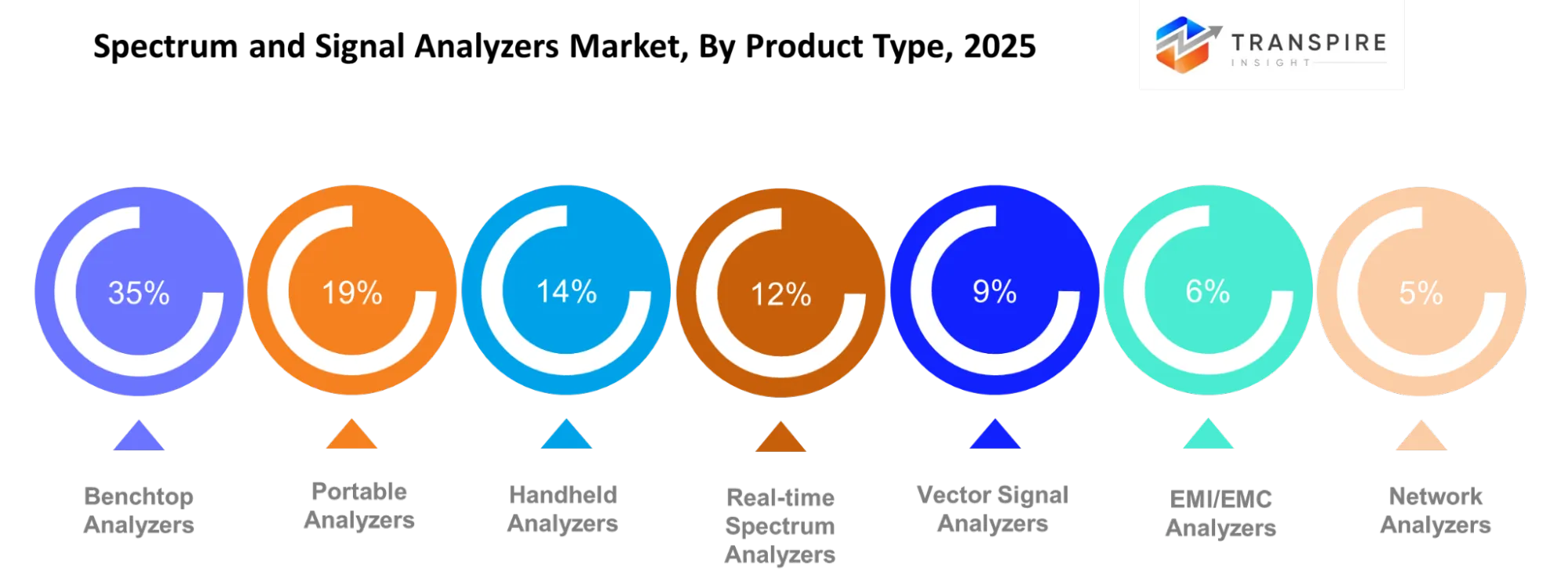
- North America (U.S., Canada, Mexico)
- Europe (Germany, France, U.K., Italy, Spain, Rest of Europe)
- Asia-Pacific (China, Japan, India, Rest of APAC)
- South America (Brazil and the Rest of South America)
- The Middle East and Africa (UAE, South Africa, Rest of MEA)
North America is the fastest-growing region in the Spectrum and Signal Analyzers Market during the period, holding almost 36% share.
North America is expected to grow at a rapid CAGR in the Spectrum and Signal Analyzers Market holding almost 36% share during the forecast period. The North American region is the Spectrum and Signal Analyzers Market’s fastest-growing region and has approximately 36% of the market share, thanks to the fast adoption of 5G and the impending rollout of 6G, increasing investments in telecom infrastructure, and the advance in aerospace and defense initiatives. The region has a strong semiconductor market, innovativeness in technologies, and the prompt usage of advanced RF testing technologies.
Asia Pacific is the fastest-growing region in the Spectrum and Signal Analyzers Market during the period, holding almost 32% share.
Asia Pacific is the fastest-growing region in the Spectrum and Signal Analyzers Market during the forecast period, holding almost 32% share during the forecast period. Asia Pacific is the highest-growth area in the Market for Spectrum and Signal Analyzers, which has a share of close to 32%, due to increased rollout of 5G networks, growth in telecommunications infrastructure, and increased manufacturing of semiconductors and electronics. Increased investment in aerospace and defense technologies, as well as in Internet of Things (IoT) and advanced wireless is assisting in boosting the demand for RF was testing and spectrum monitoring services in this region.
Europe is expected to grow at a rapid CAGR in theSpectrum and Signal Analyzers Market, holding almost 20% of the share during the forecast period.
Europe is expected to grow at a rapid CAGR in the Spectrum and Signal Analyzers Market holding almost 20% share during the forecast period. According to data, the European region is projected to experience rapid growth during the forecast period. The region is expected to command a near 20% share of the spectrum and signal analyzers market during the forecast period. This growth can be attributed to the development of better 5G services and the advent of 6G technology, as well as huge investments in the aerospace and defense sector and rising demand for advanced RF testing solutions. In addition, the growing semiconductor manufacturing market and increasing demand for automotive electronics, wireless communication, and regulatory compliance have also bolstered the use of spectrum and signal analyzers in Europe.
Strategies for Market Growth in Non-Leading Regions:
The growth of less developed regions through the use of innovative methods for the production of spectrum and signal analyzers will bring positive changes for medium- and small-sized manufacturers of electronics and test equipment. The manufacture and assembly of spectrum and signal analyzers in local areas and the opening of regional test equipment centers will lead to the reduced dependence on imports and cut overall procurement costs. Partnership with regional companies in telecommunication, semiconductor, aerospace and defense, as well as in electronics manufacturing and distribution industries will open new market opportunities for the suppliers of spectrum and signal analyzers. In order to enhance the knowledge of RF testing, signal analysis, calibration, measurement accuracy, and advanced spectrum monitoring it will be necessary to arrange appropriate training programs to improve technical competencies. To make the solutions of spectrum and signal analyzers accessible to wide audiences it is essential to establish flexible financing methods, long-term contracts for supply deals, and contract manufacturing.
Future Market Trends for the Spectrum and Signal Analyzers Market: -
- Artificial Intelligence Adoption: Organizations progressively utilize artificial intelligence and machine learning for labor-saving anomaly detection processes, as well as optimal sweep times and immediate signal detection.
- Real-Time and High-Frequency Capabilities: The advent of high speed 5G networks, as well as aerospace monitoring and defense electronics, leading to the immense migration to real-time spectrum analysis of frequencies that exceed 44 GHz.
- Portability and Handheld Units: Technicians operating in the field prefer portable, battery-powered, and cloud-connected handheld spectrum analyzers to facilitate field repairs quicker.
- Software-Defined Infrastructure: Software-defined measurement systems take the places of outdated hardware providing opportunities for obtaining upgrades and integration with data analyzing applications.
- Leading Growth Regions: Asia-Pacific is leading the growth due to massive 5G implementation and growing activity of local producers while North America continues being the oldest developed market.
Recent Development
- In January 2026: Anritsu launched the newest version of its Electronic Measuring Instruments Digest 2026 Catalog, which includes cutting-edge electronic and radio frequency measurement tests for spectrum analysis, signal measurement, and wireless communication.
- In February 2026: Rohde & Schwarz launched the R&S FPL1044 spectrum analyzer that provides frequency range going up to 44 GHz and 40 MHz real-time analysis option resulting in the expansion of its range of products for RF testing of high frequency signals, signal monitoring activities, aerospace and defense, satellite technology testing, radar and testing of high class components.
- In July 2026: Research Electronics International (REI) unveiled the OSCOR® Max, a high-performance portable spectrum analyzer capable of detecting frequency coverage in the range of 10 kHz to 43 GHz. The device facilitates advanced RF spectrum monitoring as well as interference detection.
This study forecasts revenue at global, regional and country levels from 2020 to 2033. Transpire Insight has segmented the Spectrum and Signal Analyzers Market based on the below-mentioned segments:
Spectrum and Signal Analyzers Market, By Product Type
- Benchtop Analyzers
- Portable Analyzers
- Handheld Analyzers
- Real-time Spectrum Analyzers
- Vector Signal Analyzers
- EMI/EMC Analyzers
- Network Analyzers
- Others
Spectrum and Signal Analyzers Market, By Frequency Range
- Below 3 GHz
- 3–6 GHz
- 6–18 GHz
- 18–40 GHz
- 40–50 GHz
- Above 50 GHz
- Others
Spectrum and Signal Analyzers Market, By Technology
- Swept-tuned
- Superheterodyne
- FFT-based
- Real-time
- Vector Signal Analysis
- Digital Signal Processing
- Others
Spectrum and Signal Analyzers Market, By Application
- Telecommunications
- Aerospace & Defense
- Electronics Manufacturing
- Automotive
- Healthcare
- Research
- Broadcasting
- Others
Spectrum and Signal Analyzers Market, By End User
- Telecom Operators
- Defense Organizations
- Electronics Manufacturers
- Automotive OEMs
- Research Institutes
- Universities
- Government Agencies
- Others
Spectrum and Signal Analyzers Market, By Regional Analysis
North America
- US
- Canada
- Mexico
Europe
- Germany
- UK
- France
- Italy
- Spain
- Russia
- Rest of Europe
Asia Pacific
- China
- Japan
- India
- South Korea
- Australia
- Rest of Asia Pacific
South America
- Brazil
- Argentina
- Rest of South America
Middle East & Africa
- UAE
- Saudi Arabia
- Qatar
- South Africa
- Rest of the Middle East & Africa
Frequently Asked Questions
Find quick answers to common questions.
5G, emerging 6G, IoT expansion, spectrum congestion, aerospace modernization, and advanced RF testing technologies drive market growth.
Benchtop analyzers dominate, holding nearly 43% in 2025, supported by accuracy, reliability, and advanced laboratory testing capabilities.
Telecommunications leads with nearly 32% in 2025, driven by 5G deployment, network densification, spectrum optimization, and interference monitoring.
North America leads with approximately 36% share, supported by advanced telecommunications, aerospace, defense, semiconductor, and RF testing investments.
Keysight Technologies, Rohde & Schwarz, Anritsu, Tektronix, Teledyne Technologies, VIAVI Solutions, and other leading RF testing companies compete globally.
- Keysight Technologies
- Rohde & Schwarz
- Anritsu
- Tektronix
- Teledyne Technologies
- VIAVI Solutions
- National Instruments
- Cobham
- CRFS
- Chroma ATE
- GW Instek
- Rigol Technologies
- Aaronia
- Giga-tronics
- Signal Hound
About the Authors

Mayur Shinde
I am Mayur Shinde, a Senior Research Analyst at Transpire Insight, specializing in the Automotive & Transportation and Information & Communication Technology (ICT) Industry. My work focuses on analyzing emerging market trends, technological advancements, competitive landscapes, and industry developments to deliver accurate, data-driven insights. I am passionate about transforming complex market information into clear, actionable content that helps businesses, professionals, and decision-makers stay informed and make confident strategic decisions.

Chakradhar Khansole
Chakradhar serves as the Research Director at Transpire Insight, bringing over 8 years of experience in technology, innovation, and strategic market intelligence. He specializes in transforming complex market data into actionable business insights that enable organizations to make informed, growth-oriented decisions. Recognized for his strategic vision and analytical expertise, Chakradhar leads high-impact research initiatives, delivering comprehensive market assessments, competitive intelligence, and forward-looking industry analysis.
Recently Published Reports
-
Apr 2026
3D Optical Profiler Market
3D Optical Profiler Market Size, Share & Analysis Report By Type (Desktop 3D Optical Profiler, and Portable 3D Optical Profiler), By Technology (Confocal Technology, and White Light Interference), By End-Use Industry (Manufacturing, Research Institutions, Automotive, Aerospace and Defense, Medical Devices, and Other), and Geography (North America, Europe, Asia-Pacific, Middle East and Africa, South and Central America), 2021 - 2031
-
Apr 2026
Depth Sensor Market
Depth Sensor Market Size, Share & Analysis Report By Type (Infrared Depth Sensors, Time-of-Flight (ToF) Sensors, Stereo Vision Sensors, Structured Light Sensors, Ultrasonic Depth Sensors), By Application (Automotive, Robotics, Gaming, Consumer Electronics, Industrial Automation, Healthcare, Security & Surveillance, Others), By End Users (Automotive Manufacturers, Consumer Electronics Companies, Healthcare Providers, Industrial Companies, Security Agencies, Gaming Companies, Robotics Companies, Others), and Geography (North America, Europe, Asia-Pacific, Middle East and Africa, South and Central America), 2021 – 2031
-
Apr 2026
Digital Manufacturing Market
Digital Manufacturing Market Size, Share & Analysis Report By Component (Hardware, Software, and Services), By Technology (Robotics, 3D Printing, Internet of Things (IoT), and Others), By Application (Automotive and Transportation, Aerospace and Defense, Consumer Electronics, Industrial Machinery, and Others), By Process Type (Computer-Based Designing, Computer-Based Simulation, Computer 3D Visualization, Analytics, and Others), and Geography (North America, Europe, Asia-Pacific, Middle East and Africa, South and Central America), 2021 – 2031
-
Apr 2026
Digital Visa Services Market
Digital Visa Services Market Size, Share & Analysis Report By Type (Individual Travelers, Group Travelers), By Application (Tourism, Business Travel, Others), and Geography (North America, Europe, Asia-Pacific, Middle East and Africa, South and Central America), 2021 – 2031