

North America Coagulation Analyzers Market Size & Forecast:
- North America Coagulation Analyzers Market Size 2025: USD 1.37 Billion
- North America Coagulation Analyzers Market Size 2033: USD 2.199 Billion
- North America Coagulation Analyzers Market CAGR: 6.10%
- North America Coagulation Analyzers Market Segments: By Product Type (Fully Automated Coagulation Analyzers, Semi-Automated Coagulation Analyzers, Point-of-Care Coagulation Analyzers, Portable Analyzers, Benchtop Analyzers, High-Throughput Analyzers, Integrated Hemostasis Systems, Others); By Test Type (Prothrombin Time (PT), Activated Partial Thromboplastin Time (aPTT), D-Dimer Testing, Fibrinogen Testing, Thrombin Time Testing, Platelet Function Testing, Coagulation Factor Assays, Others); By End User (Hospitals, Clinical Laboratories, Diagnostic Centers, Blood Banks, Academic Institutes, Research Laboratories, Specialty Clinics, Others); By Technology (Optical Detection, Mechanical Detection, Electrochemical Detection, Chromogenic Assays, Immunological Assays, Fluorescence Detection, Hybrid Detection, Others); By Distribution Channel (Direct Sales, Medical Device Distributors, Hospital Procurement, Group Purchasing Organizations, Online Medical Suppliers, Specialty Dealers, Others).
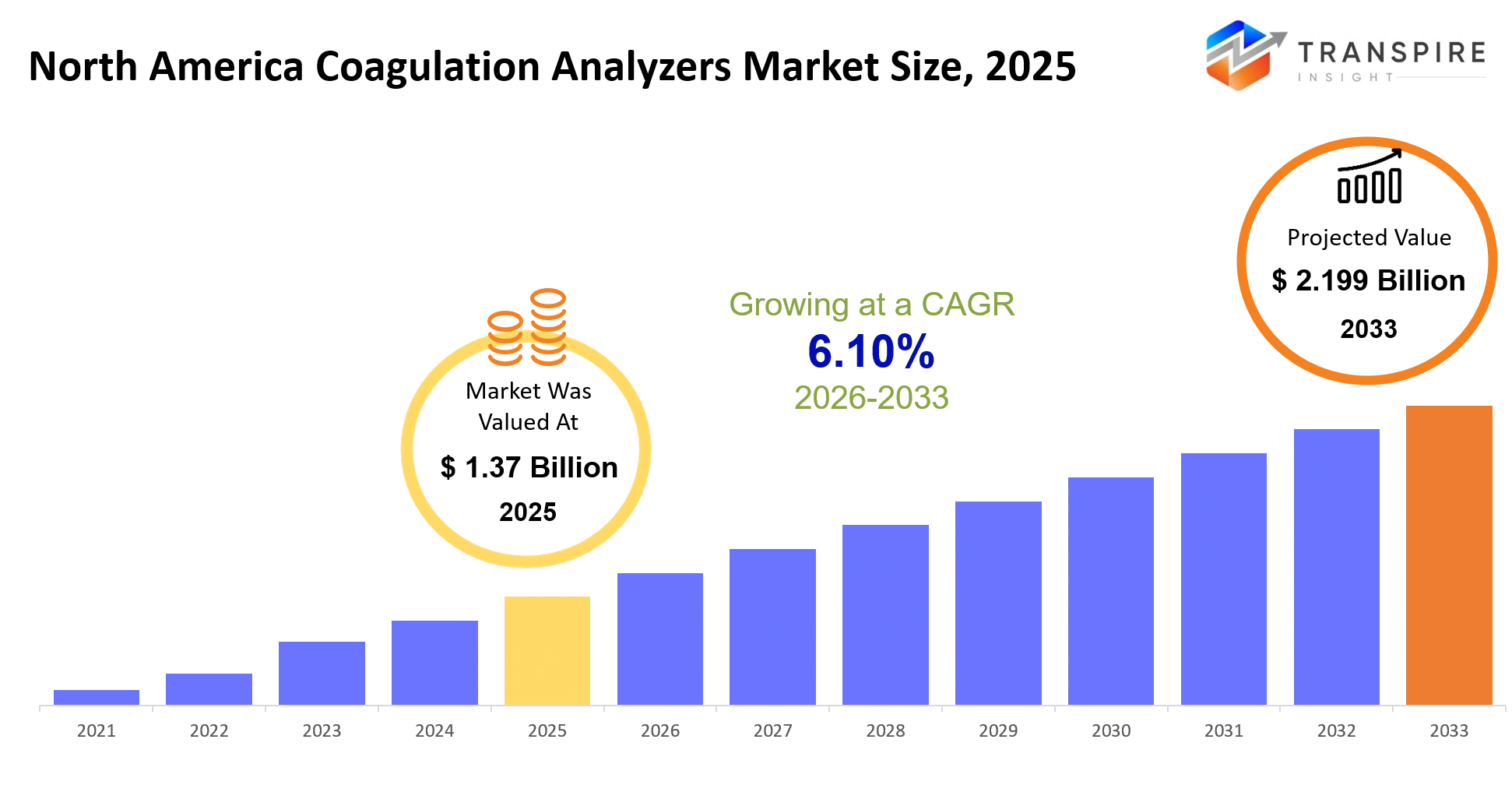
North America Coagulation Analyzers Market Summary
The North America Coagulation Analyzers Market was valued at USD 1.37 Billion in 2025. It is forecast to reach USD 2.199 Billion by 2033. That is a CAGR of 6.10% over the period.
The North America Coagulation Analyzers Market lets hospitals, diagnostic labs, and blood centers quickly check blood clotting function , so clinicians can handle bleeding disorders and thrombotic issues faster, plus better manage anticoagulant therapy. In the same way, it supports earlier clinical choices and makes day to day lab work feel more efficient, like less back and forth and more ready-to-use results.
Over the past few years the market kind of moved , toward fully automated high throughput analyzers that are connected with laboratory information systems. That shift helps keep workflows consistent, cuts down on manual handling, and speeds up report turnaround times across larger centralized diagnostic networks.
One big push behind this change was the COVID-19 pandemic. It showed how important coagulation testing is for hospitalized patients, and it also revealed weak spots in global supply chains for reagents and individual components. Because of that, healthcare teams leaned into instrument reliability , inventory resilience, and supplier diversification. At the manufacturer side, companies improved regional production capabilities and they added more automation options too, in order to keep lab operations running without interruption even when testing volumes rise and fall.
Key Market Insights
- North America is more or less led by the United States, with about 82% market share in 2025, being backed by really advanced laboratory setups and massive diagnostic test volumes, so yeah it keeps pulling ahead.
- Canada is expected to be the fastest-growing regional market during the 2025–2032 forecast window, mainly because of hospital modernization, and also more laboratory automation funding, which helps a lot.
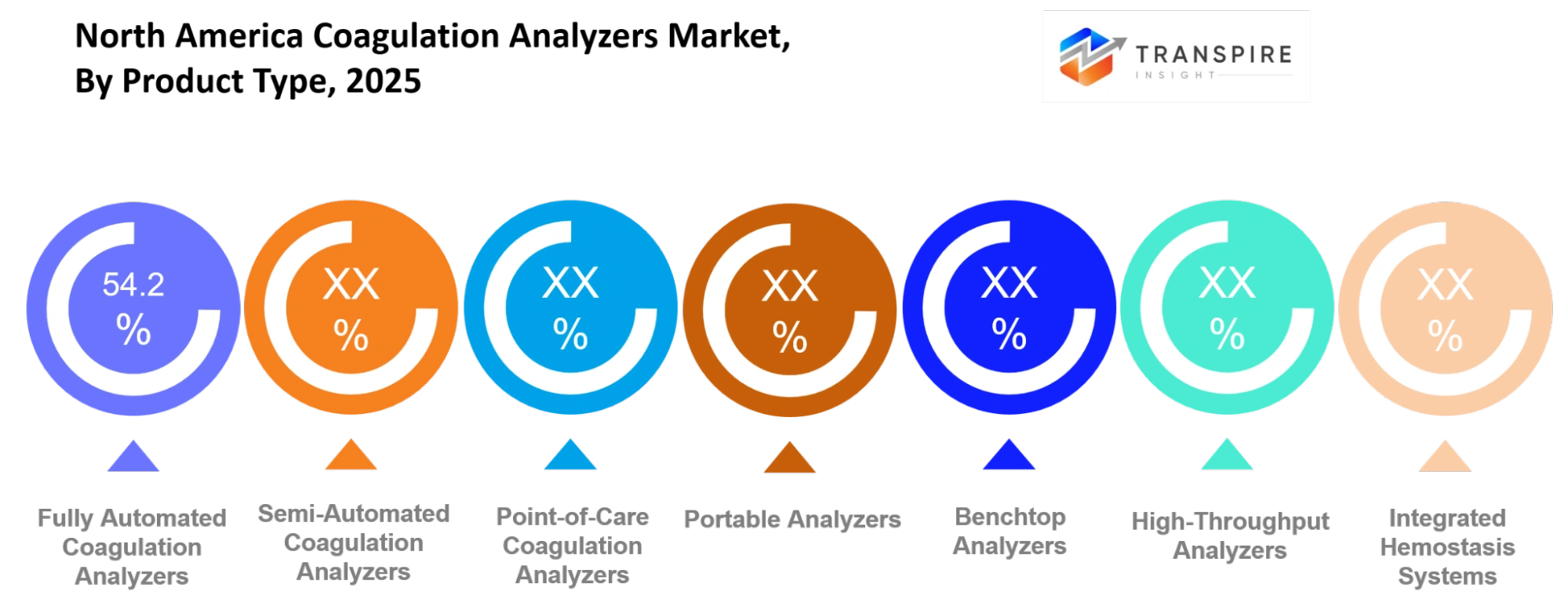
- Automated coagulation analyzers basically dominate the product map, taking around 68% market share in 2025. This shows how labs tend to prefer standardized, high-throughput testing, pretty consistently.
- Semi-automated coagulation analyzers still stay in the second-largest position, and they are used by medium-volume laboratories that want lower capex costs, yet still need dependable analytical performance.
- Point-of-care coagulation analyzers are forecasted to grow the quickest between 2025 and 2032, supported by decentralized diagnostic workflows and emergency care adoption, kind of moving diagnostics closer to the patient.
- Routine coagulation testing is the top application, holding nearly 60% market share, because hospitals keep embedding standardized hemostasis evaluation into their clinical pathways.
- Specialized coagulation assays are anticipated to see the fastest application growth through 2032, driven by wider use of precision diagnostics and the ongoing need to handle more complex coagulation conditions.
- Hospital laboratories account for roughly 52% market share in 2025, they dominate end-user demand via centralized procurement, plus continuous testing capacity expansion, in a steady rhythm.
- Independent diagnostic laboratories are expected to become the fastest-growing end-user segment over the forecast period, largely due to regional lab network expansion, along with workflow automation that smooths operations out.
What are the Key Drivers, Restraints, and Opportunities in the North America Coagulation Analyzers Market?
The most powerful driver of growth is this rapid shift toward automated lab diagnostics, like you can see it happening quickly. Hospital consolidation plus accreditation rules, kind of pushed the quicker swap of manual workflows with integrated coagulation platforms. After the pandemic digital laboratory information system connectivity became a buying must. With faster turnaround times, emergency care gets a better rhythm, and anticoagulation management improves. And because the testing process runs more smoothly, instrument utilization goes up, while reagent consumption also climbs. These operational wins then flow straight into stronger recurring revenues for analyzer makers, and for reagent suppliers.
The main structural limit stays the high total cost of ownership tied to advanced analyzers and proprietary reagent ecosystems. Big hospitals can make those investments make sense. Smaller labs, though, usually cannot. Requirements around validation, staff training, and software integration all add extra time, sometimes stretching deployment by several months, maybe more. In practice instrument replacement cycles often run longer than seven years, and that drags out when new equipment gets purchased. From a Transpire Insight review of regional procurement announcements and launch timetables, supply chain concentration still looks like the top execution risk. Component shortages and reagent availability keep delaying installations, and that then cuts into near-term revenue opportunities.
The next expansion phase is likely to be driven by AI-enabled hemostasis diagnostics, and also decentralized testing, sort of in parallel. Cloud-connected analyzers will help raise quality monitoring across multi site laboratory networks, even when teams are far apart. At the same time investments in precision medicine and specialized coagulation testing are opening up fresh procurement openings, not just incremental budgets. Point of care platforms equipped with deeper analytics will be useful for emergency departments, surgical centers and outpatient clinics. In the end, vendors that bundle automation, connectivity, and predictive software will seem to be well placed to win premium contracts throughout the forecast period.
What Has the Impact of Artificial Intelligence Been on the North America Coagulation Analyzers Market?
Artificial intelligence along with digital technologies is kind a changing coagulation diagnostics, automating quality checks, workflow managing, and instrument performance tracking, like in the real world. Modern hemostasis analyzers more and more depend on AI assisted algorithms to find unusual clotting patterns, to flag results that seem inconsistent, and to tune calibration routines on schedule, without needing constant hands on help. When these systems connect with laboratory information systems, they can do automated sample prioritization and even build compliance paperwork automatically, so less time gets spent on admin tasks, while the reports stay more consistent.
At the same time, machine learning is making predictive maintenance work better across lab networks. Equipment manufacturers look at sensor readings, to foresee component problems before they mess up testing operations. Predictive demand models also help laboratories plan reagent inventories, so shortages drop and waste becomes less, more controlled. In practice this means better analyzer uptime, faster turnaround, and higher lab productivity while maintenance expenses get pushed down across big healthcare organizations.
Still though, the rollout is not even everywhere. Plenty of laboratories run older information systems, and they often need costly integration first, before AI features can be really used. Data standardization gets tricky too, and interoperability between instruments from different manufacturers is sometimes weak, which can make the algorithms less accurate in daily use. On top of that, implementation costs stay high, cybersecurity requirements are not optional, and validation rules keep adoption slower especially for smaller diagnostic labs with tighter capital budgets.
Key Market Trends
- Since 2021, labs have started to push replacement of older analyzer units with more fully automated systems, that kinda boost throughput, consistency, and day to day operations, pretty rapidly.
- AI enabled quality assurance utilities have also spread across premium analyzer platforms, cutting down manual checking time and supporting regulatory compliance, by 2025.
- Across multi-site healthcare networks, more organizations are buying standardized analyzer fleets, which helps maintenance run smoother and reduces the training maze across different regional lab setups.
- Manufacturers have diversified reagent production and regional distribution after pandemic related disruptions. That’s been helping supply chain resilience since 2022, more than before.
- Point of care coagulation testing is expanding beyond emergency departments, into outpatient clinics and ambulatory surgical centers, through the 2025–2032 window.
- Over roughly the last five years, specialized coagulation assays for thrombosis and anticoagulant monitoring have been taking a bigger slice of laboratory testing menus.
- Werfen, Roche, and Siemens Healthineers keep investing in integrated software ecosystems alongside analyzer hardware, this is meant to strengthen customer stickiness.
- Cloud enabled instrument monitoring has turned into a competitive edge since 2023, letting networks do remote diagnostics and schedule predictive servicing.
- Diagnostic laboratory consolidation has moved purchasing toward long term enterprise contracts, so suppliers with a full instrument, reagent, and service bundle have a clearer advantage.
- Meanwhile sustainability efforts are nudging manufacturers to reduce reagent waste, improve analyzer energy efficiency, and fine tune packaging across newly introduced product lines.
North America Coagulation Analyzers Market Segmentation
By Product Type :
Fully automated coagulation analyzers are holding the leading position, mostly because large hospitals and clinical laboratories need quick processing , stable precision, and less manual busywork. High-throughput analyzers also help when testing volumes are heavy, since they manage large sample batches with shorter turnaround periods and less effort. Integrated hemostasis systems keep drawing attention too, because centralized labs prefer connected platforms that smooth workflow and strengthen data governance.
Semi-automated coagulation analyzers still fit well in places with medium testing volumes and budgets that are a bit more controlled. Point-of-care, portable , and benchtop analyzers continue spreading across emergency care and outpatient areas where rapid clinical choices stay crucial. Other product categories exist as well, covering specialized testing needs and more specific laboratory use cases, so the whole product mix stays fairly balanced across different types of healthcare facilities.
By Test Type :
Prothrombin Time (PT) and Activated Partial Thromboplastin Time (aPTT) remain the most often performed tests, since day-to-day coagulation checks rely on dependable monitoring before surgery, and during anticoagulant management. Clinical laboratories run these assays daily, which supports steady instrument use and predictable reagent consumption. Standardized procedures also help keep results consistent across healthcare networks, even when sites operate somewhat independently.
D-Dimer testing is still growing, because doctors often want fast assistance for evaluating thrombotic conditions. Fibrinogen testing, thrombin time testing, platelet function testing, and coagulation factor assays add meaningful context for complicated bleeding disorders, and they help with specialized treatment planning. Beyond that, additional testing groupings keep supporting advanced diagnostic demands across research centers and specialty labs.
By End User :
Hospitals count for a rather big share , mainly because emergency departments, surgical units and critical care centers run ongoing coagulation testing. Clinical laboratories also show up as a major customer group, since they process high testing volumes for many healthcare providers at once. Diagnostic centers keep pushing up their testing capability too, by relying on automation and more standardized laboratory routines, so it kinda runs smoother day to day.
Blood banks depend on coagulation analyzers to help with donor screening and to check blood component quality. Academic institutes , along with research laboratories, contribute through clinical research efforts and technology evaluation programs. Specialty clinics, plus other healthcare facilities , keep widening their testing scope as outpatient diagnostic services become more and more common.
By Technology :
Optical detection technology still feels like the preferred option, because automated platforms give fast analysis , with better testing efficiency. Mechanical detection is still useful in labs that manage specimens that really need alternative measurement methods. Hybrid detection technologies blend multiple analytical approaches, which adds flexibility across different clinical uses, and honestly makes it easier to adapt.
Chromogenic assays together with immunological assays back specialized coagulation testing, by boosting analytical precision for selected biomarkers. Fluorescence detection keeps growing in advanced laboratory settings, where higher sensitivity helps meet complicated testing demands. Beyond that, other technology platforms remain on the table for laboratories with their own operational quirks and diagnostic needs.
By Distribution Channel :
Direct sales still stay as the main way things move, mostly because healthcare providers often need install support, kind of hands on training, maintenance, and longer term supply agreements. Hospital procurement teams, they then negotiate big purchasing contracts that cover analyzers, reagents, software, plus service packages too. Group purchasing organizations keep affecting the buying decisions by getting competitive pricing across various healthcare networks, not just one area.
Meanwhile medical device distributors work on regional coverage by sending products to community hospitals and independent laboratories. Online medical suppliers slowly broaden what people can buy, especially accessories and consumables, and specialty dealers tend to offer technical support for advanced laboratory systems. Also, other distribution channels keep showing up for local healthcare facilities, mainly when there are specialized procurement requirements involved.
What are the Key Use Cases Driving the North America Coagulation Analyzers Market?
The biggest use case kind of starts with routine coagulation testing in hospitals and clinical laboratories, where fully automated analyzers support big daily sample volumes. Healthcare systems buy these platforms so they can deliver quick, standardized results for things like surgical preparation, anticoagulant therapy monitoring , and emergency patient assessment, while still keeping lab output consistent.
Then there are the expanded applications , like coagulation testing in blood banks and specialty clinics. Blood banks depend on these analyzers for more robust donor screening and blood component quality evaluation, and specialty clinics lean on advanced coagulation assays to help with diagnosis and treatment planning for bleeding disorders, as well as thrombotic conditions. In both places, they keep adopting systems that improve workflow efficiency and reporting accuracy, even if the setup is a bit different.
Some emerging use cases are more decentralized, using point-of-care platforms for coagulation testing, plus AI-assisted analytical systems that help interpret complicated results. Regulatory attention on faster clinical decision-making and on digital lab integration, will likely push wider adoption across outpatient care networks and multi-site healthcare organizations over the forecast period.
|
Report Metrics |
Details |
|
Market size value in 2025 |
USD 1.37 Billion |
|
Market size value in 2026 |
USD 1.453 Billion |
|
Revenue forecast in 2033 |
USD 2.199 Billion |
|
Growth rate |
CAGR of 6.10% from 2026 to 2033 |
|
Base year |
2025 |
|
Historical data |
2021 - 2024 |
|
Forecast period |
2026 - 2033 |
|
Report coverage |
Revenue forecast, competitive landscape, growth factors, and trends |
|
Regional scope |
North America (Canada, The United States, and Mexico) |
|
Key company profiled |
Siemens Healthineers, Roche Diagnostics, Sysmex Corporation, Werfen, Diagnostica Stago, Abbott Laboratories, Beckman Coulter, HORIBA, Thermo Fisher Scientific, Helena Laboratories, Erba Mannheim, Sekisui Diagnostics, Nihon Kohden, Trinity Biotech, Bio-Rad Laboratories. |
|
Customization scope |
Free report customization (country, regional & segment scope). Avail customized purchase options to meet your exact research needs. |
|
Report Segmentation |
By Product Type (Fully Automated Coagulation Analyzers, Semi-Automated Coagulation Analyzers, Point-of-Care Coagulation Analyzers, Portable Analyzers, Benchtop Analyzers, High-Throughput Analyzers, Integrated Hemostasis Systems, Others); By Test Type (Prothrombin Time (PT), Activated Partial Thromboplastin Time (aPTT), D-Dimer Testing, Fibrinogen Testing, Thrombin Time Testing, Platelet Function Testing, Coagulation Factor Assays, Others); By End User (Hospitals, Clinical Laboratories, Diagnostic Centers, Blood Banks, Academic Institutes, Research Laboratories, Specialty Clinics, Others); By Technology (Optical Detection, Mechanical Detection, Electrochemical Detection, Chromogenic Assays, Immunological Assays, Fluorescence Detection, Hybrid Detection, Others); By Distribution Channel (Direct Sales, Medical Device Distributors, Hospital Procurement, Group Purchasing Organizations, Online Medical Suppliers, Specialty Dealers, Others). |
Which Regions are Driving the North America Coagulation Analyzers Market Growth?
The United States still looks like the most dominant regional market , making up roughly 82% of the total revenue. Solid clinical laboratory standards along with reimbursement policies that are pretty favorable, and then an advanced healthcare infrastructure , all of that together helps the widespread use of automated coagulation testing systems. Big diagnostic manufacturers, along with broad distributor networks, plus continuous spending for lab modernization—these pieces really reinforce both the regional supply chain and day to day product availability. And the steady swapping out of older legacy instruments for connected, high throughput platforms should keep the market in front through most of the forecast window.
Canada comes in as the second biggest region , though the healthcare setup there is more about standardized purchasing and long term capital planning. Provincial healthcare budgets back steady investment in lab equipment, while regulatory oversight basically nudges the adoption of validated diagnostic technologies. With centralized buying models, procurement cycles tend to stay stable , and that means more predictable demand for analyzers as well as consumables. So even if the patient base is smaller than the U.S. Canada still feels like a steady provider of repeat revenue across the period.
Mexico is expected to see the quickest kind of expansion during the 2026–2033 span, as healthcare infrastructure projects and diagnostic laboratory upgrades keep speeding up. More funding for hospital modernization plus private diagnostic networks has apparently improved access to automated coagulation testing across city based healthcare centers. Meanwhile, the steady adoption of globally recognized laboratory standards is making it easier to buy advanced analytical platforms. This push should translate into really appealing opportunities for manufacturers and investors who want to grow via partnerships, distributor networks, and locally tuned service capabilities.
Who are the Key Players in the North America Coagulation Analyzers Market and How Do They Compete?
Competition is still pretty moderately consolidated, because only a small number of global diagnostic players hold a large slice of analyzer installs and reagent sales. In other words, it’s not price alone that really drives the battle. Instead, the core ground is made from technology, integrated software, service support, plus those long-term reagent agreements that kinda lock in relationships. Existing manufacturers keep defending their position with nonstop product upgrades, while the more specialized companies try to win ground by rolling out improved testing capabilities and more flexible lab setups, kind of a different angle.
Roche tends to put emphasis on integrated lab automation, where coagulation testing gets paired with digital workflow management, so healthcare providers can raise efficiency across big diagnostic networks. Siemens Healthineers goes for connected diagnostic platforms, connecting analyzers with laboratory information systems, and using that to widen operational visibility in practice. Werfen, meanwhile, centers on hemostasis diagnostics, with dedicated coagulation platforms for specialized clinical testing, this also helps strengthen customer loyalty through concentrated know-how and not so much through broad general coverage.
Sysmex Corporation tries to stay competitive by putting money into automation tools, aiming to boost lab throughput and cut down on manual handling in routine test environments. Danaher Corporation supports its market presence via portfolio expansion, advanced diagnostic tech, and strategic acquisitions that broaden what labs can offer. Ongoing investment in software connectivity, predictive maintenance, and regional service reach also matters a lot , because it helps these companies secure longer procurement contracts and stay distinct, even when instrument performance isn’t the only talking point anymore.
Company List
- Siemens Healthineers
- Roche Diagnostics
- Sysmex Corporation
- Werfen
- Diagnostica Stago
- Abbott Laboratories
- Beckman Coulter
- HORIBA
- Thermo Fisher Scientific
- Helena Laboratories
- Erba Mannheim
- Sekisui Diagnostics
- Nihon Kohden
- Trinity Biotech
- Bio-Rad Laboratories
Recent Development News
In April 2026, Roche launched its AI Factory and announced the cobas MPX-E assay for blood donor screening as part of its Diagnostics portfolio. The investment strengthens diagnostic automation capabilities and expands molecular testing infrastructure that supports high-volume clinical laboratories, including facilities using coagulation workflows.
Source: https://www.roche.com/
In April 2026, Roche entered into a definitive agreement to acquire SAGA Diagnostics. The acquisition expands Roche's precision diagnostics portfolio and reinforces long-term investment in advanced laboratory diagnostics, supporting broader innovation across hospital and reference laboratory networks.
Source: https://www.roche.com/
What Strategic Insights Define the Future of the North America Coagulation Analyzers Market?
The North America Coagulation Analyzers Market is likely to move toward very connected diagnostic ecosystems, where automation, digital lab integration, and data driven clinical decision support start showing up as normal procurement requirements, not really as “extra” premium add ons. That path is being pushed by healthcare network consolidation, and by the need to push faster, more standardized testing across multiple site laboratory systems, all at once. There’s also a less visible risk that tends to sit in the background, namely the ongoing reliance on a small set of reagent suppliers and specialized component manufacturers. This can leave labs exposed to supply disruptions and procurement delays, even while instrument demand stays strong.
At the same time, an opportunity is starting to form, kinda under the surface, around AI assisted coagulation analysis that’s integrated with decentralized testing platforms for outpatient care and community healthcare settings, especially as digital health infrastructure keeps expanding. For companies and investors, it makes sense to focus on interoperability platforms with flexible software, broader reagent sourcing, and regional service support, so resilience improves and long term replacement and modernization chances can be captured as well.
North America Coagulation Analyzers Market Report Segmentation
By Product Type
- Fully Automated Coagulation Analyzers
- Semi-Automated Coagulation Analyzers
- Point-of-Care Coagulation Analyzers
- Portable Analyzers
- Benchtop Analyzers
- High-Throughput Analyzers
- Integrated Hemostasis Systems
By Test Type
- Prothrombin Time (PT)
- Activated Partial Thromboplastin Time (aPTT)
- D-Dimer Testing
- Fibrinogen Testing
- Thrombin Time Testing
- Platelet Function Testing
- Coagulation Factor Assays
By End User
- Hospitals
- Clinical Laboratories
- Diagnostic Centers
- Blood Banks
- Academic Institutes
- Research Laboratories
- Specialty Clinics
By Technology
- Optical Detection
- Mechanical Detection
- Electrochemical Detection
- Chromogenic Assays
- Immunological Assays
- Fluorescence Detection
- Hybrid Detection
By Distribution Channel
- Direct Sales
- Medical Device Distributors
- Hospital Procurement
- Group Purchasing Organizations
- Online Medical Suppliers
- Specialty Dealers
Frequently Asked Questions
Find quick answers to common questions.
The expected North America Coagulation Analyzers Market size for the market will be USD 2.199 Billion in 2033.
Key segments for the North America Coagulation Analyzers Market are Type By Product Type (Fully Automated Coagulation Analyzers, Semi-Automated Coagulation Analyzers, Point-of-Care Coagulation Analyzers, Portable Analyzers, Benchtop Analyzers, High-Throughput Analyzers, Integrated Hemostasis Systems, Others); By Test Type (Prothrombin Time (PT), Activated Partial Thromboplastin Time (aPTT), D-Dimer Testing, Fibrinogen Testing, Thrombin Time Testing, Platelet Function Testing, Coagulation Factor Assays, Others); By End User (Hospitals, Clinical Laboratories, Diagnostic Centers, Blood Banks, Academic Institutes, Research Laboratories, Specialty Clinics, Others); By Technology (Optical Detection, Mechanical Detection, Electrochemical Detection, Chromogenic Assays, Immunological Assays, Fluorescence Detection, Hybrid Detection, Others); By Distribution Channel (Direct Sales, Medical Device Distributors, Hospital Procurement, Group Purchasing Organizations, Online Medical Suppliers, Specialty Dealers, Others).
Major North America Coagulation Analyzers Market players are Siemens Healthineers, Roche Diagnostics, Sysmex Corporation, Werfen, Diagnostica Stago, Abbott Laboratories, Beckman Coulter, HORIBA, Thermo Fisher Scientific, Helena Laboratories, Erba Mannheim, Sekisui Diagnostics, Nihon Kohden, Trinity Biotech, Bio-Rad Laboratories.
The North America Coagulation Analyzers Market size is USD 1.37 Billion in 2025.
The North America Coagulation Analyzers Market CAGR is 6.10% from 2026 to 2033.
- Siemens Healthineers
- Roche Diagnostics
- Sysmex Corporation
- Werfen
- Diagnostica Stago
- Abbott Laboratories
- Beckman Coulter
- HORIBA
- Thermo Fisher Scientific
- Helena Laboratories
- Erba Mannheim
- Sekisui Diagnostics
- Nihon Kohden
- Trinity Biotech
- Bio-Rad Laboratories
About the Authors

Pankaj Ghogare Patil
I am Pankaj Ghogare Patil, a Senior Research Analyst at Transpire Insight, specializing in the Pharmaceutical, Chemicals & Materials, Healthcare IT, and Biotechnology industry. My expertise lies in conducting comprehensive market research, analyzing industry trends, evaluating competitive landscapes, and translating complex data into actionable insights. At Transpire Insight, I closely follow emerging technologies, regulatory developments, and market innovations to create accurate, well-researched, and informative content that helps businesses and professionals make informed decisions. I am committed to producing credible, evidence-based articles that reflect industry best practices while making technical topics accessible and valuable for a broad audience.

Chakradhar Khansole
Chakradhar serves as the Research Director at Transpire Insight, bringing over 8 years of experience in technology, innovation, and strategic market intelligence. He specializes in transforming complex market data into actionable business insights that enable organizations to make informed, growth-oriented decisions. Recognized for his strategic vision and analytical expertise, Chakradhar leads high-impact research initiatives, delivering comprehensive market assessments, competitive intelligence, and forward-looking industry analysis.
Recently Published Reports
-
Apr 2026
AI in Diabetic Retinopathy Market
AI in Diabetic Retinopathy Market Size, Share & Analysis Report By Type (Screening AI Systems, Diagnostic AI Systems, and Predictive AI Models), By Application Segment (Hospitals, Ophthalmology Clinics, Diagnostic Centers, and Research and Development), and Geography (North America, Europe, Asia-Pacific, Middle East and Africa, South and Central America), 2021 - 2031
-
Apr 2026
Psychometric Tests Market
Psychometric Tests Market Size, Share & Analysis Report By Type (Personality Tests, Ability/Aptitude Tests, Skill/Knowledge Tests, and Others), By Application (Talent Acquisition and Talent Management), and Geography (North America, Europe, Asia-Pacific, Middle East and Africa, South and Central America), 2021 – 2031
-
Apr 2026
Rare Biological Sample Collection Market
Rare Biological Sample Collection Market Size, Share & Analysis Report By Type (Isolation Kits & Reagent, Blood Collection Tubes, and Others), By Application (Oncology, Transcriptomics, Pharmacogenomics, and Others), and Geography (North America, Europe, Asia-Pacific, Middle East and Africa, South and Central America), 2021 – 2031
-
Jul 2026
Diabetic Retinopathy Market
Diabetic Retinopathy Market Size, Share & Analysis Report By Type (Proliferative Diabetic Retinopathy, and Diabetic Macular Edema (DME)), By Treatment Type (Anti VEGF Drug, Steroid Implants, Laser Surgeries, and Vitrectomy), and Geography (North America, Europe, Asia-Pacific, Middle East and Africa, South and Central America), 2021 – 2031
Our Clients







