

South Korea Water Purifier Market Size & Forecast:
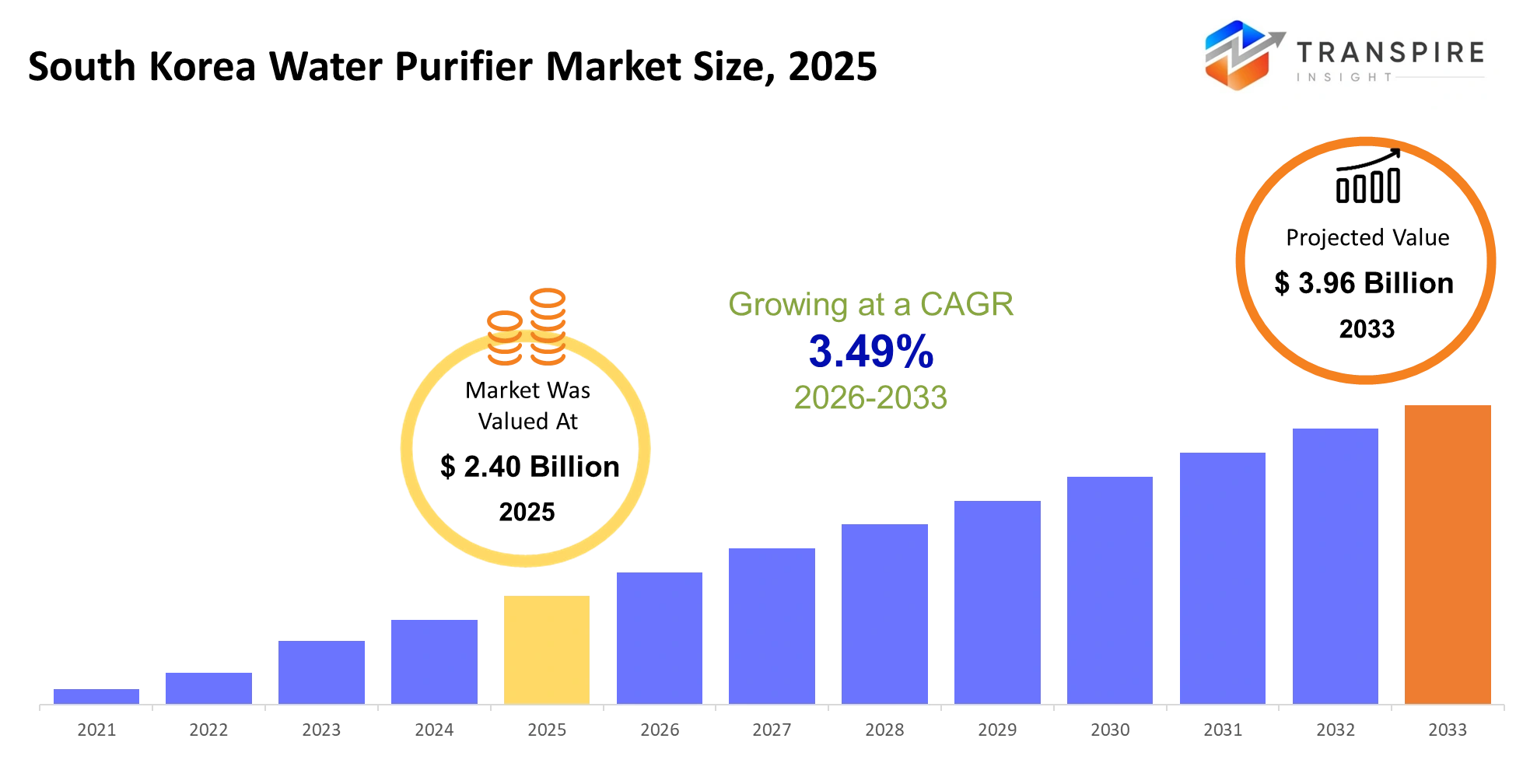
- South Korea Water Purifier Market Size 2025: USD 2.40 Billion
- South Korea Water Purifier Market Size 2033: USD 3.96 Billion
- South Korea Water Purifier Market CAGR: 3.49%
- South Korea Water Purifier Market Segments: By Technology (RO Water Purifiers, UV Water Purifiers, UF Water Purifiers, Activated Carbon Purifiers, Others); By Product Type (Countertop Purifiers, Under-sink Purifiers, Portable Purifiers, Smart Water Purifiers, Others); By Application (Residential Use, Commercial Use, Industrial Use, Others); By Distribution Channel (Online Retail, Electronics Stores, Supermarkets, Direct Sales, Others); By End User (Households, Offices, Hotels & Restaurants, Healthcare Facilities, Others).
To learn more about this report,  Download Free Sample Report
South Korea Water Purifier Market Summary
The South Korea Water Purifier Market was valued at USD 2.40 Billion in 2025. It is forecast to reach USD 3.96 Billion by 2033. That is a CAGR of 3.49% over the period.
In practice, the South Korea Water Purifier Market basically keeps safe drinking water within easy reach for daily life in homes, offices, and public spaces. It does this by getting rid of contaminants like fine dust, heavy metals, and microbial impurities, often right at the point of use. This matters a lot in South Korea, because many consumers don’t depend as much on bottled water and they want continuous, high quality filtration that can blend into kitchen setups, and even smart home ecosystems, pretty seamlessly.
Over the last 3–5 years, the market has started to move in a more structural way toward smart, IoT-enabled purification systems. These allow real time monitoring of filter life and water quality using mobile apps, which feels more like peace of mind than a simple appliance. Meanwhile, stricter indoor environmental safety rules, plus growing anxiety about aging water pipelines have sped up replacement demand, especially for urban apartments. A major nudge has been periodic water contamination incidents, and also the higher level of public attention on whether municipal supply stays consistent. Because of that, households leaned into premium subscription based purifier models. In turn purchasing habits changed from buying a one time device to adopting a recurring service style solution, which improves long term revenue predictability for providers.
Key Market Insights
- In South Korea, the water purifier market feels mostly driven by regular household , residential installations and in 2025 they hold more than 60% of the share.
- The Seoul Metropolitan region seems to steer demand , with almost 40% of it stacked in urban apartment zones.
- If you look at the growth curve, Busan and Gyeonggi Province look like the quickest movers because housing expansion keeps rolling, plus infrastructure upgrades too, stretching out through 2033.
- On the product side, reverse osmosis along with multi-stage filtration systems pretty much dominate, and they keep a notable chunk of the market.
- Meanwhile the fastest growing slice is smart IoT-enabled purifiers, powered by app-based monitoring and those subscription style upkeep arrangements, where service comes along with replacements.
- For applications, residential drinking water purification stays on top too, holding over 70% share. Still, commercial use in offices and hospitality is emerging fast , mainly tied to hygiene compliance and higher expectations for premium service.
- When it comes to end-users, urban households are leading the pack, and they tend to run replacement cycles every 3–5 years across premium purifier lines.
- The fastest growing end-user group is more like SMEs and shared office spaces, since workplace wellness investments are rising there.
- Companies are getting an edge with AI-enabled purification systems, rental-based subscription models, and ongoing filter replacement services.
What are the Key Drivers, Restraints, and Opportunities in the South Korea Water Purifier Market?
The main growth driver is basically the widespread swap out of older water infrastructure, mixed with a noticeable rise in distrust regarding whether municipal water stays consistent. That kind of thing has pushed homes to move toward advanced filtration systems, ones that can promise real time purification right at the point of use. In response, manufacturers have been weaving smart sensor tech into the units and adding automated filter alerts too, and honestly that tends to help with user retention and repeat service revenue. So adoption is no longer just a one-off buying moment, it turns into a long lasting service bond, which helps market players lean on steadier and more predictable revenue streams.
One big structural restraint is the high upfront cost for the premium purification systems plus the ongoing maintenance subscriptions that come with them. Even though people do value safety, price sensitivity is still strong in mid income households, and that naturally limits penetration in the more cost conscious pockets. Also there are complex installation requirements, especially for older residential buildings, which slows the whole rollout. These barriers end up suppressing volume growth and they also delay replacement cycles, more so outside major metropolitan areas where income levels and infrastructure readiness do not line up the same way.
A major opportunity is AI enabled predictive maintenance, along with water quality analytics that are integrated into smart home ecosystems. Coway and others are already expanding subscription models that bundle the hardware together with real time monitoring services. As smart city infrastructure keeps expanding in places like Gyeonggi and Incheon, demand should climb for connected purifiers that can sync with home energy, and water management systems as well, which is expected to open up the next phase of expansion for the market.
What Has the Impact of Artificial Intelligence Been on the South Korea Water Purifier Market?
Artificial intelligence is kind of reshaping the South Korea Water Purifier Market, not just by swapping parts but by taking those old-school filtration units and turning them into linked up, self monitoring systems, at least that’s how it looks. Manufacturers now add AI driven sensors that watch water quality, filter saturation, and even the way people use the unit, all in real time. Then you get automated alerts for upkeep, plus reminders for filter replacement. In practice this cuts down on the amount of manual servicing, and the whole setup feels more steady, with better reliability across both homes and businesses.
Meanwhile, machine learning is being used more and more to forecast when a filter will start degrading, basically by looking at consumption behavior. That helps companies like LG Electronics and Coway schedule services more intelligently and also reduce operational downtime. The efficiency boost comes from avoiding the “surprise” failures, and by stretching the product life span. And that tends to support customer retention too, especially for subscription based purifier models where people are less likely to churn if everything runs smoothly.
On the operations side, AI enabled diagnostics help keep the water output quality more consistent and can lower maintenance expenses, particularly in high usage urban households. Still, adoption is held back by not enough real world training data, since water quality can vary a lot between regions. Also the integration costs for AI modules stay rather high, especially for mid tier purifier models. So even with strong technological potential, mass market penetration moves slower than you might expect, because the price hurdle is hard.
Key Market Trends
- Smart IoT water purifiers kinda jumped, by around 35% from 2022 to 2025 in South Korea urban households.
- Subscription based purifier programs now make up more than half of the new installs, and they are kind of swapping out the usual ownership pattern.
- Coway rolled out AI enabled filter tracking across about 70% of its premium lineup by 2025.
- Meanwhile reverse osmosis systems stayed in the lead, still grabbing over 40% share, mainly because people keep asking for that high purification efficiency thing.
- LG Electronics also upped its investment in smart home water systems, linking purifiers with AI based home IoT platforms.
- On the consumer side, residential demand almost reaches 70% of total use, and that’s largely fueled by the spread of apartment living in the cities.
- Also replacement cycles got faster from 5 years down to roughly 3–4 years, mostly because stricter cleanliness expectations showed up after 2020.
- In offices and cafés, adoption rose pretty hard too, as workplace wellness expectations increased after 2022.
- Filter as a service models helped reduce maintenance downtime by nearly 25% , which in turn improved customer retention.
- Competitive pressure feels stronger now as Korean brands go global and launch these premium connected purifier ecosystems, kind of all at once.
South Korea Water Purifier Market Segmentation
By Technology
RO Water Purifiers basically keep the dominant spot because of their strong ability to get rid of dissolved solids, heavy metals and microbial contaminants. You see this in urban households and apartment complexes , since municipal water can be a bit all over the place, so there’s a constant need for high efficiency purification. Also, the established manufacturing ecosystems and the proven results from multi stage filtration setups really help them stay ahead across most residential installations.
The growth here is pushed by rising worries around pipeline corrosion and those intermittent water quality swings in crowded city infrastructure. UV Water Purifiers are picking up steady momentum in areas where microbiological contamination is the main problem, most notably in smaller residential units where the water hardness stays pretty stable. UF Water Purifiers still matter in low pressure locations where electricity-free filtration is preferred, while Activated Carbon Purifiers help a lot with taste and odor, usually as part of combo arrangements. Other options, like hybrid multi technology systems , show up in premium smart appliances too.
Over the forecast period RO based systems will likely remain the top choice, and at the same time hybrid RO plus UV configurations should keep expanding as manufacturers fold in energy saving improvements and smart monitoring features.
By Product Type
Countertop Purifiers seem to hold a pretty strong position, mainly because they’re easy to install and priced in an affordable way, so they fit well in rental apartments and those small busy city kitchens. These systems also usually need only minor plumbing changes, this helps them get taken up in high-density residential buildings more often. On top of that , they’re easy to find in retail outlets and have a low starting cost which just keeps their market presence steady.
This segment is also getting a lift from the steady demand by mid-income households, who often want a quick set-up without a lot of hassle. Under-sink Purifiers are growing especially fast in more premium home types, where people care about kitchen look and space optimization. Portable Purifiers are getting some niche traction too , think students, short term stays, and travelers, while Smart Water Purifiers are showing up as a faster rising category. That push seems tied to IoT connection and subscription-style service models. Other options still show up as well, like wall-mounted hybrid systems that get used in institutional environments.
Over the forecast period, smart systems are expected to move ahead faster than the more traditional categories. Connected home adoption keeps rising, and the fact that maintenance automation becomes a notable “buying reason” gives smart options an extra edge.
By Application
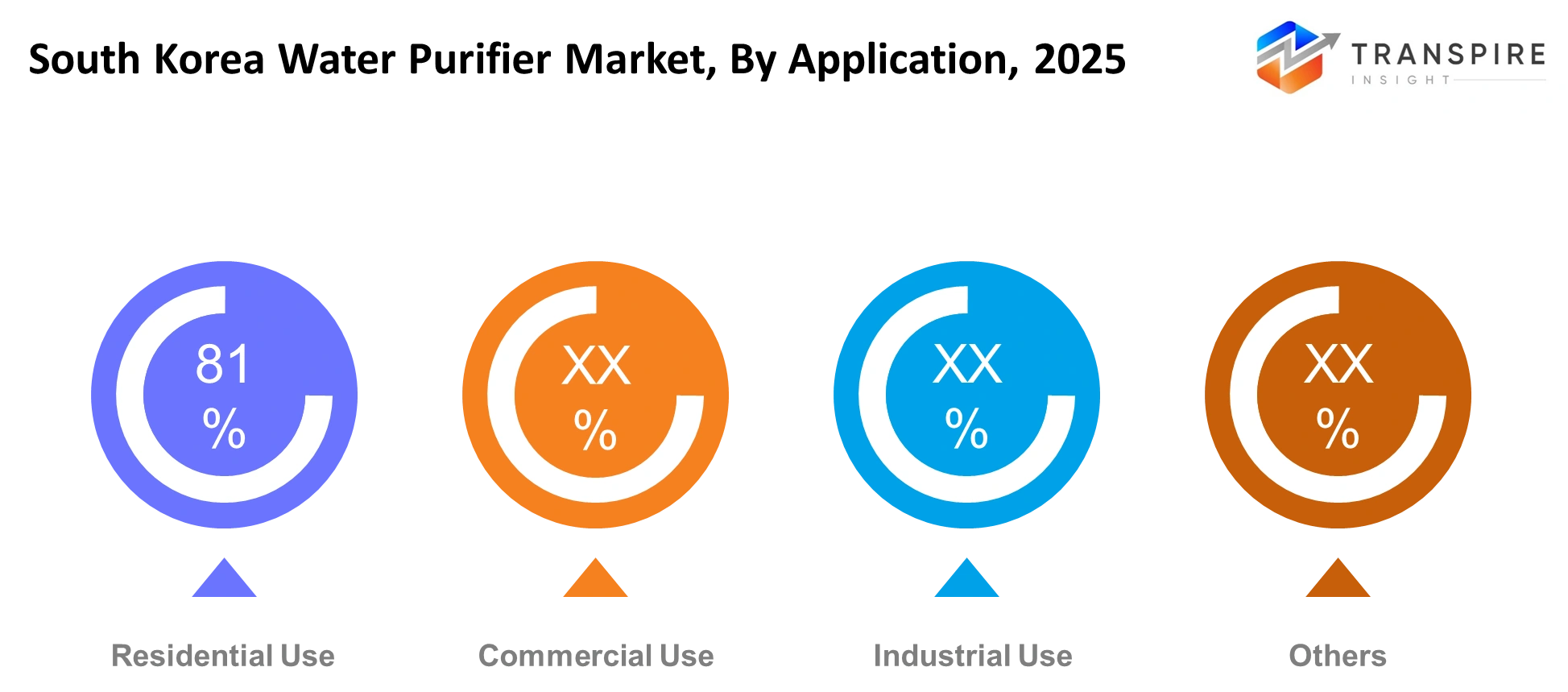
Residential Use pretty much leads, because a lot of people rely on in-home purification systems, especially in dense city apartment settings. Most homeowners install these setups to deal with worries about older municipal pipelines, plus the fact that water quality can be kind of inconsistent. So continuous filtration becomes sort of non-negotiable for everyday drinking and cooking. On top of that, subscription service models really push the recurring pull of demand, year after year for the same households.
Segment growth is getting helped by rising urbanization and longer replacement cycles, meaning people swap out units more often as time goes. Commercial use is also growing, showing up across offices, cafés, and hospitality spaces, where hygiene expectations and employee wellbeing are treated more seriously now. Industrial Use stays limited but steady, mainly tied to food processing and pharmaceutical-grade water needs, where strict purity rules are a must. Then there are the Others category, including schools, universities, and public infrastructure installations. Over the forecast period, commercial adoption should accelerate as workplace health standards tighten, and premium service environments keep spreading through more metropolitan regions, bit by bit.
To learn more about this report, Download Free Sample Report
By Distribution Channel
Electronics Stores sort of hold the leading position because of strong brand visibility ,and people like to see the physical product first before they buy it. This kind of demonstration based selling and, also those after-sales service assurances, makes the channel pretty effective for higher value purifier systems. The established retail networks from the big appliance brands are what really keep them ahead.
In this segment, growth is also nudged along by urban consumers who prefer bundled installation and service packages. Online Retail is moving fast as well ,mostly because discount driven purchasing behavior is common and customers are getting more comfortable with e-commerce platforms for appliances. Direct Sales keeps doing well too ,especially with rental and subscription models. Meanwhile Supermarkets stay somewhat limited, mainly centered on entry-level products. Other routes include corporate procurement channels and institutional distributors.
Over the forecast period, online and direct subscription channels will pick up more share as digital-first purchasing habits and service-based models reshape the whole distribution strategy.
By End User
Households kinda end up being the dominant end user part, mostly because a lot of people rely on point-of-use purification setups inside homes. In cities, families tend to care a lot about getting safe drinking water every day, and especially in high rise apartments where the plumbing situation can be kind of not the same block to block. Those repeated filter change routines—like, cycle after cycle—also keep pushing household demand forward.
This segment grows because middle class income is climbing and people are becoming more health minded with what they buy and use. Offices are also rolling out systems more and more, partly through employee wellness efforts, and also for corporate hygiene initiatives. Hotels and restaurants, meanwhile, are putting in more advanced purification solutions so drinks stay consistent, and so they meet guest safety expectations without much hassle. Healthcare settings keep demand fairly steady too, since patient care depends on strict water purity levels. Other users include schools and public service buildings. Over the forecast period, the office and hospitality groups should expand quicker, since commercial hygiene rules are getting tighter, and premium service expectations keep rising.
What are the Key Use Cases Driving the South Korea Water Purifier Market?
In South Korea, household drinking water purification is still kinda the main thing in the water purifier market, mostly because cities are packed, and people worry about old pipeline networks. In apartment complexes and tall residential towers, they tend to install multi-stage filtration setups, so the residents get water pretty much nonstop and it stays safe, plus mineral-balanced. Because filter replacements happen on a steady rhythm, the demand keeps coming back, especially with those recurring subscription servicing models—so yeah it’s the highest recurring portion.
For workplaces, like offices, cafés, and healthcare facilities, purifiers are being picked up more and more, in order to align with hygiene compliance expectations and also employee wellness preferences. A lot of end users lean toward high-capacity units, often paired with centralized dispensing components. This is especially common in corporate buildings, and also in hospitality chains where the foot traffic is intense.
There are also newer patterns popping up, such as purifiers being folded into smart apartments and co-living arrangements. In those situations, the water purification system links into building-wide IoT platforms, so it can send automated maintenance alerts, and it may also track usage. That kind of visibility then makes the upkeep feel more managed than random, and it supports more proactive servicing schedules.
|
Report Metrics |
Details |
|
Market size value in 2025 |
USD 2.40 Billion |
|
Market size value in 2026 |
USD 2.55 Billion |
|
Revenue forecast in 2033 |
USD 3.96 Billion |
|
Growth rate |
CAGR of 3.49% from 2026 to 2033 |
|
Base year |
2025 |
|
Historical data |
2021 - 2024 |
|
Forecast period |
2026 - 2033 |
|
Report coverage |
Revenue forecast, competitive landscape, growth factors, and trends |
|
Regional scope |
South Korea |
|
Key company profiled |
Coway, LG Electronics, Samsung Electronics, SK Magic, Panasonic, Kent RO Systems, Whirlpool, A. O. Smith, Eureka Forbes, Philips, Culligan, Pentair, Unilever Pureit, Toray Industries, Midea Group. |
|
Customization scope |
Free report customization (country, regional & segment scope). Avail customized purchase options to meet your exact research needs. |
|
Report Segmentation |
By Technology (RO Water Purifiers, UV Water Purifiers, UF Water Purifiers, Activated Carbon Purifiers, Others); By Product Type (Countertop Purifiers, Under-sink Purifiers, Portable Purifiers, Smart Water Purifiers, Others); By Application (Residential Use, Commercial Use, Industrial Use, Others); By Distribution Channel (Online Retail, Electronics Stores, Supermarkets, Direct Sales, Others); By End User (Households, Offices, Hotels & Restaurants, Healthcare Facilities, Others). |
Which Regions are Driving the South Korea Water Purifier Market Growth?
The Seoul Metropolitan Area seems to lead the South Korea Water Purifier Market , mainly because it has a really high population density plus those quite advanced smart apartment setups. Also, municipal water quality monitoring is strict, and pipe replacement programs happen often, so people end up leaning on home purification systems more and more. In places like Gangnam and Songpa, higher income households basically make premium purifier adoption feel normal , especially when subscription based services are offered. Add in the fact that major manufacturers are present, and the after sales service networks are strong, and yeah the region just keeps reinforcing its regional lead.
Busan and the surrounding coastal industrial areas sit more like a steady second tier region , with demand that stays relatively consistent from both regular homes and maritime linked commercial sites. In other words, unlike Seoul, the growth doesn’t rely as much on premium consumption habits. Instead it’s more about port connected worker housing and longer term industrial steadiness. Shipbuilding clusters, along with logistics hubs, keep supporting ongoing installation of commercial grade filtration systems. So suppliers tend to see predictable , lower volatility revenue which is kind of a reliable thing for water purifier providers.
Then there is Gyeonggi Province, which looks like the fastest growing region, because suburban expansion is moving quickly and there are large scale residential projects around Seoul. Recent smart city initiatives and new housing complexes have rolled out IoT based home appliance ecosystems as a kind of standard package. Meanwhile, the middle class population is rising, and people are relocating from central Seoul, which pushes adoption of mid range purifier systems even further. For market entrants, this area feels like the best expansion runway through 2026–2033 , since the housing driven demand is scalable.
Who are the Key Players in the South Korea Water Purifier Market and How Do They Compete?
Competition in the South Korea Water Purifier Market feels kind of moderately consolidated, with the domestic appliance giants showing strong dominance, and also a pretty fierce rivalry in subscription - based service models. Most of the incumbents dont rely just on the hardware product itself anymore, they tend to push an integrated sort of set up, filtration units plus IoT monitoring, then they tie it together with long term service contracts. In the end, the real battlefield shifted , away from one time appliance sales and more toward keeping customers, managing filter replacement cycles and using digital service platforms that keep things sticky.
Coway is pretty much leading with a rental first approach, and they bundle AI water quality monitoring with scheduled maintenance services, so the recurring revenue stays more stable. LG Electronics differentiates a bit through smart home integration , like they embed purifiers into the wider ThinQ ecosystem, then they connect water usage with energy management and other appliance control systems. SK Magic leans into compact, design driven purification systems that fit urban apartments better, so they strengthen their spot in space constrained homes by using flexible rental contracts.
Cuckoo Homesys goes after premium filtration performance, plus quick service response networks, especially in high density residential areas. Chungho Nais keeps more of a niche edge with cost competitive models aimed at mid income households, while also expanding into smart filter tracking features. Overall, the firms are scaling by adding more service bundles, leaning into AI enabled diagnostics, and pushing subscription penetration aggressively across both urban and suburban markets, pretty steadily.
Company List
- Coway
- LG Electronics
- Samsung Electronics
- SK Magic
- Panasonic
- Kent RO Systems
- Whirlpool
- A. O. Smith
- Eureka Forbes
- Philips
- Culligan
- Pentair
- Unilever Pureit
- Toray Industries
- Midea Group
Recent Development News
In May 2026, Coway intensified its subscription-driven purifier strategy in the domestic market. The company expanded its recurring rental and service model with enhanced smart filtration systems, reinforcing its leadership in Korea’s premium water purifier ecosystem.
Source: https://biz.chosun.com
What Strategic Insights Define the Future of the South Korea Water Purifier Market?
The South Korea Water Purifier Market is shifting, you know, toward fully service-led ecosystems where the hardware is basically a gateway to long-term subscription cash and data driven water management. In the next 5–7 years, the growth curve will be steered by deeper integration of IoT enabled purification systems into smart housing infrastructure, especially in those newly developed urban clusters. One risk that stays kinda out of sight is that concentration is rising around just a few dominant appliance manufacturers, and that could lower pricing flexibility and slow down innovation spread across mid tier brands. At the same time, there is dependency on imported filtration membranes, which makes supply more shaky when global materials are under pressure. Still, an emerging chance is AI driven municipal-to-home water synchronization systems, connecting building level monitoring with individual purifier analytics. Market players should push for scalable subscription ecosystems rather than standalone product sales, so they can lock in retention, and keep margins more stable, too.
South Korea Water Purifier Market Report Segmentation
By Technology
- RO Water Purifiers
- UV Water Purifiers
- UF Water Purifiers
- Activated Carbon Purifiers
- Others
By Product Type
- Countertop Purifiers
- Under-sink Purifiers
- Portable Purifiers
- Smart Water Purifiers
- Others
By Application
- Residential Use
- Commercial Use
- Industrial Use
- Others
By Distribution Channel
- Online Retail
- Electronics Stores
- Supermarkets
- Direct Sales
- Others
By End User
- Households
- Offices
- Hotels & Restaurants
- Healthcare Facilities
- Others
Frequently Asked Questions
Find quick answers to common questions.
The expected South Korea Water Purifier Market size for the market will be USD 3.96 Billion in 2033.
Key segments for the South Korea Water Purifier Market are By Technology (RO Water Purifiers, UV Water Purifiers, UF Water Purifiers, Activated Carbon Purifiers, Others); By Product Type (Countertop Purifiers, Under-sink Purifiers, Portable Purifiers, Smart Water Purifiers, Others); By Application (Residential Use, Commercial Use, Industrial Use, Others); By Distribution Channel (Online Retail, Electronics Stores, Supermarkets, Direct Sales, Others); By End User (Households, Offices, Hotels & Restaurants, Healthcare Facilities, Others).
Major South Korea Water Purifier Market players are Coway, LG Electronics, Samsung Electronics, SK Magic, Panasonic, Kent RO Systems, Whirlpool, A. O. Smith, Eureka Forbes, Philips, Culligan, Pentair, Unilever Pureit, Toray Industries, Midea Group.
The South Korea Water Purifier Market size is USD 2.40 Billion in 2025.
The South Korea Water Purifier Market CAGR is 3.49% from 2026 to 2033.
- Coway
- LG Electronics
- Samsung Electronics
- SK Magic
- Panasonic
- Kent RO Systems
- Whirlpool
- A. O. Smith
- Eureka Forbes
- Philips
- Culligan
- Pentair
- Unilever Pureit
- Toray Industries
- Midea Group
Recently Published Reports
-
Apr 2026
Bottled Water Market
Bottled Water Market Size, Share & Analysis Report By Product Type (Still Bottled Water, Carbonated Bottled Water, Functional Bottled Water, and Others), By Packaging (PET, Cans, and Others), By Sales Channel (Supermarkets/Hypermarkets, Convenience Stores/Drug Stores, Grocery Stores/Club Stores, Foodservice, and Others) and Geography (North America, Europe, Asia-Pacific, Middle East and Africa, South and Central America), 2021 - 2032
-
Apr 2026
Color Cosmetic Packaging Market
Color Cosmetic Packaging Market Size, Share & Analysis Report By Application (Mascara Packaging, Liquid Packaging, and Liquid Face), By Type (Tubes & Bottles, Pens & Markers, Compacts & Containers, and Droppers & Pumps), and Geography (North America, Europe, Asia-Pacific, Middle East and Africa, South and Central America), 2021 - 2031
-
Apr 2026
External Microphone For Camera Market
External Microphone For Camera Market Size, Share & Analysis Report By Type (Shotgun Microphone, Lavalier Microphone, and Others), By Application (Digital Camera, Professional Video Camera, and Others), and Geography (North America, Europe, Asia-Pacific, Middle East and Africa, South and Central America), 2021 - 2031
-
Apr 2026
Foot Orthotic Insoles Market
Foot Orthotic Insoles Market Size, Share & Analysis Report By Type (Pre-fabricated, and Custom-made), By Material (Thermoplastic, Composite Carbon Fiber, and Others), By Distribution Channel (Drug Stores, Hospitals & Clinics, and Others), and Geography (North America, Europe, Asia-Pacific, Middle East and Africa, South and Central America), 2021 - 2031