
South Korea Transparent Display Market Summary
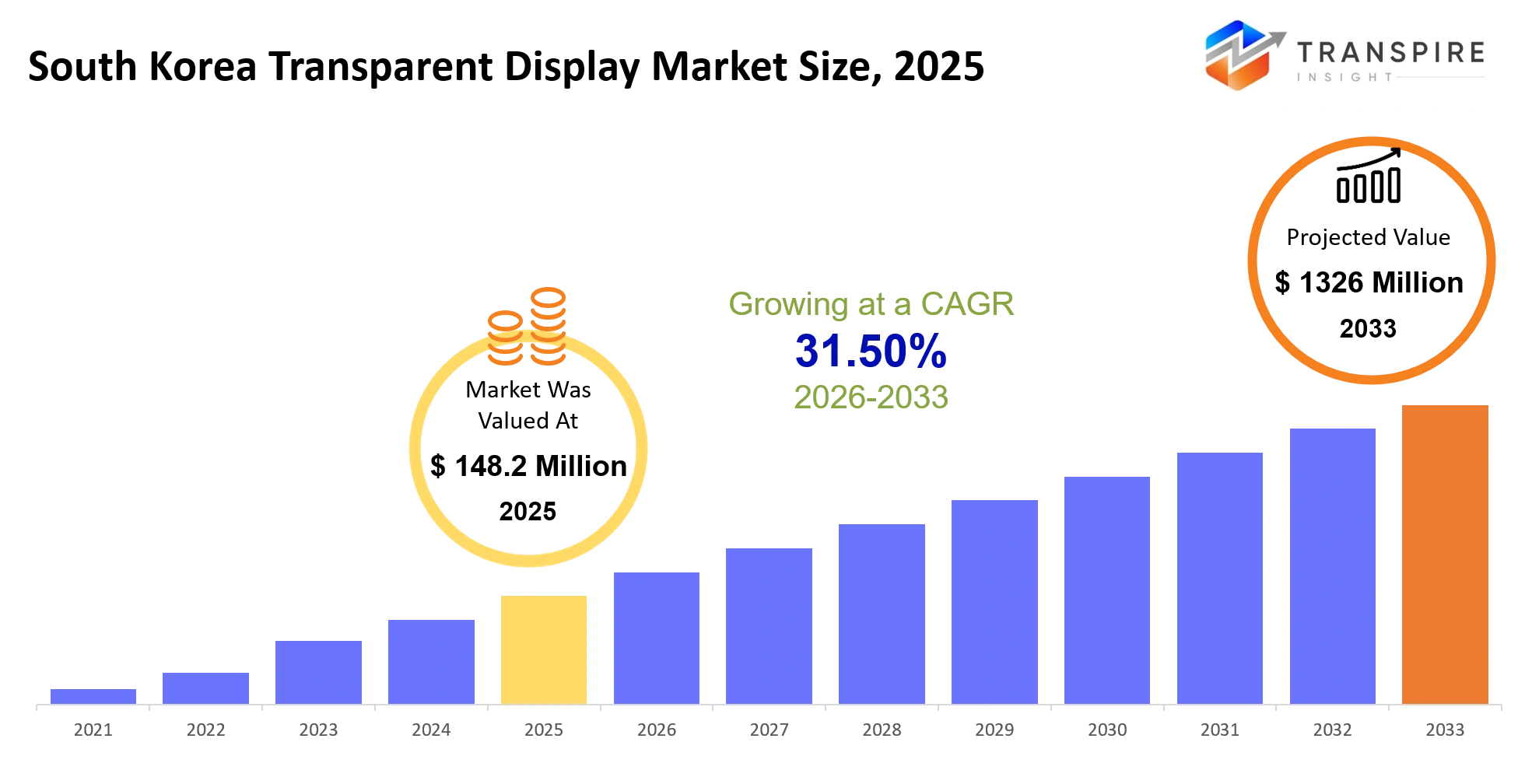
As per Transpire Insight Analysis the South Korea Transparent Display Market size is estimated at USD 20.8 Million in 2025 and is anticipated to reach USD 1326 Million by 2033, growing at a CAGR of 31.50% from 2026 to 2033.
The South Korean transparent display industry sort of helps retailers, transport operators, automakers , and industrial facilities place digital information right on glass surfaces, without really blocking products, views, or physical surroundings. These transparent panels can turn shop windows, vehicle windows, exhibition cases, control interfaces, and even architectural surfaces into something like interactive information points, while visibility stays intact.
Over the last three to five years, the market has moved away from experimental OLED setups toward wider commercial trials and public demos that lean on transparent OLED and MicroLED technologies. In 2024 Samsung unveiled a transparent MicroLED display, and in the same general period LG Display supplied 55-inch transparent OLED panels for Korea’s GTX-A railway, which kind of signals that the shift is not just concept now but also transport and broader commercial use.
On top of that, government policy has helped the ecosystem along, with financial support and pilot programs for transparent displays in areas like platform screen doors and museums. The market is valued at USD 148.2 million in 2025 , and it could climb to USD 1,326 million by 2033 as premium retail, mobility, signage, and architectural deployments keep expanding.
South Korea Transparent Display Market Size & Forecast:
- South Korea Transparent Display Market Size 2025: USD 148.2 Million
- Expected Market Value 2033: USD 1326 Million
- Forecast CAGR: 31.50%
- Leading region in 2025:
- Fastest Growing region:
- Key Profile: LG Display, Samsung Display, BOE Technology, AUO Corporation, Innolux Corporation, Sony Corporation, Panasonic Holdings, Sharp Corporation, TCL CSOT, Leyard Optoelectronic, Planar Systems, SeeReal Technologies, Crystal Display Systems, Visionox, E Ink Holdings.
Key Market Insights
- Regional leadership, Seoul and the nearby capital area basically lead the whole deployment effort because big retailers, tech companies, transit projects and display makers all they tend to cluster there.
- Technology transition: Transparent OLED is already commercially set in place, and then Samsung’s 2024 transparent MicroLED launch sort of widened the high-end technology pipeline too.
- Industry size. The market is currently estimated around USD 148.2 million in 2025 and the use cases are growing past “trial type” installations into more regular commercial settings,
- Forecast outlook: by 2033 the market could hit USD 1.326 billion, which would make sense with adoption spreading across mobility, retail, signage, and also architectural use.
- Transport adoption: LG Display put 55-inch transparent OLED panels into cabin windows for Korea’s GTX-A railway in 2024, so the commuting experience gets a more visible layer.
- Retail transformation: transparent screens more and more mix actual product visibility with promotional content too, so stores can share messaging without fully covering merchandise or blocking the storefront view.
- Modular formats: Samsung’s transparent MicroLED approach supports tailored screen sizes, which helps open doors for larger commercial installs and building related projects.
- Government support: South Korea has basically marked out transparent displays for technology demonstrations and pilot runs, including platform screen doors and museum programs.
- Competitive strategy: LG Display is leaning hard on transparent OLED commercialization while Samsung is steering transparent MicroLED into premium commercial environments.
- Investment direction: public funding for next-generation display infrastructure is reinforcing domestic OLED abilities and also strengthening the supplier base for premium display tech.
What are the Key Drivers, Restraints, and Opportunities in the South Korea Transparent Display Market?
The strongest growth driver is South Korea’s shift toward premium OLED and next generation display uses across retail, mobility, signage, and smart infrastructure, kind of. Government backing has strengthened the technology pipeline through financial incentives and pilot efforts for transparent displays, including platform screen doors and museum exhibitions, with more momentum than before. On the commercial side, validation has improved too. LG Display installed 55-inch transparent OLED panels in GTX-A railway cabins, basically showing a real world use case beyond showrooms and galleries. When those kinds of deployments land, they become reference projects that lower buyer hesitation, and then they tend to nudge additional orders from transport operators , retailers, and infrastructure developers.
Still, the big blockers are manufacturing intricacy and installation expenses, and they remain structural not temporary. Transparent displays call for specialized materials, careful manufacturing, high brightness output, thermal management, and integration with current glass structures or connected electronic systems. Meanwhile, premium MicroLED also brings production and assembly difficulties, which keep the business math less friendly for many mass market deployments. Because of that buyers often choose flagship installs instead of broad rollouts, and this reduces near term unit growth and slows revenue conversion.
The best opportunity sits in commercializing transparent MicroLED and advanced OLED across large format retail, transportation , museums, and architectural environments. Samsung’s 2024 transparent MicroLED demonstration showed a high transmission, modular display approach that fits customized commercial layouts. Continued Korean investment in next generation OLED and inorganic display technologies can further push brightness, durability, efficiency, and production economics, creating condition.
What Has the Impact of Artificial Intelligence Been on the South Korea Transparent Display Market?
Artificial intelligence is, sort of, shifting transparent display systems mostly via content optimization, computer vision, personalization, and automatic device handling, not so much through maritime scrubber or emissions-control type stuff. In retail spaces, AI-based cameras can look at visitor crowd levels and then tweak connected systems on their own, while transparent signage can show different content based on where customers walk, the store situation, or even just time of day. Samsung showed AI-enabled store monitoring and automated energy management with SmartThings Pro, and it kinda makes clear how AI links the physical area with digital control platforms.
Also, AI helps with predictive maintenance across display production and the real-world installed setups by spotting weird temperatures, brightness drift, pixel faults, and slower component aging using operating data. Machine learning models can aid operators in setting maintenance windows before anything obvious breaks, so retail campaigns, transport information systems, or public displays don’t get interrupted. Samsung’s wider AI-screen direction really underlines this too, including the idea of combining AI processing with next-gen display products like MicroLED platforms. Done right, these features can boost uptime, cut down on needless service calls, and tune energy consumption. Still, the cost of deep integration, the lack of standardized operational datasets, and uneven real-world installation conditions continue to limit AI rollout across smaller projects.
Key Market Trends
- Samsung kind of moved transparent MicroLED from that lab stage into broader commercial demonstrations, with its first big public unveil in 2024.
- LG Display then shifted transparent OLED toward transportation use, after it supplied 55-inch panels for the GTX-A railway cabins in 2024, sort of the usual step from trial to real-world service.
- On top of that government programs are backing more transparent display pilots for platform screen doors, museums and other public infrastructure uses.
- And yeah the commercial playbook is also drifting toward modular formats, so companies can request customized sizes plus installation setups that work for large retail spaces and architectural projects.
- In retail spaces especially, installations are increasingly mixing product visibility with digital information, which reduces that annoying trade-off between physical merchandising and promotional messaging, because people can still see stuff and also get updates.
- Meanwhile transparent OLED picked up better environmental credentials in 2024, when LG Display secured certifications tied to reduced plastics and more recycled materials being used.
- Samsung also broadened transparent MicroLED attention beyond CES, by showing the tech at ISE 2024 for commercial use cases, not just for the enthusiasts.
- Also AI-enabled retail management is nudging display infrastructure away from standalone signage and toward connected systems that can monitor stores, and help optimize energy use.
- Public and private investment meanwhile is leaning toward higher-value OLED technologies, which reinforces South Korea’s premium display manufacturing ecosystem.
- So overall premium display development is getting more concentrated on higher brightness, less power consumption, modularity, and the ability to blend into connected digital environments.
South Korea Transparent Display Market Segmentation
By Display Technology
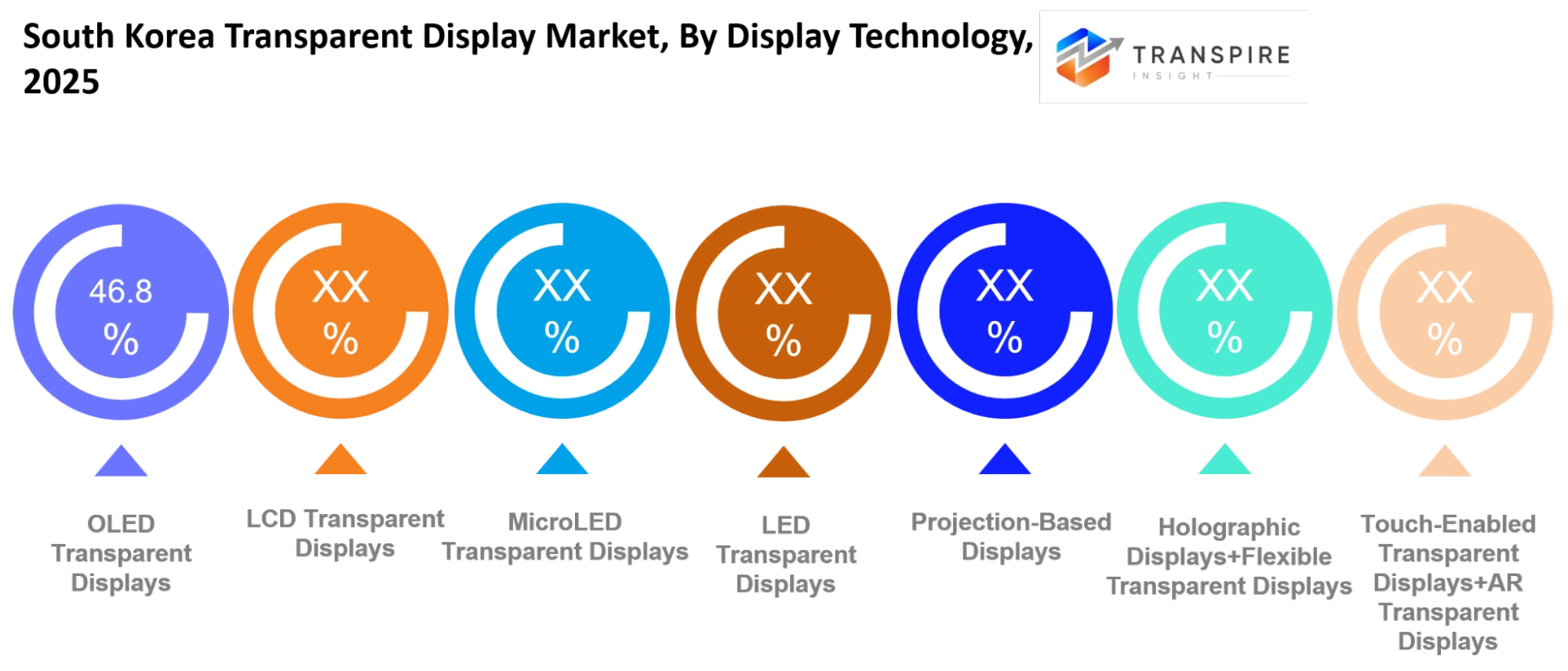
OLED transparent displays are mostly driving early commercial adoption because, you know, OLED can stay with a thin panel build, gives strong contrast , and still fits those practical transparent product shapes. LG Display has already shown it in the transportation space, including 55-inch transparent OLED windows for GTX-A rail cabins, which is pretty telling for real world use. LCD transparent displays still feel relevant too, mainly when you’re looking at lower cost options, plus the whole manufacturing process is already well established, so price-sensitive installs can happen without too much drama. MicroLED transparent displays sit in a more premium, high-value emerging lane, with Samsung unveiling transparent MicroLED tech in 2024 and pushing ideas like high transmission, modular construction, and a noticeably premium image quality.
Then there are LED transparent displays, which often end up powering retail windows, advertising frames , and bigger commercial deployments that need solid brightness. Projection based displays tend to show up in exhibitions, retail contexts, and architectural installations, where flexible placement of the image really helps build creative layouts. Holographic displays aim more at premium promotional moments and gallery style presentations, while flexible transparent displays handle curved surfaces and unusual structures without losing the transparent angle. Touch-enabled transparent displays add interactive controls for retail, education, museums , and public information systems, so it’s not only about seeing. AR transparent displays lean into automotive and wearable interfaces, while “Others” is basically the catch-all for newer technologies that still have specialized commercial uses.
By Application
Retail Displays are a major use case, because transparent screens can show promotions while still keeping the products in view and the storefront looking, more or less, normal. Samsung has basically placed its transparent MicroLED for retail stores and big exhibitions, where the content can show up while the physical items stay visible behind the display. Automotive HUDs can deliver directions, safety cues, and vehicle related data, without pushing drivers to move their eyes away from the road for long. On the consumer side, there are premium televisions, smart appliances, and connected home interfaces, all backed by South Korea’s well established display ecosystem.
Digital Signage helps with advertisements, public guidance, and two-way style communication across commercial buildings. Museums and Exhibitions lean on transparent displays so physical objects and digital explanations can coexist, and the exhibit sightline isn’t blocked. Healthcare use can include medical information and patient facing interfaces, while Smart Homes tie transparent displays into connected appliances plus home controls. Transportation is also getting practical confirmation, for example railway installs, including LG Display’s GTX-A transparent OLED deployment. Hospitality applications cover hotel details, advertising, concierge services, and those interactive guest moments too, while Others is for specialized deployments that do not fit neatly elsewhere.
By Display Size
Below 20 Inches targets compact interfaces, smart appliances, point of sale systems, and specialized equipment, basically stuff where space is tight. 20–40 Inches is more for retail information panels, interactive displays, control interfaces, and medium size commercial placements . 40–60 Inches gives a solid format for retail windows, transportation interiors, digital signage, and exhibition systems, and LG Display using 55 inch transparent OLED panels in GTX-A railway cabins. Above 60 Inches goes after the big commercial displays that need stronger viewing impact and wider content areas.
Custom Size solutions support architectural projects and installations that need unusual dimensions, not the standard ones. Ultra-Large Displays benefit from MicroLED modular construction since the screen dimensions can expand depending on what the install demands. Samsung showed modular MicroLED formats running from 76 up to 140 inches and also introduced transparent MicroLED tech with customized configuration potential. Compact Displays fit space constrained use, while Modular Displays back scalable commercial setups. Commercial Displays aim at retail , hospitality, transportation, exhibitions, and corporate environments, while Others covers those more specialized size requests.
By End User
Retail is a major end-user space, because with transparent displays the ads, product data, and even merchandising can kind of happen all in the same physical room, not sure why but it just works. In Automotive manufacturing, companies are using transparent display solutions for HUDs, cabin dashboards and also the more advanced vehicle knowledge systems. For Consumer Electronics, transparent tech shows up in premium television sets, smart appliances, and interactive home products. In Healthcare, organizations can put transparent displays to work for info distribution, equipment touchpoints, and patient-facing scenarios that feel more direct. Government initiatives may back public messaging, transit related infrastructure, and smart-city deployments too.
On the Education side, there are interactive learning surfaces, lab visualization displays, and digital teaching systems. Hospitality operators can roll out transparent screens around reception, for guest information, for advertising, and for those higher-end interior moments. Aerospace and Defense programs can lean on specialized visualization and information interfaces where lighter or see-through display frameworks deliver real operational advantages. In Entertainment, it’s used in immersive venues, exhibitions, and interactive experiences that pull people in. Others, includes industrial, corporate, architectural, and niche institutional users who still need transparent digital interfaces, in a more controlled or domain specific way.
By Distribution Channel
Retail is a major end-user space, because with transparent displays the ads, product data, and even merchandising can kind of happen all in the same physical room, not sure why but it just works. In Automotive manufacturing, companies are using transparent display solutions for HUDs, cabin dashboards and also the more advanced vehicle knowledge systems. For Consumer Electronics, transparent tech shows up in premium television sets, smart appliances, and interactive home products. In Healthcare, organizations can put transparent displays to work for info distribution, equipment touchpoints, and patient-facing scenarios that feel more direct. Government initiatives may back public messaging, transit related infrastructure, and smart-city deployments too.
On the Education side, there are interactive learning surfaces, lab visualization displays, and digital teaching systems. Hospitality operators can roll out transparent screens around reception, for guest information, for advertising, and for those higher-end interior moments. Aerospace and Defense programs can lean on specialized visualization and information interfaces where lighter or see-through display frameworks deliver real operational advantages. In Entertainment, it’s used in immersive venues, exhibitions, and interactive experiences that pull people in. Others, includes industrial, corporate, architectural, and niche institutional users who still need transparent digital interfaces, in a more controlled or domain specific way.
What are the Key Use Cases Driving the South Korea Transparent Display Market?
Retail and commercial visual communication stay big adoption zones, because transparent displays let promotional content show up across store windows and product showcases , without basically covering or hiding the merchandise. Samsung has also shown transparent MicroLED things pretty directly for retail outlets and big exhibitions, where digital information runs alongside the real products, like they are kind of coexisting.
Transportation is turning into a more serious secondary use case as transparent OLED starts moving into real operating conditions. For example, LG Display’s 55-inch transparent OLED set up inside the GTX-A railway cabins, shows how the windows can carry route maps, announcements, and passenger info. At the same time you still keep a clear line of sight outside. Automotive HUD setups likewise bring chances for navigation updates and safety prompts, not just fancy visuals.
New directions are forming too, like platform screen doors, museums, smart architectural surfaces, and immersive exhibitions. South Korean government programs name transparent displays for platform screen doors and museums, and that gives a sort of runway for pilot efforts to grow into larger infrastructure deployments.
|
Report Metrics |
Details |
|
Market size value in 2025 |
USD 148.2 Million |
|
Market size value in 2026 |
USD USD 195 Million |
|
Revenue forecast in 2033 |
USD 1326 Million |
|
Growth rate |
CAGR of 31.50% from 2026 to 2033 |
|
Base year |
2025 |
|
Historical data |
2021 - 2024 |
|
Forecast period |
2026 - 2033 |
|
Report coverage |
Revenue forecast, competitive landscape, growth factors, and trends |
|
Regional scope |
United States; Canada; Mexico; United Kingdom; Germany; France; Italy; Spain; Denmark; Sweden; Norway; China; Japan; India; Australia; South Korea; Thailand; Brazil; Argentina; South Africa; Saudi Arabia; United Arab Emirates |
|
Key company profiled |
LG Display, Samsung Display, BOE Technology, AUO Corporation, Innolux Corporation, Sony Corporation, Panasonic Holdings, Sharp Corporation, TCL CSOT, Leyard Optoelectronic, Planar Systems, SeeReal Technologies, Crystal Display Systems, Visionox, E Ink Holdings. |
|
Customization scope |
Free report customization (country, regional & segment scope). Avail customized purchase options to meet your exact research needs. |
|
Report Segmentation |
By Display Technology (OLED Transparent Displays, LCD Transparent Displays, MicroLED Transparent Displays, LED Transparent Displays, Projection-Based Displays, Holographic Displays, Flexible Transparent Displays, Touch-Enabled Transparent Displays, AR Transparent Displays, Others); By Application (Retail Displays, Automotive HUDs, Consumer Electronics, Digital Signage, Museums & Exhibitions, Healthcare, Smart Homes, Transportation, Hospitality, Others); By Display Size (Below 20 Inches, 20–40 Inches, 40–60 Inches, Above 60 Inches, Custom Size, Ultra-Large Displays, Compact Displays, Modular Displays, Commercial Displays, Others); By End User (Retail, Automotive, Consumer Electronics, Healthcare, Government, Education, Hospitality, Aerospace & Defense, Entertainment, Others); By Distribution Channel (Direct Sales, OEMs, System Integrators, Electronics Distributors, Online Sales, Dealers, Value-Added Resellers, Commercial Integrators, Exporters, Others). |
Which Regions are Driving the South Korea Transparent Display Market Growth?
Seoul together with the wider Gyeonggi capital zone feels like the most important regional cluster, mostly because the Display R&D, headquarters, retail innovation, mobility projects and major technology buyers are all kind of clustered around that core. Seoul gives you the densest customer pool for premium retail, museums, commercial buildings, plus hands-on experiential installations, and then Gyeonggi sort of backs it up with manufacturing and technology development. LG Display keeps showing up with transparent OLED uses in mobility and commercial settings, and that tends to lock in the capital region as a sort of launch platform for fresh display formats.
Meanwhile Chungcheongnam-do, and the central manufacturing stretch around it, adds value more from panel production, component suppliers, and industrial infrastructure, rather than from all the end-user projects that get concentrated in the capital. The upside there is that the area already has display production know-how and is close to big electronics production networks, so it acts like a sturdier staging ground for scaling OLED and related technologies. Because of this, the region’s growth path looks different, supplier relationships and production efficiency can keep revenue steady even if individual retail or architectural projects go up and down a bit. With more investment in advanced display tech, the corridor keeps reinforcing its position as a dependable manufacturing base, not just a place for pilots.
Then Gyeongsangbuk-do, that one looks like a quicker opportunity, mainly because industrial modernization and smart-city initiatives are opening new locations for advanced signage, mobility interfaces, and public information displays. The latest commercialization push has moved transparent tech beyond just demonstrations, and Samsung’s 2025 and 2026 showcases also broadened transparent MicroLED into immersive commercial and lifestyle environments.
Who are the Key Players in the South Korea Transparent Display Market and How Do They Compete?
Competition still stays kinda concentrated around Korean technology leaders, even if international panel manufacturers plus specialized display companies keep adding more pressure in the background. Most of the big competitive elements are things like transparency, brightness, image quality, the ability to scale manufacturing, durability, modularity, and basically how well the display can be integrated into retail, mobility, and architectural spaces. LG Display really has a meaningful edge in the transparent OLED commercialization area, while Samsung leans on MicroLED, AI-enabled commercial displays, and a lot of highly modular formats.
LG Display concentrates on transparent OLED commercialization and already showed practical mobility use cases, including 55-inch transparent OLED panels installed inside GTX-A railway cabins. Samsung competes with premium MicroLED development, and it leans into high transparency, bezel-free building, and modular architecture, to go after museums, retail, and those experiential installs. BOE Technology and Visionox also make things tougher through OLED manufacturing scale and flexible-display development, while AUO and Innolux rely on long standing panel manufacturing capabilities to pursue commercial plus automotive applications.
LG Electronics takes transparent OLED farther than just panel supply, moving into premium consumer and experiential applications, like the 77-inch SIGNATURE OLED T, and also collaborations with artists and design brands. Samsung meanwhile expanded transparent MicroLED demonstrations into new commercial formats, including museum displays and immersive signage. Together, these moves gradually shift the whole fight toward full display experiences instead of thinking only about panel pricing.
Company List
- LG Display
- Samsung Display
- BOE Technology
- AUO Corporation
- Innolux Corporation
- Sony Corporation
- Panasonic Holdings
- Sharp Corporation
- TCL CSOT
- Leyard Optoelectronic
- Planar Systems
- SeeReal Technologies
- Crystal Display Systems
- Visionox
- E Ink Holdings (mordorintelligence.com)
Recent Development News
"In May 2025, LG Electronics entered a partnership with artist Steven Harrington for a Frieze New York exhibition featuring the transparent LG SIGNATURE OLED T. The collaboration expanded the use of transparent OLED technology into premium digital art and experiential applications while supporting LG's positioning of transparent displays as design products.
Source: https://www.lg.com/global/newsroom/news/media-entertainment-solution/lg-oled-x-steven-harrington-at-frieze-ny-where-vibrant-pop-art-meets-the-transparent-oled-tv/ (LG Global)."
"In January 2026, LG Display unveiled a strategic OLED lineup at CES 2026 focused on expanding OLED adoption across consumer, IT, and automotive applications. The investment in higher-performance OLED technologies strengthens the technology platform supporting future transparent and advanced mobility display applications.
Source: https://www.lgcorp.com/media/release/29752 (LG)."
What Strategic Insights Define the Future of the South Korea Transparent Display Market?
The South Korea Transparent Display Market is sorta shifting in a structural way, from those big showcase installations to more integrated, commercial infrastructure setups. At the same time OLED and MicroLED are getting pulled into retail environments, mobility systems , smart buildings, and those immersive public spaces that basically blur the line between advertising and architecture. The main push isn’t just screen swapping or replacement every few cycles, but the ability to add digital information, while still keeping visibility clear, keeping usable floor space intact, and not breaking the architectural design.
There’s also a less visible (but still real) risk, like technology substitution: if conventional MicroLED, MiniLED, AR interfaces, and projection systems keep improving fast enough, then the addressable demand for those costly transparent panels could shrink, even before manufacturing costs drop to a more comfortable level. Another concern is that the ecosystem is concentrated around a smaller group of Korean technology leaders, which can make the supply chain kinda exposed if production direction changes, or if pricing decisions go a certain way.
Still, the emerging opening seems strongest in automotive transparent displays, especially windshield and cabin use cases. In that setting transparent MicroLED can stack navigation, entertainment, and vehicle information into one experience. Market players should really start building partnerships with automotive OEMs and system integrators now, and at the same time work on modular products—so the same core platform can support both retail and mobility projects, with fewer rewrites each time.
South Korea Transparent Display Market Report Segmentation
By Display Technology
• OLED Transparent Displays
• LCD Transparent Displays
• MicroLED Transparent Displays
• LED Transparent Displays
• Projection-Based Displays
• Holographic Displays
• Flexible Transparent Displays
• Touch-Enabled Transparent Displays
• AR Transparent Displays
• Others
By Application
• Retail Displays
• Automotive HUDs
• Consumer Electronics
• Digital Signage
• Museums & Exhibitions
• Healthcare
• Smart Homes
• Transportation
• Hospitality
• Others
By Display Size
• Below 20 Inches
• 20–40 Inches
• 40–60 Inches
• Above 60 Inches
• Custom Size
• Ultra-Large Displays
• Compact Displays
• Modular Displays
• Commercial Displays
• Others
By End User
• Retail
• Automotive
• Consumer Electronics
• Healthcare
• Government
• Education
• Hospitality
• Aerospace & Defense
• Entertainment
• Others
By Distribution Channel
• Direct Sales
• OEMs
• System Integrators
• Electronics Distributors
• Online Sales
• Dealers
• Value-Added Resellers
• Commercial Integrators
• Exporters
• Others
Frequently Asked Questions
Find quick answers to common questions.
The expected South Korea Transparent Display Market size for the market will be USD 1326 Million in 2033.
Key segments for the South Korea Transparent Display Market are By Display Technology (OLED Transparent Displays, LCD Transparent Displays, MicroLED Transparent Displays, LED Transparent Displays, Projection-Based Displays, Holographic Displays, Flexible Transparent Displays, Touch-Enabled Transparent Displays, AR Transparent Displays, Others); By Application (Retail Displays, Automotive HUDs, Consumer Electronics, Digital Signage, Museums & Exhibitions, Healthcare, Smart Homes, Transportation, Hospitality, Others); By Display Size (Below 20 Inches, 20–40 Inches, 40–60 Inches, Above 60 Inches, Custom Size, Ultra-Large Displays, Compact Displays, Modular Displays, Commercial Displays, Others); By End User (Retail, Automotive, Consumer Electronics, Healthcare, Government, Education, Hospitality, Aerospace & Defense, Entertainment, Others); By Distribution Channel (Direct Sales, OEMs, System Integrators, Electronics Distributors, Online Sales, Dealers, Value-Added Resellers, Commercial Integrators, Exporters, Others).
Major South Korea Transparent Display Market players are LG Display, Samsung Display, BOE Technology, AUO Corporation, Innolux Corporation, Sony Corporation, Panasonic Holdings, Sharp Corporation, TCL CSOT, Leyard Optoelectronic, Planar Systems, SeeReal Technologies, Crystal Display Systems, Visionox, E Ink Holdings.
The South Korea Transparent Display Market size is USD 148.2 Million in 2025.
The South Korea Transparent Display Market CAGR is 31.50% from 2026 to 2033.
- LG Display
- Samsung Display
- BOE Technology
- AUO Corporation
- Innolux Corporation
- Sony Corporation
- Panasonic Holdings
- Sharp Corporation
- TCL CSOT
- Leyard Optoelectronic
- Planar Systems
- SeeReal Technologies
- Crystal Display Systems
- Visionox
- E Ink Holdings (mordorintelligence.com)
About the Authors

Avinash Kumar
I’m Avinash Kumar, a Senior Research Analyst at Transpire Insight, with expertise in the Electronics and Semiconductor and Energy & Power industry. My work focuses on analyzing emerging technologies, market trends, industry developments, and innovation across these sectors. I specialize in transforming complex technical and market insights into clear, research-backed content that helps professionals, businesses, and decision-makers stay informed. Through continuous industry research and data-driven analysis, I strive to deliver accurate, reliable, and practical perspectives on the latest advancements shaping the semiconductor and energy landscape.

Chakradhar Khansole
Chakradhar serves as the Research Director at Transpire Insight, bringing over 8 years of experience in technology, innovation, and strategic market intelligence. He specializes in transforming complex market data into actionable business insights that enable organizations to make informed, growth-oriented decisions. Recognized for his strategic vision and analytical expertise, Chakradhar leads high-impact research initiatives, delivering comprehensive market assessments, competitive intelligence, and forward-looking industry analysis.
Recently Published Reports
-
Apr 2026
Fiber Optic Faceplates Market
Fiber Optic Faceplates Market Size, Share & Analysis Report By Type (< 300 mm2, 300-350 mm2, and > 350 mm2, By Application (Night Vision, Holographic Imaging, Medical, and Others), and Geography (North America, Europe, Asia-Pacific, Middle East and Africa, South and Central America), 2021 - 2031
-
Apr 2026
High Temperature Superconductors Market
High Temperature Superconductors Market Size, Share & Analysis Report By Type (1G HTS, and 2G HTS), By Application (Power Cable, Fault Current Limiter, and Transformer), and Geography (North America, Europe, Asia-Pacific, Middle East and Africa, South and Central America), 2021 - 2031
-
Apr 2026
Industrial Plugs and Socket Market
Industrial Plugs and Socket Market Size, Share & Analysis Report By Type (Industrial Plugs, Industrial Sockets), By Current (Up to 32 A, 32 to 125 A, Above 125 A), By Protection (Dustproof and Splash Proof, Waterproof, Explosion Proof), By End User (Heavy Industries, Oil and Gas, Chemicals and Pharmaceuticals, Power Generation, Others), and Geography (North America, Europe, Asia-Pacific, Middle East and Africa, South and Central America), 2021 - 2031
-
Apr 2026
InGaAs Avalanche Photodiodes Market
InGaAs Avalanche Photodiodes Market Size, Share & Analysis Report By Type (1100 - 1700 nm, and 1000 - 1600 nm), By Application (Missile Warning System, Muzzle Flash Detection, Wafer Defect Inspection, Laser Rangefinders, and Others), and Geography (North America, Europe, Asia-Pacific, Middle East and Africa, South and Central America), 2021 - 2031