
Transportation Management Systems (TMS) Market Summary:
According to Transpire Insights, a detailed research report on the market reflects that the logistics and transportation application segment dominates the Transportation Management Systems (TMS) Market, accounting for a significant share of the total demand worldwide. Oracle Corporation leads the market with approximately (around USD 50 billion) in annual revenue and a strong market presence, making it a leading contributor to market development, innovation, advanced transportation management software solutions, expanding cloud-based logistics capabilities, supply chain optimization, and growth dynamics.
Market Snapshot
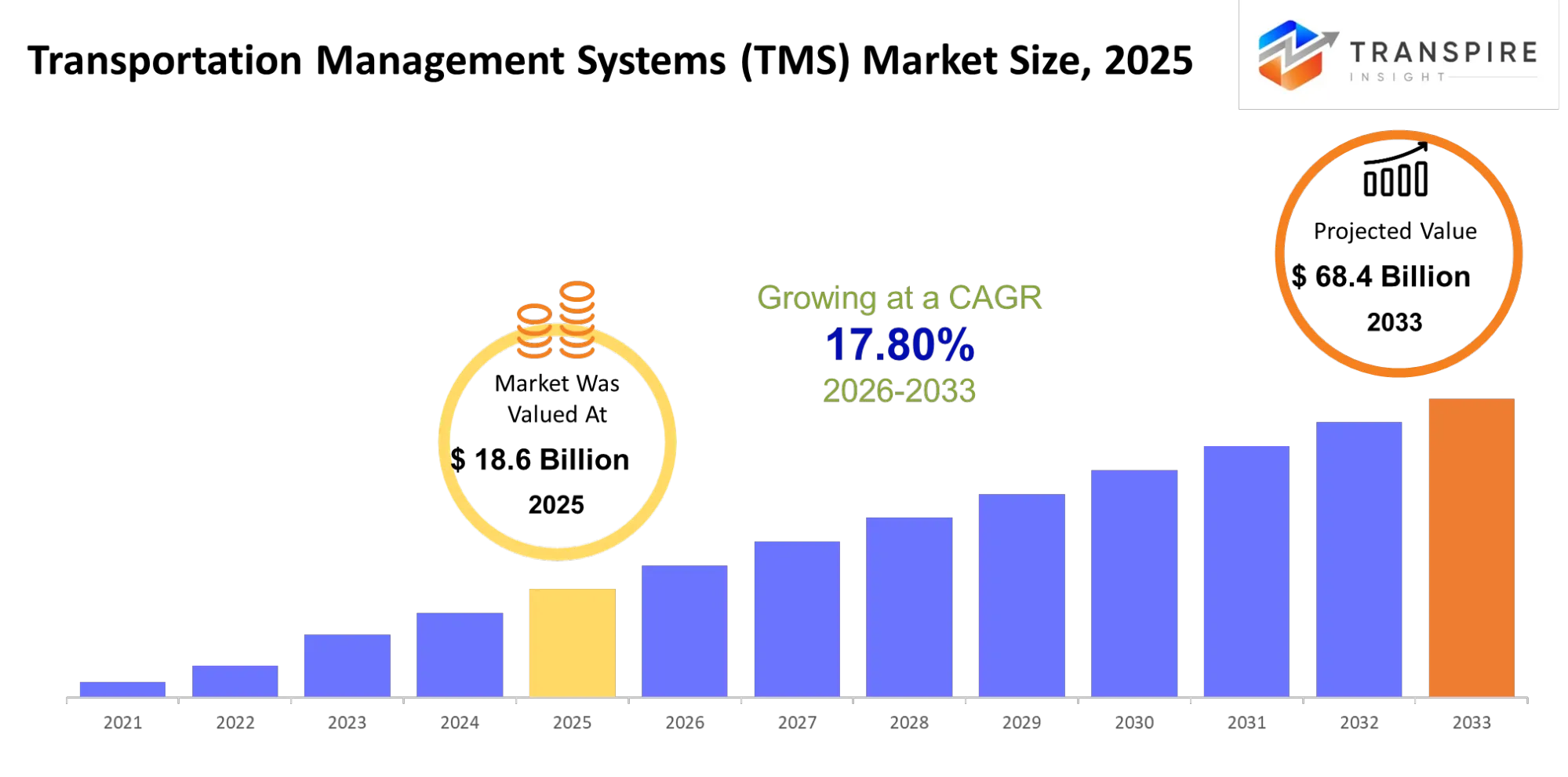
- Market Value (2025): USD 18.6 Billion.
- Expected Market Value (2026): USD 21.8 Billion.
- Estimated Market Value (2033): USD 68.4 Billion.
- Forecast CAGR (2026–2033): 17.80%.
- Leading Region in 2025: North America
- Second-largest Region: Europe
- Fastest Growing Region: Asia Pacific
Introduction
A Transportation Management System is a part of supply chain management software that is created to facilitate proper planning, execution, and optimization of goods, both incoming and outgoing, ensuring that the shipping process remains legal, cost-efficient, and traceable. The part of supply chain management that is centered around freight shipping, choosing the carrier, and optimizing shipment routing. A Transportation Management System (TMS) is a type of digital transportation platform (like the ones provided by SAP) that makes logistics easier by allowing shipment planning and optimization, real-time tracking, selection of carriers and automation in billing. The Transportation Management Systems (TMS) enable a high operational efficiency by helping in saving freight procurement costs, optimizing fuel usage, and shrinking overall transportation costs through effective route planning and automated carrier rate comparisons. Its real-time visibility function helps track and check the status of shipments while being transported from one point to another and increases transparency and control over the supply chain. Advanced process automation improves the efficiency of load planning, carrier booking, freight payment, and documentation processes. TMS solutions also help improve customer satisfaction by increasing the accuracy of deliveries, sending automated notifications about shipments, and allowing customers to use self-service to track their packages.
- For instance: North America is the primary regional hub in the rapidly growing worldwide Transportation Management Systems (TMS) industry, which is fueled by supply chain digitalization, cloud computing, and e-commerce. Grand View Research provides in-depth analysis of how technological investments are influencing this sector.
Market Highlights: -
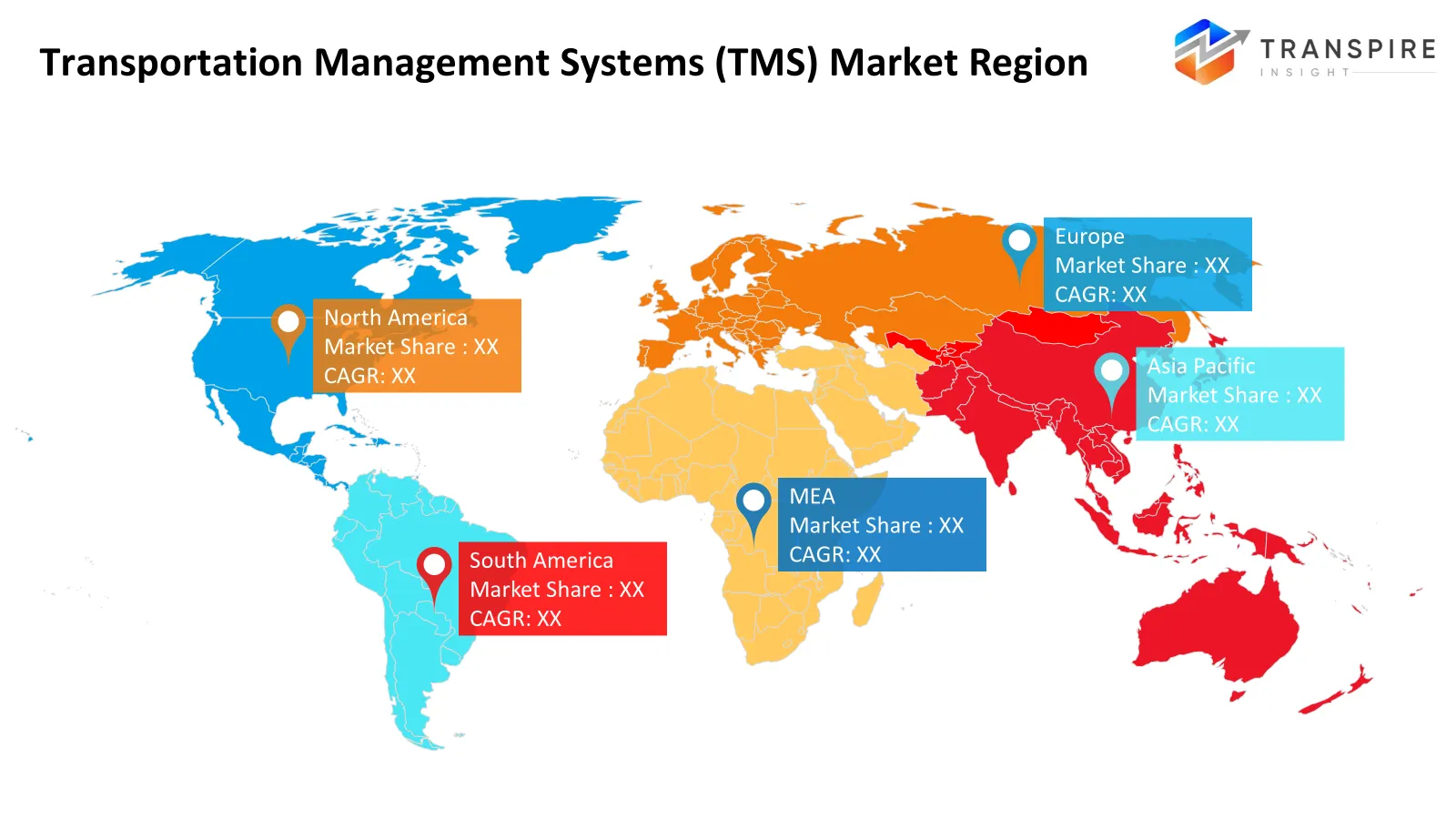
1.North America is expected to grow at a rapid CAGR in the Transportation Management Systems (TMS) Market by holding roughly 34% of the share during the forecast period.
2.Europe is anticipated to hold around 25% share of the Transportation Management Systems (TMS) Market over the predicted timeframe.
3.Asia Pacific is anticipated to hold roughly 23% share of the Transportation Management Systems (TMS) Market over the predicted timeframe.
4.By components, the Software segment dominated the market and holds nearly 69% share in 2025 and is projected to grow at a substantial CAGR during the forecast period.
5.By deployment, the Public Cloud segment dominated the market and holds nearly 62% share in 2025 and is projected to grow at a substantial CAGR during the forecast period.
6.By end users, the Retail & E-commerce segment dominated the market and holds nearly 22% share in 2025 and is projected to grow at a substantial CAGR during the forecast period.
7.With India’s National Logistics Policy and the Unified Logistics Interface Platform (ULIP) being rolled out, the process of digital transformation within the logistics industry is advancing rapidly. The aim of this policy is to connect numerous transportation databases through the use of application programming interface (API) technology, thus allowing local logistics providers and companies to adopt better Transportation Management System (TMS) solutions.
How is Technology Driving Growth in the Transportation Management Systems (TMS) Market?
Cloud computing (SaaS), artificial intelligence (AI), machine learning (ML), and IoT technologies are changing the landscape of the Transportation Management Systems (TMS) Market by enabling scalability, automation, and efficiency in operations. Cloud-based TMS solutions provide flexible pay-as-you-go options that lower infrastructure spending and aid in quick adoption by small and mid-sized companies. AI and ML improve logistics effectiveness through predictive analysis, freight auditing, routing optimization, and minimizing operations errors. Integrating IoT connects telematics information from vehicles, GPS information, and smart sensors to facilitate shipment visibility and tracking in real time, cold chain monitoring, proactive exception handling, and predictive maintenance, therefore contributing to enhancing efficiency in the supply chain and enabling digital transformation of transportation.
Market Drivers
E-commerce and omnichannel retail expansion are changing the Transportation Management Systems (TMS) Market by increasing package volumes and shortening distribution times, resulting in fast-growing demand for route-planning and dispatcher solutions, as well as improvement in carrier management. The widespread use of such technologies as AI, ML and IoT allows receiving ETA predictions, having real-time information about the fleet and enabling automated freight auditing. Increasing costs make the companies search for solutions such as load optimization, dynamic selection of carriers, and transportation analytics. Additionally, efforts to reach sustainability goals and fulfill regulatory requirements concerning ecological footprint are stimulating the use of electronic freight systems and improved transportation management technologies. The implementation of Transportation Management Systems (TMS) simplifies operations by minimizing transport expenses. Automated rate comparisons allow for reducing costs effectively, while streamlined shipments and smart invoice auditing processes also contribute to the significant cuts in freight transportation expenses. Furthermore, TMS improves speed and efficiency of shipping with the help of real-time tracking and monitoring features that provide users with dashboards on transport vehicles being used as well as their location via different types of transport (air, land, sea, etc.). More advanced algorithms of route optimization can find an optimal path based on multiple factors such as road traffic, weather, type of transport, etc. Finally, automation of any administrative process allows for fast documentation and customs clearance while reducing the risk of mistakes.
- For Instance: - Supply chain automation, cloud integration, and the growth of e-commerce are driving the Transportation Management Systems (TMS) market. Russia's domestic logistics software industry has been essentially cut off from key worldwide TMS systems (such as SAP, Oracle, and Blue Yonder) due to western sanctions and trade isolation, and local investments have completely shifted onto domestic or alternative sovereign digital corridors.
- The Transportation Management Systems (TMS) market is expanding rapidly as a result of supply chain digitization, cloud usage, and e-commerce growth, with substantial regional investment focused on South Africa as a major African logistics hub.
Restrain
The Transportation Management Systems (TMS) Market encounters hurdles such as high costs of implementation, intricate software development, concerns about cybersecurity, and lack of skilled personnel. Major expenditures for implementation, maintenance, and upgrades can prevent this technology from being accepted by small enterprises. Moreover, merging TMS software solutions with old infrastructures while ensuring safety and developing digital logistics skills is the main roadblock blocking the way of TMS to mass acceptance.
Analysis of Prices and Consumer Behaviour
Most of the transportation management systems (TMS) market is made up of cloud-based solutions accounting for almost 55–60% of the overall market. The reason behind this is the growing number of logistics providers, vendors, manufacturers, retailers, and e-commerce players with a growing interest in digital supply chain management solutions. It is expected that the price of an advanced AI-powered transportation management system would be approximately 20–30% higher than traditional systems due to its more advanced technology including predictive analytics, automation, real-time tracking, and optimization. It is indicated that about 50% of all different TMS integrations globally are cloud-based, which is mainly because cloud-based solutions provide organizations with flexibility and lower hosting costs. Companies operating in logistics, transportation, and supply chain represent around 65–70% of all TMS needs. It is noted that nearly 60% of businesses give high priority to real-time visibility, operational efficiency, and integration of systems when making purchasing decisions. Among other things, about 30–35% of businesses tend to sign yearly software contracts or have subscription-based agreements with TMS companies in order to decrease the costs of implementation and get access to advanced solutions on a permanent basis.
Top Companies in the Transportation Management Systems (TMS) Market
- Oracle
- SAP
- Blue Yonder
- Manhattan Associates
- Descartes Systems Group
- Trimble
- MercuryGate
- e2open
- Körber
- Infor
- IBM
- Oracle Transportation Management
- WiseTech Global
- Transporeon
- Epicor
Market Segmentation
The Transportation Management Systems (TMS) Market share is divided into five categories: By component, deployment, transportation mode, end user and enterprise size.
The Software dominated the market, accounting for nearly 69% in 2025 and is expected to rise at a significant CAGR during the forecast period.
The Transportation Management Systems (TMS) Market is segmented by component into Software, Services, Consulting, Managed Services, Support & Maintenance, Integration Services, Analytics Solutions, Others. Among these, the Software segment dominated the market, accounting for nearly 69% in 2025 and expected to increase at a significant CAGR during the forecast period. The software sector led the TMS Market globally, having nearly 69% of the market share in 2025, with developments in the demand for cloud-based platforms, automation, and advanced logistics management systems being the key drivers of this industry growth. Transportation management software allows for visibility in real-time, route optimization, planning of shipments, and integration with various enterprises' systems. The growing inclination towards digital transformation, rise of e-commerce, and the constant need for more efficient supply chain activities shall augment the adoption of software and support high CAGR during the time period in question.
The Public Cloud dominated the market, accounting for nearly 62% in 2025, and is expected to rise at a significant CAGR during the forecast period.
The Transportation Management Systems (TMS) Market is segmented by deployment into Cloud-based, On-premise, Hybrid, Multi-cloud, Private Cloud, Public Cloud, Edge Deployment, Others. Among these, the Public Cloud segment dominated the market, accounting for nearly 62% in 2025 and expected to increase at a significant CAGR during the forecast period. The Transportation Management Systems (TMS) Market was headed by the public cloud segment with nearly 62% of the total market performing business in 2025, attributed towards it being a highly cost-effective and flexible logistics technology solution. The TMS solution built on public cloud technology, no doubt supports fast deployment of systems while reducing infrastructural costs associated with deploying it. Integration of the platform with an organization’s IT framework can enable real-time data access. The increasing trend of businesses opting for the service to boost their workflow and provide high visibility will be contributing positively towards the segment growth.
The Retail & E-commerce dominated the market, accounting for nearly 22% in 2025 and is expected to rise at a significant CAGR during the forecast period.
The Transportation Management Systems (TMS) Market is segmented by end user into Retail & E-commerce, Manufacturing, Logistics Providers, Healthcare, Automotive, Food & Beverage, Government, Others. Among these, the Retail & E-commerce segment dominated the market, accounting for nearly 22% in 2025 and expected to increase at a significant CAGR during the forecast period. The Retail & E-commerce sector took the lead in the Transportation Management Systems Market, with nearly 22% of the overall market share projected for 2025 due to the increasing e-commerce growth, rising volume of parcels, and the demand for speedy deliveries. TMS solutions assist retailers in route optimization, carrier management, tracking, and enhanced efficiency of supply chains. Implementation of omnichannel retail strategies, automated logistics operations, and real-time tracking is expected to contribute significantly to the expected CAGR growth throughout the forecast period.
Regional Segment Analysis of the Transportation Management Systems (TMS) Market:
- North America (U.S., Canada, Mexico)
- Europe (Germany, France, U.K., Italy, Spain, Rest of Europe)
- Asia-Pacific (China, Japan, India, Rest of APAC)
- South America (Brazil and the Rest of South America)
- The Middle East and Africa (UAE, South Africa, Rest of MEA)
North America is the fastest-growing region in the Transportation Management Systems (TMS) Market during the period, holding roughly34%share.
North America is expected to grow at a rapid CAGR in the Transportation Management Systems (TMS) Market holding roughly 34% share during the forecast period. North America is the fastest-growing region in the Transportation Management Systems (TMS) Market as it has a share of about 34% due to advanced logistics infrastructure, rapid cloud-based TMS platforms adoption, and effective digital transformation initiatives. The growing e-commerce sector, modernization of the supply chain, integration of AI, and need for real-time transportation visibility are contributing to the expansion of the regional market.
Europe is expected to grow at a rapid CAGR in theTransportation Management Systems (TMS) Market, holding around25%of the share during the forecast period.
Europe is expected to grow at a rapid CAGR in the Transportation Management Systems (TMS) Market holding around 25% share during the forecast period. Europe is poised for robust growth in the Transportation Management Systems (TMS) market, predicted to occupy nearly 25% of the market share in the years to come, driven largely by the growing logistics digitization, e-commerce boom, and improved development in the supply chain. Further growth of the market is ensured mainly by the utilization of cloud-based TMS solutions, compliance with regulations, the need for sustainability, and effective transportation visibility.
Asia Pacific is the fastest-growing region in the Transportation Management Systems (TMS) Market during the period, holding roughly23%share.
Asia Pacific is the fastest-growing region in the Transportation Management Systems (TMS) Market during the forecast period, holding roughly 23% share during the forecast period. Asia Pacific claims the title of fastest growing region in Transportation Management Systems (TMS) Market and taking around 23% share in this industry, with rapid growth of e-commerce, improved logistics infrastructure and widespread usage of digital supply chain solutions being the main drivers of this trend. Emerging investments in cloud-based TMS platforms, deployment of automation and providing real time shipment tracking are the processes that are modernizing the logistic management in this territory.
Strategies for Market Growth in Non-Leading Regions:
Implementing efficient and scalable TMS technologies for the growth of non-leading economies would be beneficial for small and medium-sized logistics providers and enterprises. Implementing advanced transportation management systems, cloud-based solutions, and regional logistics optimization services at local level would result in eliminating operational inefficiencies by enhancing supply chain visibility and minimizing transportation costs. Developing relations with logistics companies, tech providers, freight operators, producers, and distribution networks will help to successfully expand the market for TMS solutions. In order to become aware of TMS implementation issues, route optimization, digital logistics management, and supply chain automation, specific training programs and improvement of technical skills will be required. Apart from that, flexible financing and long-lasting technology partnership along with provision of managed services is important for TMS adoption by the businesses.
Future Market Trends for the Transportation Management Systems (TMS) Market: -
1.Artificial Intelligence and Predictive ETAs: Employing machine learning to determine arrival times more accurately and reduce detention fees.
2.Cloud-Native SaaS: Transitioning from traditional on-premise software systems to modern pay-as-you-use cloud solutions that lower the initial investment.
3.Real-Time Visibility: Utilizing the combination of IoT sensors and GPS monitoring to keep track of shipments at all times.
Recent Development
- In June 2026: Trimble reinforced its presence in the TMS arena via advancements in TMS technology that is cloud-based and suitable for shippers. There have been enhancements to provide real-time visibility, automated workflows, and improved supply chain efficiency. This is in response to the increased demand for digital logistics platforms that allow organizations to become more efficient in terms of their transportation operations and reduce costs.
- In June 2026: The Descartes Systems Group improved its transportation management services through an introduction of advanced carrier management and compliance tracking features in its digital logistics platform. These improvements provide support for automated audit trails, carrier-selection visibility, and regulatory compliance management, helping companies improve transportation efficiency.
Market Segmentation
This study forecasts revenue at global, regional and country levels from 2020 to 2033. Transpire Insights has segmented the Transportation Management Systems (TMS) Market based on the below-mentioned segments:
Transportation Management Systems (TMS) Market, By Component
- Software, Services
- Consulting
- Managed Services
- Support & Maintenance
- Integration Services
- Analytics Solutions
- Others
Transportation Management Systems (TMS) Market, By Deployment
- Cloud-based
- On-premise
- Hybrid
- Multi-cloud
- Private Cloud
- Public Cloud
- Edge Deployment
- Others
Transportation Management Systems (TMS) Market, By Transportation Mode
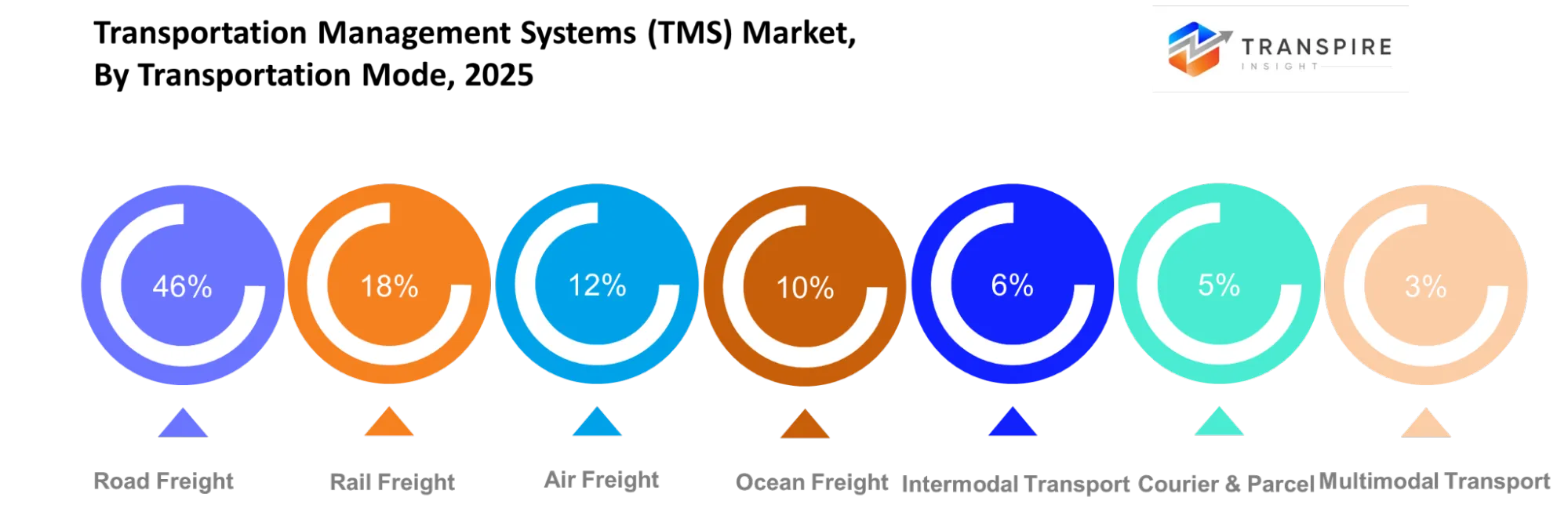
- Road Freight
- Rail Freight
- Air Freight
- Ocean Freight
- Intermodal Transport
- Courier & Parcel
- Multimodal Transport
- Others
Transportation Management Systems (TMS) Market, By End User
- Retail & E-commerce
- Manufacturing
- Logistics Providers
- Healthcare
- Automotive
- Food & Beverage
- Government
- Others
Transportation Management Systems (TMS) Market, By Enterprise Size
- Large Enterprises
- SMEs
- Logistics Startups
- Government Organizations
- Third-party Logistics Providers
- Freight Brokers
- Fleet Operators
- Others
Transportation Management Systems (TMS) Market, By Regional Analysis
North America
- United States
- Canada
- Mexico
Europe
- Germany
- United Kingdom
- France
- Spain
- Italy
- Rest of Europe
Asia Pacific
- Japan
- China
- Australia & New Zealand
- South Korea
- India
- Rest of Asia Pacific
South America
- Brazil
- Argentina
- Rest of South America
Middle East & Africa
- Saudi Arabia
- United Arab Emirates
- South Africa
- Rest of the Middle East & Africa
Frequently Asked Questions
Find quick answers to common questions.
The market will reach USD 68.4 billion by 2033, growing at a 17.80% CAGR.
Software dominates with 69% share due to cloud adoption, automation, and advanced logistics optimization solutions.
North America leads due to digital logistics infrastructure, cloud adoption, e-commerce growth, and supply chain modernization.
AI, IoT, cloud computing, and predictive analytics are enhancing transportation efficiency and digital supply chain transformation.
Retail, e-commerce, manufacturing, logistics, healthcare, and automotive industries use TMS for optimized transportation operations.
- Oracle
- SAP
- Blue Yonder
- Manhattan Associates
- Descartes Systems Group
- Trimble
- MercuryGate
- e2open
- Körber
- Infor
- IBM
- Oracle Transportation Management
- WiseTech Global
- Transporeon
- Epicor
About the Authors

Mayur Shinde
I am Mayur Shinde, a Senior Research Analyst at Transpire Insight, specializing in the Automotive & Transportation and Information & Communication Technology (ICT) Industry. My work focuses on analyzing emerging market trends, technological advancements, competitive landscapes, and industry developments to deliver accurate, data-driven insights. I am passionate about transforming complex market information into clear, actionable content that helps businesses, professionals, and decision-makers stay informed and make confident strategic decisions.

Chakradhar Khansole
Chakradhar serves as the Research Director at Transpire Insight, bringing over 8 years of experience in technology, innovation, and strategic market intelligence. He specializes in transforming complex market data into actionable business insights that enable organizations to make informed, growth-oriented decisions. Recognized for his strategic vision and analytical expertise, Chakradhar leads high-impact research initiatives, delivering comprehensive market assessments, competitive intelligence, and forward-looking industry analysis.
Recently Published Reports
-
Apr 2026
3D Optical Profiler Market
3D Optical Profiler Market Size, Share & Analysis Report By Type (Desktop 3D Optical Profiler, and Portable 3D Optical Profiler), By Technology (Confocal Technology, and White Light Interference), By End-Use Industry (Manufacturing, Research Institutions, Automotive, Aerospace and Defense, Medical Devices, and Other), and Geography (North America, Europe, Asia-Pacific, Middle East and Africa, South and Central America), 2021 - 2031
-
Apr 2026
Depth Sensor Market
Depth Sensor Market Size, Share & Analysis Report By Type (Infrared Depth Sensors, Time-of-Flight (ToF) Sensors, Stereo Vision Sensors, Structured Light Sensors, Ultrasonic Depth Sensors), By Application (Automotive, Robotics, Gaming, Consumer Electronics, Industrial Automation, Healthcare, Security & Surveillance, Others), By End Users (Automotive Manufacturers, Consumer Electronics Companies, Healthcare Providers, Industrial Companies, Security Agencies, Gaming Companies, Robotics Companies, Others), and Geography (North America, Europe, Asia-Pacific, Middle East and Africa, South and Central America), 2021 – 2031
-
Apr 2026
Digital Manufacturing Market
Digital Manufacturing Market Size, Share & Analysis Report By Component (Hardware, Software, and Services), By Technology (Robotics, 3D Printing, Internet of Things (IoT), and Others), By Application (Automotive and Transportation, Aerospace and Defense, Consumer Electronics, Industrial Machinery, and Others), By Process Type (Computer-Based Designing, Computer-Based Simulation, Computer 3D Visualization, Analytics, and Others), and Geography (North America, Europe, Asia-Pacific, Middle East and Africa, South and Central America), 2021 – 2031
-
Apr 2026
Digital Visa Services Market
Digital Visa Services Market Size, Share & Analysis Report By Type (Individual Travelers, Group Travelers), By Application (Tourism, Business Travel, Others), and Geography (North America, Europe, Asia-Pacific, Middle East and Africa, South and Central America), 2021 – 2031