

South Korea Sugar Confectionery Market Size & Forecast:
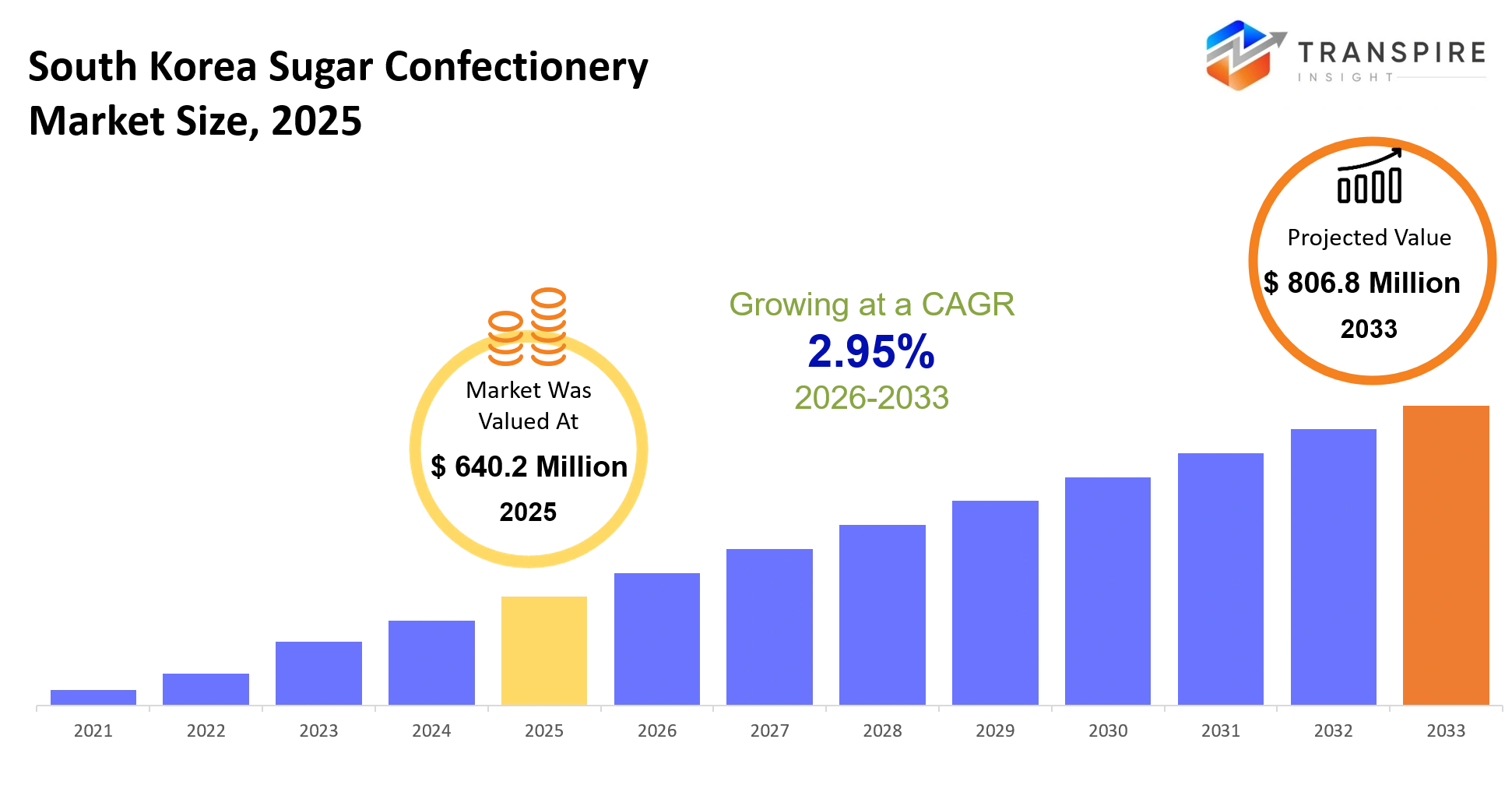
- South Korea Sugar Confectionery Market Size 2025: USD 640.2 Million
- South Korea Sugar Confectionery Market Size 2033: USD 806.8 Million
- South Korea Sugar Confectionery Market CAGR: 2.95%
- South Korea Sugar Confectionery Market Segments: By Product Type (Hard-boiled Candies, Gummies & Jellies, Toffees & Caramels, Lollipops, Others); By Flavor (Fruit Flavors, Chocolate Flavors, Mint Flavors, Mixed Flavors, Others); By Distribution Channel (Supermarkets, Convenience Stores, Online Retail, Specialty Stores, Others); By Packaging Type (Pouches, Boxes, Sachets, Jars, Others); By End User (Children, Teenagers, Adults, Others)
To learn more about this report,  Download Free Sample Report
South Korea Sugar Confectionery Market Summary
The South Korea Sugar Confectionery Market was valued at USD 640.2 billion in 2025. It is forecast to reach USD 806.8 billion by 2033. That is a CAGR of 2.95% over the period.
The South Korea Sugar Confectionery Market sort of runs like a small but useful cog inside the wider country consumer goods ecosystem, mostly because it gives affordable, easy-to-carry treats that fit impulse buys, tiny gifting moments and even that everyday munching routine. Sugar confectionery items are typically placed across convenience stores, supermarkets, vending stations and e-commerce platforms, so it stays pretty steady as a slice of the fast-moving consumer goods stream.
Over the last five years, there has been a noticeable structural shift, it leans more into premiumization and product diversification, not just plain sweetness. Producers kind of moved beyond the typical candy assortment and started rolling out functional varieties, low-sugar choices, and texture-first products, which end up sounding attractive to a wider spread of ages. One driver that helped this change gather pace was the disruption in global sugar, and other ingredient supply channels, after the COVID-19 period, plus the later swings in commodity prices too. In that kind of environment, manufacturers had to revisit their sourcing methods and also revise their recipes a bit.
And honestly, as brands keep unveiling differentiated items with higher value per pack and strengthen their omnichannel footprint, sales growth is getting more tied to product innovation and a premium positioning vibe, instead of only chasing bigger volumes.
Key Market Insights
- The Seoul Capital Area is really big in the South Korea Sugar Confectionery Market. It is going to have than 45 percent of the market in 2025. This is because there are a lot of stores in this area.
- Gyeonggi Province also has a part of the market. People in this area have a lot of money to spend. There are many convenience stores.
- The areas around Busan are going to be the growing places for sugar confectionery in the future. This is because more stores are being built in these areas.
- Gummies and Jellies are the popular sugar confectionery products. They will have than 30 percent of the market in 2025. People like to try textures and flavors.
- Hard-boiled candies are the most popular. They are cheap. Can be stored for a long time. Many people like them.
- Special Gummies and Jellies with benefits are going to be very popular soon. They will be different from products.
- Fruit flavors are the popular. They will have than 35 percent of the market in 2025. People like to try fruit flavors.
- Mixed flavors are also popular. Many brands are making products with flavors.
- Mint flavors are becoming popular too. They are good for people who want to feel fresh and healthy.
- Convenience stores are where most people buy sugar confectionery products. They have 40 percent of the market. There are convenience stores, in South Korea.
What are the Key Drivers, Restraints, and Opportunities in the South Korea Sugar Confectionery Market?
Premiumization an d product diversification have turned into kinda the main drivers pushing growth across the South Korea Sugar Confectionery Market. In the last few years, producers have been reacting to shifting consumer buying patterns by rolling out premium gummies, functional candies, and those limited edition flavor line ups. Honestly the push behind this change kinda started when classic confectionery groups started feeling saturated, and when the industry still needed to keep revenue moving even though the domestic market is already pretty mature. So firms gradually leaned toward higher value offerings that bring in better margins than the usual candies. That move has lifted average selling prices, and it has helped manufacturers earn more revenue without depending only on selling more units.
At the same time, South Korea’s aging population plus the falling birth rate is the most noticeable structural limit on market growth. For years, children have taken up a big portion of confectionery demand, so when demographics shift, the impact shows up fast. And unlike a temporary dip tied to the economy, demographic trends develop over decades and they can’t be flipped around quickly just by running business strategies. Because of that, long term volume growth stays capped, while manufacturers end up putting more effort into drawing adult shoppers, which in turn raises marketing spend and product development costs, and it also tightens the path for revenue expansion.
Functional confectionery is showing this real growth path, like it has a decent chance to grow more, in the future. Items that carry vitamins, probiotics, collagen, or even oral health advantages are getting more attention among adult people who want something extra from snacks they already eat. The companies that can blend the usual sweet appeal, with wellbeing oriented components can reach higher margin market sections faster, and then extend past the classic “just for eating” moments.
What Has the Impact of Artificial Intelligence Been on the South Korea Sugar Confectionery Market?
Artificial intelligence and other advanced digital tech are, kind of, steadily reshaping how things run across South Korea’s sugar confectionery space. It’s mostly showing up in manufacturing, quality checks, and the supply chain work. A lot of confectionery producers are now rolling out AI enabled production monitoring setups to handle ingredient dosing, packaging inspections, and also day to day line monitoring. With computer vision, companies can catch product defects, strange shape variations or wrapping problems right as they happen. So there’s less reliance on manual checking, and in general the output stays more consistent.
At the same time, machine learning is now being used in a predictive maintenance kind of way for processing equipment like mixers, molding machines, and packaging setups. By watching vibration signals, temperature readouts, and the wider performance patterns of the machines, manufacturers can sort of flag component issues before they turn into that kind of unplanned downtime. On top of that, AI powered demand forecasting supports better inventory decisions too, so waste gets reduced and production schedules end up matching seasonal purchasing habits. The end result, is more equipment uptime, lower operating costs, and a smoother, more efficient supply chain.
Meanwhile, advanced analytics platforms also support flavor research and consumer direction analysis. They use purchasing behavior, online reviews, and retail sales data, so companies can move faster from idea to iteration, then launch items that feel more tailored. Still, there’s a major sticking point, integrating AI systems with older or legacy manufacturing infrastructure can be expensive. Smaller producers often run into problems with data not being prepared enough, high implementation costs, and the technical know how required to actually run these digital tools correctly.
Key Market Trends
- Since 2021 candy makers have been making premium jelly candies. People want to try textures and kinds of sweets. They are looking for something
- Between 2022 and 2025 candy companies started making candies with sugar because adults want sweets that're better for them.
- Lotte Confectionery and Orion Corporation started making limited edition candies after 2023 to keep people in their candies. By making candies they can come out with things faster.
- People started buying candies from 2021. Now candy companies are trying to sell their candies to people using the internet to advertise their candies.
- The price of sugar was over the place from 2022 to 2024 so candy makers had to find places to get sugar and think about how they buy it.
- Candies with vitamins and good bacteria became popular after 2023 because people want sweets that're good for them too not just as a treat.
- Convenience stores started giving space to premium candies from 2022 to 2025. People are buying them on impulse when they see them and want to try candies.
- Candy companies started using computers to check the quality of their candies after 2022, which helped reduce mistakes in packaging and made production better.
- Candy makers started using packaging after 2023 because people want products that are better, for the environment.
- The way candy companies compete with each other has changed since 2021. Now candy companies focus on making flavors and having a premium brand like candy makers they want their candies to stand out and candy makers do not just try to be the cheapest candy makers are making candies that're special, like premium candies.
South Korea Sugar Confectionery Market Segmentation
By Product Type:
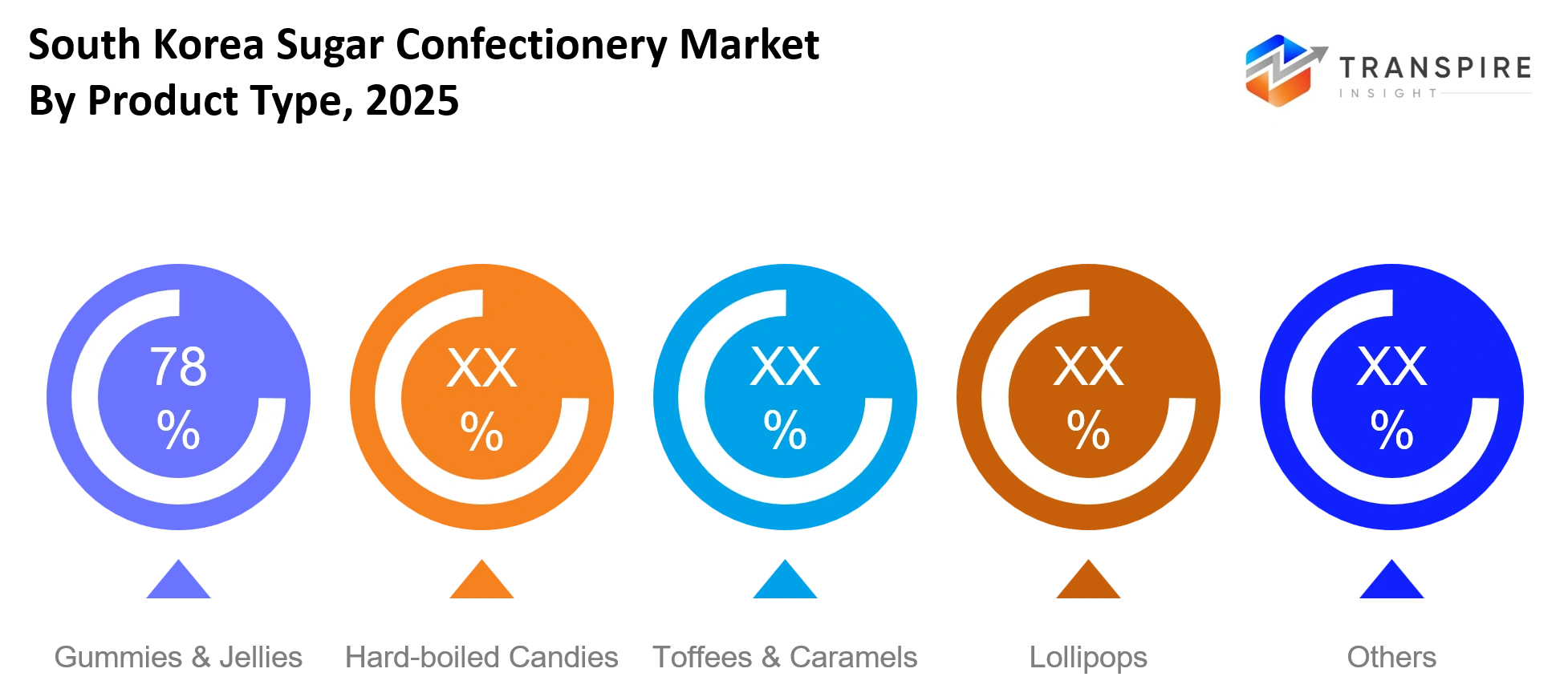
Hard-boiled Candies still hold onto a fairly stable spot in the lineup, mostly because they last forever, they’re affordable and generally liked by a lot of people, yes it’s kind of dependable in a lowkey way. The usual flavors keep turning up in conversations across different age groups, especially in convenience retail, like, all the time. Since they’re reliably on hand and the whole making process is rather straight forward, sales usually stay steady. Manufacturers also do seasonal plus limited edition batches, sort of just to keep consumer curiosity alive, even when demand feels calm or mildly flat.
Gummies & Jellies, meanwhile, have boosted their visibility in a noticeable way, largely because people want special textures fruit-forward tastes and, honestly, more premium ingredients. Toffees & Caramels remain relevant through long-standing snacking habits and those gifting moments that keep repeating each year, no big surprise there. Lollipops are still commonly grabbed for personal munching and quick impulse buys, you know. Then there are the others—specialty items, novelty confectionery products, and related types—which help diversify the category and open the door for new ideas that actually get tested by the market, eventually.
To learn more about this report, Download Free Sample Report
By Flavor:
Fruit Flavors are holding the leading position a lot lately, because they have broad appeal, a wide variety of flavor options, and they work well across many confectionery formats. Citrus, berry, grape, and tropical types keep pulling in solid consumer attention too. There are frequent product launches in this segment, and it helps keep the market moving. Producers often lean on fruit-derived flavor profiles to bring out new items and seasonal selections, even when the campaign is a bit late.
Chocolate Flavors still keep a strong presence, especially in premium confectionery lines and gift-related products. Mint Flavors fit freshness oriented moments and smaller niche categories, in a way that feels refreshing without being heavy. Mixed Flavors also matter because they create differentiation by blending multiple taste impressions into one product, which some shoppers prefer. There are also other options like regional herbal, and specialty flavor profiles that support overall portfolio growth, kind of expanding what a brand can offer at different times.
By Distribution Channel:
Convenience stores sort of stand out as the most influential distribution channel because there’s this wide store network, plus people tend to buy on impulse quite often. Since access is really easy, consumers can grab confectionery products during their everyday routines, like on the way somewhere else. Also, when brands place items near the checkout counters, sales performance basically gets a little extra boost. Then there are these frequent promotional campaigns, they really help the products stay visible across most urban areas.
Supermarkets keep pulling in a big share of sales, mainly through bulk purchases, and these more family focused shopping habits. Online retail has grown at a steady pace too, especially as digital commerce platforms get better and the product choice feels wider. Specialty stores add value by supporting premium and imported confectionery sales, because they carry differentiated product ranges—more curated, in a way. And “others” covers vending machines along with alternative retail formats, those basically widen the overall market reach even further.
By Packaging Type:
Pouches stay the preferred packaging format, basically because they’re portable, convenient, and come with that resealable vibe. Flexible packaging solutions also tend to help with cost efficiency and moving items around without too much hassle. Their strong suitability for single use as well as repeated consumption occasions helps them get taken up across a lot of product categories. In response, product manufacturers are more and more looking into sustainable materials, inside pouch packaging formats, too.
Boxes keep their place for premium confectionery, seasonal promos, and gift based applications. Sachets, on the other hand, back affordability and smaller portioning, so the products become easier to reach for a broader consumer base. Jars still fit well with family sized and bulk buying preferences in selected categories. Other options show up as well—innovative, even customized packaging formats meant to lift shelf appeal and support brand differentiation in a more noticeable way.
By End User:
Children take up a pretty substantial chunk of consumption, mainly because they really have a strong liking for sweet treats, bright packaging and those kind of newer novelty items. A lot of the product designs feel like theyre aimed at younger age groups, maybe through character branding, or those more interactive formats even if it looks pretty straightforward. When buying habits stay consistent demand stays pretty solid across several confectionery categories, so it doesnt really wobble much. Meanwhile promotional activity also nudges category engagement even further
Teenagers land as another key segment, shaped by trends, testing out fresh flavors and honestly, a lot of it comes from social media exposure. Adults are a big part of the overall picture too, mostly via premium buys, functional confections and gift oriented purchasing. More and more manufacturers craft options that suit a more mature palate, and they also move toward wellness focused positioning. Then there are a few other groups in the mix, more niche in practice, with specific buying behaviors and consumption moments that are slightly different from what the broader market does.
What are the Key Use Cases Driving the South Korea Sugar Confectionery Market?
The main use case pushing market adoption seems to be everyday snacking, especially through convenience retail channels. Single serve candies, gummies, and lollipops are commonly bought for fast eating while commuting, during school hours, and during work breaks. Because access is high and prices are pretty easy to reach, this angle becomes the biggest driver behind sales, kind of the largest contributor.
Other use cases are also showing up, like gifting, plus premium confectionery buys. Boxed sweets are getting used more often around seasonal celebrations, holidays, and corporate gifting moments. At the same time adult shoppers are picking up premium and functional confectionery, mainly because it brings differentiated flavors, distinct textures, or added ingredients that feel more intentional.
And then there are the newer applications forming around wellness focused confectionery and customized products. Candies that include vitamins, probiotics, collagen, or oral care ingredients are pulling attention from people who are more health minded. Limited edition items, released via digital channels and influencer collaborations, also look like they can create fresh consumption occasions across the forecast period.
|
Report Metrics |
Details |
|
Market size value in 2025 |
USD 640.2 Billion |
|
Market size value in 2026 |
USD 658.4 Billion |
|
Revenue forecast in 2033 |
USD 806.8 Billion |
|
Growth rate |
CAGR of 2.95% from 2026 to 2033 |
|
Base year |
2025 |
|
Historical data |
2021 - 2024 |
|
Forecast period |
2026 - 2033 |
|
Report coverage |
Revenue forecast, competitive landscape, growth factors, and trends |
|
Regional scope |
United States; Canada; Mexico; United Kingdom; Germany; France; Italy; Spain; Denmark; Sweden; Norway; China; Japan; India; Australia; South Korea; Thailand; Brazil; Argentina; South Africa; Saudi Arabia; United Arab Emirates |
|
Key company profiled |
Lotte Confectionery, Orion Corporation, Haitai Confectionery, Nestlé, Mondelez International, Mars Inc., Haribo, Ferrero, Perfetti Van Melle, Meiji Holdings, Morinaga, Hershey Company, Yildiz Holding, General Mills, Crown Confectionery |
|
Customization scope |
Free report customization (country, regional & segment scope). Avail customized purchase options to meet your exact research needs. |
|
Report Segmentation |
By Product Type (Hard-boiled Candies, Gummies & Jellies, Toffees & Caramels, Lollipops, Others); By Flavor (Fruit Flavors, Chocolate Flavors, Mint Flavors, Mixed Flavors, Others); By Distribution Channel (Supermarkets, Convenience Stores, Online Retail, Specialty Stores, Others); By Packaging Type (Pouches, Boxes, Sachets, Jars, Others); By End User (Children, Teenagers, Adults, Others) |
Which Regions are Driving the South Korea Sugar Confectionery Market Growth?
The Seoul Capital Area keeps feeling like the main hub, mainly because its population density is high, retail take-up is strong, and consumer spending is kind of concentrated there. Big supermarket groups, convenience store chains, and e-commerce fulfillment centers together make distribution run smoothly, almost too efficiently. When new products are released, they often land in this region first, so manufacturers can trial new tastes and premium items before anything wider happens. Good brand presence, solid logistics foundations, and access to a diverse set of shoppers are still what keep it in front.
Gyeonggi Province is coming in as the second-largest contributor, yet the growth vibe is a little different from the Seoul Capital Area. Demand is supported by a blend of residential expansion, steady household consumption, and being close to major manufacturing sites. Here, results depend less on premium urban purchases and more on reliable everyday buying across a wider customer reach. That steadiness turns the province into a dependable stream of revenue for both confectionery manufacturers and retailers.
Meanwhile, the Busan area and the southeastern region is showing the fastest growth momentum, because of ongoing city development, tourism activity, and retail network growth. New spending on commercial zones and modern shopping spaces has improved product availability across various sales routes. In metro areas, younger shoppers seem to show more enthusiasm for premium gummies, functional candy, and special limited-edition releases. If modern retail infrastructure keeps expanding, it’s expected to open up interesting chances for new brands, product creators, and investors, through 2033.
Who are the Key Players in the South Korea Sugar Confectionery Market and How Do They Compete?
Competition in the South Korea sugar confectionery market feels moderately consolidated, like a smaller group of big domestic and outside manufacturers grab a large portion of the retail sales. In practice, the fight is less about price only, and more about newness of products, how strong the brand is, flavor crafting, and how far the distribution can actually go. Most established firms just keep defending their market position with nonstop launches and a premium type of positioning. Meanwhile, smaller niche brands hunt for openings in functional sweets, and also in more specialty types. What often decides results is still things like shelf visibility in retail, how loyal people stay, and how quickly new flavors or formats show up.
Lotte Confectionery leans on wide portfolio diversification, plus solid domestic distribution, they seem comfortable with it. They keep rolling out limited edition items, and even adjust flavors for local taste, which helps keep consumers interested across different age groups, not only one segment. Orion Corporation stands out with fast product development rhythms and a clear know-how around texture centric confectionery, especially for gummy and jelly products. Both companies keep pushing forward via product innovation projects, and they also push deeper partnerships across convenience stores and digital retail channels.
Nestlé and Mondelez International kind of compete by using their global research abilities, plus they lean on internationally recognized brands. In practice product development is usually about premium ingredients, keeping quality steady across places, and adjusting to local taste preferences with a more attentive, almost local touch. Haribo, meanwhile, sets itself apart by specializing in gummies and fruit-based confectionery, and they end up with pretty strong brand recognition inside that narrower category, not trying to be everything. Both companies also tend to push harder on market presence by rolling out new product ideas, building retail partnerships, and expanding their premium confectionery offerings, so they can reach higher-value consumer segments, it’s like a value tier play.
Company List
- Lotte Confectionery
- Orion Corporation
- Haitai Confectionery
- Nestlé
- Mondelez International
- Mars Inc.
- Haribo
- Ferrero
- Perfetti Van Melle
- Meiji Holdings
- Morinaga
- The Hershey Company
- Yildiz Holding
- General Mills
- Crown Confectionery
Recent Development News
In February 2026, Lotte Wellfood launched a new cacao bean processing system at its Yangsan plant. The upgraded production line increased liquefied cacao mass output from 1 ton to 2.5 tons per hour and improved production efficiency by 25%, strengthening domestic chocolate ingredient production and supporting future confectionery innovation.https://www.koreatimes.co.kr
In April 2025, Orion Corporation announced an investment of KRW 830 billion (approximately USD 580 million) in production and logistics facilities. The investment includes development of an integrated manufacturing and logistics complex, expanding production capacity and supporting long-term growth across confectionery categories.https://www.kedglobal.com
What Strategic Insights Define the Future of the South Korea Sugar Confectionery Market?
Over the next five to seven years, the South Korea Sugar Confectionery Market is expected to drift toward a value-driven model, not really the “more units” kind of growth. Product innovation, premium positioning, and the integration of functional ingredients will slowly but surely start to decide who wins. Since demographic trends will limit expansion in the usual consumer groups, manufacturers will aim to squeeze more spending per customer, through differentiated items, a bit of personalization, and digital engagement strategies that feel more direct. In short, the shift tends to favor companies that can respond quickly when consumption preferences change, even when it’s subtle.
There’s also a risk that s not as obvious at first. Premium revenue is getting more concentrated in only a handful of categories and brands. If a company leans too much on a small set of top performers, then any sudden pivot in consumer tastes could hit revenue hard, so you get volatility even if the overall market picture stays positive.
At the same time, there’s an emerging opening: using artificial intelligence for consumer preference analysis and faster product development. Firms that apply predictive analytics to spot flavor trends, and then tune their launches accordingly, should gain a real edge. Market players might want to put money into data-driven innovation platforms, while also strengthening direct consumer feedback channels. That way product development gets more efficient, and the chance of an unsuccessful launch becomes lower, more manageable.
South Korea Sugar Confectionery Market Report Segmentation
By Product Type
- Hard-boiled Candies
- Gummies & Jellies
- Toffees & Caramels
- Lollipops
- Others
By Flavor
- Fruit Flavors
- Chocolate Flavors
- Mint Flavors
- Mixed Flavors
- Others
By Distribution Channel
- Supermarkets
- Convenience Stores
- Online Retail
- Specialty Stores
- Others
By Packaging Type
- Pouches
- Boxes
- Sachets
- Jars
- Others
By End User
- Children
- Teenagers
- Adults
- Others
Frequently Asked Questions
Find quick answers to common questions.
The expected South Korea Sugar Confectionery Market size for the market will be USD 806.8 Million in 2033.
Key segments for the South Korea Sugar Confectionery Market are By Product Type (Hard-boiled Candies, Gummies & Jellies, Toffees & Caramels, Lollipops, Others); By Flavor (Fruit Flavors, Chocolate Flavors, Mint Flavors, Mixed Flavors, Others); By Distribution Channel (Supermarkets, Convenience Stores, Online Retail, Specialty Stores, Others); By Packaging Type (Pouches, Boxes, Sachets, Jars, Others); By End User (Children, Teenagers, Adults, Others).
Major South Korea Sugar Confectionery Market players are Lotte Confectionery, Orion Corporation, Haitai Confectionery, Nestlé, Mondelez International, Mars Inc., Haribo, Ferrero, Perfetti Van Melle, Meiji Holdings, Morinaga, Hershey Company, Yildiz Holding, General Mills, Crown Confectionery.
The South Korea Sugar Confectionery Market size is USD 640.2 Million in 2025.
The South Korea Sugar Confectionery Market CAGR is 2.95% from 2026 to 2033.
- Lotte Confectionery
- Orion Corporation
- Haitai Confectionery
- Nestlé
- Mondelez International
- Mars Inc.
- Haribo
- Ferrero
- Perfetti Van Melle
- Meiji Holdings
- Morinaga
- The Hershey Company
- Yildiz Holding
- General Mills
- Crown Confectionery
About the Authors

Chetan Dhatrak
I’m Chetan Dhatrak, a Senior Research Analyst at Transpire Insight, specializing in the Consumer Goods, Foods and Beverages industry. I focus on analyzing market trends, consumer behavior, competitive landscapes, and industry developments to deliver accurate, data-driven insights. My research at Transpire Insight is built on credible sources and in-depth analysis, helping businesses and readers better understand market dynamics, emerging opportunities, and evolving consumer preferences. I’m committed to creating reliable, well-researched content that supports informed decision-making and reflects the latest developments in the consumer goods and food & beverage sectors.

Chakradhar Khansole
Chakradhar serves as the Research Director at Transpire Insight, bringing over 8 years of experience in technology, innovation, and strategic market intelligence. He specializes in transforming complex market data into actionable business insights that enable organizations to make informed, growth-oriented decisions. Recognized for his strategic vision and analytical expertise, Chakradhar leads high-impact research initiatives, delivering comprehensive market assessments, competitive intelligence, and forward-looking industry analysis.
Recently Published Reports
-
Apr 2026
Baby Infant Formula Market
Baby Infant Formula Market Size, Share & Analysis Report By ype (Infant Milk, Follow On Milk, Specialty Baby Milk, Growing-Up Milk), By Ingredient (Carbohydrate, Fat, Protein, Minerals, Vitamins, and Others), By Product Form (Powder, Liquid, and Ready-to-feed), By Distribution Channels (Supermarket/Hypermarket, Specialty Store, Pharmacies, Online Retail, and Others), and Geography (North America, Europe, Asia-Pacific, Middle East and Africa, South and Central America), 2021 - 2031
-
Apr 2026
Edible Insects for Animal Feed Market
Edible Insects for Animal Feed Market Size, Share & Analysis Report By Type (Insect Powder, Insect Meal, Insect Bar, Insect Paste, Insect Oil, and Others), By Insect Type (Beetles, Cricket, Caterpillar, Hymenoptera, Orthoptera, Tree Bugs, and Others), By Application (Livestock, Pet Food, and Aquaculture), By Livestock Type (Poultry, Swine, and Others), and Geography (North America, Europe, Asia-Pacific, Middle East and Africa, South and Central America), 2021 - 2031
-
Apr 2026
Food Industry Disinfection and Bacterial Control Market
Food Industry Disinfection and Bacterial Control Market Size, Share & Analysis Report By Type (Chemical Disinfectants, Physical Disinfectants, and Biocides and Antimicrobials), By Application (Food Processing Equipment Surface Disinfection, Food Preparation Areas Surface Disinfection, Storage Areas Surface Disinfection, Anti-microbial Coatings Food Preservation, and Preservative Solutions Food Preservation), By End User (Meat and Poultry Processing, Dairy Processing, Seafood Processing, Bakery and Confectionery, Restaurants and Commercial Kitchens, and Food Service Providers), By Sales Channel (Online, Offline), and Geography (North America, Europe, Asia-Pacific, Middle East and Africa, South and Central America), 2021 - 2031
-
May 2026
Freeze Dried Food Market
Freeze Dried Food Market Size, Share & Analysis Report By Product Type (Fruits, Vegetables, Freeze-Dried Dairy Products, Freeze-Dried Meat and Seafood, Freeze-Dried Pet Food, and Prepared Meal), By Nature (Organic, and Conventional), By Form (Powdered, Granules, and Diced), By End Use (Breakfast Cereals, Dairy Products, Bakery & Confectionery, Nutritional Bars & Supplements, Powdered Beverages, Snacks, and Retail (Household)), and Geography (North America, Europe, Asia-Pacific, Middle East and Africa, South and Central America), 2021 - 2031