

South Korea Sucrose Esters Market Size & Forecast:
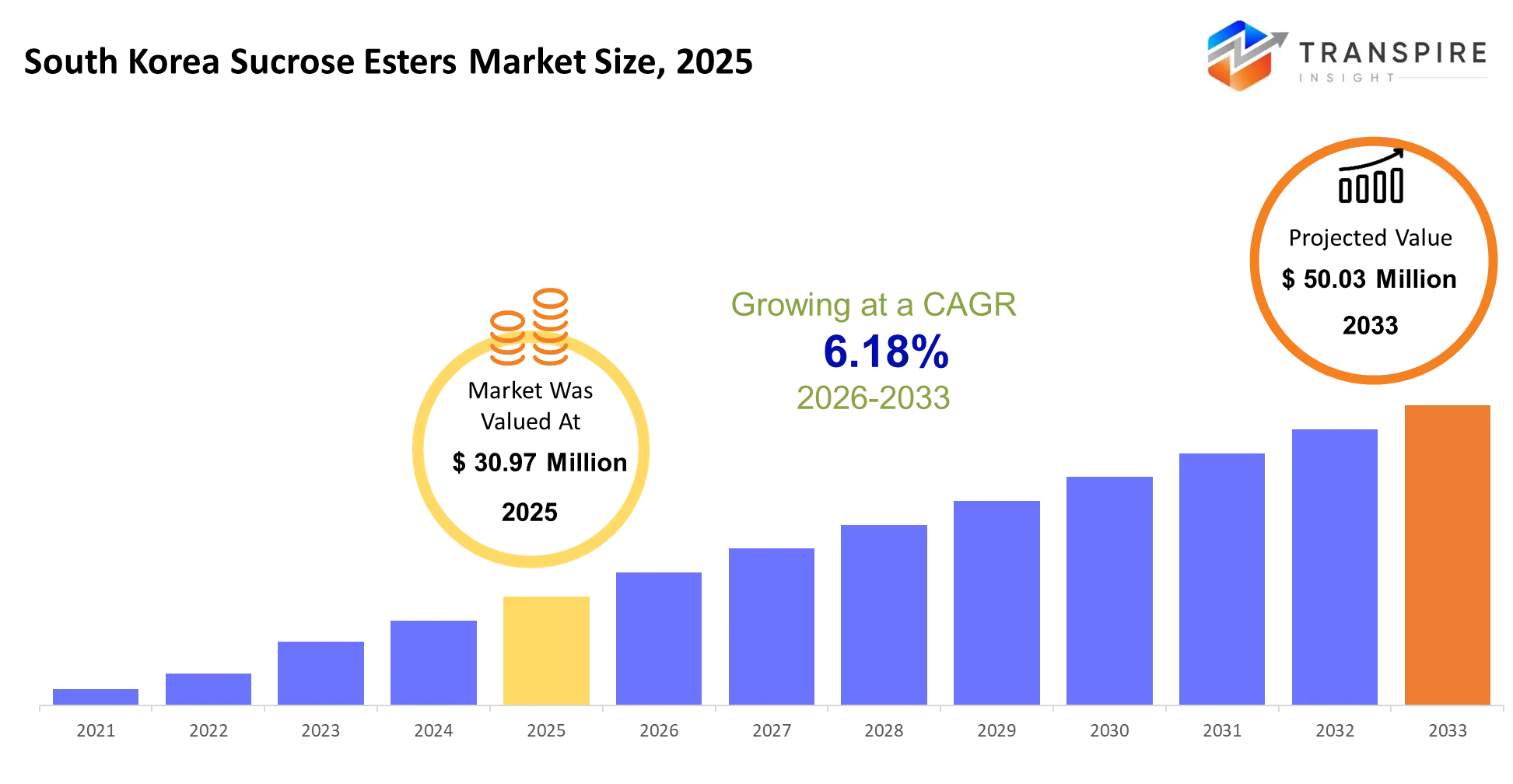
- South Korea Sucrose Esters Market Size 2025: USD 30.97 Million
- South Korea Sucrose Esters Market Size 2033: USD 50.03 Million
- South Korea Sucrose Esters Market CAGR: 6.18%
- South Korea Sucrose Esters Market Segments: By Type (Food Grade Sucrose Esters, Cosmetic Grade Sucrose Esters, Industrial Grade Sucrose Esters, Others); By Application (Food Emulsifiers, Cosmetics & Personal Care, Pharmaceuticals, Industrial Lubricants, Others); By Form (Powder, Liquid, Granules, Others); By End User (Food & Beverage Industry, Cosmetics Industry, Pharmaceutical Industry, Chemical Industry, Others); By Function (Emulsification, Stabilization, Foaming, Dispersion, Others)
To learn more about this report,  Download Free Sample Report
South Korea Sucrose Esters Market Summary
The South Korea Sucrose Esters Market was valued at USD 30.97 Million in 2025. It is forecast to reach USD 50.03 Million by 2033. That is a CAGR of 6.18% over the period.
In South Korea, sucrose esters are mostly used to help processed foods, dairy alternatives, bakery fillings, and K-beauty skincare products stay stable, kinda like swapping out older synthetic emulsifiers and getting a smoother texture, better mouthfeel, all that, plus making the products last longer once they're sitting on shelves. Over the past five years, the market moved away from choosing additives just because they're cheap, and toward formulation plans that feel more clean label, and also line up with export-ready cosmetic requirements.
One big structural change has been the gradual replacement of petrochemical-based surfactants with plant-derived emulsifiers, since both food makers and cosmetic brands are trying to deal with stricter expectations about ingredient visibility, even when it costs a bit more time and effort.
This switch happened faster during the pandemic, when supply chains got messy , and when price swings hit imported palm oil derivative costs, so everyone could see how dependent the industry had been on only a small number of raw material routes. Because of that, more producers leaned on sucrose esters to reduce supply risk, while still matching premium product needs, even if input prices climb. And in the end, this helped back steady revenue growth across both food and personal care uses.
Key Market Insights
- In South Korea, the Seoul–Gyeonggi region kinda leads the Sucrose Esters Market—holding roughly 44–46% share in 2025 , mostly because of how tightly packed food and cosmetics manufacturing clusters are.
- Meanwhile the Busan–Ulsan industrial corridor looks like the quickest riser, expanding at a faster pace through export-focused chemical and processing investments , by 2026–2030.
- On the segmentation side, cosmetic-grade sucrose esters take the second spot, driven by ongoing K-beauty formulation upgrades, and more upgraded lotions and serums.
- For growth momentum, powder-based sucrose esters are showing up as the fastest-growing segment, getting pulled for stable industrial blending and longer shelf-life uses.
- And for end-use, food & beverage applications dominate the South Korea Sucrose Esters Market, with nearly 50% share, particularly in processed foods and dairy alternatives.
- Personal care and cosmetics look like the fastest-growing application area, mostly because clean-label skincare is in demand and sulfate-free formulations keep getting chosen.
- Industrial emulsification needs are also going up, since manufacturers are swapping synthetic surfactants for bio-based alternatives , which is kind of a big shift.
- In 2025, food processing companies hold the biggest share, about 48% , and they’re basically the reason bulk emulsifier consumption stays high.
- On the cosmetics side, manufacturers are showing the quickest end-user growth, linked to export-driven K-beauty product expansion.
- Meanwhile pharmaceutical formulation users are gradually increasing adoption too, mainly for stable drug delivery emulsification systems.
What are the Key Drivers, Restraints, and Opportunities in the South Korea Sucrose Esters Market?
South Korea Sucrose Esters Market growth seems mostly tied to this kind of structural shift toward formulation, reformulation in food and cosmetics, where manufacturers are kind of replacing synthetic emulsifiers with bio based options, not just for trend but for compliance too. It really picked up steam after the ingredient transparency requirements in South Korea’s food labeling framework got stricter, plus export compliance rules in cosmetics markets like the EU and Japan. So when companies change their formulas to keep up, sucrose esters are more often chosen for their multi functional contribution, like stabilization, texture tuning, and shelf-life enhancement. That ends up pushing per unit use higher, and also makes procurement feel more recurring, almost like a cycle that comes back again and again.
Still, the biggest restraint is the production cost, because sucrose esters usually cost more than standard surfactants. You know, the conventional ones made from petrochemical routes, or sometimes cheaper fatty acid esters. The gap is pretty persistent, structurally speaking, since sucrose ester manufacturing needs multi step esterification and tightly managed raw material sourcing, which limits how much prices can drop through scale. Because of that, smaller firms and mid-sized producers often postpone adoption, or they only use sucrose esters in premium product lines, and that basically weakens broader volume growth. In the end it limits revenue scaling especially in price sensitive sections of the South Korea Sucrose Esters Market.
A key opportunity is kind of showing up in precision fermentation based and enzyme catalyzed production methods, and it looks like specialty chemical producers are looking at this while teaming up with Korean biotech startups. There are pilot efforts happening in Gyeonggi Province, where the focus is on higher yield efficiency, and also lower energy use , so that input costs could drop a lot. If that works out, the whole thing may help broaden into mid tier food and personal care products, and in general unlock the next stage of growth.
What Has the Impact of Artificial Intelligence Been on the South Korea Sucrose Esters Market?
Artificial intelligence is getting more and more baked into manufacturing and formulation routines across the South Korea Sucrose Esters Market, especially in chemical production and for food-grade emulsifier work. Companies are increasingly leaning on machine learning guided process control setups, to tune esterification reaction settings like temperature, catalyst level, and mixing cycles, so batches feel more uniform and less material ends up being wasted. On the automated quality side, computer vision plus spectroscopy style AI models can spot impurity levels, along with those small swings in particle size, all in real time. This cuts back the need for constant manual checking, and in turn boosts overall throughput.
At the same time, predictive analytics tools are rolling out to foresee equipment wear inside high-pressure reactors and mixing lines. That way, scheduled maintenance can be planned earlier, which lowers the odds of surprise downtime, and helps keep output steady for export focused supply chains. From the commercial angle, demand forecasting algorithms look at what’s happening downstream with food and cosmetics manufacturers. They help suppliers fine tune production volumes and inventory decisions with better precision, which then supports cost efficiency across the South Korea Sucrose Esters Market too.
Still, the adoption story has limits. The integration expenses are high, and there’s also a shortage of big standardized datasets for specialty chemical formulations. Quite a few production plants still run legacy systems that don’t quite gel with more advanced AI platforms, so rollouts tend to be slow, gradual rather than instant, and it can feel a bit uneven across the market.
Key Market Trends
- After 2023 , the labeling reforms got stricter and food manufacturers sort of stopped leaning on synthetic emulsifiers, and moved toward sucrose esters instead, across basically most packaged food categories .
- In South Korea cosmetic firms then increased sucrose ester integration by around 35% from 2022–2025, kinda responding to those EU export compliance pressures that kept showing up.
- Procurement strategies also changed, going away from bulk commodity buying and turning more toward contract based specialty sourcing, which helped emulsifier manufacturers keep supply stability more reliably.
- Manufacturers like Croda International expanded localized formulation support in 2024, to match K-beauty customization demand trends that are pretty specific .
- Meanwhile supply chain disruptions in 2022–2023 made companies diversify away from palm derived emulsifiers, and they leaned more into sucrose based alternatives, overall.
- Later on, after 2023, advanced reactor automation was adopted, and this improved batch consistency, so production variability dropped in sucrose ester manufacturing sites.
- Then in 2024 , demand forecasting models were introduced, which boosted inventory accuracy by as much as 20% and reduced overproduction across chemical suppliers , at the same time .
South Korea Sucrose Esters Market Segmentation
By Type:
Food Grade Sucrose Esters are ending up in more routines because they get strong adoption in bakery, dairy, and other processed foods where a stable emulsification really helps texture, and also tends to support longer shelf life. Cosmetic Grade Sucrose Esters then see steady uptake too, especially in K-beauty type formulations that like mild, plant based ingredients, kind of a gentle profile.
On the other side, Industrial Grade Sucrose Esters, along with several related variants, stick to more niche situations like technical formulations and specialized blending setups. Overall demand seems to rise slowly, showing a gradual shift away from some synthetic emulsifiers toward safer and more dependable plant derived options across manufacturing lines in South Korea.
By Application:
Food emulsifiers in particular still dominate, mostly because producers lean on sucrose esters to get steady texture control, and product stability across those processed food production lines. In cosmetics and personal care, growth keeps climbing as people increasingly choose gentle bio based formulation systems, especially in skincare products.
For pharmaceuticals the expansion is slower but it does move forward, since sucrose esters can help support controlled drug dispersion. Industrial lubricants and other uses stay comparatively limited but they keep developing where stable emulsification improves performance, and helps formulation efficiency across chemical processing environments.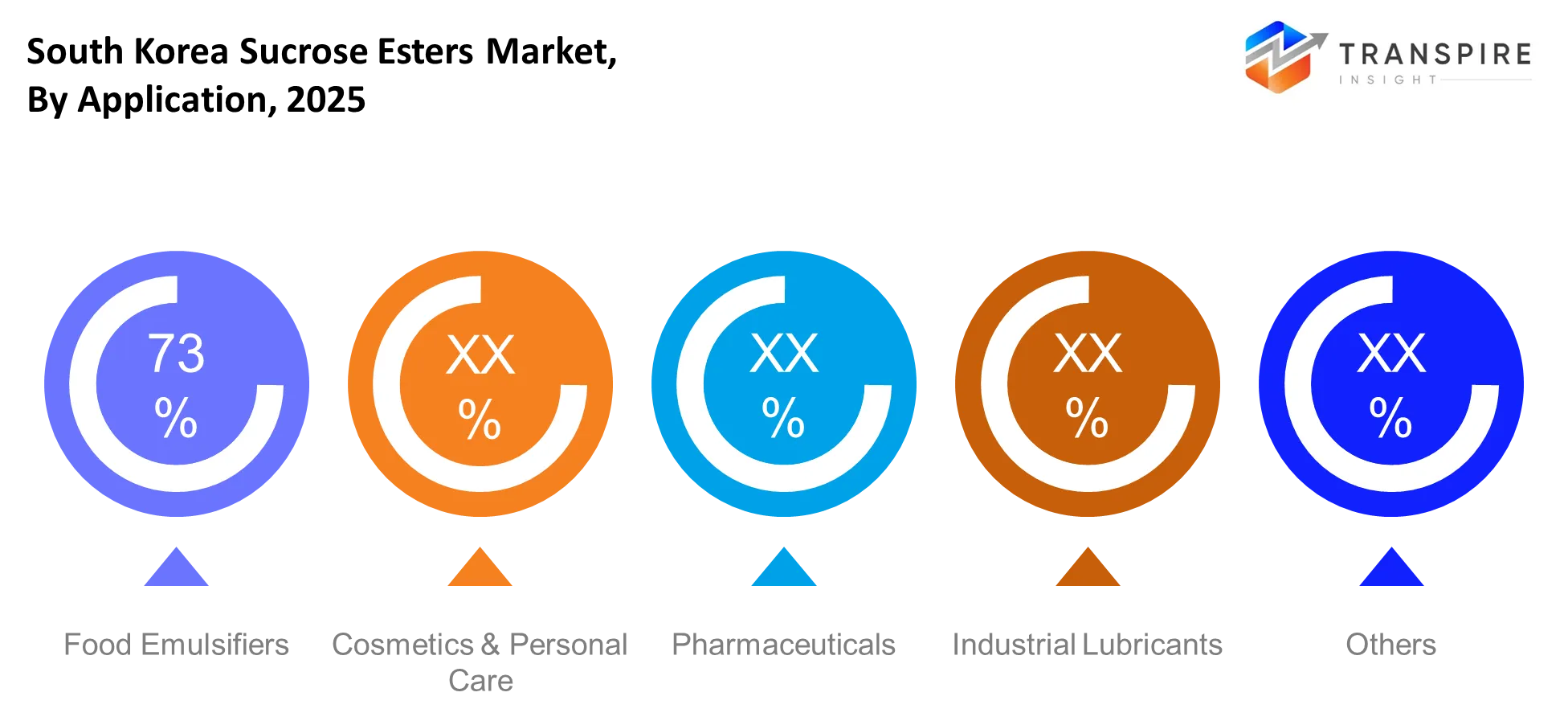
To learn more about this report, Download Free Sample Report
By Form:
Powder form stays pretty much the most widely used, mainly because it’s easy to deal with , it lasts longer in storage, and it matches well with dry blending systems in both food and cosmetic production. Liquid forms, in contrast, help dispersion feel faster when you run high-speed processing lines and yeah, they just spread out quicker.
Granules plus a few other variants get chosen in a more selective way, especially when someone needs tighter dosing, and also less dust in the air. Overall, the choice of form is still moving toward operational efficiency, and more process automation in modern production plants across South Korea.
By End User:
In food and beverage, demand leads the whole thing, since manufacturers are adding sucrose esters to get better stability and improved texture in packaged items. In cosmetics, growth is strong too, mostly because formulations are shifting toward clean-label skincare systems and similar “simple ingredient” approaches.
Meanwhile, pharmaceutical and chemical industries bring sucrose esters in for controlled emulsification and dispersion tasks. Other end users stay smaller, but they gradually expand, as production standards start leaning more toward safer, more steady ingredient systems, and that direction keeps getting stronger over time..
By Function:
Emulsification is still the central thing, since sucrose esters help meld the oil and water parts in a pretty smooth way, for both food and cosmetic products . Stabilization, well that one supports longer shelf lives, and keeps the product quality steady between manufacturing batches, even when conditions shift a bit.
Meanwhile foaming and dispersion functions are getting more attention, especially in specialty formulas where texture guidance matters and ingredients need to be spread out in a uniform manner. The functional need just keeps rising, because many makers are swapping synthetic additives for calmer plant based alternatives that tend to be more stable.
What are the Key Use Cases Driving the South Korea Sucrose Esters Market?
Food and beverage processing is still the main thing in the South Korea Sucrose Esters Market, mainly in bakery, dairy, and ready-to-eat items where emulsification plus texture stability really impact what customers get. Most manufacturers use sucrose esters, kind of as a substitute for synthetic additives while also aligning with tighter ingredient disclosure requirements and export conditions. That combination tends to keep the demand steady especially for big, high-volume food processors.
Cosmetics and personal care uses are growing fast too, driven by K-beauty brands who are reformulating skincare with milder, plant sourced emulsifiers. In a similar direction, pharmaceutical formulation is picking up, especially inside controlled drug delivery setups where a consistent dispersion helps improve overall product behavior. Mostly, these applications come from mid-sized to large manufacturers, and they are going after premium focused, export oriented product portfolios.
Newer applications are starting to appear as well, for example functional nutraceutical products and advanced bio based coatings meant for specialty packaging. Those are early stages right now but the signal looks strong, as regulatory pressure keeps rising against synthetic additives and companies keep looking for multi-functional ingredient options that support more sustainable product development.
|
Report Metrics |
Details |
|
Market size value in 2025 |
USD 30.97 Million |
|
Market size value in 2026 |
USD 32.88 Million |
|
Revenue forecast in 2033 |
USD 50.03 Million |
|
Growth rate |
CAGR of 6.18% from 2026 to 2033 |
|
Base year |
2025 |
|
Historical data |
2021 - 2024 |
|
Forecast period |
2026 - 2033 |
|
Report coverage |
Revenue forecast, competitive landscape, growth factors, and trends |
|
Country scope |
South Korea |
|
Key company profiled |
Mitsubishi Chemical, Dai-Ichi Kogyo Seiyaku, Sisterna, BASF, Croda International, Evonik Industries, P&G Chemicals, Stearinerie Dubois, Compass Foods, Zhejiang Synose Tech, Guangzhou ZIO Chemical, Ryoto Sugar Ester, DK Ester, Cargill, Kerry Group |
|
Customization scope |
Free report customization (country, regional & segment scope). Avail customized purchase options to meet your exact research needs. |
|
Report Segmentation |
By Type (Food Grade Sucrose Esters, Cosmetic Grade Sucrose Esters, Industrial Grade Sucrose Esters, Others); By Application (Food Emulsifiers, Cosmetics & Personal Care, Pharmaceuticals, Industrial Lubricants, Others); By Form (Powder, Liquid, Granules, Others); By End User (Food & Beverage Industry, Cosmetics Industry, Pharmaceutical Industry, Chemical Industry, Others); By Function (Emulsification, Stabilization, Foaming, Dispersion, Others) |
Which Regions are Driving the South Korea Sucrose Esters Market Growth?
Seoul plus the surrounding Gyeonggi area seems to lead the South Korea Sucrose Esters Market a lot, mainly because so many food processing giants, and also advanced cosmetics manufacturing clusters, are concentrated there. With strong enforcement on ingredient transparency, manufacturers in the region keep moving toward plant-based emulsifiers, and they do it at scale, not just in small batches. Add to that the R&D centers and formulation laboratories, they keep feeding continuous product development, and the commercialization pace becomes quicker. In practice this whole ecosystem gives stable, high-volume demand and keeps that leadership position reinforced
Busan and Ulsan then sit as a steadier second region, backed by their export-focused industrial foundation and their already solid port infrastructure. Here growth doesn’t feel as tied to rapid innovation cycles like in the capital region, instead it is more about day to day operational continuity in chemical processing, plus logistics efficiency, which is kind of the real driver. Processed food ingredient shipments, and cosmetic intermediate materials too, pass through Busan Port in a regular rhythm, so demand patterns stay predictable. Established manufacturers make longer-term investments, and that supports stable procurement of sucrose esters that links to export-driven production
Meanwhile the fastest-growing momentum shows up in Incheon and the nearby industrial zones, largely due to fresh expansion in clean manufacturing parks and upgraded port-linked logistics systems. Incentives that the government supports, for sustainable chemical processing, were introduced after 2023, and those really sped up adoption of bio-based emulsifiers inside new production lines. This change also pulled in mid-sized formulators and contract manufacturers who want cost-efficient compliance approaches. For investors, and for new entrants, the region reads like an expansion signal through 2026–2033, since capacity additions keep coming.
Who are the Key Players in the South Korea Sucrose Esters Market and How Do They Compete?
In South Korea , the Sucrose Esters Market looks like a moderately consolidated space, where international specialty chemical firms compete alongside regional distributors plus contract formulators . Instead of just undercutting on price , the fight is usually over formulation behavior, regulatory compliance, and whether the supply chain can stay steady, month after month , without weird delays. Meanwhile, food and cosmetics makers want emulsifiers that are traceable, and also plant-derived, with export certification already in place. Because of that, the real separation between vendors is mostly tech know-how and repeatable, consistent product quality, not just marketing claims.
roda International zeroes in on bio based emulsifiers for higher-end cosmetics, and they tend to stand out via hands-on formulation support for K-beauty brands. Evonik Industries leans on an integrated specialty chemical setup, aiming for stable emulsifier performance across a range of industrial uses . ADM, for its part, reinforces its edge through agricultural sourcing integration, which can smooth out input costs and also help food manufacturers move toward cleaner, label friendly ingredient systems.
Mitsubishi Chemical Group brings advanced chemical engineering to the table, developing customized emulsifiers aligned with food and pharmaceutical stability needs . Sisterna (Royal Cosun) concentrates on high purity sucrose-based ingredients, mostly for manufacturers who care a lot about what appears on the label. Both firms tend to grow by forming partnerships with Korean food and cosmetics processors, which keeps technical collaboration stronger and speeds up adoption across those industries that are really formulation driven .
Company List
- Mitsubishi Chemical
- Dai-Ichi Kogyo Seiyaku
- Sisterna
- BASF
- Croda International
- Evonik Industries
- P&G Chemicals
- Stearinerie Dubois
- Compass Foods
- Zhejiang Synose Tech
- Guangzhou ZIO Chemical
- Ryoto Sugar Ester
- DK Ester
- Cargill
- Kerry Group
Recent Development News
The collaboration leverages CJ CheilJedang’s South Korea-based bio-manufacturing infrastructure and global production network to support industrial-scale fermentation-derived ingredient production for food, beverage, and cosmetic applications, reinforcing its role in advanced bio-based functional ingredient supply chains closely aligned with emulsifier and sucrose ester application markets.
Source https://www.prnewswire.com/
In September 2025, Cosmax partnered with CJ CheilJedang to co-develop biodegradable bio-based cosmetic packaging using PHA materials.
The agreement focuses on expanding sustainable biomaterial applications in personal care packaging, strengthening downstream demand for sucrose ester–compatible surfactants and emulsifier systems used in cosmetic formulations across South Korea’s functional ingredients market.
Source https://view.asiae.co.kr/
What Strategic Insights Define the Future of the South Korea Sucrose Esters Market?
The South Korea Sucrose Esters Market seems to be edging toward a deeper, sort of messy integration of bio-based specialty components across food, cosmetics, and pharmaceutical manufacturing systems . And yep, a lot of this momentum comes from the ingredient disclosure rules getting tighter, plus that continued export alignment with stricter global standards, so formulators are increasingly pushed away from synthetic emulsifiers. In the next 5 to 7 years, you’ll likely see demand landing more in high-performance multifunctional emulsifiers, ones that can still satisfy both regulatory requirements and the sensory side, especially in those premium product lanes.
There’s also a quieter kind of risk, not as visible at first, which is possible substitution by next-generation emulsifiers made through fermentation and by enzymatically engineered surfactants. If these alternatives reach cost parity, they could end up squeezing the growth rate for older sucrose ester blends, particularly in mid-tier uses where budgets are tighter and performance expectations are “good enough”. On top of that, raw material dependence on sugar and fatty acid inputs creates another exposure, agricultural price swings can shake margin stability, pretty directly.
Still, a strong emerging opportunity is showing up with enzyme-catalyzed production platforms that are being piloted in South Korean specialty chemical clusters, notably around the Gyeonggi industrial zones . These approaches might lower production costs while also improving sustainability credentials. Market participants should move early into process innovation partnerships, and set up local formulation alliances too, because that helps lock in long-term positioning as supply chains shift toward lower-carbon ingredient systems.
South Korea Sucrose Esters Market Report Segmentation
By Type
- Food Grade Sucrose Esters
- Cosmetic Grade Sucrose Esters
- Industrial Grade Sucrose Esters
By Application
- Food Emulsifiers
- Cosmetics & Personal Care
- Pharmaceuticals
- Industrial Lubricants
By Form
- Powder
- Liquid
- Granules
By End User
- Food & Beverage Industry
- Cosmetics Industry
- Pharmaceutical Industry
- Chemical Industry
By Function
- Emulsification
- Stabilization
- Foaming
- Dispersion
Frequently Asked Questions
Find quick answers to common questions.
The South Korea Sucrose Esters Market size is USD 50.03 Million in 2033.
Key Segments for the South Korea Sucrose Esters Market are By Type (Food Grade Sucrose Esters, Cosmetic Grade Sucrose Esters, Industrial Grade Sucrose Esters, Others); By Application (Food Emulsifiers, Cosmetics & Personal Care, Pharmaceuticals, Industrial Lubricants, Others); By Form (Powder, Liquid, Granules, Others); By End User (Food & Beverage Industry, Cosmetics Industry, Pharmaceutical Industry, Chemical Industry, Others); By Function (Emulsification, Stabilization, Foaming, Dispersion, Others).
Major South Korea Sucrose Esters Market Players are Mitsubishi Chemical, Dai-Ichi Kogyo Seiyaku, Sisterna, BASF, Croda International, Evonik Industries, P&G Chemicals, Stearinerie Dubois, Compass Foods, Zhejiang Synose Tech, Guangzhou ZIO Chemical, Ryoto Sugar Ester, DK Ester, Cargill, Kerry Group.
The South Korea Sucrose Esters Market size is USD 30.97 Million in 2025.
The South Korea Sucrose Esters Market CAGR is 6.18% from 2026 to 2033.
- Mitsubishi Chemical
- Dai-Ichi Kogyo Seiyaku
- Sisterna
- BASF
- Croda International
- Evonik Industries
- P&G Chemicals
- Stearinerie Dubois
- Compass Foods
- Zhejiang Synose Tech
- Guangzhou ZIO Chemical
- Ryoto Sugar Ester
- DK Ester
- Cargill
- Kerry Group
Recently Published Reports
-
May 2026
Healthcare Polymer Packaging Market
Healthcare Polymer Packaging Market Size, Share & Analysis Report By Packaging Type (Syringes, IV Bottles and Pouches, Clamshells, Blisters, Bottles & Jars, Containers, Tubes, IV Parental Packaging, Others), By Type (Regulated, Non-regulated), By Polymer Type (LDPE (Low-Density Polyethylene), HDPE (High-Density Polyethylene), Homo-polymer (Homo), Random Copolymer (Random), Block Copolymer (Block), PET, Polystyrene, Polyvinyl Chloride, Polyamide/EVOH, Others), and Geography (North America, Europe, Asia-Pacific, Middle East and Africa, South and Central America), 2021 - 2031
-
Apr 2026
Hydrophilic Tape (Waterstop) Market
Hydrophilic Tape (Waterstop) Market Size, Share & Analysis Report By Type (Bentonite-Based Hydrophilic Tape, Rubber-Based Hydrophilic Tape), By Application (Residential Buildings, Commercial Buildings, Infrastructure Projects), and Geography (North America, Europe, Asia-Pacific, Middle East and Africa, South and Central America), 2021 - 2031
-
Apr 2026
Metalens Market
Metalens Market Size, Share & Analysis Report By Type (Visible Light Metalens, and Infrared Metalens), By Application (Consumer Electronics, Automotive Electronics, Industrial, Medical, and Others), and Geography (North America, Europe, Asia-Pacific, Middle East and Africa, South and Central America), 2021 - 2031
-
Apr 2026
PBT Resin Market
PBT Resin Market Size, Share & Analysis Report By Type (Reinforced PBT Resin, Unreinforced PBT Resin), By Processing Method (Injection Molding, Extrusion, Blow Molding, Others), By End-User (Automotive, Electrical & Electronics, Consumer Appliances, Industrial Machinery, Medical Devices, Packaging, Others), and Geography (North America, Europe, Asia-Pacific, Middle East and Africa, South and Central America), 2021 - 2031