
South Korea Soyabean Meal Market Size & Forecast:
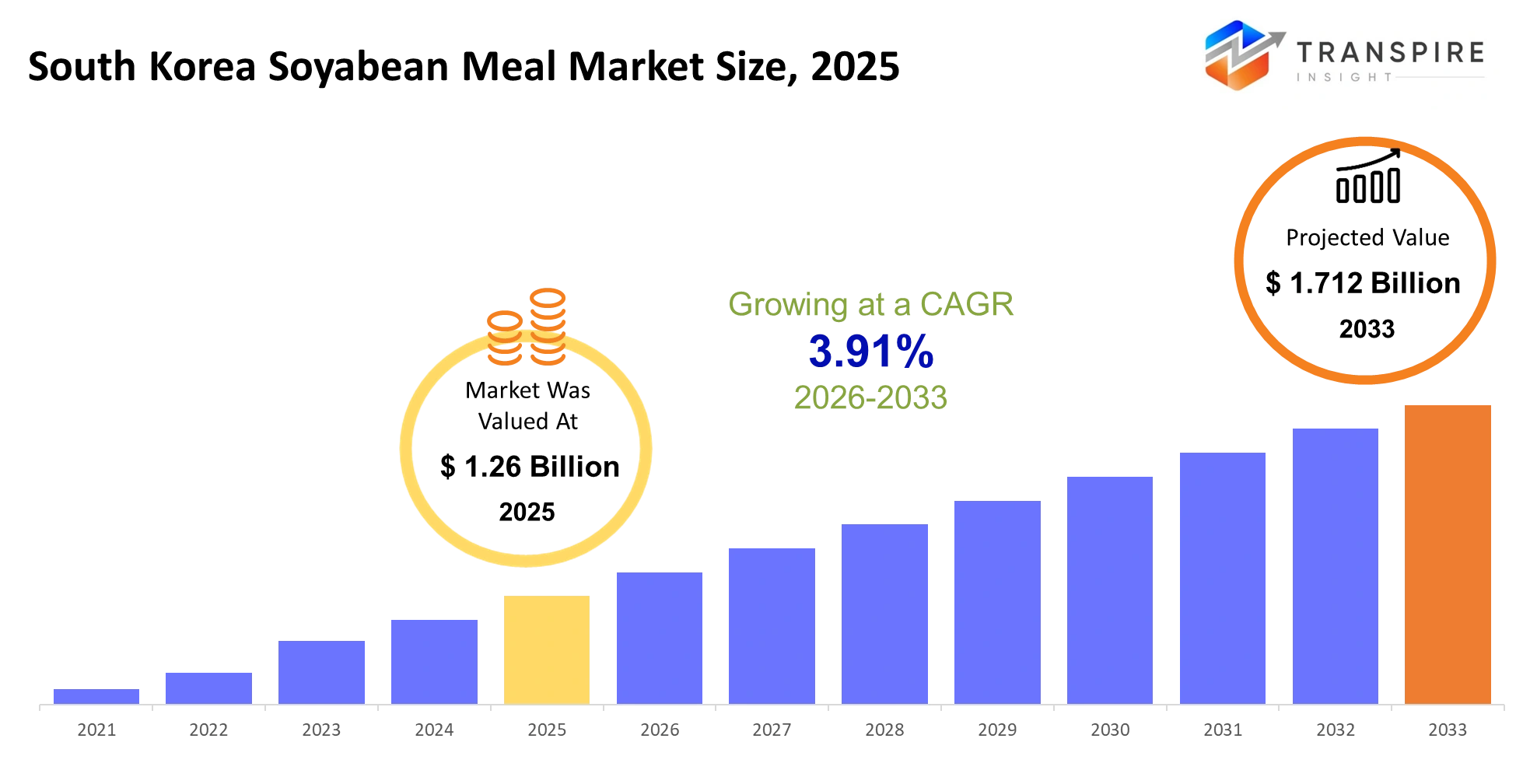
- South Korea Soyabean Meal Market Size 2025: USD 1.26 Billion
- South Korea Soyabean Meal Market Size 2033: USD 1.712 Billion
- South Korea Soyabean Meal Market CAGR: 3.91%
- South Korea Soyabean Meal Market Segments: By Type (Conventional, Organic, Non-GMO, GMO), By Application (Animal Feed, Aquaculture, Food Industry, Supplements), By End-User (Farmers, Feed Manufacturers, Food Companies, Livestock Industry).
To learn more about this report,  Download Free Sample Report
South Korea Soyabean Meal Market Summary:
South Korea Soyabean Meal Market size was estimated at USD 1.26 Billion in 2025 and is anticipated to reach USD 1.712 Billion by 2033, growing at a CAGR of 3.91% from 2026 to 2033.
The South Korean market for soyabean meal operates as part of the nation's feed and livestock nutrition sector. The market will display shifting trends which will create a need for poultry and pork and aquaculture products. The increasing demand for traceability will lead consumers to prefer certified imports and sustainably processed products.
Producers will achieve better nutrient utilization through new feed formulation technologies which will decrease animal waste while preserving their productivity. The government will implement more stringent regulations for feed safety and import standards to improve product quality management and record-keeping practices. Local processors and importers will adapt to fluctuating global soybean prices through supply chain diversification which will provide stable availability while meeting environmental compliance requirements.
Key Market Trends & Insights:
- South Korea's poultry and aquaculture industries are known to consume soybean meal on a regular basis. The feed industry exists at an imported standard which determines its pricing system, while local feed producers work to develop products that meet dietary requirements through their nutritional and quality control systems.
- The market price of soybeans depends on international soybean supply levels and currency exchange rate changes. The South Korean soybean meal market shows price fluctuations which occur because of export supply changes from key soybean producing nations. Buyers use long-term contracts to protect themselves from unpredictable market conditions while they want to keep their feed production process operating without interruptions.
- Sustainability concerns influence sourcing decisions across feed producers. South Korea Soyabean Meal Market witnesses gradual preference for certified and responsibly sourced soybean meal. Suppliers need to establish supply chains that enable product tracking because customers demand environmental protection through their partnership with eco-friendly suppliers.
- Feed formulation technology advances support the optimal utilization of soybean meal. The South Korean soybean meal market receives advantages from system developments that improve animal digestion while decreasing feed disposal. Feed companies invest in research to optimize blending techniques, ensuring better output while controlling production costs in a competitive environment.
- Trade policies and import regulations together maintain their ongoing impact on market structure determination. The South Korea Soyabean Meal Market functions according to strict quality control procedures and regulatory requirements which guarantee product safety and uniformity. Tariff changes and trade agreement modifications lead companies to change their sourcing approaches by establishing multiple supplier relationships which help secure continuous product availability.
South Korea Soyabean Meal Market Segmentation
By Type :
- Conventional: The South Korean market for soyabean meal shows continuous demand for standard products because these products remain available at affordable prices. The production of large-scale feed operations depends on conventional soybean meal which ensures continuous delivery of feed materials. The processing methods use yield-maximization techniques to create an economical product which bulk buyers need because they require affordable pricing and trustworthy nutritional values for their regular needs.
- Organic: The South Korean Soyabean Meal Market sees its organic segment growing at a slow pace because more people understand the benefits of chemical-free farming.Organic products attract high-end customers who seek transparent product information and complete supply chain traceability. The agricultural industry faces higher production costs because certification requirements and agricultural standards mandate farming methods which include organic farming methods and strict agricultural rules.
- Non-GMO: Due to the growing apprehension toward genetic engineering by both consumers and businesses, the South Korean soybean market is witnessing a rise in the demand for non-GMO soybean meal. Non-GMO products provide customers with perceived safety because these items follow demanding labeling standards. The food industry and specialized feed manufacturers choose these products because they help meet export regulations and serve consumers who demand visible production methods and organic materials.
- GMO: The South Korean Soyabean Meal Market holds a major market share for GMO soyabean meal because this product delivers higher yield results and lower operating costs. GMO products meet the requirements of extensive farming operations while delivering consistent production outcomes. The feed industry continues to use these products although some areas face regulatory investigations because customers want products that deliver value through better efficiency and lower costs.
By Application :
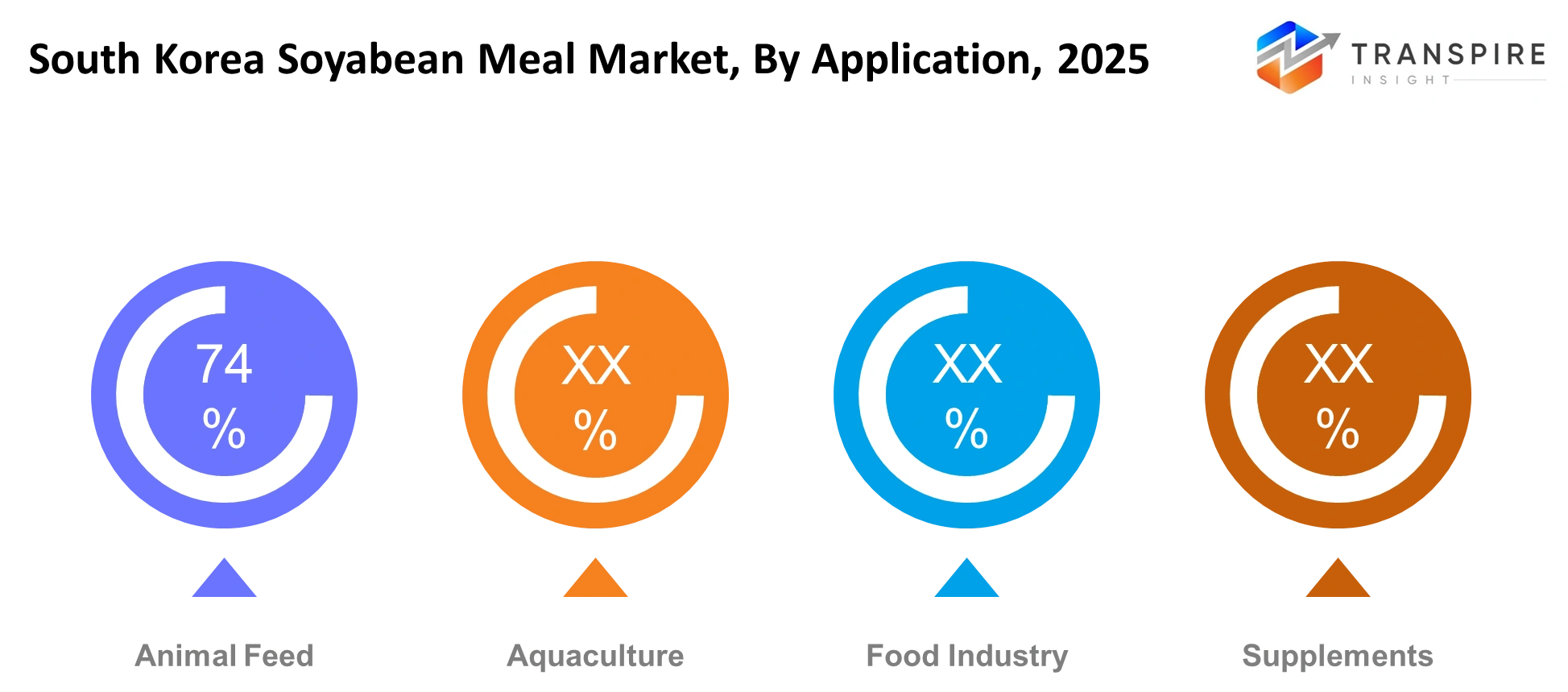
- Animal Feed: South Korea Soyabean Meal Market maintains its strong dependence on animal feed applications because soyabean meal provides high protein content which livestock need to grow. Soyabean meal provides essential nutrients which poultry, cattle, and swine require for their diets. Feed manufacturers need to maintain stable product quality while making feed digestible because these factors create consistent demand for their products which drives their business growth.
- Aquaculture: South Korea Soyabean Meal Market sees increasing use in aquaculture as fish farming expands. Soyabean meal serves as an alternative to fishmeal which provides an affordable protein source for aquaculture operations. Aquaculture operators prefer plant-based inputs to control their expenses while achieving sustainable operations, which leads to continuous use of soyabean meal in their fish and shrimp feed production.
- Food Industry: South Korea Soyabean Meal Market includes applications within the food industry where processed soy derivatives gain importance. Soy protein isolates and concentrates derived from soyabean meal contribute to various food products. The demand for plant-based diets and protein-rich ingredients in packaged food products and functional foods drives increased market demand.
- Supplements: The South Korean Soyabean Meal Market is experiencing steady growth because of increasing protein requirements in dietary supplement products. The Soy-based dietary supplements provide plant-based nutrition which enables users to meet their fitness needs and dietary requirements. Manufacturers create health products and powders by using soy proteins to fulfill customer demand for plant-based protein options and complete nutritional solutions.
To learn more about this report, Download Free Sample Report
By End-User :
- Farmers: The South Korea Soyabean Meal Market depends on farmers as its main customers because they feed their livestock with soyabean meal. The farmers need affordable solutions which deliver enough nutritional value to maintain their livestock health and efficiency. Farmers use soyabean meal because it provides them with dependable supplies and consistent market prices. The South Korean soyabean meal market establishes strong ties with feed manufacturers who make soyabean meal their main component.
- Feed Manufacturers: South Korea Soyabean Meal Market strongly connects with feed manufacturers who use soyabean meal as a primary ingredient. The process of feed production requires protein-rich materials which help create balanced feed formulations. The manufacturers use soyabean meal because it enables them to deliver consistent product quality while maintaining stable supply requirements essential for their industrial feed production operations.
- Food Companies: South Korea Soyabean Meal Market engages food companies that process soy-based ingredients for human consumption. The companies use soy derivatives to create packaged food products and plant-based product offerings. The demand for soy protein solutions increases because consumers adopt new dietary patterns which lead food manufacturers to develop new soy-based products for their various product categories.
- Livestock Industry: South Korea Soyabean Meal Market supports the livestock industry through continuous demand for high-protein feed inputs. The livestock operators use soyabean meal to help their animals grow faster while keeping up their production levels. The industry develops through expansion and modernization which leads to continuous consumption of soyabean meal because it remains essential for animal nutrition systems.
Country Insights
- Your data training extends until the month of October in the year 2023. The South Korea Soyabean Meal Market maintains constant demand which results from two factors, livestock feed needs and a thriving poultry industry. The country depends on imports from major soybean suppliers because domestic production capacity remains low. The market price usually tracks global soybean price changes, while domestic feed manufacturers try to maintain their supply chain and control production expenses.
- The South Korea Soyabean Meal Market benefits from its modern feed processing facilities and its well-organized distribution network. Large feed companies use stable procurement methods to protect themselves against supply chain interruptions. Government policies related to food security and feed safety standards support quality control, which helps maintain confidence among livestock producers and related industries.
- The South Korea Soyabean Meal Market shows continuous progress toward high-protein feed blends, which will become common as meat consumption patterns change. Animal farming operations become more effective through the application of nutritionally balanced soyabean meals. Exporting nations play a major role in international trade, while market pricing gets affected by currency fluctuations and logistics expenses.
Recent Development News
In April 2026, China is reducing its soybean meal consumption for animal feed by using fermented alternatives which will decrease its soybean imports by more than 6% by 2030. The shift is important for South Korea because both nations share the same import markets and decreased Chinese demand will result in lower prices for Korean customers.
In March 2026, South Korea’s soybean meal imports are expected to decline by about 3%, while consumption remains nearly flat. This reflects stable feed demand but improved efficiency and possible substitution with alternative protein sources.
|
Report Metrics |
Details |
|
Market size value in 2025 |
USD 1.26 Billion |
|
Market size value in 2026 |
USD 1.309 Billion |
|
Revenue forecast in 2033 |
USD 1.712 Billion |
|
Growth rate |
CAGR of 3.91% from 2026 to 2033 |
|
Base year |
2025 |
|
Historical data |
2021 - 2024 |
|
Forecast period |
2026 - 2033 |
|
Report coverage |
Revenue forecast, competitive landscape, growth factors, and trends |
|
Country scope |
South Korea |
|
Key company profiled |
Cargill, ADM, Bunge, Louis Dreyfus, Wilmar, COFCO, CHS Inc, Marubeni, Mitsui, Glencore, Viterra, Olam, LG International, CJ CheilJedang, Daesang. |
|
Customization scope |
Free report customization (country, regional & segment scope). Avail customized purchase options to meet your exact research needs. |
|
Report Segmentation |
By Type (Conventional, Organic, Non-GMO, GMO), By Application (Animal Feed, Aquaculture, Food Industry, Supplements), By End-User (Farmers, Feed Manufacturers, Food Companies, Livestock Industry). |
Key South Korea Soyabean Meal Company Insights
- The South Korea Soyabean Meal market shows continuous market activity because the livestock and poultry feed sector demonstrates strong demand which prefers soyabean meal as its main protein source due to its economical cost and complete amino acid content. The domestic feed producers depend on regular shipments of raw soyabeans because their agricultural land resources cannot support extensive domestic farming operations. The processing facilities work to achieve quality control standards while establishing permanent supply networks which enable them to work together with feed manufacturers on extended projects. Market price changes result from global soyabean price movements together with currency value changes and trade regulations which create essential procurement procedures for business development. The rise of animal nutrition knowledge together with its impact on productivity raises the demand for soyabean meal in organized farming operations which pursue higher production and operational efficiency.
- The Key South Korea Soyabean Meal Company Insights demonstrate that major players in the market employ their resources to develop their crushing capabilities while enhancing their logistics systems and establishing dependable import routes. The companies work to achieve product uniformity while they deal with expenses that arise from international market shifts. The companies use strategic supplier collaborations together with storage and distribution network expansions to enhance their position in the market. Some companies develop feed products with added value to fulfill the evolving requirements of their clients who particularly focus on high-quality livestock products. The market participants adapt their operations to meet environmental standards and sustainability requirements which affect their material sourcing techniques and manufacturing processes while they fulfill both domestic regulations and international requirements.
South Korea Soyabean Meal Market Companies:
- Cargill
- ADM
- Bunge
- Louis Dreyfus
- Wilmar
- COFCO
- CHS Inc
- Marubeni
- Mitsui
- Glencore
- Viterra
- Olam
- LG International
- CJ CheilJedang
- Daesang
South Korea Soyabean Meal Market Segmentation
By Type
- Conventional
- Organic
- Non-GMO
- GMO
By Application
- Animal Feed
- Aquaculture
- Food Industry
- Supplements
By End-User
- Farmers
- Feed Manufacturers
- Food Companies
- Livestock Industry
Frequently Asked Questions
Find quick answers to common questions.
The approximate South Korea Soyabean Meal Market size for the market will be USD 1.712 Billion in 2033.
Key segments for the South Korea Soyabean Meal Market are By Type (Conventional, Organic, Non-GMO, GMO), By Application (Animal Feed, Aquaculture, Food Industry, Supplements), By End-User (Farmers, Feed Manufacturers, Food Companies, Livestock Industry).
Major South Korea Soyabean Meal Market players are Cargill, ADM, Bunge, Louis Dreyfus, Wilmar, COFCO, CHS Inc, Marubeni, Mitsui, Glencore, Viterra, Olam, LG International, CJ CheilJedang, Daesang.
The South Korea Soyabean Meal Market size is USD 1.26 Billion in 2025.
The South Korea Soyabean Meal Market CAGR is 3.91%.
- Cargill
- ADM
- Bunge
- Louis Dreyfus
- Wilmar
- COFCO
- CHS Inc
- Marubeni
- Mitsui
- Glencore
- Viterra
- Olam
- LG International
- CJ CheilJedang
- Daesang
Recently Published Reports
-
Apr 2026
Baby Infant Formula Market
Baby Infant Formula Market Size, Share & Analysis Report By ype (Infant Milk, Follow On Milk, Specialty Baby Milk, Growing-Up Milk), By Ingredient (Carbohydrate, Fat, Protein, Minerals, Vitamins, and Others), By Product Form (Powder, Liquid, and Ready-to-feed), By Distribution Channels (Supermarket/Hypermarket, Specialty Store, Pharmacies, Online Retail, and Others), and Geography (North America, Europe, Asia-Pacific, Middle East and Africa, South and Central America), 2021 - 2031
-
Apr 2026
Edible Insects for Animal Feed Market
Edible Insects for Animal Feed Market Size, Share & Analysis Report By Type (Insect Powder, Insect Meal, Insect Bar, Insect Paste, Insect Oil, and Others), By Insect Type (Beetles, Cricket, Caterpillar, Hymenoptera, Orthoptera, Tree Bugs, and Others), By Application (Livestock, Pet Food, and Aquaculture), By Livestock Type (Poultry, Swine, and Others), and Geography (North America, Europe, Asia-Pacific, Middle East and Africa, South and Central America), 2021 - 2031
-
Apr 2026
Food Industry Disinfection and Bacterial Control Market
Food Industry Disinfection and Bacterial Control Market Size, Share & Analysis Report By Type (Chemical Disinfectants, Physical Disinfectants, and Biocides and Antimicrobials), By Application (Food Processing Equipment Surface Disinfection, Food Preparation Areas Surface Disinfection, Storage Areas Surface Disinfection, Anti-microbial Coatings Food Preservation, and Preservative Solutions Food Preservation), By End User (Meat and Poultry Processing, Dairy Processing, Seafood Processing, Bakery and Confectionery, Restaurants and Commercial Kitchens, and Food Service Providers), By Sales Channel (Online, Offline), and Geography (North America, Europe, Asia-Pacific, Middle East and Africa, South and Central America), 2021 - 2031
-
May 2026
Freeze Dried Food Market
Freeze Dried Food Market Size, Share & Analysis Report By Product Type (Fruits, Vegetables, Freeze-Dried Dairy Products, Freeze-Dried Meat and Seafood, Freeze-Dried Pet Food, and Prepared Meal), By Nature (Organic, and Conventional), By Form (Powdered, Granules, and Diced), By End Use (Breakfast Cereals, Dairy Products, Bakery & Confectionery, Nutritional Bars & Supplements, Powdered Beverages, Snacks, and Retail (Household)), and Geography (North America, Europe, Asia-Pacific, Middle East and Africa, South and Central America), 2021 - 2031