
South Korea Solder Materials Market Summary:
According to Transpire Insights, a detailed research report on the market reflects that the electronics application segment dominates the South Korea Solder Materials Market, accounting for approximately 65% of the total market share. Kester is a prominent participant in the market, supported by its broad solder paste, wire, flux, and assembly-material portfolio, while its South Korea-specific revenue and market share are not publicly disclosed, making precise company-level percentages unavailable from reliable public sources..
Market Snapshot
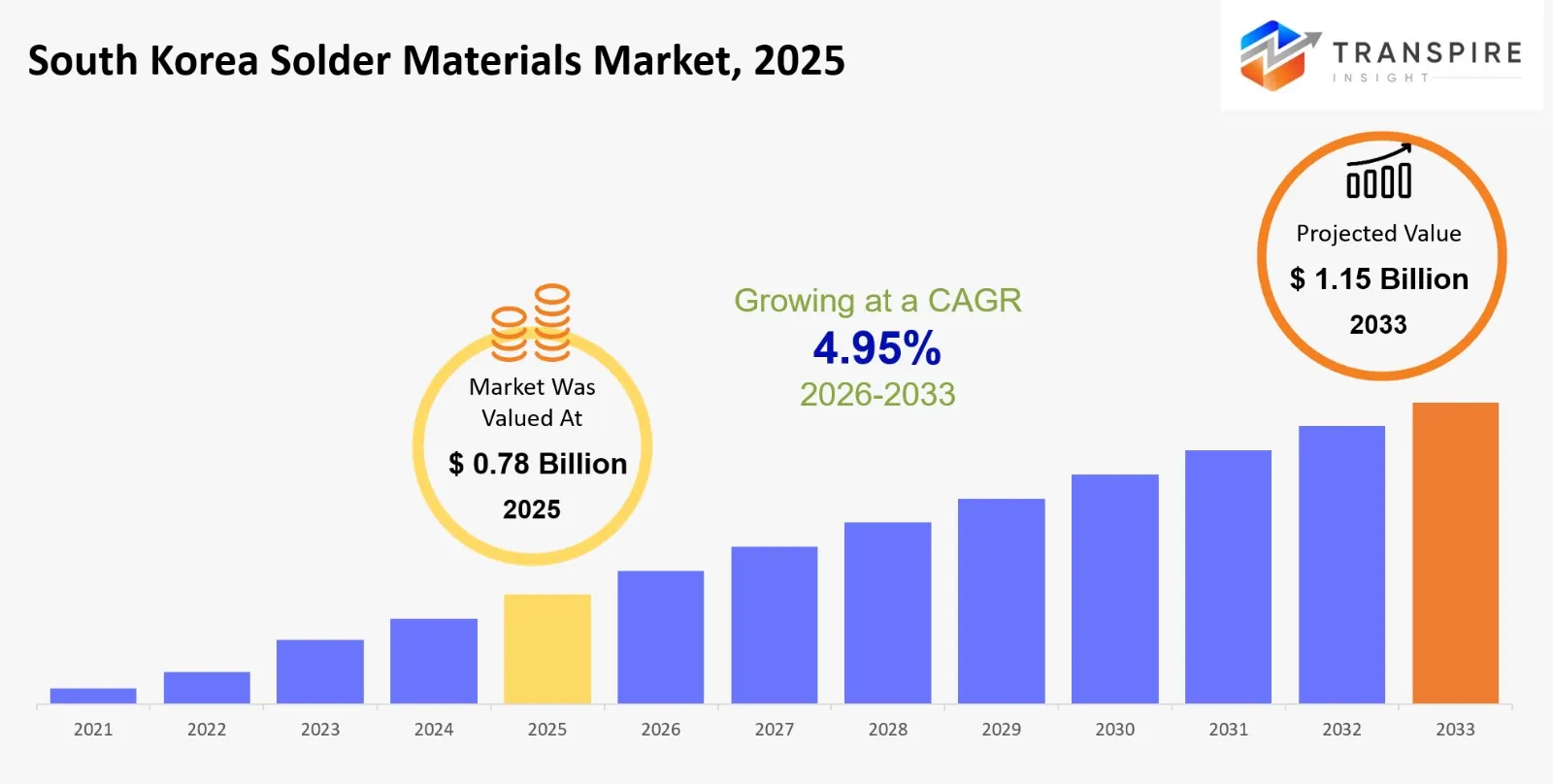
- Market Value (2025): USD 0.78 Billion.
- Expected Market Value (2026): USD 0.82 Billion.
- Estimated Market Value (2033): USD 1.15 Billion.
- Forecast CAGR (2026–2033): 4.95%
Introduction
Solder Materials Market refers to the manufacture, sale, and use of fusible metal alloys and chemical compounds that create permanent bonds both electrically and mechanically between components in electronics and printed circuit boards (PCBs). Solder Materials is the metal alloy that is fusible and traditionally composed of tin and lead, but nowadays uses alloys without lead like tin-silver-copper or SAC. The South Korea Solder Materials Market derives advantage from superior infrastructure with large semiconductor and electronics companies like Samsung and SK hynix being active in the market, leading to increased internal demand. Innovation and heavy investment in R&D are making rapid progress in miniaturization, ultrafine solder powders, advanced packaging and automated assembly compatibility. Regulation and environmental harmony are making it favorable for the use of lead-free and RoHS compatible, low-temperature solder materials to achieve sustainability goals. Additionally, ecosystem resilience, backed by the government in support of hi-tech parts, semiconductor fabrication and green technology, leads to increased internal supply chain connections.
Key Market Highlights: -
- By product, the Solder Paste segment dominated the market and holds nearly 38% share in 2025 and is projected to grow at a substantial CAGR during the forecast period.
- By application, the Consumer Electronics segment dominated the market and holds nearly 30% share in 2025 and is projected to grow at a substantial CAGR during the forecast period.
- By end user, the Semiconductors segment dominated the market and holds nearly 28% share in 2025 and is projected to grow at a substantial CAGR during the forecast period.
- Semiconductor Materials and Equipment Fund: South Korea revealed a KRW 5 trillion (around US$3.52 billion) semiconductor fund that promotes local materials, components, equipment, and fabless enterprises. This is an indirect boon to the South Korea Solder Materials Market through improved semiconductor packaging, supply chain stability, advanced manufacturing processes, and superior solder material demands.
How is Technology Driving Growth in the South Korea Solder Materials Market?
The South Korea Solder Materials Market is experiencing development due to advanced semiconductor packaging, automobile electrification, and sustainable automated manufacturing processes. Increased use of chiplet integration, 3D interconnects, heterogeneous integration, and high bandwidth memory (HBM) is raising the demand for high performance micro-solder balls, advanced solder pastes, and thermal electrical interconnections. Increasing fine pitch miniaturization calls for uniform solder spheres and advanced flux formulation to reduce bridging and assembly defects. In automotive electronics, electric vehicles, power trains, inverters, and ADAS are creating the need for high reliability solder alloys that can withstand thermal and mechanical stress. However, lead free material, low temperature soldering, Industry 4.0 automation, real time process monitoring, precision dispensing, and predictive maintenance have enhanced manufacturing efficiencies.
Market Drivers
Factors such as the trend toward miniaturization and high density of semiconductor packaging drive the South Korea Solder Materials Market through the demand for fine solder powders. Electrification of vehicles along with the advent of ADAS and EVs has resulted in the increased need for solder materials resistant to thermal and mechanical stresses. At the same time, technological developments in 5G and telecommunications have improved the requirements for precision electronic interconnections. The restrictions on environmental issues and lead content are pushing forward the development of Sn-Ag-Cu solders. South Korean Solder Material Market takes advantage of technological infrastructure which is advanced as there are modern cleanroom facilities, accurate production facilities and integrated semiconductor production capabilities. There is a very skilled labor force that assists in doing complex soldering operations, high-density packaging and advanced electronics applications. Government assistance in terms of regulation, financing, green technologies and R&D helps in enhancing innovation and use of lead-free solder materials. Moreover, proximity of the ecosystem to the electronics and semiconductor manufacturers such as Samsung and SK hynix makes it easier for integration of the supply chain and rapid technology application, research and development and customization of the materials.
Restrain
The South Korea Solder Materials Market is hindered by fluctuating tin, silver, and copper prices. Stringent environmental regulation leads to high costs related to testing and manufacturing. Lead-free conversion hurdles make it difficult for small assemblers. Disruptions within the supply chain may result in longer delivery times, and geopolitical risk may limit supplies. Furthermore, miniaturization issues such as joint fatigue, oxidation, and inconsistency may pose additional challenges.
|
Driver |
Relative Impact on Growth (%) |
Geographic Relevance |
Impact Timeline |
Demand Strength |
Growth Mechanism |
Key Beneficiaries |
Major Constraint |
|
Advanced semiconductor packaging and HBM expansion |
30% |
Gyeonggi, Chungcheong, Yongin, Cheongju |
Long-term (≥4 years) |
High |
Increases precision solder demand for advanced packaging |
Solder manufacturers, semiconductor fabs, packaging suppliers |
Complex processes increase qualification and reliability costs |
|
Electronics miniaturization and high-density PCB assembly |
23% |
Seoul, Gyeonggi, Incheon, Chungcheong |
Medium-term (2–4 years) |
High |
Drives fine-pitch solder paste and powder consumption |
Solder suppliers, PCB assemblers, electronics manufacturers |
Miniaturization raises defect-control and process requirements |
|
Automotive electrification and EV electronics growth |
18% |
Gyeonggi, Ulsan, Chungnam |
Medium-term (2–4 years) |
High |
Expands high-reliability solder use in EV electronics |
Automotive suppliers, solder producers, electronics assemblers |
Automotive qualification cycles remain lengthy and costly |
|
Lead-free solder adoption and environmental compliance |
15% |
Nationwide; strongest in electronics clusters |
Short-term (≤2 years) |
High |
Accelerates demand for compliant lead-free solder alloys |
Lead-free alloy producers, electronics exporters, assemblers |
Higher material costs and reliability concerns persist |
|
Government semiconductor investment and supply-chain localization |
14% |
Gyeonggi, Chungcheong, Gwangju |
Long-term (≥4 years) |
Medium |
Strengthens domestic production and materials procurement |
Domestic materials firms, technology vendors, semiconductor manufacturers |
Capital intensity and qualification barriers limit localization |
Analysis of Prices and Consumer Behaviour
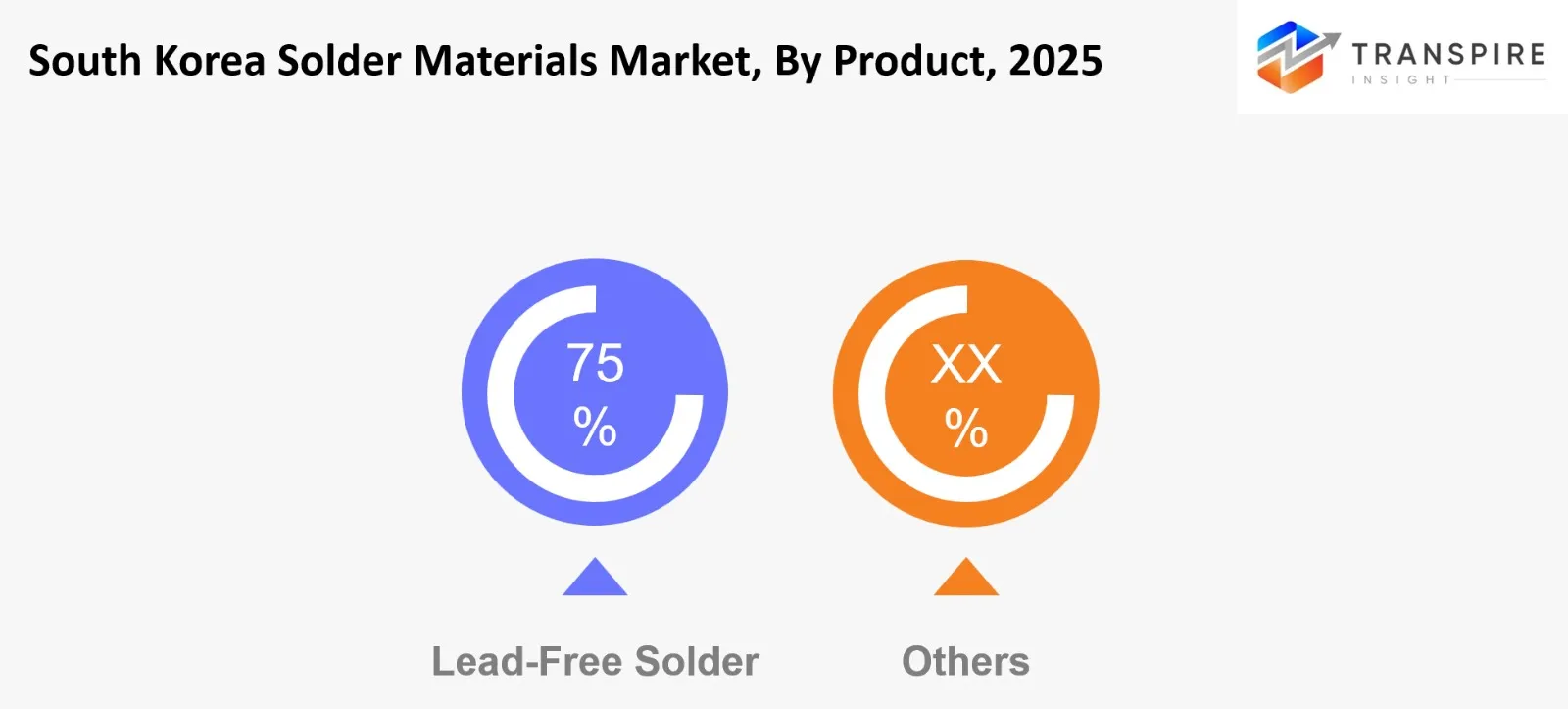
The sales volumes of solder materials are mainly occupied by lead-free solder materials (about 75% of total market volumes; this is due to the demand coming from the electronics manufacturing, semiconductor packaging, and automotive electronics industries). High-reliability, premium solder materials are likely to cost about 20–30% more than the standard products since high-reliability, premium products require advanced alloy compositions, strict size-control of particles, quality certification, and enhanced reliability performance. About 40–45% of South Korean solder-paste demand is tied to consumer electronics, driven by high-volume PCBs and electronics assembling. Consumer electronics, semiconductor and automotive-electronics industries account for about 70% of the total demand due to the well-developed electronics manufacturing industry in South Korea. The buying patterns of industrial buyers demonstrate that technical performance, purity, alloy uniformity, and reliability are the most important criteria, especially for semiconductor and automotive applications. About 55–70% of solder-paste formulations' requirements are likely to be satisfied by imports, mainly regional.
Who are the Key Players in the South Korea Solder Materials Market and how do they compete?
The competitiveness of the South Korea Solder Materials Market requires special firms engaged in development and manufacture of advanced solder materials, solder solutions for semiconductors and electronics applications, and efficient distribution systems. Competing not only through price, but through reliability of material, lead-free solder materials, fine-pitch soldering materials, and process optimization, this strategy of competition will result in continuous improvement of products, as well as in increasing precision and efficiency of production processes of manufacturers.
Development of advanced solder materials, fine-pitch soldering materials and high-reliability alloys allows enhancing the competitive position of Senju Metal Industry in the market. Development of solder pastes, solder powders, solder balls and other special materials, required for semiconductor packaging, electronics manufacture and automotive applications, is the way to compete with other companies. Indium Corporation is positioning itself as a developer of integrated solder materials and packaging solutions used in semiconductor manufacturing and electronics assembly in South Korea.
Top Companies in the South Korea Solder Materials Market
- Indium Corporation
- Kester
- Alpha Assembly Solutions
- AIM Solder
- Nihon Superior
- Senju Metal Industry
- MacDermid Alpha
- Henkel
- Tamura
- Qualitek
- STANNOL
- Balver Zinn
- Heraeus
- Samsung Electro-Mechanics
- KOKI Company
|
Company |
Est. Revenue Share Range |
Key Offerings |
Strategic Positioning |
Geographic Strength |
Technology Focus |
|
DUKSAN Hi-Metal Co., Ltd. |
10–14% (Estimated) |
Solder balls, solder powder, solder paste, cored solder balls |
Domestic semiconductor materials leadership |
Asia-Pacific, South Korea, China |
Fine-pitch solder balls, ultra-fine powder, semiconductor packaging |
|
Senju Metal Industry Co., Ltd. |
8–12% (Estimated) |
Solder paste, solder alloys, solder balls, flux-cored wire |
Advanced materials and reliability differentiation |
Asia-Pacific, Japan, South Korea |
Fine-pitch printing, low-voiding, low-temperature soldering |
|
Indium Corporation |
7–11% (Estimated) |
Solder paste, alloys, preforms, solder spheres |
Premium advanced-packaging specialization |
North America, Asia-Pacific, Europe |
Microbump materials, low-temperature alloys, high-reliability interconnects |
|
MacDermid Alpha Electronics Solutions |
8–12% (Estimated) |
ALPHA solder pastes, Kester materials, preforms, fluxes |
Broad portfolio and process-technology leadership |
North America, Europe, Asia-Pacific |
Ultra-fine printing, zero-halogen, low-voiding, high-reliability alloys |
|
Henkel AG & Co. KGaA |
6–10% (Estimated) |
LOCTITE solder materials, solder pastes, fluxes, electronic materials |
Integrated electronics-materials platform strategy |
Europe, Asia-Pacific, North America |
Advanced solder chemistry, thermal management, automated assembly |
|
KOKI Company Limited |
5–8% (Estimated) |
Solder paste, flux, solder wire, lead-free materials |
Japanese precision and process specialization |
Asia-Pacific, Japan, Europe |
Fine-pitch SMT, lead-free chemistry, printing stability |
|
Nihon Superior Co., Ltd. |
4–7% (Estimated) |
SN100C solder alloy, solder paste, wire, balls, preforms |
Silver-free lead-free alloy specialization |
Asia-Pacific, Japan, Europe |
Sn-Cu-Ni alloys, low-voiding, halogen-free soldering |
|
Tamura Corporation |
4–7% (Estimated) |
Solder paste, solder wire, solder bars, high-temperature solder |
High-reliability automotive and electronics materials |
Asia-Pacific, Japan, Europe |
Low-temperature soldering, micro-bump, laser-compatible materials |
|
AIM Solder |
3–6% (Estimated) |
Solder paste, solder wire, alloys, bar solder, flux |
Application-focused global supplier |
North America, Europe, Asia-Pacific |
Ultra-fine powder, robotic soldering, no-clean chemistry |
|
Heraeus Electronics |
3–5% (Estimated) |
Solder materials, bonding materials, semiconductor packaging materials |
High-performance semiconductor materials specialization |
Europe, Asia-Pacific, North America |
Advanced packaging, power electronics, high-reliability interconnects |
South Korea Solder Materials Market Segmentation
The South Korea Solder Materials Market share is divided into five categories: By product, composition, application, process and end user.
The Solder Paste dominated the market, accounting for nearly 38% in 2025 and is expected to rise at a significant CAGR during the forecast period.
The South Korea Solder Materials Market is segmented by product into Solder Wire, Solder Paste, Solder Bar, Solder Preforms, Solder Balls, Solder Foils, Solder Powder. Among these, the Solder Paste segment dominated the market, accounting for nearly 38% in 2025 and expected to increase at a significant CAGR during the forecast period. In terms of revenue, the Solder Paste category captured the largest market share in 2025, capturing about 38%. This is attributed to its wide usage in surface-mount technology (SMT), printed circuit board assembly, semiconductor packaging, and consumer electronic production. Miniaturization, finer pitch components, automation, and lead-free soldering are some of the factors driving the use of these products and likely to fuel the segment’s growth.
The Consumer Electronics dominated the market, accounting for nearly 30% in 2025, and is expected to rise at a significant CAGR during the forecast period.
The South Korea Solder Materials Market is segmented by application into PCB Assembly, Semiconductor Packaging, Electronics Assembly, Automotive Electronics, Consumer Electronics, Telecommunications, Industrial Electronics. Among these, the Consumer Electronics segment dominated the market, accounting for nearly 30% in 2025 and expected to increase at a significant CAGR during the forecast period. Consumer Electronics was the leading segment in the global market, with a share of about 30% in 2025, because of South Korea's well-established production capacities for smartphones, displays, computers, and household appliances. Higher electronics miniaturization, density of PCB assembly, semiconductor integration, and lead-free soldering needs are fueling demand for flux. Increased manufacturing of smart devices and electronic components will ensure the continued growth of the segment.
The Semiconductors dominated the market, accounting for nearly 28% in 2025 and is expected to rise at a significant CAGR during the forecast period.
The South Korea Solder Materials Market is segmented by end user into Consumer Electronics, Automotive, Semiconductors, Telecommunications, Aerospace, Industrial Equipment, Medical Electronics. Among these, the Semiconductors segment dominated the market, accounting for nearly 28% in 2025 and expected to increase at a significant CAGR during the forecast period. The Semiconductors sector was leading the industry, with 28% share in 2025 owing to South Korea's superior semiconductor manufacturing environment and high demand for solder materials in chip packaging, interconnections, and electronic assemblies. The rising use of advanced packaging, HBM, miniaturization, and high performance computing technologies is fueling solder material usage.
Future Market Trends for the South Korea Solder Materials Market: -
- Lead Free and Environmental Compliant: Transition to Tin-Silver-Copper (SAC) alloy such as SAC305 and other lead free low melting point materials due to environmental compliance.
- Miniaturization and Advanced Packaging: Increasing need for fine pitch solder paste, Au-Sn specialty paste, and microelectronic solder wires to manufacture IoT and 5G modules.
- Electric Vehicles (EV): Growing use of lead free solders in BMS and ADAS of electric vehicles for high thermal/mechanical stability.
- Smart Manufacturing Integration: Use of AI-based quality assurance systems and precision dispensing systems in assembly lines.
Recent Development
- In March 2026:Durafuse LT, Indium Corporation’s new alloy system for low-temperature, lead-free solder paste, was selected by Indium Corporation for display at the upcoming APEX EXPO 2026. This technology is useful in the efficient and reliable assembly of electronic components and applicable to South Korea’s advanced semiconductors and electronics manufacturing industry.
- In September 2026: Indium Corporation introduced AI and HPC advanced packaging materials at SEMICON Taiwan 2026, which included fine-pitch microbumps, Durafuse® LT soldering products, and thermal management products. This development will be helpful for the South Korea Solder Materials Market because it will cater to the demand for advanced semiconductor packaging and reliable soldering materials.
Market Segment
This study forecasts revenue at South Korea, regional and country levels from 2020 to 2033. Transpire Insights has segmented the South Korea Solder Materials Market based on the below-mentioned segments:
South Korea Solder Materials Market, By Product
- Solder Wire
- Solder Paste
- Solder Bar
- Solder Preforms
- Solder Balls
- Solder Foils
- Solder Powder
South Korea Solder Materials Market, By Composition
- Lead-Free
- Lead-Based
- Tin-Silver
- Tin-Copper
- Tin-Bismuth
- Tin-Silver-Copper
- Tin-Lead
South Korea Solder Materials Market, By Application
- PCB Assembly
- Semiconductor Packaging
- Electronics Assembly
- Automotive Electronics
- Consumer Electronics
- Telecommunications
- Industrial Electronics
South Korea Solder Materials Market, By Process
- Wave Soldering
- Reflow Soldering
- Selective Soldering
- Hand Soldering
- Dip Soldering
- Laser Soldering
- Vacuum Soldering
South Korea Solder Materials Market, By End User
- Consumer Electronics
- Automotive
- Semiconductors
- Telecommunications
- Aerospace
- Industrial Equipment
- Medical Electronics
Frequently Asked Questions
Find quick answers to common questions.
The market is projected to reach USD 1.15 billion by 2033, growing at a 4.95% CAGR.
Solder Paste dominates with approximately 38% share in 2025, driven by SMT, PCB assembly, and semiconductor packaging.
Consumer Electronics leads with approximately 30% share in 2025, supported by South Korea’s advanced electronics manufacturing industry
Semiconductors dominate with approximately 28% share in 2025, driven by advanced packaging, HBM, and high-performance computing.
Key trends include lead-free soldering, miniaturization, advanced packaging, EV electrification, smart manufacturing, and AI-based quality control.
- Indium Corporation
- Kester
- Alpha Assembly Solutions
- AIM Solder
- Nihon Superior
- Senju Metal Industry
- MacDermid Alpha
- Henkel
- Tamura
- Qualitek
- STANNOL
- Balver Zinn
- Heraeus
- Samsung Electro-Mechanics
- KOKI Company
About the Authors

Pankaj Ghogare Patil
I am Pankaj Ghogare Patil, a Senior Research Analyst at Transpire Insight, specializing in the Pharmaceutical, Chemicals & Materials, Healthcare IT, and Biotechnology industry. My expertise lies in conducting comprehensive market research, analyzing industry trends, evaluating competitive landscapes, and translating complex data into actionable insights. At Transpire Insight, I closely follow emerging technologies, regulatory developments, and market innovations to create accurate, well-researched, and informative content that helps businesses and professionals make informed decisions. I am committed to producing credible, evidence-based articles that reflect industry best practices while making technical topics accessible and valuable for a broad audience.

Chakradhar Khansole
Chakradhar serves as the Research Director at Transpire Insight, bringing over 8 years of experience in technology, innovation, and strategic market intelligence. He specializes in transforming complex market data into actionable business insights that enable organizations to make informed, growth-oriented decisions. Recognized for his strategic vision and analytical expertise, Chakradhar leads high-impact research initiatives, delivering comprehensive market assessments, competitive intelligence, and forward-looking industry analysis.
Recently Published Reports
-
May 2026
Healthcare Polymer Packaging Market
Healthcare Polymer Packaging Market Size, Share & Analysis Report By Packaging Type (Syringes, IV Bottles and Pouches, Clamshells, Blisters, Bottles & Jars, Containers, Tubes, IV Parental Packaging, Others), By Type (Regulated, Non-regulated), By Polymer Type (LDPE (Low-Density Polyethylene), HDPE (High-Density Polyethylene), Homo-polymer (Homo), Random Copolymer (Random), Block Copolymer (Block), PET, Polystyrene, Polyvinyl Chloride, Polyamide/EVOH, Others), and Geography (North America, Europe, Asia-Pacific, Middle East and Africa, South and Central America), 2021 - 2031
-
Apr 2026
Hydrophilic Tape (Waterstop) Market
Hydrophilic Tape (Waterstop) Market Size, Share & Analysis Report By Type (Bentonite-Based Hydrophilic Tape, Rubber-Based Hydrophilic Tape), By Application (Residential Buildings, Commercial Buildings, Infrastructure Projects), and Geography (North America, Europe, Asia-Pacific, Middle East and Africa, South and Central America), 2021 - 2031
-
Apr 2026
Metalens Market
Metalens Market Size, Share & Analysis Report By Type (Visible Light Metalens, and Infrared Metalens), By Application (Consumer Electronics, Automotive Electronics, Industrial, Medical, and Others), and Geography (North America, Europe, Asia-Pacific, Middle East and Africa, South and Central America), 2021 - 2031
-
Apr 2026
PBT Resin Market
PBT Resin Market Size, Share & Analysis Report By Type (Reinforced PBT Resin, Unreinforced PBT Resin), By Processing Method (Injection Molding, Extrusion, Blow Molding, Others), By End-User (Automotive, Electrical & Electronics, Consumer Appliances, Industrial Machinery, Medical Devices, Packaging, Others), and Geography (North America, Europe, Asia-Pacific, Middle East and Africa, South and Central America), 2021 - 2031