

South Korea Solder Flux Market Size & Forecast:
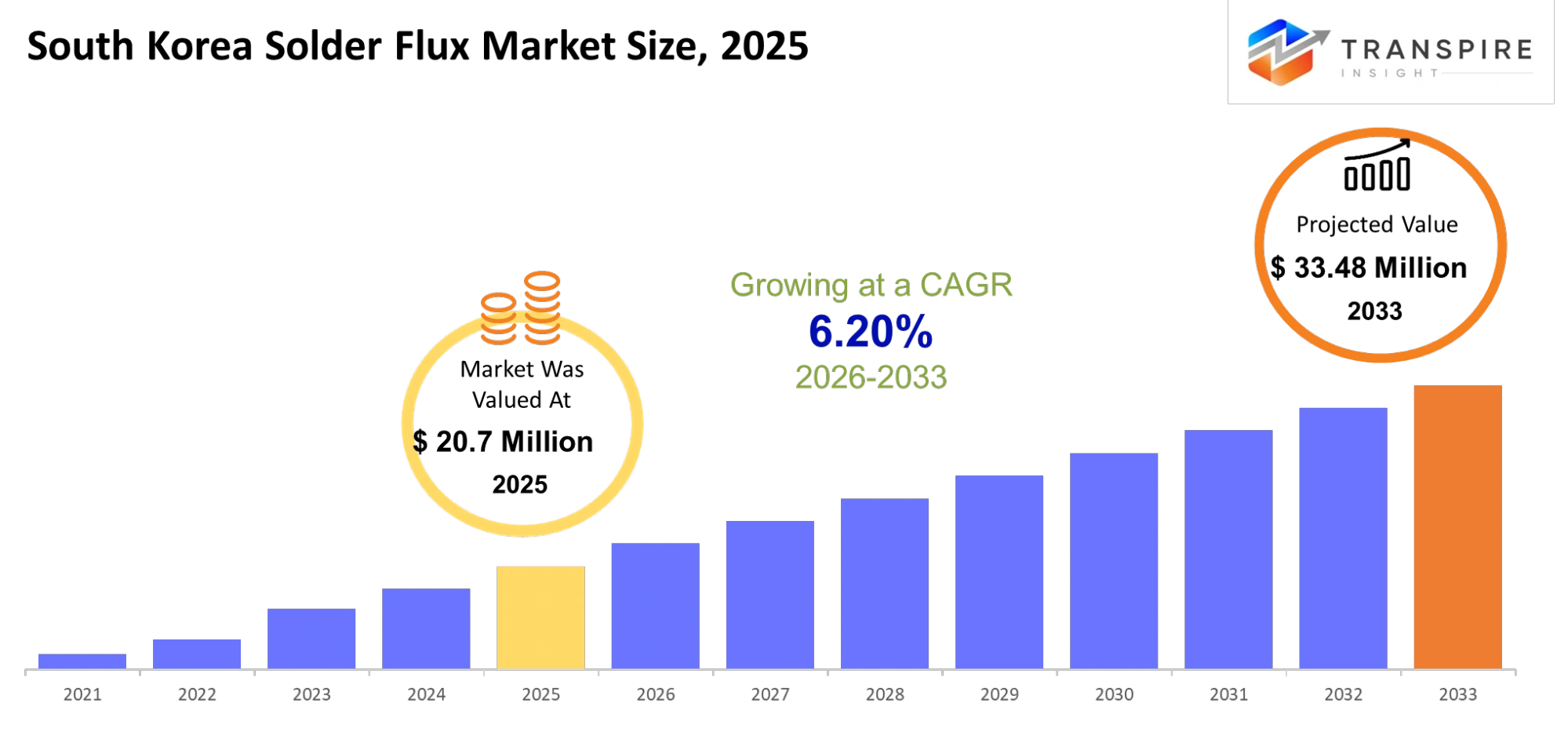
- South Korea Solder Flux Market Size 2025: USD 20.7 Million
- South Korea Solder Flux Market Size 2033: USD 33.48 Million
- South Korea Solder Flux Market CAGR: 6.20%
- South Korea Solder Flux Market Segments: By Type (Rosin-based Flux, Water-soluble Flux, No-clean Flux, Organic Flux, Synthetic Flux, Others); By Application (Electronics Assembly, PCB Manufacturing, Semiconductor Packaging, Automotive Electronics, Industrial, Others); By End-User (Electronics, Automotive, Industrial, Semiconductor, Manufacturing, Others); By Form (Liquid, Paste, Gel, Powder, Spray, Others)
To learn more about this report,  Download Free Sample Report
South Korea Solder Flux Market Summary:
The South Korea Solder Flux Market size is estimated at USD 20.7 Million in 2025 and is anticipated to reach USD 33.48 Million by 2033, growing at a CAGR of 6.20% from 2026 to 2033.
The electronics materials industry in South Korea needs solder fluxing materials to support its operations while making high-precision manufacturing processes work for semiconductor production and consumer electronics manufacturing and automotive electronics development. Manufacturers will select cleaner residue-free products because they require components that are both smaller and faster and more reliable. The production environment needs flux solutions which can support automated assembly operations and meet export industry standards for product quality.The process of product development and implementation will receive major changes through technology advances which will establish more sustainable chemical solutions and materials that comply with stricter environmental regulations. Companies will respond to increasing regulatory requirements by prohibiting hazardous materials while they develop safer product options which deliver equivalent functionality. Buyers will demand consistent product quality which allows them to track product origins and use modern soldering methods. The market will develop through the upcoming years according to the changing relationship between operational results and legal requirements and productivity levels.
What Has the Impact of Artificial Intelligence Been on the South Korea Solder Flux Market?
The artificial intelligence technology currently operates within the South Korean solder flux industry to improve decision-making processes and operational effectiveness. South Korean solder flux market companies use AI technology to process their production and customer data which enables them to identify market research patterns and competitive benchmarking data. Manufacturers use machine learning models to forecast demand and predict trends which enables them to match production output with the changing requirements of semiconductor and automotive electronics and high-density PCB manufacturing.
South Korean solder flux market artificial intelligence technology enables manufacturing facilities to implement smart automation technologies throughout their production processes. The AI-powered systems determine optimal soldering settings through continuous monitoring which results in decreased defects and enhanced uniformity of flux application.
AI technology creates supply chain optimization and supply chain innovation improvements throughout operations in the South Korean solder flux market. AI tools enable companies to optimize their procurement processes and inventory control while minimizing material waste which results in cost savings and quicker delivery times. The client-specific flux formulation development process receives assistance from AI-driven insights which enable the creation of custom flux formulas.
Key Market Trends & Insights:
- South Korea holds the largest share of the solder flux market in South Korea because it controls more than 85% of the market through its semiconductor and electronics manufacturing centers which operate as their main production facilities.
- The regions of Busan and Gyeonggi experience their most rapid demand growth because of their industrial clusters and the projected increase in electronics production which will continue until 2030.
- The market for rosin-based flux reaches its highest point because this product achieves approximately 40% market share in 2025 through its dependable performance during PCB assembly process.
- The third most popular cleaning solution water-soluble flux holds about 30% market share because it provides both affordable cleaning solutions and operational efficiency during large-scale manufacturing processes.
- The consumer electronics sector controls approximately 45% of the market because smartphone and display and semiconductor device manufacturing create strong demand for their products.
- The automotive electronics segment experiences its most rapid growth because of increased adoption of electric vehicle systems and advanced driver assistance systems which will occur between 2025 and 2030.
- The electronics manufacturing sector serves as the primary end-user because it needs to produce large quantities of printed circuit boards which account for more than 50% of its requirements.
- The automotive industry experiences fast expansion because vehicle manufacturers increase their use of electronic components while battery system requirements rise.
- The company increases its market presence through strategic partnerships which enable long-term contracts with original equipment manufacturers and semiconductor companies.
- The company improves its production capabilities through regional development and smart automation system implementation which provides it with a competitive edge.
South Korea Solder Flux Market Segmentation
By Type:
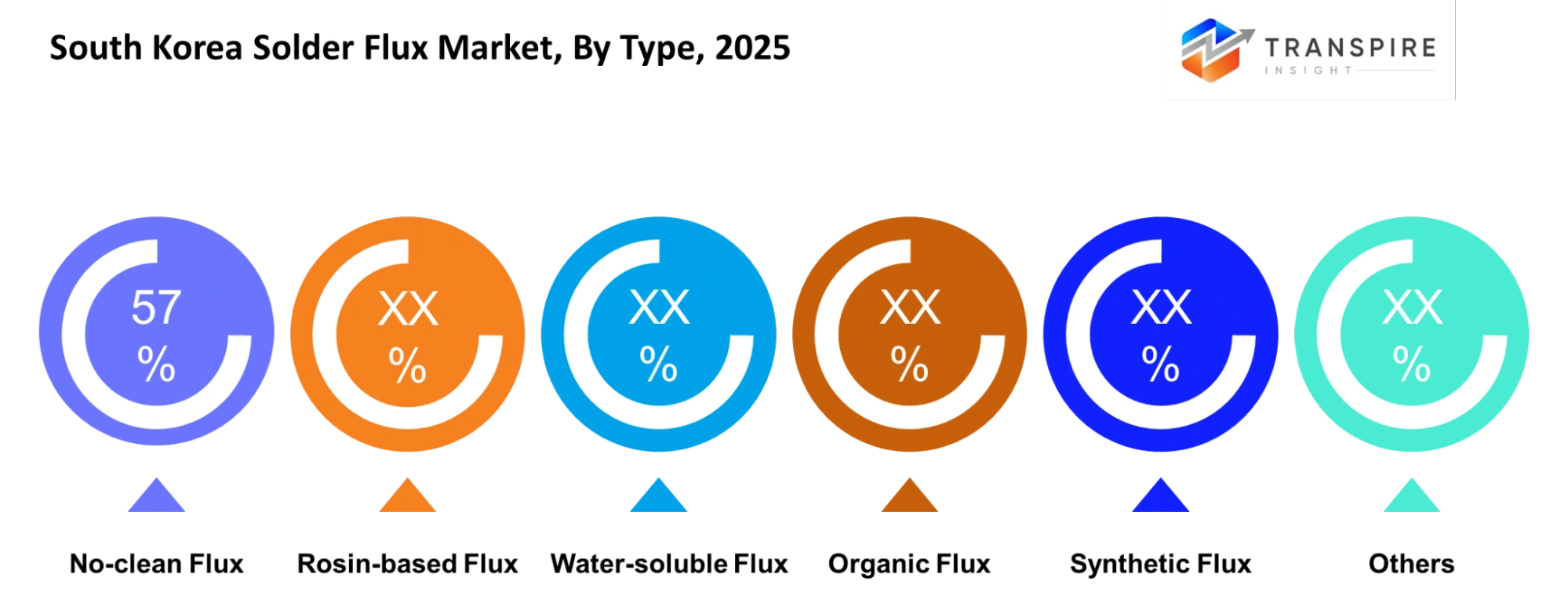
The South Korea Solder Flux Market operates through three main segments which include rosin-based flux, water-soluble flux, no-clean flux, organic flux, synthetic flux and other products. The circuit assembly industry will keep using rosin-based flux because it delivers consistent performance, while water-soluble flux will enable manufacturers to achieve quick cleaning results during their production processes. No-clean flux will gain preference for residue-free processes. The industry will utilize organic and synthetic alternatives to meet environmental regulations and specific industrial applications.
To learn more about this report, Download Free Sample Report
By Application:
Electronics Assembly, PCB Manufacturing, Semiconductor Packaging, Automotive Electronics, Industrial, Others serve as the South Korea Solder Flux Market application sectors. The industry will maintain steady demand for electronics assembly and PCB manufacturing because of their ability to produce numerous devices. The semiconductor packaging industry requires high accuracy and complete product cleanliness. The electric vehicle systems will drive growth in automotive electronics. Industrial applications will support automation equipment, while other uses will cover niche production environments.
By End-User:
The South Korea Solder Flux Market operates through six end-user categories which include electronics, automotive, industrial, semiconductor, manufacturing and other sectors. The electronics sector will drive market growth through its ongoing production of consumer electronics and computing devices.
The automotive segment will grow with increasing electronic integration. The semiconductor and manufacturing industries need trustworthy materials, while industrial users need strong soldering performance for their machinery and control systems.
By Form:
The South Korea Solder Flux Market functions through six product types which include liquid, paste, gel, powder, spray and other products. Automated manufacturing lines will prefer liquid flux for its simple application method, while paste flux will enable workers to complete their precise soldering tasks.
Gel forms will offer controlled placement, and powder will serve specialized uses. Large-scale operations will benefit from spray formats that deliver better coverage and other features.
What are the Main Challenges for the South Korea Solder Flux Market Growth?
The ongoing technical and operational limitations create difficulties for the south korean solder flux market which needs to develop products that remain stable under extreme temperature and manufacturing speed conditions.
The process of manufacturing products and bringing them to market presents obstacles which prevent business growth, as companies must bear increasing expenses that result from adhering to environmental protection and safety regulations.
The industry transition toward halogen-free and eco-friendly flux materials results in higher research and development costs together with more complicated manufacturing processes. South Korean solder flux market companies, especially small- and mid-sized ones, face commercial launch delays because they must complete extensive testing and certification while meeting international quality standards semiconductor and electronics customers require.
Advanced flux solutions encounter adoption hurdles because manufacturers have difficulty connecting these solutions with their current production systems. The facilities need to improve their current systems because they require both process enhancements and qualified personnel to operate next-generation materials, which results in training and expense obstacles.
Regional Insights
The Gyeonggi province will emerge as the market leader because its semiconductor clusters and electronics manufacturing facilities create continuous demand for advanced soldering materials. The Seoul metropolitan area will provide resources for research and development activities, while Incheon will improve logistics and export functions, which will enable the company to keep its supply chain running smoothly and distribute products effectively to international markets.
The Busan and Ulsan regions will experience increasing demand because of both automotive production growth and industrial development which focuses on electric vehicle components and control systems. Daegu and other new industrial areas will start to implement new technologies because small-scale manufacturing businesses continue to grow whereas regional development initiatives will support equal industrial expansion and increased material availability.
Recent Development News
In April 2026, MK Electron announced capacity expansion. The company revealed plans to expand solder paste production including integrated flux blending capabilities, and palladium alloy output to support semiconductor packaging demand growth.https://circuitsassembly.com
In March 2026, MK Electron reported strategic investment expansion. The company initiated new capital investments to scale its solder materials business (including flux-integrated solder paste manufacturing) and improve cost efficiency via recycling systems for key metals used in flux and solder formulations.https://circuitsassembly.com
|
Report Metrics |
Details |
|
Market size value in 2025 |
USD 20.7 Million |
|
Market size value in 2026 |
USD 21.98 Million |
|
Revenue forecast in 2033 |
USD 33.48 Million |
|
Growth rate |
CAGR of 6.20% from 2026 to 2033 |
|
Base year |
2025 |
|
Historical data |
2021 - 2024 |
|
Forecast period |
2026 - 2033 |
|
Report coverage |
Revenue forecast, competitive landscape, growth factors, and trends |
|
Regional scope |
South Korea |
|
Key company profiled |
Kester, Indium Corporation, Henkel, Alpha Assembly, AIM Solder, Senju Metal, Nihon Superior, Tamura, Qualitek, Heraeus, MacDermid Alpha, Nordson, Kyzen, Shenzhen Bright, Superior Flux |
|
Customization scope |
Free report customization (country, regional & segment scope). Avail customized purchase options to meet your exact research needs. |
|
Report Segmentation |
By Type (Rosin-based Flux, Water-soluble Flux, No-clean Flux, Organic Flux, Synthetic Flux, Others); By Application (Electronics Assembly, PCB Manufacturing, Semiconductor Packaging, Automotive Electronics, Industrial, Others); By End-User (Electronics, Automotive, Industrial, Semiconductor, Manufacturing, Others); By Form (Liquid, Paste, Gel, Powder, Spray, Others) |
How Can New Companies Establish a Strong Foothold in the South Korea Solder Flux Market?
New entrants aiming to build a strong position in the south korea solder flux market will need to focus on clear differentiation rather than scale alone. The market of semiconductors and advanced electronics products operates through precision manufacturing which creates intense competition. Companies that target niche needs—such as low-residue, halogen-free, or high-reliability flux for compact PCB assemblies—can gain early traction. New players should focus on three critical areas which include improving defect reduction and enhancing thermal stability and achieving compliance with strict environmental standards.
The south Korea solder flux market will determine its success through innovation strategies which work as essential development elements. Startups that invest in R&D to develop flux compatible with next-generation technologies, including AI chips and electric vehicle systems, will stand out. For example, an emerging player like FluxCore Labs (illustrative) could focus on eco-friendly, high-performance flux tailored for high-speed automated production lines. The company NanoBond Solutions (illustrative) will create a competitive advantage through its nano-engineered flux which enhances manufacturing efficiency by improving conductivity and decreasing material waste.
Strategic partnerships will also accelerate market entry and credibility in the south korea solder flux market. New companies will achieve supply chain access and product performance validation through partnerships with local electronics manufacturers and automotive suppliers and research institutes. Technical support and customized solutions and process optimization services will enable companies to build strong relationships with their clients. New entrants will achieve success through targeted innovation combined with strong partnerships and their complete understanding of market development drivers.
Key South Korea Solder Flux Market Company Insights
The South Korea Solder Flux Market experiences higher adoption rates because semiconductor and PCB manufacturing industries show strong demand for soldering materials. The production of high-density circuits needs systems which maintain oxidation control and deliver accurate solder flow to achieve miniaturization of devices. The volume of consumer electronics products continues to grow because the market keeps expanding. The main suppliers of the market develop low-residue flux products and eco-friendly formulations which help them meet manufacturing standards while maintaining export competitiveness.
The South Korea Solder Flux Market provides constant demand for advanced soldering materials because of automotive electronics and electric vehicle systems. The battery modules control units and safety systems need to establish durable joints which can handle thermal stress. The new flux technology enables materials to maintain heat resistance and deliver extended operational reliability. The market participants develop high-temperature flux products which they use to create long-term supply agreements with automotive original equipment manufacturers through their partnership relationships.
The South Korea Solder Flux Market displays growing application possibilities through industrial automation medical device development and renewable energy system implementation. Smart factories rely on accurate soldering to develop their sensor systems and control modules but solar power systems and medical devices demand ongoing operational consistency. The emerging technological field maintains strong growth potential. The competitive advantages of companies rest on their focus for research development which they use to create custom solutions and improve operational processes which help them protect their current clients and develop new specialized markets.
Company List
- Kester
- Indium Corporation
- Henkel
- Alpha Assembly
- AIM Solder
- Senju Metal
- Nihon Superior
- Tamura
- Qualitek
- Heraeus
- MacDermid Alpha
- Nordson
- Kyzen
- Shenzhen Bright
- Superior Flux
What are the Key Use-Cases Driving the Growth of the South Korea Solder Flux Market?
The south korea solder flux market experiences strong growth because its soldering materials play an essential role in manufacturing advanced electronics products that include semiconductors and printed circuit boards (PCBs). South Korea’s dominance in chip production and consumer electronics has created sustained demand for high-performance soldering materials that ensure precision, conductivity, and durability. The essential function of flux prevents oxidation while it enhances solder joint strength making the material necessary for use in compact electronic systems found in smartphones, wearables, and AI-powered devices.
The south korea solder flux market experiences accelerated growth through its application in the expanding electric vehicle (EV) market and the rising demand for automotive electronic components. Modern vehicles depend on electronic control units alongside battery management systems and advanced driver-assistance systems (ADAS), which need dependable soldering methods.
The South Korea solder flux market experiences growth through industrial manufacturing, robotics, and robotic process automation, which includes smart factory development initiatives. Precision soldering is vital for sensors, IoT modules, and control systems used in Industry 4.0 environments. The development of medical devices and renewable energy systems such as solar inverters has created new growth opportunities which demonstrate the ability to scale and innovate across different industries.
South Korea Solder Flux Market Report Segmentation
By Type
- Rosin-based Flux
- Water-soluble Flux
- No-clean Flux
- Organic Flux
- Synthetic Flux
- Others
By Application
- Electronics Assembly
- PCB Manufacturing
- Semiconductor Packaging
- Automotive Electronics
- Industrial
- Others
By End-User
- Electronics
- Automotive
- Industrial
- Semiconductor
- Manufacturing
- Others
By Form
- Liquid
- Paste
- Gel
- Powder
- Spray
- Others
Frequently Asked Questions
Find quick answers to common questions.
The approximate South Korea Solder Flux Market size for the market will be USD 33.48 Million in 2033.
Key segments for the South Korea Solder Flux Market are By Type (Rosin-based Flux, Water-soluble Flux, No-clean Flux, Organic Flux, Synthetic Flux, Others); By Application (Electronics Assembly, PCB Manufacturing, Semiconductor Packaging, Automotive Electronics, Industrial, Others); By End-User (Electronics, Automotive, Industrial, Semiconductor, Manufacturing, Others); By Form (Liquid, Paste, Gel, Powder, Spray, Others).
Major South Korea Solder Flux Market players are Kester, Indium Corporation, Henkel, Alpha Assembly, AIM Solder, Senju Metal, Nihon Superior, Tamura, Qualitek, Heraeus, MacDermid Alpha, Nordson, Kyzen, Shenzhen Bright, Superior Flux.
The South Korea Solder Flux Market size is USD 20.7 Million in 2025.
The South Korea Solder Flux Market CAGR is 6.20%.
- Kester
- Indium Corporation
- Henkel
- Alpha Assembly
- AIM Solder
- Senju Metal
- Nihon Superior
- Tamura
- Qualitek
- Heraeus
- MacDermid Alpha
- Nordson
- Kyzen
- Shenzhen Bright
- Superior Flux
Recently Published Reports
-
Dec 2024
Fiber Optic Faceplates Market
Fiber Optic Faceplates Market Size, Share & Analysis Report By Type (< 300 mm2, 300-350 mm2, and > 350 mm2, By Application (Night Vision, Holographic Imaging, Medical, and Others), and Geography (North America, Europe, Asia-Pacific, Middle East and Africa, South and Central America), 2021 - 2031
-
Jan 2025
High Temperature Superconductors Market
High Temperature Superconductors Market Size, Share & Analysis Report By Type (1G HTS, and 2G HTS), By Application (Power Cable, Fault Current Limiter, and Transformer), and Geography (North America, Europe, Asia-Pacific, Middle East and Africa, South and Central America), 2021 - 2031
-
Jan 2025
Industrial Plugs and Socket Market
Industrial Plugs and Socket Market Size, Share & Analysis Report By Type (Industrial Plugs, Industrial Sockets), By Current (Up to 32 A, 32 to 125 A, Above 125 A), By Protection (Dustproof and Splash Proof, Waterproof, Explosion Proof), By End User (Heavy Industries, Oil and Gas, Chemicals and Pharmaceuticals, Power Generation, Others), and Geography (North America, Europe, Asia-Pacific, Middle East and Africa, South and Central America), 2021 - 2031
-
Jan 2025
InGaAs Avalanche Photodiodes Market
InGaAs Avalanche Photodiodes Market Size, Share & Analysis Report By Type (1100 - 1700 nm, and 1000 - 1600 nm), By Application (Missile Warning System, Muzzle Flash Detection, Wafer Defect Inspection, Laser Rangefinders, and Others), and Geography (North America, Europe, Asia-Pacific, Middle East and Africa, South and Central America), 2021 - 2031