
South Korea Smart Helmet Market Summary
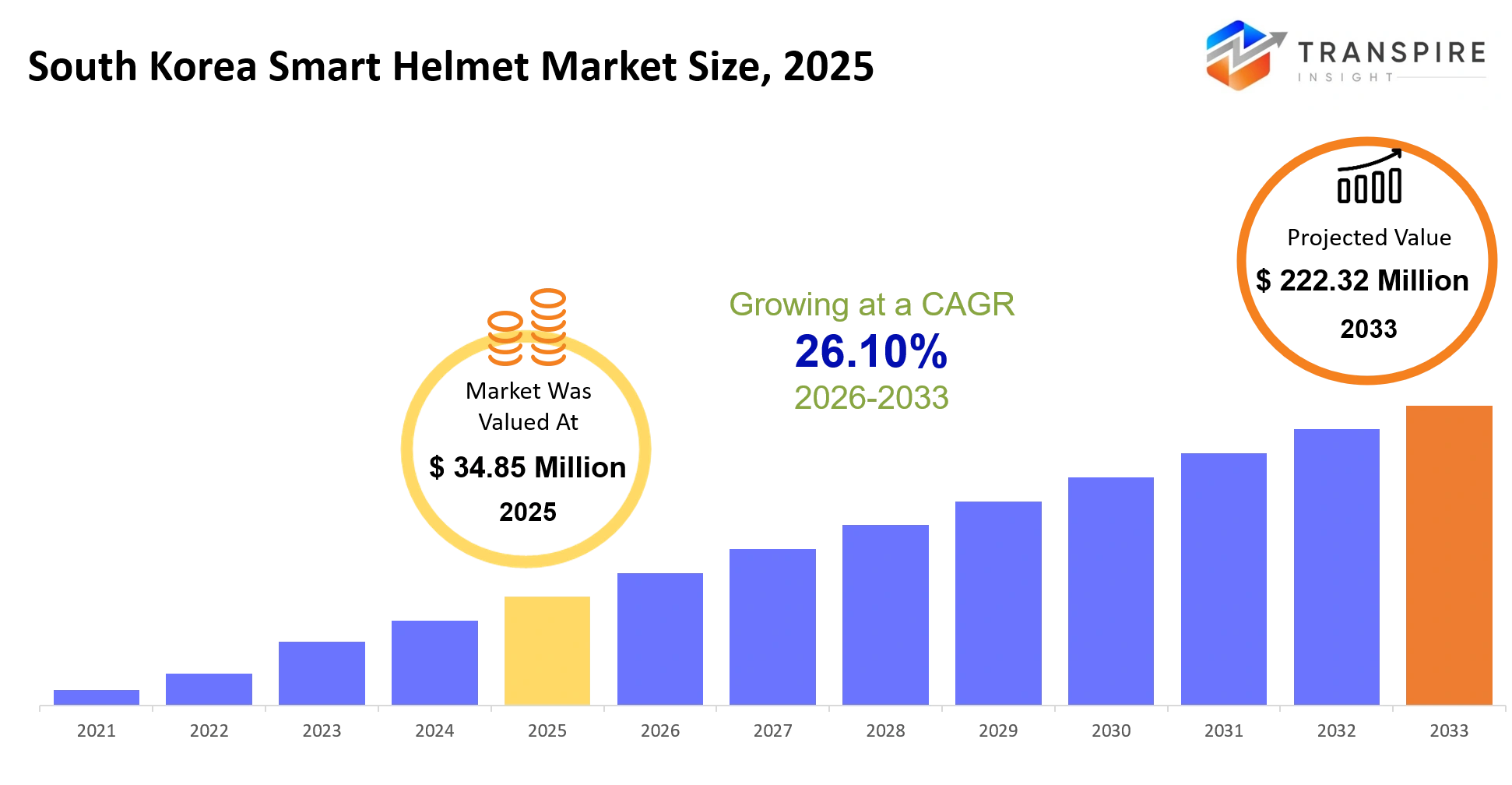
As per Transpire Insight Analysis, the South Korea Smart Helmet Market size is estimated at USD 34.85 Million in 2025 and is anticipated to reach USD 222.32 Million by 2033, growing at a CAGR of 26.10% from 2026 to 2033.
Smart helmets merge sensors, connectivity, and on-board processing into everyday headgear for workers, riders, and soldiers - giving them real-time warnings rather than simply relying on passive protection itself. In South Korea, factories and building sites are currently the largest adopters, since much stricter workplace safety regulations force employers to monitor fatigue, falls, and gas exposure completely automatically. The helmets connect to central control panels, so managers can take action even before an incident becomes severe, and that's really changing how safety funds are allocated all over heavy industry.
The market's also moving faster as the nationwide 5G deployment made real-time video streaming and location monitoring very practical within a helmet. Motorcycle riders are buying Bluetooth-enabled helmets mostly for navigation and phone calls, while military procurement has started evaluating AI-powered visors for understanding one's surroundings. Sports enthusiasts make up a somewhat smaller part, yet action camera integration and impact sensors are bringing in more cyclists and skiers wanting both performance information and protection itself.
South Korea Smart Helmet Market Size & Forecast:
- South Korea Smart Helmet Market Size 2025: USD 34.85 Million
- Expected Market Value 2033: USD 222.32 Million
- Forecast CAGR: 26.10%
- Leading Application Segment in 2025: Worker Safety Monitoring
- Fastest Growing Segment: AI-powered Helmets
- Key Profile: Samsung Electronics, LG Electronics, DAQRI, Sena Technologies, Forcite Helmet Systems, Livall, Jarvish, Bell Helmets, Shoei Co. Ltd., Schuberth, Honeywell, 3M, Bosch, MSA Safety, Guardhat
Key Market Insights
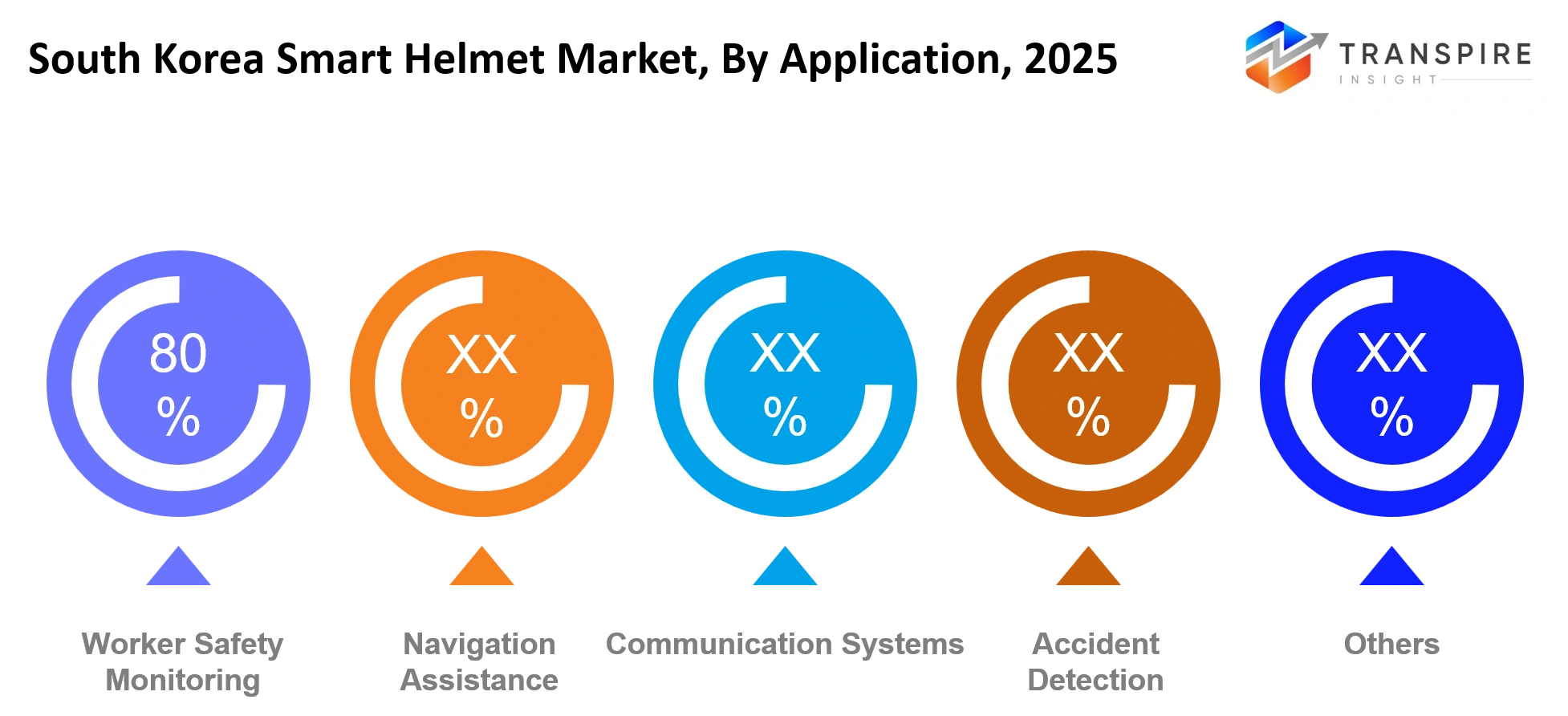
- Worker safety monitoring really leads the application segment - holding nearly 80% market share in 2025 - due to much tighter industrial safety regulations all over construction and manufacturing sites.
- AI-powered helmets are set to grow at the fastest rate up until 2032 because fatigue detection and hazard recognition just keep getting better as onboard processors become less expensive.
- Industrial smart helmets actually hold the biggest product share, because factories and building sites require continuous communication links between workers and safety control centers all the time.
- Motorcycle smart helmets are gaining ground pretty quickly too, especially because of Korea's very high-density urban driving patterns and a growing number of delivery riders.
- Construction remains the biggest end-user category, closely followed by manufacturing - both needing real-time hazard alerts greatly to reduce the number of injuries reported.
- The defense sector is smaller now, yet pilot programs for AR visors imply procurement could really take off by 2030.
- Wireless connectivity really dominates new purchases because plants are replacing their wired intercom systems with helmet-based mesh networks.
- Seoul itself and the surrounding Gyeonggi industrial region make up most of the current demand - mainly because there are so many factories and logistics centers located there.
What are the Key Drivers, Restraints, and Opportunities in the South Korea Smart Helmet Market?
Changes in workplace safety laws are really the number one driving factor at the moment. Following some very public industrial accidents, Korean authorities strengthened reporting requirements for construction and manufacturing businesses - and lots of employers reacted by introducing connected helmets that automatically record falls, gas exposure, and heart rate. This development shifts safety compliance from just paperwork to real-time monitoring - and it provides insurers with even more reason to offer lower premiums to companies adopting this type of technology.
Cost remains our biggest holdback. One AI-powered helmet can cost several times as much as an ordinary hard hat - and smaller contractors frequently hold off buying until their bigger competitors demonstrate a clear return on investment. Battery life and how comfortable it is over a long shift also come up all too often in field feedback, since workers really don't like gear that feels very heavy or needs constant recharging.
Opportunity is growing around defence and sports-related use cases - where profit margins are better and customers worry less about the price per unit. The big domestic electronics companies actually already have the sensor and display supply chains all set up, so getting into these related areas should be relatively straightforward when demand finally starts to pick up.
What Has the Impact of Artificial Intelligence Been on the South Korea Smart Helmet Market?
Artificial intelligence (AI) has really advanced smart helmets - moving them from basic data loggers into very active safety companions indeed. The onboard models now identify fatigue through eye movement patterns, spot falls even before they happen via accelerometer trends, and send out emergency alerts all by themselves - no need for workers to press a button. Construction companies say they respond much quicker to incidents when these features become available, since supervisors receive extremely accurate location information the moment anything goes wrong. On the production side, computer vision within visors is just starting to check if personal protective gear has been worn correctly all day long, something that previously required a thorough walk-through inspection manually.
However, adoption remains a bit slower in smaller companies mainly because fine-tuning AI models for specific work environments takes some time and local technical support isn't widely available just yet. But as cloud-based training frameworks continue to mature, that difference will likely narrow quite a lot over our predicted timeframe.
Key Market Trends
- Government backed pilot programs expanded across public construction projects during 2024 and 2025, pushing smart helmet trials into mid sized contractors.
- Domestic electronics makers deepened partnerships with safety equipment firms between 2023 and 2025 to bundle sensors directly into helmet shells.
- Delivery and logistics companies started equipping riders with Bluetooth helmets after 2023, mainly for navigation and hands free dispatch calls.
- Battery efficiency improved noticeably through 2024, stretching helmet run time and easing one of the most common worker complaints.
- Interest in AR visors for defense training grew steadily across 2024 and 2025, supported by broader military modernization spending.
South Korea Smart Helmet Market Segmentation
By Product Type:
Industrial smart helmets lead the market, since factories and building sites need constant safety data flowing back to control rooms. Motorcycle smart helmets follow closely, helped by rising delivery rider numbers and navigation demand. Sports smart helmets appeal to a smaller but growing group chasing performance tracking. Military smart helmets stay niche today but carry strong long term upside as defense budgets modernize. Other formats keep emerging as manufacturers experiment with new use cases.
By Technology:
AI powered helmets are pulling ahead fastest, since fatigue and hazard detection keep getting smarter and cheaper to build in. Bluetooth enabled helmets remain the most common entry point, mainly for calls and audio alerts. IoT connected helmets link individual workers into wider safety networks across a site. AR enabled helmets are still early stage but are drawing defense and industrial interest for hands free data display. Other technologies continue to surface as component costs fall.
By Application:
Worker safety monitoring dominates application demand, since regulatory pressure keeps pushing employers toward continuous hazard tracking. Accident detection is growing fast too, as automatic fall and impact alerts cut emergency response times. Navigation assistance matters most for riders and logistics staff who need turn by turn guidance without looking at a phone. Communication systems help teams coordinate on noisy sites. Other applications keep expanding as sensor packages get more capable.
By End User:
The construction industry leads end user demand, given how often falls and equipment accidents happen on site. Manufacturing follows close behind, relying on helmets to flag gas leaks and machine proximity risks. The defense sector is smaller today but growing through pilot procurement for AR visors. Sports industry buyers care more about performance data than compliance. Other end users, including logistics and utilities, are starting to test the technology too.
By Connectivity:
Wireless smart helmets are the clear preference, since plants are phasing out wired intercom systems in favor of mesh networks. Hybrid smart helmets appeal to buyers who want wireless convenience with a wired backup for critical alerts. Wired smart helmets still show up in a few controlled industrial settings where signal interference is a concern. Other connectivity setups keep appearing as five G coverage expands further into industrial zones.
Report Metrics
|
Report Metrics |
Details |
|
Market size value in 2025 |
USD 34.85 Million |
|
Market size value in 2026 |
USD 43.84 Million |
|
Revenue forecast in 2033 |
USD 222.32 Million |
|
Growth rate |
CAGR of 26.10% from 2026 to 2033 |
|
Base year |
2025 |
|
Historical data |
2021 - 2024 |
|
Forecast period |
2026 - 2033 |
|
Report coverage |
Revenue forecast, competitive landscape, growth factors, and trends |
|
Regional scope |
South Korea |
|
Key company profiled |
Samsung Electronics, LG Electronics, DAQRI, Sena Technologies, Forcite Helmet Systems, Livall, Jarvish, Bell Helmets, Shoei Co. Ltd., Schuberth, Honeywell, 3M, Bosch, MSA Safety, Guardhat. |
|
Customization scope |
Free report customization (segment and application scope). Avail customized purchase options to meet your exact research needs. |
|
Report Segmentation |
By Product Type (Industrial Smart Helmets, Motorcycle Smart Helmets, Sports Smart Helmets, Military Smart Helmets, Others); By Technology (AR-enabled Helmets, Bluetooth-enabled Helmets, AI-powered Helmets, IoT-connected Helmets, Others); By Application (Worker Safety Monitoring, Navigation Assistance, Communication Systems, Accident Detection, Others); By End User (Construction Industry, Manufacturing Industry, Defense Sector, Sports Industry, Others); By Connectivity (Wireless Smart Helmets, Wired Smart Helmets, Hybrid Smart Helmets, Others). |
What are the Key Use Cases Driving the South Korea Smart Helmet Market?
Construction site safety is the leading use case, since real time fall and gas exposure alerts help firms cut both injury rates and compliance costs at the same time. Large contractors are ahead here, running fleets of connected helmets tied to a central monitoring dashboard that flags problems as they happen rather than after an incident is reported.
Delivery and courier work is the second major driver, especially in dense cities where riders lean on Bluetooth helmets for navigation and hands free dispatch. This segment moves fast because unit costs are lower and the payback period for a rider is short.
Looking ahead, defense modernization and sports performance tracking look like the next growth areas, as AR visors and impact sensors move from pilot testing into wider procurement over the coming years.
Which Regions are Driving the South Korea Smart Helmet Market Growth?
Seoul and the surrounding Gyeonggi industrial belt account for most current demand, since the region concentrates the country's construction activity, manufacturing plants, and logistics hubs. Dense infrastructure spending and strict local safety enforcement keep pushing employers toward connected protective gear faster than in other provinces.
Busan and the southeastern industrial corridor are catching up quickly, helped by shipbuilding and heavy manufacturing sites that face similar safety pressures. Regional government incentives for workplace technology upgrades are giving smaller manufacturers there a reason to adopt smart helmets sooner than they otherwise would.
Who are the Key Players in the South Korea Smart Helmet Market and How Do They Compete?
Competition sits between domestic electronics giants and specialized safety equipment makers. Samsung Electronics and LG Electronics bring display, sensor, and battery expertise that smaller helmet makers can't easily match, while firms like Sena Technologies and DAQRI focus purely on wearable safety hardware and software integration.
Honeywell, 3M, MSA Safety, and Guardhat compete on industrial trust and existing distribution into construction and manufacturing accounts, leaning on decades of safety equipment relationships. Sports and motorcycle focused brands such as Livall, Jarvish, Bell Helmets, Shoei, and Schuberth compete more on design and consumer appeal, while Forcite Helmet Systems and Bosch push forward on sensor and connectivity components that other manufacturers license.
Company List
- Samsung Electronics
- LG Electronics
- DAQRI
- Sena Technologies
- Forcite Helmet Systems
- Livall
- Jarvish
- Bell Helmets
- Shoei Co. Ltd.
- Schuberth
- Honeywell
- 3M
- Bosch
- MSA Safety
- Guardhat
Recent Development News
In March 2026, Samsung Electronics expanded its industrial wearables lab to include dedicated smart helmet sensor testing, signaling deeper commitment to the safety technology segment alongside its existing consumer electronics business.
In late 2025, Honeywell rolled out an updated connected hard hat platform for Korean construction clients, adding real time gas detection and centralized dashboard reporting to its existing safety hardware lineup.
What Strategic Insights Define the Future of the South Korea Smart Helmet Market?
Over the next five to seven years, growth should keep tilting toward AI driven features, as fatigue detection and predictive hazard alerts move from pilot programs into standard equipment specifications across construction and manufacturing procurement.
A quieter risk sits in battery supply and component costs, since helmet electronics rely on the same chip and sensor supply chains as broader consumer electronics, and any disruption there could slow rollout timing even while demand stays strong.
The clearer opportunity is in defense and sports crossover products, where buyers pay a premium for performance and situational awareness features rather than pure compliance. Manufacturers that build modular sensor platforms usable across both industrial and consumer lines should hold an edge as the market matures.
South Korea Smart Helmet Market Report Segmentation
By Product Type
- Industrial Smart Helmets
- Motorcycle Smart Helmets
- Sports Smart Helmets
- Military Smart Helmets
By Technology
- AR-enabled Helmets
- Bluetooth-enabled Helmets
- AI-powered Helmets
- IoT-connected Helmets
By Application
- Worker Safety Monitoring
- Navigation Assistance
- Communication Systems
- Accident Detection
By End User
- Construction Industry
- Manufacturing Industry
- Defense Sector
- Sports Industry
By Connectivity
- Wireless Smart Helmets
- Wired Smart Helmets
- Hybrid Smart Helmets
Frequently Asked Questions
Find quick answers to common questions.
The expected South Korea Smart Helmet Market size will be USD 222.32 Million by 2033.
Key segments are By Product Type (Industrial Smart Helmets, Motorcycle Smart Helmets, Sports Smart Helmets, Military Smart Helmets, Others); By Technology (AR-enabled Helmets, Bluetooth-enabled Helmets, AI-powered Helmets, IoT-connected Helmets, Others); By Application (Worker Safety Monitoring, Navigation Assistance, Communication Systems, Accident Detection, Others); By End User (Construction Industry, Manufacturing Industry, Defense Sector, Sports Industry, Others); By Connectivity (Wireless Smart Helmets, Wired Smart Helmets, Hybrid Smart Helmets, Others).
Major players are Samsung Electronics, LG Electronics, DAQRI, Sena Technologies, Forcite Helmet Systems, Livall, Jarvish, Bell Helmets, Shoei Co. Ltd., Schuberth, Honeywell, 3M, Bosch, MSA Safety, and Guardhat.
The South Korea Smart Helmet Market size is USD 34.85 Million in 2025.
The South Korea Smart Helmet Market CAGR is 26.10% from 2026 to 2033.
- Samsung Electronics
- LG Electronics
- DAQRI
- Sena Technologies
- Forcite Helmet Systems
- Livall
- Jarvish
- Bell Helmets
- Shoei Co. Ltd.
- Schuberth
- Honeywell
- 3M
- Bosch
- MSA Safety
- Guardhat
About the Authors

Chetan Dhatrak
I’m Chetan Dhatrak, a Senior Research Analyst at Transpire Insight, specializing in the Consumer Goods, Foods and Beverages industry. I focus on analyzing market trends, consumer behavior, competitive landscapes, and industry developments to deliver accurate, data-driven insights. My research at Transpire Insight is built on credible sources and in-depth analysis, helping businesses and readers better understand market dynamics, emerging opportunities, and evolving consumer preferences. I’m committed to creating reliable, well-researched content that supports informed decision-making and reflects the latest developments in the consumer goods and food & beverage sectors.

Chakradhar Khansole
Chakradhar serves as the Research Director at Transpire Insight, bringing over 8 years of experience in technology, innovation, and strategic market intelligence. He specializes in transforming complex market data into actionable business insights that enable organizations to make informed, growth-oriented decisions. Recognized for his strategic vision and analytical expertise, Chakradhar leads high-impact research initiatives, delivering comprehensive market assessments, competitive intelligence, and forward-looking industry analysis.
Recently Published Reports
-
Apr 2026
Bottled Water Market
Bottled Water Market Size, Share & Analysis Report By Product Type (Still Bottled Water, Carbonated Bottled Water, Functional Bottled Water, and Others), By Packaging (PET, Cans, and Others), By Sales Channel (Supermarkets/Hypermarkets, Convenience Stores/Drug Stores, Grocery Stores/Club Stores, Foodservice, and Others) and Geography (North America, Europe, Asia-Pacific, Middle East and Africa, South and Central America), 2021 - 2032
-
Apr 2026
Color Cosmetic Packaging Market
Color Cosmetic Packaging Market Size, Share & Analysis Report By Application (Mascara Packaging, Liquid Packaging, and Liquid Face), By Type (Tubes & Bottles, Pens & Markers, Compacts & Containers, and Droppers & Pumps), and Geography (North America, Europe, Asia-Pacific, Middle East and Africa, South and Central America), 2021 - 2031
-
Apr 2026
External Microphone For Camera Market
External Microphone For Camera Market Size, Share & Analysis Report By Type (Shotgun Microphone, Lavalier Microphone, and Others), By Application (Digital Camera, Professional Video Camera, and Others), and Geography (North America, Europe, Asia-Pacific, Middle East and Africa, South and Central America), 2021 - 2031
-
Apr 2026
Foot Orthotic Insoles Market
Foot Orthotic Insoles Market Size, Share & Analysis Report By Type (Pre-fabricated, and Custom-made), By Material (Thermoplastic, Composite Carbon Fiber, and Others), By Distribution Channel (Drug Stores, Hospitals & Clinics, and Others), and Geography (North America, Europe, Asia-Pacific, Middle East and Africa, South and Central America), 2021 - 2031