
South Korea Smart Electric Meter market Size & Forecast:
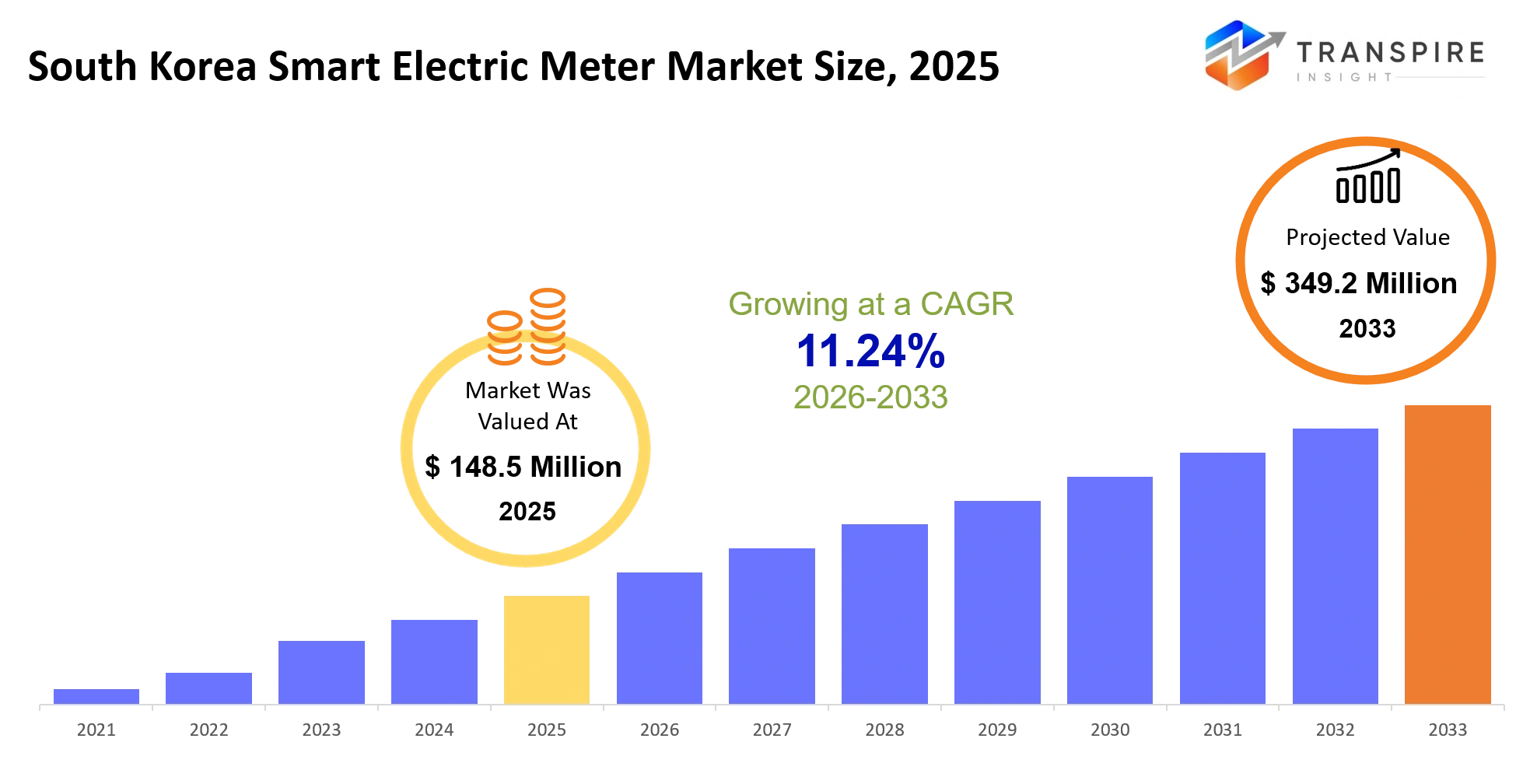
- South Korea Smart Electric Meter market Size 2025: USD 148.5 Million
- South Korea Smart Electric Meter market Size 2033: USD 349.2 Million
- South Korea Smart Electric Meter market CAGR: 11.24%
- South Korea Smart Electric Meter market Segments: By Meter Type (Smart Electricity Meters, Smart Gas Meters, Smart Water Meters, Others); By Technology (AMI Technology, AMR Technology, IoT-enabled Smart Meters, RF-based Smart Meters, Others); By Application (Residential Utilities, Commercial Utilities, Industrial Utilities, Smart Grid Systems, Others); By Communication Technology (PLC Communication, Cellular Communication, RF Mesh Communication, Others); By End User (Utility Providers, Industrial Facilities, Commercial Buildings, Households, Others).
To learn more about this report,  Download Free Sample Report
South Korea Smart Electric Meter market Summary
The South Korea Smart Electric Meter market was valued at USD 148.5 Million in 2025. It is forecast to reach USD 349.2 Million by 2033. That is a CAGR of 11.24% over the period.
In practical terms, South Korea’s smart electric meter market lets operators do near real-time tracking of household and industrial electricity usage, kind of replacing manual meter reading with automated data flows that help keep billing precise, stabilize the grid, and improve demand-side management. Utilities and energy operators lean on these meters so they can notice load spikes right away, curb energy theft, and fold in distributed renewable generation more efficiently, into the wider grid.
Over the last 3–5 years , the market has moved in a more structural way from pilot-scale AMR systems to countrywide Advanced Metering Infrastructure (AMI) platforms, largely thanks to digital grid modernization efforts. One notable catalyst was the post-COVID period, with energy volatility happening alongside stricter stability rules, so utilities were pushed to treat real time consumption visibility as a priority. This transition has, in turn, boosted operational efficiency for utilities, while also making room for time-of-use pricing schemes. Because of that, revenue growth is now more and more connected to data services that sit on top of metering hardware, not simply device sales by themselves.
Key Market Insights
- South Korea smart electric meter market is expected to top USD 349.2 Million by 2033, mainly because AMI rollout expansion goes full scale and keeps moving forward.
- Seoul and Busan basically lead the deployment landscape, with more than 45% combined utility smart meter penetration, inside urban residential grids. In other words, those areas are doing most of the heavy lifting, though other cities are catching up.
- The industrial side still holds nearly 38% share, due to the need for closer energy monitoring in semiconductor and manufacturing clusters, where every kilowatt matters a lot.
- Residential adoption is also climbing, rising above 52% in 2025 as utilities phase out the analog systems nationwide, step by step. You can feel the shift happening in everyday billing and measurement, not just in paperwork.
- For the fastest growth, commercial buildings are showing the quickest movement, especially where IoT based energy management systems are being folded into smart city projects.
- On the tech deployment side, Landis+Gyr and Itron are leading, particularly where grid analytics integration is involved, and where software plus hardware need to cooperate.
- Meanwhile, Schneider Electric is expanding AI driven energy optimization platforms in Korea, and Samsung SDS is backing utility cloud migration initiatives across the region.
- More and more utilities are moving toward predictive billing models too, powered by real time consumption analytics and edge computing infrastructure, and they’re trying to make forecasting feel practical.
- Finally, cybersecurity integration inside smart meters has become a priority, because grid digitization keeps increasing, and data exposure risks are becoming harder to ignore.
What are the Key Drivers, Restraints, and Opportunities in the South Korea Smart Electric Meter market?
The main thing driving the South Korea smart electric meter market is that national grid modernization push , led by utilities that are moving toward AMI-like infrastructure, kind of, well, you know. In other words government supported smart grid policies have nudged utilities to swap older meters for connected devices that can relay real-time usage info . Because of that utilities are getting better at load forecasting, and they can also run dynamic pricing schemes, which in turn helps power distributors improve revenue efficiency . At the same time it cuts operational losses linked to manual meter reading, plus billing mistakes too.
A big restraint though is the heavy upfront infrastructure and systems integration cost tied to rolling out AMI across the whole country. Just putting smart meters in place isn’t enough; utilities still need to pay for communication networks, data platforms, and those cybersecurity protections. So this becomes a sort of structural hitch for smaller regional operators who do not have the same capital expenditure leeway, and this basically slows down consistent adoption across all provinces. On top of that, interoperability issues between older grid setups and newer IoT-based meters , can drag timelines even further, delaying full scale implementation.
The most noticeable opportunity sits in AI powered energy analytics built on top of smart meter data. As utilities gather more granular consumption records , there’s more room to turn that into money through predictive energy management offerings, especially for industrial users. Some pilot programs in Seoul’s smart areas are already showing better load balancing and reduced peak demand, and that is opening additional income channels that go beyond the usual electricity billing approach.
What Has the Impact of Artificial Intelligence Been on the South Korea Smart Electric Meter market?
Artificial intelligence is, uh, reshaping South Korea’s smart electric meter ecosystem by taking raw consumption data and turning it into kind of actionable grid intelligence. Utilities are now leaning on machine learning models to automate load balancing choices, so they can spot peak demand patterns in real time and then tweak distribution flows with out any hands-on intervention. The end result is less strain on substations, plus better overall grid stability, especially in crowded urban zones where the demand swings can be brutal.
At the same time, predictive analytics is being pushed into transformer and meter health monitoring. In these setups, AI spots abnormal voltage fluctuations, which can hint at early equipment degradation. This really helps maintenance planning land at the right time, and it trims the odds of unexpected outages, so distribution networks stay up more often. There’s also AI-based forecasting, which supports demand prediction, letting utilities fine-tune electricity procurement and lower imbalance costs in wholesale energy markets.
Still, adoption isn’t smooth all the way through, because data quality inconsistencies show up and integration gets complicated when you’re dealing with older grid infrastructure. A lot of legacy substations don’t have standardized digital outputs, and that, in turn, reduces the usefulness of training datasets for predictive systems. So you end up with a noticeable performance gap between small pilot smart city projects and what could work nationwide. Even so, AI integration keeps moving forward, since utilities keep prioritizing digital grid resilience and broader automation.
Key Market Trends
- After the 2023 policy reforms, deployment of AMI systems kind of sped up, especially once real time consumption reporting became a requirement in urban utilities
- In 2025, residential smart meter setups jumped by about 52% across the Seoul metropolitan energy networks, a pretty dramatic increase
- For industrial customers, smart meters were used more and more for 24 7 load optimization in semiconductor manufacturing clusters
- AI enabled predictive maintenance cut grid failure rates by roughly 18% in pilot smart city projects, and honestly that felt noticeable
- Also in 2024, smart meter data was integrated with cloud platforms in a major way, during the utility modernization efforts
- Cybersecurity upgrades became compulsory later, due to growing cyberattack risks targeting connected energy infrastructure systems
- Commercial buildings started adopting IoT linked meters, for automated HVAC and energy efficiency optimization which helps operations
- Time of use pricing models spread across around 60% of urban consumers in advanced utility zones
- Utilities managed to lower manual meter reading costs by more than 30%, after big AMI rollouts
- Finally demand side response programs gained momentum as real time pricing incentives showed up in peak load management initiatives
South Korea Smart Electric Meter market Segmentation
By Meter Type
Smart Electricity Meters hold a dominant spot, because of the large-scale swap out of analog meters across urban residential as well as industrial grids. Utility modernization programs, plus high electricity consumption density in metropolitan regions, really push their strong deployment share. Smart Gas Meters sit in a moderate position, largely driven by urban safety monitoring needs and a gradual digitization of gas distribution networks. Smart Water Meters take a smaller piece, but they start picking up momentum in municipal infrastructure upgrades, especially those aiming at leakage detection and consumption optimization. The other meter types stay somewhat niche, and are usually tucked into pilot smart city projects.
Smart Electricity Meters are also the ones that grow faster, since they match grid digitization closely and they’re tied to demand-side management programs led by utilities. Smart Gas Meters do well thanks to safety-led adoption, but they’re still held back by slower replacement cycles for the underlying infrastructure. Smart Water Meters gain extra relevance in sustainability-focused municipal initiatives where water conservation becomes a policy priority. Other categories tend to expand through trial deployments inside integrated utility platforms. Over the forecast period, electricity meters will basically anchor the revenue concentration while multi utility integration leads to bundled deployment models for developers and investors.
By Technology
AMI Technology keeps the leading spot, mostly because it can enable real time data passing, remote supervision, and centralized control of utility operations. Big utility operators tend to prioritize AMI rollouts because it cuts down operational expenses, and it makes invoicing more precise , especially when you scale up. AMR Technology still shows a declining portion , but it stays relevant in grid areas that are only partly digitized, where full infrastructure upgrades are just not finished yet. IoT-enabled Smart Meters are becoming a fast expanding slice of the market, largely because they link with smart home ecosystems , and they also support industrial energy optimization platforms. RF based Smart Meters are still used in transitional circumstances where cellular or mesh coverage is limited, or not consistently available.
AMI Technology keeps stretching outward as utilities move into fully digital grid ecosystems, ones that need steady information exchange and automation routines. AMR Technology slowly sheds share, since many utilities swap out older legacy systems for more advanced architectures. IoT-enabled Smart Meters keep growing, driven by the push for connected energy experiences in smart buildings and industrial automation settings. RF-based systems remain around in deployments that are very cost constrained, but in the long run they will likely be replaced by cellular and IoT focused options. Overall, the evolution path seems to lean toward platforms that bundle analytics, interoperability features, and cloud based energy management tools.
By Application
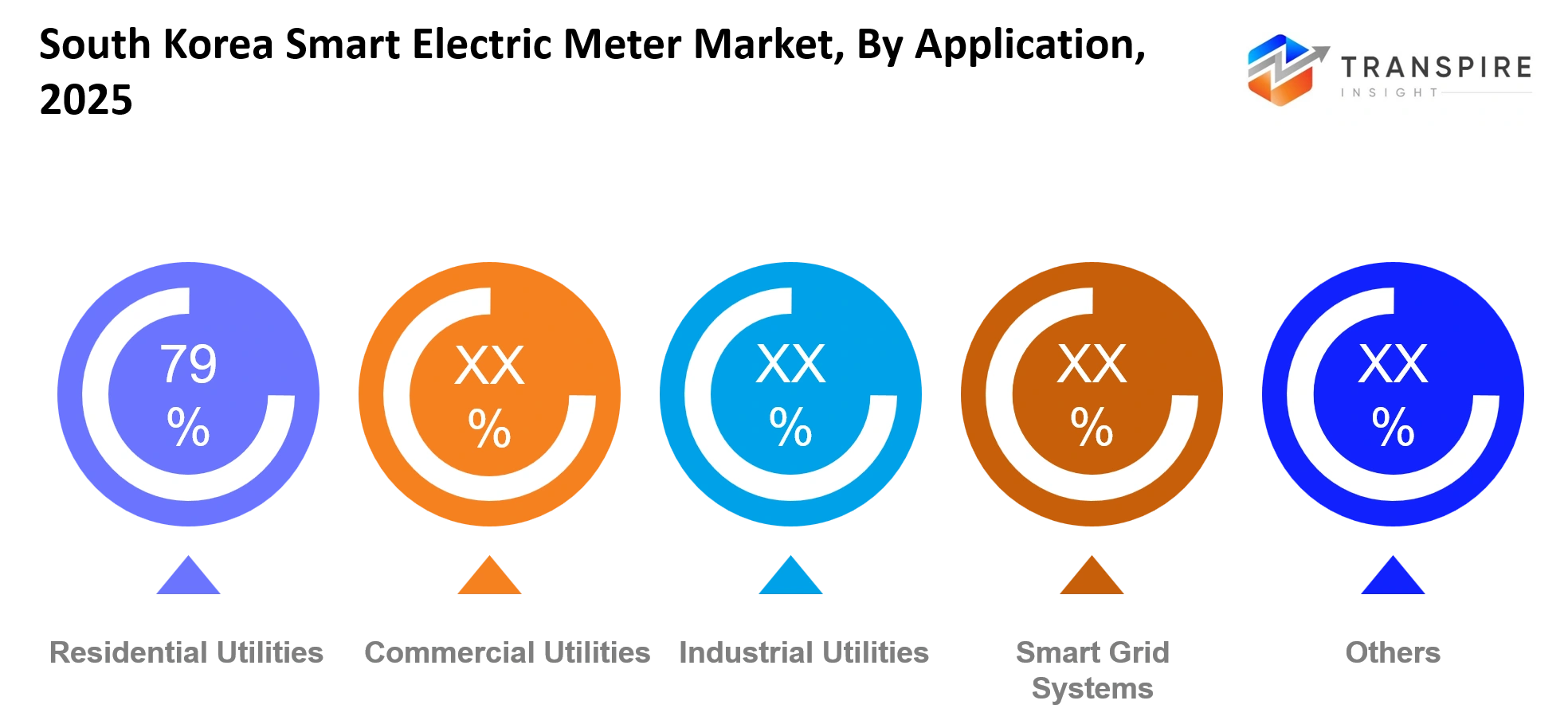
Residential Utilities basically sit in the leading seat, because nationwide smart meter rollout programs push household energy efficiency, plus they help the whole dynamic pricing adoption thing. The reason looks obvious enough, high urban density and a more centralized utility backbone helps those residential deployments scale up faster. Commercial Utilities still keep a solid share, mostly from energy-intensive properties where there’s need for real-time consumption tuning and tight cost control. Industrial Utilities are a key part, supported by manufacturing clusters that run on high, steady energy demand. Meanwhile Smart Grid Systems are moving fast too, as utilities fold in distributed energy resources, and also use renewable power balancing mechanisms.
Residential Utilities will stay in front, not just by habit but from regulatory mandates, and also because there are big infrastructure replacement programs coming through. Commercial Utilities should keep growing in a steady way as building automation systems start to weave in energy monitoring, and cost optimization tools as well. Industrial Utilities will expand along with more emphasis on predictive load management, plus operational efficiency inside heavy industries. Smart Grid Systems are likely to be the fastest-growing, since grid decentralization really gains momentum and renewable integration accelerates. And application diversification will nudge value creation away from plain metering, towards more intelligent energy management platforms.
To learn more about this report, Download Free Sample Report
By Communication Technology
PLC Communication has this kinda dominant role, mainly because it stays reliable inside the existing power line setup and it’s pretty cost-effective to roll out across neighborhoods. Utilities really like PLC , since it cuts the need for extra outside communication channels and still keeps the data flowing in a stable way. Meanwhile, Cellular Communication is moving fast, especially once 4G and 5G keep improving things like data speed, coverage , and overall scalability for real-time metering. RF Mesh Communication keeps a steady presence too, most clearly in crowded cities, where peer to peer routing makes the network feel more sturdy and able to recover. The remaining communication technologies don’t usually go far beyond experimental trials, or they show up as mixed, hybrid layouts only.
PLC is still broadly used, but it’s slowly getting squeezed by alternatives that feel more flexible and easier to scale. Cellular Communication keeps growing because utilities are pushing harder for real-time analytics, plus deeper cloud integration for better grid optimization. RF Mesh Communication keeps spreading across smart city deployments, because redundancy matters a lot , and network self healing becomes a must-have feature. Other approaches stay pretty niche, mostly due to interoperability limitations , which is why they don’t get adopted widely. Over time, the overall communication design is trending toward hybrid systems, mixing cellular and mesh networks together, so you get improved dependability along with better scalability.
By End User
Utility Providers take the leading, more or less dominant position, as the main deployers of smart metering infrastructure over both residential and industrial grids. The strong regulatory support, plus these centralized energy distribution patterns, tend to lock in their leadership. Industrial Facilities are seen as a high-value lane, partly because they need nonstop energy monitoring and then efficiency fine-tuning where manufacturing is heavy. Commercial Buildings still hold a solid share, mostly due to the growing uptake of building energy management systems , which is kind of the whole point these days. Households, meanwhile, make up the biggest volume-based portion, but they’re basically tethered to the utility-led rollout schedules.
Utility Providers are likely to keep steering market expansion since digital grid transformation stays centrally directed. Industrial Facilities will keep growing steadily, with more emphasis being placed on energy efficiency measures and operational optimization. Commercial Buildings should expand more quickly, as smart building ecosystems blend energy analytics with automation systems, pretty seamlessly. Households will still rise at a steady pace, but mainly through phased rollout programs, not through truly independent adoption. Over time, the end-user makeup will shift toward these data-driven energy ecosystems, where utilities function as platform operators instead of just being electricity suppliers.
What are the Key Use Cases Driving the South Korea Smart Electric Meter market?
The dominant use case is real-time residential and industrial energy monitoring, where smart meters help utilities keep an eye on consumption instantly, and at the same time improve billing accuracy. This becomes pretty important in urban places with dense populations and heavy electricity variability.
Secondary use cases show up as demand response programs in commercial buildings, plus energy optimization in manufacturing facilities. Industrial users end up relying on smart meters to handle peak load consumption, specifically in semiconductor and automotive production hubs, where energy intensity is high and always feels kind of unforgiving.
Newer, emerging applications cover things like integration with renewable microgrids and electric vehicle charging networks. These setups use smart meter data to balance distributed energy input and also optimize charging schedules, especially across smart city districts where grid decentralization is expanding quickly, and people want steadier outcomes.
|
Report Metrics |
Details |
|
Market size value in 2025 |
USD 148.5 Million |
|
Market size value in 2026 |
USD 165.7 Million |
|
Revenue forecast in 2033 |
USD 349.2 Million |
|
Growth rate |
CAGR of 11.24% from 2026 to 2033 |
|
Base year |
2025 |
|
Historical data |
2021 - 2024 |
|
Forecast period |
2026 - 2033 |
|
Report coverage |
Revenue forecast, competitive landscape, growth factors, and trends |
|
Regional scope |
South Korea |
|
Key company profiled |
LG Electronics, Samsung SDS, Siemens, Schneider Electric, Honeywell, Landis+Gyr, Itron, Kamstrup, Sensus, ABB, Mitsubishi Electric, Toshiba, Eaton, GE Digital, CyanConnode. |
|
Customization scope |
Free report customization (country, regional & segment scope). Avail customized purchase options to meet your exact research needs. |
|
Report Segmentation |
By Meter Type (Smart Electricity Meters, Smart Gas Meters, Smart Water Meters, Others); By Technology (AMI Technology, AMR Technology, IoT-enabled Smart Meters, RF-based Smart Meters, Others); By Application (Residential Utilities, Commercial Utilities, Industrial Utilities, Smart Grid Systems, Others); By Communication Technology (PLC Communication, Cellular Communication, RF Mesh Communication, Others); By End User (Utility Providers, Industrial Facilities, Commercial Buildings, Households, Others). |
Which Regions are Driving the South Korea Smart Electric Meter market Growth?
Seoul metropolitan region kinda leads, because it has really advanced smart city infrastructure and utility digitization policies that are pretty aggressive too. The high population density creates this pretty steady demand, for real-time energy monitoring systems, across both residential and commercial buildings. On top of that , government backed grid modernization programs have sped up AMI deployment in most districts. And well, the advanced ICT infrastructure there, also makes data integration and analytics adoption feel more seamless.
Busan and Incheon show up as stable secondary markets, they have solid industrial plus port related electricity demand. Instead of Seoul’s more policy driven acceleration, these areas tend to grow through consistent investment in industrial energy efficiency, and also port electrification systems. Manufacturing clusters and logistics hubs basically keep smart meter adoption moving, especially across larger commercial facilities. That ends up giving utility providers a more balanced revenue base, for export oriented industries.
If we’re talking fastest-growing, it seems the smart city corridors in Ulsan and Daegu are taking the lead. That’s mostly tied to newer investments in industrial automation and renewable integration. There are also new government backed decarbonization programs, which have accelerated smart grid deployment in those places. Utilities are modernizing their infrastructure to handle hybrid energy systems , mixing solar with the traditional grid. Overall, this quick transformation suggests strong opportunities for technology providers between 2026 and 2033.
Who are the Key Players in the South Korea Smart Electric Meter market and How Do They Compete?
The South Korea smart electric meter market is fairly consolidated, but, you know, not in a way that everything is fully settled. Global utility technology firms are jostling alongside domestic digital infrastructure providers. Mostly, competition comes from advanced metering tech, grid system interoperability, and the whole data analytics thing, not just price alone. Many established players are pushing harder on software centric value, especially now that hardware margins feel like they are compressing.
Landis+Gyr and Itron go head to head with advanced AMI platforms, these also bring predictive analytics and grid automation tools together. What really separates them is the big deployment experience, plus solid utility partnerships across Asia-Pacific, so they can integrate quicker into national grid programs.
Schneider Electric and ABB lean into digital grid ecosystems that connect smart meters with IoT energy management solutions. Their approach is heavily about software integration and industrial energy optimization, particularly for large commercial users. Samsung SDS is strengthening its position through cloud based energy data platforms and partnerships with local utilities. Their key advantage is domestic infrastructure integration and enterprise scale digital transformation abilities, especially across smart city projects.
Company List
- LG Electronics
- Samsung SDS
- Siemens
- Schneider Electric
- Honeywell
- Landis+Gyr
- Itron
- Kamstrup
- Sensus
- ABB
- Mitsubishi Electric
- Toshiba
- Eaton
- GE Digital
- CyanConnode
Recent Development News
In April 2026, Schneider Electric advanced its EcoStruxure-based smart energy and grid modernization initiatives across Asia-Pacific utilities, integrating smart metering data with AI-driven energy management systems. This improves demand-side optimization and accelerates deployment of connected metering infrastructure in commercial and residential grids.
Source: https://www.se.com
In February 2025, Landis+Gyr continued expansion of its advanced metering infrastructure (AMI) deployments across Asian utility markets, focusing on real-time data analytics and grid efficiency improvements. This supports utilities in reducing energy losses and improving billing accuracy through digital meter integration.
Source: https://www.landisgyr.com
What Strategic Insights Define the Future of the South Korea Smart Electric Meter market?
Over the next 5–7 years South Korea smart electric meter market is kind of moving, toward a more fully software defined energy ecosystem, where metering hardware turns into like a data node inside national digital grid platforms. That change is largely pushed by utility scale electrification, renewable intermittency management and, honestly the need for real time demand balancing across really dense urban load centers. Theres also a risk that feels less visible at first: vendor concentration in AMI software stacks keeps getting stronger, and that can lead to dependency on a smaller set of global platform providers. Over time that could expose utilities to pricing pressure and interoperability constraints, even when they still want to innovate.
On the upside though, peer to peer energy trading is starting to show up, enabled by blockchain enabled smart meters in new smart city districts. This is especially promising in mixed residential commercial developments where consumption patterns can actually vary a lot. Strategically, market participants should give priority to open architecture meter designs and put money into API first data platforms, so long term integration flexibility stays intact. And rather than betting on hardware replacement cycles, they can secure recurring revenue from analytics driven energy services, which is maybe the more scalable route.
South Korea Smart Electric Meter market Report Segmentation
By Meter Type
- Smart Electricity Meters
- Smart Gas Meters
- Smart Water Meters
- Others
By Technology
- AMI Technology
- AMR Technology
- IoT-enabled Smart Meters
- RF-based Smart Meters
- Others
By Application
- Residential Utilities
- Commercial Utilities
- Industrial Utilities
- Smart Grid Systems
- Others
By Communication Technology
- PLC Communication
- Cellular Communication
- RF Mesh Communication
- Others
By End User
- Utility Providers
- Industrial Facilities
- Commercial Buildings
- Households
- Others
Frequently Asked Questions
Find quick answers to common questions.
The estimated South Korea Smart Electric Meter Market size for the market will be USD 349.2 Million in 2033.
Key segments for the South Korea Smart Electric Meter Market are By Meter Type (Smart Electricity Meters, Smart Gas Meters, Smart Water Meters, Others); By Technology (AMI Technology, AMR Technology, IoT-enabled Smart Meters, RF-based Smart Meters, Others); By Application (Residential Utilities, Commercial Utilities, Industrial Utilities, Smart Grid Systems, Others); By Communication Technology (PLC Communication, Cellular Communication, RF Mesh Communication, Others); By End User (Utility Providers, Industrial Facilities, Commercial Buildings, Households, Others).
Major South Korea Smart Electric Meter Market players are LG Electronics, Samsung SDS, Siemens, Schneider Electric, Honeywell, Landis+Gyr, Itron, Kamstrup, Sensus, ABB, Mitsubishi Electric, Toshiba, Eaton, GE Digital, CyanConnode.
The South Korea Smart Electric Meter Market size is USD 148.5 Million in 2025.
The South Korea Smart Electric Meter Market CAGR is 11.24% from 2026 to 2033.
- LG Electronics
- Samsung SDS
- Siemens
- Schneider Electric
- Honeywell
- Landis+Gyr
- Itron
- Kamstrup
- Sensus
- ABB
- Mitsubishi Electric
- Toshiba
- Eaton
- GE Digital
- CyanConnode
About the Authors

Avinash Kumar
I’m Avinash Kumar, a Senior Research Analyst at Transpire Insight, with expertise in the Electronics and Semiconductor and Energy & Power industry. My work focuses on analyzing emerging technologies, market trends, industry developments, and innovation across these sectors. I specialize in transforming complex technical and market insights into clear, research-backed content that helps professionals, businesses, and decision-makers stay informed. Through continuous industry research and data-driven analysis, I strive to deliver accurate, reliable, and practical perspectives on the latest advancements shaping the semiconductor and energy landscape.

Chakradhar Khansole
Chakradhar serves as the Research Director at Transpire Insight, bringing over 8 years of experience in technology, innovation, and strategic market intelligence. He specializes in transforming complex market data into actionable business insights that enable organizations to make informed, growth-oriented decisions. Recognized for his strategic vision and analytical expertise, Chakradhar leads high-impact research initiatives, delivering comprehensive market assessments, competitive intelligence, and forward-looking industry analysis.
Recently Published Reports
-
Apr 2026
Active Power Filter Market
Active Power Filter Market Size, Share & Analysis Report By Type (Shunt Active Power Filters, Series Active Power Filter, Hybrid Active Power Filter), By Application (Harmonics Mitigation, Reactive Power Compensation, Voltage Regulation, Power Factor Correction), By Phase (Single Phase, Three Phase), By End-User Industry (Manufacturing, Healthcare, Commercial, Automotive, Oil and Gas, Others), and Geography (North America, Europe, Asia-Pacific, Middle East and Africa, South and Central America), 2021 - 2031
-
Apr 2026
Electrical Transformer Market
Electrical Transformer Market Size, Share & Analysis Report By Core (Closed, Shell, and Berry), By Insulation (Gas, Oil, Solid, Air, and Other), By Phase (Single, and Three), By Rating (100 MVA to 500 MVA, 501 MVA to 800 MVA, and 801 MVA to 1200 MVA), and Geography (North America, Europe, Asia-Pacific, Middle East and Africa, South and Central America), 2021 – 2031
-
Apr 2026
Hydraulic Piston Pumps Market
Hydraulic Piston Pumps Market Size, Share & Analysis Report By Type (Axial Piston Pumps, Radial Piston Pumps), By Operating Pressure (Low Pressure, Medium Pressure, High Pressure), By Application (Construction, Mining, Agriculture, Automotive, Oil & Gas, Industrial Machinery, Others), By End-User (OEMs, Aftermarket), and Geography (North America, Europe, Asia-Pacific, Middle East and Africa, South and Central America), 2021 – 2031
-
Apr 2026
Laboratory Gas Generators Market
Laboratory Gas Generators Market Size, Share & Analysis Report By Product (Nitrogen Gas Generator, Hydrogen Gas Generator, Zero Air Gas Generator, Purge Gas Generator, TOC Gas Generators, Others), By Application (Gas Chromatography, Liquid Chromatography-mass Spectrometry (LC-MS), Gas Analyzers, Others), By End-user (Life Science, Chemical & Petrochemical, Food & Beverage, Others), and Geography (North America, Europe, Asia-Pacific, Middle East and Africa, South and Central America), 2021 – 2031