
South Korea Smart Card IC Market Summary:
According to Transpire Insight, a detailed research report on the market reflects that the microprocessor-based smart card IC segment dominates the South Korea Smart Card IC Market, accounting for approximately 58% of the total market, supported by demand from financial cards, telecommunications, government identification, and transportation applications. Infineon Technologies AG is a leading global smart-card IC supplier, with an estimated 10–15% South Korea market share, supported by its secure microcontroller, payment, identification, and authentication technologies, making it a significant contributor to South Korea market development, innovation, advanced secure IC production, and competitive growth dynamics.
Market Snapshot
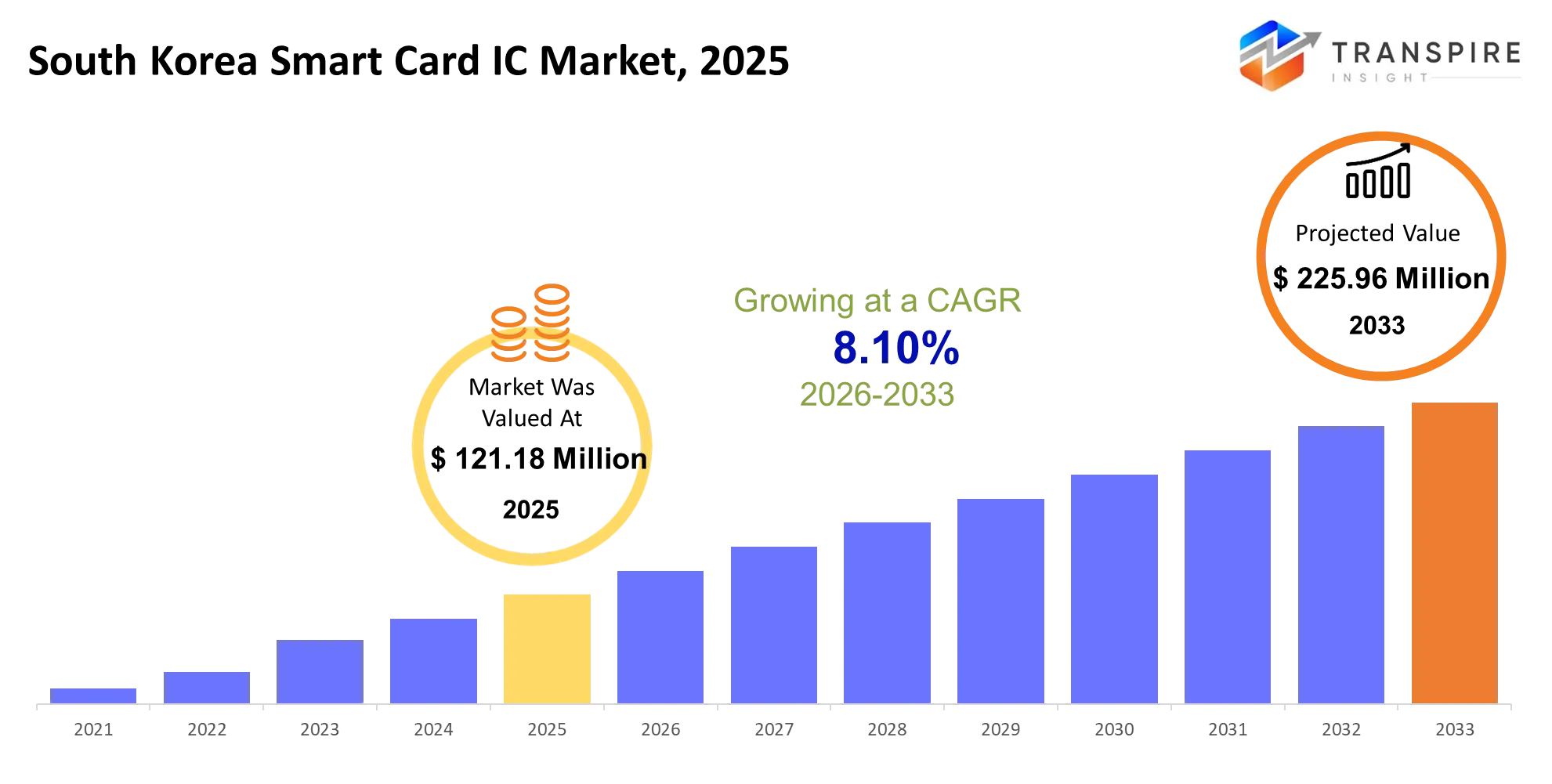
- Market Value (2025): USD 121.18 Million.
- Expected Market Value (2026): USD 131.01 Million.
- Estimated Market Value (2033): USD 225.96 Million.
- Forecast CAGR (2026–2033): 8.10%
Introduction
The Smart Card IC (Integrated Circuit) market is made up of the design, production, and marketing of small computer ICs that are implanted on a plastic card. The chip stores and processes the data securely through secure memory and processors. Smart Card IC (Integrated Circuit) is a tamper-proof microchip embedded in plastic cards to process and store the data securely. Advantages of the South Korea Smart Card IC Market include increased security, where microcontrollers and secure elements offer support for encryption, authentication, and secure data storage. Multi-functionality allows smart cards to be used for transport, payments, entry into buildings, and digital identification using IC technology architecture. The convenience of contactless technology allows transactions to take place through wireless communication in the short range, hence increasing the adoption of the technology in financial and transport services. Furthermore, an advantage of the South Korea Smart Card IC market includes resilience of the supply chain, owing to the highly developed semiconductor industry in South Korea.
Key Market Highlights: -
- By type, the Microcontroller ICs segment dominated the market and holds nearly 52% share in 2025 and is projected to grow at a substantial CAGR during the forecast period.
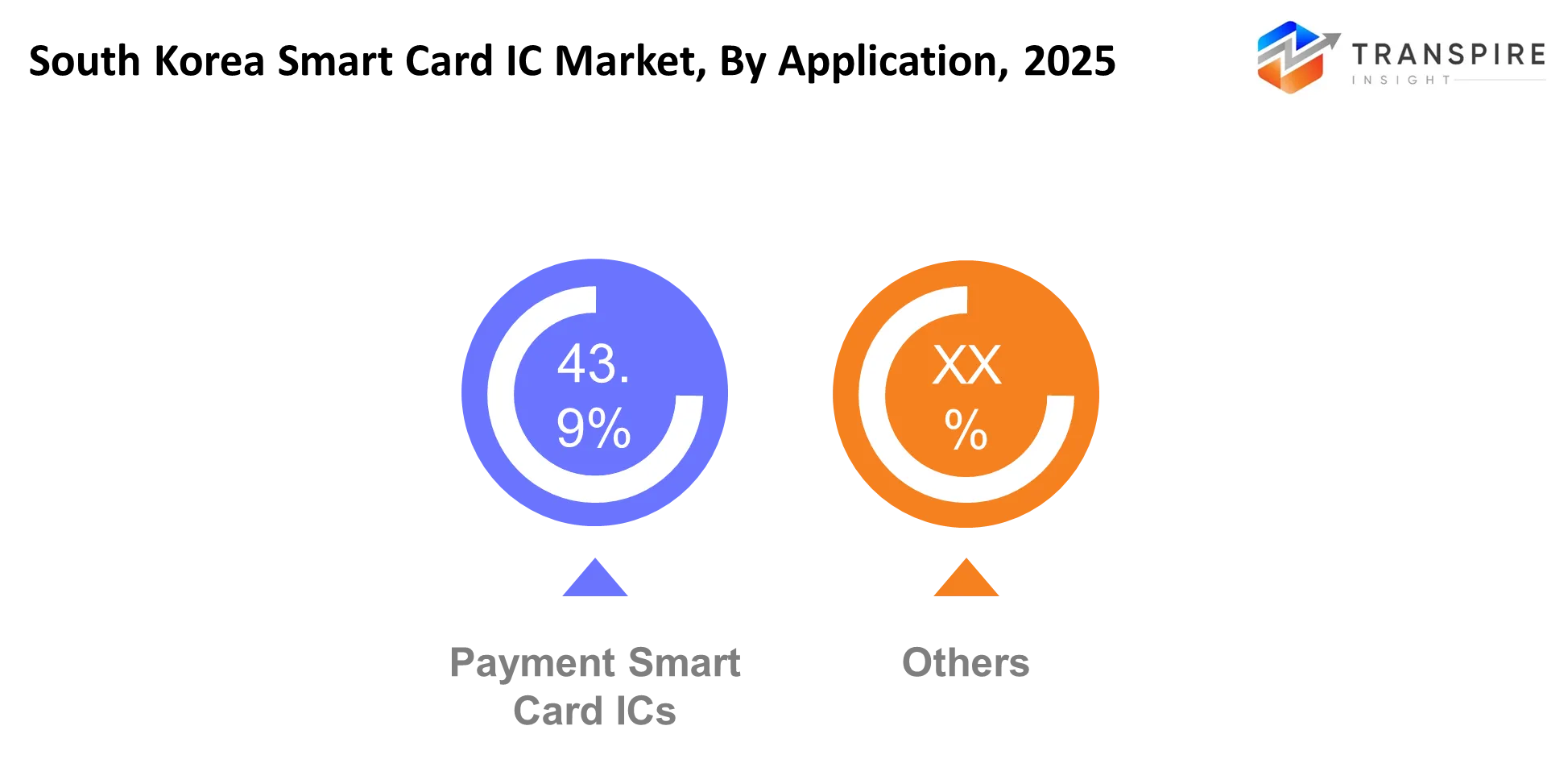
- By application, the Payment Cards segment dominated the market and holds nearly 41% share in 2025 and is projected to grow at a substantial CAGR during the forecast period.
- By end user, the Banks segment dominated the market and holds nearly 28% share in 2025 and is projected to grow at a substantial CAGR during the forecast period.
- Digital Identity Deployment Across Country: South Korea introduced Mobile Resident Registration Card throughout the country in March 2025. The system utilizes resident cards embedded with IC which authenticate the user through their smartphones using the Mobile ID App. The innovation has enhanced the need for secured IC smart cards, contactless authentication, encryption, digital identity services, and identification technologies.
How is Technology Driving Growth in the South Korea Smart Card IC Market?
The South Korean Smart Card IC Market is making progress through innovations such as digital payments, contactless solutions, biometric security, and smart infrastructure. Adoption of NFC and mobile payment is driving demand for secure and low latency IC chips, while dual interface architecture enables contact as well as contactless transactions. Innovations like fingerprint based authentication and advancements in cryptography help improve the process of authentication and transactions. In addition, initiatives related to smart cities and IoT are helping expand application areas of smart cards ICs in access control, transportation, utility services, and other connected services. An advanced semiconductor market in South Korea helps in prototype development and IC chip design and production.
Market Drivers
South Korea Smart Card IC Market is being bolstered by rising uptake of contactless payment technology due to growing preference of consumers for tap and go payments in both retail and public transport systems. Government policies and digital identity programs have increased the demand for secure authentication and identification chips for access control purposes. Heightened security standards have also increased the uptake of secure element technology, biometrics and encryption technology to minimize risk of fraud and security breaches. On the other hand, there has been growth in smart infrastructure deployment that is creating use cases for smart cards in digital wallets, intelligent transport systems, devices, and internet of things solutions. The South Korea Smart Card IC Market is aided by an ecosystem of highly developed semiconductors that benefit from advanced chip manufacturing, component manufacturing, and technology infrastructure. The highly digitized, technologically aware consumers speed up the implementation of contactless payments, NFC services, and digital identification solutions. The favorable government policies for digitalization, intelligent transport, identification, and smart infrastructure ensure steady demand for smart card IC technologies. Furthermore, high levels of security standards promote innovations in secure elements, encryption, multi-factor authentication, and biometric-enabled IC technologies. All these advantages ensure a competitive smart card IC market ecosystem in South Korea.
Restrain
In the case of South Korea Smart Card IC Market, the threats are posed by the threat of mobile wallet substitution as well as the threat of increasing use of smartphones for making payments. The emergence of eSIM is posing a challenge to the use of traditional SIM and USIM cards. Higher costs of production as well as the cost of research and development are limiting profit margins. Threats related to cybersecurity have increased.
|
Driver |
Relative Impact on Growth (%) |
Geographic Relevance |
Impact Timeline |
Demand Strength |
Growth Mechanism |
Key Beneficiaries |
Major Constraint |
|
Driver 1: Contactless Payment and Digital Payment Adoption |
27% |
Nationwide; Seoul and major urban centers |
Short-term |
High |
Expands secure contactless card issuance and replacement |
IC manufacturers, banks, payment networks, consumers |
Mobile wallet substitution limits physical card growth |
|
Driver 2: Digital Identity and Government ID Expansion |
23% |
Nationwide; government and financial-service ecosystems |
Medium-term |
High |
Increases secure IC-based authentication and identification demand |
Secure IC vendors, governments, identity providers |
Migration toward smartphone-only credentials |
|
Driver 3: Advanced Security and Authentication Requirements |
20% |
Nationwide; banking, telecom, government |
Medium-term |
High |
Drives secure elements, encryption, and authentication upgrades |
Security IC suppliers, banks, telecom operators |
Higher development and certification costs |
|
Driver 4: NFC, Dual-Interface and Smart Infrastructure Adoption |
17% |
Seoul, Busan, Incheon and smart-city hubs |
Medium-term |
High |
Expands multifunctional contactless IC applications |
IC vendors, transport authorities, enterprises |
Interoperability and infrastructure integration costs |
|
Driver 5: Semiconductor Technology and Domestic Supply Ecosystem |
13% |
Nationwide; semiconductor manufacturing clusters |
Long-term |
Medium |
Supports advanced secure IC design and production capabilities |
Semiconductor manufacturers, technology vendors, OEMs |
High capital expenditure and technological complexity |
Analysis of Prices and Consumer Behaviour
South Korea Smart Card ICs market consists mostly of microprocessor smart card ICs (about 58% of the total market; mainly due to financial cards, telecommunication, and government identification and transportation application segments). An estimated cost premium for high-end, advanced smart card IC with secure element architecture and advanced authentication capabilities is 20-30% more expensive than standard smart card ICs since these products require sophisticated semiconductor technology, security certifications and data protection capabilities. Around 62% of smart card IC demand comes from contactless/dual interface segments because of increasing usage of contactless payments, transportation and identification solutions. The sales volumes are driven by the versatility of usage for payment cards, SIM/eSIM solutions, transportation cards, government identification and access control systems as well as the service life of smart card ICs. Financial services, telecommunication and government segments account for about 65% of demand for smart card IC applications. Customers' purchasing preferences show that about 58% give the highest priority to security certification, reliability of the IC and advanced authentication capabilities. Another 30% of customers prefer to buy ICs in bulk or under long-term contracts as they try to decrease procurement expenses and ensure constant supply of qualified smart card ICs for card issuance.
Who are the Key Players in the South Korea Smart Card IC Market and how do they compete?
Competitiveness in the South Korea Smart Card IC Market relies on companies specializing in security-focused semiconductor technologies, payments and identification systems, advanced authentications, and regional distribution and technological partnerships. Competing both in terms of price and architecture of secure element, contactless capability, encryption capability, certifications and payments, transportation, telecoms, and governmental identification systems integration, such a type of competitiveness ensures constant product innovation while providing organizations with more security, reliability, transaction efficiency, and data protection.
Through the development of secure microcontrollers, secure elements, contactless ICs, and payment security solutions, Samsung Electronics improves its competitiveness in the market via advanced semiconductor technologies and security innovations. Through the development of advanced secure ICs and contactless solutions for payments, identification, transportation, and embedded systems, Infineon Technologies distinguishes itself through security knowledge and comprehensive smart card technologies. NXP Semiconductors develops its competitiveness by offering secure identification, payments, NFC, and authentication IC solutions capable of being integrated into digital payment platforms, transportation systems, governmental ID programs, and connected device systems.
Top Companies in the South Korea Smart Card IC Market
- Samsung Electronics
- SK Hynix
- Infineon Technologies
- NXP Semiconductors
- STMicroelectronics
- Renesas Electronics
- Sony Semiconductor Solutions
- Microchip Technology
- Toshiba
- ABLIC
- Magnachip Semiconductor
- Kioxia
- EM Microelectronic
- Giesecke+Devrient
- IDEMIA
|
Company |
Est. Revenue Share Range |
Key Offerings |
Strategic Positioning |
Geographic Strength |
Technology Focus |
|
Samsung Electronics |
12–18% |
Smart Card ICs, biometric payment ICs, secure elements, fingerprint security ICs |
Technology leadership through integrated secure IC solutions |
Asia-Pacific, North America, Europe |
Biometric security, secure elements, embedded flash, NFC |
|
Infineon Technologies |
11–17% |
TEGRION security controllers, SECORA Pay, SECORA Pay Bio, secure smart-card controllers |
Premium security leadership for payment applications |
Europe, Asia-Pacific, North America |
Hardware security, cryptography, biometric payment, dual-interface |
|
NXP Semiconductors |
10–16% |
SmartMX3, MIFARE DESFire, MIFARE Plus, secure smart-card controllers |
Broad contactless and multi-application platform strategy |
Europe, Asia-Pacific, North America |
NFC, contactless security, cryptography, secure microcontrollers |
|
STMicroelectronics |
8–13% |
ST31 secure MCUs, STPay-Topaz, STeID, ST21NFC |
Diversified secure MCU and payment technology portfolio |
Europe, Asia-Pacific, North America |
Secure MCUs, Java Card, NFC, biometric authentication |
|
Sony Semiconductor Solutions |
4–7% |
FeliCa ICs, contactless IC technologies, NFC-related solutions |
Contactless specialization across transportation ecosystems |
Asia-Pacific, Japan, North America |
FeliCa, NFC, RFID, contactless communication |
|
EM Microelectronic |
3–6% |
EM4333 smart-card IC, NFC ICs, high-frequency contactless ICs |
Niche specialization in low-power contactless ICs |
Europe, Asia-Pacific, North America |
RFID, NFC, ISO/IEC 14443, ISO/IEC 15693 |
|
Microchip Technology |
2–4% |
CryptoRF ICs, CryptoMemory, SEC1110/1210 smart-card controllers |
Specialized security and smart-card interface solutions |
North America, Europe, Asia-Pacific |
Hardware encryption, authentication, ISO 7816, EMV |
|
Renesas Electronics |
1–3% |
Secure MCUs, smart-card interface technologies, authentication ICs |
Embedded security specialization across connected systems |
Asia-Pacific, Japan, Europe |
Secure MCUs, authentication, ISO 7816, embedded security |
|
Thales |
1–3% |
IDPrime smart cards, secure authentication cards, PKI solutions |
Secure identity ecosystem and authentication specialization |
Europe, Asia-Pacific, North America |
PKI, secure authentication, dual-interface, NFC |
|
Giesecke+Devrient (G+D) |
1–3% |
Payment cards, secure identity solutions, SIM/eSIM and card-security technologies |
End-to-end secure credential and payment ecosystem |
Europe, Asia-Pacific, North America |
Secure credentials, payment security, digital identity, eSIM |
South Korea Smart Card IC Market Segmentation
The South Korea Smart Card IC Market share is divided into six categories: By type, application, security level, interface, end user and card.
The Microcontroller ICs dominated the market, accounting for nearly 52% in 2025 and is expected to rise at a significant CAGR during the forecast period.
The South Korea Smart Card IC Market is segmented by type into Contact ICs, Contactless ICs, Dual-Interface ICs, Secure ICs, Memory ICs, Microcontroller ICs, NFC ICs, eSIM ICs. Among these, the Microcontroller ICs segment dominated the market, accounting for nearly 52% in 2025 and expected to increase at a significant CAGR during the forecast period. The ultimate convenience, portability and on-the-go consumption of dietary supplements are what propel their domination and expansion. These portable, ready-to-use formats are becoming more and more popular among consumers who lead hectic, fast-paced lives.
The Payment Cards dominated the market, accounting for nearly 41% in 2025, and is expected to rise at a significant CAGR during the forecast period.
The South Korea Smart Card IC Market is segmented by application into Payment Cards, Transportation Cards, Identification Cards, Access Control, SIM Cards, Healthcare Cards, Government IDs, Loyalty Cards. Among these, the Payment Cards segment dominated the market, accounting for nearly 41% in 2025 and expected to increase at a significant CAGR during the forecast period. Because they are ideal for today's fast-paced lifestyles, handheld functional foods are the norm. Because they provide rapid preventative health benefits, such as immunity and energy boosts, without interfering with their hectic schedules, consumers greatly want these portable, nutrient-dense products.
The Banks dominated the market, accounting for nearly 28% in 2025 and is expected to rise at a significant CAGR during the forecast period.
The South Korea Smart Card IC Market is segmented by end user into Banks, Telecom Operators, Governments, Transport Authorities, Healthcare Providers, Enterprises, Retailers, Security Organizations. Among these, the Banks segment dominated the market, accounting for nearly 28% in 2025 and expected to increase at a significant CAGR during the forecast period. Rapid urbanization, growing disposable incomes and a strong demand from busy, health-conscious customers for quick, on-the-go snacking have all contributed to the dominance and expansion of the handheld food and beverage market.
Future Market Trends for the South Korea Smart Card IC Market: -
- Domination of Contactless Payment Technologies: Higher consumer preference for NFC and contactless technologies increases the demand for high-end IC chips for wireless applications.
- Smart City Infrastructure Implementation: Government initiatives for digital water management and smart city initiatives increase the use of IC chips for utility meters.
- Increased Security Measures: Increased cases of cyber-frauds force financial and health-care institutions to adopt stronger encryption techniques and PCI-PTS approved terminals.
- Advanced Architecture for Chips: Transition from 8-bit ICs to 32-bit ICs takes place quickly to provide multi-functional cards with reduced power consumption.
- Eco-Friendly Substrates: Green initiatives encourage the use of recyclable substrates in IC chips.
Recent Development
- In September 2026: Both Shinhan Card and Hana Card became members of SK Telecom’s AI for All Alliance, which has been working on the standardization of Agent Pay technology to facilitate AI-powered payments. This helps South Korea advance its digital payment infrastructure and indirectly contributes to the Smart Card IC Market through the need for secure and safe payments.
- In July 2026: The Company announced Samsung Galaxy Card that is powered by Visa and features virtual and metal versions of cards with Samsung Wallet integration and Knox security. This development is not related to the release of a smart card IC in South Korea, but shows the progress made in the area of secure payment cards.
Market Segment
This study forecasts revenue at South Korea, regional and country levels from 2020 to 2033. Transpire Insight has segmented the South Korea Smart Card IC Market based on the below-mentioned segments:
South Korea Smart Card IC Market, By Type
- Contact ICs
- Contactless ICs
- Dual-Interface ICs
- Secure ICs
- Memory ICs
- Microcontroller ICs
- NFC ICs
- eSIM ICs
South Korea Smart Card IC Market, By Application
- Payment Cards
- Transportation Cards
- Identification Cards
- Access Control
- SIM Cards
- Healthcare Cards
- Government IDs
- Loyalty Cards
South Korea Smart Card IC Market, By Security Level
- Basic Security
- Advanced Security
- High Security
- Hardware Encryption
- Secure Element
- Biometric Security
- Tamper Resistant
- Multi-Application Security
South Korea Smart Card IC Market, By Interface
- Contact
- Contactless
- Dual Interface
- NFC
- RFID
- ISO/IEC 7816
- ISO/IEC 14443
- Other Interfaces
South Korea Smart Card IC Market, End User
- Banks
- Telecom Operators
- Governments
- Transport Authorities
- Healthcare Providers
- Enterprises
- Retailers
- Security Organizations
South Korea Smart Card IC Market, By Card Type
- Debit Cards
- Credit Cards
- Prepaid Cards
- Transit Cards
- ID Cards
- SIM Cards
- Access Cards
- Membership Cards
Frequently Asked Questions
Find quick answers to common questions.
The market is projected to reach USD 225.96 million by 2033, growing at a 8.10% CAGR during 2026–2033.
Microcontroller ICs dominated the market with approximately 52% share in 2025, driven by payment, identification, transportation, and telecommunications applications.
Payment Cards dominated the market with approximately 41% share in 2025, supported by secure and increasingly contactless payment transactions.
Banks dominated the market with approximately 28% share in 2025, driven by secure payment cards, authentication, encryption, and fraud prevention.
Contactless payments, digital identities, cybersecurity, smart infrastructure, NFC adoption, and advanced semiconductor manufacturing are key market growth drivers.
- Samsung Electronics
- SK Hynix
- Infineon Technologies
- NXP Semiconductors
- STMicroelectronics
- Renesas Electronics
- Sony Semiconductor Solutions
- Microchip Technology
- Toshiba
- ABLIC
- Magnachip Semiconductor
- Kioxia
- EM Microelectronic
- Giesecke+Devrient
- IDEMIA
About the Authors

Mayur Shinde
I am Mayur Shinde, a Senior Research Analyst at Transpire Insight, specializing in the Automotive & Transportation and Information & Communication Technology (ICT) Industry. My work focuses on analyzing emerging market trends, technological advancements, competitive landscapes, and industry developments to deliver accurate, data-driven insights. I am passionate about transforming complex market information into clear, actionable content that helps businesses, professionals, and decision-makers stay informed and make confident strategic decisions.

Chakradhar Khansole
Chakradhar serves as the Research Director at Transpire Insight, bringing over 8 years of experience in technology, innovation, and strategic market intelligence. He specializes in transforming complex market data into actionable business insights that enable organizations to make informed, growth-oriented decisions. Recognized for his strategic vision and analytical expertise, Chakradhar leads high-impact research initiatives, delivering comprehensive market assessments, competitive intelligence, and forward-looking industry analysis.
Recently Published Reports
-
Apr 2026
3D Optical Profiler Market
3D Optical Profiler Market Size, Share & Analysis Report By Type (Desktop 3D Optical Profiler, and Portable 3D Optical Profiler), By Technology (Confocal Technology, and White Light Interference), By End-Use Industry (Manufacturing, Research Institutions, Automotive, Aerospace and Defense, Medical Devices, and Other), and Geography (North America, Europe, Asia-Pacific, Middle East and Africa, South and Central America), 2021 - 2031
-
Apr 2026
Depth Sensor Market
Depth Sensor Market Size, Share & Analysis Report By Type (Infrared Depth Sensors, Time-of-Flight (ToF) Sensors, Stereo Vision Sensors, Structured Light Sensors, Ultrasonic Depth Sensors), By Application (Automotive, Robotics, Gaming, Consumer Electronics, Industrial Automation, Healthcare, Security & Surveillance, Others), By End Users (Automotive Manufacturers, Consumer Electronics Companies, Healthcare Providers, Industrial Companies, Security Agencies, Gaming Companies, Robotics Companies, Others), and Geography (North America, Europe, Asia-Pacific, Middle East and Africa, South and Central America), 2021 – 2031
-
Apr 2026
Digital Manufacturing Market
Digital Manufacturing Market Size, Share & Analysis Report By Component (Hardware, Software, and Services), By Technology (Robotics, 3D Printing, Internet of Things (IoT), and Others), By Application (Automotive and Transportation, Aerospace and Defense, Consumer Electronics, Industrial Machinery, and Others), By Process Type (Computer-Based Designing, Computer-Based Simulation, Computer 3D Visualization, Analytics, and Others), and Geography (North America, Europe, Asia-Pacific, Middle East and Africa, South and Central America), 2021 – 2031
-
Apr 2026
Digital Visa Services Market
Digital Visa Services Market Size, Share & Analysis Report By Type (Individual Travelers, Group Travelers), By Application (Tourism, Business Travel, Others), and Geography (North America, Europe, Asia-Pacific, Middle East and Africa, South and Central America), 2021 – 2031