
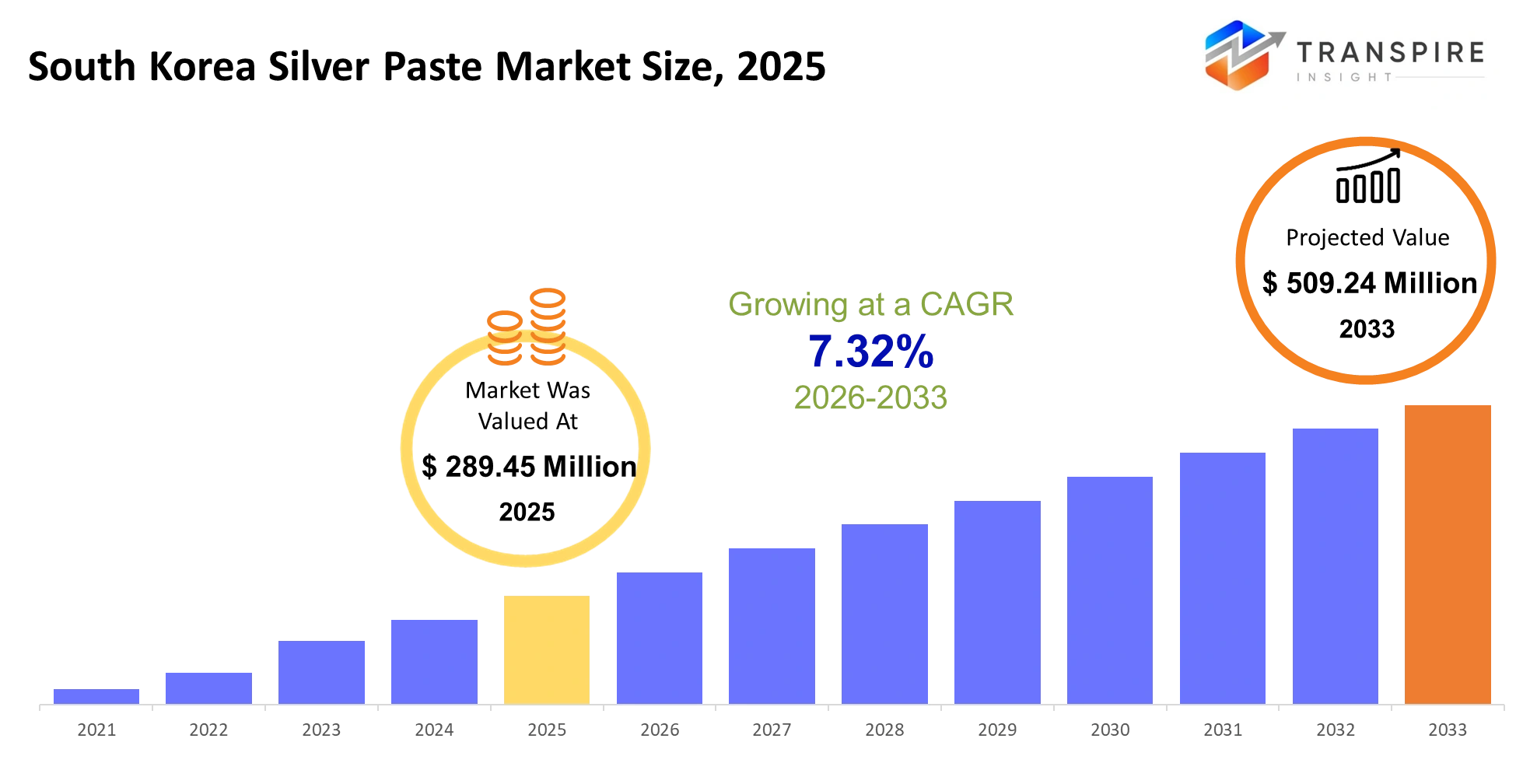
South Korea Silver Paste Market Size & Forecast:
- South Korea Silver Paste Market Size 2025: USD 289.45 Million
- South Korea Silver Paste Market Size 2033: USD 509.24 Million
- South Korea Silver Paste Market CAGR: 7.32%
- South Korea Silver Paste Market Segments: By Type (Conductive Silver Paste, Photovoltaic Silver Paste, Low-temperature Silver Paste, Others); By Application (Solar Cells, Printed Electronics, Automotive Electronics, RFID Tags, Others); By Technology (Screen Printing Paste, Nano Silver Paste, Hybrid Silver Paste, Others); By End User (Electronics Manufacturers, Solar Panel Manufacturers, Automotive Industry, Others); By Form (Paste, Ink, Coating, Others).
To learn more about this report,  Download Free Sample Report
South Korea Silver Paste Market Summary
The South Korea Silver Paste Market was valued at USD 289.45 Million in 2025. It is forecast to reach USD 509.24 Million by 2033. That is a CAGR of 7.32% over the period.
South Korea’s silver paste market is sort of in the heart of high-precision electronics manufacturing, where conductive inks get used to build ultra-thin electrical pathways in solar cells, semiconductor packaging displays, and multilayer ceramic capacitors . Basically it helps electrons move efficiently, and it supports dependable miniaturized links that a lot of today’s devices are basically built on.
In the last few years, the whole market kind of shifted toward high-efficiency formulations , aimed at advanced solar setups like HJT and TOPCon plus there’s been more demand for finer line printing when it comes to semiconductor packaging. Meanwhile, geopolitical strain inside semiconductor supply chains and the post-pandemic material disruptions have made companies rethink things , so they try to localize sourcing and lock in stable silver feedstock. That change has driven more use of premium high-purity pastes , and it also tightened the performance demands.So now producers are grabbing more value through customization and precision engineering instead of chasing pure volume, and that’s starting to reshape how revenue moves across the industry.
Key Market Insights
- South Korea’s Silver Paste Market is moving, kind of noticeably, toward ultra fine conductive inks, pushed by 5G chips, AI semiconductors, and this high efficiency solar cell integration need.
- In terms of who’s using it most, semiconductor packaging applications still dominate with something like 40–45% share in 2026, which also mirrors how concentrated advanced chip manufacturing is in South Korea, overall.
- When it comes to speed, photovoltaic silver paste looks like the fastest growing segment from 2024 to 2028, mainly because TOPCon and heterojunction solar cell adoption keeps spreading across local renewable projects, little by little.
- For electronics-grade silver paste, it takes the lead in the South Korea Silver Paste Market around 55–60%, and that’s tied to MLCC demand, display panels, and also chip interconnects.
- Meanwhile, solar cell applications keep a meaningful presence close to 30–35%, but semiconductor packaging is likely seeing the quickest revenue expansion, mostly due to advanced node scaling, and the whole push for smaller chips.
- Seoul Capital Region kind of dominates both production and consumption , with more than 50% share, and it’s really supported by semiconductor fabs alongside electronics OEM clustering, so yeah it all ties together.
- Chungcheong , and the southern industrial zones are seeing the fastest growth, mainly because clean energy is expanding, plus component manufacturing facilities keep getting added .
- For the leading end user segment, electronics manufacturers still stay on top, around 60% share, driven by the big chip and display producers who keep scaling up.
- And for the fastest-growing end-user group, renewable energy companies are taking the lead, as South Korea pushes harder on solar deployment, and the overall energy transition policies become more intense.
What are the Key Drivers, Restraints, and Opportunities in the South Korea Silver Paste Market?
The primary growth driver is the quick move toward advanced semiconductor nodes, and also high-efficiency photovoltaic technologies. In South Korea, as production ramps up for AI chips, HBM memory, and TOPCon solar cells, manufacturers basically need ultra-fine silver paste with better conductivity plus tighter line width control. This whole shift was set in motion by the commercial rollout of sub-10nm chip architectures, and the next generation solar efficiency goals, which in turn made OEMs upgrade their materials so performance stays stable. So, silver paste usage is drifting from usual formulations into premium, high-purity variants and that is what pushes up per unit revenue across the South Korea Silver Paste Market.
The main restraint is the swingy, volatile dependency on silver pricing, it stays baked into the production economics in a pretty structural way. Since silver is globally traded as a commodity, with only a few real alternatives in high-performance uses, producers get hit by unpredictable input costs. That then translates into pricing pressure during long term supply contracts, and it also causes delays in mass adoption, especially in cost-sensitive photovoltaic segments. Even with strong demand overall, those factors end up holding back margin expansion a bit.
A big opportunity sits, in localized high performance paste production—connected to Korea’s growing semiconductor landscape, especially around Chungcheong. Through domestic R&D teams and pilot fabs, investments in low temperature sintering methods and nano silver formulations are helping companies slot into advanced packaging lines more quickly, and with less friction than before. In the end this should, potentially unlock the next growth phase of the South Korea Silver Paste Market by lowering import reliance and making the supply chain much more responsive.
What Has the Impact of Artificial Intelligence Been on the South Korea Silver Paste Market?
Artificial intelligence and advanced digital manufacturing systems are kind of reshaping the South Korea Silver Paste Market, mostly by boosting formulation accuracy , keeping production more consistent, and making semiconductor processing more efficient. Electronics as well as photovoltaic manufacturers are increasingly putting AI-driven process control platforms to work; they monitor things like viscosity, particle dispersion, and curing temperatures while silver paste is being made. Then these setups automatically nudge mixing parameters and printing conditions in real time, which cuts down on material waste , and also tends to lift conductive performance for semiconductor packaging plus solar cell use.
At the same time, machine learning models are being used to forecast screen-printing defects and to optimize silver consumption on TOPCon and heterojunction solar cell manufacturing lines. When they sift through past production records, producers can spot conductivity deviations before those deviations start hurting yield rates. Several Korean electronics suppliers have mentioned some directional improvements in production uptime, plus fewer rejected parts after they paired AI-assisted inspection methods with automated optical monitoring. For semiconductor packaging, predictive analytics are also helping fabs hold tighter line-width tolerances, and that directly supports chip miniaturization in a practical way.
Still though, AI adoption has a noticeable ceiling because linking older, legacy manufacturing equipment with modern analytics platforms can be expensive to integrate. Many smaller material suppliers don’t have standardized production data, so the model accuracy drops, and it slows down wider deployment across the broader conductive paste sector.
Key Market Trends
- Since 2021 , Korean semiconductor suppliers started moving away from normal conductive pastes toward nano-silver formulations that support the whole sub-10nm chip packaging precision thing .
- At first it looked like a minor tweak but now it’s kind of a shift in direction. After 2023, TOPCon and heterojunction solar cell adoption really accelerated, and that basically pushed silver paste makers to work on finer grid line printing technologies with lower resistivity. It wasn’t just “improve quality”, it was more like redesign the process, smaller features , tighter tolerances.
- After the post pandemic supply disruptions, manufacturers began cutting how much they rely on imported silver feedstock.
- By 2024 this translated into more investment in localized material processing partnerships, because everyone wanted less exposure to sudden shortages.
- Meanwhile, DuPont and Heraeus expanded their high purity conductive paste portfolios aiming at advanced semiconductor packaging applications, and that growth took shape especially after 2022.
- Between 2023 and 2025, electronics manufacturers increasingly relied on AI based inspection systems.
- Also, low temperature sintering technologies gained traction after flexible electronics production expanded, so conductive paste integration could happen on heat sensitive substrates without losing conductivity, even when temperatures are limited.
- On the Korean solar side, manufacturers have reduced silver loading per cell by about 15–20% since 2021, mainly to absorb commodity price volatility and keep manufacturing economics from getting messy.
- And later the competition changed, it stopped being only volume driven supply contracts and turned more into tailored formulations. Producers started offering application specific pastes for automotive electronics, and also for AI accelerator related packaging needs.
South Korea Silver Paste Market Segmentation
By Type:
Conductive silver paste keeps holding a pretty strong position , because electronic manufacturers need dependable conductivity and proper circuit behavior for semiconductors, multilayer ceramic capacitors, and display panels. Even the steady push to improve fine line printing, has helped with smoother electrical transfer, and it also cuts down on production defects in newer electronic parts.
Photovoltaic silver paste will keep getting more notice, since solar cell manufacturers push for higher conversion efficiency and less energy loss. Low temperature silver paste helps with flexible electronics, plus heat sensitive substrates where the usual high heat processing becomes a real limitation. Other kinds of paste still get used for specialized industrial cases too, where tailored conductivity and bonding strength matter for how the product actually performs.
By Application:
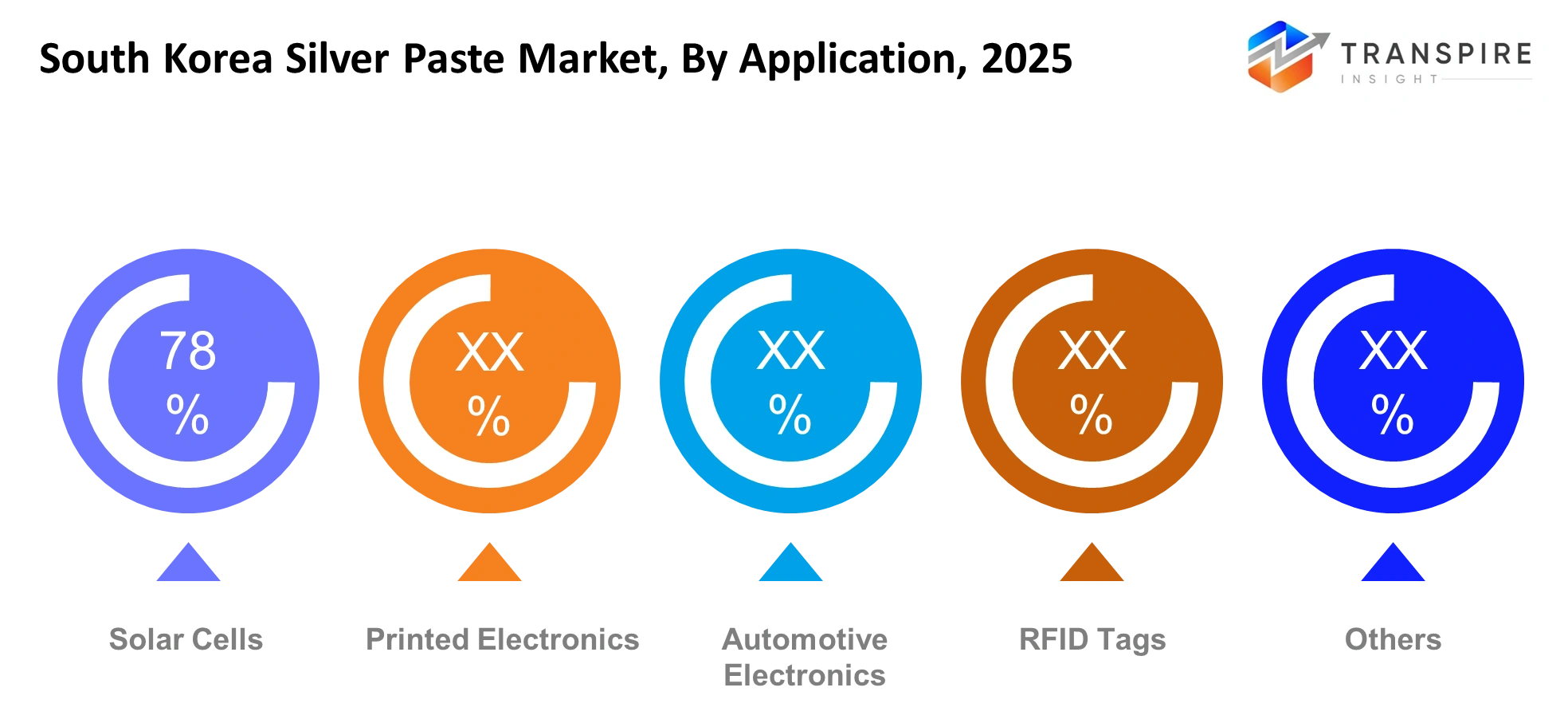
Solar cells still look like a major application area, due to big investments in renewable energy production, and also because photovoltaic tech keeps advancing. In solar modules, silver paste supports electrical conductivity and helps lift energy conversion efficiency, something that stays crucial for commercial and industrial solar installations in real manufacturing plants.
Printed electronics and automotive electronics are expected to grow steadily , because today’s vehicles and compact devices need lightweight plus very reliable conductive materials. RFID tags add another layer of demand, since logistics, retail tracking , and inventory systems are moving toward automated monitoring solutions that rely on durable printed conductive tracks.
To learn more about this report, Download Free Sample Report
By Technology:
Screen printing paste keeps driving adoption, mostly because manufacturers like cost-effective, high-volume production approaches for electronic circuits and solar panels. This method offers pretty accurate deposition and it fits well into mass manufacturing, without forcing big operational changes in the current production lines component suppliers already run.
Nano silver paste is expected to see more rapid acceptance too, driven by the need for improved conductivity and tighter semiconductor layouts. Hybrid silver paste, in the same vein, supports situations where flexibility, thermal steadiness and reduced material usage matter. A few other approaches also stay relevant for more niche industrial needs, when tailored formulations help raise electrical as well as mechanical outcomes.
By End User:
On the electronics side, manufacturers take a big portion of usage, since semiconductor packaging, display production and multilayer circuit making depend on stable conductive materials, especially for precision-based output. As production keeps expanding for advanced chips and memory devices, silver paste demand should keep moving upward long term, particularly in higher-value electronic applications.
Solar panel manufacturers meanwhile are building solid opportunities, since renewable energy capacity keeps increasing across both industrial and utility-scale projects. And in automotive, consumption should climb bit by bit, because electric vehicles and connected mobility systems need compact electronic assemblies, with dependable conductive behavior under different operating conditions.
By Form:
Paste form remains widely preferred, because thick film applications and screen printing processes need controlled viscosity and also stable adhesion during circuit formation. Manufacturers tend to favor paste formulations for semiconductor packaging, and solar cell production, where accuracy and consistent conductivity directly affect final product quality.
Ink and coating forms are becoming more crucial as flexible electronics and printed sensor technologies expand into commercial output. These forms help support lightweight, and very thin conductive layers across compact electronic surfaces. Some other forms handle specialized industrial demands, where manufacturers look for customized deposition methods and application flexibility.
What are the Key Use Cases Driving the South Korea Silver Paste Market?
Semiconductor packaging still feels like the main thing that keeps adoption moving in the South Korea Silver Paste Market. Things like advanced memory chips, AI processors, and display components need silver paste that’s not only very conductive but also pretty precise, because they’re trying to keep electrical stability inside those tight circuit layouts. Meanwhile, big chip production runs by local electronics manufacturers keep turning into steady demand for the material, every so often without much pause, really.
Solar cell manufacturing is starting to look like a more important secondary use, especially as TOPCon and heterojunction technologies get real commercial traction. Automotive electronics are also pushing the market forward , since electric vehicles rely more and more on compact sensors, control modules, and conductive materials that help maintain stable electronic connectivity.
Some newer or emerging applications show up too, for example flexible electronics and printed medical sensors. In those cases, low temperature silver paste helps support delicate substrates , without harming components. Demand is also showing up in wearables and smart industrial monitoring systems, where lightweight conductive routes are needed, plus dependable miniaturized electronic performance for long-running operating hours and extended use cycles.
|
Report Metrics |
Details |
|
Market size value in 2025 |
USD 289.45 Million |
|
Market size value in 2026 |
USD 310.65 Million |
|
Revenue forecast in 2033 |
USD 509.24 Million |
|
Growth rate |
CAGR of 7.32% from 2026 to 2033 |
|
Base year |
2025 |
|
Historical data |
2021 - 2024 |
|
Forecast period |
2026 - 2033 |
|
Report coverage |
Revenue forecast, competitive landscape, growth factors, and trends |
|
Country scope |
South Korea |
|
Key company profiled |
DuPont, Heraeus, Daejoo Electronic Materials, Samsung SDI, Ferro Corporation, Johnson Matthey, AG PRO Technology, Toyo Aluminium, Giga Solar Materials, Noritake, Shin-Etsu Chemical, Sun Chemical, Henkel, Mitsui Mining & Smelting, Targray. |
|
Customization scope |
Free report customization (country, regional & segment scope). Avail customized purchase options to meet your exact research needs. |
|
Report Segmentation |
By Type (Conductive Silver Paste, Photovoltaic Silver Paste, Low-temperature Silver Paste, Others); By Application (Solar Cells, Printed Electronics, Automotive Electronics, RFID Tags, Others); By Technology (Screen Printing Paste, Nano Silver Paste, Hybrid Silver Paste, Others); By End User (Electronics Manufacturers, Solar Panel Manufacturers, Automotive Industry, Others); By Form (Paste, Ink, Coating, Others). |
Which Regions are Driving the South Korea Silver Paste Market Growth?
East Asia is still kinda the main regional hub for silver paste, mainly because South Korea, China, Taiwan, and Japan together run one of the world’s strongest semiconductor and electronics manufacturing setups. South Korea takes the lead in regional consumption with tightly packed chip fabrication sites, better display manufacturing, and big solar technology bets. Also, government-supported semiconductor expansion schemes, plus incentives for domestic material sourcing, have pushed production strength for high performance conductive materials. There is also a dense supplier web, a long history of electronics exports, and ongoing investment into AI chip infrastructure, and all of that basically keeps the region dominant for a long time.
North America keeps a pretty stable stance in the market, mostly from steady spending on semiconductor modernization and advanced electronics work. But unlike East Asia, the region leans more on tech partnerships , research led innovation, and durable industrial budgets, not only on huge manufacturing concentration. The United States keeps backing domestic semiconductor output through funding initiatives linked to supply chain protection and advanced chip autonomy. When material developers , research centers, and electronics companies collaborate well, it creates a more reliable revenue situation for conductive paste suppliers.
Southeast Asia seems like it is becoming the fastest growing regional market , mainly because a lot of electronics manufacturing is getting relocated and solar module production keeps expanding. Lately, places like Vietnam, Malaysia, and Thailand have pulled in fresh semiconductor assembly as well as photovoltaic investments, while global manufacturers try to diversify their supply chains, not only beyond China but kind of away from it overall. At the same time, industrial park expansion has been happening, and operating costs are lower there , plus trade conditions are more favorable. So from 2023 on, new production lines have been getting installed at a quicker pace. This whole momentum should keep building and, by 2026–2033, it may open up solid chances for suppliers of conductive materials, and also for tech investors , in general.
Who are the Key Players in the South Korea Silver Paste Market and How Do They Compete?
In South Korea, the Silver Paste Market is kind of moderately consolidated, so you end up with a scene where global material companies compete next to more specialized Asian manufacturers , mostly aimed at semiconductor and photovoltaic use. Over time competition is less about raw pricing alone, more about conductivity precision, low temperature processing that actually works, and how well the paste fits with advanced chip packaging technologies. The established suppliers usually hold their ground by locking in long term supply agreements with semiconductor and electronics manufacturers. Meanwhile, newer participants show up through narrower conductive formulations for flexible electronics, and for next generation solar cells too. Across the whole field, technical customization, stable silver sourcing and quick product qualification, these things have become the main differentiators.
DuPont leans hard into technology innovation , especially for semiconductor packaging and photovoltaic applications. It differentiates itself with ultra fine conductive paste formulations for advanced node architectures and also for higher efficiency solar cells. They keep working with electronics manufacturers in Asia , which helps with application specific product development and it also speeds up commercialization cycles. Heraeus on the other hand competes by focusing on high purity material engineering and deep know how in precious metal processing. The company has also grown its research momentum around low silver consumption solar cell technologies, so customers can handle raw material cost swings without giving up conductivity performance.
Mitsubishi Materials keeps a kind of edge because it can deliver materials in a more integrated way, plus it runs stable quality control for electronics manufacturing, so everything stays pretty steady. At the same time they keep expanding conductive material solutions for automotive electronics, and even smaller, compact semiconductor devices. Meanwhile Johnson Matthey leans into specialty conductive formulations, and they focus on advanced material efficiency upgrades for industrial electronics uses. Also there was strategic investment in sustainability programs, especially silver recovery and recycling technologies, which has quietly strengthened long-term supply reliability and helped with operational cost management too.
Company List
- DuPont
- Heraeus
- Daejoo Electronic Materials
- Samsung SDI
- Ferro Corporation
- Johnson Matthey
- AG PRO Technology
- Toyo Aluminium
- Giga Solar Materials
- Noritake
- Shin-Etsu Chemical
- Sun Chemical
- Henkel
- Mitsui Mining & Smelting
- Targray
Recent Development News
In April 2025, DuPont launched new silver nanowire-based material solutions in South Korea for automotive electronics and smart mobility applications. The launch expanded DuPont’s conductive materials portfolio for transparent heaters, ADAS systems, and EMI shielding, strengthening demand for advanced silver-based conductive technologies in the regional electronics market.
Source: https://www.dupont.com/
In July 2025, Wuxi DK Electronic Materials announced the acquisition of a 60% stake in Zhejiang Suite Materials Technology Co., Ltd. The transaction gave DK Materials control of the Solamet photovoltaic silver paste business formerly owned by DuPont, accelerating consolidation in the global PV silver paste market and expanding production scale for advanced solar metallization materials.
Source: https://www.energytrend.com/
What Strategic Insights Define the Future of the South Korea Silver Paste Market?
The South Korea Silver Paste Market is moving toward higher value, precision engineered materials aligned with advanced semiconductor packaging, AI computing hardware , and next-generation photovoltaic technologies. Over the next five to seven years, revenue growth will depend less on sheer production volume and more on conductivity performance, fine line capability, and material efficiency. The strongest underlying force behind this transition is probably the increasing complexity of electronic architectures, which needs conductive materials that can run reliably inside smaller, more thermally sensitive systems.
One hidden risk sits in the gradual reduction of silver loading in solar cells and electronic components. As manufacturers tighten up material efficiency, total silver consumption per unit might actually fall even while device output climbs, so there’s this pressure on long term volume expansion for paste suppliers. Meanwhile low temperature nano silver formulations for flexible electronics and wearable medical devices are showing up as a meaningful future opportunity, especially as printed electronics manufacturing starts to mature across Asia.
Market participants should start early with application specific R&D partnerships with semiconductor and solar manufacturers instead of just competing on commodity pricing , because that’s usually a harder road.
South Korea Silver Paste Market Report Segmentation
By Type
- Conductive Silver Paste
- Photovoltaic Silver Paste
- Low-temperature Silver Paste
By Application
- Solar Cells
- Printed Electronics
- Automotive Electronics
- RFID Tags
By Technology
- Screen Printing Paste
- Nano Silver Paste
- Hybrid Silver Paste
By End User
- Electronics Manufacturers
- Solar Panel Manufacturers
- Automotive Industry
By Form
- Paste
- Ink
- Coating
Frequently Asked Questions
Find quick answers to common questions.
The South Korea Silver Paste Market size is USD 509.24 Million in 2033.
Key segments for the South Korea Silver Paste Market are By Type (Conductive Silver Paste, Photovoltaic Silver Paste, Low-temperature Silver Paste, Others); By Application (Solar Cells, Printed Electronics, Automotive Electronics, RFID Tags, Others); By Technology (Screen Printing Paste, Nano Silver Paste, Hybrid Silver Paste, Others); By End User (Electronics Manufacturers, Solar Panel Manufacturers, Automotive Industry, Others); By Form (Paste, Ink, Coating, Others).
Major South Korea Silver Paste Market players are DuPont, Heraeus, Daejoo Electronic Materials, Samsung SDI, Ferro Corporation, Johnson Matthey, AG PRO Technology, Toyo Aluminium, Giga Solar Materials, Noritake, Shin-Etsu Chemical, Sun Chemical, Henkel, Mitsui Mining & Smelting, Targray.
The South Korea Silver Paste Market size is USD 289.45 Million in 2025.
The South Korea Silver Paste Market CAGR is 7.32% from 2026 to 2033.
- DuPont
- Heraeus
- Daejoo Electronic Materials
- Samsung SDI
- Ferro Corporation
- Johnson Matthey
- AG PRO Technology
- Toyo Aluminium
- Giga Solar Materials
- Noritake
- Shin-Etsu Chemical
- Sun Chemical
- Henkel
- Mitsui Mining & Smelting
- Targray
Recently Published Reports
-
May 2026
Healthcare Polymer Packaging Market
Healthcare Polymer Packaging Market Size, Share & Analysis Report By Packaging Type (Syringes, IV Bottles and Pouches, Clamshells, Blisters, Bottles & Jars, Containers, Tubes, IV Parental Packaging, Others), By Type (Regulated, Non-regulated), By Polymer Type (LDPE (Low-Density Polyethylene), HDPE (High-Density Polyethylene), Homo-polymer (Homo), Random Copolymer (Random), Block Copolymer (Block), PET, Polystyrene, Polyvinyl Chloride, Polyamide/EVOH, Others), and Geography (North America, Europe, Asia-Pacific, Middle East and Africa, South and Central America), 2021 - 2031
-
Apr 2026
Hydrophilic Tape (Waterstop) Market
Hydrophilic Tape (Waterstop) Market Size, Share & Analysis Report By Type (Bentonite-Based Hydrophilic Tape, Rubber-Based Hydrophilic Tape), By Application (Residential Buildings, Commercial Buildings, Infrastructure Projects), and Geography (North America, Europe, Asia-Pacific, Middle East and Africa, South and Central America), 2021 - 2031
-
Apr 2026
Metalens Market
Metalens Market Size, Share & Analysis Report By Type (Visible Light Metalens, and Infrared Metalens), By Application (Consumer Electronics, Automotive Electronics, Industrial, Medical, and Others), and Geography (North America, Europe, Asia-Pacific, Middle East and Africa, South and Central America), 2021 - 2031
-
Apr 2026
PBT Resin Market
PBT Resin Market Size, Share & Analysis Report By Type (Reinforced PBT Resin, Unreinforced PBT Resin), By Processing Method (Injection Molding, Extrusion, Blow Molding, Others), By End-User (Automotive, Electrical & Electronics, Consumer Appliances, Industrial Machinery, Medical Devices, Packaging, Others), and Geography (North America, Europe, Asia-Pacific, Middle East and Africa, South and Central America), 2021 - 2031