

South Korea SCARA Robots Market Summary:
According to Transpire Insights, a detailed research report on the market reflects that the automotive application segment dominates the South Korea SCARA Robots Market, accounting for approximately 30% of the total market share in 2025. FANUC Corporation leads the market with approximately (around USD 5.5 billion) in annual revenue and an estimated significant South Korea market presence, making it an important contributor to South Korea market development, innovation, advanced SCARA robotic automation, expanding manufacturing capabilities, and growth dynamics.
Market Snapshot
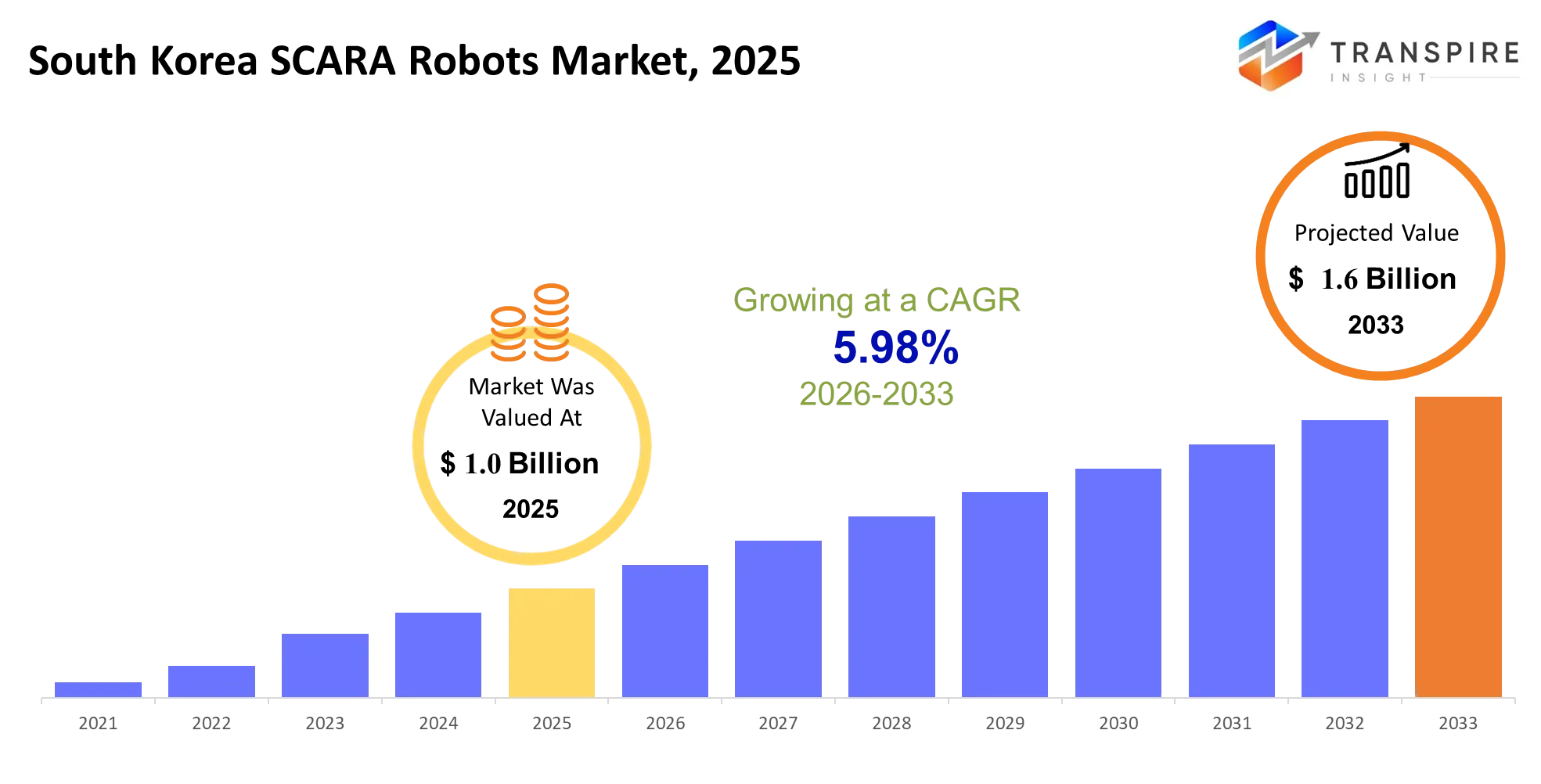
- Market Value (2025): USD 1.0 Billion.
- Expected Market Value (2026): USD 1.07 Billion.
- Estimated Market Value (2033): USD 1.6 Billion.
- Forecast CAGR (2026–2033): 5.98%
Introduction
A SCARA (Selective Compliance Assembly Robot Arm or Selective Compliance Articulated Robot Arm) robot is an industrial robotic system featuring a rigid vertical structure that is capable of performing flexible horizontal movements without losing stability on the vertical axis. The market for SCARA robots includes the development, manufacturing, selling, and integration of these high-speed and precise robotic arms. These robots often perform repeating industrial works like assembly, pick-and-place, packaging, and handling. The SCARA Robot Market in South Korea offers various advantages, including high-speed accuracy, cleanroom adaptability, economic benefits, and durability. SCARA robots have superior repeatability and time efficiency, which facilitate high-volume electronics manufacturing, semiconductor packaging, and precision manufacturing. Specially designed cleanroom versions comply with strict contamination prevention requirements in delicate production processes. The compact dimensions of SCARA robots support effective use of factory space and cleanroom space, thus optimizing labor and productivity. Moreover, high stiffness and robust construction allow for uninterrupted operation in harsh and repetitive production conditions.
Key Market Highlights: -
- By payload, the Up to 5 kg segment dominated the market and holds nearly 35% share in 2025 and is projected to grow at a substantial CAGR during the forecast period.
- By application, the Handling segment dominated the market and holds nearly 42% share in 2025 and is projected to grow at a substantial CAGR during the forecast period.
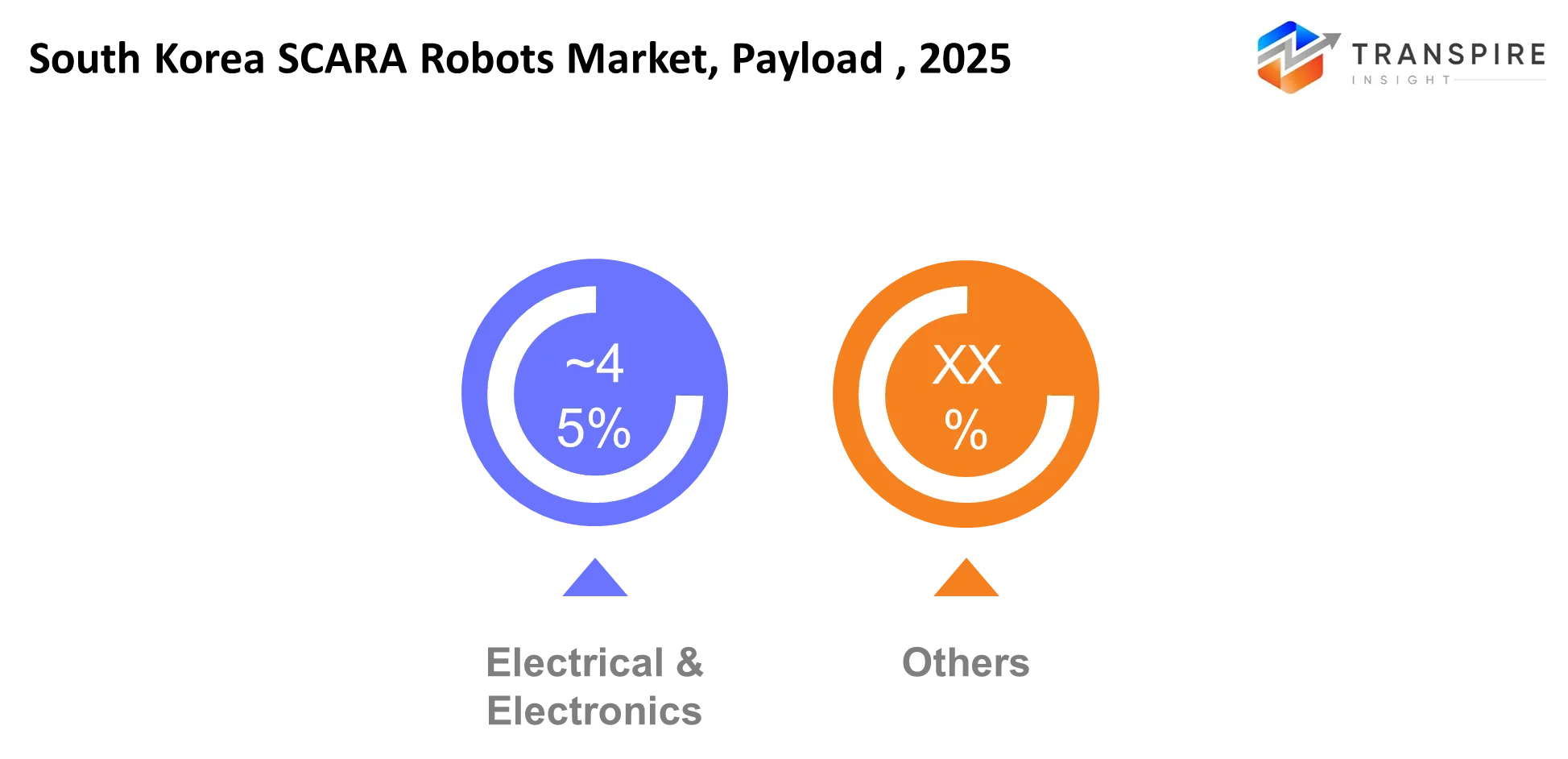
- By industry, the Electrical & Electronics segment dominated the market and holds nearly 16% share in 2025 and is projected to grow at a substantial CAGR during the forecast period.
- The 4th Intelligent Robot Basic Plan in South Korea enhances the innovation, commercialization, workforce development, and industry application of robotics until 2028. Its goal to pool over KRW 3 trillion in public-private investment by 2030 helps in the advancement of automation technology. These measures hasten the process of implementing SCARA robots in such industries as semiconductors, electronics, automotive, and smart manufacturing.
How is Technology Driving Growth in the South Korea SCARA Robots Market?
The SCARA Robots Market in South Korea is on the rise due to the expansion of both semiconductor and display manufacturing, especially with respect to the major industrial clusters that need precise wafer handling and contamination-controlled automation. The utilization of AI, IoT, machine vision, as well as intelligent motion-control technologies is helping enhance the capabilities of SCARA robots through instant optimization, predictive maintenance, and increased efficiency. The companies in South Korea invest heavily into smart factories and advanced manufacturing techniques which helps to speed up the adoption of specialized robots in electronics, automotive, and semiconductor industries respectively. Along with that, the population aging and declining working-age population creates the necessity for implementing automated production solutions.
Market Drivers
Growth in the South Korea SCARA Robotic Market can be attributed to the flourishing semiconductor and electronics industries, where high-speed automation combined with accuracy leads to impeccable handling of the components and reducing contamination. Increasing labor shortages have sped up the adoption of robots in repetitive assembly and production jobs. The major South Korean conglomerates' investments in semiconductors, artificial intelligence, intelligent factories, and industrial automation sectors only add to the demand for SCARA Robots in the region. The Industry 4.0 initiatives supported by the government are yet another reason why automation and digitalization are becoming so prevalent on the factory floor. Moreover, innovation in technology such as AI-based simulation and commissioning systems has also shortened the time of integration and improved efficiency in using SCARA robots in South Korea. The South Korea SCARA Robots Market is aided by the development of a highly advanced semiconductor and electronics manufacturing environment that has generated strong domestic economic demand and integrated automation supply chains. The advancement in the high uptake of automated and closely linked human manufacturing technologies is further facilitated by an aging population and the problem of labor shortages. Additionally, governmental assistance via Industry 4.0 and the smart factory initiative increases the support for the usage and improvement of robots. SCARA robots make it possible to provide high-speed, precise, and repeatable movements, being appropriate for various operations in electronics assembly, semiconductor processing, and other types of mass production. Their small design and high compatibility with cleanrooms make them suitable for various operations in cabinets, provide ease of maintenance, and optimize the implementation process regarding new manufacturing capabilities affecting productivity, contamination risks, costs, and efficiency.
Restrain
The SCARA Robots Market in South Korea encounters significant costs related to capital and cleanroom integration that restricts the uptake among the smaller manufacturers. The problem of customization may lead to a longer time period for deployment and lower flexibility in manufacturing processes. The shortage of qualified personnel in the field of robotics as well as servo control engineering poses further challenges. The dependency on the imported high-technology components contributes to the issue of supply chain disruptions, price fluctuations, and procurement issues.
|
Driver |
Relative Impact on Growth (%) |
Geographic Relevance |
Impact Timeline |
Demand Strength |
Growth Mechanism |
Key Beneficiaries |
Major Constraint |
|
Semiconductor, Electronics & Precision Manufacturing Expansion |
28% |
Gyeonggi, Chungcheong, Seoul |
Long-term |
High |
Accelerates precision automation across high-volume production |
SCARA manufacturers, semiconductor firms, electronics manufacturers |
High cleanroom and integration costs |
|
Labor Shortages and Workforce Demographic Changes |
22% |
Nationwide, especially industrial clusters |
Long-term |
High |
Replaces repetitive manual tasks with automated operations |
Robot vendors, manufacturers, system integrators |
Skilled robotics integration workforce shortages |
|
AI Smart Factories and Industry 4.0 Adoption |
20% |
Gyeonggi, Seoul, Chungcheong, Busan |
Medium-term |
High |
Integrates robots with AI-enabled production optimization |
Robotics vendors, AI providers, smart-factory operators |
Complex AI integration and implementation requirements |
|
Government Robotics and Manufacturing Automation Support |
16% |
Nationwide, SME manufacturing regions |
Medium-term |
High |
Reduces adoption barriers through automation support programs |
SMEs, robot suppliers, integrators, technology providers |
Funding eligibility and project implementation constraints |
|
AI, Machine Vision and Intelligent Robotics Innovation |
14% |
Seoul, Gyeonggi, major technology hubs |
Long-term |
High |
Improves robot flexibility, inspection accuracy, and autonomy |
Vision vendors, SCARA manufacturers, advanced manufacturers |
Higher technology costs and interoperability challenges |
|
Total |
100% |
— |
— |
— |
— |
— |
— |
Analysis of Prices and Consumer Behaviour
The Storage Area Network (SAN) technology segment leads in the sales of the South Korea data center storage market accounting for 41.92% of the market in 2025. The company estimates that the size of the South Korea data center storage market will be USD 1.23 billion in 2025 and will reach USD 2.35 billion by 2031 with a healthy CAGR of 11.43% from 2026 to 2031. The colocation facilities generated over 54% of the total revenue in 2025, which indicates strong demand for effective and reliable storage delivery systems in the market. The IT and telecommunications sector occupied around 36.78% of the South Korea data center storage market in 2025, driven by large volumes and advanced storage technologies that emerged in the long run ahead. The direction of the customers’ purchasing behavior shifts towards storage networking infrastructure that possesses low latency, scalability, reliability, and security high enough to ensure necessary interoperability as well as lower total cost of ownership. The rack-mounted storage accounted for 55.74% of total sales in 2025 and still dominates the market as space economy and storage efficiency remain essential factors in data center storage selection.
Who are the Key Players in the South Korea SCARA Robots Market and how do they compete?
The market for SCARA robots in South Korea is characterized by competition among companies that are engaged in robotics automation technology, industry-specific solutions, and advancement of manufacturing capabilities. Companies that differentiate themselves based on not only price but also high-speed robotic capabilities, precision, flexible automation, intelligent control systems and integration with smart factory technologies are able to constantly develop their products and achieve productivity and operational efficiency.
FANUC Corporation develops its position in the market through the development of efficient SCARA robots, intelligent motion-control technologies, and automation solutions. The differentiation from competitors is achieved by the creation of the high-speed and precision industrial robots for use in electronics, automotive, semiconductor, and industry.
Top Companies in the South Korea SCARA Robots Market
- Epson Robots
- FANUC
- Yaskawa Electric
- Mitsubishi Electric
- Omron
- Kawasaki Robotics
- Denso Robotics
- Yamaha Motor Robotics
- ABB
- KUKA
- Stäubli
- Nachi-Fujikoshi
- Doosan Robotics
- Hanwha Robotics
- Hyundai Robotics
|
Company |
Est. Revenue Share Range |
Key Offerings |
Strategic Positioning |
Geographic Strength |
Technology Focus |
|
FANUC |
14–18%* |
SR-3iA, SR-6iA, SR-12iA, SR-20iA, R-30iB controllers |
High-performance automation with broad industrial integration |
Asia-Pacific, North America, Europe |
High-speed SCARA, integrated vision, intelligent control |
|
Epson Robots |
12–16%* |
LS Series, GX Series, G Series, RC+ software |
Precision-focused SCARA portfolio with application flexibility |
Asia-Pacific, North America, Europe |
High-speed motion, vision, compact integration |
|
Yaskawa Electric |
10–14%* |
SCARA robots, MOTOMAN solutions, controllers, motion systems |
Integrated robotics and motion-control ecosystem |
Asia-Pacific, Europe, North America |
Servo control, i³-Mechatronics, smart automation |
|
Mitsubishi Electric |
8–12%* |
MELFA RH-CRH, RH-FRH, controllers, MELFA SmartPlus |
Factory-automation integration with PLC connectivity |
Asia-Pacific, Europe, North America |
PLC integration, intelligent control, vision |
|
Yamaha Motor Robotics |
7–10%* |
YK-XG, YK-XE, YK-XEC, YE Series, RCX controllers |
Broad SCARA range spanning cost-sensitive to cleanroom applications |
Asia-Pacific, Europe, North America |
High-speed motion, cleanroom, vision, high rigidity |
|
Omron |
6–9%* |
i4L, i4H, eCobra, ACE/Sysmac integration |
Integrated robotics, controls, vision and factory automation |
Asia-Pacific, North America, Europe |
Vision, controls integration, intelligent automation |
|
DENSO Robotics |
5–8%* |
LPH, HM, HS-A1, HSR Series |
Compact precision robotics for electronics and assembly |
Asia-Pacific, North America, Europe |
High-speed SCARA, precision motion, compact design |
|
Kawasaki Robotics |
4–7%* |
duAro, SCARA solutions, controllers, automation systems |
Differentiation through collaborative and specialized automation |
Asia-Pacific, Europe, North America |
Dual-arm SCARA, collaboration, material handling |
|
ABB |
3–6%* |
IRB 910SC, RobotStudio, IRC5 controllers |
Premium automation supported by digital robotics ecosystem |
Europe, Asia-Pacific, North America |
Robotics software, high-speed motion, digital simulation |
|
KUKA |
2–5%* |
KR SCARA, KR C5 micro controllers, Express Pack |
Cost-efficient compact robotics for flexible production cells |
Europe, Asia-Pacific, North America |
Compact SCARA, cleanroom, integrated peripherals |
South Korea SCARA Robots Market Segmentation
The South Korea SCARA Robots Market share is divided into five categories: By payload, application, industry, robot and offering.
The Up to 5 kg dominated the market, accounting for nearly 35% in 2025 and is expected to rise at a significant CAGR during the forecast period.
The South Korea SCARA Robots Market is segmented by payload into Up to 5 kg, 5.01–15 kg, Above 15 kg, Micro Payload, Light Payload, Medium Payload, Heavy Payload. Among these, the Up to 5 kg segment dominated the market, accounting for nearly 35% in 2025 and expected to increase at a significant CAGR during the forecast period. In 2025, the South Korea SCARA Robots Market was led by the up to 5 kg category, which represented around 35% of the market share, on account of the considerable demand from electronic, semiconductor, and precision assembly applications. Due to their speed and precision, as well as their compact design and superior handling ability for light materials, these robots are perfect for automated high-volume manufacturing as well as smart factory automations.
The Handling dominated the market, accounting for nearly 42% in 2025, and is expected to rise at a significant CAGR during the forecast period.
The South Korea SCARA Robots Market is segmented by application into Handling, Assembling & Disassembling, Welding & Soldering, Dispensing, Processing, Inspection & Testing, Packaging. Among these, the Handling segment dominated the market, accounting for nearly 42% in 2025 and expected to increase at a significant CAGR during the forecast period. The Handling segment acquired the largest share of South Korea SCARA Robots Market in 2025 by holding about 42% of the market. Automation increases in various sectors, such as electronics, semiconductor, automotive, and precision manufacturing, has contributed to the segment's dominance. SCARA robots are used in various applications like high-speed material handling, component transferring, and assembly processes.
The Electrical & Electronics dominated the market, accounting for nearly 16% in 2025 and is expected to rise at a significant CAGR during the forecast period.
The South Korea SCARA Robots Market is segmented by industry into Electrical & Electronics, Automotive, Metals & Machinery, Food & Beverages, Plastics, Rubber & Chemicals, Precision Engineering & Optics, Pharmaceuticals & Cosmetics. Among these, the Electrical & Electronics segment dominated the market, accounting for nearly 16% in 2025 and expected to increase at a significant CAGR during the forecast period. By 2025, the Electric and Electronics category prevailed as the best-performing segment for SCARA robots market in South Korea, with a share of nearly 16%, due to the fast-growing electronics manufacturing, production of electronics components, and the increased need for precise automation. SCARA robots give the opportunity for high-speed repetitive movements while assembling, manipulating, inspecting, and packing the components and therefore aid in enhancing the productivity, precision, quality, and efficiency of manufacturing processes.
Future Market Trends for the South Korea SCARA Robots Market: -
- High Level of Reliance on Imports: A considerable proportion, around 55%-70% of the total supply, is being fulfilled through imports. The premium segment is largely occupied by Japanese and European players whereas the Korean companies cater to the mid-range and specific application needs.
- Vision-Based Integration of SCARAs: Factories are leveraging SCARA robots in conjunction with AI and vision systems for detecting defects in real time and for flexible handling purposes.
- Compact Size: Manufacturing companies are looking for robotic devices that are smaller in size and can occupy minimal space.
- R&D of Local Conglomerates: Companies like Samsung, Hyundai, Doosan, and HanWha continue to invest substantially in smart automation and local supply chain sustainability.
Recent Development
- In January 2026: Epson Korea announced the launch of LS50-C, LS20-C, and RS4/S6-C SCARA robots, expanding its industrial automation portfolio. LS50-C can handle a payload of 50 kg with an arm length of 1,000 mm, focusing on automotive electrification and battery applications. With this launch, Epson strengthens demand for speedy and effective SCARA automation in various advanced manufacturing sectors across South Korea.
- In May 2026: LG CNS has launched PhysicalWorks which is a complete robot training and simulation platform that uses 3D settings and AI engineering. This software decreases robot training and initiation period to 1-2 months and makes seal authentic automation and smart factory project implementation possible in South Korea factory sector.
Market Segment
This study forecasts revenue at South Korea, regional and country levels from 2020 to 2033. Transpire Insights has segmented the South Korea SCARA Robots Market based on the below-mentioned segments:
South Korea SCARA Robots Market, By Payload
- Up to 5 kg
- 5.01–15 kg
- Above 15 kg
- Micro Payload
- Light Payload
- Medium Payload
- Heavy Payload
South Korea SCARA Robots Market, By Application
- Handling
- Assembling & Disassembling
- Welding & Soldering
- Dispensing
- Processing
- Inspection & Testing
- Packaging
South Korea SCARA Robots Market, By Industry
- Electrical & Electronics
- Automotive
- Metals & Machinery
- Food & Beverages
- Plastics
- Rubber & Chemicals
- Precision Engineering & Optics
- Pharmaceuticals & Cosmetics
South Korea SCARA Robots Market, By Robot Type
- Standard SCARA
- High-Speed SCARA
- Cleanroom SCARA
- Compact SCARA
- Heavy-Payload SCARA
- Vision-Guided SCARA
- Collaborative SCARA
South Korea SCARA Robots Market, Offering
- Robot Hardware
- Controllers
- End Effectors
- Vision Systems
- Software
- Integration Services
- Maintenance Services
Frequently Asked Questions
Find quick answers to common questions.
The market is projected to reach USD 1.6 billion by 2033, growing at a 5.98% CAGR.
The Up to 5 kg segment dominated with nearly 35% share in 2025, driven by electronics and precision manufacturing.
The Handling segment dominated with approximately 42% share in 2025, supported by increasing industrial automation and material handling.
The Electrical & Electronics segment held nearly 16% share in 2025, driven by precision automation and semiconductor manufacturing.
Key trends include AI vision integration, compact designs, smart factories, cleanroom automation, advanced motion control, and robotics investments.
- Epson Robots
- FANUC
- Yaskawa Electric
- Mitsubishi Electric
- Omron
- Kawasaki Robotics
- Denso Robotics
- Yamaha Motor Robotics
- ABB
- KUKA
- Stäubli
- Nachi-Fujikoshi
- Doosan Robotics
- Hanwha Robotics
- Hyundai Robotics
About the Authors

Avinash Kumar
I’m Avinash Kumar, a Senior Research Analyst at Transpire Insight, with expertise in the Electronics and Semiconductor and Energy & Power industry. My work focuses on analyzing emerging technologies, market trends, industry developments, and innovation across these sectors. I specialize in transforming complex technical and market insights into clear, research-backed content that helps professionals, businesses, and decision-makers stay informed. Through continuous industry research and data-driven analysis, I strive to deliver accurate, reliable, and practical perspectives on the latest advancements shaping the semiconductor and energy landscape.

Chakradhar Khansole
Chakradhar serves as the Research Director at Transpire Insight, bringing over 8 years of experience in technology, innovation, and strategic market intelligence. He specializes in transforming complex market data into actionable business insights that enable organizations to make informed, growth-oriented decisions. Recognized for his strategic vision and analytical expertise, Chakradhar leads high-impact research initiatives, delivering comprehensive market assessments, competitive intelligence, and forward-looking industry analysis.
Recently Published Reports
-
Apr 2026
Fiber Optic Faceplates Market
Fiber Optic Faceplates Market Size, Share & Analysis Report By Type (< 300 mm2, 300-350 mm2, and > 350 mm2, By Application (Night Vision, Holographic Imaging, Medical, and Others), and Geography (North America, Europe, Asia-Pacific, Middle East and Africa, South and Central America), 2021 - 2031
-
Apr 2026
High Temperature Superconductors Market
High Temperature Superconductors Market Size, Share & Analysis Report By Type (1G HTS, and 2G HTS), By Application (Power Cable, Fault Current Limiter, and Transformer), and Geography (North America, Europe, Asia-Pacific, Middle East and Africa, South and Central America), 2021 - 2031
-
Apr 2026
Industrial Plugs and Socket Market
Industrial Plugs and Socket Market Size, Share & Analysis Report By Type (Industrial Plugs, Industrial Sockets), By Current (Up to 32 A, 32 to 125 A, Above 125 A), By Protection (Dustproof and Splash Proof, Waterproof, Explosion Proof), By End User (Heavy Industries, Oil and Gas, Chemicals and Pharmaceuticals, Power Generation, Others), and Geography (North America, Europe, Asia-Pacific, Middle East and Africa, South and Central America), 2021 - 2031
-
Apr 2026
InGaAs Avalanche Photodiodes Market
InGaAs Avalanche Photodiodes Market Size, Share & Analysis Report By Type (1100 - 1700 nm, and 1000 - 1600 nm), By Application (Missile Warning System, Muzzle Flash Detection, Wafer Defect Inspection, Laser Rangefinders, and Others), and Geography (North America, Europe, Asia-Pacific, Middle East and Africa, South and Central America), 2021 - 2031