
South Korea Holter ECG Market Summary:
According to Transpire Insights, a detailed research report on the market reflects that the Holter ECG application segment dominates the South Korea Holter ECG Market, accounting for approximately 67% of the total share worldwide. GE HealthCare leads the market with approximately (around USD 19.6 billion) in annual revenue and an estimated 12–17% South Korea market share, making it the leading contributor to South Korea market development, innovation, advanced Holter ECG monitoring production, expanding diagnostic capabilities, and growth dynamics.
Market Snapshot
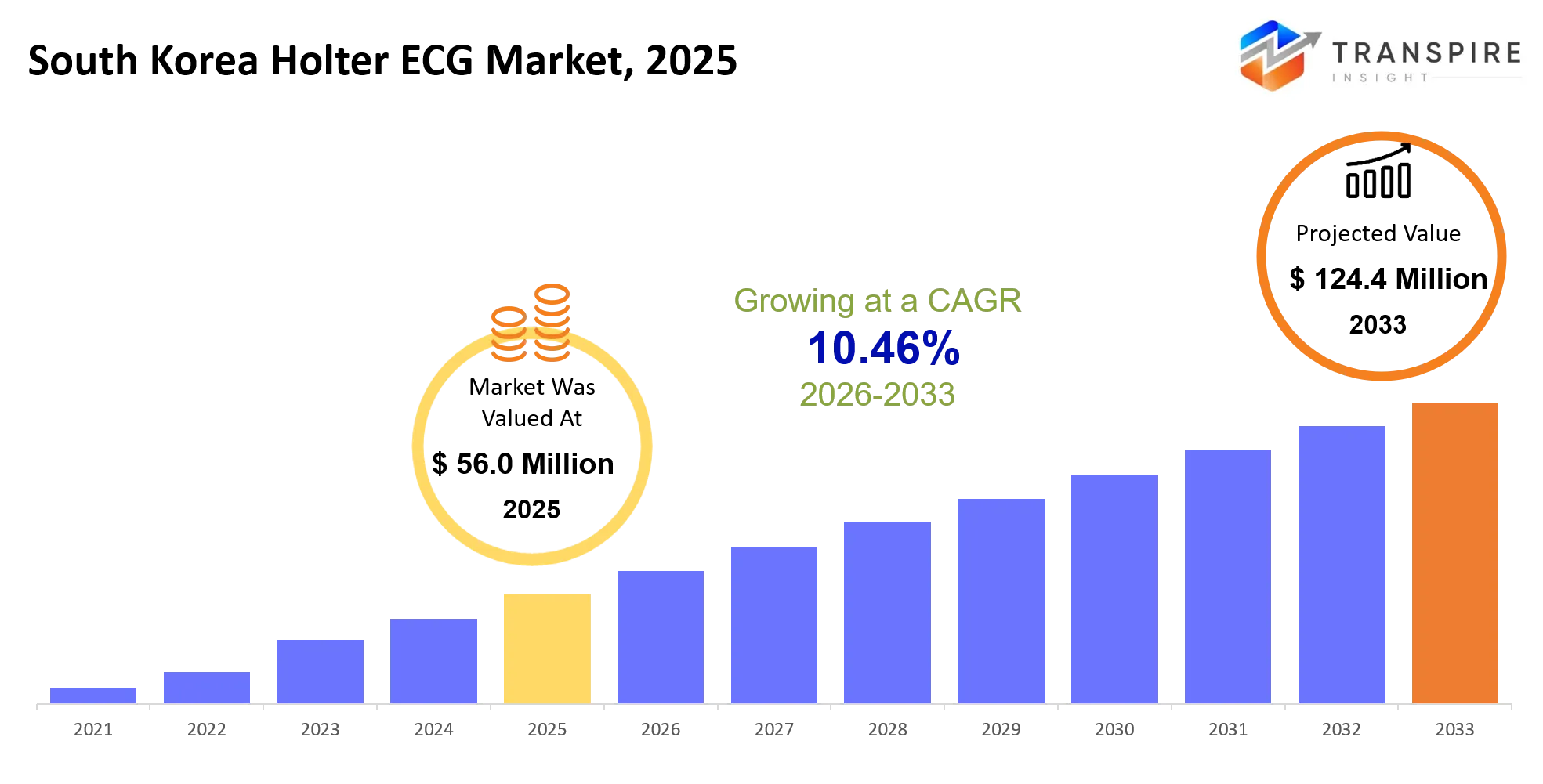
- Market Value (2025): USD 56.0 Million.
- Expected Market Value (2026): USD 62.0 Million.
- Estimated Market Value (2033): USD 124.4 Million.
- Forecast CAGR (2026–2033): 10.46%.
Introduction
The South Korea Holter ECG Market consists of mobile and wearable cardiac monitoring devices that monitor the heart function continuously during patients' daily activities in order to detect intermittent arrhythmias, which are often difficult to be identified by resting ECG tests performed under usual conditions. The South Korean Holter ECG market is progressing from conventional wired Holter ECG devices to wireless, patch-based and digitally-connected Holter ECG products, thereby enabling greater mobility, continuous monitoring and improved clinical workflow. The rise in incidence of cardiovascular diseases, aging population, the need for ambulatory diagnosis of heart ailments, and remote patient monitoring trends are driving the use of these products in hospitals, specialty clinics, diagnostic centers and at home care environments. The use of artificial intelligence, arrhythmia detection software, data management software, mobile communication technology and electronic health record integration is boosting the diagnostic potential.
Key Market Highlights: -
- By Product Type, the Patch-Based Holter dominated the market and holds approximately 60 % share in 2025 and is projected to grow at a substantial CAGR during the forecast period.
- By Channel, the Multi-Channel dominated the market and holds approximately 48 % share in 2025 and is projected to grow at a substantial CAGR during the forecast period.
- By Application Type, the Atrial Fibrillation Manufacturers segment dominated the market and holds approximately 38.2 % share in 2025 and is projected to grow at a substantial CAGR during the forecast period.
- Holter ECGs in South Korea have the advantage of digital-medical-device regulations, development of AI-centric medical-device innovations, innovations in wearable cardiac devices, and wider clinical adoption for ECG diagnosis.
How is Technology Driving Growth in the South Korea Holter ECG Market?
New technological developments are propelling the growth of the South Korea Holter ECG market in terms of smaller and wearable patches, duration of recording, AI-based ECG analysis, and connectivity solutions. Wearable ECG devices increase patient comfort and help conduct more prolonged recordings to better detect intermittent arrhythmias. Artificial intelligence and deep-learning systems can analyze ECG waveforms automatically and detect arrhythmias. Connectivity with mobile and PCs ensures transmission of ECG data, while connecting with hospital information systems improves the digital workflow in cardiac monitoring. In addition, new solutions from South Korean developers include subscription-based ECG analysis and patient monitoring services not limited to traditional hospital environment.
Market Drivers
Factors such as aging population, high incidences of heart diseases and arrhythmia, and demand for ambulatory cardiac monitoring have spurred the growth of South Korea Holter ECG market. High incidences of atrial fibrillation and other forms of irregular heart rhythms are creating the need for extended recordings of ECG readings beyond traditional ECG examinations. Technological advancements in ECG monitors have improved patient experience, mobility, recording periods, and diagnostic capability through the use of wearable, wireless, and patch ECG monitors. The highly developed healthcare system in South Korea has enabled artificial intelligence-driven interpretation of ECG readings and wireless transmission of health data from mobile health records to clinicians.
Restrain
However, the South Korea Holter ECG Market is constrained by high acquisition and maintenance costs associated with multi-channel and wireless systems. Integration of the continuous ECG data with hospital systems is another potential challenge. Issues with reimbursements might also be considered as a factor influencing the adoption of new ambulatory solutions. Moreover, training needs for reading long-term ECG recordings and handling artificial intelligence systems are other barriers to adoption in small clinics and non-specialized cardiac care centers.
|
Driver |
Relative Impact on Growth (%) |
Geographic Relevance |
Impact Timeline |
Demand Strength |
Growth Mechanism |
Key Beneficiaries |
Major Constraint |
|
Driver 1: Rising atrial fibrillation and arrhythmia burden |
30% |
Seoul, Gyeonggi, Busan; nationwide |
Long-term |
High |
Expanding AF prevalence increases ambulatory rhythm-monitoring requirements |
Holter manufacturers, cardiology hospitals, diagnostic laboratories |
Limited specialist capacity for growing monitoring volumes |
|
Driver 2: Rapid adoption of wearable and patch-based ECG technologies |
25% |
Seoul metropolitan area; nationwide digitally connected populations |
Medium-term |
High |
Wearable ECG expands continuous and ambulatory cardiac monitoring adoption |
Wearable manufacturers, ECG vendors, software providers, patients |
Wearable ECG remains complementary to clinical-grade Holter monitoring |
|
Driver 3: AI-enabled ECG interpretation and digital-health integration |
20% |
Seoul, Gyeonggi, major tertiary hospitals |
Medium-term |
High |
AI-assisted analysis reduces interpretation workload and accelerates arrhythmia detection |
AI developers, Holter manufacturers, hospitals, cardiologists |
Clinical validation, interoperability, and algorithm reliability requirements |
|
Driver 4: Aging population and increasing cardiovascular monitoring needs |
15% |
Nationwide; particularly metropolitan and aging regional populations |
Long-term |
High |
Older populations require greater detection and longitudinal rhythm monitoring |
Hospitals, diagnostic centers, device manufacturers, elderly patients |
Healthcare expenditure and reimbursement constraints |
|
Driver 5: Supportive digital-medical-device regulatory environment |
10% |
Nationwide, with strongest effect in technology hubs |
Short-term |
Medium |
Clearer digital-device pathways encourage connected ECG innovation and commercialization |
Medical-device companies, digital-health firms, technology vendors |
Regulatory compliance increases development and approval costs |
Analysis of Prices and Consumer Behaviour
South Korea’s market for Holter ECG devices is characterized by highly advanced multi-channel Holter ECG systems and wearable Holter ECG systems (68% of total market share; because of the rising demands from hospitals, cardiology clinics, diagnostic centers, and ambulatory cardiac monitoring services). The cost of a high-performing clinically standardized Holter ECG system is anticipated to be 35% higher compared to other products as it will include advanced ECG recording technology, automatic arrhythmia analysis, connectivity options and constant high diagnostics performance. Around 45% of the total units sold are portable and wearable Holter ECG systems. This market is driven by the benefits of ambulatory monitoring, mobility, prolonged recording, and increasing use of wireless ECG technology. The demand from cardiology clinics, hospitals, and specialty diagnostic centers makes up about 70% of the total end user demand. The buying pattern of healthcare facilities shows that 55% of customers value the highest diagnostic accuracy, monitoring time and system reliability. The other 33% of healthcare organizations prefer buying their machines via bulk purchasing or contracts since they wish to lower the expenses that will incur while obtaining the equipment and ensure steady availability of the Holter ECG monitoring systems.
|
Company |
Est. Revenue Share Range |
Key Offerings |
Strategic Positioning |
Geographic Strength |
Technology Focus |
|
GE HealthCare |
12–17% |
SEER 1000; SEER 12; MARS Ambulatory ECG; CardioDay |
Integrated cardiology ecosystem and workflow leadership |
North America; Europe; Asia Pacific |
Digital Holter; automated ECG analysis; connectivity |
|
Nihon Kohden Corporation |
10–15% |
Long-term ECG monitoring; ECG management; Cardiofax systems; arrhythmia analysis |
Premium clinical diagnostics with broad hospital integration |
Asia Pacific; North America; Europe |
Arrhythmia algorithms; ECG analytics; digital connectivity |
|
Bionet Co., Ltd. |
9–14% |
Cardio7; ECG systems; digital cardiac monitoring; ECG data management |
Korean value-focused ECG and monitoring specialist |
Asia Pacific; Middle East; Latin America |
Digital ECG; automated interpretation; data management |
|
Fukuda Denshi Co., Ltd. |
7–11% |
Holter ECG systems; FX-series ECG; analysis software; cardiology systems |
Specialized cardiology portfolio with diagnostic depth |
Asia Pacific; North America; Europe |
High-fidelity ECG; arrhythmia analysis; workflow integration |
|
Koninklijke Philips N.V. |
6–10% |
DigiTrak Holter recorders; Holter analysis; IntelliSpace ECG; ECG informatics |
Premium connected cardiology and informatics ecosystem |
North America; Europe; Asia Pacific |
ECG informatics; cloud connectivity; advanced analysis |
|
SEERS Technology Co., Ltd. |
5–9% |
mobiCARE; wearable Holter ECG; ECG analysis platform; specialist-reviewed reports |
AI-enabled subscription and long-duration monitoring |
South Korea; Middle East; North America |
Wearable ECG; deep learning; remote analysis |
|
Baxter / Welch Allyn |
4–7% |
H12+ Digital Holter; H3+ Digital Holter; ECG systems; analysis software |
Established diagnostic platform with broad clinical distribution |
North America; Europe; Asia Pacific |
Digital Holter; automated analysis; interoperability |
|
Spacelabs Healthcare |
3–6% |
Pathfinder SL; Eclipse Pro; Eclipse Mini; Sentinel platform |
Advanced ambulatory diagnostics and workflow specialization |
North America; Europe; Asia Pacific |
AF detection; extended monitoring; ECG analytics |
|
SCHILLER AG |
2–5% |
medilogFD; medilogAR; medilog DARWIN2; SEMA |
Swiss precision and specialized Holter diagnostics |
Europe; Asia Pacific; Middle East |
P-wave analysis; AF detection; HRV/ST/QT analysis |
|
Shenzhen Mindray Bio-Medical Electronics Co., Ltd. |
2–5% |
ECG systems; patient monitoring; cardiac diagnostics; connected ECG solutions |
Value-oriented expansion through broad hospital portfolio |
Asia Pacific; Europe; Latin America |
Digital ECG; connectivity; integrated patient monitoring |
Who are the Key Players in the South Korea Holter ECG Market and how do they compete?
South Korea Holter ECG Market competitiveness in the international market is determined by companies which specialize in technological innovation, specific cardiac solutions and development of their distribution network on the international scale. Competing not on prices, but rather on durable monitoring solutions, advanced ECG technology, intelligent and connected solutions, and digital healthcare platform integration, such approach to competition guarantees constant development of the company's products as well as helps healthcare institutions to increase diagnostic productivity and efficiency, patient monitoring and clinical visibility.
Philips gains its competitive advantage by developing intelligent Holter ECG solutions, advanced ambulatory cardiac monitoring solutions, AI-powered ECG analysis and connected cardiac technologies. GE HealthCare differentiates itself from its competitors due to its development of advanced ECG monitoring solutions designed for cardiac monitoring, arrhythmia detection, ambulatory diagnostics and other cardiovascular solutions. Nihon Kohden gains its competitive advantage through development of integrated solutions in Holter ECG monitoring, ECG diagnostics, connected healthcare and digital cardiac technologies.
Top Companies in the South Korea Holter ECG Market
- Philips
- GE HealthCare
- Hillrom/Baxter
- iRhythm
- Medtronic
- Nihon Kohden
- Fukuda Denshi
- Schiller
- Spacelabs Healthcare
- OSI Systems
- Bittium
- BioTelemetry
- Medicalgorithmics
- Preventice Solutions
- Samsung Medison
South Korea Holter ECG Market Segmentation
The South Korea Holter ECG Market share is divided into six categories: By Product Type, By Channel, By Application, By Wear Duration, By End User, By Distribution Channel.
The Patch-Based Holter dominated the market, accounting for nearly 60% in 2025 and is expected to rise at a significant CAGR during the forecast period.
The South Korea Holter ECG Market is segmented by product type into holter ecg monitors, wireless holter monitors, patch-based holters, event holters, mobile cardiac telemetry, digital holters, multi-channel holters, single-channel holters. Among these, the Patch-Based Holter segment dominated the market, accounting for nearly 60% in 2025 and expected to increase at a significant CAGR during the forecast period. Patch-Based Holter held the largest market share, nearly 60% in 2025, owing to higher patient comfort, wireless mobility, longer monitoring time and growing demand for arrhythmia detection.
The Multi-Channel dominated the market, accounting for nearly 48% in 2025, and is expected to rise at a significant CAGR during the forecast period.
The South Korea Holter ECG Market is segmented by channel into 3-channel, 5-channel, 7-channel, 12-channel, 15-channel, 18-channel, single-channel, multi-channel. Among these, the Multi-Channel dominated the market, accounting for nearly 48% in 2025 and expected to increase at a significant CAGR during the forecast period. Multi-Channel held the largest market share, nearly 48% in 2025, owing to high diagnostic accuracy, complete ECG information and high arrhythmia detection rate.
The Atrial Fibrillation dominated the market, accounting for nearly 38.2% in 2025 and is expected to rise at a significant CAGR during the forecast period.
The South Korea Holter ECG Market is segmentedby application into arrhythmia detection, insertable cardiac monitors , atrial fibrillation, tachycardia, bradycardia, heart failure monitoring, ischemia detection, syncope investigation, postoperative monitoring. Among these, the Atrial Fibrillation dominated the market, accounting for nearly 38.2% in 2025 and expected to increase at a significant CAGR during the forecast period. Atrial Fibrillation segment held the largest market share, nearly 38.2% in 2025, owing to growing incidence of arrhythmia and elderly population.
Future Market Trends for the South Korea Holter ECG Market:-
Wireless & Patch-based Monitoring: The adoption of wireless and patch-based Holter ECG devices is gaining pace in South Korean healthcare due to the emphasis on patient comfort, mobility, longer monitoring periods, and intermittent arrhythmia detection.
AI-based ECG Analysis: Artificial intelligence is playing a key role in changing the face of Holter ECGs in South Korea via automated arrhythmia detection and ECG analysis and clinical decision support.
Remote & Connected Cardiac Monitoring: The growth of remote ECG monitoring, reimbursement, and hospital connectivity is providing decentralization in cardiac monitoring in South Korea.
Recent Development
In January 26, 2026 – Fast-Track Regulatory Launch: South Korea introduced a fast track regulation for medical technology, which accelerated the clinical use of cutting-edge AI-powered Holter ECG and wearable cardiac monitoring technologies.
In February 6, 2026 – Commercialization Agreement Launch: Otsuka Pharmaceutical and Sky Labs launched an exclusive commercialization agreement, boosting continuous cardiac monitoring technology and the development of the digital cardiology ecosystem in South Korea.
In May 2, 2025 – Clinical Adoption Expansion: Seers Technology expanded the domestic clinical adoption of mobiCARE, facilitating the adoption of wireless ECG patch monitoring and extending arrhythmia detection at top South Korean hospitals.
Market Segmentation
This study forecasts revenue at Japan, regional and country levels from 2020 to 2033. Transpire Insights has segmented the South Korea Holter ECG Market based on the below-mentioned segments:
South Korea Holter ECG Market, By Product Type
- Holter ECG Monitors
- Wireless Holter Monitors
- Patch-Based Holters
- Event Holters
- Mobile Cardiac Telemetry
- Digital Holters
- Multi-Channel Holters
- Single-Channel Holters
South Korea Holter ECG Market, By Channel
- 3-Channel
- 5-Channel
- 7-Channel
- 12-Channel
- 15-Channel
- 18-Channel
- Single-Channel
- Multi-Channel
South Korea Holter ECG Market, By Application
- Arrhythmia Detection
- Atrial Fibrillation
- Tachycardia
- Bradycardia
- Heart Failure Monitoring
- Ischemia Detection
- Syncope Investigation
- Postoperative Monitoring
South Korea Holter ECG Market, By Wear Duration
- 24 Hours
- 48 Hours
- 72 Hours
- 5–7 Days
- 7–14 Days
- Above 14 Days
- Extended Monitoring
- Continuous Monitoring
South Korea Holter ECG Market, By End User
- Hospitals
- Cardiology Clinics
- Diagnostic Centers
- Ambulatory Centers
- Homecare
- Research Institutes
- Emergency Centers
- Specialty Clinics
South Korea Holter ECG Market, By Distribution Channel
- Hospital Procurement
- Direct Sales
- Distributors
- Medical Device Dealers
- Online Channels
- Specialty Distributors
- Retail Medical Suppliers
- Other Channels
Frequently Asked Questions
Find quick answers to common questions.
Aging demographics, rising arrhythmia prevalence, wearable ECG adoption, AI-enabled analysis, and expanding remote cardiac monitoring are driving market growth.
Patch-based Holters dominate due to superior patient comfort, wireless mobility, extended monitoring duration, and improved intermittent arrhythmia detection capabilities.
Multi-channel systems provide comprehensive ECG information, higher diagnostic accuracy, improved waveform analysis, and reliable detection of complex cardiac rhythm abnormalities.
AI enables automated ECG interpretation, arrhythmia detection, waveform analysis, clinical decision support, and faster identification of potentially significant cardiac abnormalities
Wireless patches, AI-powered analysis, remote monitoring, cloud connectivity, extended-duration recording, and digitally integrated cardiac-care workflows are shaping future market development.
About the Authors

Pankaj Ghogare Patil
I am Pankaj Ghogare Patil, a Senior Research Analyst at Transpire Insight, specializing in the Pharmaceutical, Chemicals & Materials, Healthcare IT, and Biotechnology industry. My expertise lies in conducting comprehensive market research, analyzing industry trends, evaluating competitive landscapes, and translating complex data into actionable insights. At Transpire Insight, I closely follow emerging technologies, regulatory developments, and market innovations to create accurate, well-researched, and informative content that helps businesses and professionals make informed decisions. I am committed to producing credible, evidence-based articles that reflect industry best practices while making technical topics accessible and valuable for a broad audience.

Chakradhar Khansole
Chakradhar serves as the Research Director at Transpire Insight, bringing over 8 years of experience in technology, innovation, and strategic market intelligence. He specializes in transforming complex market data into actionable business insights that enable organizations to make informed, growth-oriented decisions. Recognized for his strategic vision and analytical expertise, Chakradhar leads high-impact research initiatives, delivering comprehensive market assessments, competitive intelligence, and forward-looking industry analysis.
Recently Published Reports
-
Apr 2026
AI in Diabetic Retinopathy Market
AI in Diabetic Retinopathy Market Size, Share & Analysis Report By Type (Screening AI Systems, Diagnostic AI Systems, and Predictive AI Models), By Application Segment (Hospitals, Ophthalmology Clinics, Diagnostic Centers, and Research and Development), and Geography (North America, Europe, Asia-Pacific, Middle East and Africa, South and Central America), 2021 - 2031
-
Apr 2026
Psychometric Tests Market
Psychometric Tests Market Size, Share & Analysis Report By Type (Personality Tests, Ability/Aptitude Tests, Skill/Knowledge Tests, and Others), By Application (Talent Acquisition and Talent Management), and Geography (North America, Europe, Asia-Pacific, Middle East and Africa, South and Central America), 2021 – 2031
-
Apr 2026
Rare Biological Sample Collection Market
Rare Biological Sample Collection Market Size, Share & Analysis Report By Type (Isolation Kits & Reagent, Blood Collection Tubes, and Others), By Application (Oncology, Transcriptomics, Pharmacogenomics, and Others), and Geography (North America, Europe, Asia-Pacific, Middle East and Africa, South and Central America), 2021 – 2031
-
Jul 2026
Diabetic Retinopathy Market
Diabetic Retinopathy Market Size, Share & Analysis Report By Type (Proliferative Diabetic Retinopathy, and Diabetic Macular Edema (DME)), By Treatment Type (Anti VEGF Drug, Steroid Implants, Laser Surgeries, and Vitrectomy), and Geography (North America, Europe, Asia-Pacific, Middle East and Africa, South and Central America), 2021 – 2031
Our Clients







