
Marketing automation software Market Summary:
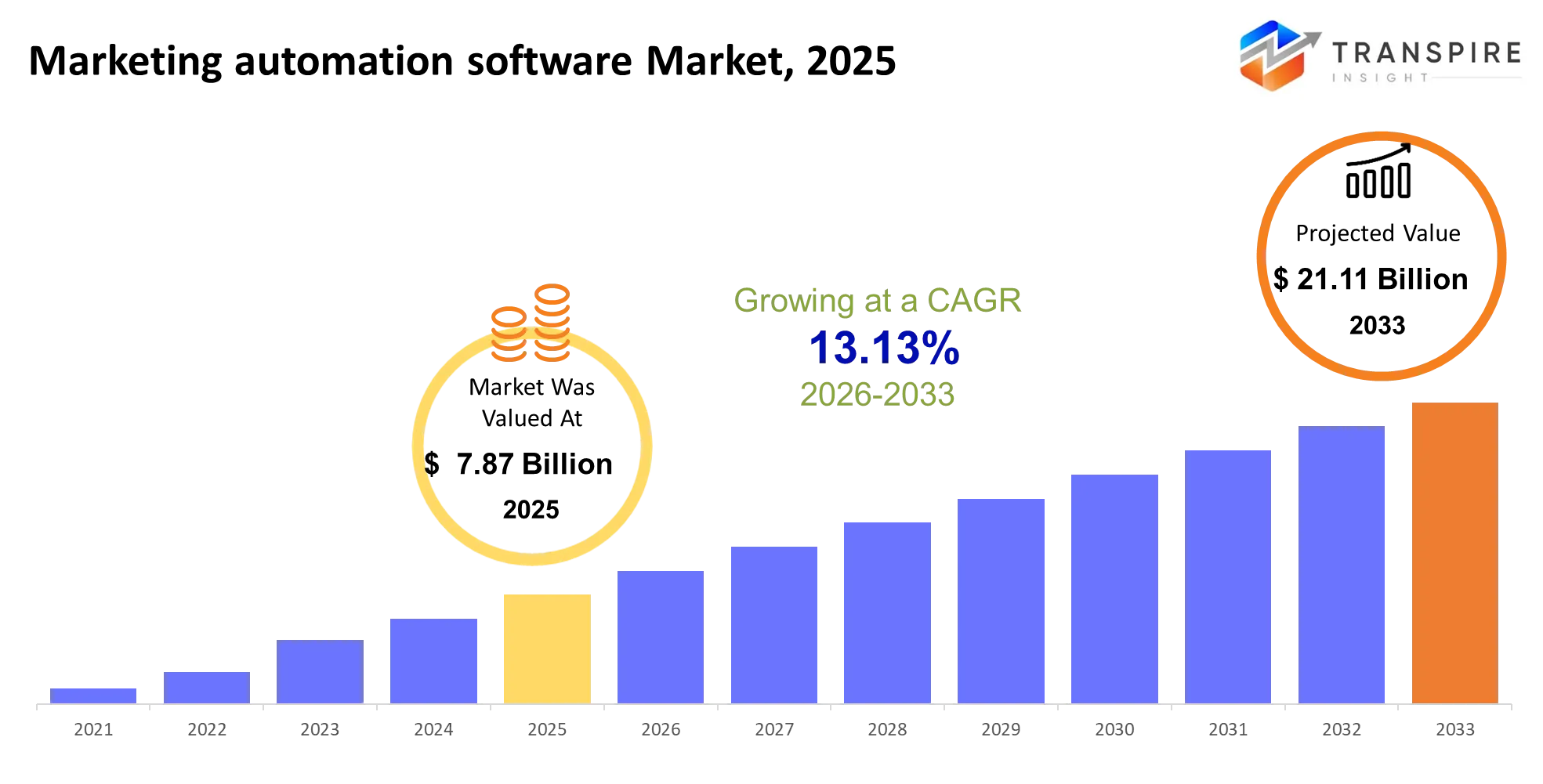
As per Transpire Insight Analysis, The Marketing automation software Market size is estimated at USD 7.87 billion in 2025 and is anticipated to reach USD 21.11 billion by 2033, growing at a CAGR of 13.13% from 2026 to 2033.
The marketing automation software market provides companies plan, run, personalise, and check how well campaigns work through email, mobile, social media, websites and other places where customers interact. In the past three to five years, the tools have gone from simply scheduling messages to using connected customer data, automatic steps that guide customers, predicting which leads are best and using artificial intelligence to help with tasks. A big change in how things work's moving from separate tools to cloud-based systems that link customer relationship management, data analysis, content and how campaigns are set up. The growth of people buying things from afar and using digital ways to interact with companies has made it even more important for businesses to automate follow-ups and keep customers engaged in the same way across all channels. This change helps the market grow because automation makes it easier to do the tasks over and over, makes handling leads better and gives teams quicker information about how well their campaigns are doing. As businesses deal with customer data and more customer interactions, using software to manage everything is becoming a normal part of everyday marketing work.
Marketing automation software Market Size & Forecast:
- Market Size 2025: USD 7.87 Billion
- Expected Market Value (2033): USD 21.11 Billion
- Forecast CAGR (2026–2033): 13.13%
- Leading Region in 2025: North America
- Fastest Growing Region: Asia Pacific
- Key Company Profiles: Salesforce, Adobe, HubSpot, Oracle, SAP, Microsoft, ActiveCampaign, Marketo, Braze, Klaviyo, SAS, Acoustic, Iterable, Mailchimp, Zoho
Key Market Insights:
The market is moving toward software platforms that support campaign management, client communication, and personalised marketing.
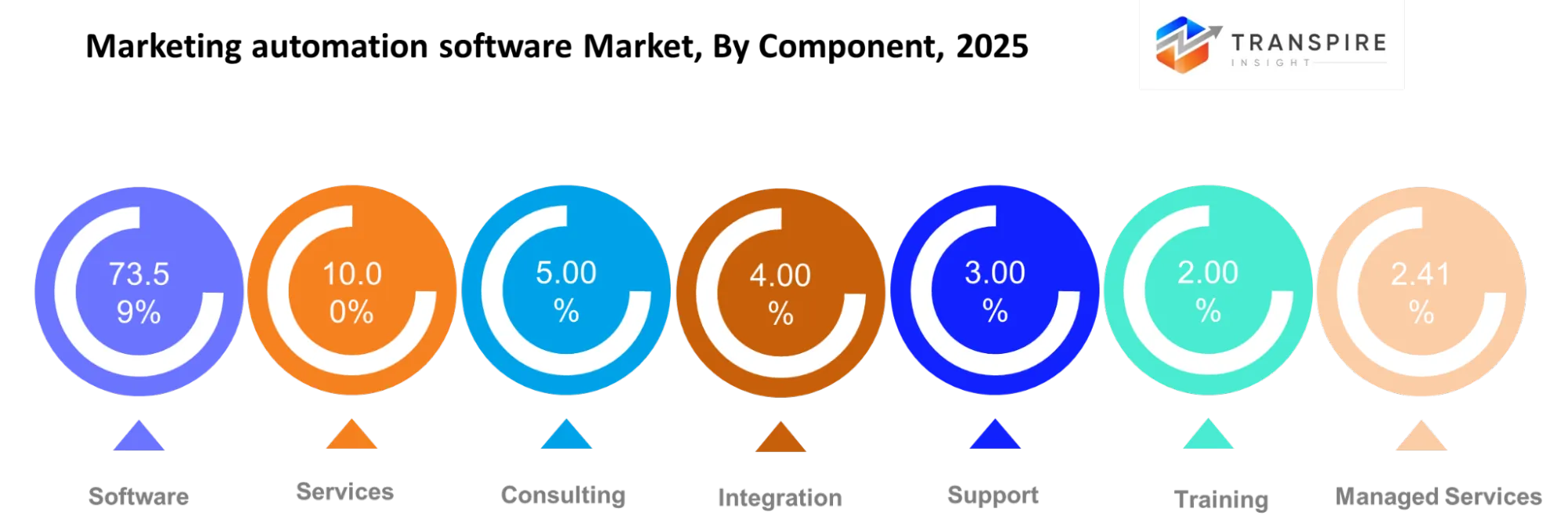
- Software accounts for 73.59% share of the components market, but Salesforce is still growing in developing campaign automation and a connected customer journey through AI.
- Services make up a 10.00% share of the market to help with implementation and operations due to the necessity of connecting the automation platform with the marketing technology ecosystem.
- Consulting makes up a 5.00% share of the market because workflow, data strategy, and automation planning become necessary for marketing processes.
- Integration accounts for a 4.00% share of the market as vendors, like Adobe, are developing integration of automation with CRM, customer data, analytics, and AI technologies.
- Support accounts for a 3.00% share of the market since companies need support to keep workflows, integrations, data, and campaigns running.
What are the Key Drivers, Restraints, and Opportunities in the Marketing automation software Market?
Drivers
The growth is driven by the transition from manual marketing campaign management to automation with connections throughout the customer journey. With this development, marketers can synchronise emails, web experiences, mobile experiences, social media, lead scoring, and analytics without increasing their workload proportionately. This has been made possible by the increased adoption of CRM and customer-data platforms in the cloud because automation systems can use more advanced behavioural data.
Restraints
Issue of implementation difficulty. Automation in marketing often works with CRM systems, websites, analytics, data sources, consent management, and current processes. This integration may involve some expertise, cleanup, design, and management, and small businesses may postpone implementation of such technologies. The reason for this problem is the fact that marketing stacks vary from company to company and are not easy to replicate.
Opportunities
opportunity emerges with AI-based automation that may provide recommendations on audiences, content, timing, follow-up actions, and adjustments of campaigns. Software providers are incorporating more artificial intelligence agents, predictive analytics, and unification of data into their offerings. The latest Salesforce 2026 versions, for instance, are introducing additional AI and data activation and automation functionality, which leaves an opening for automation of marketing and customer operations.
What Has the Impact of artificial intelligence on the Marketing automation software Market?
AI is revolutionising marketing automation from executing based on rules to systems capable of signal analysis and decision-making. With the help of AI, marketers can vary campaigns, classify leads, personalise communications, segment audiences, and tailor journeys based on consumer behaviour. AI predictions can forecast buying intent, lead qualification, engagement timing, or next steps, enabling marketers to allocate their resources where the likelihood of conversions is higher. As per Salesforce, there are AI-powered campaigns, predictive send-time optimisation, and cross-channel journeys available; at the same time, in addition to AI agents and intelligent journey features, Adobe has included AI in Marketo Engage. It improves operations by minimising repetitive campaign configuration, streamlining content creation, and linking customer signals to automation.AI is effective only if it relies on the data provided by customers. Poor quality of data, inconsistency in data collection, lack of proper integration, or poor forecasts may result in non-relevant targeting and reduced confidence in automation processes. Also, implementation may involve additional investments in technology, governance, and workforce training.
Instance
In June 2026, Salesforce launched AI-enabled marketing agents capable of content creation, campaign development, lead qualification, and ongoing customer experience optimisation. This illustrates how the use of AI technology has become more independent, personalised, and data-oriented in marketing automation processes.https://www.salesforce.com/news/stories/agentic-marketing-teams-announcement/
Key Market Trends
The trend in the market now is away from task automation and towards platforms that integrate customer data, AI, analytics and multichannel engagement. The use of automation by businesses today is not just for the purpose of saving time but also for improving personalisation and decision-making.
- Marketing teams have transitioned from simple email scheduling to complex journey automation involving many customer touchpoints.
- The use of the cloud has become more vital as enterprises want quick access and updates along with integration with other marketing solutions.
- Artificial intelligence has evolved from being a novel technology to offering solutions like content creation, lead generation, segmentation, and campaign optimisation.
- Customer data has taken centre stage as enterprises integrate their CRM data with behaviour data and engagement data.
- Mobile engagement has taken priority as marketers look for ways to communicate more quickly through mobile customer engagement.
- Marketing automation has become closely tied to revenue management rather than just being about campaign execution.
Marketing automation software Market Segmentation
By component
Software constitutes 73.59% of the market value and represents the most important component within the marketing automation ecosystem. Software offers the basic platform required for campaigns to be created, leads managed, analysis done, workflow automation implemented, and customer engagement facilitated. Services constitute 10.00%, while Consulting is 5.00%, Integration 4.00%, Support 3.00%, Training 2.00%, and Managed Services 2.41%. It shows that software still forms the basic purchasing unit, with services helping to support its implementation.
By deployment
the cloud and SaaS types of deployment become more significant because of the reduction of necessity to set up an extensive local IT infrastructure, which will be able to provide updates to the automation capabilities of the companies through a flexible environment. The on-premises type of deployment stays relevant for those companies that are interested in having more control over the data and internal systems, whereas the hybrid option is suitable for companies that try to balance their cloud adoption with the current infrastructure. Such options of the deployment as hosted, public, and private cloud will give the business more options to choose its own structure through deployment depending on needs related to the security, scalability, integration, etc.
By organization
large enterprises stay an important category of users since the complexity of their customer journeys, number of brands, size of the databases, and geographically spread marketing departments mean that advanced automation capability is needed. Cloud-based platforms become more popular for SMEs because of the ability to cut infrastructure costs and get access to automated workflows without investing extensively in internal technology
By application
Marketing automation is categorised into Email Marketing, Campaign Management, Lead Management, Social Media Marketing, Inbound Marketing, Analytics and Reporting, Mobile Marketing, and Content Marketing. Among the application segments, Mobile Marketing holds the fastest-growing market with a CAGR of 14.79%. It indicates that mobile customer engagement is becoming more important day by day. Email and Lead management have become significant for customer nurturing, and analytics have become important for organisations to measure campaign effectiveness. Social, inbound, and content marketing applications are making automation not only a tool for executing campaigns but also for managing customer journeys.
By end users
Automated marketing is important for Retail and E-Commerce companies for segmentation of customers, personalised promotion, communication for abandoned carts, and engagement. BFSI organisations can use automated marketing for coordination of customer communication and nurturing of leads, and in the case of healthcare applications, it can be used for structured engagement and information delivery. For IT and Telecom sectors, automation can be helpful in long sales processes and account-based communications, and for manufacturing organisations, automation can be used for B2B lead nurturing.
By sales channels
Direct Sales is significant for corporate deployment where advice, customisation, and integration help are needed. Resellers and Distributors increase the geographical presence of vendors, while Online Platforms make it more convenient for companies to purchase products online. System Integrators help in implementing the solution, while Marketing Agencies rely on the help of automation platforms for managing marketing campaigns of many customers at once.
What are the Key Use Cases Driving the Marketing automation software Market?
Use cases include campaign automation and lead management. The dominant Software segment of the market share and the business processes the use of workflows to schedule communications, score leads, segment audience and progress them through customer journeys using less manual processes. Other use cases involve email marketing, social media, analytics, content delivery, and mobile engagement. Retail, BFSI, Healthcare and IT companies can synchronise messaging through touchpoints and monitor responses and conversion activities. Predictive Engagement, AI-driven Content, Conversations and Real-time Journey Decisions are some other emerging use cases. Mobile is one of the emerging use cases that corresponds to the mobile engagement trend.
|
Report Metrics |
Details |
|
Market size value in 2025 |
USD 7.87 Billion |
|
Market size value in 2026 |
USD 8.90 Billion |
|
Revenue forecast in 2033 |
USD 21.11 Billion |
|
Growth rate |
CAGR of 13.13% from 2026 to 2033 |
|
Base year |
2025 |
|
Historical data |
2021 - 2024 |
|
Forecast period |
2026 - 2033 |
|
Report coverage |
Revenue forecast, competitive landscape, growth factors, and trends |
|
Regional scope |
United States; Canada; Mexico; United Kingdom; Germany; France; Italy; Spain; Denmark; Sweden; Norway; China; Japan; India; Australia; South Korea; Thailand; Brazil; Argentina; South Africa; Saudi Arabia; United Arab Emirates |
|
Key company profiled |
Salesforce, Adobe, HubSpot, Oracle, SAP, Microsoft, ActiveCampaign, Marketo, Braze, Klaviyo, SAS, Acoustic, Iterable, Mailchimp, Zoho |
|
Customization scope |
Free report customization (country, regional & segment scope). Avail customized purchase options to meet your exact research needs. |
|
Report Segmentation |
Component (Software, Services, Consulting, Integration, Support, Training, Managed Services); Deployment (Cloud, On-Premise, Hybrid, SaaS, Hosted, Public Cloud, Private Cloud); Organization Size (Large Enterprises, SMEs, Startups, Agencies, Franchises, Government, Nonprofits, Other Organizations); Application (Email Marketing, Campaign Management, Lead Management, Social Media Marketing, Inbound Marketing, Analytics & Reporting, Mobile Marketing, Content Marketing); End User (Retail & E-Commerce, BFSI, Healthcare, IT & Telecom, Manufacturing, Media & Entertainment, Education, Travel & Hospitality); Sales Channel (Direct Sales, Resellers, Distributors, Online Platforms, System Integrators, Marketing Agencies, Marketplaces, Partner Networks) |
Which Regions are Driving the Marketing automation software Market Growth?
North America
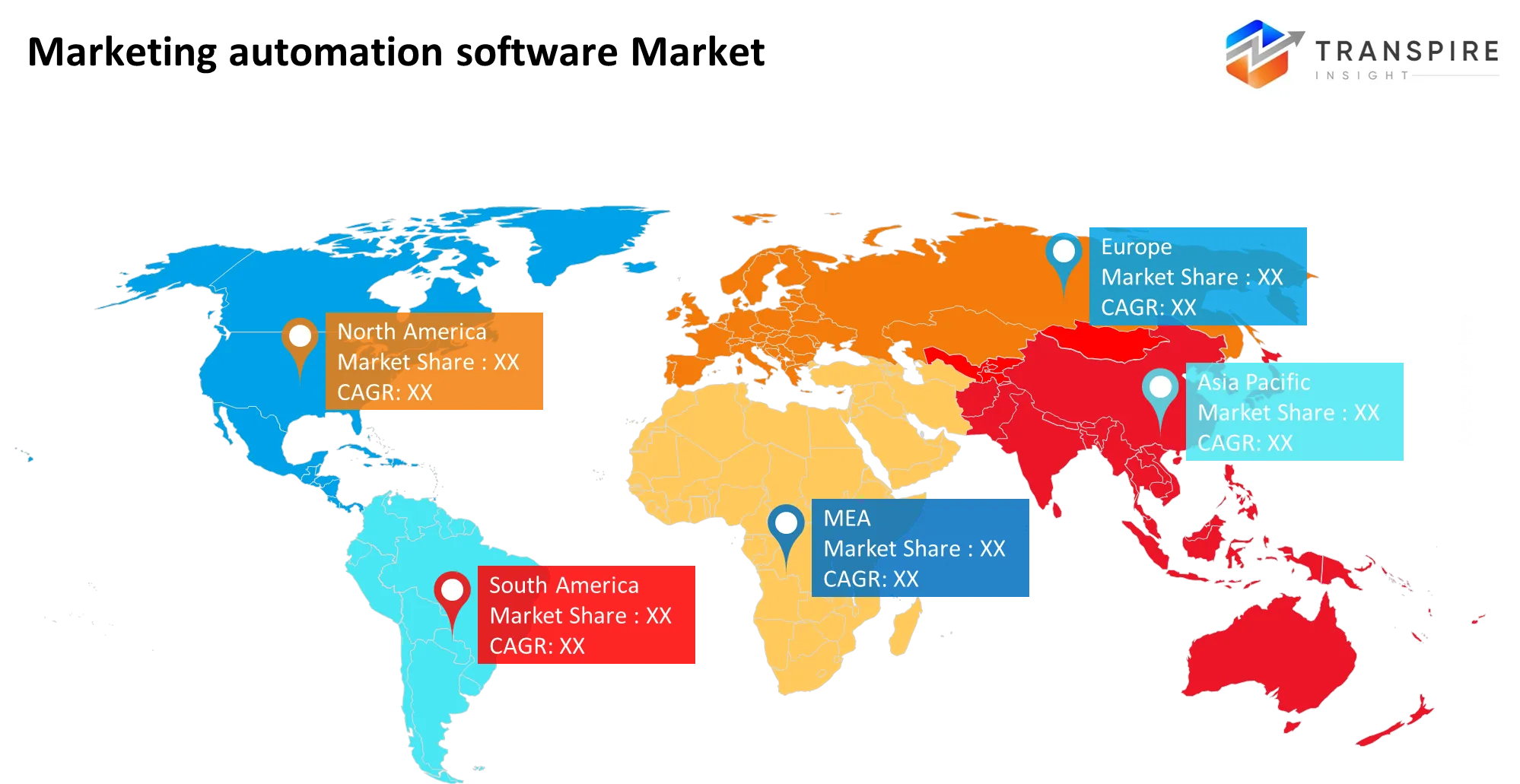
North America leads in the marketing automation software market and accounts for 42.38% of total market revenue. The presence of a mature digital marketing ecosystem and extensive utilisation of CRM and cloud computing solutions is driving the growth of the marketing automation software market. Moreover, businesses in the region are implementing AI-driven customer engagements and automated revenue operations systems to fuel adoption rates.
In June 2026, Salesforce launched AI-enabled marketing agents that will assist marketers with their campaign creation, content generation, lead qualification, and optimisation of customer experience, thus enhancing the role of AI-enabled marketing automation in North America.https://www.salesforce.com/news/stories/agentic-marketing-teams-announcement/
Europe
Europe accounts for 27.00% of the total market revenue and serves as an important region due to the presence of established digital organisations and systematic data management. In comparison with the North American region, Europe is characterised by strict privacy and data governance laws and customer engagement. Therefore, enterprises in the region focus on security integrations and customer information management.
In October 2025, SAP rolled out customer engagement features in SAP Emarsys, including AI-enabled campaign execution, automated decision-making, and personalisation, and SAP Engagement Cloud will be available in 2026.https://news.sap.com/2025/10/sap-connect-customer-experience-innovations-profitable-growth/
Asia-Pacific
The Asia-Pacific region holds a 20.00% share of the market and is also the fastest-growing region with a 13.96% CAGR. Increasing use of e-commerce, smartphones, cloud services, and investments made in technology are opening up new avenues for the automation of customer engagements. Companies in developing nations are gradually shifting their marketing activities online by using various software. There is space for vendors providing automation solutions using mobility, cloud, artificial intelligence, and cost-efficiency.
In May 2026, Salesforce announced that organisations from Singapore such as Kaplan, StarHub, INSEAD and Panasonic Asia Pacific have embraced Agentforce 360 to support their AI and data-driven transformation.https://www.salesforce.com/ap/news/press-releases/2026/05/14/agentforce-360-adoption-drives-strong-customer-growth-for-salesforce-singapore/
Who are the Key Players in the Marketing automation software Market, and how do they compete?
The competition in the market for marketing automation software has shifted towards platform depth, connectivity, artificial intelligence capability, user interface and connecting marketing efforts to measurable revenue gains. Vendors have gone beyond email automation by integrating campaign execution with CRM data, analytics, customer journeys, content and AI-enabled decision-making. Hence, integration breadth and flexibility of workflows become key competitive aspects. Salesforce has been developing a marketing offering based on unified customer data, AI agents, cross-channel journeys and automation, thus developing its marketing offering as part of its broader CRM ecosystem strategy. The key difference made by Marketo Engage is defined by B2B automation, predictive audiences, journey orchestration, personalisation, and integration with Adobe Experience Platform, with an emphasis on growing integration of automation with AI and customer experience workflows. In its turn, Oracle competes with Eloqua through cross-channel campaign management, lead management, AI-enabled efficiency and integration within its CX ecosystem.
Marketing automation software Market companies
- Salesforce
- Adobe
- HubSpot
- Oracle
- SAP
- Microsoft
- ActiveCampaign
- Marketo
- Braze,
- Klaviyo
- SAS
- Acoustic
- Iterable
- Mailchimp
- Zoho
Recent Development News
In June 2026, Adobe launched CX Enterprise Coworker. This agentic AI product will integrate customer data, content, analytics, and journey orchestration for marketing campaign automation and customer experience workflows.https://news.adobe.com/news/2026/06/adobe-announces-general-availability-of-cx-enterprise-coworker
In December 2025, Salesforce announced an acquisition deal with Qualified. The idea was to incorporate agentic marketing features such as web engagement, lead qualification, nurturing, and autonomous pipeline building into Salesforce’s marketing ecosystem.https://www.salesforce.com/news/stories/salesforce-signs-definitive-agreement-to-acquire-qualified/
What Strategic Insights Define the Future of the Marketing Automation Software Market?
The market is shifting towards AI-enabled integrated marketing operations, rather than individual campaigns. Connecting customer data, CRM, content, analytics, and automated journeys could help in making decisions and enable personalisation, whereas AI agents are increasingly taking care of parts of the campaign strategy and optimisation process. The danger is that people will automate bad-quality data or bad customer journeys, resulting in large-scale targeting mistakes. The opportunity lies in real-time mobile-first engagements enabled by predictive modelling and agentic workflows, especially in. Strategic attention should be focused on robust data infrastructure, integration capabilities, measurable results of the customer journey, and responsible AI use, rather than just automation. The ability to combine automation with governance, human supervision, and good customer signals enables marketing operations to become sustainable for vendors and buyers as the market becomes more integrated.
Component
- Software
- Services
- Consulting
- Integration
- Support
- Training
- Managed Services
Deployment
- Cloud
- On-Premise
- Hybrid
- SaaS
- Hosted
- Public Cloud
- Private Cloud
Organization Size
- Large Enterprises
- SMEs
- Startups
- Agencies
- Franchises
- Government
- Nonprofits
- Other Organizations
Application
- Email Marketing
- Campaign Management
- Lead Management
- Social Media Marketing
- Inbound Marketing
- Analytics & Reporting
- Mobile Marketing
- Content Marketing
End User
- Retail & E-Commerce
- BFSI
- Healthcare
- IT & Telecom
- Manufacturing
- Media & Entertainment
- Education
- Travel & Hospitality
Sales Channel
- Direct Sales
- Resellers
- Distributors
- Online Platforms
- System Integrators
- Marketing Agencies
- Marketplaces
- Partner Networks
By Regional Analysis
North America
- US
- Canada
- Mexico
Europe
- Germany
- UK
- France
- Italy
- Spain
- Russia
- Rest of Europe
Asia Pacific
- China
- Japan
- India
- South Korea
- Australia
- Rest of Asia Pacific
South America
- Brazil
- Argentina
- Rest of South America
Middle East & Africa
- UAE
- Saudi Arabia
- Qatar
- South Africa
- Rest of the Middle East & Africa
Frequently Asked Questions
Find quick answers to common questions.
The marketing automation software market size was valued at USD 7.87 Billion in 2025 and is poised to reach USD 21.11 Billion by 2033, expanding at a 13.13% CAGR.
Key segments for the marketing automation software market are Component (Software, Services, Consulting, Integration, Support, Training, Managed Services); Deployment (Cloud, On-Premise, Hybrid, SaaS, Hosted, Public Cloud, Private Cloud); Organization Size (Large Enterprises, SMEs, Startups, Agencies, Franchises, Government, Nonprofits, Other Organizations); Application (Email Marketing, Campaign Management, Lead Management, Social Media Marketing, Inbound Marketing, Analytics & Reporting, Mobile Marketing, Content Marketing); End User (Retail & E-Commerce, BFSI, Healthcare, IT & Telecom, Manufacturing, Media & Entertainment, Education, Travel & Hospitality); Sales Channel (Direct Sales, Resellers, Distributors, Online Platforms, System Integrators, Marketing Agencies, Marketplaces, Partner Networks)
Growth is primarily driven by an increase in the use of digital marketing, increased personalisation of customer interactions, more usage of artificial intelligence and analytics, an increase in e-commerce, and automation of repetitive marketing processes.
The market is led by major manufacturers including Salesforce, Adobe, HubSpot, Oracle, SAP, Microsoft, ActiveCampaign, Marketo, Braze, Klaviyo, SAS, Acoustic, Iterable, Mailchimp, Zoho
North America constitutes 42.38% of the worldwide marketing automation software market due to the presence of top-notch technological infrastructure, extensive adoption of digital marketing, substantial enterprise expenditure, and availability of significant software vendors.
These business opportunities include the increased use of marketing automation systems powered by artificial intelligence, growth in cloud computing applications, and increased demand from small and medium-sized businesses as well as e-commerce firms.
- Salesforce
- Adobe
- HubSpot
- Oracle
- SAP
- Microsoft
- ActiveCampaign
- Marketo
- Braze,
- Klaviyo
- SAS
- Acoustic
- Iterable
- Mailchimp
- Zoho
About the Authors

Mayur Shinde
I am Mayur Shinde, a Senior Research Analyst at Transpire Insight, specializing in the Automotive & Transportation and Information & Communication Technology (ICT) Industry. My work focuses on analyzing emerging market trends, technological advancements, competitive landscapes, and industry developments to deliver accurate, data-driven insights. I am passionate about transforming complex market information into clear, actionable content that helps businesses, professionals, and decision-makers stay informed and make confident strategic decisions.

Chakradhar Khansole
Chakradhar serves as the Research Director at Transpire Insight, bringing over 8 years of experience in technology, innovation, and strategic market intelligence. He specializes in transforming complex market data into actionable business insights that enable organizations to make informed, growth-oriented decisions. Recognized for his strategic vision and analytical expertise, Chakradhar leads high-impact research initiatives, delivering comprehensive market assessments, competitive intelligence, and forward-looking industry analysis.
Recently Published Reports
-
Apr 2026
3D Optical Profiler Market
3D Optical Profiler Market Size, Share & Analysis Report By Type (Desktop 3D Optical Profiler, and Portable 3D Optical Profiler), By Technology (Confocal Technology, and White Light Interference), By End-Use Industry (Manufacturing, Research Institutions, Automotive, Aerospace and Defense, Medical Devices, and Other), and Geography (North America, Europe, Asia-Pacific, Middle East and Africa, South and Central America), 2021 - 2031
-
Apr 2026
Depth Sensor Market
Depth Sensor Market Size, Share & Analysis Report By Type (Infrared Depth Sensors, Time-of-Flight (ToF) Sensors, Stereo Vision Sensors, Structured Light Sensors, Ultrasonic Depth Sensors), By Application (Automotive, Robotics, Gaming, Consumer Electronics, Industrial Automation, Healthcare, Security & Surveillance, Others), By End Users (Automotive Manufacturers, Consumer Electronics Companies, Healthcare Providers, Industrial Companies, Security Agencies, Gaming Companies, Robotics Companies, Others), and Geography (North America, Europe, Asia-Pacific, Middle East and Africa, South and Central America), 2021 – 2031
-
Apr 2026
Digital Manufacturing Market
Digital Manufacturing Market Size, Share & Analysis Report By Component (Hardware, Software, and Services), By Technology (Robotics, 3D Printing, Internet of Things (IoT), and Others), By Application (Automotive and Transportation, Aerospace and Defense, Consumer Electronics, Industrial Machinery, and Others), By Process Type (Computer-Based Designing, Computer-Based Simulation, Computer 3D Visualization, Analytics, and Others), and Geography (North America, Europe, Asia-Pacific, Middle East and Africa, South and Central America), 2021 – 2031
-
Apr 2026
Digital Visa Services Market
Digital Visa Services Market Size, Share & Analysis Report By Type (Individual Travelers, Group Travelers), By Application (Tourism, Business Travel, Others), and Geography (North America, Europe, Asia-Pacific, Middle East and Africa, South and Central America), 2021 – 2031