
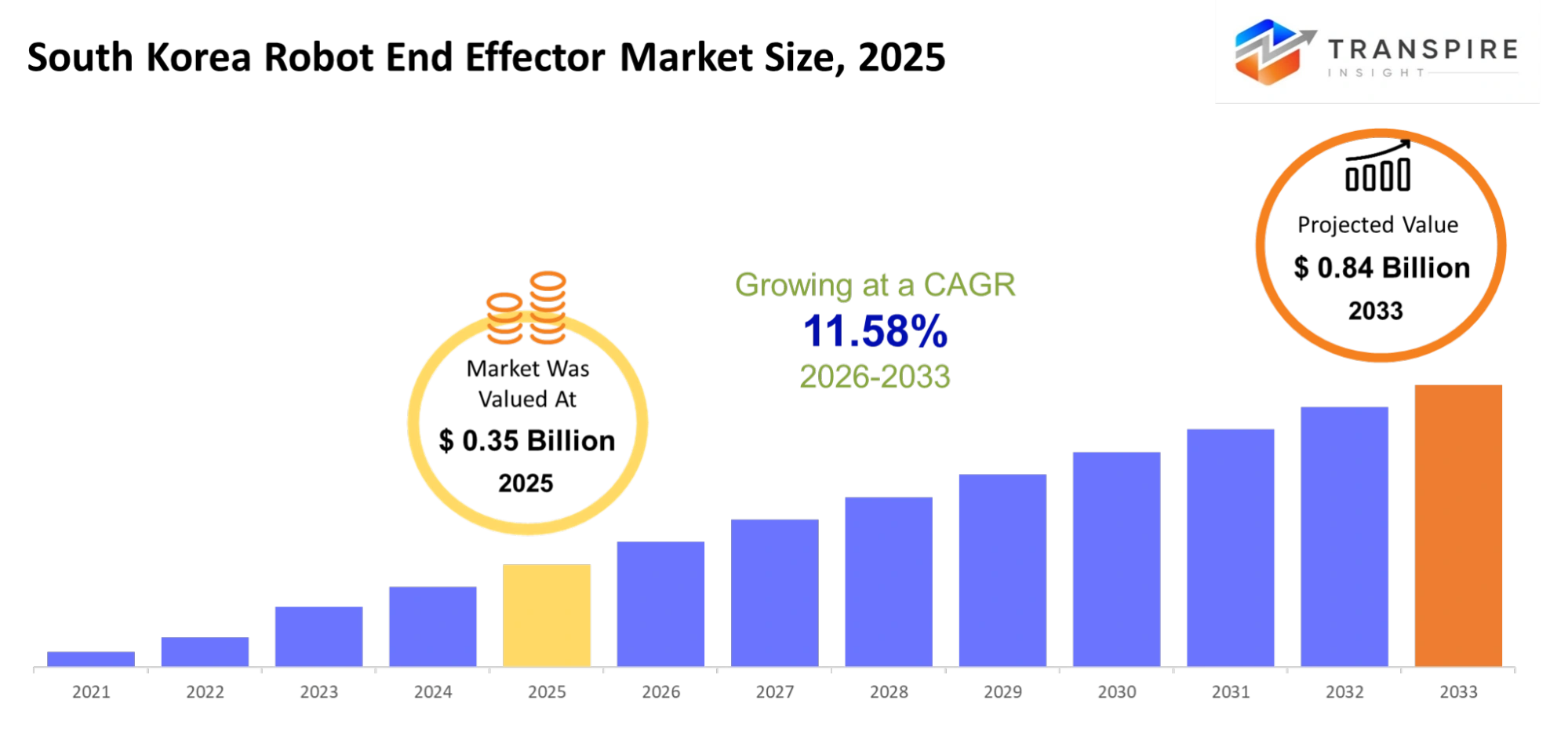
South Korea Robot End Effector Market Size & Forecast:
- South Korea Robot End Effector Market Size 2025: USD 0.35 Billion
- South Korea Robot End Effector Market Size 2033: USD 0.84 Billion
- South Korea Robot End Effector Market CAGR: 11.58%
- South Korea Robot End Effector Market Segments: By Type (Grippers, Welding Guns, Tool Changers, Sensors), By Application (Automotive, Electronics, Food & Beverage, Logistics), By End-User (Manufacturers, OEMs, Industrial Firms, Robotics Companies)
To learn more about this report,  Download Free Sample Report
South Korea Robot End Effector Market Summary:
The South Korea Robot End Effector Market size is estimated at USD 0.35 Billion in 2025 and is anticipated to reach USD 0.84 Billion by 2033, growing at a CAGR of 11.58% from 2026 to 2033.
The South Korea Robot End Effector Market within the advanced robotics and industrial automation industry will reflect a highly specialized segment shaped by the country’s precision-driven manufacturing culture. The study will concentrate on the equipment which robotic arms use to perform operations that involve holding objects, welding materials, detecting elements, and working on delicate electronics assembly in the electronics, automotive, and semiconductor manufacturing sectors.
South Korean manufacturers will continue to expect end effectors that deliver not only accuracy but also adaptability, as production lines will shift toward shorter product cycles and customized outputs. The design process for these tools will change because engineers now prefer to use lightweight materials, create modular systems, and develop systems that include multiple sensors which can detect instant changes occurring within the work environment.
The upcoming demand will require products which possess both intelligent handling capabilities and durability standards required for operating in situations where even minor errors can result in major financial losses.The development of collaborative robotics will lead to new methods for implementing robotic systems in environments which contain both human workers and automated machines. The South Korean safety regulations will become stricter which will force manufacturers to create end effectors that possess pressure detection and grip adjustment abilities which protect employees while maintaining operational efficiency.
Companies must implement tools that deliver consistent results because consumer demand for high-quality electronics and vehicles will drive their operations. Robots will gain the ability to identify objects with better accuracy through artificial intelligence and embedded vision systems which will enable them to perform advanced assembly tasks without needing human support. The smart factory movement will transform this market because its economic value now depends on the ability of companies to develop solutions that process actual operational data from their devices.
What Has the Impact of Artificial Intelligence Been on the South Korea Robot End Effector Market?
The South Korea Robot End Effector Market experiences transformation through AI technology, which brings new data analysis methods and automated decision-making systems to the industry.
The South Korea Robot End Effector Market benefits from AI technology, which enables businesses to conduct market research and data analysis with improved efficiency because it allows for speedier interpretation of intricate data sets and immediate access to information.
Businesses can use machine learning algorithms and predictive analytics to track market developments while they improve product design and handle industrial requirements that keep evolving. The South Korea Robot End Effector Market has achieved higher competitiveness because manufacturers now operate with increased strategic alignment capabilities.
The South Korea Robot End Effector Market uses artificial intelligence technologies to improve its demand forecasting and production planning activities. AI systems use historical data and current operational patterns to create demand forecasts that achieve higher accuracy, which helps businesses decrease uncertainty and lower their inventory expenses.
AI-powered smart automation systems enhance manufacturing operations by enabling robotic end effectors to execute adaptive gripping tasks and handle materials with precise accuracy while making on-the-fly modifications. The South Korea Robot End Effector Market gains increased production capabilities through these developments, which also enhance operational reliability while decreasing downtime and production mistakes.
AI technology plays a fundamental role in South Korean Robot End Effector Market operations through its ability to optimize supply chain processes and decrease expenses. Intelligent systems streamline logistics operations by tracking supplier performance and improving procurement processes to enhance resource distribution. The South Korea Robot End Effector Market uses artificial intelligence to drive innovation because it enables creation of specialized solutions that meet particular industrial needs.
Key Market Trends & Insights:
- The Seoul metropolitan area will maintain its position as the most rapidly developing area until 2030 because of ongoing investments in robotics research and development and the development of smart manufacturing facilities.
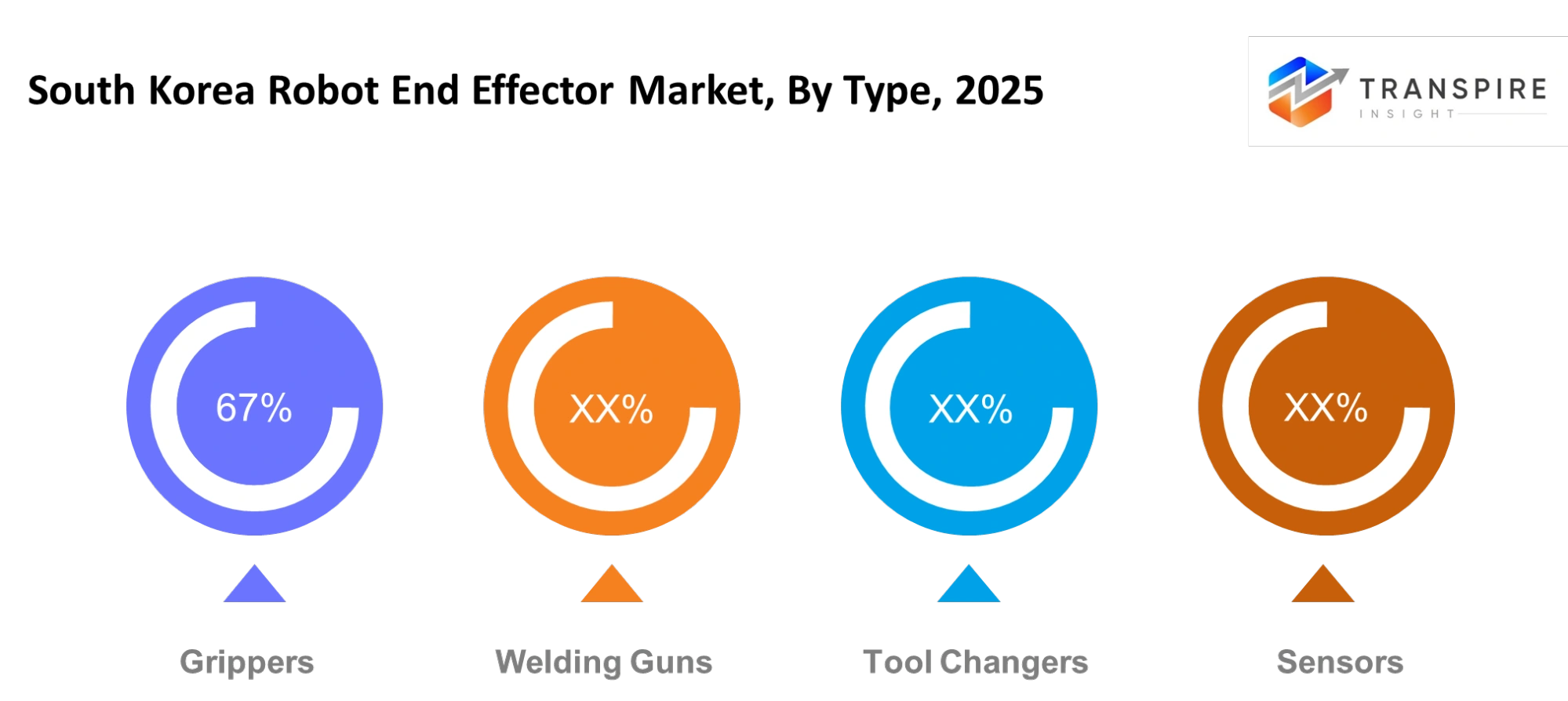
- In 2024 South Korea Robot End Effector Market designates grippers as the dominant market segment which accounts for more than 45% of total market share because of their common application in assembly and material handling tasks.
- The automotive and heavy machinery production requirements provide support to welding torches and tool changers which represent the second most important market segment.
- Vacuum-based end effectors have become the most rapidly expanding product segment which will grow at 11% annual rate until 2030 because of semiconductor handling requirements.
- The automotive manufacturing field leads all other industrial applications because it uses robots at high densities to perform precise assembly tasks which account for 35% of total industrial applications.
- Electronics and semiconductor industries represent the fastest expanding markets which will experience growth above 12% annual rate because of increasing demand for chip production.
- Large-scale manufacturers hold a significant share exceeding 60% in 2024, benefiting from established automation infrastructure and capital investment capacity.
- The fastest expanding end-user segment consists of small and medium-sized enterprises which receive support through government incentives and their growing use of affordable robotic technologies.
- The main industry participants are SCHUNK GmbH, SMC Corporation, Festo AG, Zimmer Group, and OnRobot.
South Korea Robot End Effector Market Segmentation
By Type :
People use grippers because they function as essential elements for South Korea Robot End Effector Market which allows safe handling of multiple materials with different shapes throughout production processes. The design enables adaptation to both sensitive electronic components and heavy industrial components. The need for automation will drive upcoming advancements which will enhance grip accuracy and material durability and power consumption efficiency.
The consistent need for welding guns in automotive assembly operations establishes their importance in the industry. The process maintains stable weld quality while requiring fewer manual tasks which results in higher production speed through automated operations. Tool changers enable robots to perform multiple tasks because they allow quick function changes which result in shorter operational interruptions. The system gains intelligence through sensors which provide real-time feedback to improve accuracy and safety and control systems throughout various industrial settings.
To learn more about this report, Download Free Sample Report
By Application :
The Automotive application holds the top market position in the South Korean Robot End Effector Market because robotics systems are used extensively for assembly work and welding tasks and painting operations. The manufacturing process needs dependable and consistent performance because it requires high output levels, which leads to increased usage of advanced end effectors that can perform intricate tasks with exactness and rapidity.
The electronics manufacturing industry creates demand because it requires precise handling of tiny and delicate items. The food and beverage industry needs hygienic and secure operations, which leads to the use of special materials and specific design solutions. Automated picking systems and sorting systems and packaging systems in the logistics industry experience performance improvements from efficient end effectors, which enhance operational efficiency while decreasing errors.
By End-User :
The manufacturers use their end-user capacity to boost their production efficiency while decreasing their need for human workers. Advanced robotic systems provide manufacturers with continuous production capabilities and help them manage their operational expenses. The OEMs create tailored solutions which enable their robotic systems to meet particular product needs while ensuring operational compatibility across different manufacturing environments.
Industrial companies use robotic end effectors to stay competitive in their large operations which require both exactness and fast performance. The robotics industry advances through its ongoing research activities which result in fresh designs and technologies that enhance system adaptability and operational capabilities. The groups will work together to achieve continuous market development and technological progress.
What are the Main Challenges for the South Korea Robot End Effector Market Growth?
The South Korea Robot End Effector Market encounters multiple technical and operational obstacles which prevent it from achieving complete market expansion. The South Korea Robot End Effector Market encounters its main challenge when it attempts to deliver stable and precise products which function effectively in different industrial settings. End effectors must handle varying payloads, materials, and conditions, which often leads to performance limitations and integration complexity. Supply chain limitations, which affect the procurement of high-quality sensors and advanced materials, result in production delays and increased expenses.
The South Korea Robot End Effector Market continues to face obstacles because of manufacturing and commercialization challenges. Creating advanced robotic end effectors requires manufacturers to complete complex design processes and adhere to strict quality requirements while investing substantial financial resources.
The South Korea Robot End Effector Market gets shaped by the challenges which organizations face when they try to adopt new technologies. The country maintains strong industrial infrastructure but lacks professionals who possess the necessary skills to operate and maintain AI-based robotic systems. The financial constraints which small and medium enterprises face through high initial investment requirements and inadequate funding options create barriers which prevent them from adopting new technologies.
Businesses face two main problems which include technological progress and intense market competition. The South Korea Robot End Effector Market experiences pricing difficulties because of pressure from both alternative automation solutions and affordable international competitors.
Country Insights
The driving forces of growth in two industries which require high-precision operations to create electronic and automotive products will benefit from increased automation. The production operations will need advanced gripping solutions because they will start to work with smaller and more delicate components. The implementation of new technologies will progress because businesses will need to compete through better cost efficiency and reduced need for human workers in their operations.
The current technology patterns show that smart sensors together with adaptive gripping systems will provide operational flexibility improvements. The system will achieve enhanced object recognition together with accurate positioning capabilities through its vision-based system integration. The use of lightweight materials together with compact designs will improve system efficiency because robotic systems can operate in both small spaces and different manufacturing conditions.
The industry faces two main obstacles which include the need for expensive startup costs and the requirement for trained personnel to operate and keep robotic equipment running. The existing equipment compatibility problems will create delays in technology implementation at specific sites. The combination of better user interface designs together with improved training materials will help organizations to overcome their current obstacles while making it easier for people to use their products.
Seoul and Busan and Incheon emerge as major industrial centers because their advanced manufacturing facilities and technology-focused companies establish a high level of operational sophistication. The local area needs efficient robotic components because it has a high density of electronics and automotive production facilities which require end effectors. The regional growth receives additional support from government programs that promote automation and smart factory development.
The southern regions, which include Ulsan and Daegu, show increasing adoption rates because of their developing industrial infrastructure and their growing efforts to enhance productivity. The areas experience steady demand for affordable robotic systems because small and medium enterprises continue to grow. The market will expand beyond major metropolitan areas because balanced regional development creates opportunities in different markets.
Recent Development News
In March 2026, SMC Korea showcased advanced robotic end effector and tool changer solutions at Smart Factory + Automation World 2026. The company demonstrated integrated packaging automation systems combining collaborative robots with modular end effectors for high-speed industrial applications.
Source https://www.thelec.net/
In March 2026, KUKA presented its KR DELTA robot systems with integrated end effector solutions at interpack 2026. The company highlighted high-speed pick-and-place capabilities enabled by optimized gripper and tooling systems for food and packaging industries.
|
Report Metrics |
Details |
|
Market size value in 2025 |
USD 0.35 Billion |
|
Market size value in 2026 |
USD 0.39 Billion |
|
Revenue forecast in 2033 |
USD 0.84 Billion |
|
Growth rate |
CAGR of 11.58% from 2026 to 2033 |
|
Base year |
2025 |
|
Historical data |
2021 - 2024 |
|
Forecast period |
2026 - 2033 |
|
Report coverage |
Revenue forecast, competitive landscape, growth factors, and trends |
|
Regional scope |
United States; Canada; Mexico; United Kingdom; Germany; France; Italy; Spain; Denmark; Sweden; Norway; China; Japan; India; Australia; South Korea; Thailand; Brazil; Argentina; South Africa; Saudi Arabia; United Arab Emirates |
|
Key company profiled |
Schunk, SMC, Festo, Zimmer Group, OnRobot, Piab, Destaco, ATI Industrial Automation, Robotiq, ABB, FANUC, KUKA, Yaskawa, Mitsubishi Electric, Denso |
|
Customization scope |
Free report customization (country, regional & segment scope). Avail customized purchase options to meet your exact research needs. |
|
Report Segmentation |
By Type (Grippers, Welding Guns, Tool Changers, Sensors), By Application (Automotive, Electronics, Food & Beverage, Logistics), By End-User (Manufacturers, OEMs, Industrial Firms, Robotics Companies) |
How Can New Companies Establish a Strong Foothold in the South Korea Robot End Effector Market?
New entrants aiming to succeed in the South Korea Robot End Effector Market must begin with focused niche targeting and clear value differentiation. Companies should solve specific problems which semiconductor manufacturing and healthcare robotics and logistics automation face instead of trying to compete across all sectors. The market requires two types of solutions which include precision grippers that handle delicate chips and hygienic end effectors designed for medical use.
The South Korea Robot End Effector Market requires companies to use innovation strategies together with technology differentiation to establish market presence. Artificial intelligence and machine learning together with sensor integration should be used by startups to create intelligent adaptive end effectors which will boost operational performance while minimizing equipment failures. Doosan Robotics is an emerging player which shows how intelligent automation together with collaborative robotics systems can transform work operations.
Strategic partnerships together with ecosystem integration create a competitive advantage for our company. The company can accelerate both product development and distribution processes through its partnerships with original equipment manufacturers and system integrators and research organizations. The example of Rainbow Robotics shows that consistent research and development investment along with partnerships drives product development progress for innovative companies. The South Korea Robot End Effector Market requires new businesses to build successful operations through targeted innovation and strategic partnerships and customer-focused development work.
Key South Korea Robot End Effector Market Company Insights
The robot end effector market in South Korea demonstrates continuous development because manufacturing processes and automated systems in electronics and automotive and semiconductor industries continue to expand. The production lines benefit from end effectors which include grippers and welding tools and suction devices because these tools enhance both precision and operational efficiency. The industrial sector will experience rising demand because businesses work to decrease their dependence on human labor while they strive for more precise operational outcomes.
Robotic systems achieve better performance through advanced materials and sensor-based designs because these technologies enable robots to execute complex operations that require delicate handling. The overall market base increases through robotic solution adoption by small and medium enterprises. Local companies drive industrial development through their new product creation which follows technology-driven policy support that exists in their operational environment.
The market competition includes multiple international companies and domestic businesses which specialize in precise engineering solutions that minimize operational costs. Companies focus their resources on developing lightweight products that incorporate intelligent gripping technologies and seamless compatibility with current robotic arm systems. The business will achieve wider market presence through its collaborative efforts with automation solution providers who will help the company establish connections within various business sectors. The process of product upgrades together with tailored solutions create major factors that determine customer preferences while businesses use pricing and customer service to develop their relationships with clients throughout the years.
Company List
- Schunk
- SMC
- Festo
- Zimmer Group
- OnRobot
- Piab
- Destaco
- ATI Industrial Automation
- Robotiq
- ABB
- FANUC
- KUKA
- Yaskawa
- Mitsubishi Electric
- Denso
What are the Key Use-Cases Driving the Growth of South Korea Robot End Effector Market?
The South Korea Robot End Effector Market is experiencing rapid growth because it serves an essential function in high-precision manufacturing which operates mainly through its work in automotive and electronics production. The use of robotic grippers and welding end effectors in automotive production enables precise assembly operations which include painting and material handling tasks, which results in increased production rates and improved product quality.
The South Korea Robot End Effector Market establishes itself as a growing market in healthcare and medical device production through its implementation of applications that require sterile operations with high-precision handling. The medical field increasingly adopts robotic end effectors for their use in surgical assistance systems laboratory automation and pharmaceutical packaging operations. The system provides automated solutions through its capability to execute repetitive duties while maintaining a safe environment for controlled situations.
The South Korea Robot End Effector Market experiences its second major growth force through logistics and e-commerce automation. Advanced gripping systems and AI-enabled picking solutions are streamlining warehouse operations, order fulfillment, and sorting processes. The development of smart factories and collaborative robots leads to new applications which enable companies to implement their systems throughout various sectors.
South Korea Robot End Effector Market Report Segmentation
By Type
- Grippers
- Welding Guns
- Tool Changers
- Sensors
By Application
- Automotive
- Electronics
- Food & Beverage
- Logistics
By End-User
- Manufacturers
- OEMs
- Industrial Firms
- Robotics Companies
Frequently Asked Questions
Find quick answers to common questions.
The approximate South Korea Robot End Effector Market size for the market will be USD 0.84 Billion in 2033.
Key segments for the South Korea Robot End Effector Market are By Type (Grippers, Welding Guns, Tool Changers, Sensors), By Application (Automotive, Electronics, Food & Beverage, Logistics), By End-User (Manufacturers, OEMs, Industrial Firms, Robotics Companies).
Major South Korea Robot End Effector Market players are Schunk, SMC, Festo, Zimmer Group, OnRobot, Piab, Destaco, ATI Industrial Automation, Robotiq, ABB, FANUC, KUKA, Yaskawa, Mitsubishi Electric, Denso.
The South Korea Robot End Effector Market size is USD 0.35 Billion in 2025.
The South Korea Robot End Effector Market CAGR is 11.58%.
- Schunk
- SMC
- Festo
- Zimmer Group
- OnRobot
- Piab
- Destaco
- ATI Industrial Automation
- Robotiq
- ABB
- FANUC
- KUKA
- Yaskawa
- Mitsubishi Electric
- Denso
Recently Published Reports
-
Apr 2026
Fiber Optic Faceplates Market
Fiber Optic Faceplates Market Size, Share & Analysis Report By Type (< 300 mm2, 300-350 mm2, and > 350 mm2, By Application (Night Vision, Holographic Imaging, Medical, and Others), and Geography (North America, Europe, Asia-Pacific, Middle East and Africa, South and Central America), 2021 - 2031
-
Apr 2026
High Temperature Superconductors Market
High Temperature Superconductors Market Size, Share & Analysis Report By Type (1G HTS, and 2G HTS), By Application (Power Cable, Fault Current Limiter, and Transformer), and Geography (North America, Europe, Asia-Pacific, Middle East and Africa, South and Central America), 2021 - 2031
-
Apr 2026
Industrial Plugs and Socket Market
Industrial Plugs and Socket Market Size, Share & Analysis Report By Type (Industrial Plugs, Industrial Sockets), By Current (Up to 32 A, 32 to 125 A, Above 125 A), By Protection (Dustproof and Splash Proof, Waterproof, Explosion Proof), By End User (Heavy Industries, Oil and Gas, Chemicals and Pharmaceuticals, Power Generation, Others), and Geography (North America, Europe, Asia-Pacific, Middle East and Africa, South and Central America), 2021 - 2031
-
Apr 2026
InGaAs Avalanche Photodiodes Market
InGaAs Avalanche Photodiodes Market Size, Share & Analysis Report By Type (1100 - 1700 nm, and 1000 - 1600 nm), By Application (Missile Warning System, Muzzle Flash Detection, Wafer Defect Inspection, Laser Rangefinders, and Others), and Geography (North America, Europe, Asia-Pacific, Middle East and Africa, South and Central America), 2021 - 2031