
South Korea Recycled Glass Market Size & Forecast:
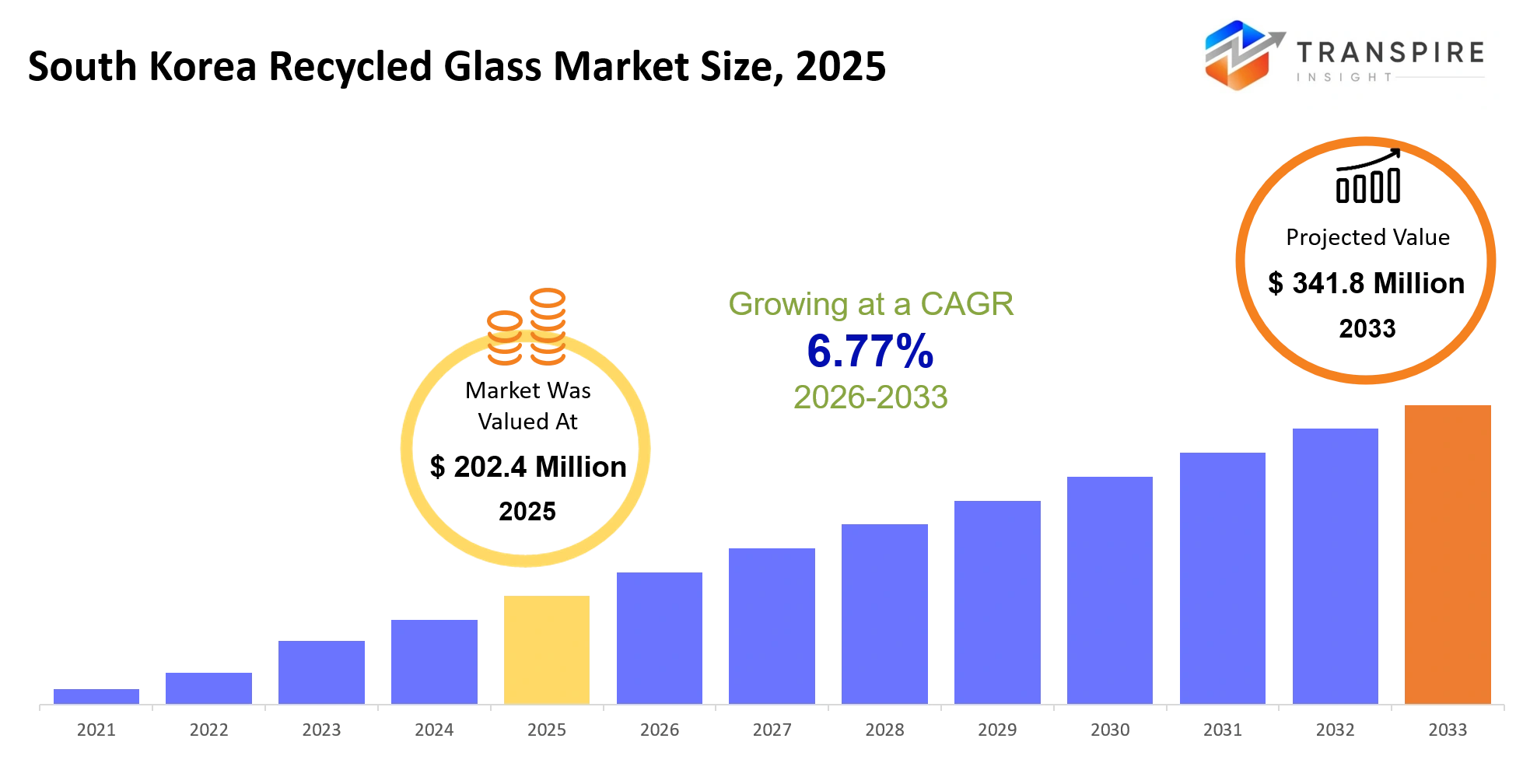
- South Korea Recycled Glass Market Size 2025: USD 202.4 Million
- South Korea Recycled Glass Market Size 2033: USD 341.8 Million
- South Korea Recycled Glass Market CAGR: 6.77%
- South Korea Recycled Glass Market Segments: By Product Type (Cullet, Crushed Glass, Glass Powder, Others); By Application (Container Glass, Fiberglass, Construction Materials, Abrasives, Others).
To learn more about this report,  Download Free Sample Report
South Korea Recycled Glass Market Summary
The South Korea Recycled Glass Market was valued at USD 202.4 Million in 2025. It is forecast to reach USD 341.8 Million by 2033. That is a CAGR of 6.77% over the period.
In South Korea, the recycled glass market matters a lot when it comes to turning post-consumer and industrial glass scrap into a real, usable feedstock. That feedstock then ends up in packaging, construction materials, insulation products, and even industrial abrasives. At the same time, it reduces reliance on virgin raw materials and helps cut furnace energy use, so manufacturers can better control their production costs while also backing the country's circular economy objectives.
Over the last five years, the whole market kind of shifted in a more structural way, mainly because the rules around resource circulation became tighter and because companies started making stronger sustainability pledges. This push has made glassmakers use more cullet in the manufacturing process. One big trigger was South Korea's waste management plus carbon reduction agenda getting more serious, which basically nudged industries to raise recycling rates and to lean away from landfill. In this policy atmosphere, investments moved faster into collection, sorting and processing infrastructure, even when budgets were tight. Since recycled glass gives both environment compliance advantages, and also modest day to day operational cost savings, manufacturers are now slowly inserting more recovered content into their production lines, bit by bit. The result is that it gets used in more end-use areas, which creates fresh income pathways for recyclers and helps keep the whole market on a sturdier long-term growth path.
Key Market Insights
- In the Seoul Capital Area, it kinda dominates the South Korea Recycled Glass Market and in 2025 it’s looking like 35–40% market share, mostly because of the dense population and the recycling infrastructure that’s already there, kind of continuously running.
- Meanwhile southeastern industrial zones, like Ulsan and Busan , show up as the fastest-growing regional market through the forecast period. This is backed by manufacturing investments, and the whole thing feels pretty tied to that industrial momentum.
- Also, regional governments keep expanding collection and sorting facilities, which helps raise cullet recovery rates, and it also strengthens the market supply chain situation a bit more each year.
- When you look at segments, glass cullet is still the leading one, with over 60% share in 2025, mainly because it’s widely used in container glass production .
- Recycled glass powders and aggregates come in second, supported by construction and infrastructure use cases, and demand that keeps building, bit by bit.
- Processed high purity recycled glass , is seen as the fastest growing slice through 2030 , basically riding on advanced sorting technologies.
- Glass packaging manufacturing still is the main application pool, with an estimated 45–50% share in 2025 ; that’s largely backed by beverage and food packaging pull.
- The container and packaging industry is the most important end user segment, and it’s expected to bring in over 40% of market revenue in 2025.
- Construction and infrastructure companies are moving ahead faster than the rest, mainly because low-carbon material adoption keeps accelerating.
- Meanwhile industrial manufacturers are more and more integrating recycled glass, not just for circularity but also to trim energy usage and sharpen sustainability performance metrics, overall.
What are the Key Drivers, Restraints, and Opportunities in the South Korea Recycled Glass Market?
The main force pushing the South Korea recycled glass market forward is the country’s growing circular economy structure, plus tougher policies about resource circulation. In practice, government measures intended to reduce reliance on landfill and increase material recovery tend to nudge glass makers to incorporate more recycled glass cullet into their production processes. The logic is pretty clear: recycled glass often offers a cost benefit because it requires less heat and energy to melt than virgin raw materials. With energy prices and feedstock costs staying high, manufacturers keep treating recycled content as some kind of workable lever for cost control. So you tend to see more processed cullet being sourced, higher utilization rates in recycling plants, and more income moving through the value chain, overall .
Still, the biggest hurdle is the scattered collection and sorting setup for post-consumer glass. Even if recycling rates look decent on paper, contamination from mixed waste streams cuts the usable amount of glass that can be turned into high-grade cullet. And that problem feels structural, because getting collection systems better across the country means building sorting facilities, improving logistics, and lining everything up , which demands real capital spend, plus tight coordination between municipalities, recyclers, and end users. Because of this, shortages of premium recycled glass keep popping up, then adoption in higher-spec applications gets slowed down. It also tends to cap the revenue upside the market could reach.
Advanced glass sorting and processing technologies are kinda like a major growth lane, especially when you think about where the money is going. If companies invest in optical sorting systems, plus AI-enabled material recognition, and more automated recycling facilities, then you can boost cullet purity quite a lot, and at the same time improve recovery rates too. Areas like Busan and Ulsan are starting to look pretty attractive for these investments, not just because they’re industrial, but because manufacturing activity is concentrated there, and the logistics infrastructure is already in place. Then, as these tools get more mature and processing efficiency keeps rising, recyclers can end up supplying higher value recycled glass products to packaging, construction, and even industrial end users, which should help push the market into its next expansion phase , or something close to that.
What Has the Impact of Artificial Intelligence Been on the South Korea Recycled Glass Market?
Artificial intelligence and advanced digital technologies are, kinda, increasingly changing South Korea’s recycled glass value chain. They do it by improving material recovery, plant efficiency, and the overall product quality. Recycling facilities are now rolling out AI enabled optical sorting systems, which basically recognize glass by color composition, and contamination level automatically. The point is that these systems can handle big waste streams with more stable results than people sorting by hand, so operators can boost cullet purity and also cut down material losses that otherwise slip through. On top of that, automated control platforms optimize crushing, cleaning and separation steps in real time. That tends to lower energy consumption, and also reduces operating costs.
Machine learning is also being applied for predictive maintenance across recycling plants. These models look at vibration, temperature and throughput signals from equipment, and then they can spot early wear signs in conveyors, crushers, and sorting lines before something actually breaks. So operators are using predictive analytics to adjust maintenance timing, reduce unexpected downtime. and raise facility utilization rates, sort of more reliably. There are also digital forecasting tools that help processors manage inventory levels and estimate swings in glass waste volumes, which makes resource allocation and production planning a bit more predictable.
Overall, these technologies are creating measurable operational improvements, like higher recovery rates, better equipment uptime, and lower maintenance expenses. Still, broad adoption is slowed down by high integration costs and the requirement for large quantities of high quality operational data. Smaller recycling operators often don’t have the digital infrastructure needed to deploy the more advanced AI systems fully, so that delays implementation across the industry.
Key Market Trends
- Since 2021, glass makers have sorta amped up cullet utilization percentages, to trim furnace energy use and also handle those jittery raw material costs—more or less.
- Meanwhile, city recycling efforts expanded automated sorting capabilities from 2020 to 2025, which improved recovery efficiency, and cut down contamination, in the glass streams they collect.
- Packaging producers, have gradually moved toward containers with higher recycled content as resource-circulation policies got tighter and corporate sustainability goals became more demanding, honestly.
- After 2022, AI - enabled optical sorting systems started getting more common, so processors could boost color separation accuracy, and end up with recycled materials that are worth more.
- In construction, material producers have been adding recycled glass aggregates more often since around 2021, especially as lower-carbon building requirements showed up more in public projects.
- Industrial recyclers have also drifted away from manual checking routines to sensor-based quality control, helping throughput feel more consistent, and reducing that operational waste that just sort of accumulates.
- Overall, it looks like competition has gradually shifted toward processing quality instead of just collection volume, like, pretty clearly. The top operators are putting money into more advanced purification and contamination-removal tech, and it shows, pretty explicitly too.
- In places with heavy industry like Busan and Ulsan, manufacturers kept expanding their cooperation with recyclers from 2022 through 2025, mostly so they can keep cullet supply steady, like you know.
- Regulators have also moved their focus away from landfill-diversion targets toward material circularity measures, so the whole idea is to push higher-value re-use, not only basic waste recovery.
- Companies such as O-I Glass and AGC Inc. have also leaned harder into incorporating recycled content, to support their carbon-cut promises and also to make day-to-day operations more efficient, in practice.
South Korea Recycled Glass Market Segmentation
By Product Type :
Cullet is basically processed recycled glass bits that get used a lot as a raw material for new glass production because the melting step takes less energy than using virgin material. Crushed glass is made when people break the recovered glass into smaller fragments and it ends up in construction jobs, road works , and drainage uses too, mainly because it holds up well and it stays cost efficient.
Glass powder is usually created by grinding the material even further and then it’s used in cement blends, as fillers, and in special industrial goods where having a fine particle size really matters. The other segment covers recycled glass forms that are aimed at more specific uses, like niche industrial purposes , decorative products, landscaping setups, and customized processing needs. Overall demand across these areas is being pushed by recycling initiatives , resource conservation targets, and a steadily increasing interest in circular material use across the South Korea Recycled Glass Market.
By Application :
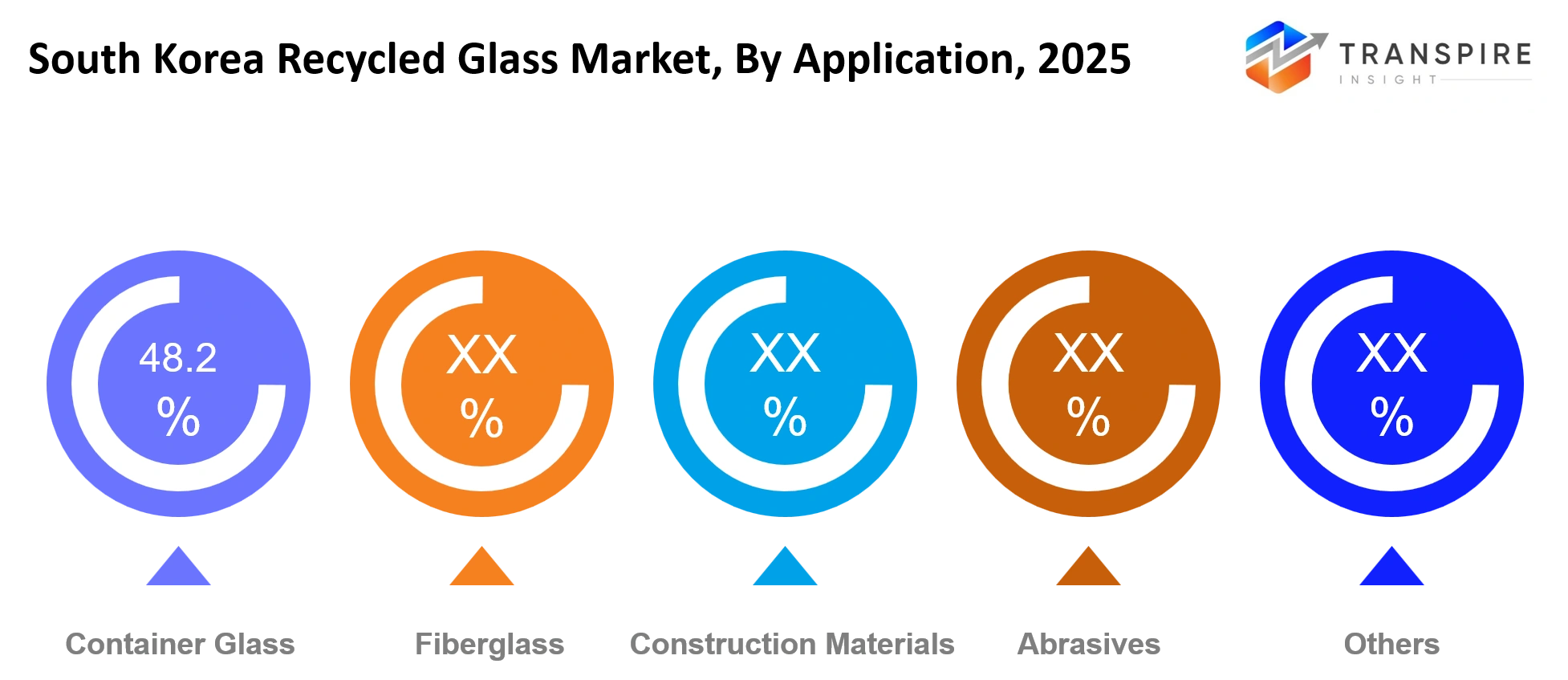
Container glass still remains a big thing, because recycled glass is often used when bottles and jars get made, and that helps makers cut down on energy needs too raw material needs, kind of all together. Fiberglass applications also lean on recycled glass as a sort of starting input for insulation materials, plus reinforced products, so they can push efficiency and sustainability targets in day to day industrial production, even when demand changes.
In construction materials, recycled glass shows up quite a bit: it can be blended into concrete, asphalt, tiles, and other building products. Abrasives, too, use processed glass for surface preparation, cleaning, and finishing operations. The other segment is more mixed, like decorative products, filtration materials, and specialized industrial use cases where recycled glass delivers practical performance and environmental advantages. Ongoing attention on waste reduction and material recovery keeps encouraging wider adoption across the various application segments.
To learn more about this report, Download Free Sample Report
What are the Key Use Cases Driving the South Korea Recycled Glass Market?
In the South Korea Recycled Glass Market, the biggest slice of demand basically comes from container manufacturing . Beverage, food, and personal care packaging producers are leaning on recycled glass more and more as a feedstock , mainly to trim production costs and lower energy consumption. With solid recycling programs plus sustainability targets in place, manufacturers are pushed to slot in more recycled content into new containers, so this use case stays the top one in the whole market.
Then there’s extra pull coming from construction and insulation. Building materials firms are starting to blend recycled glass into concrete goods, tiles, and insulation types, aiming to meet greener building standards. At the same time, infrastructure initiatives, along with busy commercial construction, are turning into steady openings for recycled glass based materials.
Over time, newer applications are showing up too, like advanced construction products and more specialized industrial materials. Finely processed recycled glass is being looked at for cement enhancement, filtration systems , and engineered composite products. And as environmental regulations keep tightening, plus material innovation moves forward, these options should pick up broader commercial acceptance during the forecast period.
|
Report Metrics |
Details |
|
Market size value in 2025 |
USD 202.4 Million |
|
Market size value in 2026 |
USD 216.1 Million |
|
Revenue forecast in 2033 |
USD 341.8 Million |
|
Growth rate |
CAGR of 6.77% from 2026 to 2033 |
|
Base year |
2025 |
|
Historical data |
2021 - 2024 |
|
Forecast period |
2026 - 2033 |
|
Report coverage |
Revenue forecast, competitive landscape, growth factors, and trends |
|
Country scope |
South Korea |
|
Key company profiled |
O-I Glass, Ardagh Group, Vetropack, Encirc, Strategic Materials, Momentum Recycling, Berryman Glass, Gallo Glass, Saint-Gobain, Sibelco, Dlubak Glass, Recresco, Pace Glass, URM Group, Glass Recycled Surfaces. |
|
Customization scope |
Free report customization (country, regional & segment scope). Avail customized purchase options to meet your exact research needs. |
|
Report Segmentation |
By Product Type (Cullet, Crushed Glass, Glass Powder, Others); By Application (Container Glass, Fiberglass, Construction Materials, Abrasives, Others). |
Which Regions are Driving the South Korea Recycled Glass Market Growth?
The Seoul Capital Area basically leads the South Korea Recycled Glass Market , mostly because it has high population density, strong consumer packaging demand, and well-built waste collection systems. Bigger cities in and around Seoul keep producing major amounts of post-consumer glass, so there is a dependable stream of reusable material. On top of that, strict recycling rules and pretty advanced sorting infrastructure help boost how efficiently stuff is collected and how much material actually gets recovered . There’s also a solid web of recyclers, packaging manufacturers, and logistics providers, so the whole region stays in that top spot.
Then you have the Southeast region , and yeah it includes major industrial hubs like Busan and Ulsan, which supports the market’s earnings in a steady, almost calm way. Compared with the Seoul Capital Area, the growth here feels more industrial , meaning it’s driven by what factories and production lines need, rather than population-based waste piling up. Meanwhile, ongoing investment in glass processing, construction materials, and industrial production keeps demand for recycled glass from drying out. In general, economic staying power plus long-running industrial operations help keep market activity steady across the region.
The Chungcheong region is starting to look like the fastest-growing place in the South Korea Recycled Glass Market . Lately, new investments in resource recovery facilities and sustainable industrial programs have expanded recycling capacity and improved how material is actually used. Also, more companies are choosing eco-leaning construction materials, and that is opening fresh doors for recycled glass suppliers. This kind of momentum is expected to pull in further funding and additional capacity expansion , which makes the region a more and more important stop for market players during the 2026–2033 period.
Who are the Key Players in the South Korea Recycled Glass Market and How Do They Compete?
In the South Korea Recycled Glass Market, competition is sort of moderately concentrated, you know, with well known glass manufacturers , cullet processors and recycling specialists all holding a decent portion of both material collection, and the end-use demand. What really pushes competition is processing efficiency, plus having reliable access to a steady recycled glass supply, product quality, and the capability to supply big packaging and industrial customers. Most established players keep tightening up their collection networks and recycling know-how, while the more specialized recyclers are quietly ramping up processing capacity to catch that rising demand for sustainable materials. Basically, the market tends to favor the companies that can lock in dependable feedstock and still ship recycled glass that matches tough manufacturing specs.
Techpack Solutions sets itself apart with large-scale glass container production and some advanced manufacturing technology. They supply beverage, food, and pharmaceutical clients using a wide product portfolio, and they have invested in production upgrades like modernization of batch and cullet handling systems. That kind of improves cost efficiency and also helps increase recycled glass utilization, in practice.
SGC Solutions competes by leaning on integrated glass container manufacturing and long-time relationships with packaging customers. They also have the advantage of multiple production facilities, plus ongoing expansion across domestic and export channels. On the other hand, SMCG (Somang Glass) is more focused on cosmetic packaging, and they use sustainability-driven differentiation. The company runs with high levels of post-consumer recycled glass, keeps global sustainability certifications in place, and continues investing in production capacity, along with specialized packaging solutions aimed at beauty brands.
Company List
- O-I Glass
- Ardagh Group
- Vetropack
- Encirc
- Strategic Materials
- Momentum Recycling
- Berryman Glass
- Gallo Glass
- Saint-Gobain
- Sibelco
- Dlubak Glass
- Recresco
- Pace Glass
- URM Group
- Glass Recycled Surfaces
Recent Development News
In February 2026, Won Kwang S&T launched the SoleBorn mobile solar-panel recycling system. The technology enables on-site recovery of materials including tempered glass from end-of-life photovoltaic modules, improving recycling efficiency and supporting South Korea’s recycled-glass value chain.
Source: https://www.pv-magazine.com/
In February 2026, Samsung Electronics earned UL Solutions Environmental Claims Validation (ECV) certification for using recycled waste-glass fiber material in its Bespoke AI Combo washer-dryer. The certification validated the commercial use of recycled glass-derived composite materials and strengthened demand for high-value recycled-glass applications in manufacturing.
Source: https://view.asiae.co.kr/
What Strategic Insights Define the Future of the South Korea Recycled Glass Market?
South Korea’s Recycled Glass Market is kind of moving toward a more circular, resource efficient setup over the next five to seven years, though it’s not happening all at once. Basically, growth will rely more and more on how well manufacturers can mix recycled content into their production , while still dealing with tougher sustainability expectations from consumers, industrial buyers and regulators. Underneath it all, the main driver is the rising economic value of recovered materials, since more sectors want to cut energy use, lower emissions, and strengthen resource security
There is also a risk that people don’t always notice quickly. Feedstock quality and collection consistency can swing a lot. Even if recycling volumes climb, contamination in collected glass and uneven recovery rates could reduce the supply of high quality material that manufacturers actually need . On top of that, market concentration—meaning a smaller number of processing facilities—may create supply bottlenecks when demand gets stronger
But there’s an opportunity too, and it’s getting clearer. Finely processed recycled glass can go into advanced construction materials and low carbon building products. As green construction standards keep expanding, demand for these uses may speed up. Market players should put money into sorting , cleaning, and processing technologies that raise material quality, because better feedstock capability is likely to turn into a real competitive edge in the coming years
South Korea Recycled Glass Market Report Segmentation
By Product Type
- Cullet
- Crushed Glass
- Glass Powder
By Application
- Container Glass
- Fiberglass
- Construction Materials
- Abrasives
Frequently Asked Questions
Find quick answers to common questions.
The expected South Korea Recycled Glass Market size is USD 341.8 Million in 2033.
Key segments for the South Korea Recycled Glass Market are By Product Type (Cullet, Crushed Glass, Glass Powder, Others); By Application (Container Glass, Fiberglass, Construction Materials, Abrasives, Others).
Major South Korea Recycled Glass Market players are O-I Glass, Ardagh Group, Vetropack, Encirc, Strategic Materials, Momentum Recycling, Berryman Glass, Gallo Glass, Saint-Gobain, Sibelco, Dlubak Glass, Recresco, Pace Glass, URM Group, Glass Recycled Surfaces.
The South Korea Recycled Glass Market size is USD 202.4 Million in 2025.
The South Korea Recycled Glass Market CAGR is 6.77% from 2026 to 2033.
- O-I Glass
- Ardagh Group
- Vetropack
- Encirc
- Strategic Materials
- Momentum Recycling
- Berryman Glass
- Gallo Glass
- Saint-Gobain
- Sibelco
- Dlubak Glass
- Recresco
- Pace Glass
- URM Group
- Glass Recycled Surfaces
About the Authors

Pankaj Ghogare Patil
I am Pankaj Ghogare Patil, a Senior Research Analyst at Transpire Insight, specializing in the Pharmaceutical, Chemicals & Materials, Healthcare IT, and Biotechnology industry. My expertise lies in conducting comprehensive market research, analyzing industry trends, evaluating competitive landscapes, and translating complex data into actionable insights. At Transpire Insight, I closely follow emerging technologies, regulatory developments, and market innovations to create accurate, well-researched, and informative content that helps businesses and professionals make informed decisions. I am committed to producing credible, evidence-based articles that reflect industry best practices while making technical topics accessible and valuable for a broad audience.

Chakradhar Khansole
Chakradhar serves as the Research Director at Transpire Insight, bringing over 8 years of experience in technology, innovation, and strategic market intelligence. He specializes in transforming complex market data into actionable business insights that enable organizations to make informed, growth-oriented decisions. Recognized for his strategic vision and analytical expertise, Chakradhar leads high-impact research initiatives, delivering comprehensive market assessments, competitive intelligence, and forward-looking industry analysis.
Recently Published Reports
-
May 2026
Healthcare Polymer Packaging Market
Healthcare Polymer Packaging Market Size, Share & Analysis Report By Packaging Type (Syringes, IV Bottles and Pouches, Clamshells, Blisters, Bottles & Jars, Containers, Tubes, IV Parental Packaging, Others), By Type (Regulated, Non-regulated), By Polymer Type (LDPE (Low-Density Polyethylene), HDPE (High-Density Polyethylene), Homo-polymer (Homo), Random Copolymer (Random), Block Copolymer (Block), PET, Polystyrene, Polyvinyl Chloride, Polyamide/EVOH, Others), and Geography (North America, Europe, Asia-Pacific, Middle East and Africa, South and Central America), 2021 - 2031
-
Apr 2026
Hydrophilic Tape (Waterstop) Market
Hydrophilic Tape (Waterstop) Market Size, Share & Analysis Report By Type (Bentonite-Based Hydrophilic Tape, Rubber-Based Hydrophilic Tape), By Application (Residential Buildings, Commercial Buildings, Infrastructure Projects), and Geography (North America, Europe, Asia-Pacific, Middle East and Africa, South and Central America), 2021 - 2031
-
Apr 2026
Metalens Market
Metalens Market Size, Share & Analysis Report By Type (Visible Light Metalens, and Infrared Metalens), By Application (Consumer Electronics, Automotive Electronics, Industrial, Medical, and Others), and Geography (North America, Europe, Asia-Pacific, Middle East and Africa, South and Central America), 2021 - 2031
-
Apr 2026
PBT Resin Market
PBT Resin Market Size, Share & Analysis Report By Type (Reinforced PBT Resin, Unreinforced PBT Resin), By Processing Method (Injection Molding, Extrusion, Blow Molding, Others), By End-User (Automotive, Electrical & Electronics, Consumer Appliances, Industrial Machinery, Medical Devices, Packaging, Others), and Geography (North America, Europe, Asia-Pacific, Middle East and Africa, South and Central America), 2021 - 2031