
South Korea Recyclable Thermosets Market Summary:
According to Transpire Insights, a detailed research report on the South Korea Recyclable Thermosets Market reflects that the market is witnessing increasing adoption of recyclable thermoset materials across coatings, adhesives, and composites, supported by growing demand from the automotive, construction, and electronics industries. The market is further characterized by the adoption of epoxy, polyester, and polyurethane resin types, alongside chemical recycling, mechanical recycling, and energy recovery technologies, making these materials increasingly important for sustainable manufacturing, circular-economy initiatives, advanced polymer development, and waste-reduction strategies in South Korea.
Market Snapshot
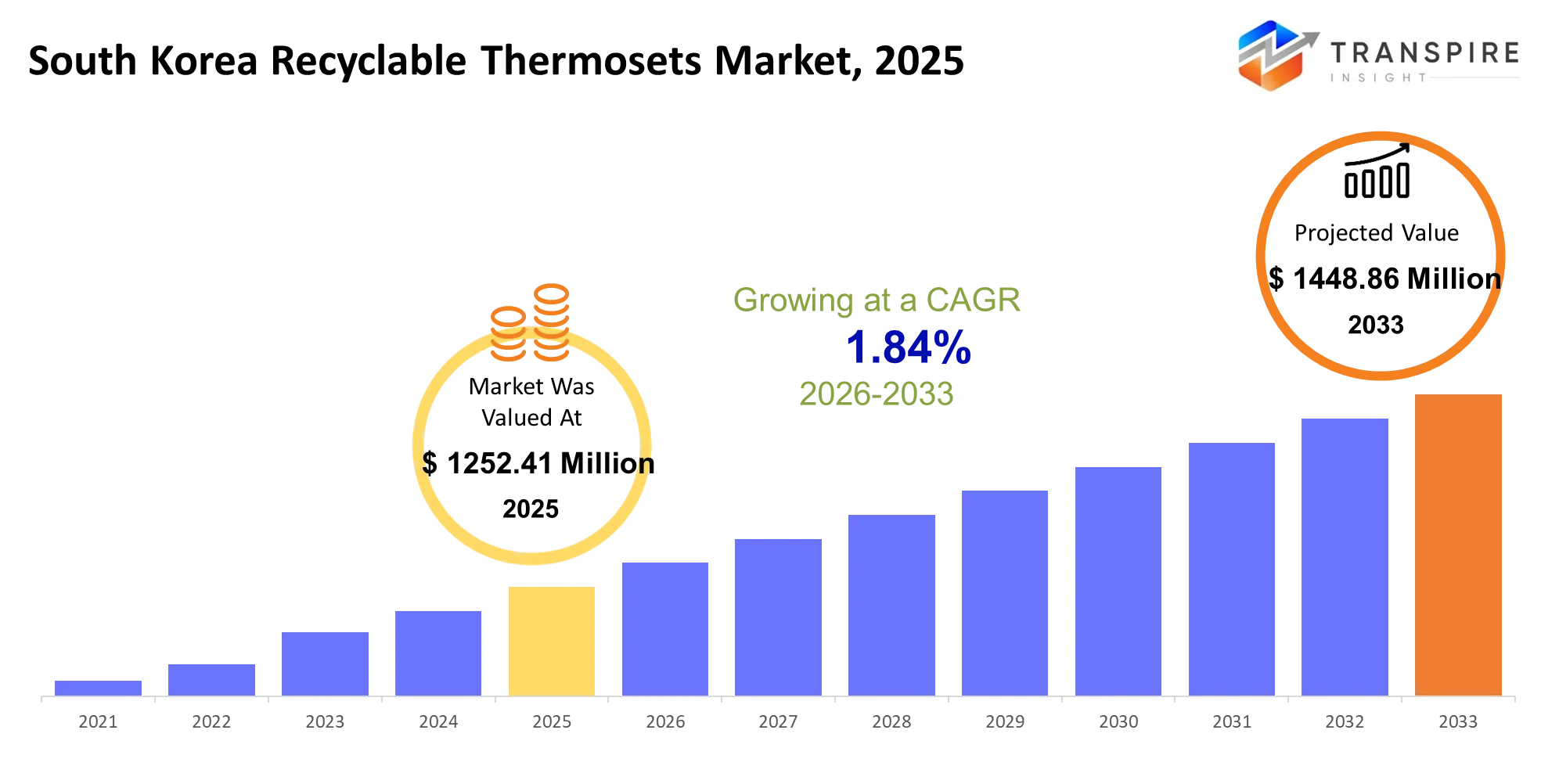
- Market Value (2025): USD 1252.41 Million.
- Expected Market Value (2026): USD 1274.95 Million.
- Estimated Market Value (2033): USD 1448.86 Million.
- Forecast CAGR (2026–2033): 1.84%
Introduction
The South Korea recyclable thermosets market is a major leap in the sustainable polymer science, as the traditional thermoset materials are known to harden permanently and cannot be reprocessed post curing. Recyclable thermosets have reversible cross-linking mechanisms and dynamic covalent bonds that allow the cured polymer networks to disassemble and re-assemble upon specific chemical or thermal stimuli. The innovation allows for the reprocessing, repair or recycling of materials including epoxy, polyurethane and phenolic resins without significant loss of performance. South Korea’s robust research infrastructure, advanced chemical manufacturing base and strict environmental regulations continue to drive development of these next-generation materials, making recyclable thermosets a key part of the country’s circular economy and sustainable materials strategy.
Key Market Highlights: -
- By Recycling Technology, the Mechanical recycling dominated the market and holds approximately 68.8% share in 2025 and is projected to grow at a substantial CAGR during the forecast period.
- By Resin, the Polyurethane dominated the market and holds approximately 30% share in 2025 and is projected to grow at a substantial CAGR during the forecast per
- By Application, the Aerospace & Defense Manufacturers segment dominated the market and holds approximately 34.29% share in 2025 and is projected to grow at a substantial CAGR during the forecast period.
- South Korea’s regulatory sandbox policy that began in January 2026 has paved the way for rapid development of commercial facilities for pyrolysis and chemical recycling, helping South Korea to increase its capacity for the same.
How is Technology Driving Growth in the South Korea Recyclable Thermosets Market?
South Korea’s market for recyclable thermosets is expanding, with technology that can be used to chemically break down, recover fibers and convert to hydrogen difficult-to-recycle plastic waste. Advanced depolymerization and dynamic covalent chemistries can be used to break down cross-linked thermoset polymers, while preserving the mechanical strength of the material. The Korea Institute of Energy Research developed continuous oxy-fuel combustion gasification of thermoset waste to clean syngas for hydrogen production. Homegrown companies including Hyosung, Toray Korea and Kolon are ramping up advanced composite production, aided by stringent Extended Producer Responsibility regulations, which encourage sustainable recovery of materials nationwide.
Market Drivers
Several converging forces are driving the recyclable thermosets market in South Korea. Strict environmental regulations and widespread recycling laws are forcing industries to switch from conventional, non-recyclable polymers to sustainable alternatives. Government policy and corporate ESG commitments are accelerating circular economy adoption, propelling closed-loop manufacturing across key industrial supply chains. South Korea’s electronics, automotive and EV battery industries are all interested in lightweight, high-performance materials and have aggressive carbon footprint reduction targets. Meanwhile, continued investment in domestic R&D and breakthroughs in chemical recycling and dynamic covalent bond chemistry mean that thermoset polymers can be reprocessed repeatedly without sacrificing mechanical strength or long-term durability.
Restrain
South Korea Market for Recyclable Thermosets – Constraints and Opportunities Thermosets are inherently difficult to remelt or re-shape as they are cured irreversible by chemical cross linking. These polymer networks can only be degraded using expensive chemical recycling techniques and high energy treatments, which increases the cost of production. Also the lack of infrastructure for large scale, standardized recovery, sorting and processing of thermoset products limits the market. Recycled thermoset products also often struggle to compete on an economic basis with newly produced virgin materials which are cheaper.
|
Driver |
Relative Impact on Growth (%) |
Geographic Relevance |
Impact Timeline |
Demand Strength |
Growth Mechanism |
Key Beneficiaries |
Major Constraint |
|
Driver 1: Expansion of Circular-Economy Policies and Recycling Requirements |
25% |
Seoul Capital Area; major industrial regions |
Short-term |
High |
Regulations accelerate adoption of recyclable thermoset materials. |
Resin producers, recyclers, automotive manufacturers |
Limited thermoset-specific recycling mandates |
|
Driver 2: Rising Demand for Sustainable Automotive Composites |
22% |
Ulsan; Gyeonggi; Chungcheong |
Medium-term |
High |
Lightweight recyclable composites support automotive sustainability targets. |
Automakers, composite suppliers, resin manufacturers |
High qualification and material-performance requirements |
|
Driver 3: Advances in Chemical Recycling and Reprocessable Vitrimers |
21% |
Seoul; Daejeon; major research clusters |
Medium-term |
High |
Advanced chemistry enables thermoset recovery and repeated reprocessing. |
Technology developers, chemical companies, recyclers |
Commercial-scale processing remains technically challenging |
|
Driver 4: Electronics and Semiconductor Industry Sustainability Demand |
18% |
Gyeonggi; Seoul; Chungcheong |
Short-term |
High |
Sustainable high-performance resins support electronics manufacturing circularity. |
Electronics firms, epoxy producers, recycling technology providers |
Strict purity and thermal-performance specifications |
|
Driver 5: Corporate Investment in Low-Carbon Materials and Manufacturing |
14% |
Nationwide; industrial manufacturing hubs |
Long-term |
Medium |
Green-material investment expands recyclable thermoset production capacity. |
Material producers, technology vendors, industrial users |
High capital costs and limited feedstock availability |
Analysis of Prices and Consumer Behaviour
In the high-performing recyclable thermoset resin market, the advanced recyclable resin systems dominate (68% of the total market; owing to the demand from automotive, electronics, composite, construction, and sustainable manufacturing sectors). The price of high-quality standard recyclable thermoset resins with better recyclability and higher thermal stability will be approximately 35% higher than that of the existing thermosets since such products will be manufactured with advanced resin technology and material processing and recovery technologies. About 45% of all unit sales of recyclable thermosets are in solid and semi-solid form resins owing to wide application range in composite manufacture, coatings, adhesives, electrical parts, and structures, as well as convenience for transportation and storage. The automotive, electronics, and composites sector consumes about 70% of the total recyclable thermosets since the demands of the industry are associated with lightweight design and circular economy along with increasing demand for sustainable high-performance materials. The consumption habits of industrial consumers indicate that 55% of buyers value the most the recyclability, performance, purity, and consistency of resins properties mainly in automotive, electronics, and composites applications. An additional 33% of consumers prefer to buy their products via bulk arrangements or long-term agreements since they wish to minimize their procurement costs and secure themselves a reliable supply chain of recyclable thermosets for their customers in South Korea as well as in international markets.
|
Company |
Est. Revenue Share Range |
Key Offerings |
Strategic Positioning |
Geographic Strength |
Technology Focus |
|
Kumho P&B Chemicals |
7–10% (Estimated) |
Epoxy resins; BPA; phenol; specialty chemical intermediates |
Technology-led Korean epoxy and recyclable-resin specialist |
Asia Pacific; South Korea; China |
Recyclable epoxy; resin chemistry; chemical decomposition |
|
LG Chem |
6–9% (Estimated) |
Sustainable resins; recycled materials; circular feedstocks; specialty polymers |
Integrated circular-materials and sustainability-driven supplier |
Asia Pacific; South Korea; China |
Chemical recycling; circular feedstocks; bio-circular materials |
|
KCC |
5–8% (Estimated) |
Epoxy resins; coatings; adhesives; composite materials |
Integrated Korean materials and coatings supplier |
South Korea; Asia Pacific; North America |
Epoxy formulation; coatings; composite resin systems |
|
LOTTE Chemical |
4–7% (Estimated) |
Synthetic resins; engineering materials; specialty polymers; circular materials |
Diversified materials supplier targeting resource circularity |
South Korea; Asia Pacific; Europe |
Advanced resins; resource circularity; lightweight materials |
|
KOLON Industries |
3–6% (Estimated) |
Composite materials; specialty polymers; industrial materials; resin systems |
Advanced-materials specialist serving mobility applications |
South Korea; Asia Pacific; North America |
Composite reinforcement; recyclable materials; lightweighting |
|
Huntsman Corporation |
3–5% (Estimated) |
ARALDITE® epoxy; recyclable thermoset systems; composite resins; curing systems |
Premium global epoxy and composite technology provider |
North America; Europe; Asia Pacific |
Recyclable epoxy; RTM; HP-RTM; mass-balance resins |
|
BASF SE |
2–4% (Estimated) |
Polyurethane systems; composite materials; coatings; specialty polymers |
Global integrated polymer supplier with local manufacturing |
Europe; Asia Pacific; South Korea |
PU composites; chemical recycling; sustainable polymer systems |
|
Covestro AG |
2–4% (Estimated) |
Polyurethane systems; thermoset composites; circular PU materials |
Circular-polyurethane technology and materials challenger |
Europe; Asia Pacific; South Korea |
Chemical PU recycling; PU composites; circular feedstocks |
|
Evonik Industries |
1–3% (Estimated) |
Amicure®; Ancamine®; Ancamide®; Vestalite® curing systems |
Specialty curing-agent and composite-performance specialist |
Europe; Asia Pacific; North America |
Epoxy curing; composite processing; sustainable crosslinkers |
|
Swancor Holding |
1–3% (Estimated) |
EzCiclo® recyclable epoxy; CleaVER® recycling solution; recyclable composites |
Niche recyclable-thermoset technology innovator |
Asia Pacific; China; Taiwan |
Recyclable epoxy; resin degradation; fiber recovery |
Who are the Key Players in the South Korea Recyclable Thermosets Market and how do they compete?
Competitiveness in the South Korea Recyclable Thermosets Market involves companies that specialize in technology innovations, development of material solutions for specific industries and the creation of distribution networks worldwide. Not only competing on price but on innovative recyclable resin technologies, highly efficient thermoset materials, recycling solutions and integration into circular economy manufacturing processes, in such competitive environment continuous product development takes place as well as enables companies to improve their material efficiency, resource management, sustainability and performance.
By developing innovative recyclable thermoset materials, sustainable polymers, chemical recycling technologies, and high performance resin systems, BASF creates its competitive advantage in the market. By developing high performance thermoset materials designed for the use in automotive, electronics, construction, composite, coating and adhesive as well as other industrial applications, Covestro creates its competitive advantage against its competitors. The competitive advantage of Huntsman is based on providing integrated solutions in epoxy resins, recyclable thermoset systems, composite materials, curing technologies, and sustainable materials applications.
Top Companies in the South Korea Recyclable Thermosets Market
- BASF
- Covestro
- Huntsman
- Dow
- Solvay
- Evonik
- Henkel
- Mitsubishi Chemical
- Toray Industries
- Teijin
- Sumitomo Bakelite
- LG Chem
- SKC
- Lotte Chemical
- Kolon Industries
South Korea Recyclable Thermosets Market Segmentation
The South Korea Recyclable Thermosets Market share is divided into five categories: By Resin, By Recycling Technology, By Application, By Product Form, By End User,
The Polyurethane dominated the market, accounting for nearly 30% in 2025 and is expected to rise at a significant CAGR during the forecast period.
The South Korea Recyclable Thermosets Market is segmented by resin into epoxy, polyurethane, phenolic, unsaturated polyester, vinyl ester, amino resin, silicone. Among these, the Polyurethane segment dominated the market, accounting for nearly 30% in 2025 and expected to increase at a significant CAGR during the forecast period. The Polyurethane segment was the dominant segment of the South Korea Recyclable Thermosets Market with almost 30% share in 2025 due to strong demand from automotive, construction, electronics, and sustainability sectors.
The Mechanical recycling dominated the market, accounting for nearly 68.8% in 2025, and is expected to rise at a significant CAGR during the forecast period.
The South Korea Recyclable Thermosets Market is segmented by recycling technology into chemical recycling, mechanical recycling, thermal recycling, solvolysis, pyrolysis, depolymerization, reprocessing. Among these, the Mechanical recycling dominated the market, accounting for nearly 68.8% in 2025 and expected to increase at a significant CAGR during the forecast period. Mechanical recycling was the dominant form of recycling in the South Korea Recyclable Thermosets Market with almost 68.8% share in 2025 due to cost-effectiveness, scalability, material recovery, and industrial sustainability.
The Aerospace & Defense dominated the market, accounting for nearly 34.29% in 2025 and is expected to rise at a significant CAGR during the forecast period.
The South Korea Recyclable Thermosets Market is segmentedby application into automotive, aerospace, electronics, construction, wind energy, sports equipment, consumer goods. Among these, the Aerospace & Defense dominated the market, accounting for nearly 34.29% in 2025 and expected to increase at a significant CAGR during the forecast period. The Aerospace & Defense segment was the dominant segment of the South Korea Recyclable Thermosets Market with almost 34.29% share in 2025 due to lightweighting, durability, high-performance composites, and sustainability needs.
Future Market Trends for the South Korea Recyclable Thermosets Market:-
Dynamic Covalent Chemistry Adoption: The industry is moving towards covalent adaptive chemistries that enable the recyclability of crosslinked thermosets in a manner similar to thermoplastics without compromising their mechanical properties.
Increased Regulatory Pressure: Due to the Extended Producer Responsibility initiatives of South Korea along with the strict recycling goals, manufacturers of electronics, automobiles, and aerospace sectors are being forced to remove the waste that cannot be recycled.
Chemical Recycling & Depolymerization Focus: Local chemical giants are investing heavily in depolymerization plants due to decreased dependence on thermal incineration.
Recent Development
In September 22, 2026 New Ultra-High-Heat-Resistant Vitrimer: Kyungpook National University developed a recyclable bismaleimide vitrimer that retains rigidity even at temperatures of 300°C, but still is completely recyclable.
In June 2026 Continuous Process of Thermoset to Hydrogen: Korea Institute of Energy Research scaled their oxy-fuel gasification system for a continuous process of conversion of hard-to-recycle thermoset materials into syngas from which hydrogen can be produced.
In January 1, 2026 Mandatory Usage Rate of Recycled Plastic: The Ministry of Climate, Energy, and Environment of South Korea introduced a 10% mandatory usage rate of recycled plastic for beverage producers, followed by cosmetics and appliances.
Market Segmentation
This study forecasts revenue at Japan, regional and country levels from 2020 to 2033. Transpire Insights has segmented the South Korea Recyclable Thermosets Market based on the below-mentioned segments:
South Korea Recyclable Thermosets Market, By Resin
- Epoxy
- Polyurethane
- Phenolic
- Unsaturated Polyester
- Vinyl Ester
- Amino Resin
- Silicone
South Korea Recyclable Thermosets Market, By Recycling Technology
- Chemical Recycling
- Mechanical Recycling
- Thermal Recycling
- Solvolysis
- Pyrolysis
- Depolymerization
- Reprocessing
South Korea Recyclable Thermosets Market, By Application
- Automotive
- Aerospace
- Electronics
- Construction
- Wind Energy
- Sports Equipment
- Consumer Goods
South Korea Recyclable Thermosets Market, By Product Form
- Composites
- Adhesives
- Coatings
- Laminates
- Molded Components
- Foams
- Encapsulants
South Korea Recyclable Thermosets Market, By End User
- Automotive
- Aerospace & Defense
- Electrical & Electronics
- Construction
- Renewable Energy
- Marine
- Consumer Products
Frequently Asked Questions
Find quick answers to common questions.
Strict environmental regulations, circular-economy initiatives, automotive lightweighting, electronics demand, and advances in recyclable resin technologies are accelerating market growth
Polyurethane dominates with approximately 30% share in 2025, supported by automotive, construction, electronics, and sustainable material applications across South Korea.
Mechanical recycling leads with approximately 68.8% share in 2025, driven by cost efficiency, scalability, material recovery, and sustainability requirements.
Aerospace and Defense leads with approximately 34.29% share in 2025, driven by lightweight composites, durability, high-performance requirements, and sustainability objectives.
Dynamic covalent chemistry, depolymerization, chemical recycling, vitrimer technology, advanced composites, and thermoset-to-hydrogen conversion are transforming sustainable material recovery.
- BASF
- Covestro
- Huntsman
- Dow
- Solvay
- Evonik
- Henkel
- Mitsubishi Chemical
- Toray Industries
- Teijin
- Sumitomo Bakelite
- LG Chem
- SKC
- Lotte Chemical
- Kolon Industries
About the Authors

Pankaj Ghogare Patil
I am Pankaj Ghogare Patil, a Senior Research Analyst at Transpire Insight, specializing in the Pharmaceutical, Chemicals & Materials, Healthcare IT, and Biotechnology industry. My expertise lies in conducting comprehensive market research, analyzing industry trends, evaluating competitive landscapes, and translating complex data into actionable insights. At Transpire Insight, I closely follow emerging technologies, regulatory developments, and market innovations to create accurate, well-researched, and informative content that helps businesses and professionals make informed decisions. I am committed to producing credible, evidence-based articles that reflect industry best practices while making technical topics accessible and valuable for a broad audience.

Chakradhar Khansole
Chakradhar serves as the Research Director at Transpire Insight, bringing over 8 years of experience in technology, innovation, and strategic market intelligence. He specializes in transforming complex market data into actionable business insights that enable organizations to make informed, growth-oriented decisions. Recognized for his strategic vision and analytical expertise, Chakradhar leads high-impact research initiatives, delivering comprehensive market assessments, competitive intelligence, and forward-looking industry analysis.
Recently Published Reports
-
May 2026
Healthcare Polymer Packaging Market
Healthcare Polymer Packaging Market Size, Share & Analysis Report By Packaging Type (Syringes, IV Bottles and Pouches, Clamshells, Blisters, Bottles & Jars, Containers, Tubes, IV Parental Packaging, Others), By Type (Regulated, Non-regulated), By Polymer Type (LDPE (Low-Density Polyethylene), HDPE (High-Density Polyethylene), Homo-polymer (Homo), Random Copolymer (Random), Block Copolymer (Block), PET, Polystyrene, Polyvinyl Chloride, Polyamide/EVOH, Others), and Geography (North America, Europe, Asia-Pacific, Middle East and Africa, South and Central America), 2021 - 2031
-
Apr 2026
Hydrophilic Tape (Waterstop) Market
Hydrophilic Tape (Waterstop) Market Size, Share & Analysis Report By Type (Bentonite-Based Hydrophilic Tape, Rubber-Based Hydrophilic Tape), By Application (Residential Buildings, Commercial Buildings, Infrastructure Projects), and Geography (North America, Europe, Asia-Pacific, Middle East and Africa, South and Central America), 2021 - 2031
-
Apr 2026
Metalens Market
Metalens Market Size, Share & Analysis Report By Type (Visible Light Metalens, and Infrared Metalens), By Application (Consumer Electronics, Automotive Electronics, Industrial, Medical, and Others), and Geography (North America, Europe, Asia-Pacific, Middle East and Africa, South and Central America), 2021 - 2031
-
Apr 2026
PBT Resin Market
PBT Resin Market Size, Share & Analysis Report By Type (Reinforced PBT Resin, Unreinforced PBT Resin), By Processing Method (Injection Molding, Extrusion, Blow Molding, Others), By End-User (Automotive, Electrical & Electronics, Consumer Appliances, Industrial Machinery, Medical Devices, Packaging, Others), and Geography (North America, Europe, Asia-Pacific, Middle East and Africa, South and Central America), 2021 - 2031