South Korea Fourth-Party Logistics Market Summary:
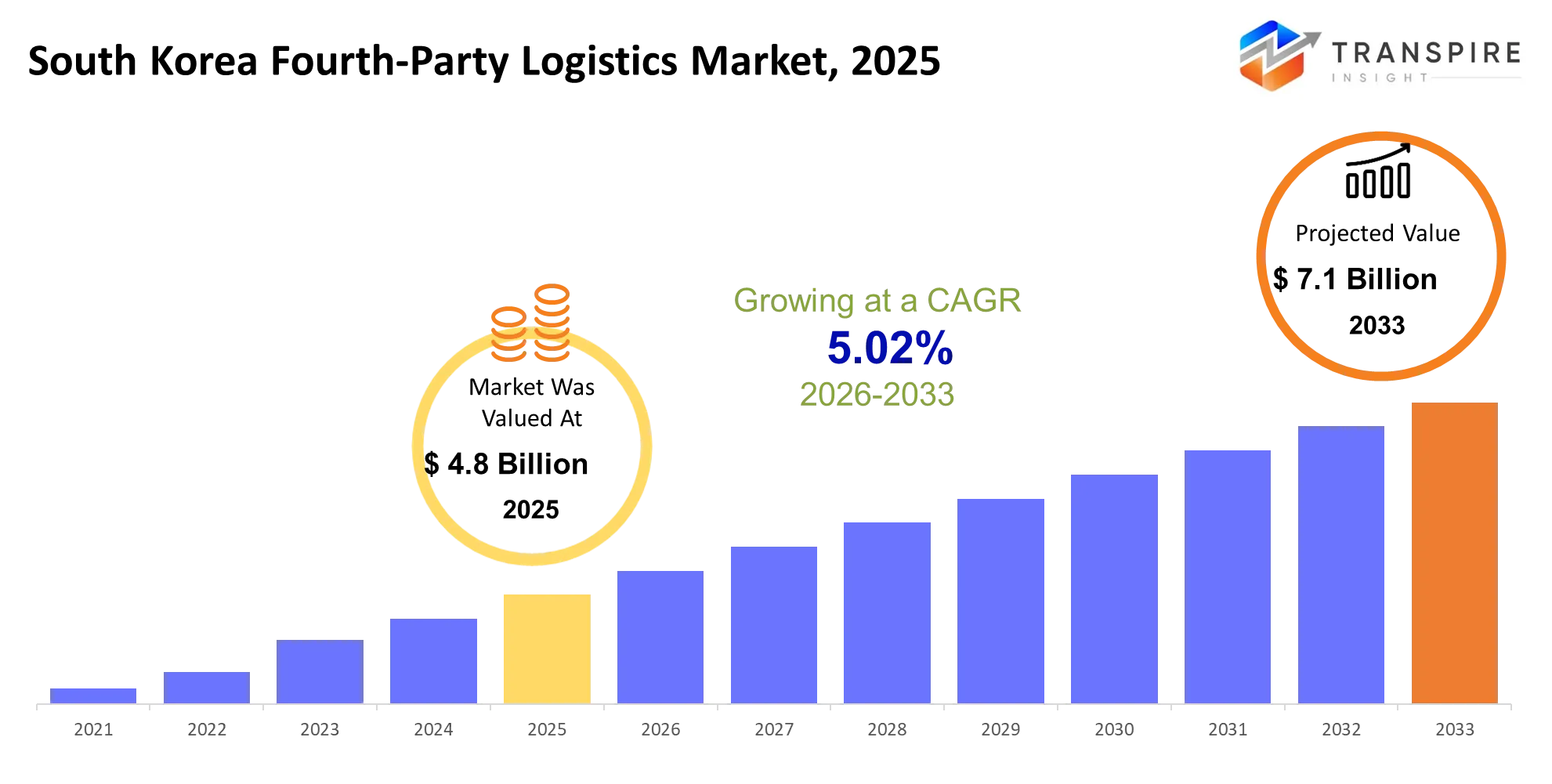
According to Transpire Insight, a detailed research report on the market reflects that the full supply chain management application segment dominates the South Korea Fourth-Party Logistics Market, accounting for approximately 67% of the total market share in South Korea. Samsung SDS leads the market with approximately USD 12.7 billion in annual revenue and an estimated 17–21% South Korea market share, making it the leading contributor to market development, innovation, advanced fourth-party logistics solutions, expanding digital supply-chain capabilities, integrated logistics management, and market growth dynamics.
Market Snapshot
- Market Value (2025): USD 4.8 Billion.
- Expected Market Value (2026): USD 5.04 Billion.
- Estimated Market Value (2033): USD 7.1 Billion.
- Forecast CAGR (2026–2033): 5.02%
Introduction
The South Korean 4PL market constitutes an important stage in the development of logistics operations, allowing organizations to delegate total logistics network control to a single central third party. In contrast to conventional third-party logistics companies, which focus on the operation of physical storage facilities and shipping assets, 4PLs are asset-light control towers that coordinate multiple carriers and logistics partners via technology integration. The fast-developing e-commerce industry, the growing need for cold chain logistics, and extensive use of artificial intelligence, the Internet of Things, and big data analytics in the country keep driving demand for efficient logistics orchestration solutions.
Key Market Highlights: -
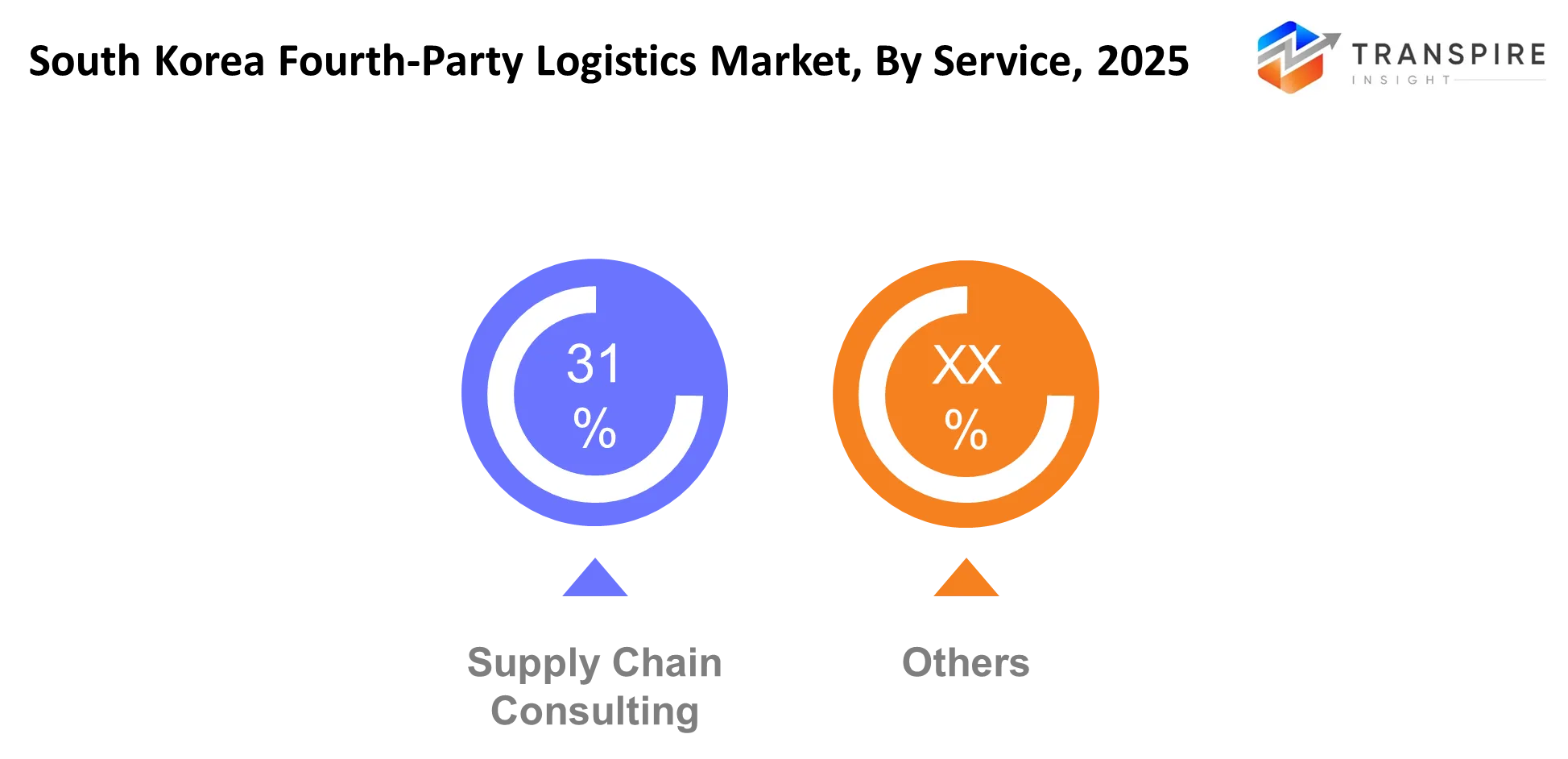
- By Service, the Transportation Management dominated the market and holds approximately 42.3% share in 2025 and is projected to grow at a substantial CAGR during the forecast period.
- By Transportation, the Road transport dominated the market and holds approximately 63.85% share in 2025 and is projected to grow at a substantial CAGR during the forecast period.
- By Technology, the Internet of Things (IoT) Manufacturers segment dominated the market and holds approximately 33.6% share in 2025 and is projected to grow at a substantial CAGR during the forecast period.
- The South Korean government is investing 4.5 trillion won to expand overseas logistics facilities from nine to forty by 2030, boosting 4PL service providers’ global operational springboard.
How is Technology Driving Growth in the South Korea Fourth-Party Logistics Market?
Technology is transforming South Korea’s 4PL market, transforming fragmented supply chains into smart, data-driven ecosystems. Predictive analytics powered by AI reduce stockouts and improve inventory planning and demand forecasting, making decision-making more efficient. High-speed 5G networks and IoT sensors can facilitate real-time tracking of cargo, which can greatly enhance supply chain visibility and crisis response. Blockchain technology ensures secure, tamper-proof traceability across high-value sectors like electronics and semiconductors, while unified cloud platforms coordinate stakeholders from manufacturers to last-mile delivery providers, driving automation, robotics adoption, and overall operational efficiency.
Market Drivers
The South Korean fourth-party logistics sector thrives because of supply chain integration, rapid rise of e-commerce platforms, and digitalization using technology. Corporations now need control towers that can integrate the activities of various third-party logistics firms. The swift growth of online shopping platforms like Naver and Coupang necessitates effective logistics management that can be scaled and covers the entire process from start to finish. Integration of AI, IoT, big data analytics, and cloud management systems makes this possible and facilitates real-time tracking. Smart logistics policies promoted by the government help drive the industry forward, whereas electronics and semiconductor manufacturers depend on 4PL firms for just-in-time deliveries.
Restrain
Key Limiting FactorsHigh Technology and Investment Cost: The 4PL model demands expensive high-end technologies such as Artificial Intelligence (AI), Internet of Things (IoT), and blockchain systems. This high capex makes it difficult and costly to adopt, especially for smaller providers.Integration and operational complexity: The integration of different operating models with multiple service types and software creates structural challenges.Loss of Direct Control: Most businesses are hesitant to adopt 4PL as it results in loss of full strategic control and visibility of their end-to-end supply chain to an external orchestrator.Geopolitical and Trade Pressures: Shifting global trade policies, external tariff pressures (e.g. U.S. policies on auto and tech exports), and increasing regional shipping costs create risk and financial friction for South Korean manufacturers, increasing the complexity of long-term 4PL integration.
|
Driver |
Relative Impact on Growth (%) |
Geographic Relevance |
Impact Timeline |
Demand Strength |
Growth Mechanism |
Key Beneficiaries |
Major Constraint |
|
Driver 1: AI-Driven Supply Chain Optimization and Logistics Automation |
27% |
Seoul Capital Area, Busan, Incheon |
Short-term |
High |
AI improves forecasting, routing, inventory, and fulfillment efficiency. |
4PL providers, AI vendors, logistics operators, manufacturers |
High implementation costs and limited AI-skilled workforce |
|
Driver 2: Smart Port and Multimodal Logistics Infrastructure Expansion |
63.85% |
Busan, Incheon, Gwangyang |
Medium-term |
High |
Smart ports enable integrated multimodal coordination and visibility. |
4PL providers, port operators, shipping firms, exporters |
Complex integration across fragmented logistics stakeholders |
|
Driver 3: E-Commerce and Omnichannel Fulfillment Expansion |
20% |
Seoul, Gyeonggi, Incheon, major metropolitan areas |
Short-term |
High |
Rising online orders increase demand for coordinated fulfillment. |
4PL providers, retailers, e-commerce firms, fulfillment operators |
Delivery cost pressures and increasingly complex fulfillment networks |
|
Driver 4: Government-Supported Digital Transformation of Logistics |
17% |
Nationwide, with major logistics hubs |
Medium-term |
High |
Government incentives accelerate AI, robotics, and digital adoption. |
SMEs, 4PL providers, technology vendors, warehouse operators |
Uneven technology adoption among smaller logistics companies |
|
Driver 5: Sustainability and Carbon-Efficient Supply Chain Management |
13% |
Nationwide, especially major industrial corridors |
Long-term |
Medium |
Carbon targets encourage optimized routing and greener logistics. |
4PL providers, manufacturers, fleet operators, exporters |
Higher costs for low-carbon infrastructure and technologies |
Analysis of Prices and Consumer Behaviour
In South Korea, the market for fourth-party logistics (4PL) service solutions is characterized mainly by the provision of integrated supply chain management (68% share of the market; primarily because of the high demand from manufacturing, automotive, electronics, e-commerce and retail sectors). The cost of innovative and technology-based 4PL service solutions is expected to be about 35% more expensive than conventional logistics coordination services since these solutions are based on artificial intelligence-enabled optimizations, real-time visibility platforms, integrated control tower, automation technologies and supply chain management technologies. Roughly 45% of all 4PL service deals in South Korea can be linked to digital and cloud-based logistics solutions. The buying volume is driven by flexibility of these platforms within transportation management, warehouse coordination, inventory optimization and comprehensive supply chain visibility. The manufacturing, e-commerce and retail sectors account for about 70% of the demand for these 4PL service solutions. Buying behavior of customers demonstrates that 55% of all companies put most emphasis on real-time supply chain visibility, reliability of services and logistics optimization based on technology. Moreover, another 33% of consumers opt for buying their services in bulk purchases or contracts as they desire to cut down on their logistics procurement expenses and ensure that they get an integrated supply chain service both nationally and internationally.
|
Company |
Est. Revenue Share Range |
Key Offerings |
Strategic Positioning |
Geographic Strength |
Technology Focus |
|
Samsung SDS |
18–22% |
Cello Square; Global Control Tower; contract logistics; freight forwarding |
Technology-led integrated logistics ecosystem |
Asia Pacific; North America; Europe |
AI analytics; cloud; control towers; real-time visibility |
|
CJ Logistics |
14–18% |
Global SCM; fulfillment; integrated transportation; contract logistics |
Domestic scale with automation-led differentiation |
Asia Pacific; North America; Europe |
AI routing; robotics; big-data logistics; smart warehouses |
|
LX Pantos |
11–15% |
Contract logistics; multimodal transport; e-commerce logistics; control-tower services |
Global network and integrated service differentiation |
Asia Pacific; Europe; North America |
Real-time visibility; logistics IT; tracking; automation |
|
Hyundai Glovis |
8–12% |
SCM; contract logistics; automotive logistics; global transportation |
Automotive-centered supply-chain integration strategy |
Asia Pacific; North America; Europe |
Physical AI; robotics; visibility platforms; automation |
|
DHL Supply Chain |
7–10% |
4PL/LLP; supply-chain orchestration; warehousing; procurement management |
Global 4PL leadership and orchestration expertise |
Europe; Asia Pacific; North America |
AI; IoT; robotics; predictive analytics; WMS/TMS |
|
Lotte Global Logistics |
6–9% |
SCM; fulfillment; warehousing; international logistics |
Broad domestic logistics and fulfillment integration |
Asia Pacific; North America; Europe |
WMS; TMS; OMS; warehouse automation |
|
Kuehne+Nagel |
4–7% |
4PL orchestration; supply-chain management; contract logistics; freight forwarding |
Global supply-chain orchestration and visibility specialist |
Europe; Asia Pacific; North America |
AI decision intelligence; visibility; digital platforms |
|
DSV |
3–6% |
Contract logistics; freight forwarding; control towers; 4PL services |
Integrated global logistics and control-tower expansion |
Europe; Asia Pacific; North America |
Digital visibility; analytics; control-tower platforms |
|
Maersk |
3–5% |
Supply-chain management; integrated logistics; multimodal transportation |
End-to-end integrated logistics platform strategy |
Asia Pacific; Europe; North America |
Supply-chain platform; predictive ETA; IoT; analytics |
|
UPS Supply Chain Solutions |
2–4% |
Supply-chain management; international logistics; distribution; technology-enabled delivery |
Time-critical logistics and technology-enabled integration |
North America; Asia Pacific; Europe |
Automation; shipment visibility; cloud platforms; analytics |
Who are the Key Players in the South Korea Fourth-Party Logistics Market and how do they compete?
The competitiveness of companies in the international market of South Korea Fourth-Party Logistics Market depends on their specialization in innovative technology, industry-oriented solutions, and the creation of distribution networks across the globe. Competing not only in terms of prices but on the basis of integrated supply chain solutions, advanced technologies, intelligent logistics services, and integration with digital platforms and systems, in such a way the firm creates conditions for constant improvement of its services and increased productivity and efficiency of business.
By implementing intelligent supply chain management, digital control towers, AI-based logistics solutions, and intelligent logistics platform, DHL Supply Chain improves its competitive position. By developing efficient logistics solutions that serve as a support for freight management, warehousing, distribution, supply chain optimization, and other logistics needs, Kuehne+Nagel differs from other companies. DB Schenker improves its competitive position by creating integrated solutions in contract logistics, transportation management, supply chain optimization, automation, and digital logistics, thus increasing efficiency of operations of enterprises.
Top Companies in the South Korea Fourth-Party Logistics Market
- DHL Supply Chain
- Kuehne+Nagel
- DB Schenker
- DSV
- CEVA Logistics
- Nippon Express
- CJ Logistics
- LX Pantos
- Hyundai Glovis
- Samsung SDS
- UPS Supply Chain Solutions
- FedEx Logistics
- GEODIS
- Maersk Logistics
- Yusen Logistics
South Korea Fourth-Party Logistics Market Segmentation
The South Korea Fourth-Party Logistics Market share is divided into five categories: By Service, By Transportation, By Technology, By End User, By Enterprise Size
The Transportation Management dominated the market, accounting for nearly 42.3% in 2025 and is expected to rise at a significant CAGR during the forecast period.
The South Korea Fourth-Party Logistics Market is segmented by service into supply chain consulting, transportation management, warehouse management, it & technology services, procurement management, network optimization, risk management. Among these, the Transportation Management segment dominated the market, accounting for nearly 42.3% in 2025 and expected to increase at a significant CAGR during the forecast period. Transportation Management led the South Korea Fourth-Party Logistics Market, holding nearly 42.3% market share in 2025, on account of growing demand for consolidated logistics, real-time monitoring, routing solutions, and supply chain management services.
The Road transport dominated the market, accounting for nearly 63.85% in 2025, and is expected to rise at a significant CAGR during the forecast period.
The South Korea Fourth-Party Logistics Market is segmented by transportation into road, rail, air, sea, multimodal, parcel & express, inland waterway. Among these, the Road transport dominated the market, accounting for nearly 63.85% in 2025 and expected to increase at a significant CAGR during the forecast period. Road Transport led the South Korea Fourth-Party Logistics Market, holding nearly 63.85% market share in 2025, owing to good domestic connectivity and flexible distribution channels coupled with rising need for efficient last mile logistics services.
The Internet of Things (IoT) dominated the market, accounting for nearly 33.6% in 2025 and is expected to rise at a significant CAGR during the forecast period.
The South Korea Fourth-Party Logistics Market is segmentedby technology into ai, iot, cloud computing, big data analytics, blockchain, digital twins, automation. Among these, the Internet of Things (IoT) dominated the market, accounting for nearly 33.6% in 2025 and expected to increase at a significant CAGR during the forecast period. Internet of Things (IoT) led the South Korea Fourth-Party Logistics Market, holding nearly 33.6% market share in 2025, on account of real-time monitoring, asset connectivity, increased visibility, and supply chain optimization.
Future Market Trends for the South Korea Fourth-Party Logistics Market:-
- Digital Control Towers on the Rise: Companies are increasingly turning to centralized command centers and AI-driven analytics in order to achieve end-to-end real-time supply chain visibility, orchestration and strategic decision-making across networks.
- Built-In Sustainability Intelligence: Green logistics and carbon-tracking metrics are being integrated directly into 4PL network optimization models, allowing companies to meet more stringent environmental compliance standards.
- E-Commerce and Cross-Border Adaptation: The growth of cross-border e-commerce and the changing trade flows are pushing 4PL players to provide highly flexible, agile and scalable supply chain solutions.
Recent Development
- In April 2026: AI-powered Control Tower and Automation: The findings in 2026 from Gartner's analysis stated that automated orchestration and predictive analytics are must-haves for South Korean logistics managers, with Coupang and NFI's Vantage being the frontrunners.
- In April 17, 2026: The Quick-Commerce Breakthrough: On this day, a report was published, stating the growth of the South Korean quick-commerce sector, fueled by 4PL technology, through Baemin, GS Retail, and dark store advancements.
- In June 2026: Selective Real Estate and Prime Assets Move (June 2026): This month, a new market report was published, highlighting 4PL operators moving towards premium logistics assets after corrections made to the warehousing supply the prior year.
- In August 12, 2026: Procurement of NATO Defense Supplies : This policy report published on this day, by KIET, details Korea-NATO procurement discussions and how they have opened up channels for Korean companies in NATO procurement.
Market Segmentation
This study forecasts revenue at Japan, regional and country levels from 2020 to 2033. Transpire Insight has segmented the South Korea Fourth-Party Logistics Market based on the below-mentioned segments:
South Korea Fourth-Party Logistics Market, By Service
- Supply Chain Consulting
- Transportation Management
- Warehouse Management
- IT & Technology Services
- Procurement Management
- Network Optimization
- Risk Management
South Korea Fourth-Party Logistics Market, By Transportation
- Road
- Rail
- Air
- Sea
- Multimodal
- Parcel & Express
- Inland Waterway
South Korea Fourth-Party Logistics Market, By Technology
- AI
- IoT
- Cloud Computing
- Big Data Analytics
- Blockchain
- Digital Twins
- Automation
South Korea Fourth-Party Logistics Market, By End User
- Retail & E-Commerce
- Manufacturing
- Automotive
- Healthcare
- Food & Beverage
- Electronics
- Consumer Goods
South Korea Fourth-Party Logistics Market, By Enterprise Size:
- Large Enterprises
- Medium Enterprises
- Small Enterprises
- Multinational Corporations
- Domestic Enterprises
- E-Commerce Businesses
- Third-Party Logistics Providers
Frequently Asked Questions
Find quick answers to common questions.
Growing e-commerce, supply-chain complexity, digital transformation, AI adoption, IoT integration, and demand for real-time logistics visibility are accelerating market growth.
Transportation Management dominates with approximately 42.3% share in 2025, supported by increasing demand for integrated logistics coordination and optimization services.
Road Transport leads with approximately 63.85% share, driven by extensive domestic connectivity, flexible distribution networks, and increasing last-mile delivery requirements.
IoT dominates with approximately 33.6% share, enabling real-time tracking, connected assets, enhanced visibility, predictive monitoring, and supply-chain optimization capabilities.
Future trends include AI-powered control towers, sustainable logistics intelligence, automated orchestration, cross-border e-commerce integration, and advanced supply-chain visibility platforms.
- DHL Supply Chain
- Kuehne+Nagel
- DB Schenker
- DSV
- CEVA Logistics
- Nippon Express
- CJ Logistics
- LX Pantos
- Hyundai Glovis
- Samsung SDS
- UPS Supply Chain Solutions
- FedEx Logistics
- GEODIS
- Maersk Logistics
- Yusen Logistics
About the Authors

Mayur Shinde
I am Mayur Shinde, a Senior Research Analyst at Transpire Insight, specializing in the Automotive & Transportation and Information & Communication Technology (ICT) Industry. My work focuses on analyzing emerging market trends, technological advancements, competitive landscapes, and industry developments to deliver accurate, data-driven insights. I am passionate about transforming complex market information into clear, actionable content that helps businesses, professionals, and decision-makers stay informed and make confident strategic decisions.

Chakradhar Khansole
Chakradhar serves as the Research Director at Transpire Insight, bringing over 8 years of experience in technology, innovation, and strategic market intelligence. He specializes in transforming complex market data into actionable business insights that enable organizations to make informed, growth-oriented decisions. Recognized for his strategic vision and analytical expertise, Chakradhar leads high-impact research initiatives, delivering comprehensive market assessments, competitive intelligence, and forward-looking industry analysis.
Recently Published Reports
-
Apr 2026
ATV & UTV Market
ATV & UTV Market Size, Share & Analysis Report By Type (ATV, and UTV), By Variants (Less Than 400 CC, 400 CC To 800 CC, and More Than 800 CC), and Geography (North America, Europe, Asia-Pacific, Middle East and Africa, South and Central America), 2021 - 2031
-
Apr 2026
Automotive Central Gateway Module Market
Automotive Central Gateway Module Market Size, Share & Analysis Report By Type (Ethernet Central Gateway Module, CAN Central Gateway Module, LIN Central Gateway Module, and FlexRay), By Application (Powertrain Control, Body Control, Infotainment System, Advanced Driver Assistance Systems (ADAS), and Others), By End User (Passenger Vehicles, and Commercial Vehicles), and Geography (North America, Europe, Asia-Pacific, Middle East and Africa, South and Central America), 2021 - 2031
-
Apr 2026
Automotive Engine Oil Filter Market
Automotive Engine Oil Filter Market Size, Share & Analysis Report By Filter Type (Fuel Filter, Engine Oil Filter, Hydraulic Oil Filter, and Others), By Filter Media (Cellulose, Synthetic, and Micro), By Sales Channel (OEMs, and Aftermarket), By Vehicle Type (Passenger Cars, Light Commercial Vehicles, Heavy Duty Trucks, Buses and Coaches, and Off-road Vehicles), and Geography (North America, Europe, Asia-Pacific, Middle East and Africa, South and Central America), 2021 - 2031
-
Apr 2026
Automotive Parts Aluminium Die Casting Market
Automotive Parts Aluminium Die Casting Market Size, Share & Analysis Report By Production Process (Pressure Die Casting, Vacuum Die Casting, Squeeze Die Casting, Gravity Die Casting), By Application (Body Parts, Engine Parts, Transmission Parts, Battery And Related Components, Other Application Types), and Geography (North America, Europe, Asia-Pacific, Middle East and Africa, South and Central America), 2021 - 2031
Our Clients