
Solid-State Battery Mechanical and Safety Test Equipment Market Summary:
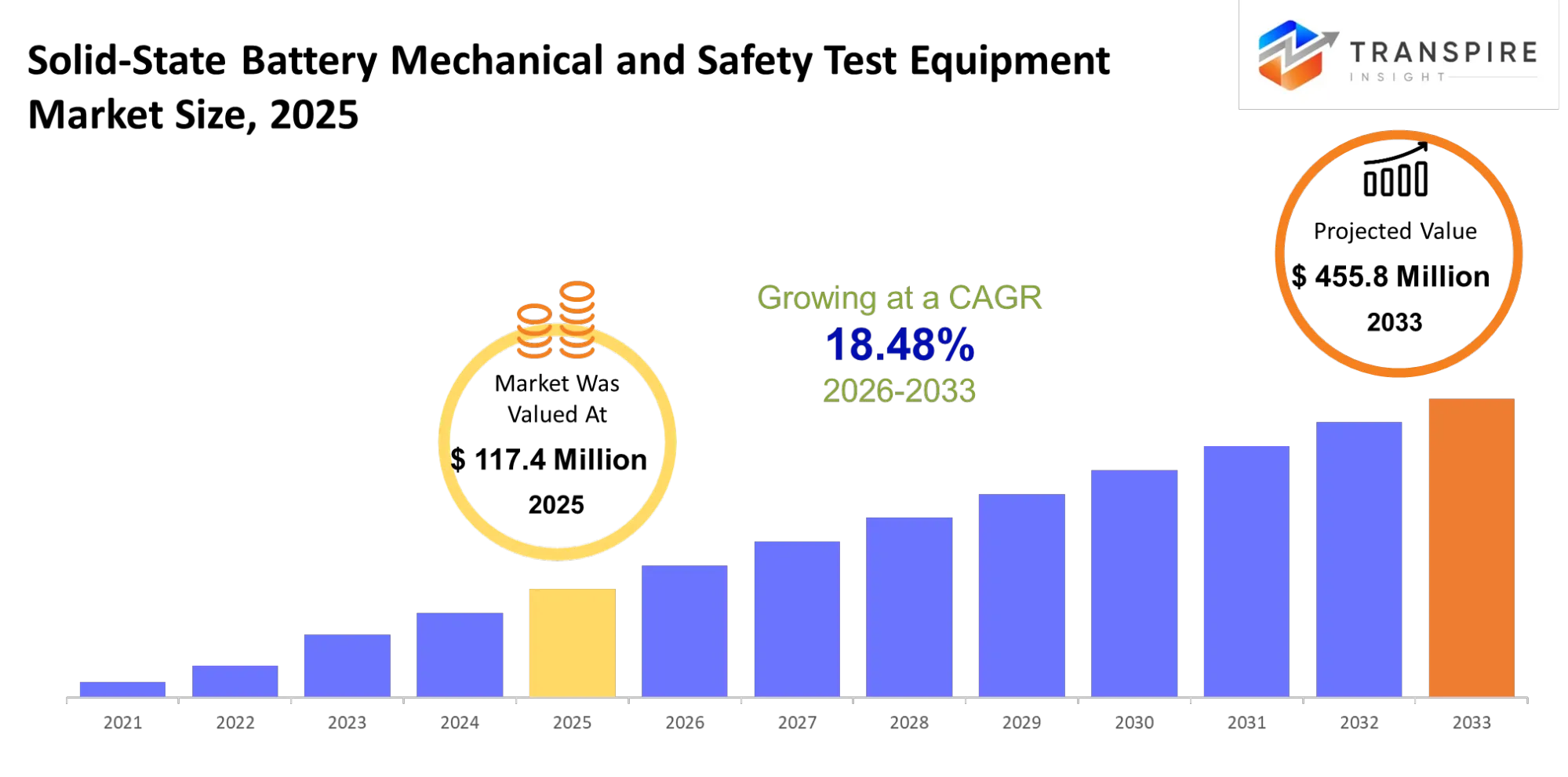
As per Transpire Insight Analysis, the Solid-State Battery Mechanical and Safety Test Equipment Market size is estimated at USD 117.4 million in 2025 and is anticipated to reach USD 455.8 million by 2033, growing at a CAGR of 18.48% from 2026 to 2033. The market is expanding because of an increase in solid-state battery manufacturing, safety regulations, and demand for test equipment.
The industry of solid-state battery safety testing equipment experiences growth due to the fact that producers of batteries want to test the quality and safety of their products before commercialization. It is necessary to test the batteries to check how they react to drops and overheating. Battery manufacturers should follow many regulations, so they apply such tests to ensure that their products comply with all requirements. It was common a year ago to conduct testing in laboratories, but now it is done using special computer equipment. It happened so because there are many manufacturers of automobiles that need batteries, so they have to test a lot of them.
Being ready to enter mass production soon, battery manufacturers of batteries invest in test equipment because it helps them to prevent breakages and speed up the process of commercialization. It means that now people search for such test equipment for the automobile and other industries.
Solid-State Battery Mechanical and Safety Test Equipment Market Size & Forecast:
- Market Size 2025: USD 117.4 Million
- Expected Market Value (2033): USD 455.8 Million
- Forecast CAGR (2026–2033): 18.48%
- Leading Region in 2025: Asia Pacific
- Fastest Growing Region: North America
- Key Company Profiles: Chroma ATE, Keysight Technologies, Maccor, Arbin Instruments, AVL List, HORIBA, Weiss Technik, ESPEC Corporation, TÜV Rheinland, Intertek, UL Solutions, Bitrode Corporation, National Instruments, Hioki, Digatron
Key Market Insights
The market is progressing due to the growth in investments in precise testing technology made by battery manufacturers, ensuring reliability, safety, and large-scale commercialisation of solid-state batteries. Moreover, there is an increased demand for smart testing solutions that provide faster validation and efficient production.
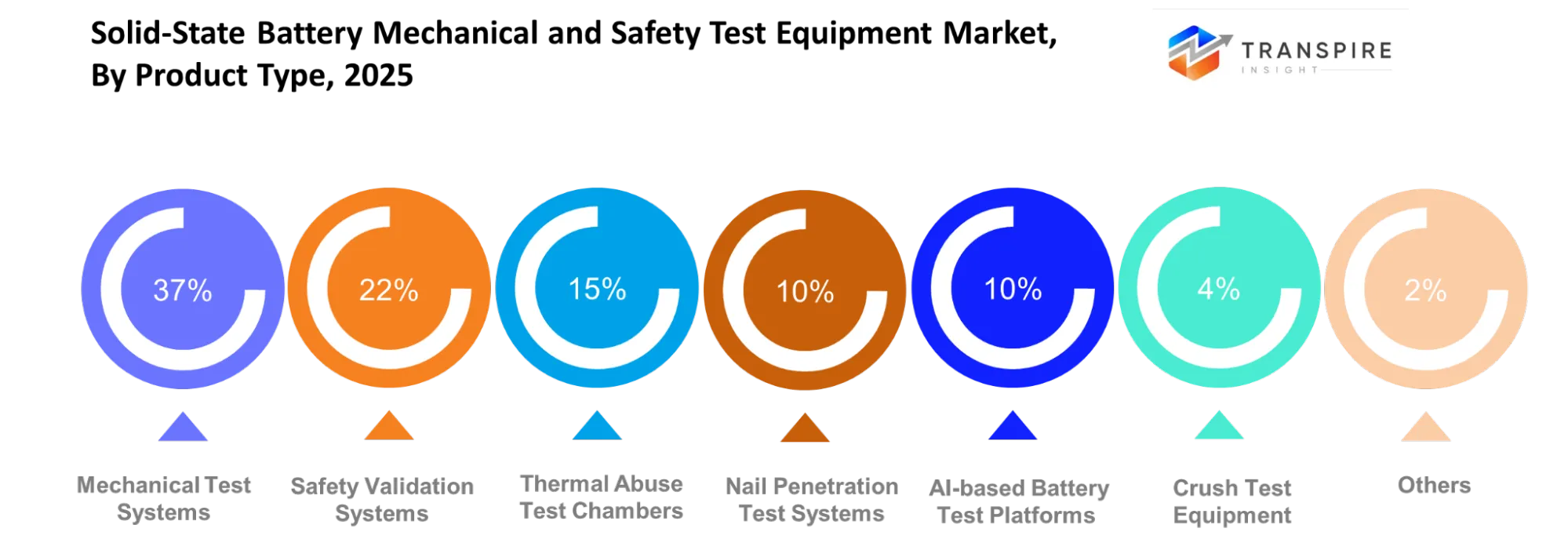
- The largest share of 37% belongs to Mechanical Test Systems and indicates its significant importance in assessing the durability of batteries to mechanical stresses.
- 22% of the market share is captured by Safety Validation Systems, which is influenced by tougher certification regulations and the necessity of safety assessments before launching.
- Thermal Abuse Test Chambers have 15% of the market and owe to the rise in attention to thermal security of high-energy battery cells.
- Nail Penetration Test Systems are responsible for 10% of the market share and are used more often for performing safety tests in extreme conditions.
- AI-based Battery Test Platforms are the most rapidly growing segment with a CAGR of 20.3%. It has 10% of the market. Crush Test Equipment comprises 4% of the market share.
- Leading test equipment vendors are offering enhanced automated and AI-driven testing solutions that facilitate shorter validation processes, as well as increased accuracy of the tests conducted within manufacturing plants.
- Manufacturing companies are incorporating digital monitoring and real-time analysis of data to help with faster decision-making and effective battery qualification.
What are the Key Drivers, Restraints, and Opportunities in the Solid-State Battery Mechanical and Safety Test Equipment Market?
Drivers
The driver of the market is the fast development of solid-state batteries, especially those used in electric vehicles, aerospace and advanced power storage. The growth of testing needs has become inevitable for the producers of such batteries as they switch from laboratory development to pilot production and commercialisation. This trend has been spurred by the tightening of safety regulations and growing investment in the development of next-generation batteries. Thus, producers increase the scope of their tests to enhance the reliability of their products and decrease development risks.
Restraints
The barrier is the substantial initial investment needed for advanced testing machines that can test solid-state batteries using various mechanical, thermal, and abusive conditions. This is because most of the battery makers are small or mid-size companies, so they have financial constraints and also due to technical difficulties of implementing these advanced machines in their manufacturing and validation processes. These problems will continue to persist even though the interest from the industry side increases.
Opportunities
The opportunity is through the advancement of testing technologies powered by artificial intelligence. With the increasing scale of battery production in Asia-Pacific, North America, and Europe, firms are adopting smart testing tools that enable predictive diagnostics, speedier analysis, and real-time quality checks. This would lead to greater testing efficiencies, facilitate mass production, and open up growth opportunities for equipment makers.
What Has the Impact of Artificial Intelligence Been on the Solid-State Battery Mechanical and Safety Test Equipment Market?
The solid-state battery mechanical and safety test equipment industry is being revolutionised by artificial intelligence through its ability to make testing processes fast, reliable, and evidence-based. The testing systems of today utilise artificial intelligence algorithms to analyse large quantities of data on the performance of batteries during mechanical stress, vibration, thermal abuse, and safety testing. Artificial intelligence will help companies detect any abnormalities in the batteries as early as possible to avoid failures during production and commercialisation of their products. It will help automate test scheduling, monitor the testing equipment, and schedule maintenance for the testing systems.
AI's prediction capability of possible defects prior to any physical damage is one of the most beneficial properties of artificial intelligence in the field. Yet, despite this promising technology, the implementation of the new testing systems based on AI technologies faces several challenges, including the high cost of implementing these systems, complicated integration with already existing facilities, and a large volume of high-quality testing data required for accurate predictions. Nevertheless, in the near future, AI is likely to become an integral part of battery testing and validation systems. In June 2025, Factorial Energy launched Gammatron, which is a digital twin platform powered by AI designed to help speed up the design, validation, and launch of solid-state batteries. By applying AI to simulate and predict the behavior of the batteries, the software can help validate the batteries without conducting physical tests repeatedly. This makes it easy to validate the next generation of solid-state batteries.
Key Market Trends:
The market is moving towards the adoption of intelligent and automated battery testing systems that replace traditional testing methodologies to improve process accuracy and efficiency, as well as compliance with new safety standards. Manufacturers are increasing investments in testing technology to promote the commercialisation of solid-state batteries.
- Battery testing is no longer limited to laboratory equipment but includes automated testing systems that minimise validation time and increase repeatability.
- Manufacturers are implementing AI-based testing systems to help in analysing battery performance data and making decisions during product development.
- Safety testing standards have become stricter as car makers and energy storage providers have realised the importance of ensuring battery reliability before full-scale production.
- Testing centres have introduced real-time monitoring and cloud-based data management systems that allow engineers to quickly obtain results from different locations.
- Equipment providers have started offering multi-purpose testing machines that can perform mechanical, thermal, vibration, and abuse testing from one platform.
- Predictive diagnostics have become in demand as manufacturers are trying to identify battery failures in the early stages to reduce manufacturing costs.
Solid-State Battery Mechanical and Safety Test Equipment Market Segmentation
By Product Type
The Mechanical Test Systems have the maximum share of 37%, as they are used by companies to assess the durability and mechanics of solid-state batteries during the development and production phase. It is due to these systems that manufacturers can test how the batteries perform in real-world situations by assessing if they can bear pressure, vibrations, and impacts. The Safety Validation Systems occupy a share of 22%, which is due to safety regulations. The Thermal Abuse Test Chambers account for 15%, owing to the increasing importance of testing performance in extreme temperature conditions. Both the Nail Penetration Test Systems and AI-based Battery Test Platforms have a share of 10% each; however, the latter are growing rapidly. This is because of their ability to automate the process and increase accuracy through AI technology. The Crush Test Equipment have a share of 4%.
By Application
The market for automotive batteries still holds a high share in terms of testing equipment use owing to the fast commercialisation of solid-state batteries among vehicle manufacturers. The consumer electronics industry continues to focus on investment in testing to ensure safety and increase battery life in portable devices. The demand for battery testing equipment has grown within energy storage systems, aerospace batteries, military applications, and laboratory environments where accurate battery validation is crucial before commercialisation.
By End User
Battery manufacturers constitute the biggest segment due to the fact that they perform constant quality validation of the battery development process. Automotive OEMs are making efforts to increase investments in testing facilities in order to support future programs of electric vehicles. Research centres keep innovating batteries by performing various tests. Electronics producers, certification laboratories, and energy storage manufacturers are enhancing testing capacities in order to conform to new safety regulations and to speed up the product certification process.
By Test Type
Mechanical testing is dominant because it confirms the durability of the batteries under pressure, vibration, and compression. Safety testing is important for the sake of regulatory compliance, while thermal testing checks the battery's performance under temperature extremes. More attention is being paid to abuse and performance tests as battery producers want comprehensive validation before the release. Greater investment in multi-functional testing systems allows laboratories to perform several types of tests simultaneously.
By Distribution Channel
Given that manufacturers are fond of customised equipment along with technical advice and services provided by suppliers. The distributors of industrial equipment keep widening their reach to regional markets, whereas OEM suppliers have started working more closely with manufacturers of batteries via integration of testing equipment. The online business-to-business marketplaces are steadily improving the purchasing process by making product comparison and supplier selection simpler. Exporters are equally important for increasing the worldwide reach of the testing equipment.
What are the Key Use Cases Driving the Solid-State Battery Mechanical and Safety Test Equipment Market?
Test Systems for Mechanical Testing, among those offered on the market, are employed by battery makers to check the mechanical strength and resistance of solid-state batteries before their commercial production. The purpose of such tests is not only to ensure compliance with industry safety standards but also to increase product reliability.
In addition to automotive batteries, testing equipment is increasingly used for consumer electronic devices, energy storage systems, aerospace batteries, military uses, and laboratory testing. Validation systems are used to assess the efficiency of batteries under different operating conditions. Such emerging applications as AI-powered battery test systems can increase the speed of product validation, minimise the risks of development, and speed up the commercial introduction of innovative solid-state batteries.
|
Report Metrics |
Details |
|
Market size value in 2025 |
USD 117.4 Million |
|
Market size value in 2026 |
USD 139.1 Million |
|
Revenue forecast in 2033 |
USD 455.8 Million |
|
Growth rate |
CAGR of 18.48% from 2026 to 2033 |
|
Base year |
2025 |
|
Historical data |
2021 - 2024 |
|
Forecast period |
2026 - 2033 |
|
Report coverage |
Revenue forecast, competitive landscape, growth factors, and trends |
|
Regional scope |
United States; Canada; Mexico; United Kingdom; Germany; France; Italy; Spain; Denmark; Sweden; Norway; China; Japan; India; Australia; South Korea; Thailand; Brazil; Argentina; South Africa; Saudi Arabia; United Arab Emirates |
|
Key company profiled |
Chroma ATE, Keysight Technologies, Maccor, Arbin Instruments, AVL List, HORIBA, Weiss Technik, ESPEC Corporation, TÜV Rheinland, Intertek, UL Solutions, Bitrode Corporation, National Instruments, Hioki, Digatron |
|
Customization scope |
Free report customization (country, regional & segment scope). Avail customized purchase options to meet your exact research needs. |
|
Report Segmentation |
By Product Type (Mechanical Test Systems, Crush Test Equipment, Nail Penetration Test Systems, Thermal Abuse Test Chambers, Safety Validation Systems, AI-based Battery Test Platforms, Multi-axis Test Equipment, Others); By Application (Automotive Batteries, Consumer Electronics, Energy Storage Systems, Aerospace Batteries, Defense Batteries, R&D Laboratories, Others); By End User (Battery Manufacturers, Automotive OEMs, Research Institutes, Electronics Manufacturers, Certification Laboratories, Energy Storage Companies, Others); By Test Type (Mechanical Testing, Safety Testing, Thermal Testing, Vibration Testing, Abuse Testing, Performance Testing, Others); By Distribution Channel (Direct Sales, Industrial Equipment Distributors, OEM Suppliers, Online B2B Platforms, Exporters, Others) |
Which Regions are Driving the Solid-State Battery Mechanical and Safety Test Equipment Market Growth?
North America
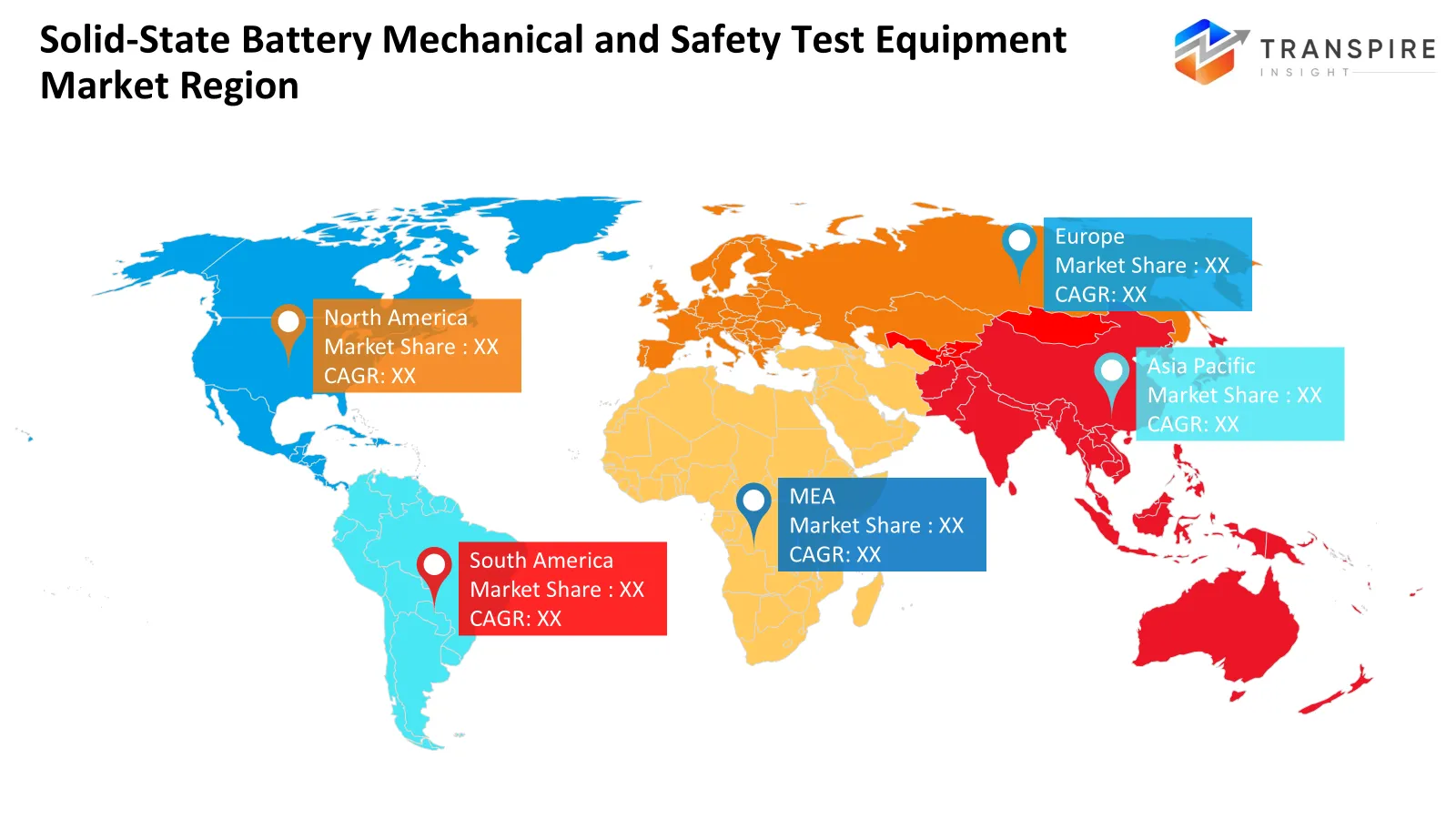
North America, with its 25% market share, is forecast to witness the fastest regional growth with a CAGR of 19.4%. The region is witnessing an accelerated rate of growth owing to the growing investments in domestic battery manufacturing, new gigafactory developments, and increasing commercialisation of solid-state batteries. There has been increased use of AI-based testing platforms and automated validation systems by companies to improve the quality of products and shorten the development process. With continuous investments from the government and the private sectors, North America is expected to open many doors for testing equipment providers.
- In January 2025, UL Solutions presented Test-a-Grid (TaG) technology to optimise the assessment of safety and reliability of EV batteries. The company stated that its North America Advanced Battery Laboratory located in Auburn Hills, Michigan, offers comprehensive mechanical abuse, thermal runaway, vibration, crush and safety testing of advanced batteries, including solid-state battery technology. Thus, the testing infrastructure for batteries in North America has been upgraded and made ready for the commercialisation of safe solid-state batteries.
Europe
The European region holds 24% market share and has continued to maintain its steady growth rate due to battery safety regulations and a strong automotive sector. As compared to Asia Pacific, the region has greater concern towards regulatory compliance, certification of products, and sustainable battery development. Investments in research organisations and battery innovation initiatives are boosting the testing capabilities of the region.
Asia-Pacific
Asia-Pacific region has a 45% share of the worldwide market owing to the robust ecosystem of battery manufacturers, the fast-growing production of electric vehicles, and the considerable investment in next-gen batteries. All countries in the region are striving to build their local battery manufacturing chains as well as boost their production of solid-state batteries. The government’s commitment to promoting clean energy projects and advanced manufacturing processes has driven the growth of high-end testing equipment demand even more.
Who are the Key Players in the Solid-State Battery Mechanical and Safety Test Equipment Market and how do they Compete?
The competition in the market of testing equipment for solid-state batteries is shaped by innovation in technology, testing precision, automation abilities, and meeting evolving international safety standards for batteries. The manufacturers are concentrating on the development of product ranges, implementing smart software, and developing accurate testing solutions in order to facilitate commercialisation of new-generation solid-state batteries. The provision of quality after-sales service, customised solutions, and services have also gained importance as competitive advantages.
In the case of Instron, differentiation is based on the use of high-performance mechanical testing systems for advanced battery validation. The firm emphasises the aspects of product innovation, precise engineering, and testing solutions while increasing the geographical reach of its operations through collaborations with automotive companies, research institutes, and battery manufacturers. The main competitive advantage of ZwickRoell is the provision of testing equipment with automation capabilities and digital data analysis.
Solid-State Battery Mechanical and Safety Test Equipment Market companies
- Chroma ATE
- Keysight Technologies
- Maccor
- Arbin Instruments
- AVL List
- HORIBA
- Weiss Technik
- ESPEC Corporation
- TÜV Rheinland
- Intertek,
- UL Solutions
- Bitrode Corporation
- National Instruments
- Hioki
- Digatron
Recent Development News
In March 2026, Instron disclosed its involvement in the upcoming InterBattery 2026 event, where it will showcase its 6800 Series Universal Testing System, Bluehill Universal Software, and ElectroPuls Testing Systems for advanced battery testing applications. The launch marks an expansion in the capabilities of the company towards providing automated mechanical and safety tests for next-generation batteries.
In June 2025, Shimadzu Corporation launched its latest technical initiative, which is aimed at lithium-ion battery testing and evaluation procedures along with testing jigs to enhance battery testing and safety assessment. This development marks a move from Shimadzu towards advanced battery testing technologies.
What Strategic Insights Define the Future of the Solid-State Battery Mechanical and Safety Test Equipment Market?
The future growth of the solid-state battery mechanical and safety testing equipment market would be determined by the commercialisation of the latest generation of batteries and the increasing demand for advanced validation technologies. Manufacturers would be able to concentrate on automating their equipment, utilising AI and advanced analytical tools, which would help them enhance accuracy and shorten product development cycles. Another important issue that might influence the future development of the market is the absence of international standards for solid-state battery testing that might complicate its certification process and slow down its adoption throughout the world. The intensification of investments in gigafactories, research centres, and advanced energy storage technologies provides numerous opportunities for manufacturers of intelligent testing equipment.
Key Market Segmentation
By Product Type
- Mechanical Test Systems
- Crush Test Equipment
- Nail Penetration Test System
- Thermal Abuse Test Chambers
- Safety Validation Systems
- AI-based Battery Test Platform
- Multi-axis Test Equipment
By Application
- Automotive Batteries
- Consumer Electronics
- Energy Storage Systems
- Aerospace Batteries
- Defense Batteries
- R&D Laboratories
By End User
- Battery Manufacturers
- Automotive OEM
- Research Institutes
- Electronics Manufacturers
- Certification Laboratories
- Energy Storage Companies
By Test Type
- Mechanical Testing
- Safety Testing
- Thermal Testing,
- Vibration Testing Abuse Testing
- Performance Testing
By Distribution Channel
- Direct Sales
- Industrial Equipment Distributors
- OEM Suppliers
- Online B2B Platforms
- Exporters
Regional Analysis
North America
- United States
- Canada
- Mexico
Europe
- Germany
- United Kingdom
- France
- Spain
- Italy
- Rest of Europe
Asia Pacific
- Japan
- China
- Australia & New Zealand
- South Korea
- India
- Rest of Asia Pacific
South America
- Brazil
- Argentina
- Rest of South America
Middle East & Africa
- Saudi Arabia
- United Arab Emirates
- South Africa
- Rest of the Middle East & Africa
Frequently Asked Questions
Find quick answers to common questions.
The solid-state battery mechanical and safety test equipment market size was valued at USD 117.4 million in 2025 and is poised to reach USD 455.8 million by 2033, expanding at a 18.48% CAGR.
Key segments for the solid-state battery mechanical and safety test equipment market are By Product Type (Mechanical Test Systems, Crush Test Equipment, Nail Penetration Test Systems, Thermal Abuse Test Chambers, Safety Validation Systems, AI-based Battery Test Platforms, Multi-axis Test Equipment, Others); By Application (Automotive Batteries, Consumer Electronics, Energy Storage Systems, Aerospace Batteries, Defense Batteries, R&D Laboratories, Others); By End User (Battery Manufacturers, Automotive OEMs, Research Institutes, Electronics Manufacturers, Certification Laboratories, Energy Storage Companies, Others); By Test Type (Mechanical Testing, Safety Testing, Thermal Testing, Vibration Testing, Abuse Testing, Performance Testing, Others); By Distribution Channel (Direct Sales, Industrial Equipment Distributors, OEM Suppliers, Online B2B Platforms, Exporters, Others)
Growth is primarily driven by rapid adoption of electric vehicles, growing investment in solid-state battery technology, high demand for testing advanced battery safety and mechanics, more stringent quality and safety standards, and growth of the battery manufacturing industry around the world.
The market is led by major manufacturers including Chroma ATE, Keysight Technologies, Maccor, Arbin Instruments, AVL List, HORIBA, Weiss Technik, ESPEC Corporation, TÜV Rheinland, Intertek, UL Solutions, Bitrode Corporation, National Instruments, Hioki, Digatron.
The Asia Pacific region accounts for 45% share of the solid-state battery mechanical and safety test equipment market due to robust battery manufacturing for electric vehicles, establishment of battery megafactories, government initiatives toward next-generation battery technology, and investments in battery testing and quality checks.
The commercial prospects will be increasing investment in solid-state batteries, growing demand for battery safety testing equipment, increasing number of EV manufacturing plants, increasing battery research and development, and stringent safety and quality standards requiring high performance testing equipment.
- Chroma ATE
- Keysight Technologies
- Maccor
- Arbin Instruments
- AVL List
- HORIBA
- Weiss Technik
- ESPEC Corporation
- TÜV Rheinland
- Intertek,
- UL Solutions
- Bitrode Corporation
- National Instruments
- Hioki
- Digatron
About the Authors

Avinash Kumar
I’m Avinash Kumar, a Senior Research Analyst at Transpire Insight, with expertise in the Electronics and Semiconductor and Energy & Power industry. My work focuses on analyzing emerging technologies, market trends, industry developments, and innovation across these sectors. I specialize in transforming complex technical and market insights into clear, research-backed content that helps professionals, businesses, and decision-makers stay informed. Through continuous industry research and data-driven analysis, I strive to deliver accurate, reliable, and practical perspectives on the latest advancements shaping the semiconductor and energy landscape.

Chakradhar Khansole
Chakradhar serves as the Research Director at Transpire Insight, bringing over 8 years of experience in technology, innovation, and strategic market intelligence. He specializes in transforming complex market data into actionable business insights that enable organizations to make informed, growth-oriented decisions. Recognized for his strategic vision and analytical expertise, Chakradhar leads high-impact research initiatives, delivering comprehensive market assessments, competitive intelligence, and forward-looking industry analysis.
Recently Published Reports
-
Apr 2026
Active Power Filter Market
Active Power Filter Market Size, Share & Analysis Report By Type (Shunt Active Power Filters, Series Active Power Filter, Hybrid Active Power Filter), By Application (Harmonics Mitigation, Reactive Power Compensation, Voltage Regulation, Power Factor Correction), By Phase (Single Phase, Three Phase), By End-User Industry (Manufacturing, Healthcare, Commercial, Automotive, Oil and Gas, Others), and Geography (North America, Europe, Asia-Pacific, Middle East and Africa, South and Central America), 2021 - 2031
-
Apr 2026
Electrical Transformer Market
Electrical Transformer Market Size, Share & Analysis Report By Core (Closed, Shell, and Berry), By Insulation (Gas, Oil, Solid, Air, and Other), By Phase (Single, and Three), By Rating (100 MVA to 500 MVA, 501 MVA to 800 MVA, and 801 MVA to 1200 MVA), and Geography (North America, Europe, Asia-Pacific, Middle East and Africa, South and Central America), 2021 – 2031
-
Apr 2026
Hydraulic Piston Pumps Market
Hydraulic Piston Pumps Market Size, Share & Analysis Report By Type (Axial Piston Pumps, Radial Piston Pumps), By Operating Pressure (Low Pressure, Medium Pressure, High Pressure), By Application (Construction, Mining, Agriculture, Automotive, Oil & Gas, Industrial Machinery, Others), By End-User (OEMs, Aftermarket), and Geography (North America, Europe, Asia-Pacific, Middle East and Africa, South and Central America), 2021 – 2031
-
Apr 2026
Laboratory Gas Generators Market
Laboratory Gas Generators Market Size, Share & Analysis Report By Product (Nitrogen Gas Generator, Hydrogen Gas Generator, Zero Air Gas Generator, Purge Gas Generator, TOC Gas Generators, Others), By Application (Gas Chromatography, Liquid Chromatography-mass Spectrometry (LC-MS), Gas Analyzers, Others), By End-user (Life Science, Chemical & Petrochemical, Food & Beverage, Others), and Geography (North America, Europe, Asia-Pacific, Middle East and Africa, South and Central America), 2021 – 2031