

South Korea Preterm Birth Prevention and Management Market Summary:
According to Transpire Insights, a detailed research report on the market reflects that the clinical perinatal software application segment dominates the South Korea Preterm Birth Prevention and Management Market, accounting for approximately 40% of the total share worldwide. GE HealthCare leads the market with approximately (around USD 19.5 billion) in annual revenue and an estimated 12–17% global market share, making it the leading contributor to global market development, innovation, advanced preterm birth prevention and management technologies, expanding healthcare capabilities, and growth dynamics.
Market Snapshot
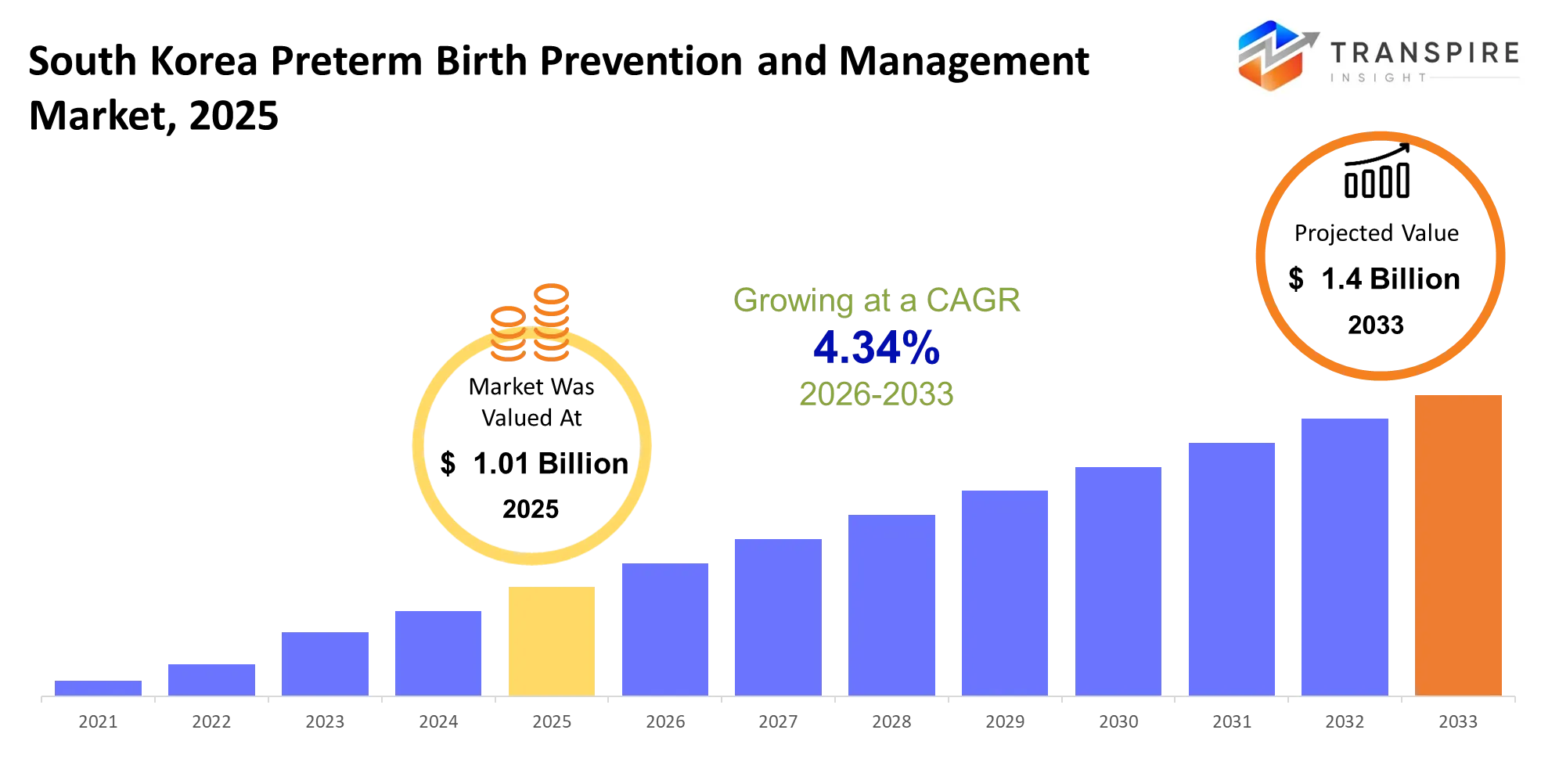
- Market Value (2025): USD 1.01 Billion.
- Expected Market Value (2026): USD 1.04 Billion.
- Estimated Market Value (2033): USD 1.4 Billion.
- Forecast CAGR (2026–2033): 4.34%
Introduction
The South Korea Preterm Birth Prevention and Management Market covers medical devices, pharmaceuticals, diagnostic tools, monitoring systems, and digital health technologies that can detect preterm birth risks, postpone preterm labor, and manage preterm birth-related complications. These technologies include tocolysis, antenatal corticosteroids, cervical cerclage, monitoring systems for both fetus and mother, diagnostic tools based on biomarkers, breathing support systems for neonates, and digital clinical management platforms. Increasing utilization of advanced maternal and fetal monitoring, improvement in neonatal intensive care unit management, and focus on early detection of risks will fuel the growth of the market. The healthcare framework, national health insurance, specialized facilities for maternal and neonatal care, and clinical technology utilization in South Korea will further foster the market growth.
Key Market Highlights: -
- By Treatment, the Progesterone Therapy dominated the market and holds approximately 40% share in 2025 and is projected to grow at a substantial CAGR during the forecast period.
- By Drug Class, the Progesterone therapy dominated the market and holds approximately 61.5%share in 2025 and is projected to grow at a substantial CAGR during the forecast period.
- By Diagnosis, the Fetal Fibronectin (fFN) Testing dominated the market and holds approximately 41.88% share in 2025 and is projected to grow at a substantial CAGR during the forecast period.
- South Korean preterm birth management market is growing via provision of services for high-risk pregnancy, fetal monitoring technology, NICU facilities, government intervention, neonatal technology, and maternal-neonatal referral systems.
How is Technology Driving Growth in the South Korea Preterm Birth Prevention and Management Market?
Technological developments are driving the growth of the South Korea Preterm Birth Prevention and Management market by way of advanced fetal monitoring, digital diagnostics, AI-powered risk assessment, and advanced neonatal intensive care facilities. AI and machine learning technologies could be used to analyze data related to the mother, ultrasound tests, and other clinical information in order to detect preterm birth risks earlier. Wireless and continuous fetal monitoring allows for better monitoring of high-risk pregnancies, and advanced incubators, neonatal warmers, respiratory therapy systems, and advanced monitoring equipment help better manage premature babies. New telemedicine and digital health solutions could enhance collaboration between specialists, especially in regional health care networks.
Market Drivers
Key factors propelling the market for South Korea Preterm Birth Prevention & Management include advanced age of mothers, rise in high-risk pregnancies, fertility enhancement technologies, health insurance coverage, and investments in maternal-neonatal infrastructure. Late pregnancies and increased number of cases where pregnancy is achieved through fertility enhancing technology raise the demand for advanced monitoring of pregnant women and proper obstetric management. Increased government intervention in the area of treatment of high-risk pregnancies, such as premature labor and preterm rupture of membranes, increases the availability of necessary procedures; at the same time, financial help in the treatment of premature babies decreases the burden of costs.
Restrain
The South Korea Preterm Birth Prevention and Management Market is expected to experience various limitations including the shortage of maternal-fetal and neonatal specialists, unequal accessibility of highly-advanced care throughout different geographical areas, high prices for monitoring and NICU technology, and complexity in their clinical application. Lack of tertiary centers for maternal-neonatal medicine could result in delays in referral and delivery of care in underdeveloped areas. There could also be restrictions in reimbursement for innovative diagnostics and digital health tools, as well as challenges due to increased costs of operation.
|
Driver |
Relative Impact on Growth (%) |
Geographic Relevance |
Impact Timeline |
Demand Strength |
Growth Mechanism |
Key Beneficiaries |
Major Constraint |
|
Rising high-risk pregnancies and advanced maternal age |
27% |
Seoul, Gyeonggi, Busan, major metropolitan areas |
Short-term |
High |
Expands screening, monitoring, and specialized obstetric interventions |
Maternal-fetal centers, hospitals, diagnostic-device manufacturers |
Limited obstetric and neonatal specialist availability |
|
Government expansion of maternal-neonatal referral networks |
24% |
Nationwide; regional and medically underserved areas |
Short-term |
High |
Improves referrals, transfers, emergency access, and NICU utilization |
Tertiary hospitals, NICUs, ambulance services, care-network providers |
Regional infrastructure and workforce shortages |
|
Advanced fetal and neonatal monitoring technologies |
20% |
Seoul metropolitan region and tertiary hospitals |
Medium-term |
High |
Enables earlier risk detection and continuous clinical monitoring |
Monitoring-device firms, hospitals, digital-health providers |
Technology costs and clinical integration barriers |
|
Expanded financial support for high-risk pregnancy and preterm care |
16% |
Nationwide, especially vulnerable households |
Short-term |
High |
Reduces treatment costs and encourages timely specialist care |
Hospitals, pharmaceutical firms, medical-device providers, families |
Budget sustainability and reimbursement limitations |
|
Growth of NICU capacity and specialized preterm management |
13% |
Nationwide; regional medical centers and metropolitan hubs |
Long-term |
Medium |
Increases survival-focused treatment capacity and post-discharge management |
NICUs, neonatal equipment suppliers, pediatric providers |
Neonatologist shortages and operating costs |
Analysis of Prices and Consumer Behaviour
The advanced solutions in preterm birth prevention and management market is mainly characterized by fetal and maternal monitoring technologies (68% of total market value; mainly owing to the demand from high-risk pregnancy monitoring and obstetrics and neonatal intensive care applications). The cost of the advanced and highly accurate monitoring system would be expected to be 35% higher as compared to traditional products since the latter feature state-of-the-art sensor technologies, monitoring abilities and performance clinically validated. Nearly 45% of all units of preterm birth prevention and management technologies are installed into hospital monitoring systems. The adoption rate is motivated by the versatile applicability of these solutions for maternal-fetal monitoring, labor management and neonatal intensive care. The maternal-fetal monitoring and neonatal intensive care markets account for about 70% of the demand from these applications. The purchase behavior of health care providers demonstrates that 55% consider clinical accuracy, monitoring reliability and technology integration as the most important characteristics. In addition, 33% of health care organizations prefer buying products based on bulk purchase agreements and contracts in order to minimize the procurement costs and secure the delivery of critical technologies in maternal and neonatal care.
|
Company |
Est. Revenue Share Range |
Key Offerings |
Strategic Positioning |
Geographic Strength |
Technology Focus |
|
Ferring Pharmaceuticals |
8–12% |
Tractocile/atosiban; preterm-labor pharmacotherapy; obstetric medicines |
Tocolytic therapy specialist with obstetric focus |
Europe, Asia Pacific, North America |
Oxytocin-receptor antagonism for preterm labor |
|
GE HealthCare |
7–11% |
Corometrics maternal/fetal monitors; Novii+ wireless monitoring; neonatal respiratory equipment; phototherapy |
Integrated maternal-neonatal technology platform |
North America, Europe, Asia Pacific |
Wireless fetal monitoring and connected patient monitoring |
|
Drägerwerk |
6–10% |
Isolette incubators; Babyroo; neonatal ventilation; phototherapy; patient monitoring |
Premium NICU equipment and respiratory-care specialist |
Europe, Asia Pacific, North America |
Thermoregulation, neonatal ventilation and integrated monitoring |
|
Samsung Medison |
5–9% |
HERA Z20/Z10; prenatal ultrasound; fetal imaging; OB/GYN diagnostic systems |
AI-enabled prenatal imaging and diagnostic differentiation |
Asia Pacific, Europe, North America |
AI-assisted obstetric ultrasound and fetal imaging |
|
Philips |
5–8% |
Avalon fetal monitoring; IntelliVue monitoring; neonatal respiratory-care solutions; NICU informatics |
Connected maternal and neonatal monitoring ecosystem |
Europe, North America, Asia Pacific |
Connected monitoring and clinical workflow integration |
|
Fisher & Paykel Healthcare |
4–7% |
Neopuff; Bubble CPAP; Optiflow Junior; FlexiTrunk; neonatal humidification |
Non-invasive neonatal respiratory-care specialist |
Asia Pacific, North America, Europe |
Humidified CPAP, nasal high-flow and neonatal interfaces |
|
Bistos |
4–7% |
BT-380 fetal-maternal monitor; BT-500 incubator; BT-550 warmer; neonatal phototherapy |
Korean value-focused maternal-neonatal equipment provider |
Asia Pacific, North America, Middle East |
Fetal monitoring and integrated neonatal-care equipment |
|
Atom Medical |
3–6% |
Dual Incu i; Incu i; IncuArch; Infa Warmer i; neonatal phototherapy |
Dedicated perinatal equipment and incubator specialist |
Asia Pacific, North America, Europe |
Precision neonatal thermoregulation and transport incubators |
|
Masimo |
3–5% |
SET pulse oximetry; neonatal sensors; Root monitoring; SafetyNet; respiratory monitoring |
Advanced neonatal monitoring and sensing specialist |
North America, Asia Pacific, Europe |
Motion-tolerant pulse oximetry and advanced neonatal sensing |
|
Mindray |
2–5% |
NB350 neonatal NIV; patient monitors; neonatal respiratory accessories; monitoring platforms |
Value-oriented integrated hospital equipment challenger |
Asia Pacific, Europe, Latin America |
Non-invasive ventilation and integrated patient monitoring |
Who are the Key Players in the South Korea Preterm Birth Prevention and Management Market and how do they compete?
The competitiveness of South Korea Preterm Birth Prevention and Management Market in the international market is ensured by companies which concentrate their efforts on innovations in pharmaceutical sphere, special solutions related to maternal and neonatal healthcare, and creation of international distribution networks. Competing not only on the price but through innovation, development of advanced therapeutic solutions, innovative treatment solutions, specialized pharmaceutical products, integration with healthcare system and clinical platform, this kind of competition results in constant development of new products as well as improvement of treatment effectiveness, clinical efficiency, patient access, and maternal/neonatal health results.
Development of innovative therapies for maternal healthcare, preterm birth management, and specialized pharmaceutical technologies allows Pfizer to strengthen its market position. Development of high-performance pharmaceutical products for maternal care, neonatal management, infection prevention and other healthcare applications distinguishes Merck from its competitors. Development of specialized solutions in the field of obstetrics, preterm labor management, reproductive health, and maternal healthcare allows Ferring Pharmaceuticals to enhance its position in the market.
Top Companies in the South Korea Preterm Birth Prevention and Management Market
- Pfizer
- Merck
- Ferring Pharmaceuticals
- Bayer
- Sanofi
- Novartis
- AbbVie
- Teva
- Viatris
- Johnson & Johnson
- AstraZeneca
- Takeda
- LG Chem
- Hanmi Pharmaceutical
- Chong Kun Dang
South Korea Preterm Birth Prevention and Management Market Segmentation
The South Korea Preterm Birth Prevention and Management Market share is divided into five categories: By Treatment, By Drug Class, By Diagnosis, By Gestational Age, By End User.
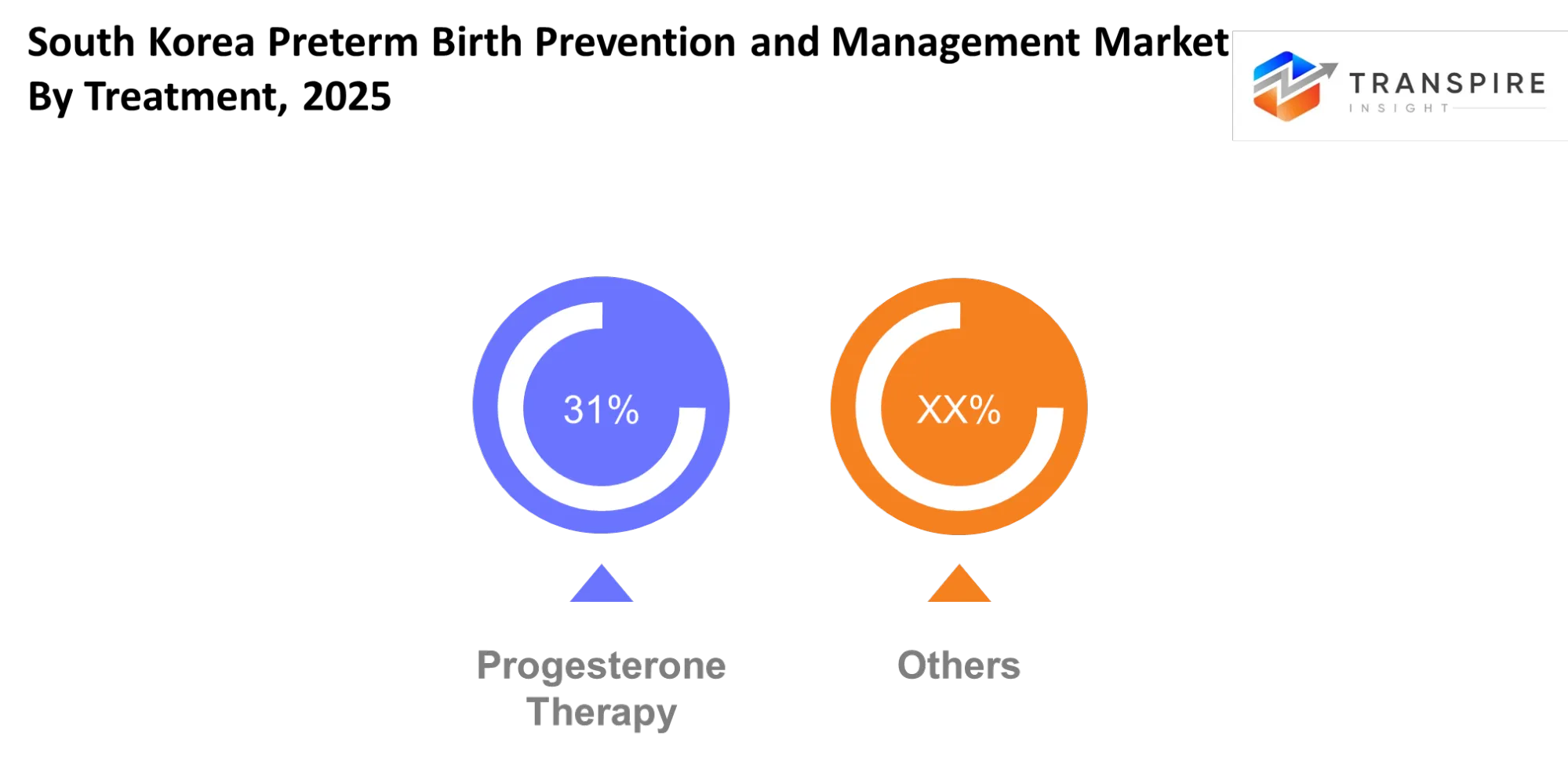
The Progesterone Therapy dominated the market, accounting for nearly 40% in 2025 and is expected to rise at a significant CAGR during the forecast period.
The South Korea Preterm Birth Prevention and Management Market is segmented by treatment into progesterone therapy, cervical cerclage, tocolytics, corticoProgesterone Therapys, antibiotics, magnesium sulfate, supportive therapy. Among these, the Progesterone Therapy segment dominated the market, accounting for nearly 40% in 2025 and expected to increase at a significant CAGR during the forecast period. Increasing cases of high-risk pregnancies and clinical use of progesterone favor prevention and treatment of spontaneous preterm birth.
The Progesterone therapy dominated the market, accounting for nearly 61.5%in 2025, and is expected to rise at a significant CAGR during the forecast period.
The South Korea Preterm Birth Prevention and Management Market is segmented by drug class into progesterone, calcium channel blockers, oxytocin receptor antagonists, nsaids, beta-adrenergic agonists, corticoprogesterone therapys, antibiotics. Among these, the Progesterone therapy dominated the market, accounting for nearly 61.5%in 2025 and expected to increase at a significant CAGR during the forecast period. The increasing cases of high-risk pregnancies and clinical use of progesterone treatment for preventing recurrent spontaneous preterm birth favor continued uptake.
The Fetal Fibronectin (fFN) Testing dominated the market, accounting for nearly 41.88% in 2025 and is expected to rise at a significant CAGR during the forecast period.
The South Korea Preterm Birth Prevention and Management Market is segmentedby diagnosis into ultrasound, cervical length measurement, fetal fibronectin testing, biomarker testing, genetic testing, maternal monitoring, fetal monitoring. Among these, the Fetal Fibronectin (fFN) Testing dominated the market, accounting for nearly 41.88% in 2025 and expected to increase at a significant CAGR during the forecast period. Increasing demand for early detection of risk of preterm birth favors fetal fibronectin test adoption.
Future Market Trends for the South Korea Preterm Birth Prevention and Management Market:-
AI-assisted Risk Prediction in Premature Birth: AI-assisted fetal monitoring and predictions are expected to provide better pre-term birth risk identification and decision-making.
Continuity in Maternal-Neonatal Healthcare: Digital health technologies, telemedicine, electronic health records, and referral systems are expected to improve continuity and integration of specialty interventions.
Advanced Technology for Neonates: Intelligent NICU equipment, respiratory non-invasive ventilation, thermoregulation, phototherapy, and neonatal monitoring technology are expected to provide better interventions for premature infants.
Recent Development
InJanuary 1, 2026Medical Expenses Reduction for Premature Infants:Expanded medical expenses reduction for premature infants came into force in South Korea, providing outpatient screening assistance until March 31 after birth year.
In August 20, 2026 Parental Leave for Short Periods:South Korea introduced parental leave provisions for short periods to deal with emergencies in medical conditions of premature infants.
Market Segmentation
This study forecasts revenue at Japan, regional and country levels from 2020 to 2033. Transpire Insights has segmented the South Korea Preterm Birth Prevention and Management Market based on the below-mentioned segments:
South Korea Preterm Birth Prevention and Management Market, By Treatment
- Progesterone Therapy
- Cervical Cerclage
- Tocolytics
- CorticoProgesterone Therapys
- Antibiotics
- Magnesium Sulfate
- Supportive Therapy
South Korea Preterm Birth Prevention and Management Market, By Drug Class
- Progesterone
- Calcium Channel Blockers
- Oxytocin Receptor Antagonists
- NSAIDs
- Beta-Adrenergic Agonists
- CorticoProgesterone Therapys
- Antibiotics
South Korea Preterm Birth Prevention and Management Market, By Diagnosis
- Ultrasound
- Cervical Length Measurement
- Fetal Fibronectin Testing
- Biomarker Testing
- Genetic Testing
- Maternal Monitoring
- Fetal Monitoring
South Korea Preterm Birth Prevention and Management Market, By Gestational Age
- Below 28 Weeks
- 28–31 Weeks
- 32–33 Weeks
- 34–36 Weeks
- Extremely Preterm
- Very Preterm
- Late Preterm
South Korea Preterm Birth Prevention and Management Market, By End User
- Hospitals
- Maternity Clinics
- Neonatal Centers
- Specialty Clinics
- Diagnostic Centers
- Research Institutes
- Home Healthcare
Frequently Asked Questions
Find quick answers to common questions.
Advanced maternal age, high-risk pregnancies, improved healthcare coverage, fetal monitoring, NICU investments, and maternal-neonatal referral networks are driving market growth.
Progesterone therapy dominates treatment demand, supported by high-risk pregnancy management and clinical use for preventing recurrent spontaneous preterm birth.
Fetal fibronectin testing leads diagnostics, supported by growing demand for early preterm birth risk assessment and timely clinical intervention.
AI-assisted monitoring, digital diagnostics, wireless fetal monitoring, telemedicine, and advanced NICU technologies are improving risk assessment and neonatal care.
AI-enabled risk prediction, connected maternal-neonatal care, advanced neonatal respiratory support, digital health platforms, and intelligent NICU technologies will shape future growth.
- Pfizer
- Merck
- Ferring Pharmaceuticals
- Bayer
- Sanofi
- Novartis
- AbbVie
- Teva
- Viatris
- Johnson & Johnson
- AstraZeneca
- Takeda
- LG Chem
- Hanmi Pharmaceutical
- Chong Kun Dang
About the Authors

Pankaj Ghogare Patil
I am Pankaj Ghogare Patil, a Senior Research Analyst at Transpire Insight, specializing in the Pharmaceutical, Chemicals & Materials, Healthcare IT, and Biotechnology industry. My expertise lies in conducting comprehensive market research, analyzing industry trends, evaluating competitive landscapes, and translating complex data into actionable insights. At Transpire Insight, I closely follow emerging technologies, regulatory developments, and market innovations to create accurate, well-researched, and informative content that helps businesses and professionals make informed decisions. I am committed to producing credible, evidence-based articles that reflect industry best practices while making technical topics accessible and valuable for a broad audience.

Chakradhar Khansole
Chakradhar serves as the Research Director at Transpire Insight, bringing over 8 years of experience in technology, innovation, and strategic market intelligence. He specializes in transforming complex market data into actionable business insights that enable organizations to make informed, growth-oriented decisions. Recognized for his strategic vision and analytical expertise, Chakradhar leads high-impact research initiatives, delivering comprehensive market assessments, competitive intelligence, and forward-looking industry analysis.
Recently Published Reports
-
Apr 2026
AI in Diabetic Retinopathy Market
AI in Diabetic Retinopathy Market Size, Share & Analysis Report By Type (Screening AI Systems, Diagnostic AI Systems, and Predictive AI Models), By Application Segment (Hospitals, Ophthalmology Clinics, Diagnostic Centers, and Research and Development), and Geography (North America, Europe, Asia-Pacific, Middle East and Africa, South and Central America), 2021 - 2031
-
Apr 2026
Psychometric Tests Market
Psychometric Tests Market Size, Share & Analysis Report By Type (Personality Tests, Ability/Aptitude Tests, Skill/Knowledge Tests, and Others), By Application (Talent Acquisition and Talent Management), and Geography (North America, Europe, Asia-Pacific, Middle East and Africa, South and Central America), 2021 – 2031
-
Apr 2026
Rare Biological Sample Collection Market
Rare Biological Sample Collection Market Size, Share & Analysis Report By Type (Isolation Kits & Reagent, Blood Collection Tubes, and Others), By Application (Oncology, Transcriptomics, Pharmacogenomics, and Others), and Geography (North America, Europe, Asia-Pacific, Middle East and Africa, South and Central America), 2021 – 2031
-
Jul 2026
Diabetic Retinopathy Market
Diabetic Retinopathy Market Size, Share & Analysis Report By Type (Proliferative Diabetic Retinopathy, and Diabetic Macular Edema (DME)), By Treatment Type (Anti VEGF Drug, Steroid Implants, Laser Surgeries, and Vitrectomy), and Geography (North America, Europe, Asia-Pacific, Middle East and Africa, South and Central America), 2021 – 2031
Our Clients







