

South Korea Polyol Market Size & Forecast:
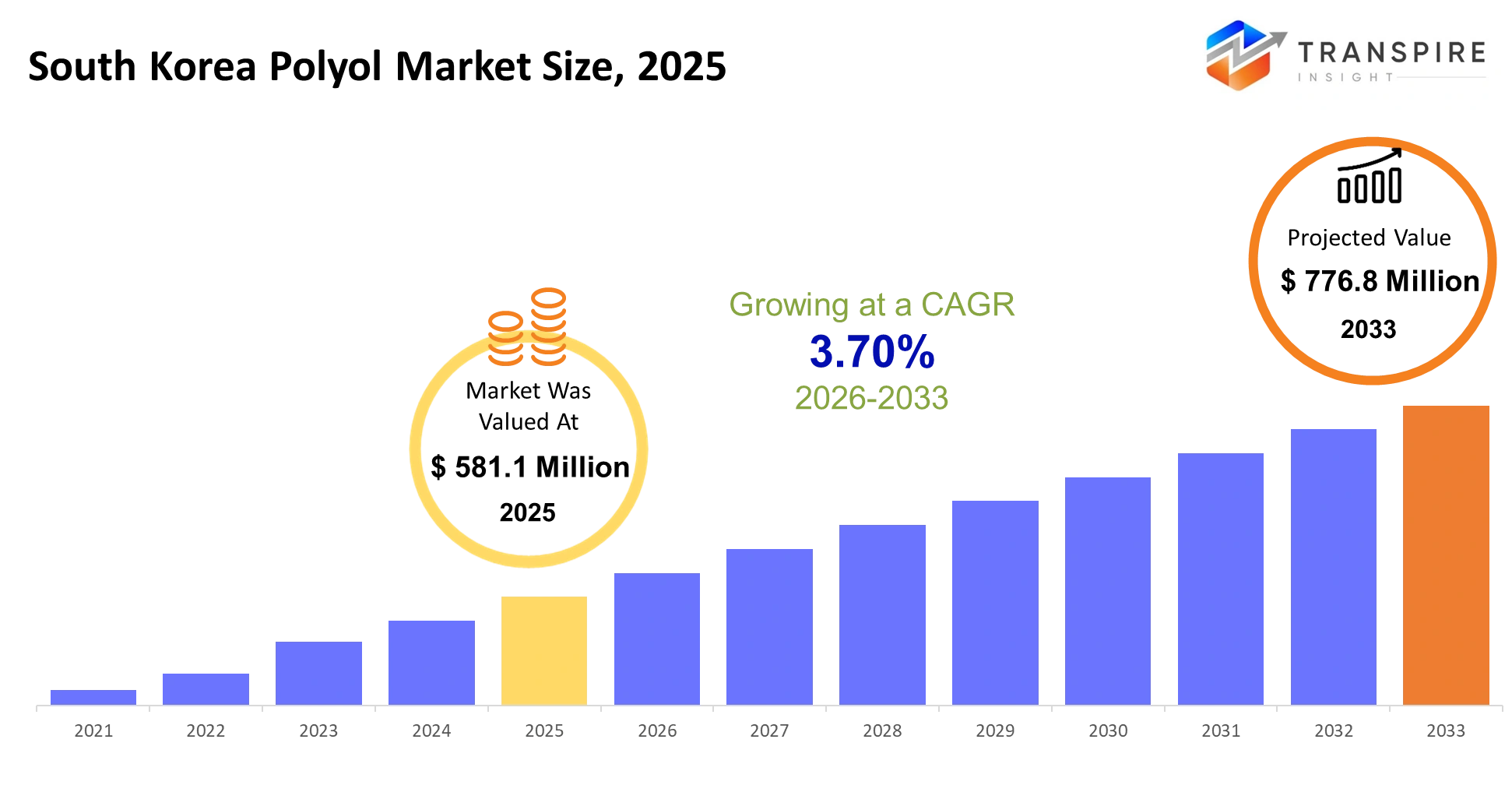
- South Korea Polyol Market Size 2025: USD 581.1 Million
- South Korea Polyol Market Size 2033: USD 776.8 Million
- South Korea Polyol Market CAGR: 3.70%
- South Korea Polyol Market Segments: By Type (Polyether Polyols, Polyester Polyols, Bio-based Polyols, Specialty Polyols), By Application (Foams, Coatings, Adhesives, Sealants), By End-User (Construction, Automotive, Furniture, Packaging)
To learn more about this report,  Download Free Sample Report
South Korea Polyol Market Summary:
South Korea Polyol Market size was estimated at USD 581.1 Millionin 2025 and is anticipated to reach USD 776.8 Million by 2033, growing at a CAGR of 3.70% from 2026 to 2033.
The chemicals and materials industry in South Korea will have its polyol market as a highly monitored sector which will experience changes due to manufacturing shifts and the various ways products are used. The market will grow because polyurethane production requires constant performance and flexible formulation options more than it needs large production capacity. The domestic automotive industry and construction sector and electronics market will drive producers to adjust their output because these markets demand both material efficiency and durable products.
Manufacturers must develop cleaner product options because consumer demand for low-emission materials will increase. The product portfolios will start transforming because of improvements in bio-based polyols and precision processing while businesses will make operational choices based on their need to meet environmental compliance standards. The market will move toward equilibrium between performance requirements and sustainability objectives which will innovate its future development.
Key Market Trends & Insights:
- The Polyol Market in South Korea experiences continuous demand because of the need for polyurethane materials which manufacturers use to create construction materials and insulation products and automotive parts. The rising demand for residential construction and energy-efficient building projects will result in increased polyol consumption. The rising demand for rigid and flexible foams will lead to changes in production techniques which domestic manufacturers will adopt.
- The Polyol Market in South Korea benefits from the strong demand that both the automotive and electronics sectors create. Polyols function as essential components for developing lightweight materials and cushioning systems which enhance both vehicle performance and passenger comfort. The increasing production of electronics will result in higher demand for protective and insulating materials which will increase the use of polyols in manufacturing operations.
- The Polyol Market in South Korea is moving toward environmentally friendly products. The manufacturing sector will concentrate on creating bio-based polyols which use renewable resources to minimize their ecological footprint. The combination of regulatory requirements and rising consumer understanding will drive companies to implement sustainable practices which will result in new developments for environmentally friendly industrial methods.
- The South Korean Polyol Market depends on better processing technologies which increase operational efficiency and product excellence. The combination of automation systems and advanced catalysts will enable businesses to increase production efficiency while minimizing material waste. Companies will allocate funds toward research initiatives which will result in the creation of specialized polyols that meet the unique needs of different industrial sectors, thereby enhancing their market position.
- The South Korean Polyol Market encounters operational difficulties because of raw material price fluctuations especially with propylene oxide and ethylene oxide. The alterations in costs will have a direct impact on both production costs and the methods used to determine product prices. Manufacturers will use long-term purchasing contracts and alternative raw material methods to handle operational risks while ensuring continuous business operations.
South Korea Polyol Market Segmentation
By Type :
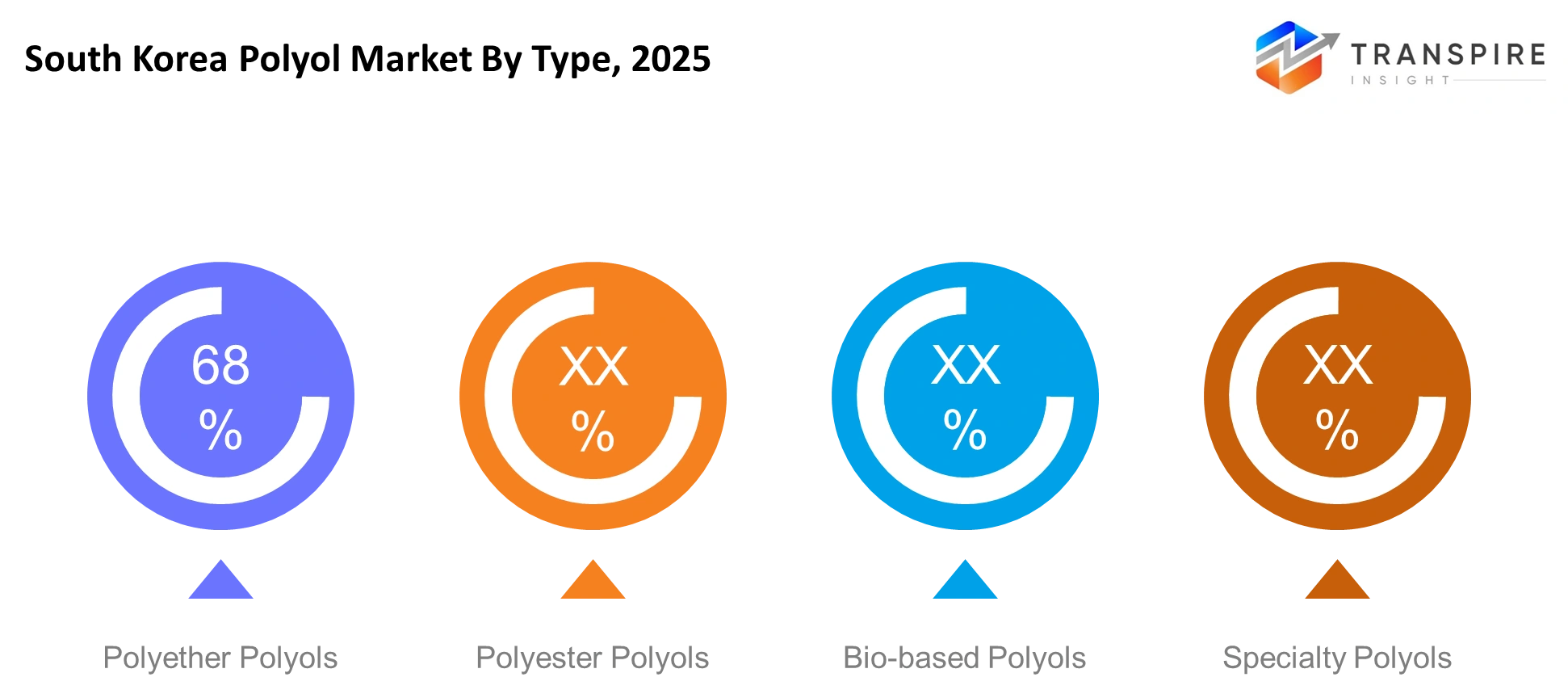
- Polyether Polyols: The South Korea Polyol Market relies on Polyether polyols because their products provide flexibility together with durable performance and moisture protection capabilities. The production processes enable industrial operations at large scale which benefits foam production. Insulation and cushioning markets maintain their demand because manufacturers need products that deliver stable performance at affordable prices.
- Polyester Polyols: Polyester polyols show steady growth because they provide strength together with chemical resistance. Industrial coatings together with adhesives benefit from enhanced bonding capabilities and extended product lifespan. The market shows rising demand for applications that require strong materials which can endure extended operational periods. The market demand increases because both the automotive and construction industries need materials that provide high strength.
- Bio-based Polyols: Bio-based polyols gain attention with rising environmental awareness and regulatory pressure. The industry moves toward sustainable production by using plant-based materials as their primary raw material sources. The adoption of sustainable practices shows an upward trend as industries attempt to decrease their carbon emissions. The industry experiences slow growth because of expense difficulties; however, it shows strong long-term growth potential because of government support and technological advancements.
- Specialty Polyols: Specialty polyols cater to niche industrial needs with tailored chemical properties. The applications of this technology span across three areas which include high-performance coatings and elastomers together with advanced adhesives. The demand for products that meet particular performance requirements becomes essential in industries that need heat resistance and elasticity. The company plans to expand its operations through research and development investments which enable product innovation together with customized solutions.
To learn more about this report, Download Free Sample Report
By Application :
- Foams: Foam applications currently dominate market usage because people widely utilize foam for insulation purposes and furniture manufacturing and automotive seating production. Urban areas experience increased demand for flexible and rigid foam materials because people seek both comfort and development needs. Energy efficiency regulations drive insulation market expansion while consumers choose furniture foam products based on their comfort preferences which applies to both residential and commercial markets.
- Coatings: The construction and industrial maintenance sectors create a constant need for coating applications which show stable demand. Protective layers provide enhanced durability which enables materials to resist both corrosion and adverse weather effects. The growth of the industry depends on infrastructure development and renovation projects which require permanent surface protection for both buildings and equipment.
- Adhesives: The adhesives market segment continues to grow because manufacturing activities increase while companies seek strong bonding solutions. The product finds application in automotive assembly operations and packaging processes and electronics manufacturing. The two performance benefits of durability and flexibility drive customers to use the product more widely. Industrial production growth directly influences consumption patterns within this segment.
- Sealants: Sealants serve essential functions in construction projects and automotive applications because they fill gaps and act as barriers against moisture entry. The demand for sealants increases with both ongoing infrastructure development work and ongoing maintenance of existing infrastructure. The industry uses performance features which include elasticity and resistance to environmental factors for different applications.
By End-User :
- Construction: The construction industry requires more resources because urban growth and infrastructure development work together to create construction needs. Residential and commercial buildings use insulation materials together with coatings and sealants as standard building components. The energy efficiency standards raise building energy needs which results in construction industry growth that drives overall market expansion.
- Automotive: The automotive industry requires more materials because it needs seating systems together with insulation and interior parts. The use of lightweight materials helps vehicles achieve better fuel efficiency which leads to more people using advanced products that contain polyol materials. The vehicle design innovations together with production increases lead to continuous growth in this market segment.
- Furniture: The furniture industry demonstrates high product usage because customers want furniture that provides both comfort and long-lasting use. Residential and office furniture products depend on foam cushioning materials as their main component. Increasing disposable income together with changes in consumer behavior results in higher furniture expenditures which drives growth in this market segment.
- Packaging: The packaging industry uses polyol-based materials to create protective packaging products with lightweight characteristics. The e-commerce and logistics sectors expand their operations which leads to higher demand for resilient packaging solutions. Various packaging applications use shock absorption materials because they help protect products during delivery.
Country Insights
- The South Korea Polyol Market exhibits continuous development because manufacturing production remains high and customers maintain steady demand for polyurethane-based construction materials and automotive parts and electronic products. The industrial clusters together with their export-oriented production systems enable reliable product availability while people use domestic products to meet their requirements for infrastructure and housing development.
- The South Korea Polyol Market depends on its advanced chemical processing capabilities and its established supply chain networks. Local producers focus on improving product quality and efficiency, supported by research initiatives and collaboration with end-use industries. Environmental regulations drive businesses to adopt sustainable production practices, which results in companies gradually switching to environmentally friendly polyol alternatives.
- The South Korea Polyol Market shows equal market expansion because domestic customers show active demand and international trade reaches its maximum. The automotive manufacturing sector together with the consumer goods sector maintains its constant product requirements. The market experiences valuation changes because raw material prices and worldwide economic developments affect it, while material innovations create new opportunities for prolonged growth and diverse usage.
Recent Development News
In February 2026, South Korea’s petrochemical companies posted ₩1.5 trillion in losses in 2025, worse than 2024.Weak margins and falling spreads are forcing companies to rethink production strategies.Lower profitability impacts investments in downstream products like polyols.
In August 2025, South Korea announced plans to cut petrochemical capacity by up to 25%. Likely closure of smaller naphtha crackers will reduce feedstock for polyols. This marks a structural shift toward a leaner, higher-efficiency chemical sector.
|
Report Metrics |
Details |
|
Market size value in 2025 |
USD 581.1 Million |
|
Market size value in 2026 |
USD 602.5 Million |
|
Revenue forecast in 2033 |
USD 776.8 Million |
|
Growth rate |
CAGR of 3.70% from 2026 to 2033 |
|
Base year |
2025 |
|
Historical data |
2021 - 2024 |
|
Forecast period |
2026 - 2033 |
|
Report coverage |
Revenue forecast, competitive landscape, growth factors, and trends |
|
Country scope |
South Korea |
|
Key company profiled |
BASF, Covestro, Dow, Huntsman, Shell Chemicals, Mitsui Chemicals, Sumitomo Chemical, LG Chem, Hanwha Solutions, Wanhua Chemical, Arkema, Evonik, Stepan, Emery Oleochemicals, Repsol |
|
Customization scope |
Free report customization (country, regional & segment scope). Avail customized purchase options to meet your exact research needs. |
|
Report Segmentation |
By Type (Polyether Polyols, Polyester Polyols, Bio-based Polyols, Specialty Polyols), By Application (Foams, Coatings, Adhesives, Sealants), By End-User (Construction, Automotive, Furniture, Packaging) |
Key South Korea Polyol Company Insights
- The South Korea Polyol Company market demonstrates a concentrated market structure which results from the presence of major chemical companies and their specialized market competitors. The domestic production facilities provide reliable output for the market supply while the existing distribution systems work to sustain market equilibrium. The company establishes its competitive advantage through its pricing strategy and product excellence and its enduring business agreements with industries such as automotive and construction.
- The market demand for South Korea Polyol Company products will remain dependent on polyurethane usage because of its applications in insulation and furniture and automotive seating. The construction requirements together with industrial activities demonstrate steady growth patterns. The increasing demand for energy-efficient materials will drive product consumption because polyol-based materials provide thermal insulation and lightweight manufacturing capabilities.
South Korea Polyol Market Companies:
- BASF
- Covestro
- Dow
- Huntsman
- Shell Chemicals
- Mitsui Chemicals
- Sumitomo Chemical
- LG Chem
- Hanwha Solutions
- Wanhua Chemical
- Arkema
- Evonik
- Stepan
- Emery Oleochemicals
- Repsol
South Korea Polyol Market Segmentation
By Type
- Polyether Polyols
- Polyester Polyols
- Bio-based Polyols
- Specialty Polyols
By Application
- Foams
- Coatings
- Adhesives
- Sealants
By End-User
- Construction
- Automotive
- Furniture
- Packaging
Frequently Asked Questions
Find quick answers to common questions.
The Approximate South Korea Polyol Market size for the Market will be USD 776.8 Million in 2033.
Key Segments for the South Korea Polyol Market are By Type (Polyether Polyols, Polyester Polyols, Bio-based Polyols, Specialty Polyols), By Application (Foams, Coatings, Adhesives, Sealants), By End-User (Construction, Automotive, Furniture, Packaging).
Major South Korea Polyol Market Players are BASF, Covestro, Dow, Huntsman, Shell Chemicals, Mitsui Chemicals, Sumitomo Chemical, LG Chem, Hanwha Solutions, Wanhua Chemical, Arkema, Evonik, Stepan, Emery Oleochemicals, Repsol.
The Current South Korea Polyol Market size is USD 581.1 Million in 2025.
The South Korea Polyol Market CAGR is 3.70%.
- BASF
- Covestro
- Dow
- Huntsman
- Shell Chemicals
- Mitsui Chemicals
- Sumitomo Chemical
- LG Chem
- Hanwha Solutions
- Wanhua Chemical
- Arkema
- Evonik
- Stepan
- Emery Oleochemicals
- Repsol
Recently Published Reports
-
May 2026
Healthcare Polymer Packaging Market
Healthcare Polymer Packaging Market Size, Share & Analysis Report By Packaging Type (Syringes, IV Bottles and Pouches, Clamshells, Blisters, Bottles & Jars, Containers, Tubes, IV Parental Packaging, Others), By Type (Regulated, Non-regulated), By Polymer Type (LDPE (Low-Density Polyethylene), HDPE (High-Density Polyethylene), Homo-polymer (Homo), Random Copolymer (Random), Block Copolymer (Block), PET, Polystyrene, Polyvinyl Chloride, Polyamide/EVOH, Others), and Geography (North America, Europe, Asia-Pacific, Middle East and Africa, South and Central America), 2021 - 2031
-
Apr 2026
Hydrophilic Tape (Waterstop) Market
Hydrophilic Tape (Waterstop) Market Size, Share & Analysis Report By Type (Bentonite-Based Hydrophilic Tape, Rubber-Based Hydrophilic Tape), By Application (Residential Buildings, Commercial Buildings, Infrastructure Projects), and Geography (North America, Europe, Asia-Pacific, Middle East and Africa, South and Central America), 2021 - 2031
-
Apr 2026
Metalens Market
Metalens Market Size, Share & Analysis Report By Type (Visible Light Metalens, and Infrared Metalens), By Application (Consumer Electronics, Automotive Electronics, Industrial, Medical, and Others), and Geography (North America, Europe, Asia-Pacific, Middle East and Africa, South and Central America), 2021 - 2031
-
Apr 2026
PBT Resin Market
PBT Resin Market Size, Share & Analysis Report By Type (Reinforced PBT Resin, Unreinforced PBT Resin), By Processing Method (Injection Molding, Extrusion, Blow Molding, Others), By End-User (Automotive, Electrical & Electronics, Consumer Appliances, Industrial Machinery, Medical Devices, Packaging, Others), and Geography (North America, Europe, Asia-Pacific, Middle East and Africa, South and Central America), 2021 - 2031