
South Korea Automotive Telematics Market Size & Forecast:
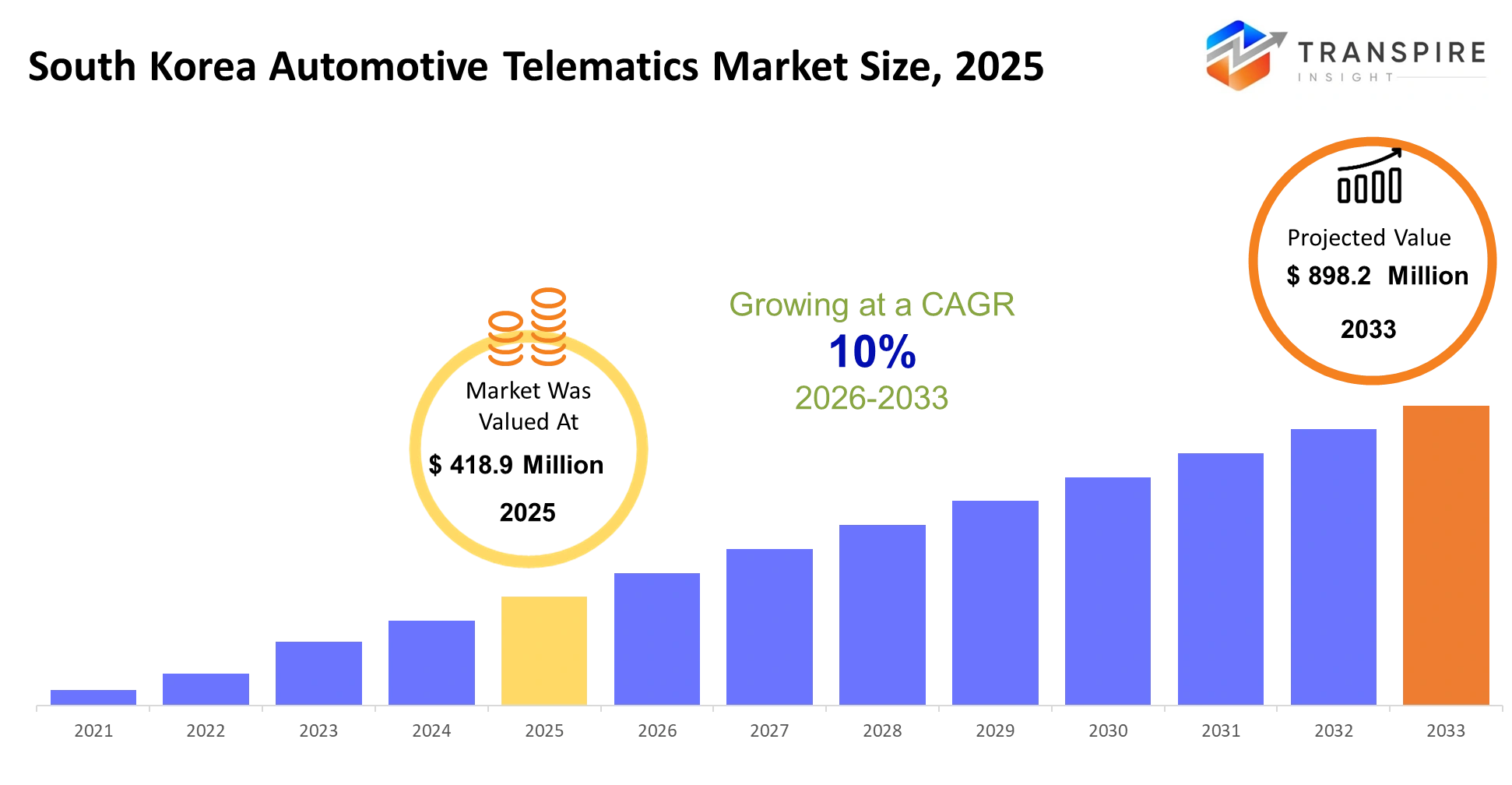
- South Korea Automotive Telematics Market Size 2025: USD 418.9 Million
- South Korea Automotive Telematics Market Size 2033: USD 898.2 Million
- South Korea Automotive Telematics Market CAGR: 10%
- South Korea Automotive Telematics Market Segments: By Component (Hardware, Software, Services), By Application (Fleet Management, Navigation & Infotainment, Safety & Security), By Vehicle Type (Passenger Cars, Commercial Vehicles)
To learn more about this report,  Download Free Sample Report
South Korea Automotive Telematics Market Summary:
South Korea Automotive Telematics Market size was estimated at USD 418.9 Millionin 2025 and is anticipated to reach USD 898.2 Million by 2033, growing at a CAGR of 10% from 2026 to 2033.
The South Korean automotive telematics market functions as part of the connected mobility and automotive technology market because South Korea possesses both fast digital technology adoption and a strong tradition of automobile manufacturing. The system will show how drivers need to have continuous internet access which must function without interruptions while they drive between their real-time navigation system and their vehicle's musical content system which serves as a replication of their mobile devices. The local market will require users to have access to systems which operate through natural instinct and immediate feedback thus forcing car manufacturers to enhance their systems while they concentrate on making data processing faster. The new requirements will match urban patterns because people now prefer solutions which help them save time.
The development of telematics equipment will depend on two factors which include regulatory guidance together with safety standards for telematics systems. Authorities will emphasize vehicle tracking, emergency response integration, and data transparency, encouraging companies to design systems that balance innovation with accountability. The development of 5G networks together with vehicle-to-everything communication systems will enhance vehicle interactions with both infrastructure elements and different devices which will result in alterations to regular driving patterns. The industry will shift towards creating driving systems which use technology to assist drivers in making decisions while presenting information to drivers in a non-disruptive manner.
Key Market Trends & Insights:
- The South Korean automotive telematics market experiences steady development because consumers and manufacturers show increasing interest in connected vehicle technology. The system delivers better driving results through its combined capabilities which include navigation, remote diagnostics, and real-time communication technologies. The automotive industry develops because digital infrastructure keeps expanding while production facilities maintain their strong output capabilities for both passenger and commercial vehicles.
- The South Korean automotive telematics market operates under government safety regulations which determine its development direction. The South Korean automotive telematics market receives advantages from strict road safety regulations which require emergency response system implementation. Fleet operators and private vehicle owners will increase their use of vehicle tracking and accident notification solutions because regulators are pushing for these technologies. The automotive industry needs telematics hardware and software because compliance requirements demand these technologies for all vehicle platforms.
- The South Korean automotive telematics market develops through 5G technology innovations. The South Korean automotive telematics market grows because 5G networks provide users with quick data transfer and dependable internet access. The advanced bandwidth capabilities enable users to access real-time traffic updates and vehicle-to-everything communication and cloud-based services. The collaboration between telecom companies and automotive manufacturers leads to new innovations which enhance their service delivery capacity.
- The South Korean automotive telematics market experiences growth because fleet management solutions receive increasing demand from customers. The South Korean automotive telematics market operates through rising telematics usage which logistics and transportation operators use to improve their operational efficiency. The fleet operators use telematics systems to achieve three objectives which include optimizing their routes and tracking fuel consumption and assessing their drivers' performance. The adoption process maintains its pace because commercial vehicle networks use telematics systems for both performance measurement and cost management.
- The South Korean automotive telematics market experiences electric vehicle integration as a direct market impact. The South Korean automotive telematics market develops in response to electric vehicle expansion because telematics systems provide essential support for battery monitoring and charging station navigation and energy management. The electric mobility ecosystem expansion leads to the integration of advanced features within the system. The automotive manufacturers develop their connected electric platforms which create new market development opportunities for the entire industry.
South Korea Automotive Telematics Market Segmentation
By Component :
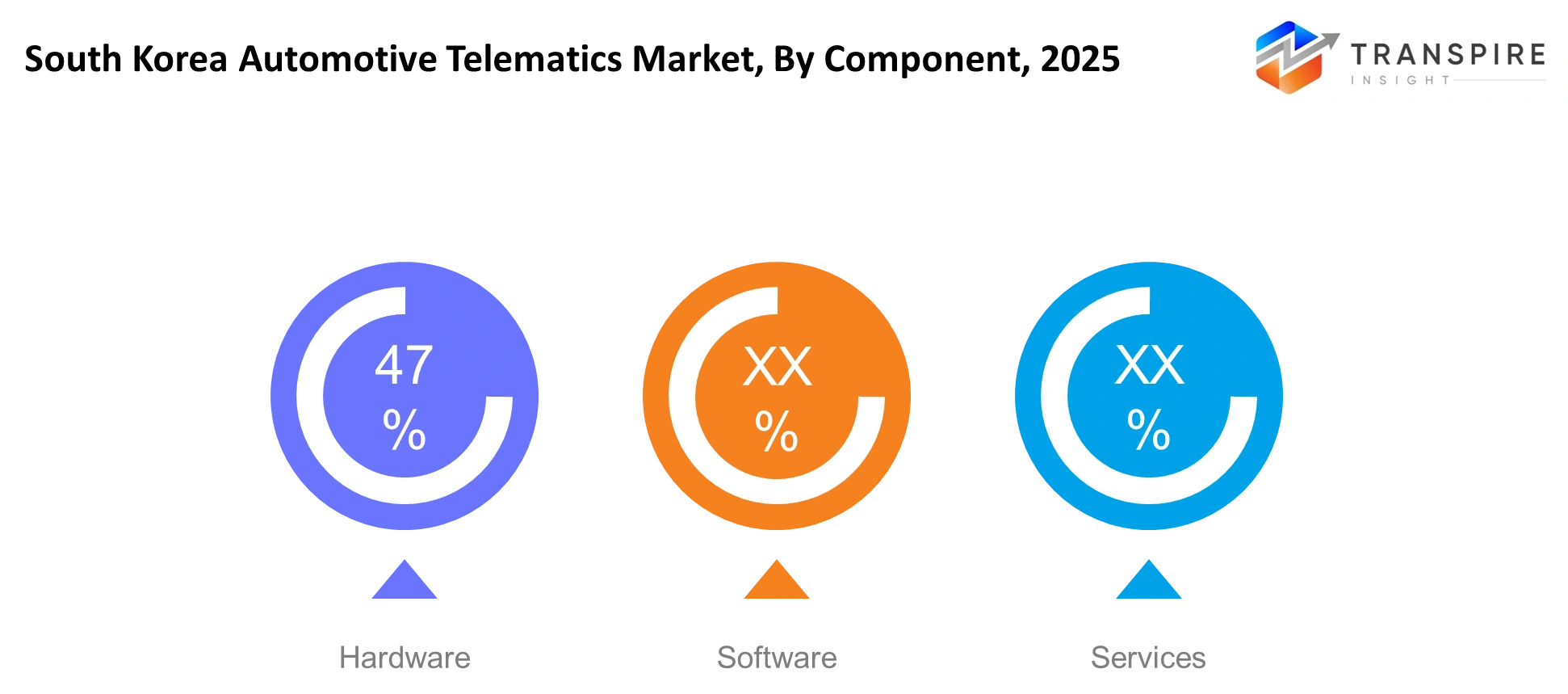
- Hardware:The fundamental components of telematics systems display their physical presence through hardware elements, which consist of control units and sensors and GPS modules and communication devices. The increasing demand for connected vehicles will create a need for manufacturers to develop hardware components which need to be integrated into all vehicle types. The automotive industry continues to prioritize cost efficiency and durability while manufacturers develop compact products that provide dependable data transmission capabilities for extended automotive applications.
- Software: Telemetry solutions depend on software functions that provide data processing abilities and system control capabilities and user interface options. The advanced platforms provide real-time tracking capabilities, diagnostic functions, and predictive analysis tools. The system will achieve better functionality and security improvements through ongoing updates. The team develops user-friendly interfaces which work together with mobile devices to enable seamless operation across various vehicle systems and digital environments.
- Services: The services provide subscription-based products which include remote diagnostic capabilities and emergency assistance services and data analytics solutions. The demand for additional services will increase as more vehicles become connected to the internet. The service providers direct their efforts toward establishing customer support systems and building cloud integration frameworks and implementing data security measures. The establishment of long-term contracts together with customized solutions will enhance the connection between service providers and vehicle owners.
To learn more about this report, Download Free Sample Report
By Application :
- Fleet Management: Fleet management solutions enable businesses to track their vehicles while they optimize routes and monitor fuel usage and study driver behavior patterns. Businesses will adopt these systems to reduce operational costs and improve efficiency. The ability to access real-time data helps organizations make better decisions while their productivity levels increase. Logistics platform integration creates better operational coordination which enables fleet operations to become more visible and manageable.
- Navigation & Infotainment:Navigation systems together with infotainment systems provide users with directions while offering streaming media and connectivity entertainment capabilities. The demand for in-car systems will increase because consumers want smarter vehicle experiences. The system provides traffic updates through real-time mode while supporting voice command and smartphone connection features. Continuous innovation improves convenience to create a more engaging and informative driving experience.
- Safety & Security: Safety and security applications provide three main functions which are emergency response and theft tracking and driver assistance systems. The rising emphasis on road safety will boost the usage of these particular solutions. Alerts, monitoring systems, and automated assistance help reduce risks. Data-driven insights support preventive measures which lead to improved safety standards across modern vehicles.
By Vehicle Type :
- Passenger Cars: Passenger cars lead adoption because people want to have connected features which improve their driving experience. The implementation of telematics systems will enable users to access navigation services and entertainment options and safety features. Manufacturers create products which customers can afford while providing simple operational methods. People will become more aware of smart mobility solutions which will drive further adoption in this market.
- Commercial Vehicles: Telematics systems enable commercial vehicles to improve their operational efficiency while decreasing their operational costs. Fleet operators will use advanced technology to track their fleet vehicles and schedule maintenance operations and verify regulatory compliance. Data insights enhance both route optimization and fuel resource management. The increasing requirements for logistics will drive telematics adoption because it has become a vital component of commercial transportation systems.
Country Insights
- The advanced digital infrastructure and high smartphone usage in South Korea enable people to adopt connected vehicle technologies. The South Korea Automotive Telematics Market keeps growing because consumers demand real-time navigation systems and safety alerts and they want to stay connected throughout their driving experience. The government funding of smart mobility projects together with intelligent transport systems will drive telematics system development across both passenger and commercial vehicle sectors during upcoming years.
- The entire automobile industry in South Korea works to make telematics systems a required standard feature for all vehicles. The demand for software platforms and cloud integration services and data-driven solutions will increase because of this shift. The South Korea Automotive Telematics Market benefits from the presence of well-established automotive and electronics industries, which will help in rapid innovation and faster deployment of connected solutions across urban and highway transport systems.
- Electric vehicle adoption and autonomous driving technologies will create new business opportunities for telematics systems.Telematics systems will enable essential functions which include vehicle diagnostics and battery monitoring and remote updates. The South Korea Automotive Telematics Market will develop new features as the industry moves towards smarter and safer transportation systems which rely on strong network infrastructure and consumers who prefer digital driving experiences.
Recent Development News
5G-enabled telematics control units gain traction
April 2026 – The Elec (Korea tech news)
New telematics control units (TCUs) using 5G and satellite connectivity (Samsung tech) are being integrated into vehicles, which establishes better real-time communication systems that advanced telematics and navigation and autonomous driving systems need to function properly.
South Korea expands EV subsidies to support smart mobility
November 2025 – ReutersThe government increased EV subsidies by 20% for 2026, which resulted in telematics adoption growth because electric vehicles need connected systems and remote diagnostic capabilities and over-the-air updates to operate.
|
Report Metrics |
Details |
|
Market size value in 2025 |
USD 418.9 Million |
|
Market size value in 2026 |
USD 460.8 Million |
|
Revenue forecast in 2033 |
USD 898.2 Million |
|
Growth rate |
CAGR of 10% from 2026 to 2033 |
|
Base year |
2025 |
|
Historical data |
2021 - 2024 |
|
Forecast period |
2026 - 2033 |
|
Report coverage |
Revenue forecast, competitive landscape, growth factors, and trends |
|
Country scope |
South Korea |
|
Key company profiled |
Verizon Communications Inc., AT&T Inc., Robert Bosch GmbH, Continental AG, Qualcomm Incorporated, Harman International Industries Inc., TomTom N.V., Trimble Inc., Geotab Inc., Octo Telematics S.p.A., CalAmp Corp., Sierra Wireless Inc., Mix Telematics Ltd., Teletrac Navman, Zonar Systems Inc. Group Corporation, Indian Oil Corporation Ltd., Gerdau S.A. |
|
Customization scope |
Free report customization (country, regional & segment scope). Avail customized purchase options to meet your exact research needs. |
|
Report Segmentation |
By Component (Hardware, Software, Services), By Application (Fleet Management, Navigation & Infotainment, Safety & Security), By Vehicle Type (Passenger Cars, Commercial Vehicles) |
Key South Korea Automotive Telematics Company Insights
- The South Korea Automotive Telematics market shows strong activity from established automotive electronics firms and connected technology providers. The primary objective of the project remains to establish vehicle connectivity with navigation systems and safety integration components. Companies invest in software platforms that support real-time data exchange, which enables improved driver awareness and traffic management and vehicle diagnostics across passenger and commercial segments.
- The current competitive situation in the South Korea Automotive Telematics market displays itself through the existing partnerships between vehicle manufacturers and telecommunications companies. The project maintains its focus on three core elements: embedded systems and cloud-based services and 5G-enabled communication. The ongoing product upgrades together with new partnerships allow companies to expand their smart mobility solutions which leads to better user experience and greater market share in both domestic and international automotive markets.
South Korea Automotive Telematics Market Companies:
- Verizon Communications Inc.
- AT&T Inc.
- Robert Bosch GmbH
- Continental AG
- Qualcomm Incorporated
- Harman International Industries Inc.
- TomTom N.V.
- Trimble Inc.
- Geotab Inc.
- Octo Telematics S.p.A.
- CalAmp Corp.
- Sierra Wireless Inc.
- Mix Telematics Ltd.
- Teletrac Navman
- Zonar Systems Inc.
South Korea Automotive Telematics Market Segmentation
By Component
- Hardware
- Software
- Services
By Application
- Fleet Management
- Navigation & Infotainment
- Safety & Security
By Vehicle Type
- Passenger Cars
- Commercial Vehicles
Frequently Asked Questions
Find quick answers to common questions.
The Approximate South Korea Automotive Telematics Market size for the Market will be USD 898.2 Million in 2033.
Key Segments for the South Korea Automotive Telematics Market are By Component (Hardware, Software, Services), By Application (Fleet Management, Navigation & Infotainment, Safety & Security), By Vehicle Type (Passenger Cars, Commercial Vehicles).
Major South Korea Automotive Telematics Market Players are Verizon Communications Inc., AT&T Inc., Robert Bosch GmbH, Continental AG, Qualcomm Incorporated, Harman International Industries Inc., TomTom N.V., Trimble Inc., Geotab Inc., Octo Telematics S.p.A., CalAmp Corp., Sierra Wireless Inc., Mix Telematics Ltd., Teletrac Navman, Zonar Systems Inc. Group Corporation, Indian Oil Corporation Ltd., Gerdau S.A.
The Current South Korea Automotive Telematics Market size is USD 418.9 Million in 2025.
The South Korea Automotive Telematics Market CAGR is 10%.
- Verizon Communications Inc.
- AT&T Inc.
- Robert Bosch GmbH
- Continental AG
- Qualcomm Incorporated
- Harman International Industries Inc.
- TomTom N.V.
- Trimble Inc.
- Geotab Inc.
- Octo Telematics S.p.A.
- CalAmp Corp.
- Sierra Wireless Inc.
- Mix Telematics Ltd.
- Teletrac Navman
- Zonar Systems Inc.
Recently Published Reports
-
Apr 2026
3D Optical Profiler Market
3D Optical Profiler Market Size, Share & Analysis Report By Type (Desktop 3D Optical Profiler, and Portable 3D Optical Profiler), By Technology (Confocal Technology, and White Light Interference), By End-Use Industry (Manufacturing, Research Institutions, Automotive, Aerospace and Defense, Medical Devices, and Other), and Geography (North America, Europe, Asia-Pacific, Middle East and Africa, South and Central America), 2021 - 2031
-
Apr 2026
Depth Sensor Market
Depth Sensor Market Size, Share & Analysis Report By Type (Infrared Depth Sensors, Time-of-Flight (ToF) Sensors, Stereo Vision Sensors, Structured Light Sensors, Ultrasonic Depth Sensors), By Application (Automotive, Robotics, Gaming, Consumer Electronics, Industrial Automation, Healthcare, Security & Surveillance, Others), By End Users (Automotive Manufacturers, Consumer Electronics Companies, Healthcare Providers, Industrial Companies, Security Agencies, Gaming Companies, Robotics Companies, Others), and Geography (North America, Europe, Asia-Pacific, Middle East and Africa, South and Central America), 2021 – 2031
-
Apr 2026
Digital Manufacturing Market
Digital Manufacturing Market Size, Share & Analysis Report By Component (Hardware, Software, and Services), By Technology (Robotics, 3D Printing, Internet of Things (IoT), and Others), By Application (Automotive and Transportation, Aerospace and Defense, Consumer Electronics, Industrial Machinery, and Others), By Process Type (Computer-Based Designing, Computer-Based Simulation, Computer 3D Visualization, Analytics, and Others), and Geography (North America, Europe, Asia-Pacific, Middle East and Africa, South and Central America), 2021 – 2031
-
Apr 2026
Digital Visa Services Market
Digital Visa Services Market Size, Share & Analysis Report By Type (Individual Travelers, Group Travelers), By Application (Tourism, Business Travel, Others), and Geography (North America, Europe, Asia-Pacific, Middle East and Africa, South and Central America), 2021 – 2031