
South Korea Plastic Antioxidants Market Size & Forecast:
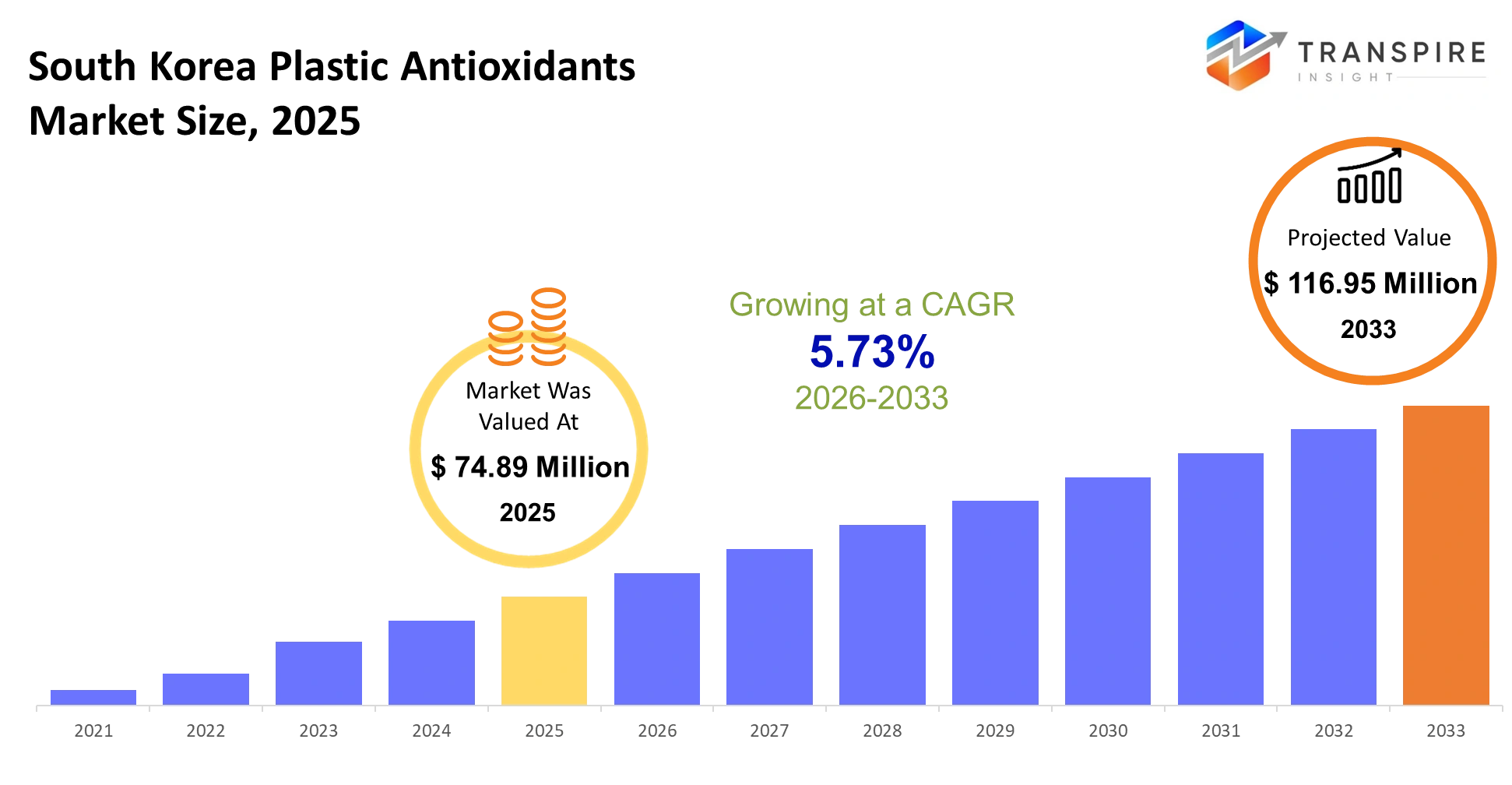
- South Korea Plastic Antioxidants Market Size 2025: USD 74.89 Million
- South Korea Plastic Antioxidants Market Size 2033: USD 116.95 Million
- South Korea Plastic Antioxidants Market CAGR: 5.73%
- South Korea Plastic Antioxidants Market Segments: By Type (Phenolic Antioxidants, Phosphite Antioxidants, Thioester Antioxidants, Antioxidant Blends, Others); By Application (Polyolefins, PVC, Engineering Plastics, Rubber Processing, Others); By Form (Powder Antioxidants, Liquid Antioxidants, Pellet Antioxidants, Others); By End User (Packaging Industry, Automotive Industry, Construction Industry, Electronics Industry, Others); By Function (Thermal Stabilization, Oxidation Prevention, UV Protection, Processing Stability, Others)
To learn more about this report,  Download Free Sample Report
South Korea Plastic Antioxidants Market Summary
The South Korea Plastic Antioxidants Market was valued at USD 74.89 Million in 2025. It is forecast to reach USD 116.95 Million by 2033. That is a CAGR of 5.73% over the period.
The South Korea Plastic Antioxidants Market takes on a kind of important role in stretching the practical life of plastic goods, especially those that get hit by heat, oxygen, and all those repeated processing cycles. You see it in automotive components, flexible packaging, electronics housings and also a lot of industrial parts, where the material has to just keep going. Manufacturers lean on these additives so they can avoid discoloration, reduce brittleness and stop polymer breakdown, even when production runs are fast and when the product is in use for a long time. Over the last five years, the market kind of moved away from plain stabilization chemistry, and toward better antioxidant systems built for recycled plastics as well as lightweight engineering polymers. That shift picked up steam after supply chain issues during the COVID-19 period made the risks show more clearly, like waste of material and uneven resin quality. South Korean converters, and compounders, answered by pulling in more advanced stabilization packages that support resin endurance and processing efficiency too . As electric vehicles keep growing, and food-grade packaging plus recycled polymer applications keep expanding, antioxidant suppliers are also taking hold of higher value agreements. Those deals are increasingly linked with performance dependability, regulatory adherence and longer material lifespans.
Key Market Insights
- In South Korea, the Plastic Antioxidants Market is slowly but surely tilting toward phosphite and phenolic blends, especially for keeping recycled polypropylene, and polyethylene processing steady, not too chaotic though.
- At the same time the Seoul metropolitan manufacturing clusters grabbed something around 42% of the country’s specialty polymer additive consumption in 2025, give or take a bit.
- Then down in the southeast industrial belt, like Ulsan and Busan, demand lift looks quicker, mostly because petrochemical projects and automotive expansion keep rolling.
- For 2025, phenolic antioxidants still pretty much dominated the market, and processors leaned on them because thermal stability matters a lot in high temperature molding, not just as a concept, but in day to day operations.
- After 2022 phosphite antioxidants became the fastest moving segment, mainly due to a wider adoption in recycled resin formulations, where tweaking performance is kind of the routine.
- Packaging applications made up more than 34% of total demand in 2025, since food contact plastics required longer shelf-life behavior, and nobody wants unexpected odor, or degradation showing up later.
- When it comes to automotive polymer use, the growth outlook also looks strongest, mostly because lightweight vehicle platforms are spreading, and EV component manufacturing is getting more intense.
- Electronics, plus semiconductor makers also increased antioxidant use in engineering plastics, focusing on improved thermal resistance and dimensional stability, even when temperatures swing.
- And across the board, manufacturers compete more and more via backward integration, supply reliability , and low-VOC additive technologies that are basically tailored for recycled plastics.
What are the Key Drivers, Restraints, and Opportunities in the South Korea Plastic Antioxidants Market?
The most impactful factor driving the South Korea Plastic Antioxidants Market is this fast move toward high-performance plus recycled polymer processing across automotive electronics and packaging. In South Korea manufacturers are basically running polymers at higher temperatures, and also with quicker production speeds, just to lift throughput while trying to trim the material expenses. But with that operational push comes higher oxidation danger during extrusion and molding, so compounders are now leaning into more sophisticated phenolic and phosphite antioxidant systems. Demand kind of got another boost after recycled resin requirements and circular economy targets, which motivated converters to make secondary plastics last longer and stay more uniform. Because of all that, additive suppliers that can support recycled polyethylene and polypropylene use cases, are also getting more premium supply contracts.
The main restraint still feels like raw material volatility tied to petrochemical feedstocks and specialty intermediates. A lot of antioxidant chemistries rely on chemical inputs that are traded globally, and those inputs stay exposed to supply interruptions, freight swings and energy cost shocks. It’s kind of structural too, since South Korea depends a lot on imported specialty chemical intermediates. When prices behave like that, processors lose purchasing certainty, and small to mid-sized compounders often end up delaying orders, or stretching procurement timelines.
A bigger opportunity is showing up in stabilization solutions built specifically for recycled engineering plastics in electric vehicles and electronics. Korean battery groups, semiconductor players, and mobility manufacturers are asking more often for recycled polymers that hold up, meaning better resistance to heat exposure and repeated processing cycles.
What Has the Impact of Artificial Intelligence Been on the South Korea Plastic Antioxidants Market?
Artificial intelligence and advanced digital fabrication systems are quietly reshaping the way plastic antioxidants get produced, checked, and then folded into polymer processing operations across South Korea. In practice, chemical manufacturers are using AI-driven process observation platforms more and more, to steady reactor temperatures, tune blending ratios, and nudge production yields upward inside antioxidant manufacturing sites. At the same time, automated quality control setups, using machine vision, now catch color shifts and thermal stability defects faster than manual review approaches. So producers can cut down on off-spec batches, more or less right at the source.
On another front, machine learning models are pushing predictive formulation work forward. Manufacturers take performance datasets from extrusion and molding runs to estimate oxidation behavior under assorted heat and pressure scenarios. That helps compounders fine-tune antioxidant loading rates while avoiding pointless additive consumption, which is kind of a win for cost and materials handling. In polymer processing plants, predictive maintenance systems also look at vibration, pressure, and energy-use signals from extrusion equipment, so downtime drops, and processing stays steadier. Overall, these tools have improved production efficiency, reduced waste output, and supported compliance with tougher industrial quality requirements.
That said, AI adoption still has limits. Deployment costs can be high, and operational data is often fragmented, so it becomes hard for smaller and mid-sized processors to roll out advanced analytics platforms at anything like scale. A lot of factories still rely on older, legacy processing systems that don’t fit cleanly with real-time digital monitoring, or with AI-based process optimization, without major upgrades and downtime.
Key Market Trends
- Since 2021, Korean converters have been moving more toward multifunctional antioxidant mixes that they say, improve thermal steadiness, in recycled polypropylene processing, and somehow it helps overall.
- Automotive suppliers ramped up antioxidant use after EV battery housings started needing more heat resistant engineering plastics during 2023, and 2024.
- Packaging manufacturers have cut back on relying so much on commodity additives , and they switched to food-contact compliant stabilization systems, for export minded production.
- SONGWON Industrial, has expanded customer focused stabilizer offerings between 2025 , and 2026 to back sustainability driven polymer uses.
- Resin processors are now asking more often for low volatility antioxidants, to reduce emissions while running high speed extrusion and injection molding operations.
- Electronics makers have accelerated their uptake of advanced phosphite stabilizers for smaller parts that face elevated thermal environments.
- After the 2020 disruptions, Korean buyers leaned toward additive suppliers that are locally integrated, with clearer feedstock visibility.
- Many companies are now investing in antioxidant formulations that match mechanically recycled polyethylene and polypropylene, better than before.
- BASF and Clariant expanded their technical collaboration approaches with regional compounders, to strengthen the ability to build customized additive packages.
- Since 2024, additive manufacturers have pushed automation investments forward, for steadier batches and to reduce operational waste, too.
South Korea Plastic Antioxidants Market Segmentation
By Type
Phenolic Antioxidants seem to keep the leading market position, mostly because manufacturers use these additives quite often to prevent thermal breakdown during plastic processing and also during long-term product use. Their good compatibility with polyolefins, engineering plastics and packaging materials keeps consumption high across industrial manufacturing. Phosphite Antioxidants are right behind them , since processors lean on these stabilizers during hot extrusion or molding steps to improve polymer staying power . Antioxidant Blends also keep climbing in relevance, because companies want more than one function from a single additive approach so production feels simpler and formulation stays more steady.
Phenolic Antioxidants are still expanding too, pulled along by demand for tougher packaging films, automotive plastics, and consumer electronics parts that should last longer in service. Phosphite Antioxidants gain momentum with higher output of heat sensitive engineering plastics, especially those connected to electric vehicle systems and high-end electronics manufacturing. Thioester Antioxidants mostly remain boxed in for specialized, high-temperature applications where long-term resistance to oxidation really has to show up. Antioxidant Blends are expected to capture more market share, since compounders increasingly prefer tailored additive packages that help processing run smoother and reduce daily operational complexity. Others include specialty antioxidant chemistries built for advanced polymer uses, plus regulatory compliant formulations that match stricter requirements.
By Application
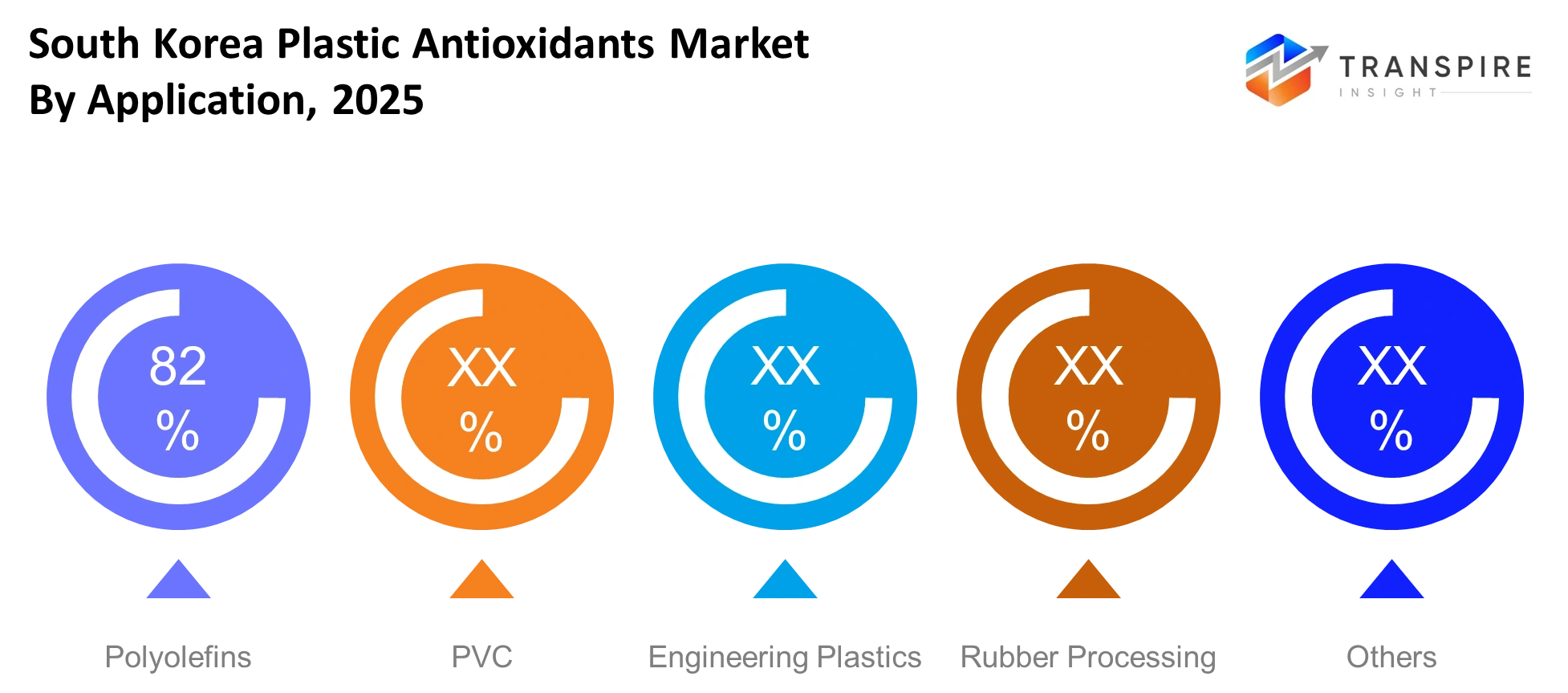
Polyolefins kinda sit as the biggest application segment, because polyethylene and polypropylene really dominate packaging, consumer goods, and a lot of industrial plastic production across South Korea. There’s a lot of high-volume manufacturing going on, plus continuous processing operations too, so demand stays fairly steady for oxidation prevention and thermal stabilization additives , not just some temporary thing.
PVC still holds a solid market place, mainly because it’s used in construction materials , piping systems , and wire insulation applications where durability really matters , and weather resistance becomes non-negotiable. Engineering Plastics keep pulling ahead as automotive electrification and electronics miniaturization push the market toward high-performance polymer systems, with more emphasis on what those materials can handle.
Polyolefins keep growing too, largely because flexible packaging manufacturers increasingly want longer shelf stability, and they try to integrate recycled polymer into their production routines. Engineering Plastics are also expanding quickly, since electric vehicle components and semiconductor equipment need stronger heat resistance and better dimensional stability. Rubber Processing stays at a moderate level , since tire and industrial rubber manufacturers rely on antioxidants to reduce degradation even under high operational stress.
Then there are “Others”, which covers more niche areas like coatings, adhesives, and industrial films. Those are expected to open up more targeted growth opportunities for advanced additive suppliers over the forecast period.
To learn more about this report, Download Free Sample Report
By Form
Powder Antioxidants seem to dominate the market, mostly because big plastic processors like the cost-efficient bulk handling, plus they want something that’s easier to integrate into compounding routines. They also show strong compatibility in polymer blending systems and they tend to keep a stable shelf life, so the demand keeps getting pulled through industrial manufacturing sites
Pellet Antioxidants still hold an important position, since manufacturers increasingly care about low dust processing rooms and more accurate dosing precision during automated production. Liquid Antioxidants take a smaller share, mainly because storage can get complicated, and they are not always a great fit for certain polymer uses.
Powder Antioxidants keep expanding, packaging and automotive manufacturers want scalable additive setups that can support high volume production efficiency. Pellet Antioxidants are picking up speed too, advanced compounding facilities are leaning into automated material feeding and cleaner manufacturing steps. Liquid Antioxidants stay more concentrated in specialty industrial applications, where rapid dispersion and formulation flexibility can really matter. Others include tailored antioxidant delivery systems made for niche polymer processing situations, and also specialty resin manufacturing use cases.
By End User
Packaging Industry holds the dominant end user position, partly because food wrapping, industrial films , and those flexible plastic applications really need antioxidants to keep up structural stability and shelf-life results. Big scale polyolefin usage in consumer goods production is still doing its job supporting high additive consumption. Automotive Industry follows pretty closely since more lightweight plastics are going into electric vehicles, battery housings, and interior parts that face heat and oxidation type stress.
Construction Industry keeps pretty stable demand, through PVC pipes, insulation products, and long lasting infrastructure use cases. Packaging Industry keeps expanding too, because recycled plastic integration has gone up, and that makes the stabilization additives request more urgent for restoring polymer performance consistency. The Automotive Industry is expected to show even stronger growth as electric vehicle production keeps climbing, which in turn raises the need for heat resistant engineering plastics and polymer systems meant for long service life.
The Electronics Industry is also growing in importance, since semiconductor equipment and electronic housings need exact thermal stabilization during manufacturing. Other end-use areas include medical devices, industrial machinery, and agricultural plastics, all of which still generate a diversified but smaller additive demand, even if none of them are really dominating in volume.
By Function
Thermal Stabilization is basically the leading functional piece, because plastic processing work sort of exposes polymers to high temperatures during extrusion, molding and compounding . Manufacturers really depend on thermal stabilizers in order to stop discoloration, brittleness, and molecular degradation across both packaging and automotive uses. Oxidation Prevention keeps a sizable market position, since long exposure to oxygen plus environmental stress can reduce plastic lifespan and weaken mechanical strength over time. Processing Stability stays important too, for keeping production consistent, and for reducing material discard during high-speed manufacturing operations.
Thermal Stabilization demand keeps climbing, partly because electric vehicle setups and advanced electronics need polymers that can hold their performance under higher working temperatures. Oxidation Prevention sees additional demand from wider recycled plastic usage, because those streams often require extra stabilization support to keep durability targets . UV Protection is starting to pick up momentum in outdoor construction materials , automotive coatings, and agricultural films that face long sunlight periods. Other solutions also expand, like multifunctional stabilization systems for specialty polymers and high-performance industrial uses, where companies increasingly look for extended service life and regulatory compliance.
What are the Key Use Cases Driving the South Korea Plastic Antioxidants Market?
The biggest use case for plastic antioxidants is still mostly packaging production, especially for polyethylene and polypropylene use in food packaging, films caps, and containers. In practice, producers rely on antioxidant systems to stop polymer degradation when they run material through high-speed extrusion, plus during that repeated heat exposure thing. This ends up supporting the end product look, its shelf stability, and the whole processing efficiency.
In addition, automotive and electronics use keeps growing at a steady pace, mostly because Korean manufacturers are taking up lighter engineering plastics for electric vehicles. You can see it in things like connectors, appliance housings, and semiconductor related components. These situations demand more advanced stabilization systems, meaning they have to keep thermal resistance and mechanical integrity together even when operating conditions get tough.
More newer opportunities are showing up too, like recycled engineering plastics, plus high-performance blends for battery related parts and more sustainable consumer products. Additive suppliers are also tuning specialized antioxidant systems for chemically recycled polymers. For them, keeping resin quality after multiple processing cycles is turning into a real commercial must, not just a nice-to-have.
|
Report Metrics |
Details |
|
Market size value in 2025 |
USD 74.89Million |
|
Market size value in 2026 |
USD 79.18 Million |
|
Revenue forecast in 2033 |
USD 116.95 Million |
|
Growth rate |
CAGR of 5.73% from 2026 to 2033 |
|
Base year |
2025 |
|
Historical data |
2021 - 2024 |
|
Forecast period |
2026 - 2033 |
|
Report coverage |
Revenue forecast, competitive landscape, growth factors, and trends |
|
Regional scope |
South Korea |
|
Key company profiled |
BASF, SONGWON Industrial, SI Group, Clariant, Adeka Corporation, Solvay, Lanxess, Eastman Chemical, Dover Chemical Corporation, Oxiris Chemicals, Astra Polymers, Mayzo Inc., Everlight Chemical, Milliken & Company, Evonik Industries |
|
Customization scope |
Free report customization (country, regional & segment scope). Avail customized purchase options to meet your exact research needs. |
|
Report Segmentation |
By Type (Phenolic Antioxidants, Phosphite Antioxidants, Thioester Antioxidants, Antioxidant Blends, Others); By Application (Polyolefins, PVC, Engineering Plastics, Rubber Processing, Others); By Form (Powder Antioxidants, Liquid Antioxidants, Pellet Antioxidants, Others); By End User (Packaging Industry, Automotive Industry, Construction Industry, Electronics Industry, Others); By Function (Thermal Stabilization, Oxidation Prevention, UV Protection, Processing Stability, Others) |
Which Regions are Driving the South Korea Plastic Antioxidants Market Growth?
Asia Pacific is still the biggest regional push shaping the South Korea Plastic Antioxidants Market ,mostly because it has this kind of connected petrochemical ecosystem, a solid polymer manufacturing base and a very export-minded industrial setup. China, South Korea and Japan together make up a large portion of the region’s polymer processing capacity, and that basically keeps the demand steady for high-performance stabilization additives. In South Korea, places like Ulsan, Yeosu, and Daesan matter a lot , because refiners, resin producers, and additive manufacturers work in near proximity, so the supply chains stay very tight. On top of that, when electronics, automotive and packaging producers keep up strict quality rules, it becomes easier for premium antioxidant formulations to be adopted across the whole region.
Europe comes next as the second-largest contributor, but the reason it expands is not the same as Asia Pacific. Here the demand is driven more by regulation, rather than raw production size. The region’s circular economy agendas and recycled-content requirements have raised the need for antioxidant systems that keep polymers durable through repeated processing cycles. Germany, France, and Italy continue to put money into specialty plastics and sustainable packaging, so additive suppliers keep a relatively stable revenue base. European processors also lean toward low-emission, and food-contact compliant formulations, which in turn supports ongoing demand for advanced stabilization technologies.
North America is getting attention as the fastest-growing regional market, mainly because of reshoring moves and ongoing modernization in polymer manufacturing and automotive supply networks. Starting in 2024, U.S.
Who are the Key Players in the South Korea Plastic Antioxidants Market and How Do They Compete?
Competition in the South Korea Plastic Antioxidants Market stays fairly moderately consolidated, with big global specialty chemical firms controlling a meaningful slice of the high performance additive supply, sorta speaking. The market also seems to reward the players that can mix formulation know how with regional production presence, and also offer technical support, not just those trying to undercut on price. Long standing producers keep defending their market share by putting out customized antioxidant systems for recycled polymers, automotive plastics, and electronics use. New entrants, however, run into a few barriers, like regulatory compliance issues, feedstock sourcing, and the long term qualification expectations that industrial customers often require.
BASF plays a strong role using advanced formulation technology, plus very close cooperation with polymer processors working on high temperature and recycled plastic applications. It differentiates itself via wide additive integration capabilities across packaging, automotive, and engineering plastics arenas. SONGWON Industrial, on the other hand, leans on manufacturing integration inside South Korea, which helps with quicker supply response and better feedstock visibility compared with many international rivals. That regional production footprint gives it a clear edge when serving Asian converters who want reliable supply and tailored stabilization systems.
SI Group zeroes in on specialty antioxidant chemistries that are tuned for long life industrial polymers and also for harsh thermal processing conditions. Clariant differentiates via sustainability oriented additive systems aimed at low emission manufacturing and food contact applications. Adeka Corporation keeps pushing forward through high performance stabilization technologies used in electronics and semiconductor.
Company List
- BASF
- SONGWON Industrial
- SI Group
- Clariant
- Adeka Corporation
- Solvay
- Lanxess
- Eastman Chemical
- Dover Chemical Corporation
- Oxiris Chemicals
- Astra Polymers
- Mayzo Inc.
- Everlight Chemical
- Milliken & Company
- Evonik Industries
Recent Development News
“In January 2026, SONGWON Industrial expanded its partnership with Biesterfeld to distribute SONGNOX and SONGSORB stabilizer product lines across additional European markets. The agreement strengthened SONGWON’s international distribution network and improved access to specialty polymer antioxidant technologies in strategic industrial regions.https://www.paint.org
“In October 2025, SONGWON Industrial launched sustainability-focused polymer stabilizer technologies at K 2025 in Germany. The new additive portfolio targeted recyclable plastics and advanced polymer processing applications, supporting the company’s expansion in circular economy materials.https://www.songwon.com
What Strategic Insights Define the Future of the South Korea Plastic Antioxidants Market?
Over the next five to seven years , the South Korea Plastic Antioxidants Market is kind of structurally shifting toward more advanced stabilization systems, meant for recycled polymers and also electric vehicle components, plus high-temperature engineering plastics. What’s happening here is that the market direction is being shaped more and more by circular economy mandates, and by the need for durable materials that can actually keep their performance after repeated processing cycles. Because of that, the shift should gradually move revenue concentration away from basic commodity antioxidants, toward customized , application specific additive systems that carry higher technical value.
There’s also a hidden risk, namely the tightening restrictions on chemical additives used in food contact and in recycled plastic applications. Any regulatory changes could push reformulation work, raise compliance costs , and even create supply challenges for manufacturers who still rely on older antioxidant chemistries. At the same time though, antioxidant systems designed for chemically recycled engineering plastics look like a real emerging opportunity. This is especially true for battery-related applications, and for semiconductor manufacturing supply chains.
Market participants should prioritize investment in localized technical support, and on collaborative formulation development. In practice, the companies that can co-develop stabilization solutions with recyclers, compounders, and automotive suppliers, will probably end up with the strongest long-term commercial position, through 2033.
South Korea Plastic Antioxidants Market Report Segmentation
By Type
- Phenolic Antioxidants
- Phosphite Antioxidants
- Thioester Antioxidants
- Antioxidant Blends
- Others
By Application
- Polyolefins
- PVC
- Engineering Plastics
- Rubber Processing
- Others
By Form
- Powder Antioxidants
- Liquid Antioxidants
- Pellet Antioxidants
- Others
By End User
- Packaging Industry
- Automotive Industry
- Construction Industry
- Electronics Industry
- Others
By Function
- Thermal Stabilization
- Oxidation Prevention
- UV Protection
- Processing Stability
- Others
Frequently Asked Questions
Find quick answers to common questions.
The estimated South Korea Plastic Antioxidants Market size for the market will be USD 116.95 Million in 2033.
Key segments for the South Korea Plastic Antioxidants Market are By Type (Phenolic Antioxidants, Phosphite Antioxidants, Thioester Antioxidants, Antioxidant Blends, Others); By Application (Polyolefins, PVC, Engineering Plastics, Rubber Processing, Others); By Form (Powder Antioxidants, Liquid Antioxidants, Pellet Antioxidants, Others); By End User (Packaging Industry, Automotive Industry, Construction Industry, Electronics Industry, Others); By Function (Thermal Stabilization, Oxidation Prevention, UV Protection, Processing Stability, Others).
Major South Korea Plastic Antioxidants Market players are BASF, SONGWON Industrial, SI Group, Clariant, Adeka Corporation, Solvay, Lanxess, Eastman Chemical, Dover Chemical Corporation, Oxiris Chemicals, Astra Polymers, Mayzo Inc., Everlight Chemical, Milliken & Company, Evonik Industries.
The South Korea Plastic Antioxidants Market size is USD 74.89 Million in 2025.
The South Korea Plastic Antioxidants Market CAGR is 5.73% from 2026 to 2033.
- BASF
- SONGWON Industrial
- SI Group
- Clariant
- Adeka Corporation
- Solvay
- Lanxess
- Eastman Chemical
- Dover Chemical Corporation
- Oxiris Chemicals
- Astra Polymers
- Mayzo Inc.
- Everlight Chemical
- Milliken & Company
- Evonik Industries
Recently Published Reports
-
May 2026
Healthcare Polymer Packaging Market
Healthcare Polymer Packaging Market Size, Share & Analysis Report By Packaging Type (Syringes, IV Bottles and Pouches, Clamshells, Blisters, Bottles & Jars, Containers, Tubes, IV Parental Packaging, Others), By Type (Regulated, Non-regulated), By Polymer Type (LDPE (Low-Density Polyethylene), HDPE (High-Density Polyethylene), Homo-polymer (Homo), Random Copolymer (Random), Block Copolymer (Block), PET, Polystyrene, Polyvinyl Chloride, Polyamide/EVOH, Others), and Geography (North America, Europe, Asia-Pacific, Middle East and Africa, South and Central America), 2021 - 2031
-
Apr 2026
Hydrophilic Tape (Waterstop) Market
Hydrophilic Tape (Waterstop) Market Size, Share & Analysis Report By Type (Bentonite-Based Hydrophilic Tape, Rubber-Based Hydrophilic Tape), By Application (Residential Buildings, Commercial Buildings, Infrastructure Projects), and Geography (North America, Europe, Asia-Pacific, Middle East and Africa, South and Central America), 2021 - 2031
-
Apr 2026
Metalens Market
Metalens Market Size, Share & Analysis Report By Type (Visible Light Metalens, and Infrared Metalens), By Application (Consumer Electronics, Automotive Electronics, Industrial, Medical, and Others), and Geography (North America, Europe, Asia-Pacific, Middle East and Africa, South and Central America), 2021 - 2031
-
Apr 2026
PBT Resin Market
PBT Resin Market Size, Share & Analysis Report By Type (Reinforced PBT Resin, Unreinforced PBT Resin), By Processing Method (Injection Molding, Extrusion, Blow Molding, Others), By End-User (Automotive, Electrical & Electronics, Consumer Appliances, Industrial Machinery, Medical Devices, Packaging, Others), and Geography (North America, Europe, Asia-Pacific, Middle East and Africa, South and Central America), 2021 - 2031