

South Korea Non-GMO Food Market Size & Forecast:
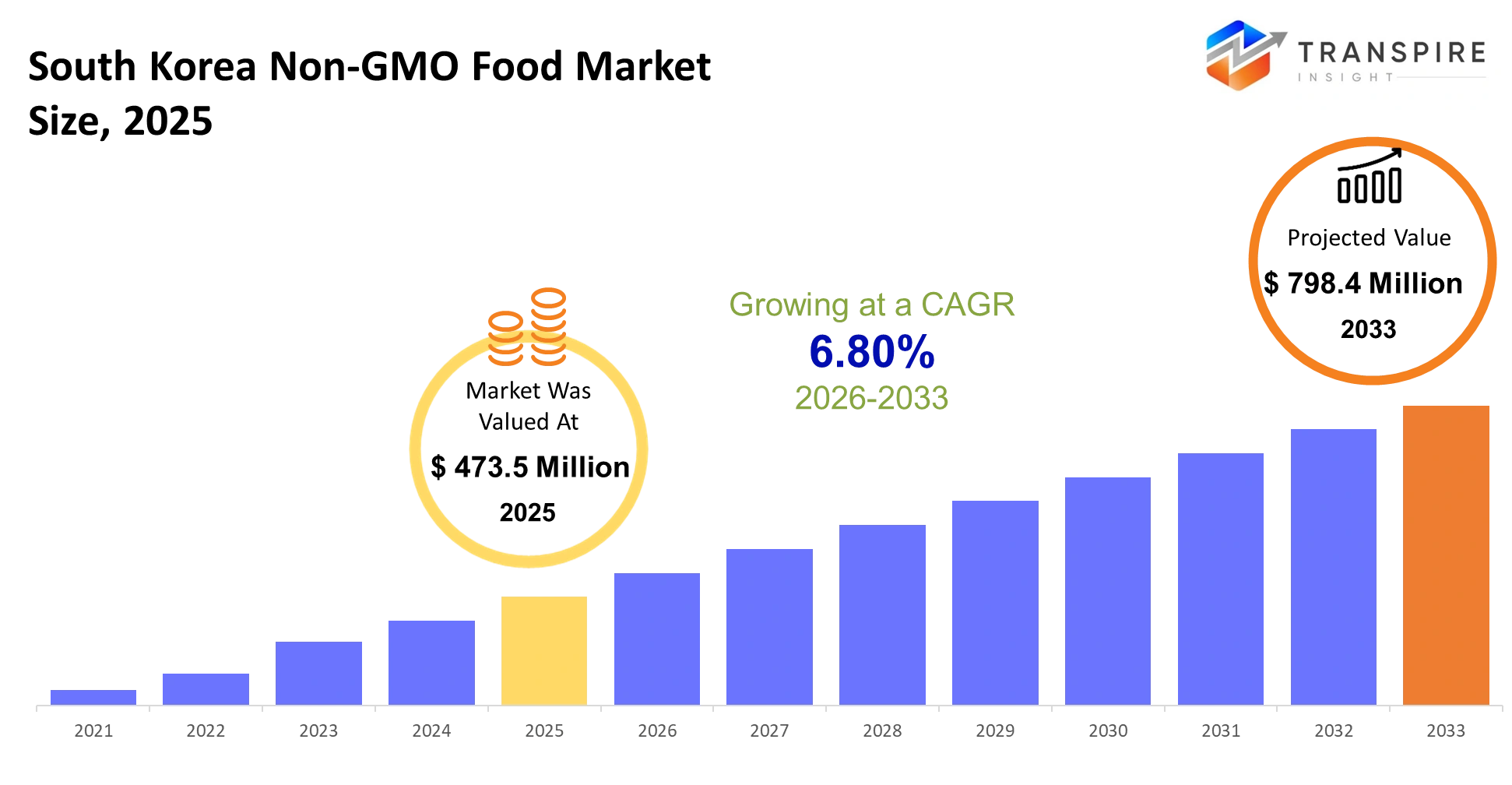
- South Korea Non-GMO Food Market Size 2025: USD 473.5 Million
- South Korea Non-GMO Food Market Size 2033: USD 798.4 Million
- South Korea Non-GMO Food Market CAGR: 6.80%
- South Korea Non-GMO Food Market Segments: By Product Type (Non-GMO Grains, Non-GMO Dairy Products, Non-GMO Snacks, Non-GMO Beverages, Organic Non-GMO Foods, Others); By Distribution Channel (Supermarkets, Online Retail, Specialty Stores, Convenience Stores, Others); By Application (Healthy Diets, Infant Nutrition, Functional Foods, Sports Nutrition, Others); By Certification (USDA Organic, Non-GMO Project Verified, Local Organic Certification, Others); By End User (Adults, Children, Health-conscious Consumers, Others)
To learn more about this report,  Download Free Sample Report
South Korea Non-GMO Food Market Summary
The South Korea Non-GMO Food Market was valued at USD 473.5 Million in 2025. It is forecast to reach USD 798.4 Million by 2033. That is a CAGR of 6.80% over the period.
The South Korea Non-GMO Food Market plays a pretty critical role in helping food manufacturers, retailers and health focused brands deliver traceable products that avoid genetically modified ingredients, while still hitting tougher sourcing and labeling expectations. In practice, this space really underpins premium packaged foods infant nutrition, plant based beverages, and those functional snack lines where ingredient transparency, honestly, changes purchasing decisions and also affects export credibility. Over the last five years, the industry moved from somewhat niche organic retail toward mainstream supermarket distribution. A lot of larger food processors did identity preserved supply chain work, and then leaned on third party certification systems which made the whole process feel more “ready” for scale.
One big catalyst came during the pandemic-era disruptions, when imported grain sourcing got shaky. That period highlighted vulnerabilities and pushed Korean buyers to diversify procurement toward verified non-GMO suppliers. As a result, domestic contract farming picked up, plus premium import channels got strengthened, and that then fed into wider shelf acceptance. Now, as retailers keep assigning more shelf space to clean label categories, suppliers with verified traceability systems are, in many cases capturing higher margins and more durable procurement contracts across South Korea’s processed food ecosystem.
Key Market Insights
- Seoul metro retail channels ended up taking almost 42% of the revenue share in 2025 , mostly because people kept spending more on premium food stuff and because the specialty retail streets are pretty packed.
- Meanwhile the southern provinces seem to be emerging as the fastest-growing demand pockets , with organic farming cooperatives spreading out and direct to consumer grocery platforms getting more traction.
- Non-GMO snacks were the main pull in product demand , they held about 31% market share in 2025, as Korean consumers leaned into convenience foods that feel more traceable.
- Non-GMO beverages then moved into the second spot after functional tea and plant based drink makers , who reformulated their products using certified ingredients.
- Organic non-GMO foods saw the quickest expansion from 2024 all the way to 2033 , helped along by premium supermarket placement and the launch of private label items.
- Supermarkets basically controlled nearly 46% of distribution revenue in 2025, largely because big retailers kept widening clean-label and traceability centered shelf categories.
- Online retail channels are also growing faster right now , since younger consumers increasingly compare ingredient sourcing certifications before they finally decide.
- For end users, adults stayed on top in 2025 , backed by higher spend on functional nutrition , diabetic friendly foods, and wellness oriented eating plans.
- For infants' nutrition applications, things expanded quickly too after ingredient scrutiny got tighter and parents started prioritizing traceable non-GMO dairy and cereal formulations.
- Big players like CJ CheilJedang , Pulmuone , Daesang Corporation , Orga Whole Foods , and Nongshim are investing in traceability systems, premium ingredient sourcing, and clean label product innovation , all to strengthen their competitive edge.
What are the Key Drivers, Restraints, and Opportunities in the South Korea Non-GMO Food Market?
The strongest force pushing the South Korea Non-GMO Food Market forward is a kind of meeting point between mandatory labeling compliance and a higher-end retail presentation, maybe more or less like that. Big supermarket groups plus convenience store operators are asking for clearer ingredient paperwork from suppliers after tighter consumer protection reviews, and also after expanded food traceability expectations that showed up during the post-pandemic recovery stretch. As a result, procurement started moving more often toward verified corn, soy, and grain ingredients coming from certified global suppliers. Food producers then adjusted—processed snacks, beverages, and infant nutrition products got reformulated so they can fit premium shelf space and land in healthier, better-margin categories.
The market’s biggest structural weakness stays the same though, which is the expensive and kind of complicated task of running segregated non-GMO supply chains without mistakes. South Korea depends a lot on imported agricultural raw materials, especially soybeans and corn, so keeping identity preservation consistent costs more across shipping, storage, and processing steps. Suppliers need separate logistics operations, testing routines, and certification audits, otherwise cross-contact and cross-contamination risks creep in. All that operational weight raises retail prices, and it tends to keep smaller food processors from joining in. On top of that, because global non-GMO crop availability is still uneven, buyers keep seeing procurement swings, and that slows wider mass-market adoption.
One obvious growth opening is to link non-GMO certification with functional nutrition and more personalized wellness foods, sort of moving beyond “just non-GMO” into added benefits. South Korea’s older demographic and a growing preventive healthcare mindset are building commercial momentum for fortified dairy alternatives, protein snack formats, and digestive support items.
What Has the Impact of Artificial Intelligence Been on the South Korea Non-GMO Food Market?
Artificial intelligence and advanced digital technologies are, in a way, reshaping the South Korea Non-GMO Food Market, by improving ingredient traceability, supply chain verification and even production forecasting. Food manufacturers more and more lean on AI based analytics platforms to keep an eye on where raw materials actually come from, spot contamination risks earlier and confirm non-GMO certification compliance across imported grain shipments. Machine learning models will look at procurement routines, weather shifts, and commodity price fluctuations to fine-tune sourcing plans for soy, corn, and also specialty grains. In practice this lets manufacturers ease inventory swings without losing certification integrity.
Automation meanwhile has boosted day to day efficiency inside food processing facilities too. Smart quality-control systems, using computer vision tech, can flag labeling inconsistencies, packaging defects, and ingredient separation problems much faster than manual inspection. A handful of premium food brands in South Korea now use predictive analytics, to estimate retail demand and limit waste in short shelf-life clean label products. As a result, production planning tends to get more precise, and storage costs across supermarket supply chains can drop.
Still, AI adoption hits some structural constraints. Bringing digital traceability platforms into fragmented agricultural supplier networks stays pricey, particularly for smaller processors and regional cooperatives. Plus, many imported raw material suppliers don’t really have standardized digital documentation, so the real-time verification models become less accurate, and harder to scale.
Key Market Trends
- Since 2021 , major Korean retailers have expanded dedicated clean-label shelf categories by over 25% , and this really changed how mainstream supermarkets place products, like it wasn't just a small tweak.
- Non-GMO snack manufacturers started swapping imported mixed-grain inputs for identity-preserved sourcing contracts more often, to lower the whole certification compliance risk, you know.
- Plant-based beverage launches picked up faster after 2022 as younger urban consumers moved toward traceable soy and oat ingredient formulations, and that type of shift became pretty visible.
- Online grocery platforms logged double-digit annual growth for certified non-GMO packaged foods from 2023 to 2025 , which suggests demand stayed steady.
- Pulmuone increased its spending on smart traceability technologies to strengthen premium food positioning across domestic retail channels , basically trying to stay ahead of expectations.
- Infant nutrition brands also expanded third-party verification partnerships after tighter parental scrutiny around imported dairy and grain ingredients got stronger, it changed purchase behavior.
- Domestic food processors more and more combined organic and non-GMO certifications, aiming to improve export competitiveness in East Asian premium grocery markets.
- Blockchain-supported sourcing verification showed up after 2023 , as distributors wanted quicker compliance tracking across imported agricultural supply chains , so the workflow got faster.
- Convenience stores expanded healthier ready-to-eat meal categories using certified ingredients , to pull in office workers who care about transparent nutrition labeling.
- Functional nutrition products with non-GMO proteins, probiotics, and fortified grains gained better pharmacy and wellness retail placement during 2024 , and also in 2025 , so distribution widened.
South Korea Non-GMO Food Market Segmentation
By Product Type
Non-GMO snacks are kind of taking the leading position in the South Korea Non-GMO Food Market, mainly because they get strong retail visibility and people keep eating them a lot within those urban convenience driven routines. Stuff like packaged chips, granola bars, protein snacks, and ready-to-eat meals usually move off the shelf faster than dairy items or more grain based categories. Big processors keep adding more snack options too, because premium pricing still feels easier to hold on to in portable food formats. Organic non-GMO foods and beverages are also holding a notable spot, since supermarket chains are carving out bigger clean label sections for those higher end grocery picks.
The rise in non-GMO snacks is backed by reformulation efforts from major packaged food brands that want a cleaner ingredient story without losing convenience. Non-GMO grains are getting more traction thanks to domestic contract farming programs, while dairy products are also gaining ground in infant and wellness nutrition segments where traceable sourcing matters. Non-GMO beverages are catching momentum from the stronger demand for plant based formulations, using verified soy and oat inputs. There are also other options like specialty sauces, frozen foods, and bakery products with smaller niche premium positioning. Over the forecast period, organic non-GMO foods should accelerate the fastest, as consumers are increasingly mixing sustainability preferences with functional nutrition buying behavior, almost like they want both at the same time.
By Distribution Channel
Supermarkets kinda dominate distribution because of strong retail networks across the whole nation, plus advanced cold chain systems, and also a really aggressive push into those premium, health minded shelf categories. Big retail chains keep higher bargaining power with their suppliers, which lets them place more certified food products across both urban and suburban consumer areas. At the same time, how family households already purchase tends to be established enough that it keeps supermarket leadership ahead of smaller specialty retail formats. Still, online retail and convenience stores keep showing up more and more, especially since younger consumers care a lot about access, and they like the whole digital product comparison part.
Their growth in supermarkets is supported by heavier private label investment, and by tighter retailer partnerships with certified ingredient suppliers. For online retail it’s expanding pretty fast, through subscription grocery models, direct to consumer food brands, and even AI driven recommendation systems that improve personalized shopping experiences, sort of smoother overall. Specialty stores stay fairly steady thanks to premium imported items and stricter product curation, while convenience stores get a lift from more consumption of healthier ready to eat meals. Then there are others, like local cooperatives or institutional distribution channels, you know more niche setups. Over the forecast period, online retail is expected to grow the fastest as digital grocery ecosystems become more deeply integrated with traceability verification and those health focused product discovery tools.
By Application
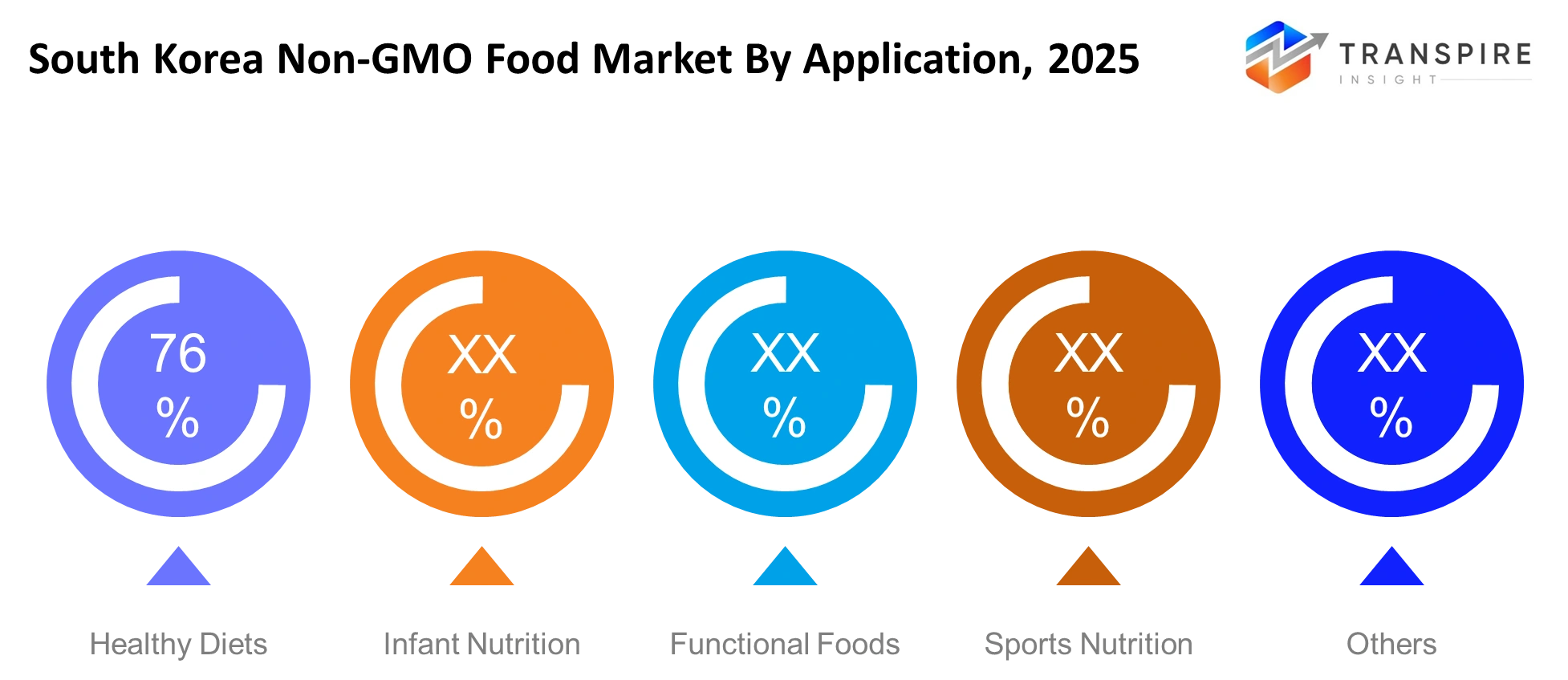
Healthy diet applications are basically the main segment, because clean label kind of eating keeps getting more attention and it’s starting to shape what people buy in mainstream packaged foods across South Korea. Functional ingredient transparency and the use of verified sourcing standards help adoption too, especially for consumers that want low additive and low processing options. This application still leads, not only due to demand, but because it fits many product types like snacks, grains, dairy alternatives, and even beverages. Functional foods along with infant nutrition also stay strong, since people care a lot about nutritional quality, and the credibility of ingredients can decide the purchase right there in the moment.
The healthy diet push is powered by preventive wellness habits and by how traceable ingredients are getting built into everyday meals. Infant nutrition is still growing steadily because parents now tend to prefer certified ingredient sourcing and they try to reduce exposure to genetically modified raw materials, even when it’s just about trust. Functional foods are gaining speed via probiotic drinks, fortified snacks, and protein enhanced products that are aimed at older consumers and also at wellness oriented professionals. Sports nutrition is smaller, but it becomes more noticeable as fitness focused lifestyles spread among younger demographics. Other areas include institutional nutrition and specialty medical foods. During the forecast window functional foods are expected to show the strongest growth, mostly from innovation in personalized wellness and preventive healthcare nutrition.
To learn more about this report, Download Free Sample Report
By Certification
Local organic certification sort of holds a strong place, mostly because domestic food brands are more and more trying to align with Korean regulatory requirements and whatever local retail procurement rules are in place. The thing is, the certification fees are still lower than some of the bigger international systems, so it becomes easier for regional manufacturers and agricultural cooperatives to jump in. And then, USDA Organic certification still matters quite a lot, since a lot of export oriented food production depends on it, plus there’s a premium angle when it comes to imported packaged food categories. On the other hand, Non-GMO Project Verified stays influential too, especially with multinational food companies aiming for those consumer groups that care a lot about high traceability.
That local organic certification momentum is supported by more domestic farming initiatives, and also by retailers who are leaning harder toward regionally verified sourcing, even when the supply chain is a bit complex. Meanwhile USDA Organic keeps climbing in importance with premium supermarket chains that want internationally recognized quality signals for imported grains, beverages, and wellness products. Non-GMO Project Verified products are getting more visible through online retail and specialty grocery channels, where sourcing transparency details can end up shaping the purchase decision. Other options exist as well—like smaller international certification systems for niche product categories, you know, the kind that don’t fit neatly into the main labels. Over the forecast period, dual certification strategies, combining organic and non-GMO verification are expected to show up more often, as brands compete for higher value health conscious consumer segments and try to stand out without being too generic.
By End User
Adults show up as the dominant end-user group , mainly because they have the spending ability, they also stick more with preventive nutrition, and they buy pretty widely across packaged food types. The need stays especially high with working professionals and middle-income households that want healthier convenience items with clear ingredient sourcing, and not the usual vague labelling. Health-conscious consumers remain very visible too, since buying habits are shifting toward traceability and real functional nutritional benefits rather than the typical mass-market options.
For children, the food categories keep climbing steadily, boosted by premium snack ideas and newer dairy product innovations. Growth on the adult side is helped by the wider take-up of wellness style eating , and by premium grocery products getting blended into daily meals more often. Meanwhile health-conscious consumers keep pushing the higher-margin ranges like fortified drinks, probiotic snack formats, and clean-label ready meals. Kids’ items are gaining traction because parents are watching artificial additives more closely and they care about imported ingredient quality a lot more.
Other segments include elderly nutrition offerings and institutional food programs, with specialized dietary needs that are hard to ignore. Looking ahead , over the forecast window health-conscious consumers are expected to post the quickest expansion as personalized nutrition and preventive healthcare trends keep reshaping how premium food is actually purchased across South Korea.
What are the Key Use Cases Driving the South Korea Non-GMO Food Market?
The biggest use case sort of comes from packaged snacks, cereals, and convenience meals that are sold through supermarkets , and also those premium grocery chains. Food manufacturers typically lean on verified non-GMO ingredients, partly to reinforce the whole clean-label vibe and also to justify that higher price. On top of that they want to stay aligned with stricter ingredient transparency expectations , especially among urban shoppers who are pretty focused.
Secondary use areas are growing fast across plant-based beverages, infant nourishment, and functional wellness foods. More dairy alternative producers are increasingly sourcing certified soy and oat components, while infant formula brands use non-GMO grains and proteins to boost retail trust with health-minded parents. E-commerce grocery platforms help too, since they promote traceable, hard-to-find specialty foods and make it easier for customers to adopt these choices.
Newer use cases are starting to show up in personalized nutrition products, plus clinical wellness foods aimed at older populations and preventive healthcare programs. Functional protein mixes, digestive wellness supplements, and sports nutrition items that rely on traceable ingredients are drawing more commercial attention as Korean consumers prioritize confirmed sourcing and higher nutritional quality, more and more.
|
Report Metrics |
Details |
|
Market size value in 2025 |
USD 473.5 Million |
|
Market size value in 2026 |
USD 503.8 Million |
|
Revenue forecast in 2033 |
USD 798.4 Million |
|
Growth rate |
CAGR of6.80% from 2026 to 2033 |
|
Base year |
2025 |
|
Historical data |
2021 - 2024 |
|
Forecast period |
2026 - 2033 |
|
Report coverage |
Revenue forecast, competitive landscape, growth factors, and trends |
|
Regional scope |
South Korea |
|
Key company profiled |
Nestlé, Danone, General Mills, Kellogg’s, Whole Foods Market, Amy’s Kitchen, Nature’s Path, Eden Foods, Organic Valley, Hain Celestial, CJ CheilJedang, Pulmuone, Nongshim, Lotte Foods, Binggrae |
|
Customization scope |
Free report customization (country, regional & segment scope). Avail customized purchase options to meet your exact research needs. |
|
Report Segmentation |
By Product Type (Non-GMO Grains, Non-GMO Dairy Products, Non-GMO Snacks, Non-GMO Beverages, Organic Non-GMO Foods, Others); By Distribution Channel (Supermarkets, Online Retail, Specialty Stores, Convenience Stores, Others); By Application (Healthy Diets, Infant Nutrition, Functional Foods, Sports Nutrition, Others); By Certification (USDA Organic, Non-GMO Project Verified, Local Organic Certification, Others); By End User (Adults, Children, Health-conscious Consumers, Others) |
Which Regions are Driving the South Korea Non-GMO Food Market Growth?
The Seoul Capital Area keeps being the dominant region in the South Korea Non-GMO Food Market, mostly because it pools together premium retail infrastructure, high-income consumers, and the country’s biggest food processing networks. Major supermarket operators, department stores, and online grocery platforms that are based around Seoul and Gyeonggi Province expanded aggressively clean label product lines after 2021, and that really sped up commercialization for certified food brands. On top of that, the region gets help from advanced cold chain logistics, import distribution centers, and the nearness to Incheon Port, which helps sourcing of certified non-GMO grains and specialty ingredients stay dependable. Large food companies like CJ CheilJedang and Pulmuone keep running extensive R&D and product development activities through the metropolitan corridor, so the leadership role keeps strengthening via quick product launches and tighter retailer relationships.
Meanwhile the southeastern industrial corridor, including Busan, Ulsan, and Daegu, supports market expansion in a slightly different way. Growth there relies more on manufacturing steadiness and export driven food production, rather than leaning heavily on premium urban retail density. Busan, for example, acts as South Korea’s largest container port, so it enables consistent imports of identity preserved soybeans, corn, and organic inputs used by local food processors. Mid sized manufacturers in this region are also putting more money into certified ingredient acquisition, to lock in longer term export agreements across Japan and Southeast Asia, especially since traceability expectations got stricter after pandemic era worries about food safety. Compared with Seoul, this area tends to advance through supply chain resilience and steady industrial spending, rather than through fast consumer trend adoption, making it a dependable contributor .
Who are the Key Players in the South Korea Non-GMO Food Market and How Do They Compete?
Competition in the South Korea Non-GMO Food Market stays sort of moderately consolidated because big food manufacturers really run the show for supermarket distribution, ingredient sourcing contracts , and even the processing infrastructure. Still, those niche organic brands and functional nutrition companies keep stirring things up in the usual packaged food lanes. They do it via specialized certifications and a more direct-to-consumer retail approach. In practice, firms don’t fight as much on low pricing , and instead lean into traceability systems, ingredient verification, export readiness, plus that premium product vibe. The market also seems to reward companies that manage to mix large-scale manufacturing efficiency with transparent sourcing and genuine clean-label credibility.
CJ CheilJedang is in the game with big automation, export-first product development, and vertically integrated sourcing capabilities. It differentiates itself by pairing Korean convenience food innovation with more advanced processing technologies, helping raise consistency and meeting overseas compliance standards. In March 2026, the company added more automated frozen food production capacity, mainly to boost global distribution efficiency and back premium packaged food exports. On another track, Pulmuone leans hard into sustainable food systems, plant-based nutrition, and pretty strict ingredient transparency. Their whole plan is built around premium wellness positioning, powered by ESG-forward branding , and collaboration with startups that develop sustainable food technologies.
Nongshim, meanwhile, uses its solid convenience food distribution network to grow healthier instant meal categories through cleaner ingredient formulations. Danone competes mostly through infant nutrition and functional dairy products, with an emphasis on ingredient traceability and premium nutritional positioning.
Company List
- Nestlé
- Danone
- General Mills
- Kellogg’s
- Whole Foods Market
- Amy’s Kitchen
- Nature’s Path
- Eden Foods
- Organic Valley
- Hain Celestial
- CJ CheilJedang
- Pulmuone
- Nongshim
- Lotte Foods
- Binggrae
Recent Development News
In April 2026, CJ CheilJedang launched the food industry’s first fully automated frozen gimbap production line at its Jincheon facility. The investment strengthened export capacity, improved production consistency, and accelerated the company’s premium K-food expansion strategy.http://newsroom.cj.ne
In March 2026, Pulmuone announced an AI-driven business transformation initiative during its Open Shareholders’ Meeting. The strategy focuses on AX innovation, sustainable food technologies, and digital operational upgrades to strengthen competitiveness in premium health-focused food categories.https://www.pulmuone.co.kr
What Strategic Insights Define the Future of the South Korea Non-GMO Food Market?
The South Korea Non-GMO Food Market is kind of moving, toward an integrated premium nutrition setup where ingredient traceability, functional health positioning and digital verification are basically working together instead of being treated as totally separate “selling points”. In the next five to seven years, food manufacturers will probably see certified sourcing as this competitive infrastructure thing that connects right to export access, shelf placement, and keeping consumers coming back.
One not so obvious risk is that they’re getting more dependent on imported identity-preserved soybeans and grains, which could leave manufacturers dealing with procurement whiplash and tighter margins when global farming disruptions happen. At the same time, blockchain enabled traceability plus AI supported sourcing verification is also a real opportunity, especially for regional suppliers who want longer term agreements with big Korean retailers and wellness focused brands.
Firms that move early into domestic contract farming networks, digital compliance systems and multifunction wellness foods are likely to end up with better pricing leverage and steadier supply resilience across the 2026–2033 period, even if the market feels a bit unpredictable.
South Korea Non-GMO Food Market Report Segmentation
By Product Type
- Non-GMO Grains
- Non-GMO Dairy Products
- Non-GMO Snacks
- Non-GMO Beverages
- Organic Non-GMO Foods
- Others
By Distribution Channel
- Supermarkets
- Online Retail
- Specialty Stores
- Convenience Stores
- Others
By Application
- Healthy Diets
- Infant Nutrition
- Functional Foods
- Sports Nutrition
- Others
By Certification
- USDA Organic
- Non-GMO Project Verified
- Local Organic Certification
- Others
By End User
- Adults
- Children
- Health-conscious Consumers
- Others
Frequently Asked Questions
Find quick answers to common questions.
The expected South Korea Non-GMO Food Market size for the market will be USD 798.4 Million in 2033.
Key segments for the South Korea Non-GMO Food Market are By Product Type (Non-GMO Grains, Non-GMO Dairy Products, Non-GMO Snacks, Non-GMO Beverages, Organic Non-GMO Foods, Others); By Distribution Channel (Supermarkets, Online Retail, Specialty Stores, Convenience Stores, Others); By Application (Healthy Diets, Infant Nutrition, Functional Foods, Sports Nutrition, Others); By Certification (USDA Organic, Non-GMO Project Verified, Local Organic Certification, Others); By End User (Adults, Children, Health-conscious Consumers, Others)
Major South Korea Non-GMO Food Market players are Nestlé, Danone, General Mills, Kellogg’s, Whole Foods Market, Amy’s Kitchen, Nature’s Path, Eden Foods, Organic Valley, Hain Celestial, CJ CheilJedang, Pulmuone, Nongshim, Lotte Foods, Binggrae
The South Korea Non-GMO Food Market size is USD 473.5 Million in 2025.
The South Korea Non-GMO Food Market CAGR is 6.80% from 2026 to 2033.
- Nestlé
- Danone
- General Mills
- Kellogg’s
- Whole Foods Market
- Amy’s Kitchen
- Nature’s Path
- Eden Foods
- Organic Valley
- Hain Celestial
- CJ CheilJedang
- Pulmuone
- Nongshim
- Lotte Foods
- Binggrae
Recently Published Reports
-
Apr 2026
Baby Infant Formula Market
Baby Infant Formula Market Size, Share & Analysis Report By ype (Infant Milk, Follow On Milk, Specialty Baby Milk, Growing-Up Milk), By Ingredient (Carbohydrate, Fat, Protein, Minerals, Vitamins, and Others), By Product Form (Powder, Liquid, and Ready-to-feed), By Distribution Channels (Supermarket/Hypermarket, Specialty Store, Pharmacies, Online Retail, and Others), and Geography (North America, Europe, Asia-Pacific, Middle East and Africa, South and Central America), 2021 - 2031
-
Apr 2026
Edible Insects for Animal Feed Market
Edible Insects for Animal Feed Market Size, Share & Analysis Report By Type (Insect Powder, Insect Meal, Insect Bar, Insect Paste, Insect Oil, and Others), By Insect Type (Beetles, Cricket, Caterpillar, Hymenoptera, Orthoptera, Tree Bugs, and Others), By Application (Livestock, Pet Food, and Aquaculture), By Livestock Type (Poultry, Swine, and Others), and Geography (North America, Europe, Asia-Pacific, Middle East and Africa, South and Central America), 2021 - 2031
-
Apr 2026
Food Industry Disinfection and Bacterial Control Market
Food Industry Disinfection and Bacterial Control Market Size, Share & Analysis Report By Type (Chemical Disinfectants, Physical Disinfectants, and Biocides and Antimicrobials), By Application (Food Processing Equipment Surface Disinfection, Food Preparation Areas Surface Disinfection, Storage Areas Surface Disinfection, Anti-microbial Coatings Food Preservation, and Preservative Solutions Food Preservation), By End User (Meat and Poultry Processing, Dairy Processing, Seafood Processing, Bakery and Confectionery, Restaurants and Commercial Kitchens, and Food Service Providers), By Sales Channel (Online, Offline), and Geography (North America, Europe, Asia-Pacific, Middle East and Africa, South and Central America), 2021 - 2031
-
May 2026
Freeze Dried Food Market
Freeze Dried Food Market Size, Share & Analysis Report By Product Type (Fruits, Vegetables, Freeze-Dried Dairy Products, Freeze-Dried Meat and Seafood, Freeze-Dried Pet Food, and Prepared Meal), By Nature (Organic, and Conventional), By Form (Powdered, Granules, and Diced), By End Use (Breakfast Cereals, Dairy Products, Bakery & Confectionery, Nutritional Bars & Supplements, Powdered Beverages, Snacks, and Retail (Household)), and Geography (North America, Europe, Asia-Pacific, Middle East and Africa, South and Central America), 2021 - 2031