

South Korea Nasal Spray Market Summary:
According to Transpire Insight, a detailed research report on the market reflects that the allergic rhinitis and sinusitis application segment dominates the South Korea Nasal Spray Market, accounting for a significant share of the total market. Haleon PLC leads the market with its established nasal spray and consumer healthcare portfolio, making it a leading contributor to market development, product innovation, advanced intranasal drug-delivery solutions, expanding distribution capabilities, and growth dynamics.
Market Snapshot
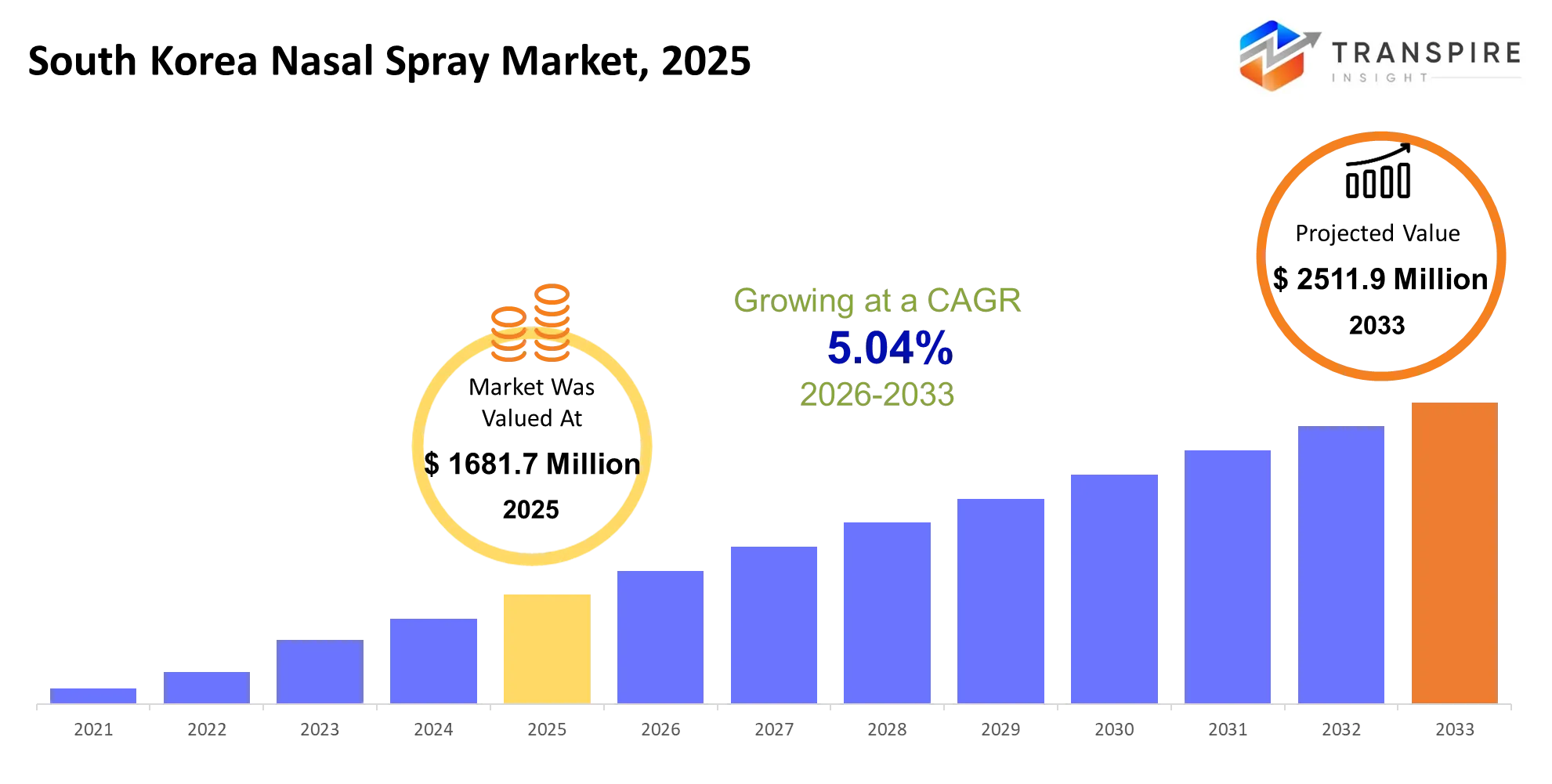
- Market Value (2025): USD 1681.7 Million.
- Expected Market Value (2026): USD 1780.9 Million.
- Estimated Market Value (2033): USD 2511.9 Million.
- Forecast CAGR (2026–2033): 5.04%
Introduction
South Korean market for nasal sprays involves development, production, distribution, and sales of intranasal drug formulations or delivery devices to administer drugs for the treatment or prevention of medical conditions or nasal care through the nasal cavity. Some of the formulations administered using nasal sprays may be in the form of liquids, suspensions, or powders, and may be applied to treat rhinitis, nasal congestion, sinus conditions, and nasal care. The product lines under the market segment may include corticosteroids, antihistamines, decongestants, saline, and special types of nasal sprays. Growth drivers for the market may include convenience in drug administration, respiratory and allergy treatments, advanced metered dosage devices, and nasal care for pollutants.
Key Market Highlights: -
- By Product, the Steroid dominated the market and holds approximately 41.2% share in 2025 and is projected to grow at a substantial CAGR during the forecast period.
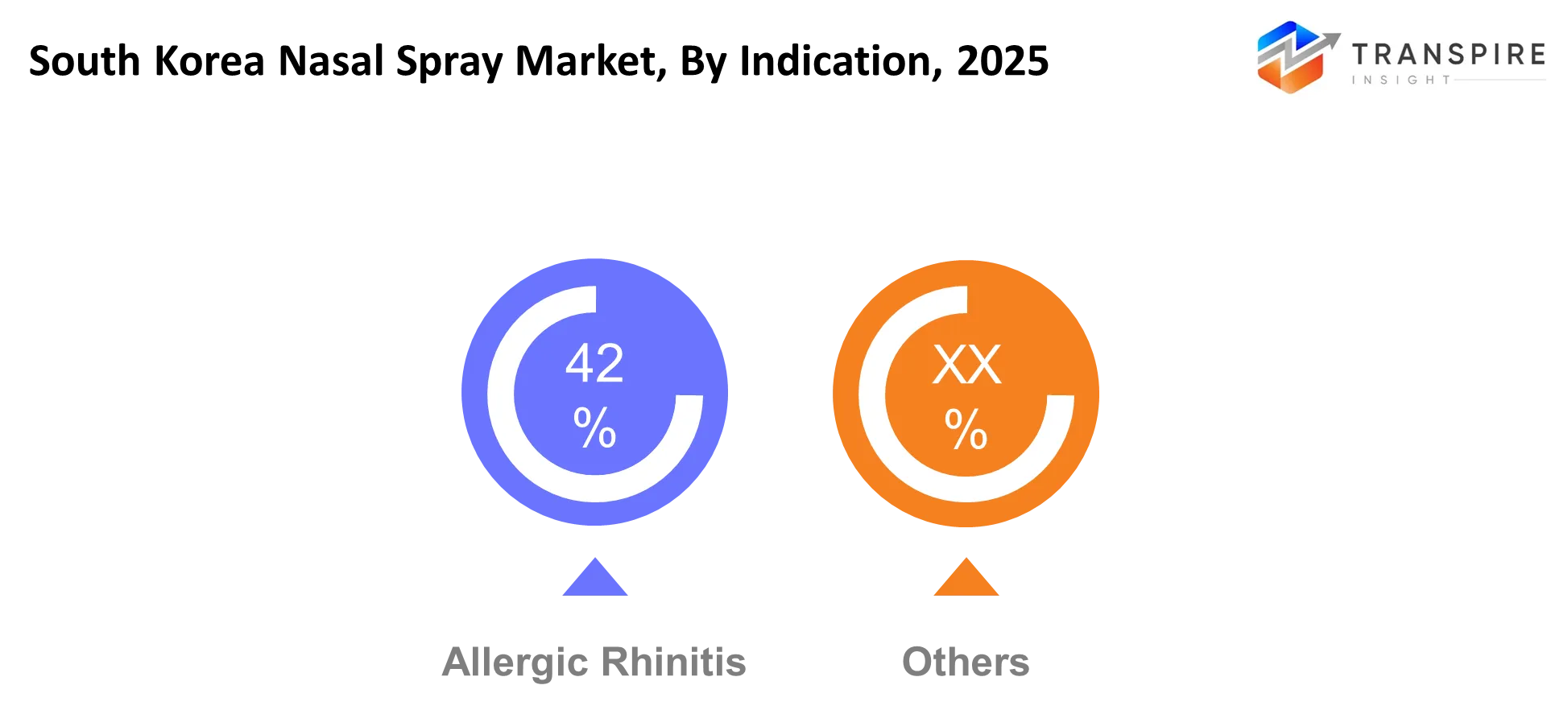
- By Indication, the Allergic Rhinitis dominated the market and holds approximately 55% share in 2025 and is projected to grow at a substantial CAGR during the forecast period.
- By Dosage Form, the Aqueous Spray Manufacturers segment dominated the market and holds approximately 88% share in 2025 and is projected to grow at a substantial CAGR during the forecast period.
- Both government actions and modern health care regulations are aiding the South Korean market for nasal spray, while antipollution nasal sprays have been forecasted to attain $196.1 million by 2033.
How is Technology Driving Growth in the South Korea Nasal Spray Market?
The South Korea Nasal Spray Market is experiencing growth due to technology with regards to advanced drug delivery methods, dosage accuracy, digitalization of healthcare and pharmaceutical developments. Microatomization and better engineering of sprays facilitate accurate dosing and higher nasal absorption, while new formulae could lead to improved efficacy of treatments. The integration of digital healthcare and platforms helps to increase engagement of patients and treatment monitoring, while biotechnological research facilitates the emergence of target-specific and peptide-based intranasal therapies. Automated production processes and quality control help to achieve greater scalability and reliability of production in South Korea's nasal spray market.
Market Drivers
The nasals spray market in South Korea is stimulated by the presence of large particulate matter in addition to pollution, which exacerbates the problem of allergic rhinitis and respiratory diseases, thus increasing the need for protection and cleansing nasal sprays. The elderly population with a higher rate of occurrence of sinus and nasal problems keeps the demand consistent. Good biotechnological expertise and strong research support promotes local innovation and product commercialization. In addition, the large proportion of smartphones makes it easy to develop companion applications that help track symptoms and adherence. All of this combined helps in maintaining the growth of the market over the forecast period.
Restrain
Strict rules in terms of product approval for both combination and digital products pose challenges to product launches; at the same time, price fluctuations associated with precision elements make the products expensive. Reimbursement and price regulations pose additional risks to margins of prescription products. The risk of adverse events such as nosebleeds and rebound congestion related to decongestant misuse can lower consumer trust in the products, along with problems with devices.
|
Driver |
Relative Impact on Growth (%) |
Geographic Relevance |
Impact Timeline |
Demand Strength |
Growth Mechanism |
Key Beneficiaries |
Major Constraint |
|
Rising Allergic Rhinitis and Respiratory Conditions |
28% |
Seoul, Incheon, Gyeonggi, major urban centers |
Short-term |
High |
Increases demand for convenient allergy and respiratory treatments. |
Nasal spray manufacturers, pharmacies, allergy-care providers, consumers |
Seasonal demand variability and treatment alternatives |
|
Air Pollution and Fine-Particulate Exposure |
24% |
Seoul Metropolitan Area, industrial urban centers |
Short-term |
High |
Drives preventive, cleansing, hydrating, and anti-pollution nasal-care adoption. |
Anti-pollution spray manufacturers, pharmacies, online retailers, consumers |
Limited clinical differentiation among preventive products |
|
Advanced Intranasal Drug-Delivery Technologies |
20% |
South Korea nationwide, technology-intensive healthcare centers |
Medium-term |
High |
Improves dosing precision, absorption, convenience, and therapeutic performance. |
Pharmaceutical companies, device manufacturers, technology vendors, patients |
Development costs and regulatory validation requirements |
|
Expansion of OTC and Self-Care Healthcare |
16% |
Nationwide, especially urban retail and e-commerce channels |
Short-term |
Medium |
Expands consumer access to convenient nasal-care and symptom-relief products. |
OTC manufacturers, pharmacies, e-commerce platforms, consumers |
Consumer awareness and responsible self-medication requirements |
|
Pharmaceutical R&D and Local Healthcare Innovation |
12% |
Seoul, Gyeonggi, major biotech and pharmaceutical clusters |
Long-term |
Medium |
Supports formulation innovation, manufacturing capabilities, and specialized |
Analysis of Prices and Consumer Behaviour
In South Korea, the market share of nasal sprays is dominated by highly purified and standardized products (68% of the total market; due to the demand from the allergy treatment, respiratory healthcare, and pharmaceutical industries). The cost of production of highly purified and standardized nasal spray containing advanced active ingredients will be estimated at 35% more than that of other products, since the development of such product is possible only via advanced formulation techniques, certified manufacturing processes, and high effectiveness. Almost 45% of all units sold of nasal sprays are sold in powder or dry form formulations. This trend is caused by the versatility of the product usage in respiratory healthcare and allergy treatments and high storability of dry nasal spray formulations. In total, the pharmaceutical and respiratory healthcare industries demand 70% of nasal sprays in South Korea. According to consumer behavior in the market, 55% of consumers give priority to the therapeutic effectiveness, purity, and standardized active ingredients in the product. Another 33% of consumers tend to buy the products via bulk or long-term agreements since they seek to reduce their procurement expenses and ensure reliable supplies of healthcare products in South Korea.
|
Company |
Est. Revenue Share Range |
Key Offerings |
Strategic Positioning |
Geographic Strength |
Technology Focus |
|
Haleon plc |
8–12% |
Otrivin; respiratory OTC products; allergy and congestion treatments |
Strong OTC respiratory healthcare positioning |
Asia Pacific; Europe; North America |
Advanced OTC nasal delivery and dosing systems |
|
Bayer AG |
8–12% |
Otrivin; decongestant nasal sprays; allergy and cold-care products |
Broad consumer-health portfolio diversification |
Europe; Asia Pacific; North America |
Precision nasal formulations and metered-dose delivery |
|
Sanofi SA |
6–9% |
Nasic; nasal decongestant products; allergy-care formulations |
Established respiratory and allergy-care presence |
Europe; Asia Pacific; North America |
Formulation optimization and intranasal drug delivery |
|
GSK plc |
5–8% |
Flonase-related allergy products; nasal corticosteroid solutions; respiratory healthcare |
Specialized allergy and respiratory-care portfolio |
North America; Europe; Asia Pacific |
Corticosteroid formulations and nasal absorption technologies |
|
Daewoong Pharmaceutical |
4–7% |
Prescription nasal formulations; respiratory medicines; local pharmaceutical products |
Regional pharmaceutical innovation and localization |
South Korea; Asia Pacific |
Advanced pharmaceutical formulations and delivery technologies |
|
Dong-A Pharmaceutical |
3–6% |
Nasal-care products; OTC healthcare products; respiratory-care formulations |
Domestic OTC healthcare and pharmacy-channel strength |
South Korea; Asia Pacific |
Consumer healthcare formulation and delivery technologies |
|
Yuyu Pharma |
2–5% |
Nasal decongestant products; allergy treatments; respiratory medicines |
Domestic specialty and respiratory-care specialization |
South Korea; Asia Pacific |
Intranasal formulation and pharmaceutical manufacturing |
|
Viatris Inc. |
2–4% |
Generic nasal sprays; corticosteroid formulations; allergy therapies |
Generic portfolio breadth and cost efficiency |
North America; Europe; Asia Pacific |
Generic formulation development and scalable manufacturing |
|
Cipla Limited |
1–3% |
Nasal corticosteroids; antihistamine sprays; respiratory therapies |
Respiratory-focused portfolio and regional expansion |
Asia Pacific; Middle East & Africa; North America |
Respiratory drug delivery and formulation innovation |
|
Novartis AG |
1–3% |
Allergy therapies; respiratory medicines; intranasal treatment portfolio |
Specialty pharmaceutical and innovation-led positioning |
Europe; North America; Asia Pacific |
Specialty formulations and targeted drug delivery |
Who are the Key Players in the South Korea Nasal Spray Market and how do they compete?
Competitiveness of the international market of South Korea Nasal Spray Market relies on the companies focused on the development of pharmaceutical innovations, nasal drug delivery technologies, and building of distribution channels across the world. Competing not on price but rather on innovative formulations, innovative technologies of nasal drug delivery, patient-oriented solutions and integration with the healthcare platform and pharmaceutical system, such a competitive strategy implies continuous innovation as well as increased effectiveness of treatment, patient convenience and healthcare efficiency.
With the development of innovative nasal spray formulations, nasal delivery technologies, and pharmaceutical technologies oriented towards patient, Haleon strengthens its position in the market. With the development of high quality pharmaceutical products designed to provide relief for allergies, respiratory care and nasal congestion, and other healthcare applications, Johnson & Johnson distinguishes itself from its competitors. Bayer positions itself with the help of integrated solutions in the field of nasal healthcare, pharmaceutical innovations, respiratory care, and consumer health.
Top Companies in the South Korea Nasal Spray Market
- Haleon
- Johnson & Johnson
- Bayer
- Sanofi
- GSK
- AstraZeneca
- Novartis
- Viatris
- Cipla
- Dr. Reddy's Laboratories
- Takeda
- Daewoong Pharmaceutical
- Hanmi Pharmaceutical
- Yuhan Corporation
- Chong Kun Dang
South Korea Nasal Spray Market Segmentation
The South Korea Nasal Spray Market share is divided into five categories: By Product, By Indication, By Dosage Form, By Distribution, By End User
The Steroid dominated the market, accounting for nearly 41.2% in 2025 and is expected to rise at a significant CAGR during the forecast period.
The South Korea Nasal Spray Market is segmented by product into decongestant sprays, steroid sprays, antihistamine sprays, saline sprays, combination sprays, anticholinergic sprays, other nasal sprays. Among these, the Steroid segment dominated the market, accounting for nearly 41.2% in 2025 and expected to increase at a significant CAGR during the forecast period. The lead position goes to steroid sprays since they offer clinically proven relief from allergic rhinitis and chronic nasal inflammation.
The Allergic Rhinitis dominated the market, accounting for nearly 55% in 2025, and is expected to rise at a significant CAGR during the forecast period.
The South Korea Nasal Spray Market is segmented by indication into allergic rhinitis, non-allergic rhinitis, nasal congestion, sinusitis, common cold, nasal polyps, other respiratory conditions. Among these, the Allergic Rhinitis dominated the market, accounting for nearly 55% in 2025 and expected to increase at a significant CAGR during the forecast period. Allergic rhinitis becomes the leader due to its high prevalence caused by fine dust, pollen, and pollution resulting in the need for nasal sprays.
The Aqueous Spray dominated the market, accounting for nearly 88% in 2025 and is expected to rise at a significant CAGR during the forecast period.
The South Korea Nasal Spray Market is segmentedby dosage form into aqueous spray, powder spray, gel spray, metered-dose spray, pump spray, preservative-free spray, combination formulation. Among these, the Aqueous Spray dominated the market, accounting for nearly 88% in 2025 and expected to increase at a significant CAGR during the forecast period. Aqueous sprays become the leaders due to ease of administration and good tolerability allowing them to be used both for prescription and OTC treatments.
Future Market Trends for the South Korea Nasal Spray Market:-
- Gentle and natural formulations: With increasing consumer interest in gentle non-medical treatments, there is an increase in the popularity of natural, preservative-free and physiological saline nasal sprays in South Korea due to increasing respiratory health consciousness.
- Device technology advances and digital health: Companies are improving atomization, dose accuracy and spray pattern, pH balanced formulas that are less irritating, and also app-connected devices are in development stage.
- Improved accessibility and supply chain: Through increased availability of digital health and online channels, the accessibility of nasal sprays is improving, and also increased local production will help in stabilizing the supply chain.
Recent Development
- In May 2026: Growth rate for the corticosteroid nasal spray segment in South Korea was seen at a projected annual volume increase of 4–6% based on the growing awareness of air pollution and allergens.
- In September 2026: The multi-dose nasal spray and antihistamine segments in South Korea launched initiatives focused on advanced technology, patient compliance, and digital healthcare integration.
Market Segmentation
This study forecasts revenue at Japan, regional and country levels from 2020 to 2033. Transpire Insight has segmented the South Korea Nasal Spray Market based on the below-mentioned segments:
South Korea Nasal Spray Market, By Product
- Decongestant Sprays
- Steroid Sprays
- Antihistamine Sprays
- Saline Sprays
- Combination Sprays
- Anticholinergic Sprays
- Other Nasal Sprays
South Korea Nasal Spray Market, By Indication
- Allergic Rhinitis
- Non-Allergic Rhinitis
- Nasal Congestion
- Sinusitis
- Common Cold
- Nasal Polyps
- Other Respiratory Conditions
South Korea Nasal Spray Market, By Dosage Form
- Aqueous Spray
- Powder Spray
- Gel Spray
- Metered-Dose Spray
- Pump Spray
- Preservative-Free Spray
- Combination Formulation
South Korea Nasal Spray Market, By Distribution
- Hospital Pharmacies
- Retail Pharmacies
- Online Pharmacies
- Drugstores
- Supermarkets
- Clinics
- Direct Sales
South Korea Nasal Spray Market, By End User
- Adults
- Pediatrics
- Elderly
- Allergy Patients
- Cold & Flu Patients
- Chronic Rhinitis Patients
- Postoperative Patients
Frequently Asked Questions
Find quick answers to common questions.
Increasing allergic rhinitis, pollution exposure, respiratory conditions, advanced drug delivery technologies, and growing demand for convenient nasal treatments.
Steroid sprays dominate the market, supported by strong demand for allergic rhinitis and chronic nasal inflammation treatment.
Allergic rhinitis leads the market, driven by fine dust, pollen, pollution exposure, and increasing demand for effective nasal treatments.
Advanced atomization, accurate dosing, digital healthcare integration, biotechnology, and automated manufacturing are improving treatment effectiveness and production scalability.
Natural formulations, preservative-free products, advanced spray devices, digital health integration, online distribution, and localized production are shaping future growth.
- Haleon
- Johnson & Johnson
- Bayer
- Sanofi
- GSK
- AstraZeneca
- Novartis
- Viatris
- Cipla
- Dr. Reddy's Laboratories
- Takeda
- Daewoong Pharmaceutical
- Hanmi Pharmaceutical
- Yuhan Corporation
- Chong Kun Dang
About the Authors

Pankaj Ghogare Patil
I am Pankaj Ghogare Patil, a Senior Research Analyst at Transpire Insight, specializing in the Pharmaceutical, Chemicals & Materials, Healthcare IT, and Biotechnology industry. My expertise lies in conducting comprehensive market research, analyzing industry trends, evaluating competitive landscapes, and translating complex data into actionable insights. At Transpire Insight, I closely follow emerging technologies, regulatory developments, and market innovations to create accurate, well-researched, and informative content that helps businesses and professionals make informed decisions. I am committed to producing credible, evidence-based articles that reflect industry best practices while making technical topics accessible and valuable for a broad audience.

Chakradhar Khansole
Chakradhar serves as the Research Director at Transpire Insight, bringing over 8 years of experience in technology, innovation, and strategic market intelligence. He specializes in transforming complex market data into actionable business insights that enable organizations to make informed, growth-oriented decisions. Recognized for his strategic vision and analytical expertise, Chakradhar leads high-impact research initiatives, delivering comprehensive market assessments, competitive intelligence, and forward-looking industry analysis.
Recently Published Reports
-
Apr 2026
AI in Diabetic Retinopathy Market
AI in Diabetic Retinopathy Market Size, Share & Analysis Report By Type (Screening AI Systems, Diagnostic AI Systems, and Predictive AI Models), By Application Segment (Hospitals, Ophthalmology Clinics, Diagnostic Centers, and Research and Development), and Geography (North America, Europe, Asia-Pacific, Middle East and Africa, South and Central America), 2021 - 2031
-
Apr 2026
Psychometric Tests Market
Psychometric Tests Market Size, Share & Analysis Report By Type (Personality Tests, Ability/Aptitude Tests, Skill/Knowledge Tests, and Others), By Application (Talent Acquisition and Talent Management), and Geography (North America, Europe, Asia-Pacific, Middle East and Africa, South and Central America), 2021 – 2031
-
Apr 2026
Rare Biological Sample Collection Market
Rare Biological Sample Collection Market Size, Share & Analysis Report By Type (Isolation Kits & Reagent, Blood Collection Tubes, and Others), By Application (Oncology, Transcriptomics, Pharmacogenomics, and Others), and Geography (North America, Europe, Asia-Pacific, Middle East and Africa, South and Central America), 2021 – 2031
-
Jul 2026
Diabetic Retinopathy Market
Diabetic Retinopathy Market Size, Share & Analysis Report By Type (Proliferative Diabetic Retinopathy, and Diabetic Macular Edema (DME)), By Treatment Type (Anti VEGF Drug, Steroid Implants, Laser Surgeries, and Vitrectomy), and Geography (North America, Europe, Asia-Pacific, Middle East and Africa, South and Central America), 2021 – 2031
Our Clients







