

South Korea Multimodal UI Market Summary:
According to Transpire Insights, a detailed research report on the market reflects that the software segment dominates the South Korea Multimodal UI Market, accounting for approximately 62% of the total market share in 2025. Samsung Electronics Co., Ltd. leads the market with approximately USD 234 billion in annual revenue and an estimated 18–22% South Korea market share, making it a leading contributor to South Korea market development, innovation, AI-powered multimodal interface technologies, expanding digital capabilities, and growth dynamics.
Market Snapshot
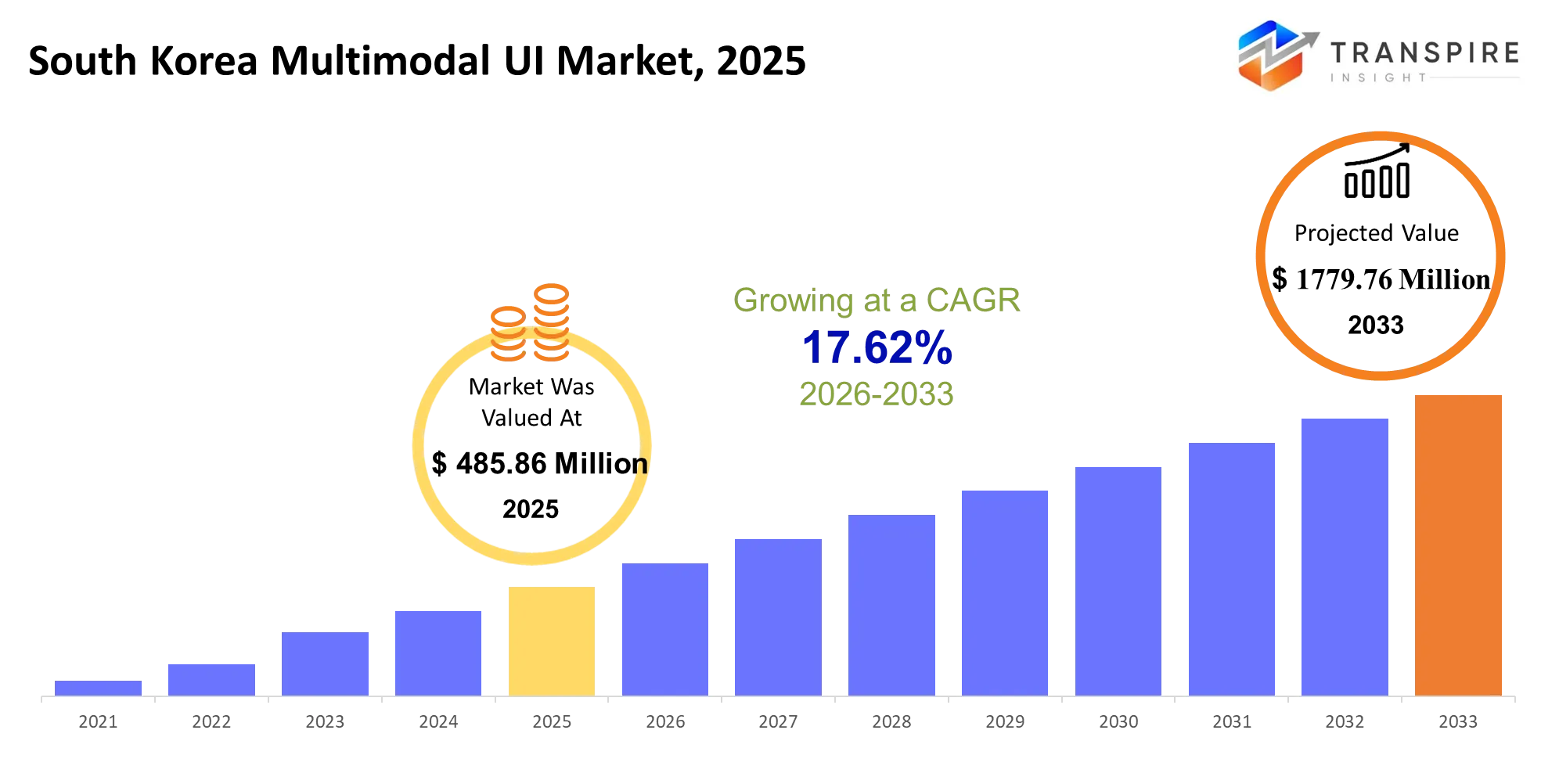
- Market Value (2025): USD 485.86 Million.
- Expected Market Value (2026): USD 571.47 Million.
- Estimated Market Value (2033): USD 1779.76 Million.
- Forecast CAGR (2026–2033): 17.62%
Introduction
Multimodal UI refers to those technologies, software, and hardware that allow for the interaction between human beings and their computer devices or applications using two or more communication channels at once. The channels may be voice commands, touch screen technology, hand gestures, and face recognition. As opposed to using the keyboard and mouse alone, the user experience is natural and human-like. A Multimodal User Interface (MMUI) is an interface design which allows for humans to communicate with the device or application through the use of two or more coordinated means of communication. As opposed to using one channel (for example typing through the use of a normal keyboard), the multimodal UI uses different channels such as voice commands, touch screens, and hand gestures. Advantages are provided by the South Korea Multimodal UI Market through natural interaction, reduced latency, better accessibility, and greater operational efficiency. Multimodal user interfaces make use of voice, touch, and gestures to provide an intuitive human-centric experience. Edge-AI technologies and NPUs help in reducing latency and enable quick local interactions. The use of multiple modalities for input and output enhances accessibility and usability among different types of users as well as in various environments. Additionally, AI orchestration and automation along with predictive analysis help in simplifying processes in smart devices, healthcare, manufacturing, automotive, and enterprise applications.
Key Market Highlights: -
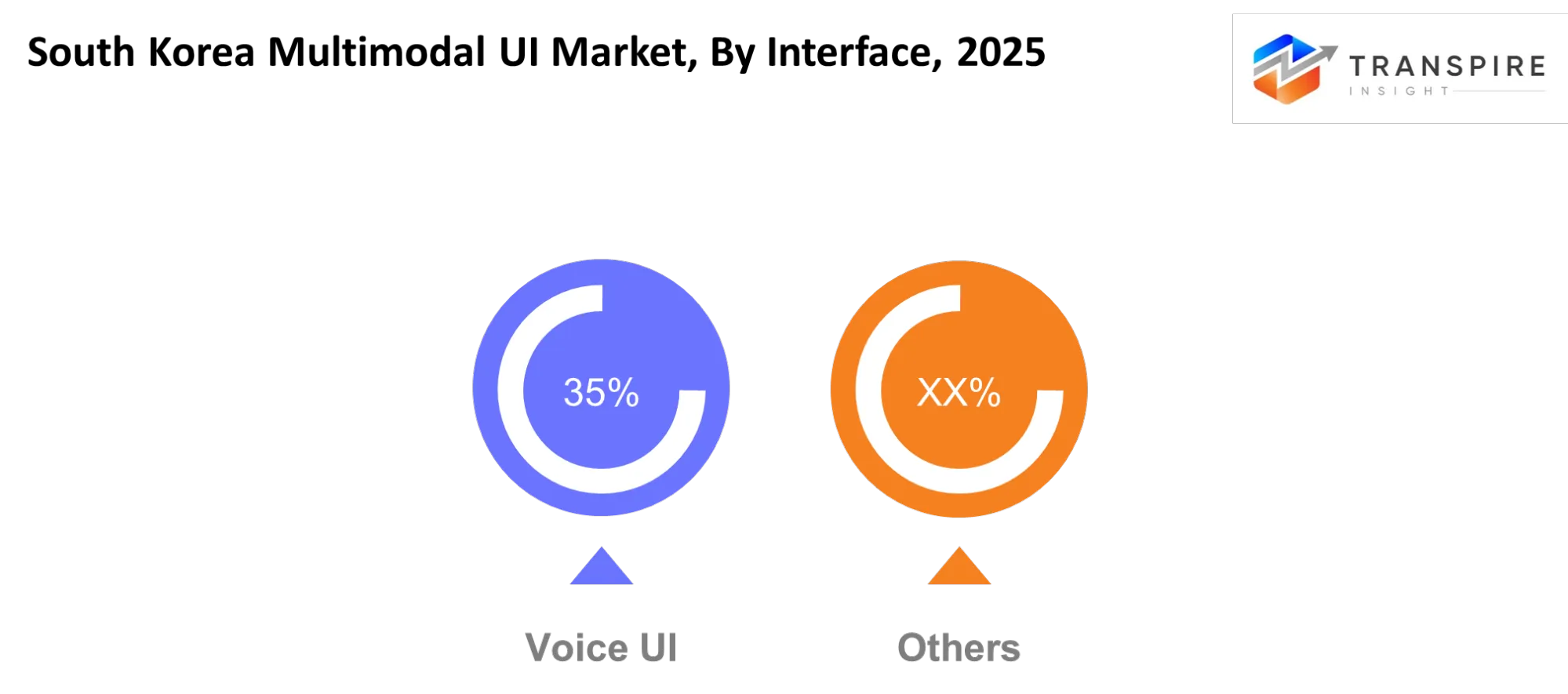
- By interface, the Touch UI segment dominated the market and holds nearly 60% share in 2025 and is projected to grow at a substantial CAGR during the forecast period.
- By technology, the Machine Learning segment dominated the market and holds nearly 38% share in 2025 and is projected to grow at a substantial CAGR during the forecast period.
- By application, the Consumer Electronics segment dominated the market and holds nearly 24% share in 2025 and is projected to grow at a substantial CAGR during the forecast period.
- AI for All Program: The 2026 “AI for All Project” of South Korea will increase the availability of domestic AI chatbots and AI-agents to the general public. This will help in increasing the adoption of natural language and voice-based interface technologies. The program will help increase the growth of the South Korea Multimodal UI Market indirectly.
How is Technology Driving Growth in the South Korea Multimodal UI Market?
The South Korea Multimodal User Interface (UI) Market is growing by integrating fast technologies such as artificial intelligence (AI), natural language processing (NLP), and generative AI, whereby the devices have become able to process difficult speech, touch, gestures, and context-based interactions. Innovations in hardware are also contributing to making devices able to perform advanced multimodal processing. The 5G networks present in South Korea are helping the devices to have low-latency and real-time interactions, which is beneficial to smart factories, automotive applications, edge devices, and other applications that require connections. Increased focus on accessibility and user experience is also fueling the demand for better digital interfaces.
Market Drivers
South Korea's Multimodal User Interface Market is influenced by favorable government initiatives on Artificial Intelligence and digitalization efforts. High adoption of IoT and connected smart devices is leading to the rising need for user interfaces that include voice, touch, gestures, and vision capabilities. Also, the advanced telecom infrastructure using 5G helps in achieving real-time and low latency processing capabilities of the multimodal interface. Furthermore, high consumer digital adoption rates and enterprise automation is driving the need for intelligent and personalized user interfaces in consumer electronics, automobiles, healthcare, telecommunications, and business applications. The Market for Multi-Modal User Interface in South Korea receives a boost through the presence of state-of-the-art digital infrastructure facilitated through high-speed broadband connectivity and 5G technology that supports low-latency multi-modal interactions and edge-AI applications. Domestic expertise in semiconductors, including in-device Neural Processing Units (NPUs), makes it easy to incorporate AI in smart devices and connected devices. State-of-the-art language foundation models in Korean such as Naver’s HyperCLOVA X add to linguistic and contextual localization of user interactions. Moreover, strong industry-government collaboration, Industry 4.0 programs, AI policies, and investments in R&D drive innovation and development of UX/UI and multi-modal interface technologies in South Korea.
Restrain
The challenges faced by the South Korea Multimodal UI Market include high cost of deploying integrated voice, vision, and gesture technology, constraints of investments among startups, stringent demands regarding data privacy, and shortage of AI and UX experts. There could be other factors as well, such as fragmentation of ecosystems and lack of interoperability between devices.
|
Driver |
Relative Impact on Growth (%) |
Geographic Relevance |
Impact Timeline |
Demand Strength |
Growth Mechanism |
Key Beneficiaries |
Major Constraint |
|
Rapid AI and Generative AI Integration |
30% |
South Korea — Nationwide, Seoul metropolitan technology hubs |
Short-term |
High |
Enables intelligent, context-aware multimodal interactions |
AI developers, UI platforms, device manufacturers |
High computing and model-development costs |
|
Growing Smart Device and Consumer Electronics Adoption |
25% |
South Korea — Nationwide, major urban markets |
Short-term |
High |
Expands touch, voice, gesture interface deployment |
Electronics manufacturers, semiconductor suppliers, consumers |
Device ecosystem fragmentation limits interoperability |
|
On-Device AI, NPU and Edge Computing Advancement |
20% |
South Korea — Semiconductor and electronics manufacturing clusters |
Medium-term |
High |
Reduces latency through localized AI processing |
Chipmakers, device OEMs, edge-AI developers |
Hardware integration increases device development costs |
|
Government AI Policies and Digital Transformation Programs |
15% |
South Korea — Nationwide, public and industrial sectors |
Medium-term |
Medium |
Accelerates AI adoption through policy support |
AI startups, enterprises, public-sector technology providers |
Compliance requirements increase implementation complexity |
|
5G Connectivity and Real-Time Interactive Applications |
10% |
South Korea — Nationwide, connected urban environments |
Long-term |
Medium |
Supports low-latency connected multimodal experiences |
Telecom operators, automotive, smart-device companies |
Infrastructure investment raises deployment expenses |
Analysis of Prices and Consumer Behaviour
Segment based on technology, the voice recognition technology is expected to account for majority share in the South Korea Multimodal UI Market, owing to rising usage of AI-enabled voice interaction in smartphones, smart devices, automobiles and online platforms. The South Korea Multimodal UI Market size in terms of value was estimated to be around USD 413.08 million in 2024, and it is anticipated to achieve a market valuation of USD 2,462.2 million by 2035, growing at a CAGR of 17.62% during 2025 to 2035. Hardware was worth around USD 82.62 million in 2024, whereas software was worth USD 165.24 million, and services constituted USD 165.22 million in the same year. Text Input contributed around USD 104.08 million in 2024. The market is driven by several factors such as AI integration, accessibility, personalization, NLP, and multimodal interaction.
Who are the Key Players in the South Korea Multimodal UI Market and how do they compete?
Competitiveness in the South Korea Multimodal UI Market is driven by firms creating AI-based interfaces which use multiple interaction channels including text, voice, images, videos, and more. Increasingly, competitiveness is based on multimodal AI, agentic services, ecosystem integration, localization in Korean language, and smooth user experience on mobile phones, search engines, telecom, and other digital services. South Korean sovereign AI initiatives are also fostering a domestic multimodal foundation model and AI application development. MSIT
NAVER develops omni-modal AI models and integrates conversational search with visual technologies, thereby extending multimodal interaction in its digital ecosystem. Its AI Tab technology combines conversational AI with Smart Lens and allows performing functions like search, discovery of maps, and making reservations. Navercorp.com SK Telecom develops execution-focused AI services via voice and messaging interface, while Kakao in conjunction with LG Uplus is focusing on AI-agent experiences via the widely-used KakaoTalk platform. LG AI Research is developing foundation-model technology for AI applications in industry.
Top Companies in the South Korea Multimodal UI Market
- Samsung Electronics
- LG Electronics
- Hyundai Motor Group
- Kia
- Naver
- Kakao
- SK Telecom
- KT
- NAVER Cloud
- Microsoft
- Apple
- Amazon
- Meta
- Qualcomm
|
Company |
Est. Revenue Share Range |
Key Offerings |
Strategic Positioning |
Geographic Strength |
Technology Focus |
|
Samsung Electronics |
16–21% |
One UI; Galaxy AI; Bixby; Galaxy multimodal features |
Integrated AI ecosystem across connected devices |
Asia-Pacific, North America, Europe |
Multimodal AI, touch, voice, vision, on-device AI |
|
LG Electronics |
10–14% |
LG AI; webOS; ThinQ AI; AI Magic Remote |
AI-powered smart-home interaction ecosystem |
Asia-Pacific, North America, Europe |
Voice, vision, gesture, AI orchestration, edge processing |
|
NAVER |
8–12% |
HyperCLOVA X; HyperCLOVA X THINK; NAVER AI Search; AI agents |
Korean-language AI platform and ecosystem expansion |
South Korea, Asia-Pacific |
Multimodal LLMs, vision, reasoning, AI agents |
|
SK Telecom |
7–11% |
A.X K2; A.; AI agents; multimodal AI services |
Telecom-led AI agent and service integration |
South Korea, Asia-Pacific |
Multimodal foundation models, voice, vision, edge AI |
|
Kakao |
6–10% |
Kanana; KakaoTalk AI; multimodal language models; AI agents |
Human-centric AI integrated into everyday services |
South Korea, Asia-Pacific |
Text, voice, image understanding, on-device AI |
|
KT Corporation |
5–8% |
AI agents; AICT services; AI-powered telecom interfaces; IPTV AI |
AI integration across telecom and digital services |
South Korea, Asia-Pacific |
Voice AI, conversational AI, AI agents, 5G |
|
|
5–8% |
Gemini; Gemini Live; Android; Google Assistant/Gemini interfaces |
Global AI platform and Android ecosystem scale |
North America, Asia-Pacific, Europe |
Multimodal Gemini, vision, voice, contextual AI |
|
Apple |
4–7% |
Siri; Apple Intelligence; iOS; Vision Pro interfaces |
Premium device ecosystem with contextual AI experiences |
North America, Asia-Pacific, Europe |
On-device AI, voice, vision, spatial computing |
|
Microsoft |
3–6% |
Copilot; Azure AI; Windows AI; Teams AI |
Enterprise AI interface and productivity integration |
North America, Europe, Asia-Pacific |
Generative AI, speech, vision, enterprise agents |
|
OpenAI |
2–5% |
ChatGPT; multimodal models; voice interaction; vision capabilities |
Foundation-model innovation and conversational AI |
North America, Asia-Pacific, Europe |
Multimodal reasoning, voice, vision, generative AI |
South Korea Multimodal UI Market Segmentation
The South Korea Multimodal UI Market share is divided into five categories: By interface, input, technology, application and deployment.
The Touch UI dominated the market, accounting for nearly 60% in 2025 and is expected to rise at a significant CAGR during the forecast period.
The South Korea Multimodal UI Market is segmented by interface into Voice UI, Touch UI, Gesture UI, Vision-Based UI, Haptic UI, Brain-Computer Interface, Multimodal Conversational UI. Among these, the Touch UI segment dominated the market, accounting for nearly 60% in 2025 and expected to increase at a significant CAGR during the forecast period. Touch interface was the most sought-after interface in the year 2025, representing almost 60% of the total market due to its intuitiveness, ease of use, proliferation of smartphones and smart devices, and increased response time. Increasing integration with consumer electronics, automotive systems, healthcare devices, and industrial systems is increasing the demand for such interfaces.
The Machine Learning dominated the market, accounting for nearly 38% in 2025, and is expected to rise at a significant CAGR during the forecast period.
The South Korea Multimodal UI Market is segmented by technology into AI, Natural Language Processing, Computer Vision, Machine Learning, Speech Recognition, Generative AI, Sensor Fusion. Among these, the Machine Learning segment dominated the market, accounting for nearly 38% in 2025 and expected to increase at a significant CAGR during the forecast period. The Machine Learning market held dominance in 2025 with a share of almost 38% due to its capability to deliver predictive analytics, intelligent automation, personalization, and decision making in real time. The adoption of machine learning is rapidly increasing in enterprise applications, digital platforms, healthcare, automotive, and industrial systems, leading to rising demand.
The Consumer Electronics dominated the market, accounting for nearly 24% in 2025 and is expected to rise at a significant CAGR during the forecast period.
The South Korea Multimodal UI Market is segmented by application into Automotive, Smartphones, Smart Home, Healthcare, Consumer Electronics, Enterprise Software, Robotics. Among these, the Consumer Electronics segment dominated the market, accounting for nearly 24% in 2025 and expected to increase at a significant CAGR during the forecast period. Consumer Electronics was the largest market segment, capturing a little under 24% of the market share, owing to the growing demand for smartphones and smart products. The increasing use of AI and touch technology, voice recognition systems and user personalization has led to a higher adoption rate.
Future Market Trends for the South Korea Multimodal UI Market: -
- AI Integration On-Device: Lower latency with processing done locally through NPUs (Neural Processing Units).
- Localizing Korean Dialects: Foundation models developed by native speakers, such as SK Telecom’s HyperCLOVA X and Naver’s Clova, enable natural language processing in a regional context.
- Smart Home & Appliances: Machine learning becomes embedded directly on consumer devices such as washing machines and air purifiers to autonomously coordinate their function.
- AR & MR Growth: Multimodal design interfaces receive tremendous attention in areas including immersive games, education, and retail.
- Industrial Automation: Smart factories integrate machine vision, IoT platforms, and user-friendly interfaces for real-time quality assurance.
Recent Development
- In September 2026: The development of multimodal AI model management technology for software-defined vehicles was spearheaded by LG Electronics in partnership with Obigo and other research institutions with a grant of KRW 14.3 billion from the Korean government. This will facilitate AI-based vehicles platforms, innovative user interfaces, smart AI agents, and future multimodal experiences.
- In March 2026: KT unveiled Agentic Fabric along with Vision Track, an AI-powered video analytics tool, at the MWC 2026 event. Such technologies bolster the Multimodal UI Market in South Korea through intelligent, context-aware interactive AI applications.
Market Segment
This study forecasts revenue at South Korea, regional and country levels from 2020 to 2033. Transpire Insights has segmented the South Korea Multimodal UI Market based on the below-mentioned segments:
South Korea Multimodal UI Market, By Interface
- Voice UI
- Touch UI
- Gesture UI
- Vision-Based UI
- Haptic UI
- Brain-Computer Interface
- Multimodal Conversational UI
South Korea Multimodal UI Market, By Input
- Speech
- Touch
- Gesture
- Facial Expression
- Eye Tracking
- Motion
- Text
South Korea Multimodal UI Market, By Technology
- AI, Natural Language Processing
- Computer Vision
- Machine Learning
- Speech Recognition
- Generative AI
- Sensor Fusion
South Korea Multimodal UI Market, By Application
- Automotive
- Smartphones
- Smart Home
- Healthcare
- Consumer Electronics
- Enterprise Software
- Robotics
South Korea Multimodal UI Market, By Deployment
- Cloud-Based
- On-Premise
- Edge-Based
- Hybrid
- Embedded
- Mobile
- Web-Based
Frequently Asked Questions
Find quick answers to common questions.
The market is projected to grow at a 17.62% CAGR during 2026–2033, driven by AI, 5G, automation, and digital adoption
Touch UI dominated with nearly 60% share in 2025, supported by smartphone adoption and intuitive smart-device interactions
Machine Learning held nearly 38% share, driven by predictive analytics, intelligent automation, personalization, and real-time decision-making capabilities.
Consumer Electronics held nearly 24% share in 2025, supported by smartphones, smart products, AI, touch technology, and voice recognition.
Key trends include on-device AI, Korean-language localization, smart-home integration, AR/MR adoption, and industrial automation across multiple applications.
- Samsung Electronics
- LG Electronics
- Hyundai Motor Group
- Kia
- Naver
- Kakao
- SK Telecom
- KT
- NAVER Cloud
- Microsoft
- Apple
- Amazon
- Meta
- Qualcomm
About the Authors

Mayur Shinde
I am Mayur Shinde, a Senior Research Analyst at Transpire Insight, specializing in the Automotive & Transportation and Information & Communication Technology (ICT) Industry. My work focuses on analyzing emerging market trends, technological advancements, competitive landscapes, and industry developments to deliver accurate, data-driven insights. I am passionate about transforming complex market information into clear, actionable content that helps businesses, professionals, and decision-makers stay informed and make confident strategic decisions.

Chakradhar Khansole
Chakradhar serves as the Research Director at Transpire Insight, bringing over 8 years of experience in technology, innovation, and strategic market intelligence. He specializes in transforming complex market data into actionable business insights that enable organizations to make informed, growth-oriented decisions. Recognized for his strategic vision and analytical expertise, Chakradhar leads high-impact research initiatives, delivering comprehensive market assessments, competitive intelligence, and forward-looking industry analysis.
Recently Published Reports
-
Apr 2026
3D Optical Profiler Market
3D Optical Profiler Market Size, Share & Analysis Report By Type (Desktop 3D Optical Profiler, and Portable 3D Optical Profiler), By Technology (Confocal Technology, and White Light Interference), By End-Use Industry (Manufacturing, Research Institutions, Automotive, Aerospace and Defense, Medical Devices, and Other), and Geography (North America, Europe, Asia-Pacific, Middle East and Africa, South and Central America), 2021 - 2031
-
Apr 2026
Depth Sensor Market
Depth Sensor Market Size, Share & Analysis Report By Type (Infrared Depth Sensors, Time-of-Flight (ToF) Sensors, Stereo Vision Sensors, Structured Light Sensors, Ultrasonic Depth Sensors), By Application (Automotive, Robotics, Gaming, Consumer Electronics, Industrial Automation, Healthcare, Security & Surveillance, Others), By End Users (Automotive Manufacturers, Consumer Electronics Companies, Healthcare Providers, Industrial Companies, Security Agencies, Gaming Companies, Robotics Companies, Others), and Geography (North America, Europe, Asia-Pacific, Middle East and Africa, South and Central America), 2021 – 2031
-
Apr 2026
Digital Manufacturing Market
Digital Manufacturing Market Size, Share & Analysis Report By Component (Hardware, Software, and Services), By Technology (Robotics, 3D Printing, Internet of Things (IoT), and Others), By Application (Automotive and Transportation, Aerospace and Defense, Consumer Electronics, Industrial Machinery, and Others), By Process Type (Computer-Based Designing, Computer-Based Simulation, Computer 3D Visualization, Analytics, and Others), and Geography (North America, Europe, Asia-Pacific, Middle East and Africa, South and Central America), 2021 – 2031
-
Apr 2026
Digital Visa Services Market
Digital Visa Services Market Size, Share & Analysis Report By Type (Individual Travelers, Group Travelers), By Application (Tourism, Business Travel, Others), and Geography (North America, Europe, Asia-Pacific, Middle East and Africa, South and Central America), 2021 – 2031