

Global Actuator Sensor Interface Market Size & Forecast:
- Global Actuator Sensor Interface Market Size 2025: USD 1.63 Billion
- Global Actuator Sensor Interface Market Size 2033: USD 2.88 Billion
- Global Actuator Sensor Interface Market CAGR: 7.38%
- Global Actuator Sensor Interface Market Segments: By Component (Actuators, Sensors, Gateways, Modules, Power Supplies, Cables, Connectors, Others); By Type (AS-i 2.1, AS-i 3.0, AS-i Safety at Work, Wireless AS-i, Others); By Application (Factory Automation, Process Automation, Robotics, Packaging, Automotive, Material Handling, Others); By End User (Manufacturing, Automotive, Food & Beverage, Electronics, Chemicals, Others); By Connectivity (Wired, Hybrid, Industrial Ethernet, Others)
Global Actuator Sensor Interface Market Summary:
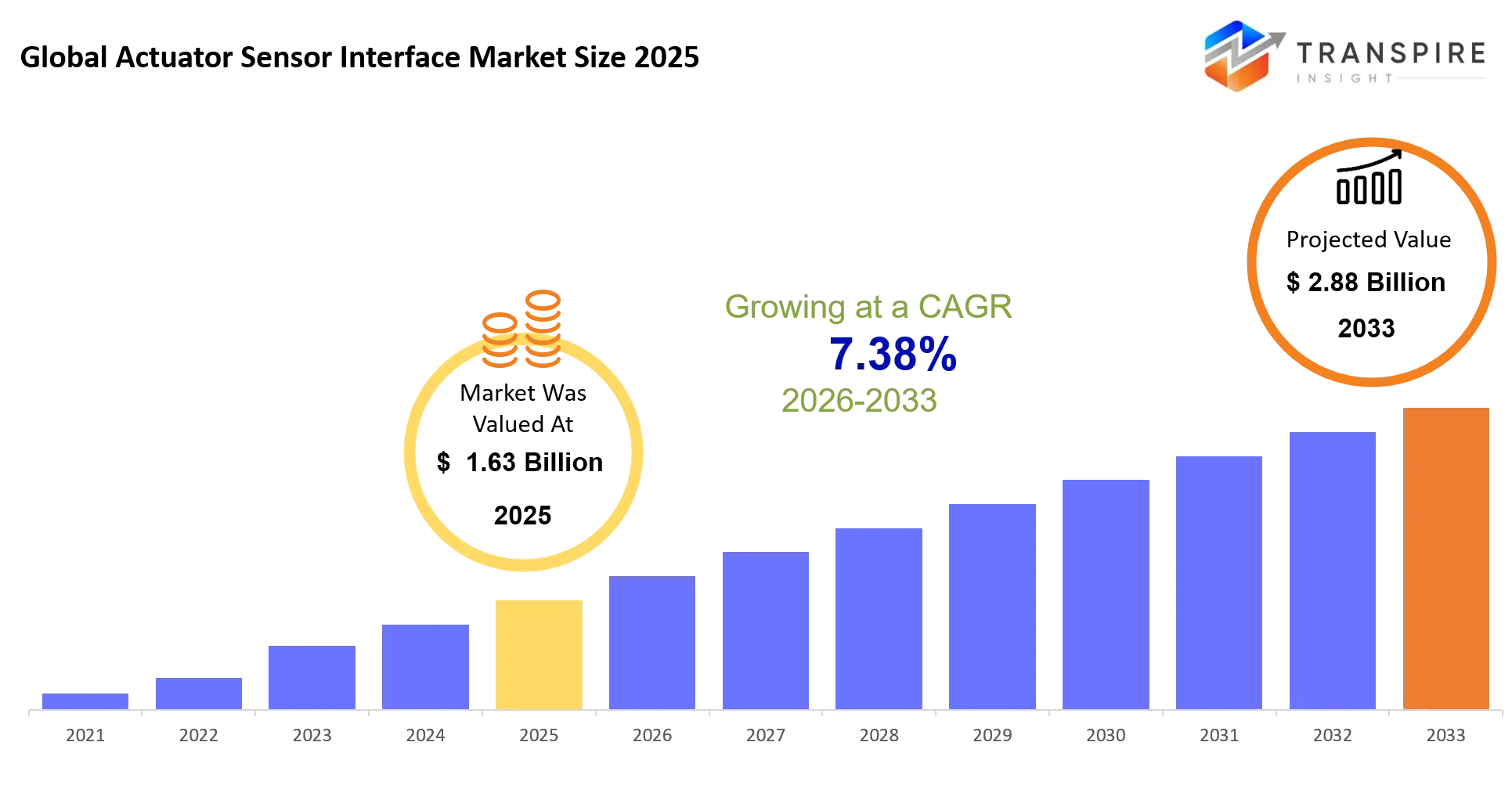
As per Transpire Insight Analysis, the Global Actuator Sensor Interface Market size is estimated at USD 1.63 Billion in 2025 and is anticipated to reach USD 2.88 Billion by 2033, growing at a CAGR of 7.38% from 2026 to 2033.
Historically an industrial communication layer, the global AS-i market now connects an essential ecosystem of sensors, actuators, safety elements and automation controllers in an evolving automated facility landscape. Industrial automation manufacturers now utilise the AS-i system for its ability to simplify machine wiring, lower overall installation time and gain enhanced real-time insights into remote operations. The previous five years, for example, have seen considerable evolution from legacy wired device signalling to intelligent, safety-enabled and Industrial Ethernet connected systems.
The structural evolution of AS-i into its integration with Industrial Ethernet and other Industry 4.0 architectures has been widely embraced due to accelerating smart factory implementations triggered by recent trends, specifically widespread automation investments driven by workforce limitations and industrial digital transformation initiatives undertaken after the pandemic.
Lower operating costs and minimum machine downtime have created the cause-and-effect drivers to increase the adoption of the simplified industrial connectivity benefits enabled by AS-i.
Key Global Actuator Sensor Interface Market Insights:
Actuator Sensor Interface networks are becoming a key component of decentralised automation, providing cost-efficient device communication and facilitating advanced industrial intelligence projects. The market is moving away from devices in a field to an interconnected automation ecosystem where safety, diagnostics and data transparency are influencing purchases.
- The market demand for Factory Automation is 41%, and Siemens is steadily building up integrated AS-i communication in digital factory architectures.
- In Industrial Robotics, the growth is expected at 13.8% CAGR, driven by the ABB and Omron development of intelligent robot-cell connectivity.
- Europe accounts for 35% of global demand, with Pepperl+Fuchs investing in sensor communication systems compatible with Industry 4.0.
- Wireless AS-i deployments grow by double digits, Bihl+Wiedemann expands flexible connectivity for mobile automation assets.
- Today, more than a third of new installations are safety-integrated networks, and Schneider Electric boosts the machine-safety communication frameworks.
- The rate of industrial Ethernet integration is nearing 40% of new automation projects, which is driving hybrid connectivity architectures.
- The initiatives of Rockwell Automation and Bosch Rexroth for flexible production lines are helping to sustain automotive applications at 11% of the market.
- Emerson's deployments increase in predictive maintenance and remote diagnostics to make up 21% of Process Automation.
- Packaging applications make up 13% of installations, while IFM and Banner Engineering have new compact sensor-networking solutions.
What are the Key Drivers, Restraints, and Opportunities in the Global Actuator Sensor Interface Market?
Driver:
This market development is all about transforming manufacturing sites into connected production plants. It is fueled by labour shortages, demand for production flexibility and, over time, the pressure to use equipment more effectively. Automation system wiring is eased with AS-i networks, which cut down installation and commissioning time, enable direct communication between devices and controllers, and dramatically reduce costs. Machines become more reliable, therefore paying for themselves much faster and seeing increasing demand within automotive, electronics, food & beverage manufacturing.
In April 2026, NORD Drivesystems launched its decentralised electronic drive systems featuring natively integrated AS-Interface network connectivity. This hardware product rollout eliminates complex, centralised control cabinet routing by allowing industrial drives to be wired directly on the plant floor.
Restraint:
The coexistence of multiple industrial communication standards across factories. Many facilities operate legacy automation infrastructures that were not originally designed for modern AS-i integration. Retrofitting these environments often requires gateway investments, protocol conversion, engineering expertise, and production downtime. This structural challenge persists because industrial assets frequently remain operational for decades, slowing complete migration toward unified communication architectures.
Opportunity:
Confluence of AS-i with industrial Ethernet, wireless automation, and edge intelligence. As the rise of smart factories requires real-time analytics and localised intelligence, next-generation AS-i is best poised to act as an integration platform connecting ground-floor devices with back-end operational intelligence in the cloud. Future growth can come from substantial investment in Asia-Pacific smart manufacturing zones, autonomous mobile robots, and smart logistics infrastructure. For example, to win in an AS-i landscape, deploy AS-i wireless into mobile robotic systems, smart cells to enable new business models, and expand AS-i out of typical plant enclosures. In May 2026, ifm electronic rolled out its direct machine-to-cloud integration framework via its moneo IIoT platform. This software launch bridges ground-floor AS-i sensor arrays directly with cloud-based diagnostic architectures, unlocking real-time data transparency
What Has the Impact of Artificial Intelligence Been on the Global Actuator Sensor Interface Market?
In this next transformation of AS-i-networks to intelligent industrial data platforms, we observe how Artificial Intelligence enables automaticity and optimised operations. AI-supported analysis Algorithms exploit real-time and historical sensor and actuator information of AS-i-controlled systems for continuous equipment-condition monitoring, anomaly detection and failure prediction. In modern production facilities, the AI analyses, in addition to vibration, temperature, pressure, or machine signals, information for reduced down-times, higher asset utilisation and optimised maintenance schedules. Based on ML, adaptive production control is also realised by automatic parameter adjustments of production, while machine-learning models optimise, for instance, real-time deployment of sensors and actuators and control signals for more production flexibility. Due to a lack of flexibility, many traditional IT infrastructures cannot seamlessly accommodate the high number of diverse data streams required by AI to support efficient data acquisition and analysis. Integration complexity – many industrial facilities maintain dated automation systems not designed for the ease of AI adoption – together with standardisation challenges, cost and availability of skills are barriers. Notwithstanding, AI-empowered predictive diagnostics and autonomous process optimisation offer great market opportunities and add value for industrial productivity.
In June 2026, Bihl+Wiedemann GmbH launched its high-current ASi-5/ASi-3 safety gateways (BWU4845), expanding available circuit capacities to 8 A per network loop. This industrial hardware rollout doubles traditional power availability while integrating embedded safety monitoring and multi-protocol industrial Ethernet connectivity.
https://control.com/news/bihlwiedemann-launches-high-current-asi-safety-gateways/
Key Global Actuator Sensor Interface Market Trends:
The market is moving toward intelligent field connectivity that will not just convey signals, but also provide actionable field operational insights. For industrial users, scalability and safety integration are becoming more important, as is real-time diagnostics, making AS-i more than just a wiring solution.
- With the adoption of mobile robots and flexible production systems in factories, wireless AS-i has gained momentum in the last 5 years.
- Safety communication is moving from a standalone infrastructure to integrated networks for machine-level protection.
- Isolated islands of automation are giving way to a single digital manufacturing environment through hybrid AS-i and Industrial Ethernet configurations.
- There are more diagnostic-rich sensors becoming commonplace, allowing to detect problems proactively rather than reacting to them.
- Edge computing integration is growing, and analytics is now closer to machines, with faster response time for critical operations.
- Packaging lines are evolving to modular production lines that need rapidly reconfigurable communication networks.
- High mix production and customisation of vehicles is driving the shift to decentralised automation architectures in the automotive industry.
- Smart factories are focusing on interoperability and are driving the need for gateways that link AS-i to cloud and MES platforms.
- As companies strive for energy savings and sustainability, energy efficiency monitoring has emerged as a crucial buying consideration.
- The choices of network architecture and communication protocols are becoming influenced by the Industrial Cyber Security perspective.
Global Actuator Sensor Interface Market Segmentation
By Component:
An overview of AS-i(C)(P) sensors and actuators dominates the AS-I market with their central role as the operating basis of communication networks that transmit machine data to facilitate real-time monitoring and control. Gateways have a rapid rise as AS-I networks are incorporated into industrial Ethernet and cloud solutions, while modules, power supplies, cable, and accessories profit from factory automation programs that aim to simplify implementation and increase the robustness of systems. Intelligence and enhanced diagnostics in sensor/actuator functions are the primary requirements for the coming years.
By Type:
AS-i 3.0 is the most broadly utilised standard with superior network abilities, giving the most extensive communications capacity and execution over its predecessor AS-i 2.1. AS-i Safety at Work, which improves machine security efforts with the expanded need to manage business hazards; a remote arrangement giving Wireless AS-I is quickly rising as its most rapidly expanding class; adaptable frameworks, mobile applications, and automated frameworks will be more adaptable in the years to come.
By Application:
Factory Automation is estimated to retain its leading position and achieve 41% share in revenue, predominantly through strong deployment within smart production facilities. Process Automation held a 21% market share in revenue, trailed by Packaging at 13%, Automotive at 11%, Material Handling at 7% and Other applications at 7%. Industrial Robotics is identified as the fastest-expanding application segment, expected to record a CAGR of 13.8%, driven by the increasing usage of robots in advanced production environments.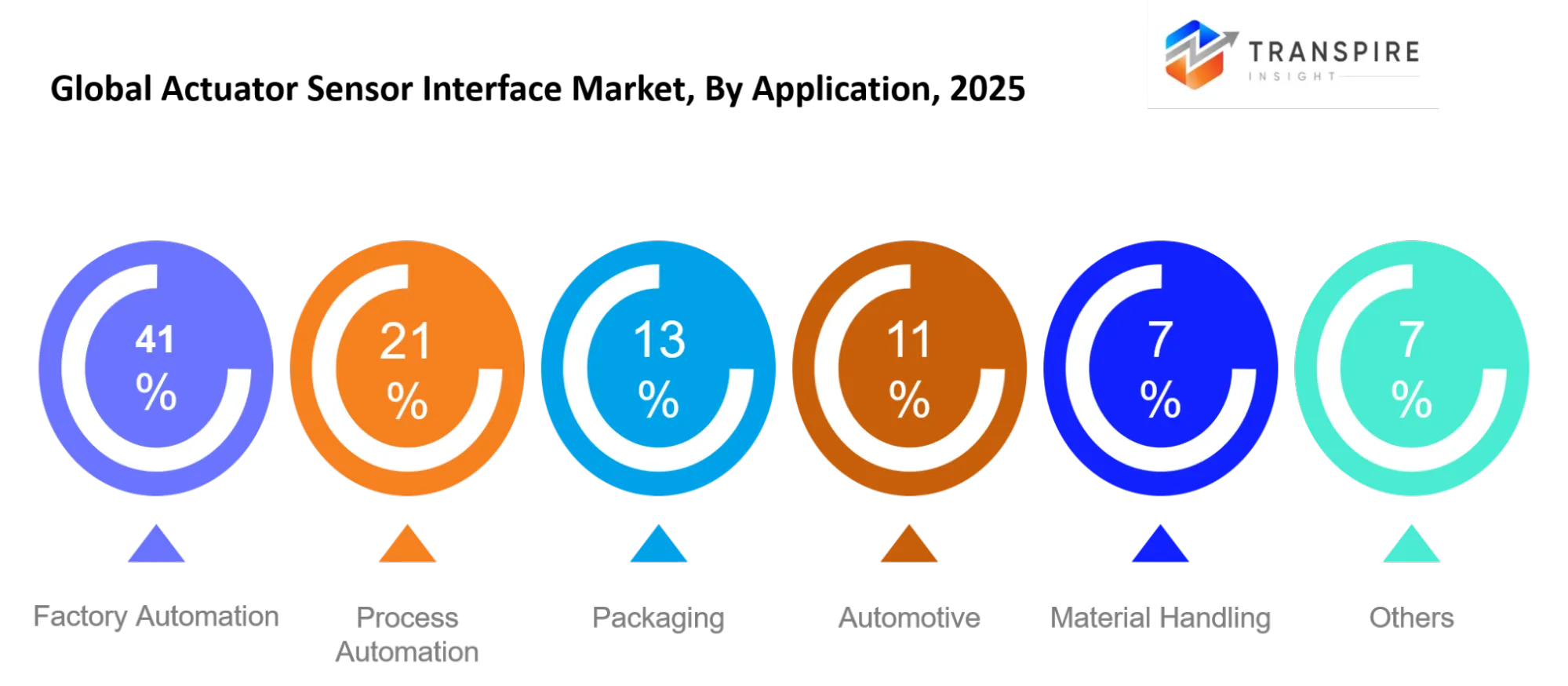
By End-User:
The industrial manufacturing sector leads demand, and is followed closely by the automotive, food and beverage, electronics, and chemicals sectors. By utilising an AS-i network and components, all these industries significantly improve the levels of operational efficiency and traceability.
By Connectivity:
Wired solutions maintain market leadership due to their reliability in industrial settings, while hybrid and Industrial Ethernet-connected systems are expanding rapidly as enterprises pursue greater flexibility, interoperability, and real-time data visibility across connected operations.
What are the Key Use Cases Driving the Global Actuator Sensor Interface Market?
The biggest market opportunity is factory automation at 41% market demand. The manufacturers rely on AS-i to link sensors, actuators, conveyor belts, and machine control interfaces while eliminating significant amounts of cabling and gaining process visualisation for entire production floors. The second- and third-largest markets after factories are the process, packaging, and automotive sectors.
These markets are adding AS-i support for distributed machine control, monitoring machinery, and safety communications to increase throughput, minimise machinery downtime, and enhance maintenance operations.
The emerging market opportunities are for industrial robotics, mobile material handling, and intelligent manufacturing. At 13.8% CAGR, the growth opportunities in industrial automation are providing greater use of wireless communications and Industrial Ethernet integration, driving applications to integrate with new technologies to support smart logistics and new smart manufacturing opportunities.
|
Report Metrics |
Details |
|
Market size value in 2025 |
USD 1.63 Billion |
|
Market size value in 2026 |
USD 1.75 Billion |
|
Revenue forecast in 2033 |
USD 2.88 Billion |
|
Growth rate |
CAGR of 7.38% from 2026 to 2033 |
|
Base year |
2025 |
|
Historical data |
2021 - 2024 |
|
Forecast period |
2026 - 2033 |
|
Report coverage |
Revenue forecast, competitive landscape, growth factors, and trends |
|
Regional scope |
United States; Canada; Mexico; United Kingdom; Germany; France; Italy; Spain; Denmark; Sweden; Norway; China; Japan; India; Australia; South Korea; Thailand; Brazil; Argentina; South Africa; Saudi Arabia; United Arab Emirates |
|
Key company profiled |
Siemens, Schneider Electric, Pepperl+Fuchs, Bihl+Wiedemann, ABB, Emerson, Rockwell Automation, IFM, Omron, Turck, Banner Engineering, Sick, Balluff, Phoenix Contact, Bosch Rexroth. |
|
Customization scope |
Free report customisation (country, regional & segment scope). Avail customised purchase options to meet your exact research needs. |
|
Report Segmentation |
By Component (Actuators, Sensors, Gateways, Modules, Power Supplies, Cables, Connectors, Others); By Type (AS-i 2.1, AS-i 3.0, AS-i Safety at Work, Wireless AS-i, Others); By Application (Factory Automation, Process Automation, Robotics, Packaging, Automotive, Material Handling, Others); By End User (Manufacturing, Automotive, Food & Beverage, Electronics, Chemicals, Others); By Connectivity (Wired, Hybrid, Industrial Ethernet, Others) |
Which Regions are Driving the Global Actuator Sensor Interface Market?
Europe led the market share by 35%. There are several reasons why this region has a commanding leadership – a mature Industrial Automation ecosystem, various Industry 4.0 programs, wider penetration of advanced technologies in modern factories and smart technologies and the presence of Industrial companies such as Germany and Italy that continue to drive Smart factory adoption and Machine Modernisation programs, backed by safety and energy efficient regulations, which also provide impetus for AS-i adoption growth.
In January 2026, Renesas Electronics delivered its ASI4U-V5 silicon transceiver ASSP with fully integrated, field-proven firmware to European automation developers. This hardware deployment delivers a massive bandwidth boost across parallel communication frequencies of 1–10 MHz.
North America’s 25% market share offers a distinct growth profile focused on increasing productivity and embracing industrial digital transformation. Unlike Europe, the pace of technology adoption in the region is propelled mainly by investments in predictive maintenance and industrial software deployment. Automakers, food & beverage manufacturers, and logistics companies are major automation spenders contributing to overall market stability, while the use of Industrial Ethernet and integrated production platforms is ubiquitous.
In January 2026, Sapcon Instruments launched its newly updated Vibrating Fork Level Sensor series, natively equipped with an integrated AS-Interface communication protocol. This targeted hardware expansion converts standard industrial liquid monitoring points into unified, low-overhead networking blocks.
The Asia-Pacific region contributes 30% to the overall market and is poised to grow at the most impressive pace with the highest CAGR of 14.6%. The increasing pace of industrialization and spiralling costs of labor have encouraged the industrial robot adoption across the last few years, leading to significant investments in industrial automation. Several nations, including China, India, and countries in Southeast Asia, along with South Korea, are aggressively pursuing smart factory deployments and automation initiatives. Increased adoption in industrial robotic solutions in the large manufacturing base, increasing electronics manufacturing and government-driven digital industrialisation initiatives are anticipated to provide lucrative opportunities going forward.
In March 2026, SEW-Eurodrive unveiled its modularised Electric Monorail System (EMS) automation platform driven natively by an ASi-5 railbus device architecture at LogiMAT 2026. This technology launch bridges regional assembly loops and robotic pick-and-place lines directly to stationary control networks.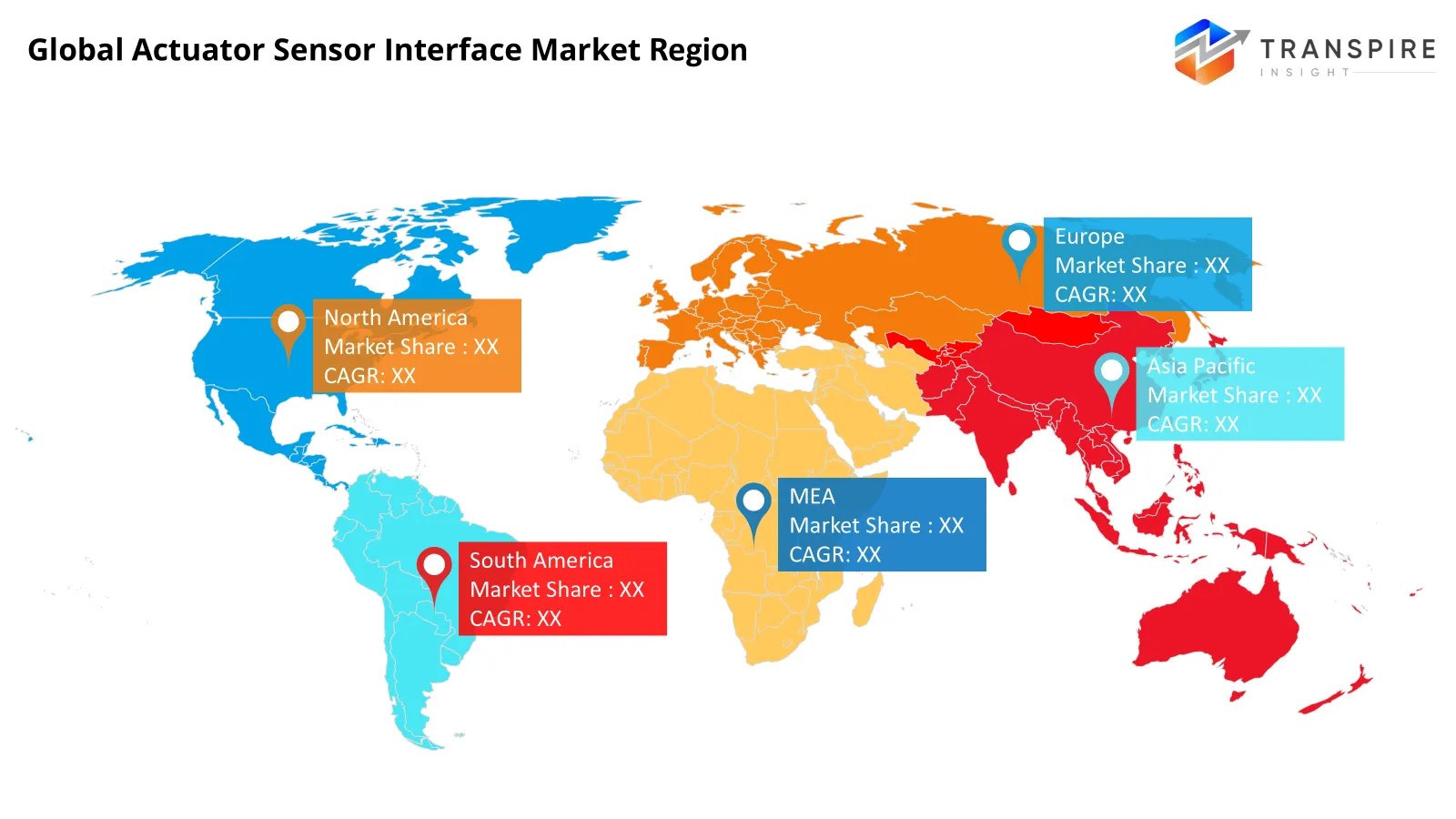
Who are the Key Players in the Global Actuator Sensor Interface Market and how do they Compete?
Market share in the actuator sensor interface arena is determined by the integration technology the actuator and sensor companies can achieve, their ability to provide a network communications system within the factory floor, the availability of a safety communication solution, and the ability to grow the partners and providers around their solutions. Therefore, it is about the vendor's ability to provide systems interoperability, diagnostics capabilities, cybersecurity readiness, and industry system readiness rather than just superior actuator and sensor performance.
Leading end-to-end automation providers, including Siemens, Schneider Electric, ABB, Emerson, and Rockwell Automation, leverage their existing control systems, digital twins, industrial software, and analytics platforms. They combine AS-i technology in their total solutions to simplify deployment and long-term system management, while focusing expansion initiatives on smart factory upgrades and smart integration. Specialised automation networking providers such as Pepperl+Fuchs, Bihl+Wiedemann, IFM, Turck, Sick, Balluff, Banner Engineering, Omron, Phoenix Contact, and Bosch Rexroth have competed through innovation in field communication, Safety-as-a-Service, intelligent devices, and flexibility. Many are compact modules and have built intelligent sensors, industrial networking capabilities that include industrial wireless networking, or specific industrial automation components. Expansion efforts target additional penetration into regional markets, support smart factory and Industry partnerships and offer intelligent sensors as a way to collect more operational data from the operational front.
Key Players are:
- Siemens
- Schneider Electric
- Pepperl+Fuchs
- Bihl+Wiedemann
- ABB
- Emerson
- Rockwell Automation
- IFM
- Omron
- Turck
- Banner Engineering
- Sick
- Balluff
- Phoenix Contact
- Bosch Rexroth
Recent Development News
- In February 2026, Bihl+Wiedemann launched its new configurable ASi-5 Safety I/O Module (BWU4277) to act as an all-in-one hardware foundation for industrial safety ecosystems. This product rollout provides up to 14 safe inputs and 2 safe outputs up to Performance Level e (PLe), allowing engineers to connect floating contacts or OSSD sensors dynamically to a single node and eliminate control cabinet clutter.
- In January 2026, Pepperl+Fuchs introduced its PROFINET AS-Interface Gateways featuring native S2 Redundancy protocols. This high-availability product deployment allows a single gateway to connect seamlessly to two separate, redundantly designed control systems.
What Strategic Insights Define the Future of the Global Actuator Sensor Interface Market?
The trend is toward future-ready, in-plant communications networks that act as smart operating platforms instead of just simple communication tunnels. Real competitive advantage is based on integrating the AS-i, Industrial Ethernet and IT data with cloud-native AI-based diagnostics at the operational edge. A latent threat is the increasing complexity born of the adoption of a patchwork of communications standards within industrial environments. Companies not taking interoperability seriously are at increasing risk of increasing costs and declining agility as automation networks grow. A future opportunity resides in wirelessly enabling the connected autonomous factory for everything from mobile robots to modular manufacturing cells to the distributed enterprise. Providers enabling tight integration between legacy AS-i infrastructure and new digital plant platforms stand to disproportionately gain. In a market dominated by hardware feature/cost-based selling, vendors would be smart to pivot to software-defined diagnostics, embedded security and interoperability at all costs. Success in the digital factory space increasingly goes to vendors that translate device-level communication networks into intelligent platforms to drive production efficiency, agility and resilience.
Key Segmentations are:
By Component
- Actuators
- Sensors
- Gateways
- Modules
- Power Supplies
- Cables
- Connectors
- Others
By Type
- AS-i 2.1
- AS-i 3.0
- AS-i Safety at Work
- Wireless AS-i
- Others
By Application
- Factory Automation
- Process Automation
- Robotics
- Packaging
- Automotive
- Material Handling
- Others
By End User
- Manufacturing
- Automotive
- Food & Beverage
- Electronics
- Chemicals
- Others
By Connectivity
- Wired
- Hybrid
- Industrial Ethernet
- Others
Regional Outlook
North America
- United States
- Canada
- Mexico
Europe
- Germany
- United Kingdom
- France
- Spain
- Italy
- Rest of Europe
Asia Pacific
- Japan
- China
- Australia & New Zealand
- South Korea
- India
- Rest of Asia Pacific
South America
- Brazil
- Argentina
- Rest of South America
Middle East & Africa
- Saudi Arabia
- United Arab Emirates
- South Africa
- Rest of the Middle East & Africa
Frequently Asked Questions
Find quick answers to common questions.
The Global Actuator Sensor Interface Market size was valued at USD 1.63 Billion in 2025 and is Poised to reach USD 2.88 Billion by 2033, expanding at a 7.38% CAGR.
Key Segments for the Global Actuator Sensor Interface Market are By Component (Actuators, Sensors, Gateways, Modules, Power Supplies, Cables, Connectors, Others); By Type (AS-i 2.1, AS-i 3.0, AS-i Safety at Work, Wireless AS-i, Others); By Application (Factory Automation, Process Automation, Robotics, Packaging, Automotive, Material Handling, Others); By End User (Manufacturing, Automotive, Food & Beverage, Electronics, Chemicals, Others); By Connectivity (Wired, Hybrid, Industrial Ethernet, Others).
Growth is primarily driven by acute industrial labour shortages, the demand for flexible production wiring, and the rapid transition of manufacturing facilities into connected, automated production plants.
The Global Actuator Sensor Interface Market is led by Major Manufacturers, including Siemens, Schneider Electric, Pepperl+Fuchs, Bihl+Wiedemann, ABB, Emerson, Rockwell Automation, IFM, Omron, Turck, Banner Engineering, Sick, Balluff, Phoenix Contact, and Bosch Rexroth.
Europe holds a commanding 35% share of the global market [Actuator Sensor Interface Market Demand, Report, Mergers ...], fundamentally anchoring industry dynamics as the birthplace and dominant force of AS-i technology due to its highly mature industrial automation sector.
High-revenue commercial opportunities lie in merging next-generation AS-i networks with industrial Ethernet, integrating AS-i wireless modules into autonomous mobile robots, and extending smart-cell connectivity outside typical plant enclosures.
- Siemens
- Schneider Electric
- Pepperl+Fuchs
- Bihl+Wiedemann
- ABB
- Emerson
- Rockwell Automation
- IFM
- Omron
- Turck
- Banner Engineering
- Sick
- Balluff
- Phoenix Contact
- Bosch Rexroth
About the Authors

Mayur Shinde
I am Mayur Shinde, a Senior Research Analyst at Transpire Insight, specializing in the Automotive & Transportation and Information & Communication Technology (ICT) Industry. My work focuses on analyzing emerging market trends, technological advancements, competitive landscapes, and industry developments to deliver accurate, data-driven insights. I am passionate about transforming complex market information into clear, actionable content that helps businesses, professionals, and decision-makers stay informed and make confident strategic decisions.

Chakradhar Khansole
Chakradhar serves as the Research Director at Transpire Insight, bringing over 8 years of experience in technology, innovation, and strategic market intelligence. He specializes in transforming complex market data into actionable business insights that enable organizations to make informed, growth-oriented decisions. Recognized for his strategic vision and analytical expertise, Chakradhar leads high-impact research initiatives, delivering comprehensive market assessments, competitive intelligence, and forward-looking industry analysis.
Recently Published Reports
-
Apr 2026
3D Optical Profiler Market
3D Optical Profiler Market Size, Share & Analysis Report By Type (Desktop 3D Optical Profiler, and Portable 3D Optical Profiler), By Technology (Confocal Technology, and White Light Interference), By End-Use Industry (Manufacturing, Research Institutions, Automotive, Aerospace and Defense, Medical Devices, and Other), and Geography (North America, Europe, Asia-Pacific, Middle East and Africa, South and Central America), 2021 - 2031
-
Apr 2026
Depth Sensor Market
Depth Sensor Market Size, Share & Analysis Report By Type (Infrared Depth Sensors, Time-of-Flight (ToF) Sensors, Stereo Vision Sensors, Structured Light Sensors, Ultrasonic Depth Sensors), By Application (Automotive, Robotics, Gaming, Consumer Electronics, Industrial Automation, Healthcare, Security & Surveillance, Others), By End Users (Automotive Manufacturers, Consumer Electronics Companies, Healthcare Providers, Industrial Companies, Security Agencies, Gaming Companies, Robotics Companies, Others), and Geography (North America, Europe, Asia-Pacific, Middle East and Africa, South and Central America), 2021 – 2031
-
Apr 2026
Digital Manufacturing Market
Digital Manufacturing Market Size, Share & Analysis Report By Component (Hardware, Software, and Services), By Technology (Robotics, 3D Printing, Internet of Things (IoT), and Others), By Application (Automotive and Transportation, Aerospace and Defense, Consumer Electronics, Industrial Machinery, and Others), By Process Type (Computer-Based Designing, Computer-Based Simulation, Computer 3D Visualization, Analytics, and Others), and Geography (North America, Europe, Asia-Pacific, Middle East and Africa, South and Central America), 2021 – 2031
-
Apr 2026
Digital Visa Services Market
Digital Visa Services Market Size, Share & Analysis Report By Type (Individual Travelers, Group Travelers), By Application (Tourism, Business Travel, Others), and Geography (North America, Europe, Asia-Pacific, Middle East and Africa, South and Central America), 2021 – 2031