
South Korea Motion Sensor Market Size & Forecast:
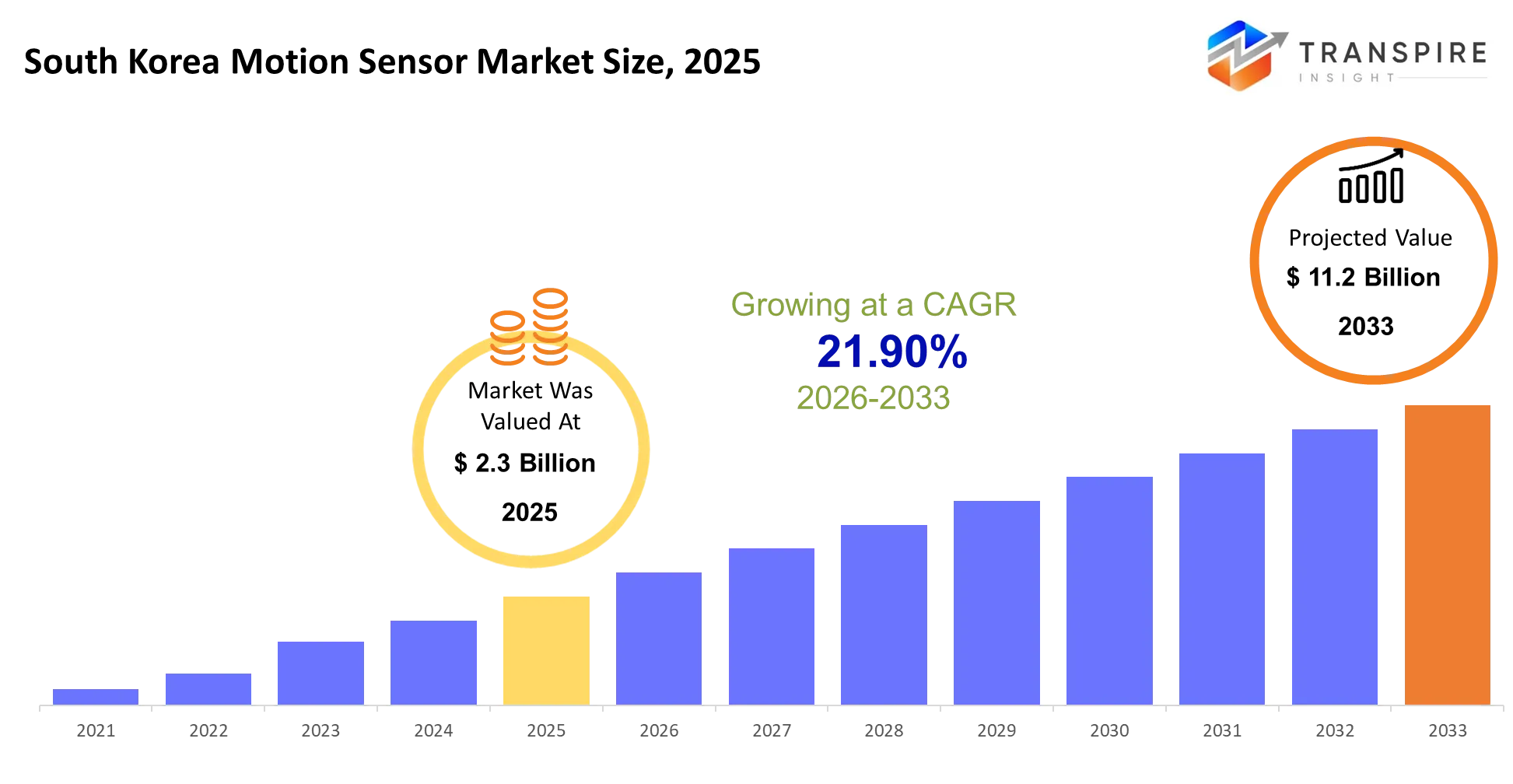
- South Korea Motion Sensor Market Size 2025: USD 2.3 Billion
- South Korea Motion Sensor Market Size 2033: USD 11.2 Billion
- South Korea Motion Sensor Market CAGR: 21.90%
- South Korea Motion Sensor Market Segments: By Sensor Type (Infrared Motion Sensors, Ultrasonic Motion Sensors, Microwave Motion Sensors, Dual Technology Sensors, Others); By Application (Consumer Electronics, Smart Homes, Industrial Automation, Automotive Systems, Security & Surveillance, Others); By Technology (MEMS-based Sensors, IoT-enabled Sensors, AI-powered Motion Sensors, Wireless Motion Sensors, Others); By End User (Residential Sector, Commercial Sector, Industrial Sector, Healthcare Sector, Others); By Connectivity (Wired Sensors, Wireless Sensors, Bluetooth-enabled Sensors, Others)
To learn more about this report,  Download Free Sample Report
South Korea Motion Sensor Market Summary
The South Korea Motion Sensor Market was valued at USD 2.3 Billion in 2025. It is forecast to reach USD 11.2 Billion by 2033. That is a CAGR of 21.90% over the period.
In South Korea, motion sensors quietly enable machines, vehicles and buildings to react to human movement and environmental shifts, which helps safety systems, factory automation, and energy efficient operations even in dense industrial and urban areas. Over the past few years, the market has moved away from simple infrared detection modules toward MEMS based, AI integrated sensor setups, that then stream real time data into connected industrial platforms.
This kind of change has been reinforced by more strict workplace safety requirements in manufacturing and shipbuilding, plus the post pandemic labor limits that made many companies push automation faster. So now enterprises are using motion sensing not only for detection but also for predictive maintenance , access regulation, and equipment tuning, leading to steadier operations and fewer surprise stoppages. Because of that, demand growth is more about productivity improvements and compliance driven upgrades, than about routine swap outs of single devices.
Key Market Insights
- Industry growth seems to be carried by the smart factory expansion in South Korea, where manufacturing upgrades make up, an estimated 35–40% of the demand in 2025.
- After the pandemic there were labor shortages, so companies leaned more on automation, which in turn really boosts sensor uptake across production lines and logistics handling.
- The Seoul Capital Region kinda leads the South Korea motion sensor market, with almost 45% share, mainly because there’s a heavy concentration of industrial sites plus smart building infrastructure in that area.
- Over in the Southeastern industrial zones, like Ulsan and Busan, the momentum is stronger, faster growing, due to shipbuilding automation along with logistics modernization directions.
- For 2025, PIR motion sensors are still taking the biggest slice, mostly because they’re cost efficient and they’re used everywhere in security systems and building automation setups.
- MEMS-based motion sensors are kind of the second-largest chunk, they’re widely taken up in consumer electronics but also in industrial monitoring solutions.
- In South Korea, industrial automation shows up as the biggest slice, roughly around 38–42% share, mainly because of smart factory transformation initiatives that keep moving forward.
- For applications, smart building, and home automation is the fastest-growing part, pushed by the need for energy efficiency and by IoT-driven infrastructure upgrades that people are rolling out more often.
- On the end-user side, manufacturing is still the main segment, with strong spending on motion-based monitoring to boost productivity and refine safety procedures.
- Automotive along with smart infrastructure are also picking up speed fast , helped by ADAS integration and those intelligent mobility adoption trends that don’t really slow down.
What are the Key Drivers, Restraints, and Opportunities in the South Korea Motion Sensor Market?
The main driver is the pretty rapid growth of smart manufacturing under South Korea’s Industry 4.0 initiatives, and honestly it feels like everything is moving together there. As factories start weaving in robotics, IoT platforms, and predictive maintenance systems, motion sensors have become kind of unavoidable for real-time monitoring and human-machine safety, not just “nice to have.” This change was nudged along by the post-pandemic push toward automation, plus tighter labor constraints , so manufacturers are being encouraged to fund sensor-heavy environments that directly lift uptime and day-to-day efficiency. Because of that, adoption is showing up as continuing demand from system upgrades instead of one-time installs, which helps strengthen long-term revenue visibility.
The biggest restraint is the high level of system integration complexity across older industrial setups. A lot of older shipbuilding and heavy manufacturing plants still use fragmented control systems, and those don’t play nicely with modern AI-enabled sensors. So there are extra retrofit costs, longer deployment cycles, and slower scaling, which makes it harder to monetize advanced solutions quickly across the South Korea Motion Sensor Market.
A key opportunity shows up in smart mobility infrastructure, especially radar-based motion sensing for autonomous and connected vehicles. Hyundai’s ongoing ADAS testing programs across urban mobility corridors show how sensor fusion setups can unlock stronger safety and navigation features, and it also puts automotive integration on track as the next major growth phase.
What Has the Impact of Artificial Intelligence Been on the South Korea Motion Sensor Market?
Artificial intelligence and advanced digital systems, kind of quietly, are changing how the South Korea Motion Sensor Market supports industrial automation and maritime operations, mainly for emission control and monitoring duties. In scrubber performance setups and exhaust gas cleaning technology, AI enabled motion sensors are now used to automate the whole operational monitoring part, by tracking vibrations, weird flow behavior, and equipment movement patterns on a constant basis. This cuts down the need for so much manual inspection. It also allows real time control tweaks inside marine emission control systems, so compliance improves as the sulfur cap rules keep getting more strict.
Then there’s machine learning which, instead of waiting for problems, boosts predictive maintenance by examining motion sensor information from pumps, valves, and exhaust related units. The idea is to foresee component degradation before a failure actually shows up. For fleet operations, these models can help tune routing and scrubber usage timing, and that tends to improve fuel efficiency by something like 3–7 percent, in optimized deployments while still backing up steadier emissions compliance reporting. From an operational view, shipping operators also say equipment uptime is higher, because sensor based alerts let them schedule maintenance during planned port stops, rather than messing around during voyages.
Even with all that, AI adoption in the South Korea Motion Sensor Market still hits a structural snag, mainly because real-world maritime data quality stays inconsistent. Rough sea conditions, sensor signal interference, and limited high frequency connectivity out at sea all reduce model accuracy. This also slows down how quickly fully autonomous optimization systems can scale up across different routes and vessel types.
Key Market Trends
- South Korea’s motion sensor market kind of shifted, from PIR being the main thing before 2022, to more MEMS and radar sensors, which helped a lot with accuracy in industrial automation settings.
- Around 2023, industrial buyers started picking up AI integrated sensors more often , and they moved away from rule-based systems , toward predictive operational monitoring across factories.
- During 2021–2025, smart factory programs kept spreading, so manufacturers were upgrading older setups to connected motion detection, for real-time machine coordination and stuff like that.
- Since 2022, shipbuilding safety rules got tighter, and that made companies deploy more advanced motion sensing for compliance monitoring, plus hazard reduction.
- In the automotive side, demand really sped up after 2023, because ADAS development efforts from Hyundai and Kia integrated radar motion sensing into their testing platforms, more or less.
- Also in 2024, edge computing showed up strongly, which allowed localized motion data processing and lowered latency in industrial control systems.
- From 2021 onward, supply chain localization efforts reduced how much they depended on imported sensor components , and that strengthened domestic production ability in South Korea.
- Then between 2022 and 2025, building automation systems increasingly leaned toward energy-optimized motion detection , improving occupancy based energy management efficiency, overall.
South Korea Motion Sensor Market Segmentation
By Sensor Type :
Infrared motion sensors keep on holding steady, use across basic detection systems in buildings and consumer devices keeps moving along , mostly because the cost stays low and deployment feels pretty simple. Ultrasonic and microwave sensors are getting more traction in industrial settings where accuracy has to be better and coverage tends to be wider, for operational safety.
Dual technology sensors are going with a lot more momentum in security and industrial setups, because they mix different detection methods and that kind of helps cut down those false alarms, while also upping overall reliability. Meanwhile other emerging sensor types are slowly finding their way into niche scenarios where motion detection needs to be more specialized , especially in places with complex layouts or high interference.
By Application :
For consumer electronics, the situation stays steady, with motion based features showing up in things like displays and handheld devices. Smart homes are also expanding steadily, since occupancy based control is becoming more common across residential spaces as well as commercial buildings.
Industrial automation is showing stronger growth too, driven by factory modernization and the constant need for safety monitoring. Automotive systems are increasing their usage as driver assistance features call for precise motion detection, and at the same time security and surveillance keep steady deployment in urban infrastructure and commercial facilities.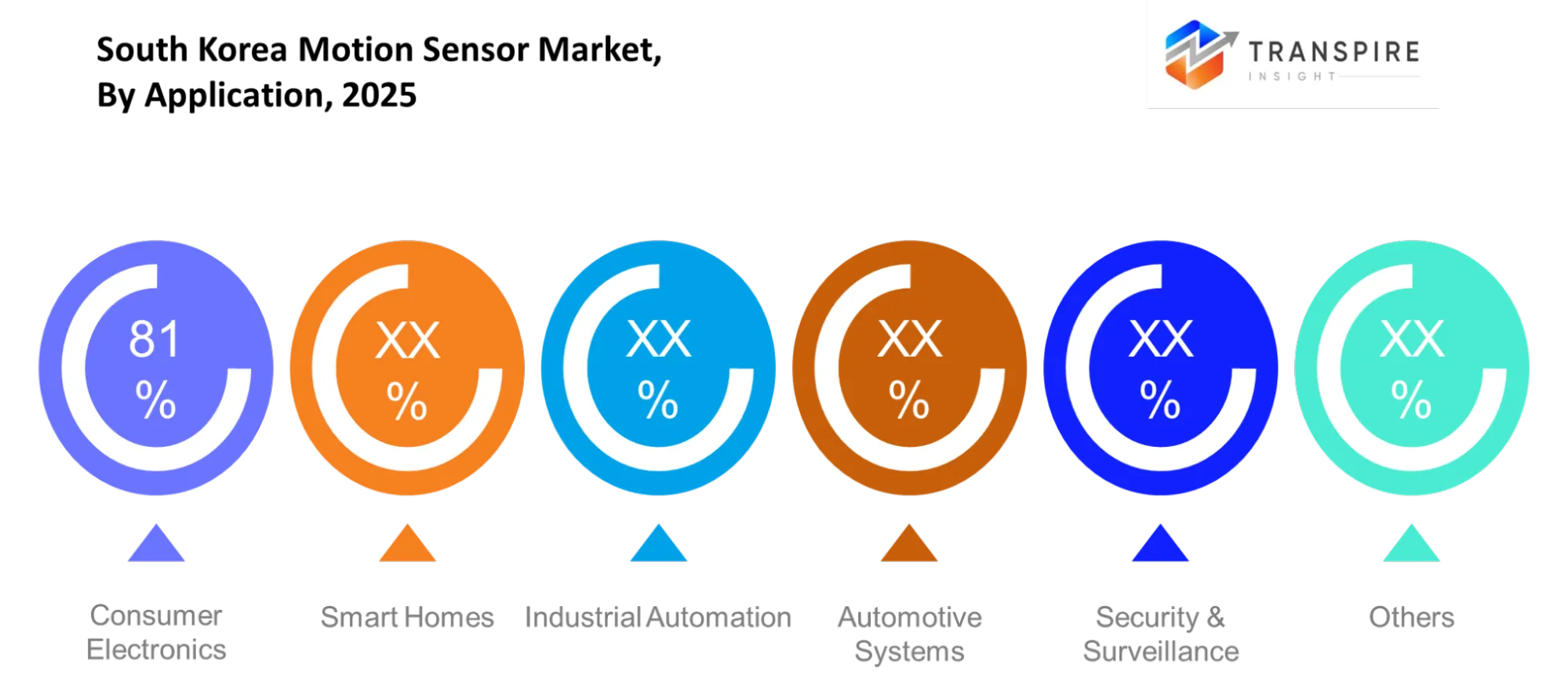
To learn more about this report, Download Free Sample Report
By Technology :
MEMS based sensors, kinda dominate usage because they stay compact and still show strong performance across both consumer and industrial setups. As connected infrastructure keeps growing in factories and smart buildings, IoT enabled sensors are also becoming more common , you know, like more everywhere.
AI powered motion sensors are getting plugged into predictive systems that help with real time decisions, and better operational tuning overall. At the same time, wireless motion sensors are picking up momentum in those flexible installation environments where putting in wired infrastructure is messy or expensive to keep up.
By End User :
Residential demand is being boosted by the growing adoption of automated lighting, security, and energy control routines in newer housing developments. Meanwhile commercial use is rising in office buildings and retail areas for things like presence tracking and efficiency improvements, pretty steadily.
In the industrial sector though, the contribution stays the biggest because automation, safety monitoring, and production optimization keep driving requirements. Healthcare is following too, since motion detection helps with patient monitoring systems and facility safety management.
By Connectivity :
Wired sensors still keep getting used in fixed industrial setups where you need steady link and, basically uninterrupted data flow, always. Wireless sensors are actually growing faster, mainly because the setup is easier and they can be deployed in a more flexible way across current infrastructure.
Bluetooth-enabled sensors are being applied more often in short-range monitoring, inside consumer spaces as well as in light commercial environments. Meanwhile other ways of connecting are also showing up, to back specialized industrial systems that need mixed communication styles and a kind of integrated network compatibility, more or less.
What are the Key Use Cases Driving the South Korea Motion Sensor Market?
Industrial automation is still the main use case in the South Korea Motion Sensor Market, kinda driven by smart factory setups where real time motion detection matters for equipment safety, smoother process coordination, and predictive maintenance. In manufacturing places these sensors help cut down downtime and keep production consistency, in particular across high volume electronics and automotive assembly lines where precision control is basically non negotiable.
Smart building automation and also automotive safety systems are becoming more important as secondary options. In commercial buildings, motion sensors get used for occupancy based lighting and energy management improvements, while automakers are folding them into driver assistance features and in cabin monitoring, as safety expectations keep tightening in the mobility space.
Newer use cases are showing up too, like healthcare patient monitoring plus more advanced robotics for logistics work. Hospitals are starting to use motion sensing for non intrusive patient tracking, and warehouse operators are looking at autonomous solutions that depend on motion feedback for navigation and inventory handling.
|
Report Metrics |
Details |
|
Market size value in 2025 |
USD 2.3 Billion |
|
Market size value in 2026 |
USD 2.8 Billion |
|
Revenue forecast in 2033 |
USD 11.2 Billion |
|
Growth rate |
CAGR of 21.90% from 2026 to 2033 |
|
Base year |
2025 |
|
Historical data |
2021 - 2024 |
|
Forecast period |
2026 - 2033 |
|
Report coverage |
Revenue forecast, competitive landscape, growth factors, and trends |
|
Country scope |
South Korea |
|
Key company profiled |
Samsung Electronics, LG Electronics, Bosch Sensortec, Honeywell, Panasonic, Murata Manufacturing, STMicroelectronics, Texas Instruments, NXP Semiconductors, Analog Devices, Omron Corporation, Sony, Infineon Technologies, TDK Corporation, Qualcomm |
|
Customization scope |
Free report customization (country, regional & segment scope). Avail customized purchase options to meet your exact research needs. |
|
Report Segmentation |
By Sensor Type (Infrared Motion Sensors, Ultrasonic Motion Sensors, Microwave Motion Sensors, Dual Technology Sensors, Others); By Application (Consumer Electronics, Smart Homes, Industrial Automation, Automotive Systems, Security & Surveillance, Others); By Technology (MEMS-based Sensors, IoT-enabled Sensors, AI-powered Motion Sensors, Wireless Motion Sensors, Others); By End User (Residential Sector, Commercial Sector, Industrial Sector, Healthcare Sector, Others); By Connectivity (Wired Sensors, Wireless Sensors, Bluetooth-enabled Sensors, Others) |
Which Regions are Driving the South Korea Motion Sensor Market Growth?
The Seoul Capital Region seems to be leading the South Korea Motion Sensor Market, mostly because there’s a dense cluster of electronics manufacturing plus smart infrastructure projects and, honestly , solid policy support for Industry 4.0 adoption. Seoul’s government-led smart city efforts have pushed faster rollouts for sensor-based building automation and public safety setups. And then there are the big tech firms and R&D hubs around, which makes innovation keep moving, especially in MEMS and AI-integrated sensing approaches. All together, this kind of environment helps commercialization happen quickly, so early adoption shows up in both industrial and consumer uses.
Meanwhile the southeastern industrial corridor, think Busan and Ulsan, adds steady momentum to the market. Here the emphasis is more on shipbuilding logistics and heavy manufacturing rather than that Seoul-style “innovation first” vibe. The region leans on operational steadiness, and longer-term capital commitments from well-established industrial participants. Shipyards and port operators often use motion sensors for equipment monitoring, safety compliance, and cargo handling performance, not just for experiments. Because large shipowners keep investing on consistent cycles, demand stays relatively stable even when global trade goes a bit up and down, you know.
Then there is Gyeonggi Province, which is showing up as the fastest-growing area. This is largely tied to fresh expansions in semiconductor fabs, logistics hubs, plus automated warehouse facilities. Since 2023, big infrastructure investments have kind of sped up adoption of motion sensing in robotics-driven logistics and precision manufacturing. Also new industrial parks near transport corridors are pulling sensor-based automation in from the design stage itself, rather than waiting until later. That ongoing pace creates strong doorway chances for suppliers trying to sell integrated smart factory and logistics solutions somewhere around 2026–2033.
Who are the Key Players in the South Korea Motion Sensor Market and How Do They Compete?
In the South Korea Motion Sensor Market, competition is sort of moderately consolidated, where the big global semiconductor names and local electronics players keep going after OEM integration deals. Most established companies stay ahead thanks to longer supply deals with industrial automation and automotive manufacturers, but smaller specialized sensor developers still pop up with more focused, niche offerings like AI-enabled motion sensing and low-power variants. Overall, the fight seems to be pushed by how different the technology really is, how well the products can be merged into IoT platforms and how dependable they remain once they’re in real industrial environments.
Samsung Electronics builds AI enabled MEMS sensors that get wired into smart factory systems and also into automotive ADAS platforms, often via partnerships with Hyundai, which helps them land integration work faster. LG Innotek leans toward automotive sensor fusion modules, combining motion with imaging for EV use cases and driver assistance scenarios. Bosch Sensortec tends to specialize in ultra compact MEMS sensors aimed at IoT devices and industrial setups, and they back it with solid automotive certification standards, so that buyers feel more confident.
STMicroelectronics concentrates on low power MEMS motion sensors, especially for industrial IoT and predictive maintenance inside manufacturing sites. Infineon Technologies, instead, works on radar based sensing approaches for automotive safety systems, supporting ADAS rollouts with regional mobility partners in the background. Honeywell meanwhile keeps expanding motion sensor applications in industrial and commercial building automation, using them for safety monitoring plus energy efficiency optimization, in a pretty practical way.
Company List
- Samsung Electronics
- LG Electronics
- Bosch Sensortec
- Honeywell
- Panasonic
- Murata Manufacturing
- STMicroelectronics
- Texas Instruments
- NXP Semiconductors
- Analog Devices
- Omron Corporation
- Sony
- Infineon Technologies
- TDK Corporation
- Qualcomm
Recent Development News
In March 2026, Movella (Xsens) rebranded its motion tracking division back to Xsens. The company officially restored the Xsens identity across its inertial motion capture and sensor product portfolio following prior restructuring under Movella.Source https://www.xsens.com/
In April 2026, ROHM Co., Ltd. announced the full withdrawal of its MEMS accelerometer product line, including legacy Kionix-branded sensor components. The company confirmed discontinuation of production and support for inertial sensor offerings used in motion detection applications. Source https://www.rohm.com/
What Strategic Insights Define the Future of the South Korea Motion Sensor Market?
The South Korea Motion Sensor Market is, um, drifting toward a kind of structurally integrated ecosystem where sensing, edge computing, and AI decision systems kind of act like one unified industrial layer. At the same time this change is being pushed by nonstop automation across manufacturing, mobility and smart infrastructure, where motion data turns into a live operational input not just passive detection. In the next 5 to 7 years, buyers are likely to cluster their spending around high-precision low-latency sensor networks placed inside connected industrial surroundings.
But there’s also a risk that’s a bit quieter and less obvious , platform concentration is rising, and a small set of semiconductor and electronics players end up controlling both the sensor hardware and the AI processing stack too. That situation can reduce pricing flexibility, and it may slow down adoption for mid-tier industrial operators who really need interoperable systems that “play nice” with each other.
Still, an opportunity is forming right now, especially around retrofitting smart factory upgrades in older industrial pockets in Gyeonggi plus coastal manufacturing areas. There, legacy setups are often only partially digitized rather than fully replaced, so modular improvements matter more. Firms that build modular plug-and-play motion sensing solutions will probably get the first traction.So market players should lean toward open-architecture sensor platforms, ones that integrate smoothly with third-party industrial software. Otherwise the long-term ecosystem lock-in can become a real problem.
South Korea Motion Sensor Market Report Segmentation
By Sensor Type
- Infrared Motion Sensors
- Ultrasonic Motion Sensors
- Microwave Motion Sensors
- Dual Technology Sensors
By Application
- Consumer Electronics
- Smart Homes
- Industrial Automation
- Automotive Systems
- Security & Surveillance
By Technology
- MEMS-based Sensors
- IoT-enabled Sensors
- AI-powered Motion Sensors
- Wireless Motion Sensors
By End User
- Residential Sector
- Commercial Sector
- Industrial Sector
- Healthcare Sector
By Connectivity
- Wired Sensors
- Wireless Sensors
- Bluetooth-enabled Sensors
Frequently Asked Questions
Find quick answers to common questions.
The South Korea Motion Sensor Market size is USD 11.2 Billion in 2033.
Key Segments for the South Korea Motion Sensor Market are By Sensor Type (Infrared Motion Sensors, Ultrasonic Motion Sensors, Microwave Motion Sensors, Dual Technology Sensors, Others); By Application (Consumer Electronics, Smart Homes, Industrial Automation, Automotive Systems, Security & Surveillance, Others); By Technology (MEMS-based Sensors, IoT-enabled Sensors, AI-powered Motion Sensors, Wireless Motion Sensors, Others); By End User (Residential Sector, Commercial Sector, Industrial Sector, Healthcare Sector, Others); By Connectivity (Wired Sensors, Wireless Sensors, Bluetooth-enabled Sensors, Others).
Major South Korea Motion Sensor Market Players are Samsung Electronics, LG Electronics, Bosch Sensortec, Honeywell, Panasonic, Murata Manufacturing, STMicroelectronics, Texas Instruments, NXP Semiconductors, Analog Devices, Omron Corporation, Sony, Infineon Technologies, TDK Corporation, Qualcomm.
The Current South Korea Motion Sensor Market size is USD 2.3 Billion in 2025.
The South Korea Motion Sensor Market CAGR is 21.90% from 2026 to 2033.
- Samsung Electronics
- LG Electronics
- Bosch Sensortec
- Honeywell
- Panasonic
- Murata Manufacturing
- STMicroelectronics
- Texas Instruments
- NXP Semiconductors
- Analog Devices
- Omron Corporation
- Sony
- Infineon Technologies
- TDK Corporation
- Qualcomm
Recently Published Reports
-
Apr 2026
Fiber Optic Faceplates Market
Fiber Optic Faceplates Market Size, Share & Analysis Report By Type (< 300 mm2, 300-350 mm2, and > 350 mm2, By Application (Night Vision, Holographic Imaging, Medical, and Others), and Geography (North America, Europe, Asia-Pacific, Middle East and Africa, South and Central America), 2021 - 2031
-
Apr 2026
High Temperature Superconductors Market
High Temperature Superconductors Market Size, Share & Analysis Report By Type (1G HTS, and 2G HTS), By Application (Power Cable, Fault Current Limiter, and Transformer), and Geography (North America, Europe, Asia-Pacific, Middle East and Africa, South and Central America), 2021 - 2031
-
Apr 2026
Industrial Plugs and Socket Market
Industrial Plugs and Socket Market Size, Share & Analysis Report By Type (Industrial Plugs, Industrial Sockets), By Current (Up to 32 A, 32 to 125 A, Above 125 A), By Protection (Dustproof and Splash Proof, Waterproof, Explosion Proof), By End User (Heavy Industries, Oil and Gas, Chemicals and Pharmaceuticals, Power Generation, Others), and Geography (North America, Europe, Asia-Pacific, Middle East and Africa, South and Central America), 2021 - 2031
-
Apr 2026
InGaAs Avalanche Photodiodes Market
InGaAs Avalanche Photodiodes Market Size, Share & Analysis Report By Type (1100 - 1700 nm, and 1000 - 1600 nm), By Application (Missile Warning System, Muzzle Flash Detection, Wafer Defect Inspection, Laser Rangefinders, and Others), and Geography (North America, Europe, Asia-Pacific, Middle East and Africa, South and Central America), 2021 - 2031