

South Korea Mineral Oil Market Size & Forecast:
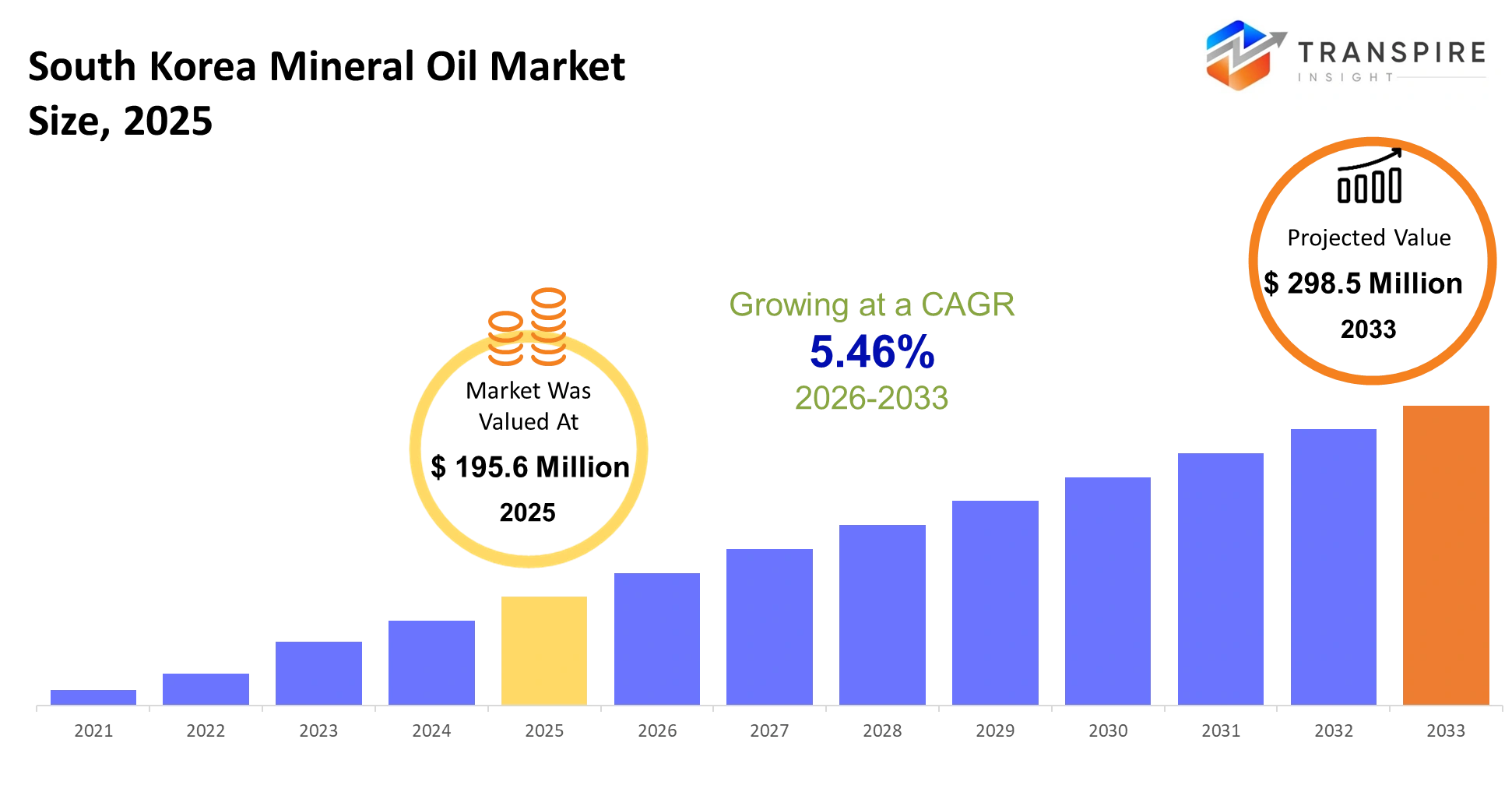
- South Korea Mineral Oil Market Size 2025: USD 195.6 Million
- South Korea Mineral Oil Market Size 2033: USD 298.5 Million
- South Korea Mineral Oil Market CAGR: 5.46%
- South Korea Mineral Oil Market Segments: By Product Type (White Mineral Oil, Technical Mineral Oil, Process Oil, Transformer Oil, Lubricating Oil, Others); By Application (Industrial Lubrication, Personal Care Products, Pharmaceuticals, Food Processing, Rubber Processing, Others); By Grade (Pharmaceutical Grade, Food Grade, Industrial Grade, Cosmetic Grade, Others); By Distribution Channel (Direct Sales, Industrial Distributors, Online Sales, Retail Channels, Others); By End User (Chemical Industry, Automotive Industry, Cosmetics Industry, Food Industry, Others)
To learn more about this report,  Download Free Sample Report
South Korea Mineral Oil Market Summary
The South Korea Mineral Oil Market was valued at USD 195.6 Million in 2025. It is forecast to reach USD 298.5 Millionby 2033. That is a CAGR of 5.46% over the period.
In practice, the South Korea Mineral Oil Market keeps marine engines running steady, along with industrial machinery and heavy duty hydraulic systems, mostly by supporting friction management, thermal steadiness, and long equipment life. It works kinda like a quiet enabler for ship operators, manufacturing plants, and parts of energy infrastructure where uninterrupted mechanical output really changes the result, plus it helps with compliance readiness too.
Over the last 3–5 years, the whole market has moved in a more structural way because maritime emission rules got tighter, in line with IMO style fuel and lubricant requirements. That pressure pushed refiners to rework and reblend mineral based oils into higher performance options. One major trigger was the post pandemic timeline combined with geopolitical disruption across global shipping corridors. This tightened supply chains and then forced operators to raise maintenance efficiency and make stock reliability a more serious priority.
As a consequence, demand has shifted toward premium grade formulations and longer life lubrication solutions. This basically shows up as broader uptake across fleet modernization initiatives and industrial automation setups where downtime costs keep going up in a noticeable way.
Key Market Insights
- The South Korea Mineral Oil Market looks like it has strong maritime dominance ,mostly because of Busan and Ulsan port based industrial clustering, they together count for around 35–40% of total lubricant consumption in marine linked operations ,which is kinda big.
- Industrial lubricants sit in the lead within the South Korea Mineral Oil Market ,mainly due to heavy manufacturing activity in 2025 ,so they contribute an estimated 45%+ share of the total demand volume.
- Marine lubricants are still the fastest growing piece ,fleet modernization keeps speeding up across coastal shipping operators, and usage growth is about 8–10% annually for premium-grade formulations.
- Transformer oils are steady as a secondary share, pushed by upgrades in energy infrastructure and grid reliability investments, with demand rising consistently at roughly 6–7% a year in utility applications.
- On the demand side, manufacturing end-users are the main driver, grabbing more than 40% consumption share in the South Korea Mineral Oil Market ,supported by ongoing automotive and electronics production cycles.
- Energy utilities are moving the quickest as well ,thanks to grid expansion plus maintenance modernization cycles, giving them high single to low double-digit growth momentum.
- SK Lubricants ,GS Caltex, and S-OIL stay prominent competitively, helped by refinery integration and product optimization strategies, and they collectively control a meaningful majority share of domestic supply capacity .
- ExxonMobil and Shell also expand their presence via high performance lubricant partnerships and marine supply agreements across Korea.
- Overall, firms are trying to widen their edge through low-viscosity formulation innovation and extended oil change interval technologies, which helps operational efficiency by reducing maintenance frequency ,by as much as 15% .
What are the Key Drivers, Restraints, and Opportunities in the South Korea Mineral Oil Market?
The main push behind the South Korea Mineral Oil Market is, kinda, the modernization of marine fleets and industrial machinery that need high-efficiency lubrication systems , so they can cut downtime and keep things more steady operationally. This change got sparked by stricter international maritime efficiency norms and the growing pressure to optimize fuel, which then pushed operators to switch toward more advanced mineral-based lubricants, with better thermal endurance and a longer service life. So, lubricant suppliers end up pulling in stronger revenue per unit , mostly by leaning on premium formulations and some bundled maintenance agreements.
One notable brake is the slow adoption of synthetic and bio-based alternatives, especially in high-performance applications. That’s largely shaped by long-range environmental compliance frameworks that favor lower-emission industrial inputs. The effect isn’t an overnight swap, more like a steady thinning of mineral oil footprint in the premium lanes, mainly in new-generation marine engines and precision manufacturing systems, which in turn reduces the long-term ability to expand volume.
A real opportunity shows up in digitized lubrication management systems that plug into industrial IoT platforms. In South Korea, the shipbuilding sector along with semiconductor-adjacent manufacturing ecosystems are increasingly using predictive maintenance setups that actually tune the lubricant use cycles , rather than just replacing by schedule. That opens up new value streams for suppliers that can provide smart monitoring-enabled oil solutions, particularly across high-value export-oriented industrial districts.
What Has the Impact of Artificial Intelligence Been on the South Korea Mineral Oil Market?
Artificial intelligence is reshaping the South Korean mineral oil market by integrating digital intelligence into lubrication management, especially across marine fleets and industrial plants. AI-driven systems are now used to watch scrubber performance systems, and engine lubrication cycles in real time, which lets operators tweak oil usage patterns based on load conditions, temperature swings ,and operating stress. That tends to cut down on extra oil consumption and keep equipment behavior steadier across long-haul shipping routes and continuous manufacturing runs.
Predictive analytics models are also being pushed into service more and more, by reading vibration data, oil degradation rates, and the operational history. On the marine emission control technology side, these models help foresee lubricant breakdown before any performance loss shows up, improving uptime and lowering the odds of unplanned maintenance stops. Operators have mentioned clear directional improvements in fuel efficiency and better maintenance scheduling accuracy, mainly in big shipping fleets and automated industrial plants.
Still, AI adoption has a limitation because real-world maritime data quality is inconsistent, and connectivity gaps appear at sea. This can restrict model accuracy on long ocean routes, where sensor data transmission is delayed, or simply incomplete, so the effectiveness of fully autonomous optimization systems is reduced.
Key Market Trends
- After 2020 IMO enforcement, mineral oil formulations sort of shifted toward low-sulfur compatibility , and by 2025 compliance-grade lubricant take up rose by close to 22% across marine fleets.
- A lot of marine shipping firms then bumped lubricant replacement cycles by about 15% following 2023 supply chain disruptions, mainly because spare-parts logistics got delayed globally, and crews used more operational buffering too.
- GS Caltex and S-OIL also expanded high-performance lubricant output capacity between 2024 and 2026, tied to refinery upgrades , and that is linked with an estimated 18–20% increase in premium-grade production share.
- In parallel, industrial automation growth during 2025 boosted demand for temperature stable hydraulic oils across manufacturing pockets, and the usage intensity went up roughly 12% year on year .
- Predictive maintenance meanwhile spread through Korean shipyards, which cut lubrication-related downtime incidents quite noticeably since 2024.
- Transformer oil demand got stronger as grid modernization accelerated in industrial areas, so utility segments kept showing a steady double digit procurement growth pattern .
- Then digital oil monitoring systems got more traction in fleet operations, helping improve lifecycle cost control, plus better compliance tracking.
- Finally, export focused shipbuilding companies folded premium lubricant agreements into long term vessel maintenance contracts , so those arrangements kept compounding over time.
South Korea Mineral Oil Market Segmentation
By Product Type
White Mineral Oil has a pretty strong standing, mostly because it’s widely used in pharmaceuticals, cosmetics, and food-grade processing, where people care about purity and how well the color holds up. Industrial uptake stays high too, since regulated sectors tend to choose consistent viscosity and this non-reactive behavior. Technical Mineral Oil is in the second spot, not just because it lubricates but because it fits the heavy-duty requirement in machinery, hydraulics, and metalworking fluids, and it’s backed by cost efficiency, which sounds simple, but it really helps budgets. Process Oil maintains a steady appetite in rubber and polymer applications, where flexibility matters and blending performance can’t be ignored. Transformer Oil keeps growing, largely for electrical insulation systems, and the “Others” group stays kinda narrow, usually tied to niche chemical formulations, sort of limited by design.
White Mineral Oil continues to expand as regulatory requirements become stricter across personal care and pharmaceuticals. Technical Mineral Oil stays steady as well, mainly due to its cost advantage when you’re looking at large-scale industrial lubrication. Transformer Oil looks like it’s becoming the fastest-growing segment, pushed by grid modernization, and by the rising investments in electricity infrastructure. During the forecast period, demand should lean more toward higher purity and performance-tuned grades, so refiners are encouraged to upgrade filtration and hydrogenation, and that means the whole supply chain has to get a bit more precise too.
By Application
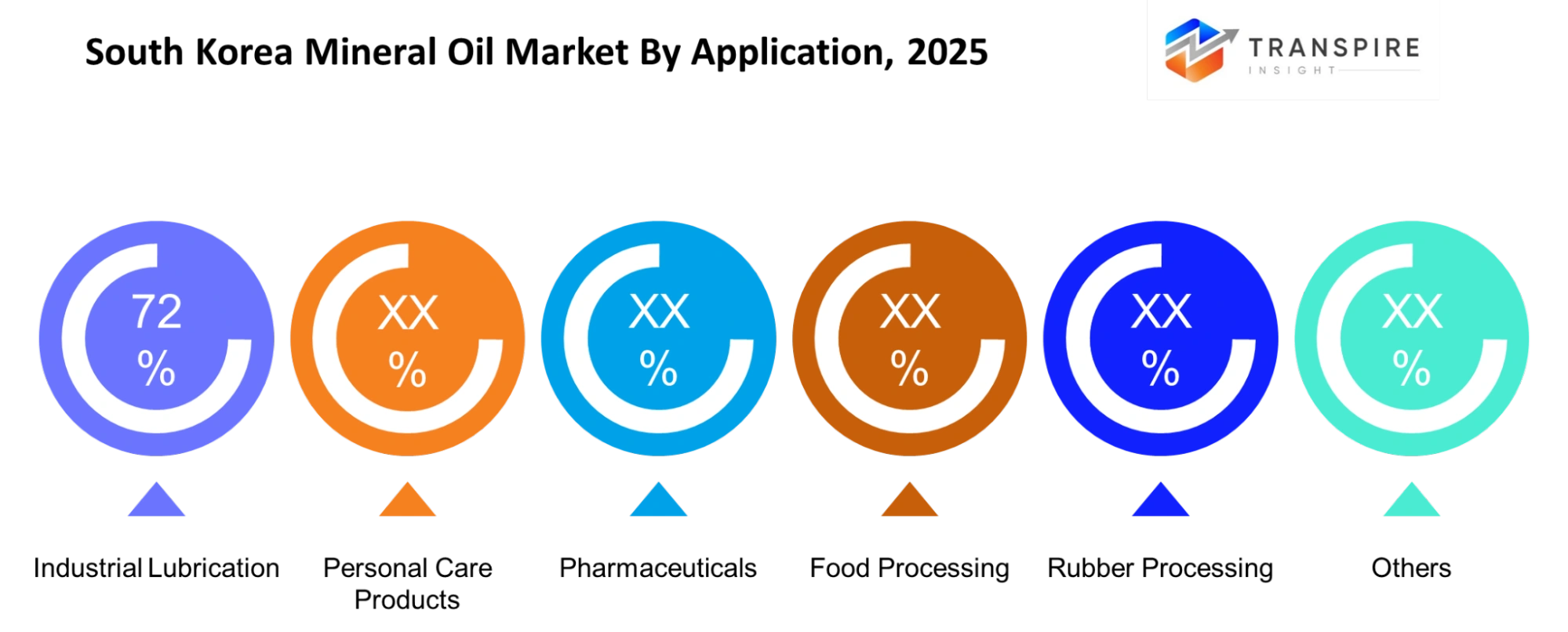
Industrial Lubrication shows up as the main application, mostly because it’s in nonstop service with manufacturing gear, marine engines, and heavy machinery, well, all the time. Strong industrial production, along with regular repair and maintenance cycles keeps it in the lead, even when demand swings a bit. Personal Care Products end up in the second spot, and that makes sense since creams, lotions, plus cosmetic blends really lean on mild emollients that are safe, and that are easy on skin. Pharmaceuticals keep a steady pace too, driven by tight purity expectations. Food Processing also matters because machinery still needs compliance-certified oils for operations, and there’s indirect contact use, where standards count a lot. Rubber Processing remains important for compounding work, where process consistency is nonnegotiable.
Industrial Lubrication keeps climbing as more automation arrives and as equipment utilization rates go up across manufacturing hubs. Personal Care Products are currently the fastest moving application, largely tied to greater demand for skin-safe, mineral- based formulations in highly regulated cosmetic markets. Pharmaceuticals continue steady growth, backed by tough safety oversight and compliance checks. Through the forecast window, overall application demand is likely to tilt toward higher-grade regulatory oils and toward multifunction blends, made to work across industries without much retooling, or extra approvals each time.
To learn more about this report, Download Free Sample Report
By Grade
Industrial Grade still holds the dominant position , mostly because it gets used a lot across lubrication, processing and manufacturing , where cost efficiency kinda outweighs purity requirements in practice. The big consumption volume in heavy industries also keeps it out in front. Pharmaceutical Grade ranks second, mainly due to stringent regulatory standards for drug formulation and medical uses. Food Grade stays fairly steady, driven by food safety compliance for processing equipment. Cosmetic Grade is rising too, with more demand showing up in skincare and personal care markets. The other grades remain somewhat limited, mostly tied to niche or very specific industrial uses.
Industrial Grade keeps expanding since manufacturing and mechanical operations keep needing large-volume lubricant supply, so it stays in demand. Pharmaceutical Grade feels like the fastest-growing segment, as global safety rules tighten and pharmaceutical production capacity continues to increase. Food Grade stays stable with only modest incremental growth, linked to food safety modernization initiatives. During the forecast period, the differences between grades will likely get sharper , because regulatory frameworks keep pushing manufacturers toward higher purity levels and more traceable supply chains.
By Distribution Channel
Direct Sales seems to hold the dominant position, mainly because of strong procurement ties between refiners and big industrial buyers, who they need bulk supply contracts. Industrial Distributors come next as the second-largest channel, since they help with regional availability and simpler scaled access for smaller industrial buyers. Online Sales keep pushing ahead, mostly originating from niche industrial procurement platforms, while Retail Channels are more limited by consumer-grade demand. Others covers special supply arrangements in regulated sectors, where compliance requirements are kind of strict.
Direct Sales keeps on growing too, because large manufacturers rather long-term contracts, not just for cost stability but also for that supply assurance angle. Industrial Distributors still matter a lot, given fragmented demand across mid-sized industrial users. Online Sales is emerging as the fastest-growing route, driven by digital procurement adoption across industrial supply chains. Through the forecast period, distribution structures are expected to drift toward hybrid models, mixing direct contracting with digital ordering systems, for efficiency and transparency .
By End User
The chemical industry still holds the upper hand because mineral oils are used a lot in processing, formulation, and in base chemical manufacturing activities, kind of all the time. The automotive industry comes in next, mainly due to the strong demand for lubricants and hydraulic applications during vehicle manufacturing and ongoing servicing. The Cosmetics Industry stays fairly consistent thanks to emollient-driven uses inside skincare formulations. The Food Industry relies on regulated mineral oils for process equipment and indirect-contact uses, while the Others are basically a mix of other industrial buyers.
The Chemical Industry keeps moving forward, partly because downstream petrochemical production is climbing, and also because refining integration keeps getting deeper. The Automotive Industry looks like the quickest growing end-user group , driven by electrification and by the growing need for thermal management fluids in EV setups. The Cosmetics Industry is showing steady momentum too, supported by the expansion of premium skincare ranges. Across the forecast window, end-user demand should gradually lean more and more toward high-compliance industries, meaning those that need advanced purity, solid traceability, and performance that stays consistent.
What are the Key Use Cases Driving the South Korea Mineral Oil Market?
In South Korea, the largest use case in the Mineral Oil Market is marine engine lubrication, where mineral oil supports friction control, heat resistance, and operational stability for cargo and container vessels that transit through Busan and Incheon ports. That particular application pulls the most demand because ships stay active almost continuously, and most operators follow very strict maintenance schedules, with no wiggle room.
Other applications are still important, such as industrial machinery lubrication at automotive and electronics manufacturing sites, where hydraulic systems require calm, stable oil behavior even during heavy-load production runs. Utility providers also rely on transformer oils, primarily for insulation performance and thermal management across the grid infrastructure.
More emerging use cases focus on smart lubrication systems that pair with IoT sensors, in ship engines as well as in automated factories. Basically, these setups allow real-time monitoring of oil condition and support predictive maintenance, boosting efficiency and extending the useful service life of equipment in newer industrial settings.
|
Report Metrics |
Details |
|
Market size value in 2025 |
USD 195.6 Million |
|
Market size value in 2026 |
USD 205.8 Million |
|
Revenue forecast in 2033 |
USD 298.5 Million |
|
Growth rate |
CAGR of 5.46%from 2026 to 2033 |
|
Base year |
2025 |
|
Historical data |
2021 - 2024 |
|
Forecast period |
2026 - 2033 |
|
Report coverage |
Revenue forecast, competitive landscape, growth factors, and trends |
|
Regional scope |
South Korea |
|
Key company profiled |
ExxonMobil, Shell, Chevron, TotalEnergies, SK Lubricants, GS Caltex, S-Oil, Hyundai Oilbank, PetroChina, Sinopec, BP, Idemitsu Kosan, Phillips 66, Indian Oil Corporation, Fuchs Petrolub |
|
Customization scope |
Free report customization (country, regional & segment scope). Avail customized purchase options to meet your exact research needs. |
|
Report Segmentation |
By Product Type (White Mineral Oil, Technical Mineral Oil, Process Oil, Transformer Oil, Lubricating Oil, Others); By Application (Industrial Lubrication, Personal Care Products, Pharmaceuticals, Food Processing, Rubber Processing, Others); By Grade (Pharmaceutical Grade, Food Grade, Industrial Grade, Cosmetic Grade, Others); By Distribution Channel (Direct Sales, Industrial Distributors, Online Sales, Retail Channels, Others); By End User (Chemical Industry, Automotive Industry, Cosmetics Industry, Food Industry, Others) |
Which Regions are Driving the South Korea Mineral Oil Market Growth?
The Busan–Ulsan area kinda dominates the South Korean mineral oil market, mostly because its maritime ecosystem is dense and shipbuilding is heavily concentrated. With Busan Port and the Ulsan industrial complexes around, there’s basically continuous demand for marine lubricants, plus other industrial grades. Big shipbuilding groups and repair yards work in close, almost built-in, connection with refinery-linked supply chains, so product availability stays steady and not really interrupted. On top of that, port efficiency rules are strict, so operators get pushed toward high-performance mineral oil usage, without much choice.
Then there’s the Yeosu–Jeollanam-do refining belt, which acts like a stable secondary hub. It’s backed by petrochemical complexes that are integrated, and refinery infrastructure that’s been around for a long time. Compared with Busan’s more ocean-focused demand, Yeosu’s need is anchored in refining operations and downstream chemical manufacturing. Here, investment cycles feel steadier, less about rapid fleet expansion and more about incremental capacity upgrades. That pattern leads to consistent baseline consumption and it helps reinforce national supply security, especially for industrial lubricants.
Meanwhile the Incheon–Gyeonggi region is the fastest growing part, and it’s tied to logistics automation plus ship repair modernization near Incheon Port. Recent changes in smart port infrastructure, along with digital maintenance systems, have raised the lubricant efficiency requirements. The region also has an advantage from being close to manufacturing clusters across the Seoul metropolitan area. Overall, this shift suggests expanding opportunities for technology integrated lubricant solutions, and also service based supply models, during 2026–2033.
Who are the Key Players in the South Korea Mineral Oil Market and How Do They Compete?
The competitive environment in the South Korea Mineral Oil Market is sort of moderately consolidated, with refinery-integrated domestic players having structural advantages , while global oil majors tend to fight more by technology differentiation and marine supply contracts. In practice, rivalry seems to come mostly from product performance, supply dependability, and compliance with marine and industrial efficiency standards, not only from price . Domestic refiners keep a strong grip on distribution networks, yet multinational firms usually push harder on high-performance and certified lubricant segments.
ExxonMobil and Shell tend to compete by offering advanced marine lubricant formulations and longer-term vessel maintenance agreements with shipping operators, differentiating themselves through technical service capabilities and fuel-efficiency optimization solutions. TotalEnergies and BP also lean into low-emission lubricant portfolios, aligning with maritime regulatory compliance and helping them on environmentally sensitive shipping routes.
On the domestic side, players like SK Lubricants, GS Caltex, S-Oil, and Hyundai Oilbank benefit from refinery integration, which supports cost efficiency and steadier supply chains. Chinese participants such as PetroChina and Sinopec seek to expand their regional presence through scale-driven pricing and downstream partnerships. Meanwhile, specialty lubricant firms like Fuchs Petrolub and Japanese suppliers like Idemitsu Kosan compete in precision applications where equipment efficiency, along with certification compliance, really decides what gets purchased.
Company List
- ExxonMobil
- Shell
- Chevron
- TotalEnergies
- SK Lubricants
- GS Caltex
- S-Oil
- Hyundai Oilbank
- PetroChina
- Sinopec
- BP
- Idemitsu Kosan
- Phillips 66
- Indian Oil Corporation
- Fuchs Petrolub
Recent Development News
In April 2026, S-Oil expanded integration across its refining and petrochemical operations to strengthen high-value lubricant base oil output and improve product mix efficiency.http://www.s-oil.com
In January 2026, GS Caltex advanced its Yeosu refinery optimization program to improve production efficiency for base oils and high-performance lubricants used in automotive and marine sectors.https://www.gscaltex.com
What Strategic Insights Define the Future of the South Korea Mineral Oil Market?
The South Korean Mineral Oil Market is structurally shifting toward high-efficiency, service-integrated lubrication ecosystems, in which product sales increasingly depend on performance monitoring and lifecycle optimization services. Demand should shift away from volume-style consumption toward value-driven contracts tied to fleet efficiency, predictive maintenance, and regulatory compliance in maritime and industrial operations. A not-so-obvious risk is showing up too, from faster substitution pressure by synthetic and bio lubricants, which could slowly chip away at mineral oil share in premium marine segments and precision manufacturing, especially when environmental frameworks get tighter and tighter.
AI-enabled lubrication management systems that connect with smart ports and automated factories. With real time oil condition monitoring, operations can run more smoothly and efficiently. This is still early-stage adoption, though, so it’s not everywhere yet, but it is expected to scale as Korea expands its digital port infrastructure. Market participants might do better by investing in service-first lubricant models rather than selling standalone product supply, and they should aim for longer-term agreements with shipbuilders, logistics operators, and energy utilities, so they can lock in recurring revenue streams through 2030 and beyond.
South Korea Mineral Oil Market Report Segmentation
By Product Type
- White Mineral Oil
- Technical Mineral Oil
- Process Oil
- Transformer Oil
- Lubricating Oil
- Others
By Application
- Industrial Lubrication
- Personal Care Products
- Pharmaceuticals
- Food Processing
- Rubber Processing
- Others
By Grade
- Pharmaceutical Grade
- Food Grade
- Industrial Grade
- Cosmetic Grade
- Others
By Distribution Channel
- Direct Sales
- Industrial Distributors
- Online Sales
- Retail Channels
- Others
By End User
- Chemical Industry
- Automotive Industry
- Cosmetics Industry
- Food Industry
- Others
Frequently Asked Questions
Find quick answers to common questions.
The estimated South Korea Mineral Oil Market size for the market will be USD 298.5 Million in 2033.
Key segments for the South Korea Mineral Oil Market are By Product Type (White Mineral Oil, Technical Mineral Oil, Process Oil, Transformer Oil, Lubricating Oil, Others); By Application (Industrial Lubrication, Personal Care Products, Pharmaceuticals, Food Processing, Rubber Processing, Others); By Grade (Pharmaceutical Grade, Food Grade, Industrial Grade, Cosmetic Grade, Others); By Distribution Channel (Direct Sales, Industrial Distributors, Online Sales, Retail Channels, Others); By End User (Chemical Industry, Automotive Industry, Cosmetics Industry, Food Industry, Others).
Major South Korea Mineral Oil Market players are ExxonMobil, Shell, Chevron, TotalEnergies, SK Lubricants, GS Caltex, S-Oil, Hyundai Oilbank, PetroChina, Sinopec, BP, Idemitsu Kosan, Phillips 66, Indian Oil Corporation, Fuchs Petrolub.
The South Korea Mineral Oil Market size is USD 195.6 Million in 2025.
The South Korea Mineral Oil Market CAGR is 5.46% from 2026 to 2033.
- ExxonMobil
- Shell
- Chevron
- TotalEnergies
- SK Lubricants
- GS Caltex
- S-Oil
- Hyundai Oilbank
- PetroChina
- Sinopec
- BP
- Idemitsu Kosan
- Phillips 66
- Indian Oil Corporation
- Fuchs Petrolub
Recently Published Reports
-
May 2026
Healthcare Polymer Packaging Market
Healthcare Polymer Packaging Market Size, Share & Analysis Report By Packaging Type (Syringes, IV Bottles and Pouches, Clamshells, Blisters, Bottles & Jars, Containers, Tubes, IV Parental Packaging, Others), By Type (Regulated, Non-regulated), By Polymer Type (LDPE (Low-Density Polyethylene), HDPE (High-Density Polyethylene), Homo-polymer (Homo), Random Copolymer (Random), Block Copolymer (Block), PET, Polystyrene, Polyvinyl Chloride, Polyamide/EVOH, Others), and Geography (North America, Europe, Asia-Pacific, Middle East and Africa, South and Central America), 2021 - 2031
-
Apr 2026
Hydrophilic Tape (Waterstop) Market
Hydrophilic Tape (Waterstop) Market Size, Share & Analysis Report By Type (Bentonite-Based Hydrophilic Tape, Rubber-Based Hydrophilic Tape), By Application (Residential Buildings, Commercial Buildings, Infrastructure Projects), and Geography (North America, Europe, Asia-Pacific, Middle East and Africa, South and Central America), 2021 - 2031
-
Apr 2026
Metalens Market
Metalens Market Size, Share & Analysis Report By Type (Visible Light Metalens, and Infrared Metalens), By Application (Consumer Electronics, Automotive Electronics, Industrial, Medical, and Others), and Geography (North America, Europe, Asia-Pacific, Middle East and Africa, South and Central America), 2021 - 2031
-
Apr 2026
PBT Resin Market
PBT Resin Market Size, Share & Analysis Report By Type (Reinforced PBT Resin, Unreinforced PBT Resin), By Processing Method (Injection Molding, Extrusion, Blow Molding, Others), By End-User (Automotive, Electrical & Electronics, Consumer Appliances, Industrial Machinery, Medical Devices, Packaging, Others), and Geography (North America, Europe, Asia-Pacific, Middle East and Africa, South and Central America), 2021 - 2031