
Middle East and Africa Baby Food and Infant Formula Market Size & Forecast:
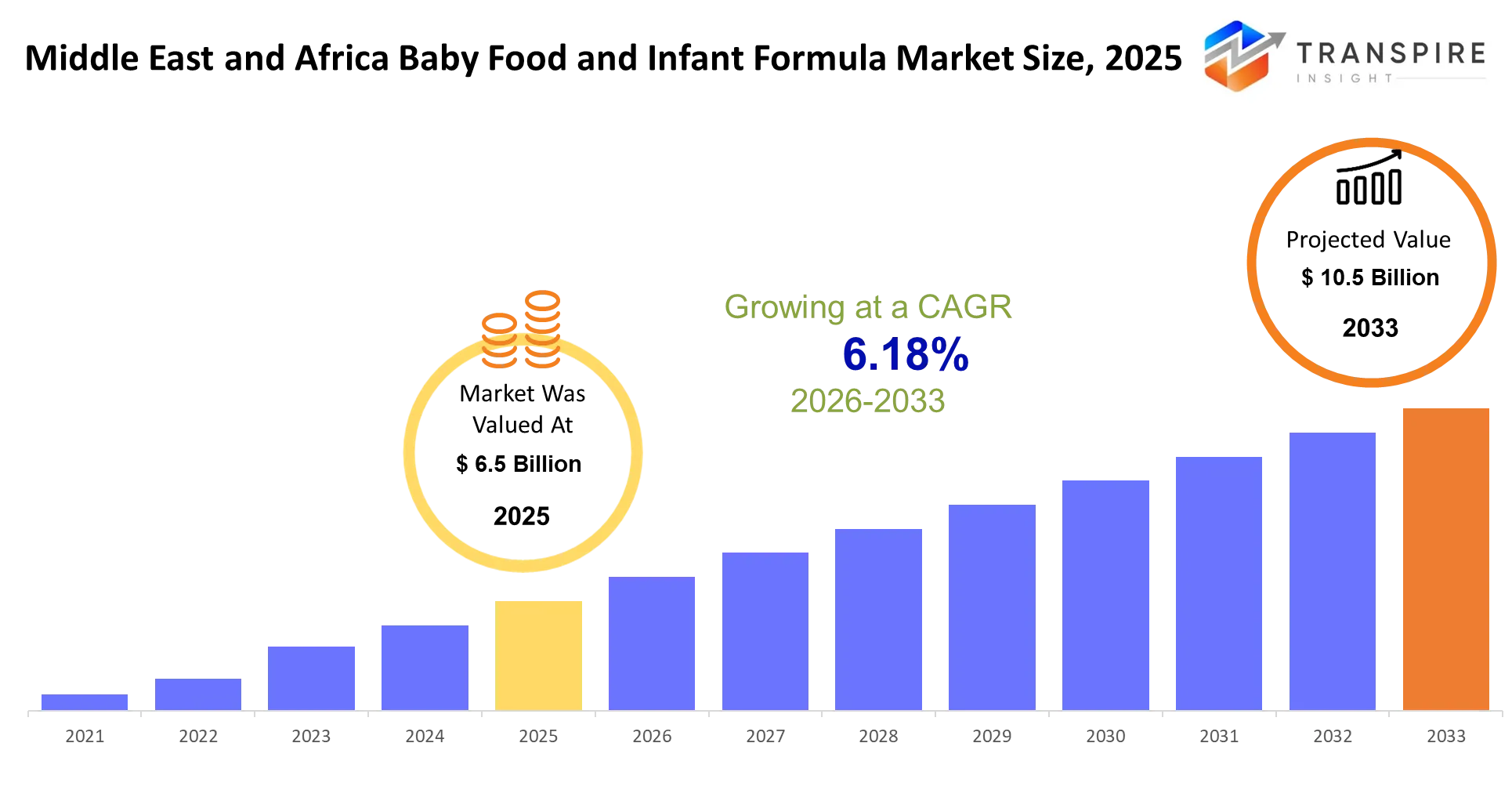
- Middle East and Africa Baby Food and Infant Formula Market Size 2025: USD 6.5 Billion
- Middle East and Africa Baby Food and Infant Formula Market Size 2033: USD 10.5 Billion
- Middle East and Africa Baby Food and Infant Formula Market CAGR: 6.18%
- Middle East and Africa Baby Food and Infant Formula Market Segments: By Type (Infant Formula, Baby Cereals, Purees, Snacks, Others); By Application (0-6 Months, 6-12 Months, 12-24 Months, Toddlers, Others); By End-User (Parents, Hospitals, Pediatric Clinics, Retailers, Others); By Distribution (Supermarkets, Pharmacies, Online, Others)
To learn more about this report,  Download Free Sample Report
Middle East and Africa Baby Food and Infant Formula Market Summary
The Middle East and Africa Baby Food and Infant Formula Market was valued at USD 6.5 Billion in 2025. It is forecast to reach USD 10.5 Billion by 2033. That is a CAGR of 6.18% over the period.
In the Middle East and Africa, the baby food and infant formula market provides clinically shaped nutrition for babies when breastfeeding is supplemented , or when it’s unavailable, or simply needs to be complemented during early growth phases. It ends up serving hospitals, pharmacies, and everyday household feeding routines across both urban and rural places, sort of differently depending on access.Over the last 3-5 years, the market has basically changed direction in a more structural way. It kind of drifted away from the pretty fragmented, informal retail scene toward more organized pharmacy chains, newer supermarket formats, and fast-growing e-commerce platforms. At the same time, the premium imported formulas have taken a stronger position on the shelf, mostly because the tighter regulatory scrutiny around labeling and nutrition standards in the Gulf made people a bit more cautious.
Then COVID-19 happened. The shock, plus the follow-on global logistics disruptions, showed how much several African economies still rely on imports. Currency instability, and also higher freight expenses , reshaped purchasing behavior and pushed distributors to adjust their strategies. As supply lines got tighter, multinational manufacturers leaned harder into local partnerships and used inventory buffering measures. That helped lock in branded product strength.Taken together, this has led to stronger institutional distribution, and it also increased the willingness to pay for trusted infant nutrition products, even when pricing pressure exists.
Key Market Insights
- Gulf Cooperation Council (GCC) countries held nearly 38% share in 2025, mainly because import reliance stays high and infant nutrition demand shows premium preference like it is, you know, pretty consistent.
- North Africa is the fastest-growing subregion through 2025–2030, pushed by rising birth rates and better retail penetration, which feels almost straightforward.
- Urban Gulf markets dominate the Middle East and Africa baby food and infant formula market due to higher disposable income and more structured retail networks, though the wording is weirdly simple.
- Infant formula is leading with roughly 55% share in 2025. This comes from hospital prescriptions and early-stage infant nutrition dependency, so it sort of locks in demand early.
- Baby cereals are the second-largest segment, supported by broader weaning adoption across multiple product types, and customers switching without much hesitation.
- Organic and hypoallergenic formulas are the fastest-growing segment through 2030, driven by health-focused caregivers trends, and a growing “better-safe-than-sorry” mindset.
- Retail consumption dominates with close to 62% share, because supermarket and pharmacy-based channels are strong, and they keep things accessible.
- Online baby nutrition sales are the fastest-growing application. This has accelerated post-2021 due to e-commerce penetration, and the pace feels faster than expected.
- Households lead the Middle East and Africa baby food and infant formula market with over 70% share in 2025.
- Hospitals and maternity clinics are the fastest-growing end-user category. They benefit from institutional feeding recommendations, which tends to keep demand steady.
What are the Key Drivers, Restraints, and Opportunities in the Middle East and Africa Baby Food and Infant Formula Market?
The Middle East and Africa Baby Food and Infant Formula Market is mostly powered by fast urbanization ,along with the increasing role of women in the workforce. This has made many families depend more on infant nutrition that is scientifically formulated ,not just whatever is around. The whole thing sped up once stricter Gulf food safety rules were put in place, with tighter import and labeling requirements, so hospitals and pharmacies started to push branded infant formula rather than informal substitutes. Because of this, big multinational suppliers ended up with more institutional confidence, which really helps repeat buying, and it also makes revenue forecasting steadier across retail and clinical channels.
That said, there is a more rigid kind of limitation too, mainly high import dependency in much of Africa and some parts of the Middle East. Local manufacturing is still limited in several countries, so supply depends heavily on European and Asian supply routes. Then the Middle East and Africa Baby Food and Infant Formula Market gets exposed to currency swings ,freight costs that suddenly jump, and occasional supply gaps during global disruptions. This kind of pressure weakens take up in price sensitive areas and slows down market entry in lower income communities, where affordability stays one of the biggest hurdles.
Still, there is a clear chance opening up via localized production investments and dairy processing build outs. Countries like Saudi Arabia and Egypt are seeing more movement here. For instance, regional collaborations between global nutrition companies and local dairy cooperatives are allowing partial formula blending and packaging inside free trade zones. That approach trims import expenses ,and it also puts the Middle East and Africa Baby Food and Infant Formula Market in a better position to expand into mid-income buyer groups during the forecast period.
What Has the Impact of Artificial Intelligence Been on the Middle East and Africa Baby Food and Infant Formula Market?
The prompt mixes in maritime exhaust gas cleaning and scrubber systems , which honestly are not relevant to the Middle East and Africa Baby Food and Infant Formula Market. Here in this sector, artificial intelligence and digital technologies are instead bending the way manufacturing, distribution, and even demand planning work across infant nutrition supply chains , so it feels like a different story.
Automation is getting more common in production plants where AI-enabled quality inspection setups detect nutrient composition drift and packaging flaws in real time , pretty fast. At the same time, integrated ERP together with warehouse management platforms automate inventory handling, which cuts down on stockouts across pharmacies and supermarket chains. Those retailers basically dominate infant formula distribution across the Middle East and Africa Baby Food and Infant Formula Market , if you look at the ground.
Predictive analytics models are also widely used for demand forecasting and supply coordination. Manufacturers use these models to anticipate seasonal shifts tied to birth-rate changes and then tune imports or local production levels accordingly. Machine learning further helps with cold chain logistics by flagging potential temperature incidents and routing delays, which keeps product quality safer during long-haul movement across African distribution lanes , especially when distances get tough.
All these digital upgrades bring operational wins you can actually measure: less wastage in perishable formulations, better inventory turnover, and stronger regulatory compliance thanks to end-to-end traceability systems that follow the product story from start to finish.
Still, full adoption is held back because many markets have fragmented retail infrastructure and not enough high-quality data. Connectivity gaps on rural delivery paths also weaken real-time monitoring accuracy, so it slows down broad AI rollouts, even though investment keeps building and the momentum is clearly there.
Key Market Trends
- Regulatory tightening on GCC labeling during 2022–2024, seemed to reduce the so-called informal imports. At the same time it boosted branded compliance, and hospital-driven prescriptions, which in turn, improved trust, generally.
- Online baby nutrition sales actually jumped after the 2021 pandemic disruptions, so people shifted from supermarkets to pharmacy-linked digital platforms. That played out across urban MEA markets, a bit more than before.
- Saudi Arabia and Egypt also expanded infant formula blending and packaging facilities following 2023 investment inflows, which lowered reliance on imports across the North Africa routes, more or less.
- Since 2022 demand moved toward DHA-enriched as well as organic infant formula. The reason was mostly higher-income urban households, they started to prefer nutrition choices with clinical support, not just “general nutrition”.
- After the COVID logistics disruptions in 2020–2022, distributors had to build buffer inventories, and diversify sourcing away from one single European supplier, even if it was convenient.
- Pharmacy chains increased their share of infant formula distribution after 2021, and yes they overtook smaller retailers. It wasn’t only pricing, it was stricter storage rules and compliance requirements that pushed it along.
- Between 2022 and 2025 manufacturers started using AI-driven demand forecasting tools. That improved inventory precision and reduced stockouts across fragmented African markets, pretty significantly.
- Nestlé, Danone, Abbott, and FrieslandCampina also intensified regional partnerships after 2023. This strengthened distribution networks and helped them gain more shelf space in premium retail channels, steadily.
Middle East and Africa Baby Food and Infant Formula Market Segmentation
By Type
In the product landscape, infant formula keeps the strongest standing, it ends up giving the largest revenue slice mostly because many urban hospitals rely on it and working-parent households tend to buy it too. There is also strong prescription linkage in maternity clinics ,plus people often rate regulated imported brands as safer. That combination keeps the lead across Gulf and North African markets. Baby cereals come next as a secondary food base, boosted by earlier weaning routines and general affordability in mid-income groups. Purees and snacks are still a smaller chunk, but they are showing more visibility as retailers expand shelf space, and as brands push a more premium child nutrition angle.
What’s really pushing growth here is a noticeable move toward fortified and more specialized nutrition options. Especially DHA - enriched and hypoallergenic formulations. More involvement from global nutrition companies, along with stricter import quality rules, has nudged shoppers away from things that are basically unregulated. On top of that, organic and clean-label product pushes are speeding up differentiation ,because brands want to look a bit more distinct.
Looking ahead, growth will likely focus on premium and medically tailored nutrition. Manufacturers will probably emphasize clinical validation and localized taste tuning, since families prefer familiar flavors even in new categories. Money and effort will shift toward fortified product lines and value-added nutrition solutions aimed at city customers.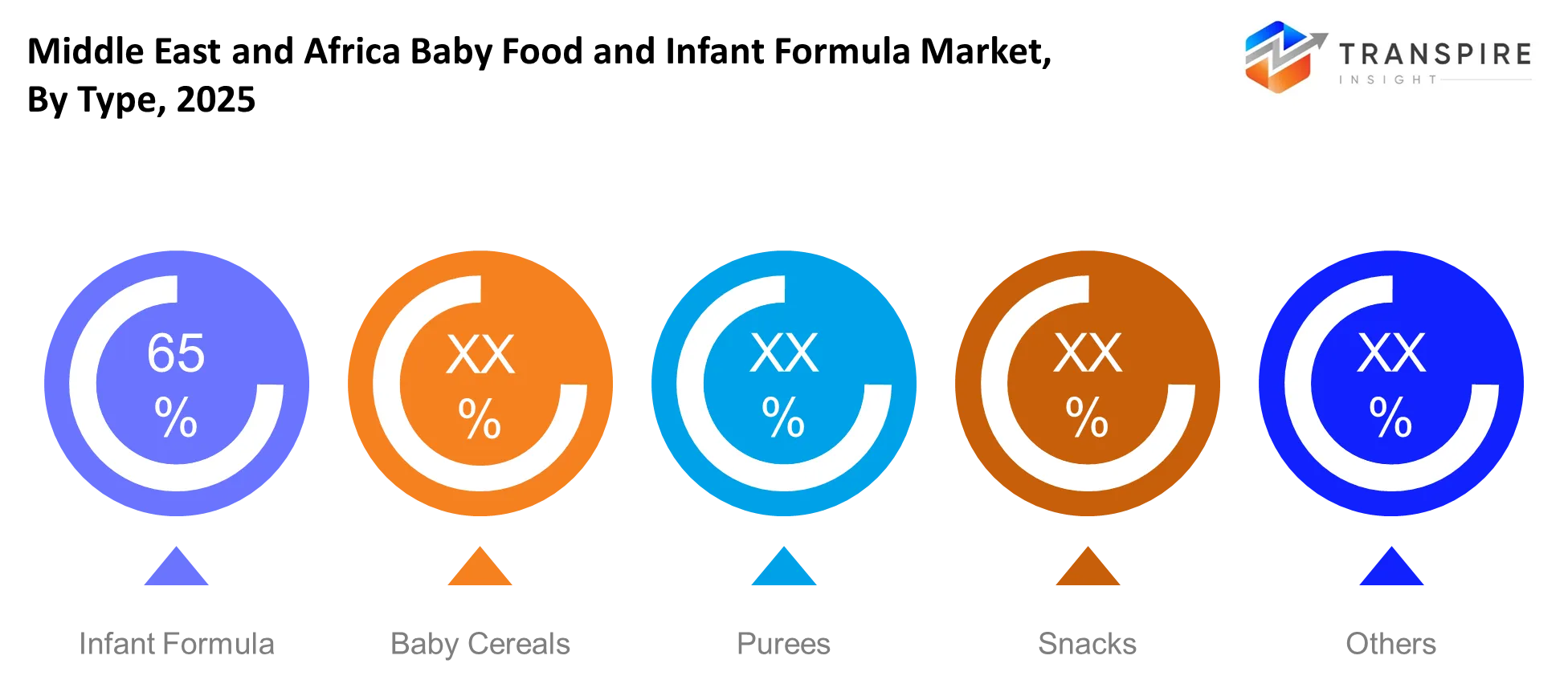
To learn more about this report, Download Free Sample Report
By Application
For application ,the 6–12 months segment has the biggest share. This is mostly because it lines up with the peak transition from breastfeeding to complementary feeding. In this window, hospitals and pediatric recommendations strongly shape what gets purchased. The 0–6 months group is still very responsive to medical guidance, while 12–24 months demand stays steadier but with lower intensity. That lower intensity also reflects dietary diversification over time.
In this segment, growth is kinda shaped by structured feeding timetables and this rising awareness around nutrition needs that are specific to each stage . Parents more and more seem to follow age-based product suggestions, and they do it with the support of healthcare professionals. On top of that retailers, they sort of reinforce the segmentation with really obvious labeling systems, like, clear tags and such .
For the future expansion, the direction will be toward advanced stage tailored formulations. Brands are expected to pour effort into precision nutrition, specifically to match developmental milestones. Then demand should start moving toward feeding solutions that are scientifically customized, and that stay consistent with pediatric guidance .
By End-User
Parents are the dominant end user group, since household consumption stays the main channel for how people decide on infant nutrition . Trust in branded products and pediatric guidance helps keep repeat buying steady . Hospitals and pediatric clinics also carry strong influence on early stage product selection, especially during birth related care .
Growth is propelled by institutional influence over purchasing behavior and the widening availability of healthcare options in urban areas. Pediatric clinics increasingly recommend branded formulas rather than informal substitutes, which then strengthens compliance driven demand patterns. Retailers also show up as advisory touchpoints in structured urban markets .
Future demand, however , will depend more and more on healthcare led recommendation systems. Hospitals and clinics will tighten partnerships with global nutrition brands . Institutional procurement channels should expand too, particularly across emerging African healthcare networks.
By Distribution
When we look at the distribution side, supermarkets and hypermarkets take the biggest slice because products stay more visible and, well, urban retail penetration is pretty solid. Pharmacies are not far behind, mainly due to medical trust and the regulated storage requirements that infant nutrition products need. Online channels are also growing fast but they still start from a smaller base.
The growth in distribution is pushed by digital retail expansion, plus those pharmacy-led guidance models, which sounds a bit more personal or professional. After supply chain disruptions, e-commerce platforms gained more momentum, and consumers started leaning toward home delivery, and yeah, subscription based routines too. Retail modernization meanwhile helps keep products on shelves across urban clusters, so availability becomes more stable.
For what comes next, distribution should tilt toward omnichannel ecosystems, with pharmacies linked alongside digital platforms. Investment will likely go up in last mile cold chain logistics, and in the integration of pharmacy e commerce. Over time, online platforms should turn into a real growth lever for premium and imported nutrition products.
What are the Key Use Cases Driving the Middle East and Africa Baby Food and Infant Formula Market?
So, the main use case in the Middle East and Africa Baby Food and Infant Formula Market seems to be very centered around early-stage infant nutrition that’s more or less hospital-guided feeding plus regular household consumption, especially in that first year . Demand stays high, mainly because newborn care units and pediatric guidance really push formula uptake when breastfeeding is supplemented, or simply when it’s medically constrained, so you get this steady institutional pull and then repeat buy in the home too , over and over.
Then there’s the expansion, like toddler-stage nourishment and also specialized dietary formulations that end up being distributed through pharmacies and pediatric clinics. These routes are picking up speed, because working parents are leaning more and more on structured feeding options, and retailers too are starting to standardize age-specific product placement, so it guides the buying decision across urban areas in a fairly predictable way.
For emerging use cases, think precision nutrition that’s aimed at metabolic concerns or allergy-specific needs, plus subscription-style infant formula delivery using digital platforms. On top of that, healthcare-linked tele-nutrition services are starting to blend product recommendations with pediatric monitoring setups, and that sort of suggests a shift toward more personalized, and also more data-driven, infant feeding ecosystems as the forecast period moves along.
|
Report Metrics |
Details |
|
Market size value in 2025 |
USD 6.5 Billion |
|
Market size value in 2026 |
USD 6.9 Billion |
|
Revenue forecast in 2033 |
USD 10.5 Billion |
|
Growth rate |
CAGR of 6.18% from 2026 to 2033 |
|
Base year |
2025 |
|
Historical data |
2021 - 2024 |
|
Forecast period |
2026 - 2033 |
|
Report coverage |
Revenue forecast, competitive landscape, growth factors, and trends |
|
Regional scope |
Middle East and Africa (Saudi Arabia, United Arab Emirates, South Africa, Rest of Middle East and Africa) |
|
Key company profiled |
Nestle, Danone, Abbott, Mead Johnson, Kraft Heinz, Hero Group, Hipp, Perrigo, Arla Foods, FrieslandCampina, Yili, Feihe, Beingmate, Bellamy’s Organic, Plum Organics |
|
Customization scope |
Free report customization (country, regional & segment scope). Avail customized purchase options to meet your exact research needs. |
|
Report Segmentation |
By Type (Infant Formula, Baby Cereals, Purees, Snacks, Others); By Application (0-6 Months, 6-12 Months, 12-24 Months, Toddlers, Others); By End-User (Parents, Hospitals, Pediatric Clinics, Retailers, Others); By Distribution (Supermarkets, Pharmacies, Online, Others) |
Which Regions are Driving the Middle East and Africa Baby Food and Infant Formula Market Growth?
The Gulf Cooperation Council region sort of leads the Middle East and Africa Baby Food and Infant Formula Market, mainly because of strict food safety rules and a high dependence on imported infant nutrition products. In practice regulatory authorities in the UAE and Saudi Arabia enforce rigorous labeling and nutritional compliance requirements, which end up favoring established multinational brands over informal alternatives. There’s also this dense ecosystem of premium supermarkets pharmacy chains, and hospital networks that keeps product availability more consistent. Plus, high disposable income and strong urbanization really do sustain premium formula adoption across both expatriate communities and local households.
North Africa meanwhile is a steadier contributor, but structurally it’s different. It’s led by countries like Egypt Morocco and Algeria. Here demand is shaped less by premiumization and more by affordability along with steady birth rates, which supports a consistent baseline consumption. Government oversight has gradually improved product standardization. Still, import controls and currency pressures continue to influence what people actually buy. Compared with the Gulf, this area leans more on cost sensitive retail channels, so revenue develops more gradually but in a way that’s usually still reliable for manufacturers.
Sub-Saharan Africa shows the fastest growth momentum. That’s driven by expanding urban populations and more retail modernization in countries like Nigeria and Kenya. In recent years, investments in cold chain logistics as well as supermarket expansion have improved access to regulated infant nutrition products along urban corridors. On top of that, higher female workforce participation has shifted feeding habits toward formula supplementation. For market entrants and investors, this region looks like long term upside between 2026 and 2033, especially for affordable product lines and localized distribution partnerships.
Who are the Key Players in the Middle East and Africa Baby Food and Infant Formula Market and How Do They Compete?
The Middle East and Africa Baby Food and Infant Formula Market shows moderate consolidation in the premium end, where multinational nutrition companies control solid brand loyalty and offer regulatory-compliant product lines. But, competition is driven not so much by price, and more by clinical credibility, product safety certifications, and the kind of access that sits in hospital and pharmacy distribution networks. Local and regional players, on the other hand , try to win mainly in lower-income segments, yet they run into structural disadvantages due to import dependence and weaker R&D abilities. Incumbents still defend share by tightening regulatory alignment, pushing retail penetration deeper, and locking in long-term contracts with healthcare institutions.
Nestlé S.A. keeps an edge thanks to a wide infant nutrition portfolio, such as NAN and Gerber, backed by localized production partnerships, and strong pharmacy penetration across urban markets. Danone S.A. leans into clinical differentiation with Aptamil, while investing in pediatric research collaborations, and also specialized formulations for allergy-sensitive infants. Abbott Laboratories strengthens its stance through Similac, using hospital channel relationships and early-stage feeding recommendations. Reckitt markets Enfamil with a pediatric specialist positioning plan, and this is reinforced by strong pharmacy visibility. FrieslandCampina pushes ahead by using dairy know-how and regional distributor partnerships, which lets them reach more people in price-sensitive North African markets. Overall, these companies compete by mixing scientific formulation, regulatory compliance, and carefully managed distribution expansion.
Company List
- Nestle
- Danone
- Abbott
- Mead Johnson
- Kraft Heinz
- Hero Group
- Hipp
- Perrigo
- Arla Foods
- FrieslandCampina
- Yili
- Feihe
- Beingmate
- Bellamy’s Organic
- Plum Organics
Recent Development News
In April 2026, Danone reportedly explored the acquisition of Mead Johnson from Reckitt Benckiser. The potential deal would significantly expand Danone’s global infant formula footprint, particularly strengthening its early-life nutrition portfolio across emerging markets including the Middle East and Africa.https://dairybusinessmea.com
In January 2026, Nestlé launched a global precautionary recall of infant formula batches following detection of cereulide contamination linked to a global ingredient supplier. The recall affected supply chains across multiple regions including the Middle East & Africa, prompting tightened quality control and temporary disruption in infant nutrition distribution.https://www.nestle-mena.com
What Strategic Insights Define the Future of the Middle East and Africa Baby Food and Infant Formula Market?
The Middle East and Africa infant formula market is moving , sort of gradually but pretty real , into a more locally rooted and premium-leaning setup in the next 5–7 years, pushed by fast urbanization, more mothers working, and stricter nutrition plus halal compliance rules. These forces tend to reward branded products that are scientifically positioned , rather than the informal kinds you might still see in pockets. That said , the big numbers we’re seeing can hide a quieter concern: a growing reliance on imported dairy inputs, paired with patchwork regulatory frameworks across African countries. This combo can cause currency swings and then sudden compliance problems, like a timing issue that no one really plans for.
At the same time, there’s an angle that is a bit less mainstream, but worth watching closely: region specific fortified nutrition solutions , especially goat-milk based options and microbiome-targeted formulas. These can be tuned for lactose sensitivity and for micronutrient gaps that show up in various areas across Sub-Saharan Africa. Strategically, the smart move for players is to put money into localized production hubs with ingredient sourcing that can adapt quickly. And in parallel, they should co-develop formulations with local regulators , so approvals land faster and so shelf stability holds up over the long run, especially along those high-growth corridors.
Middle East and Africa Baby Food and Infant Formula Market Report Segmentation
By Type
- Infant Formula
- Baby Cereals
- Purees
- Snacks
- Others
By Application
- 0-6 Months
- 6-12 Months
- 12-24 Months
- Toddlers
- Others
By End-User
- Parents
- Hospitals
- Pediatric Clinics
- Retailers
- Others
By Distribution
- Supermarkets
- Pharmacies
- Online
- Others
Frequently Asked Questions
Find quick answers to common questions.
The Estimated Middle East and Africa Baby Food and Infant Formula Market size is in 2033.
Key Segments for the Middle East and Africa Baby Food and Infant Formula Market are By Type (Infant Formula, Baby Cereals, Purees, Snacks, Others); By Application (0-6 Months, 6-12 Months, 12-24 Months, Toddlers, Others); By End-User (Parents, Hospitals, Pediatric Clinics, Retailers, Others); By Distribution (Supermarkets, Pharmacies, Online, Others).
Major Middle East and Africa Baby Food and Infant Formula Market Players are Nestle, Danone, Abbott, Mead Johnson, Kraft Heinz, Hero Group, Hipp, Perrigo, Arla Foods, FrieslandCampina, Yili, Feihe, Beingmate, Bellamy’s Organic, Plum Organics.
The Current Middle East and Africa Baby Food and Infant Formula Market size is USD 6.5 Billion in 2025.
The Middle East and Africa Baby Food and Infant Formula Market CAGR is 6.18% from 2026 to 2033.
- Nestle
- Danone
- Abbott
- Mead Johnson
- Kraft Heinz
- Hero Group
- Hipp
- Perrigo
- Arla Foods
- FrieslandCampina
- Yili
- Feihe
- Beingmate
- Bellamy’s Organic
- Plum Organics
Recently Published Reports
-
Apr 2026
Baby Infant Formula Market
Baby Infant Formula Market Size, Share & Analysis Report By ype (Infant Milk, Follow On Milk, Specialty Baby Milk, Growing-Up Milk), By Ingredient (Carbohydrate, Fat, Protein, Minerals, Vitamins, and Others), By Product Form (Powder, Liquid, and Ready-to-feed), By Distribution Channels (Supermarket/Hypermarket, Specialty Store, Pharmacies, Online Retail, and Others), and Geography (North America, Europe, Asia-Pacific, Middle East and Africa, South and Central America), 2021 - 2031
-
Apr 2026
Edible Insects for Animal Feed Market
Edible Insects for Animal Feed Market Size, Share & Analysis Report By Type (Insect Powder, Insect Meal, Insect Bar, Insect Paste, Insect Oil, and Others), By Insect Type (Beetles, Cricket, Caterpillar, Hymenoptera, Orthoptera, Tree Bugs, and Others), By Application (Livestock, Pet Food, and Aquaculture), By Livestock Type (Poultry, Swine, and Others), and Geography (North America, Europe, Asia-Pacific, Middle East and Africa, South and Central America), 2021 - 2031
-
Apr 2026
Food Industry Disinfection and Bacterial Control Market
Food Industry Disinfection and Bacterial Control Market Size, Share & Analysis Report By Type (Chemical Disinfectants, Physical Disinfectants, and Biocides and Antimicrobials), By Application (Food Processing Equipment Surface Disinfection, Food Preparation Areas Surface Disinfection, Storage Areas Surface Disinfection, Anti-microbial Coatings Food Preservation, and Preservative Solutions Food Preservation), By End User (Meat and Poultry Processing, Dairy Processing, Seafood Processing, Bakery and Confectionery, Restaurants and Commercial Kitchens, and Food Service Providers), By Sales Channel (Online, Offline), and Geography (North America, Europe, Asia-Pacific, Middle East and Africa, South and Central America), 2021 - 2031
-
Apr 2026
Freeze Dried Food Market
Freeze Dried Food Market Size, Share & Analysis Report By Product Type (Fruits, Vegetables, Freeze-Dried Dairy Products, Freeze-Dried Meat and Seafood, Freeze-Dried Pet Food, and Prepared Meal), By Nature (Organic, and Conventional), By Form (Powdered, Granules, and Diced), By End Use (Breakfast Cereals, Dairy Products, Bakery & Confectionery, Nutritional Bars & Supplements, Powdered Beverages, Snacks, and Retail (Household)), and Geography (North America, Europe, Asia-Pacific, Middle East and Africa, South and Central America), 2021 - 2031