

South Korea Microcrystalline Cellulose Market Size & Forecast:
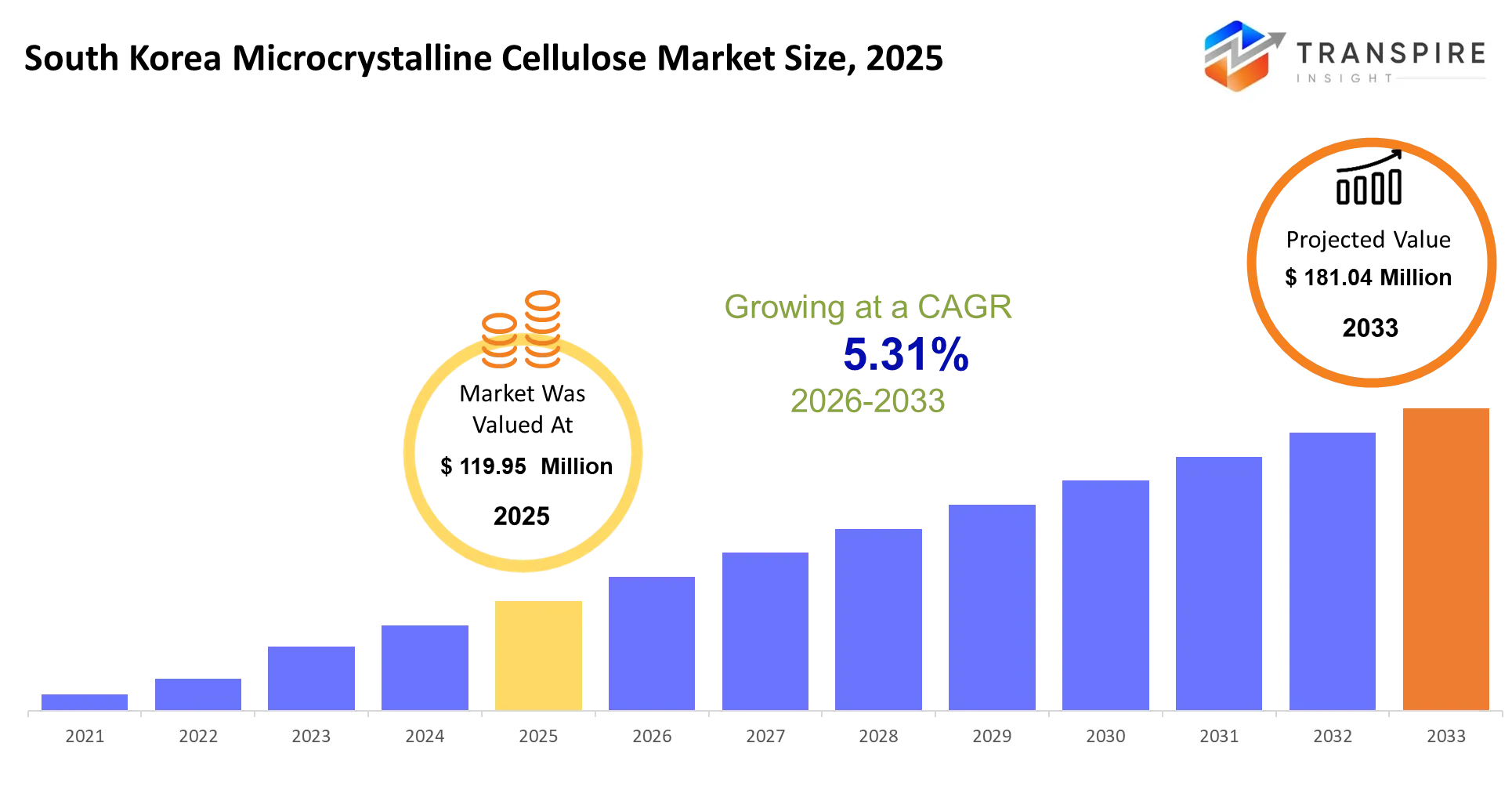
- South Korea Microcrystalline Cellulose Market Size 2025: USD 119.95 Million
- South Korea Microcrystalline Cellulose Market Size 2033: USD 181.04 Million
- South Korea Microcrystalline Cellulose Market CAGR: 5.31%
- South Korea Microcrystalline Cellulose Market Segments: By Product Type (Wood-based MCC, Non-wood MCC, Colloidal MCC, Others); By Application (Pharmaceuticals, Food & Beverage, Cosmetics, Paints & Coatings, Others); By Form (Powder, Granules, Pellets, Others); By End User (Pharmaceutical Industry, Food Industry, Cosmetics Industry, Others)
To learn more about this report,  Download Free Sample Report
South Korea Microcrystalline Cellulose Market Summary
The South Korea Microcrystalline Cellulose Market was valued at USD 119.95 Million in 2025. It is forecast to reach USD 181.04 Million by 2033. That is a CAGR of 5.31% over the period.
South Korea's microcrystalline cellulose market does a lot more than people think, it is used in pharmaceutical tablets, processed foods, cosmetics, and a range of industrial formulations where makers really need stable feel, good binding strength, steady moisture management and predictable product output when it scales up. day to day, it lets tablet producers improve compressibility, helps food producers lock in texture in lower fat recipes, and supports personal care brands in getting a smoother, more even consistency, without messing with shelf life, or at least without pushing it out of acceptable limits.
In the last several years, the market moved away from mostly commodity-grade cellulose use, and toward higher-purity plus multifunctional varieties designed for pharmaceutical and nutraceutical use. That shift sped up after supply chain disruptions during the COVID-19 period showed South Korean manufacturers how risky import dependency can get, especially for specialty excipients and formulation materials. With domestic drug manufacturing expanding and contract development activity picking up, many producers put more effort into localized sourcing and more strict quality compliance. So now the uptake of premium MCC grades is stronger across regulated industries, and suppliers gain better pricing power while also signing longer term supply agreements with pharmaceutical manufacturers and food processing companies.
Key Market Insights
- In 2025, the Seoul Capital Area sort of dominated the South Korea Microcrystalline Cellulose Market, holding close to 42% of the market share, mainly because the pharmaceutical manufacturing setup is pretty concentrated there and, well, keeps pulling demand in.
- Then the Chungcheong region emerged as the fastest-growing production hub after 2024, powered by biotechnology funding and the expansion of precision medicine facilities going out to 2033 or so.
- Powdered MCC actually took the lion share, accounting for over 55% of the industry in 2025, since tablet makers pushed hard for high compression performance and formulation that stays consistent during processing.
- Meanwhile, co-processed cellulose technologies have been showing the fastest rise since 2023 , as contract drug manufacturers started adopting multifunctional excipients for high speed tableting routines, it seems.
- On the applications side, pharmaceutical uses drove nearly 48% of South Korea Microcrystalline Cellulose Market demand in 2025, mostly from bigger generic drug production plus nutraceutical volumes that just kept climbing.
- Functional food and protein supplement needs also moved, growing by more than 15% from 2022 to 2025 , as food producers reformulated low-fat but higher-fiber product lines, basically tweaking the whole recipe direction.
- For end users, pharmaceutical manufacturers stayed out front, with roughly 50% market share, because oral solid dosage manufacturing kept expanding without much pause.
- Also, local nutraceutical brands increased their MCC purchasing by around 22% since 2022, to back chewable tablets, wellness supplements, and controlled-release formulations that require careful excipient behavior.
- Companies such as JRS Pharma, Asahi Kasei, Sigachi Industries, DuPont, and Roquette Frères boosted production capacity and upgraded excipient portfolios across Asia-Pacific markets, which adds up with the momentum you’d expect.
- And since 2024, manufacturers have been integrating AI style particle monitoring plus predictive maintenance systems, which helped cut down formulation variability, and also improved pharmaceutical batch consistency by measurable margins , at least in how they report it.
What are the Key Drivers, Restraints, and Opportunities in the South Korea Microcrystalline Cellulose Market?
So the main thing driving the market is the swift growth of South Korea’s pharmaceutical plus nutraceutical manufacturing ecosystem, and it’s not subtle. Local drug producers are putting out more tablets, capsules, and orally disintegrating formulations, where the excipients have to help deliver uniform compression plus formulation stability. That whole move felt kinda stronger after the government tightened up support for domestic pharmaceutical resilience, especially, since pandemic-era supply disruptions made everyone pay attention more than usual. When manufacturers started leaning into higher-throughput production lines and an export focused drug manufacturing push, the demand for pharmaceutical grade MCC went up. And its kind of because it lowers formulation failure rates, while also boosting production efficiency , in a practical way that backs higher procurement volumes and longer, more stable supplier agreements.
Now, the biggest constraint is that South Korea still depends heavily on imported purified cellulose feedstock and specialty processing know-how. To make pharmaceutical-grade MCC you need purification systems that are really tightly controlled, plus regulatory certifications, and raw material quality that stays consistent. Those requirements do not scale fast, even when demand rises. On top of that currency swings and global pulp pricing changes keep squeezing margins for domestic processors. All of this becomes a structural limitation, it slows capacity expansion and pushes up production costs, especially for smaller manufacturers trying to compete with well-established global excipient suppliers.
At the same time, there’s a real opportunity coming through functional nutrition and more advanced drug delivery systems. South Korean nutraceutical brands are working on chewable tablets, protein supplements, and controlled-release formulations, and those typically need multifunctional excipients with stronger binding and better disintegration performance.
What Has the Impact of Artificial Intelligence Been on the South Korea Microcrystalline Cellulose Market?
Artificial intelligence together with advanced process analytics are, bit by bit, reshaping MCC manufacturing operations in South Korea, especially inside pharmaceutical-grade production plants where steadiness and batch exactness really tie into regulatory compliance. Companies are rolling out AI-based monitoring across drying, milling, and particle-size regulation steps , with the goal of cutting down the swings in cellulose traits. These setups keep reading moisture level, particle spread, and compression response, so plant staff can tweak production settings in real time instead of depending just on scheduled lab checks.
Then there are machine learning models being folded into predictive maintenance efforts for reactors, filtration systems, and spray-drying equipment. By observing vibration rhythms, temperature drifts, and equipment load cycling, manufacturers can spot gradual underperformance before it turns into an actual stoppage. As a result, uptime goes up and the chances of expensive batch rejection shrink in highly regulated pharmaceutical settings. A few producers also lean on digital twins plus process simulation software to fine-tune energy usage and limit raw-material loss during purification and granulation phases.
Even so, AI adoption still bumps into real world boundaries. Integration expenses can be steep, legacy systems are often scattered, and the availability of big production datasets is not always there, which makes rollout harder, particularly for mid-sized processors that do not yet have a fully digitized manufacturing backbone.
Key Market Trends
- From 2021 to 2025, domestic tablet making of pharmaceuticals grew about 18% more or less, and it also pushed procurement volumes up for pharmaceutical-grade MCC additives , not just a little.
- In South Korea, nutraceutical labels leaned harder on MCC in chewable supplements and protein tablets, with usage rising by more than 22% since 2022, basically because formulation steadiness became a must.
- After those pandemic-era import disruptions, manufacturers started trimming how much they relied on overseas cellulose sources and they sped up local supplier vetting programs across multiple regulated sectors too.
- Since 2023, co-processed MCC mixes have been getting attention with contract drug makers, mainly for quicker compression rates and fewer rejected tablets , which sounds simple but it matters.
- Food producers then moved toward cellulose-based stabilizers in low-fat dairy and plant-based items, and functional food use climbed roughly 15% from 2022 through 2025.
- AI-enabled process observation rolled out further across excipient plants after 2024, so makers could lower batch-to-batch swings and get better equipment availability , more uptime efficiency, if you will.
- Firms such as Sigachi Industries and Asahi Kasei expanded their Asia-oriented manufacturing plans to keep supply steadier in the region and to shorten pharmaceutical delivery timeframes.
- Regulatory attention around excipient purity rules got tighter after 2023, so companies had stronger incentives to put money into improved filtration, particle management and validation systems, which is a lot of work.
- In the precision medicine push around Osong and Chungcheong biotech hubs, demand rose for tailored MCC grades that support controlled-release formats and high-potency drug recipes.
- Between 2024 and 2026, the investment momentum swung toward multifunctional cellulose ingredients aimed for 3D-printed pharmaceuticals and newer oral dosage methods.
South Korea Microcrystalline Cellulose Market Segmentation
By Product Type
Wood based MCC sort of keeps the first place, because lots of pharmaceutical and food manufacturers in South Korea choose it for a consistent purity profile and a dependable supply line that comes from cellulose heavy raw material sources. There are processing facilities already in place, and the regulatory acceptance feels strong when it comes to drug formulation, so it ends up being the dominant choice across tablet binding and controlled release type uses. Non-wood MCC ends up being the second-largest chunk, since many producers are starting to lean toward other feedstocks like cotton linters, plus agricultural residues, just to reduce reliance on wood pulp imports. Colloidal MCC stays smaller but it is growing, mainly because it shows up in suspensions and in stabilizing systems for liquid formats. Meanwhile “others” are still kind of limited to experimental trials or narrow grade cellulose applications.
When it comes to strength, wood based MCC works well with high volume pharmaceutical manufacturing, and it also has long term validation in oral solid dosage forms. The growth of non-wood MCC is pushed by supply diversification efforts and the sustainability pressure that nudges material flexibility in excipient sourcing. For colloidal MCC, demand is rising in advanced drug delivery systems, where better dispersion, plus rheology control, really matters. Over the forecast period non-wood MCC is expected to grow steadily, as manufacturers keep investing in multi feedstock cellulose processing technologies and in supply chain resilience strategies.
By Application
Pharmaceuticals are mostly driving the overall application landscape , since MCC is very often picked as a binder, disintegrant, and stabilizer inside tablet and capsule formats throughout South Korea’s widening generic and branded drug output, sort of like it just fits everywhere. Its chemical inertness, plus compressibility, makes it a key requirement for keeping dosage consistency while also boosting manufacturing efficiency, especially in big scale operations. Food and beverage takes the next spot, because MCC is being used more often as a fat replacer, a stabilizer, and a texturizing agent in processed foods and drinkable products. Cosmetics and paints & coatings are still moving upward, but more slowly, while the remaining use cases tend to stay tied to niche industrial recipes with smaller consumption volumes.
Pharmaceuticals keep looking steady, mainly because oral solid dosage production is climbing, and because formulation tasks are increasingly outsourced to contract manufacturing organizations. Food and beverage benefits from clean-label formulation trends, and from the ongoing need for stable, low-calorie texture enhancing ingredients. In cosmetics, MCC is helping with product stability in creams, lotions, and emulsions, particularly for premium skincare lines. During the forecast window, food and beverage applications are expected to expand quicker than the classic pharmaceutical route, driven by broader processed food innovation and adoption of functional ingredient systems.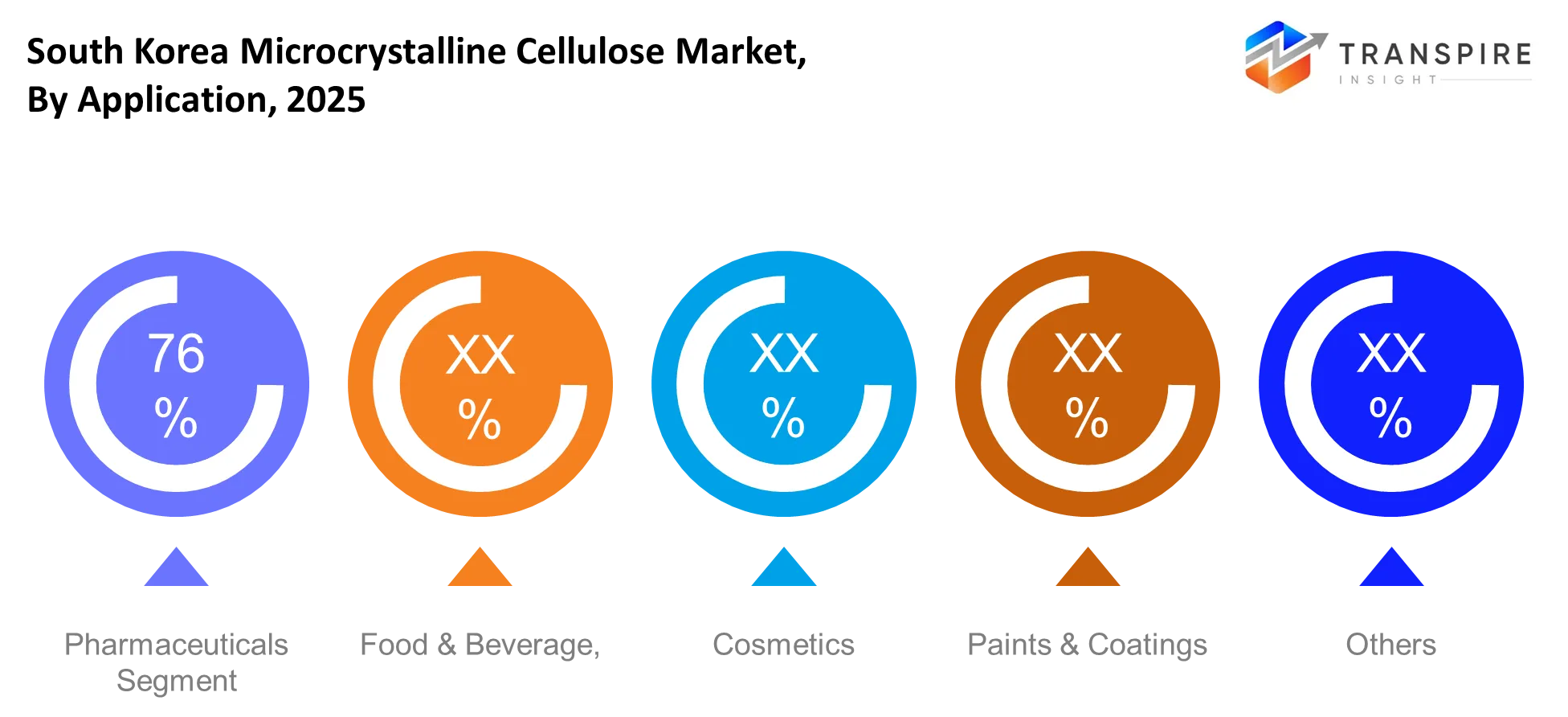
To learn more about this report, Download Free Sample Report
By Form
Powder MCC basically holds the dominant role, mainly because it slots in quite efficiently into pharmaceutical blending, direct compression tablet making, and also food ingredient processing setups. With its fine particle size distribution and steady uniform flow behaviour, it kind of becomes the most broadly adopted variant across industrial production lines, you know, in practical terms. Granules are still the second-largest portion though, since many manufacturers now prefer enhanced flowability alongside less dust creation in high-speed environments. Pellets stay a smaller but consistent slice, typically used for controlled release formulations and some specialized industrial uses, while other types are more or less limited to very narrow processing needs.
Powder MCC demand stays strong, especially with big-scale pharmaceutical production systems that really aim for consistency and straightforward formulation handling. Granular MCC expansion is pulled forward by automation on the manufacturing lines, where throughput effectiveness and minimized material loss are key, not optional. Pelletized forms—on the other hand—pair well with precision drug delivery systems and modified release technologies, which show up in more advanced therapeutic formulations. During the forecast period, granular MCC is expected to grow faster than the powder format, because companies keep fine-tuning production efficiency and also pushing tighter worker safety norms.
By End User
Pharmaceutical industry holds the leading position because MCC is kind of a critical excipient in tablet formulation, directly supporting South Korea’s strong generic drug manufacturing and export oriented pharmaceutical ecosystem. Its functional versatility in binding stabilization , and disintegration makes it indispensable in high volume production environments . Meanwhile the Food industry takes the second-largest segment role, mainly because processed foods, dairy alternatives, and functional nutrition products are using it more and more, for texture enhancement. The Cosmetics industry keeps expanding steadily , while the remaining categories are still more tied to industrial or specialized chemical applications.
This pharmaceutical edge is also reinforced by strict regulatory standards, where only high-quality excipients can be used for oral solid dosage formulations. For Food, the momentum is coming from changing dietary patterns, plus demand increasing for processed and functional foods that need better stability and texture control. Cosmetics benefits from rising interest in stabilizing agents for premium skincare , and personal care formulations . Looking ahead, across the forecast period, the Food industry demand is expected to accelerate quicker than pharmaceuticals, since innovation in functional food ingredients is spreading through South Korea’s consumer goods sector, quite broadly.
What are the Key Use Cases Driving the South Korea Microcrystalline Cellulose Market?
Pharmaceutical tablet manufacturing still feels like the main use for microcrystalline cellulose in South Korea. Most drug manufacturers lean on MCC as a binder, filler, and disintegrant, especially when they’re pushing out high-volume tablets, because it bumps up compressibility and keeps dosage uniform even when production is moving fast. With that said, this use case pulls in the biggest part of demand, helped along by the country’s growing generic drug market, and also the nutraceutical side of things.
On another track, food and beverage processors are turning to MCC for low-fat dairy items, bakery fillings sauces, and functional nutrition products where texture stability, plus moisture retention really matters. Meanwhile, personal care brands are getting more comfortable with refined cellulose grades in cosmetic powders, creams, and skincare blends, partly so the final product behaves more predictably and stays stable on the shelf.
Newer directions are showing up too, like plant-based protein products, 3D-printed pharmaceuticals, and the more advanced controlled-release drug systems. Right now these are a bit smaller, kind of niche, but they still look promising over the long run as South Korea ramps up investment in precision medicine, functional foods, and the next generation of pharmaceutical manufacturing technologies.
|
Report Metrics |
Details |
|
Market size value in 2025 |
USD 119.95 Million |
|
Market size value in 2026 |
USD 126.07 Million |
|
Revenue forecast in 2033 |
USD 181.04 Million |
|
Growth rate |
CAGR of 5.31% from 2026 to 2033 |
|
Base year |
2025 |
|
Historical data |
2021 - 2024 |
|
Forecast period |
2026 - 2033 |
|
Report coverage |
Revenue forecast, competitive landscape, growth factors, and trends |
|
Regional scope |
South Korea |
|
Key company profiled |
FMC Corporation, DuPont, JRS Pharma, DFE Pharma, Roquette Frères, Asahi Kasei, Sigachi Industries, Mingtai Chemical, Accent Microcell, Chemfield Cellulose, Blanver, Anhui Sunhere Pharmaceutical, Libraw Pharma, Rayonier Advanced Materials, NB Entrepreneurs . |
|
Customization scope |
Free report customization (country, regional & segment scope). Avail customized purchase options to meet your exact research needs. |
|
Report Segmentation |
By Product Type (Wood-based MCC, Non-wood MCC, Colloidal MCC, Others); By Application (Pharmaceuticals, Food & Beverage, Cosmetics, Paints & Coatings, Others); By Form (Powder, Granules, Pellets, Others); By End User (Pharmaceutical Industry, Food Industry, Cosmetics Industry, Others) |
Which Regions are Driving the South Korea Microcrystalline Cellulose Market Growth?
The Seoul Capital Area still feels like the big boss in the South Korea microcrystalline cellulose market, mainly because it gathers most of the country’s major pharmaceutical makers , plus contract development organizations and nutraceutical processing facilities. The companies working out of Seoul , Incheon, and Gyeonggi Province tend to ride on well-built logistics routes , closer regulatory contact with the Ministry of Food and Drug Safety, and pretty direct reach to higher value export channels. Also, the area sits on top of a tight ecosystem of formulation laboratories and excipient distributors, which in turn speeds up product qualification timelines for pharmaceutical-grade MCC.
Meanwhile the southeastern industrial corridor, sort of anchored by Busan and Ulsan , grows in another way. It leans on keeping manufacturing uninterrupted, and maintaining industrial processing stability, not only piling up pharma companies. Food processing firms, specialty chemical producers, and export focused industrial businesses in that zone use MCC for things like texture stabilization, moisture handling, and industrial formulation purposes. If you compare it with the Seoul region, the momentum here usually comes more from steady factory output and long-term production agreements rather than quick innovation loops. Port strength and export connectivity further support processors by helping them keep raw material inflows consistent and improve regional distribution flow, too.
The activity that seems to be accelerating the fastest is showing up in the central Chungcheong region, especially around Osong and the nearby biotechnology clusters. Over the last few years, government-backed investments in biopharmaceutical manufacturing , along with precision medicine infrastructure, have been pulling in new formulation sites and research-driven pharmaceutical production.
Who are the Key Players in the South Korea Microcrystalline Cellulose Market and How Do They Compete?
In the South Korea microcrystalline cellulose market , competition is sort of moderately consolidated, with major global excipient makers still holding the more premium pharmaceutical-grade supply , while smaller regional players push ahead using pricing flexibility and that more localized distribution vibe. Mostly, the fight isn’t just about volume, it’s about formulation results, regulatory alignment, particle consistency, and whether supply is dependable when customers need it . At the same time, international suppliers keep defending their share through newer excipient technologies and audited, certified production systems, and meanwhile Asian manufacturers are growing by leaning on cost-efficient manufacturing and slightly faster regional delivery routines.
JRS Pharma , for example, stands out by offering high-functionality excipients like silicified MCC preparations made for direct compression and those more complicated oral dosage layouts. They seem to win with formulation science and technical assistance depth rather than acting like a pure commodity price game, and that tends to place them pretty well with pharmaceutical manufacturers building high speed tablet production lines.
Asahi Kasei goes with advanced materials engineering , plus it uses strong Asia-Pacific manufacturing integration to stay competitive in more precision driven pharmaceutical uses. Their advantage is anchored in strict quality management systems, and also in long term relationships with local drug makers who want stable excipient behavior, every single time.
Then there’s Sigachi Industries , expanding by ramping production scale and connecting into wider pharmaceutical ingredient manufacturing. This approach helps them improve cost competitiveness , while also reinforcing supply security, which customers usually notice quickly when timelines get tight.
Company List
- FMC Corporation
• DuPont
• JRS Pharma
• DFE Pharma
• Roquette Frères
• Asahi Kasei
• Sigachi Industries
• Mingtai Chemical
• Accent Microcell
• Chemfield Cellulose
• Blanver
• Anhui Sunhere Pharmaceutical
• Libraw Pharma
• Rayonier Advanced Materials
• NB Entrepreneurs
Recent Development News
In August 2025, Sigachi Industries announced the commencement of civil works for its new 12,000 MTPA Microcrystalline Cellulose project at Dahej SEZ. The investment expanded the company’s global MCC production capacity and strengthened supply continuity for pharmaceutical and nutraceutical manufacturers across Asia-Pacific markets, including South Korea.http://www.business-standard.com
In January 2026, Bukwang Pharmaceutical confirmed the acquisition of Korea Union Pharmaceutical for KRW 30 billion through a stalking horse investment structure. The acquisition expanded Bukwang Pharmaceutical’s injectable and antibiotic drug manufacturing capabilities, strengthening South Korea’s broader pharmaceutical supply ecosystem that supports excipient and microcrystalline cellulose consumption.http://www.koreabizdaily.com
What Strategic Insights Define the Future of the South Korea Microcrystalline Cellulose Market?
The South Korea microcrystalline cellulose market is shifting, like structurally, toward high-purity multifunctional excipients that blend into advanced pharmaceutical manufacturing and more precision nutrition systems. The main idea driving this change is basically the country’s effort to make domestic pharma more resilient while still supporting export-leaning drug production , with tighter formulation consistency needs. In the coming few years, suppliers who can deliver customized MCC grades for controlled-release tablets, nutraceuticals, and even biopharmaceutical uses are probably going to win a lot more value than others.
A less obvious concern is that high-grade cellulose feedstock sourcing is concentrated in a fairly narrow global supplier web. If there is any long disruption in pulp supply, energy pricing, or trade logistics, production costs can jump fast and that could squeeze pharmaceutical margins. Yet at the same time, there are emerging openings too, around co-processed excipients meant for next-gen oral delivery platforms and also 3D printed pharmaceutical formats.
So market players should lean into localized collaborations with pharmaceutical manufacturers, and put money into application-focused R&D instead of trying to outcompete everyone mainly on commodity pricing alone.
South Korea Microcrystalline Cellulose Market Report Segmentation
By Product Type
- Wood-based MCC
- Non-wood MCC
- Colloidal MCC
- Others
By Application
- Pharmaceuticals
- Food & Beverage
- Cosmetics
- Paints & Coatings
- Others
By Form
- Powder
- Granules
- Pellets
- Others
By End User
- Pharmaceutical Industry
- Food Industry
- Cosmetics Industry
- Others
Frequently Asked Questions
Find quick answers to common questions.
The Estimated South Korea Microcrystalline Cellulose Market size for the Market will be USD 66.8 Billion in 2033.
Key segments for the South Korea Microcrystalline Cellulose Market are By Product Type (Wood-based MCC, Non-wood MCC, Colloidal MCC, Others); By Application (Pharmaceuticals, Food & Beverage, Cosmetics, Paints & Coatings, Others); By Form (Powder, Granules, Pellets, Others); By End User (Pharmaceutical Industry, Food Industry, Cosmetics Industry, Others).
Major South Korea Microcrystalline Cellulose Market players are FMC Corporation, DuPont, JRS Pharma, DFE Pharma, Roquette Frères, Asahi Kasei, Sigachi Industries, Mingtai Chemical, Accent Microcell, Chemfield Cellulose, Blanver, Anhui Sunhere Pharmaceutical, Libraw Pharma, Rayonier Advanced Materials, NB Entrepreneurs.
The Current South Korea Microcrystalline Cellulose Market size is USD 119.95 Million in 2025.
The South Korea Microcrystalline Cellulose Market CAGR is 5.31% from 2026 to 2033.
FMC Corporation
• DuPont
• JRS Pharma
• DFE Pharma
• Roquette Frères
• Asahi Kasei
• Sigachi Industries
• Mingtai Chemical
• Accent Microcell
• Chemfield Cellulose
• Blanver
• Anhui Sunhere Pharmaceutical
• Libraw Pharma
• Rayonier Advanced Materials
• NB Entrepreneurs
Recently Published Reports
-
May 2026
Healthcare Polymer Packaging Market
Healthcare Polymer Packaging Market Size, Share & Analysis Report By Packaging Type (Syringes, IV Bottles and Pouches, Clamshells, Blisters, Bottles & Jars, Containers, Tubes, IV Parental Packaging, Others), By Type (Regulated, Non-regulated), By Polymer Type (LDPE (Low-Density Polyethylene), HDPE (High-Density Polyethylene), Homo-polymer (Homo), Random Copolymer (Random), Block Copolymer (Block), PET, Polystyrene, Polyvinyl Chloride, Polyamide/EVOH, Others), and Geography (North America, Europe, Asia-Pacific, Middle East and Africa, South and Central America), 2021 - 2031
-
Apr 2026
Hydrophilic Tape (Waterstop) Market
Hydrophilic Tape (Waterstop) Market Size, Share & Analysis Report By Type (Bentonite-Based Hydrophilic Tape, Rubber-Based Hydrophilic Tape), By Application (Residential Buildings, Commercial Buildings, Infrastructure Projects), and Geography (North America, Europe, Asia-Pacific, Middle East and Africa, South and Central America), 2021 - 2031
-
Apr 2026
Metalens Market
Metalens Market Size, Share & Analysis Report By Type (Visible Light Metalens, and Infrared Metalens), By Application (Consumer Electronics, Automotive Electronics, Industrial, Medical, and Others), and Geography (North America, Europe, Asia-Pacific, Middle East and Africa, South and Central America), 2021 - 2031
-
Apr 2026
PBT Resin Market
PBT Resin Market Size, Share & Analysis Report By Type (Reinforced PBT Resin, Unreinforced PBT Resin), By Processing Method (Injection Molding, Extrusion, Blow Molding, Others), By End-User (Automotive, Electrical & Electronics, Consumer Appliances, Industrial Machinery, Medical Devices, Packaging, Others), and Geography (North America, Europe, Asia-Pacific, Middle East and Africa, South and Central America), 2021 - 2031