

South Korea Linoleic Acid Market Size & Forecast:
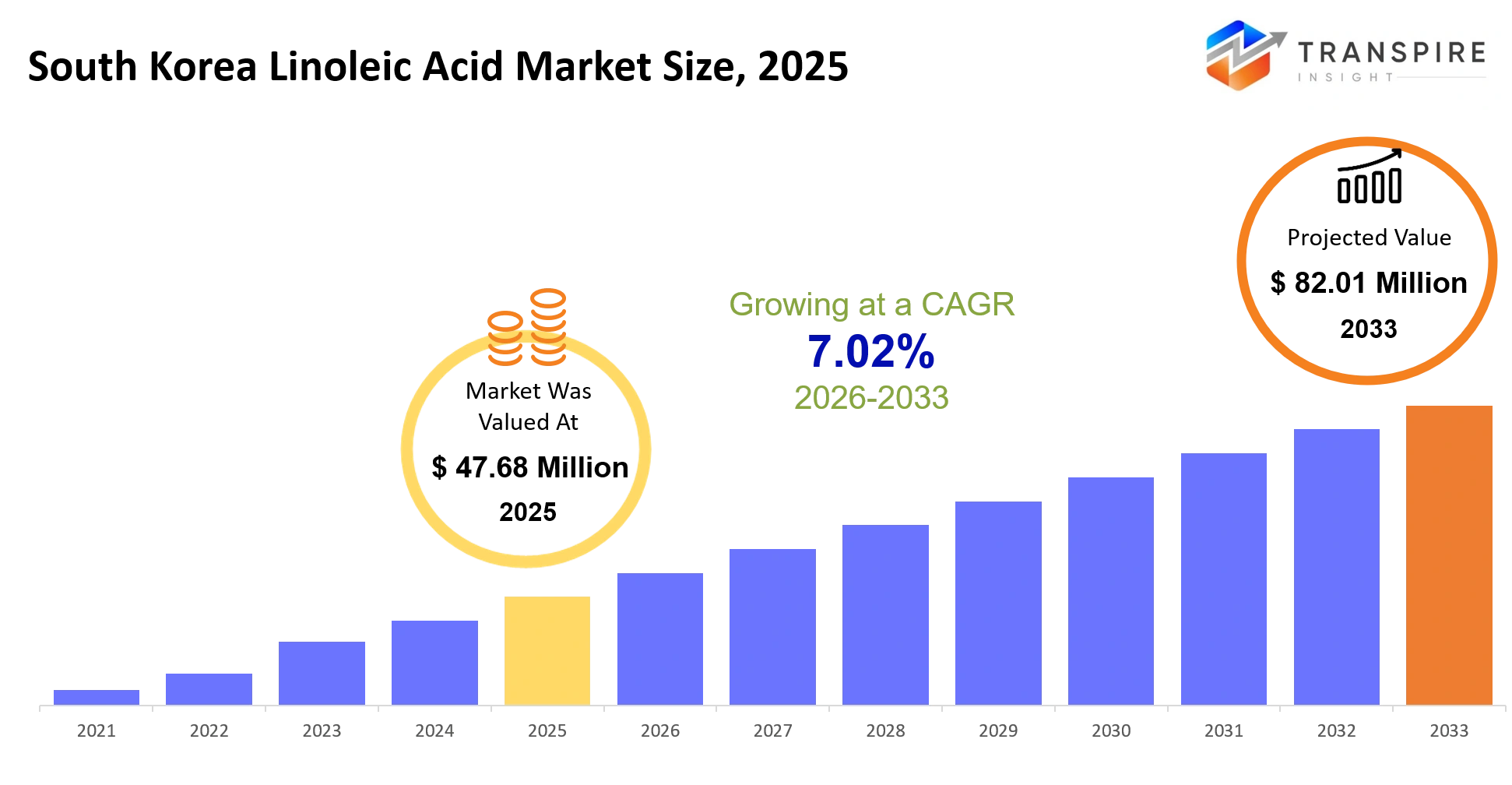
- South Korea Linoleic Acid Market Size 2025: USD 47.68 Million
- South Korea Linoleic Acid Market Size 2033: USD 82.01 Million
- South Korea Linoleic Acid Market CAGR: 7.02%
- South Korea Linoleic Acid Market Segments: By Source (Sunflower Oil, Soybean Oil, Corn Oil, Safflower Oil, Canola Oil, Others) | By Form (Liquid, Powder, Capsules, Softgels, Others) | By Application (Dietary Supplements, Food & Beverages, Cosmetics, Pharmaceuticals, Animal Nutrition, Others) | By End User (Food, Healthcare, Cosmetics, Feed, Others).
South Korea Linoleic Acid Market Summary
The South Korea Linoleic Acid Market was valued at USD 47.68 Million in 2025. It is forecast to reach USD 82.01 Million by 2033. That is a CAGR of 7.02% over the period.
South Korea's linoleic acid market is kind of a linchpin when it comes to supplying functional inputs for food processing, nutraceuticals, cosmetics, and animal nutrition. Basically, in day to day manufacturing, linoleic acid allows producers to enhance nutritional profiles, craft specialty health lines, and also build skincare solutions that support the skin barrier, not just the surface look. What makes it commercially important is that it helps companies stand out with value-added products, rather than being seen as a basic commodity thing they simply buy and move on from.
In the last three to five years things started shifting more, toward high-purity versions and application specific linoleic acid formulations. This happens as domestic manufacturers slowly move up the value chain, and then aim at more premium consumer groups. At the same time, supply chain disruptions—triggered by global commodity price volatility and those logistics bottlenecks—changed how they procure ingredients. So, more attention now goes to supply security, and also ingredient traceability which is becoming a bigger deal.
Right now, market momentum looks like it’s coming from the blend of health focused product innovation, premium food formulation preferences, and wider use in personal care. When manufacturers add linoleic acid into higher margin items, adoption doesn’t only stay tied to the classic edible oil space. Instead, it reaches further into related formulations, and that creates clearer revenue opportunities while supporting continued expansion across several end use industries.
Key Market Insights
- The Seoul Capital Area kind of dominates the South Korea Linoleic Acid Market with an estimated 45%+ share in 2025, mostly because there’s concentrated manufacturing capacity there.
- Gyeonggi Province is still the leading production hub, propped up by advanced food processing and specialty chemical infrastructure, so it stays ahead.
- The Chungcheong region grows the quickest through 2032 as newer ingredient processing investments keep expanding regional manufacturing footprints and that ripple effect continues.
- High-purity linoleic acid is the bigger winner , holding roughly 50% market share in 2025, driven by pharmaceutical and nutraceutical formulation needs.
- Industrial-grade linoleic acid sits as the second-largest slice, feeding food ingredient and chemical manufacturing uses and related demand.
- Functional and customized blends are the fastest-growing segment through 2032, because premium product differentiation turns into a real competitive priority.
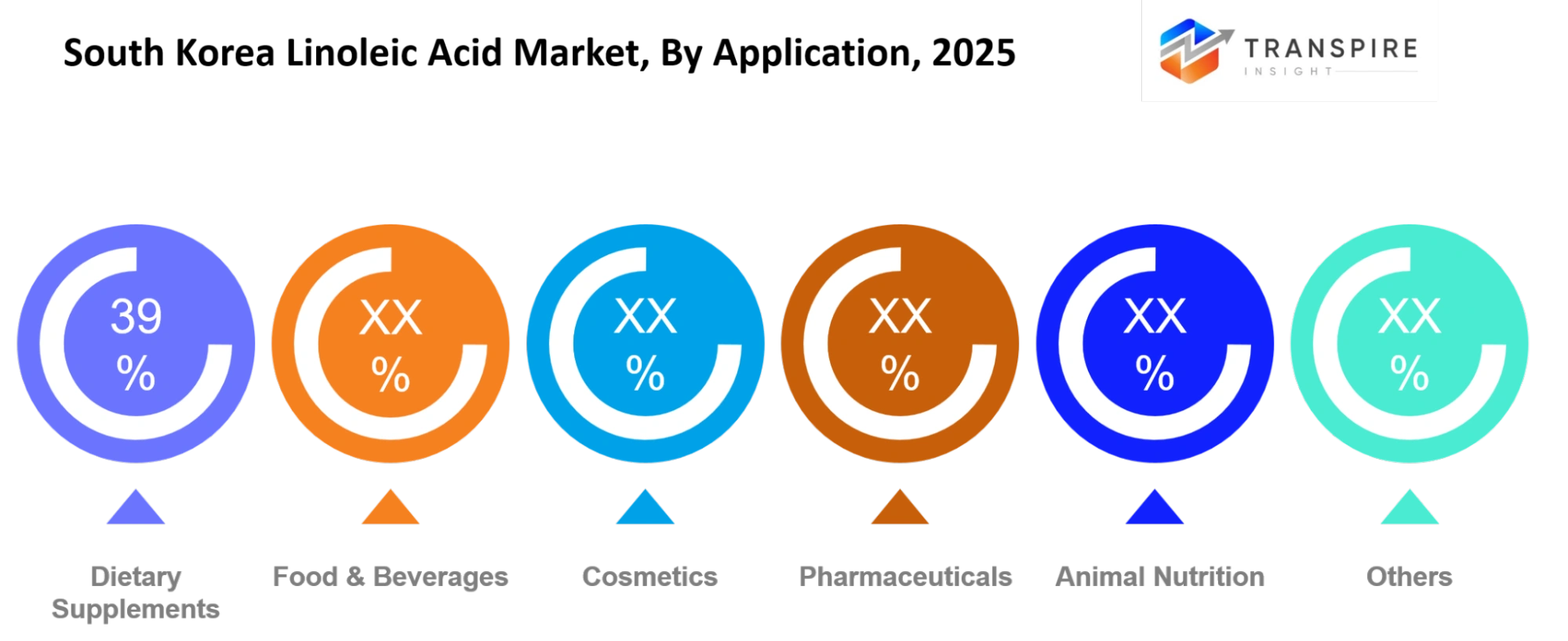
- Food and beverage applications take the largest share at nearly 40% in 2025, supported by fortified and functional product development efforts.
- Cosmetics and personal care applications are the fastest-growing category, as manufacturers move into advanced skin barrier product formulations.
- Food ingredient manufacturers remain the leading end-user group, contributing more than one-third of total market revenue.
- Nutraceutical producers become the fastest-growing end-user category over the forecast period, as premium health formulations keep expanding and getting more attention.
What are the Key Drivers, Restraints, and Opportunities in the South Korea Linoleic Acid Market?
The main force pushing the South Korea Linoleic Acid Market forward is kind of this shift toward higher-value functional ingredients across food, nutraceuticals , and personal care making. This change started to pick up speed when local producers looked for better margins from specialized formulations rather than plain commodity oils. More and more, manufacturers need purified fatty acid inputs that help them stand out, stay in line with rules, and keep a premium market look. So, linoleic acid is now showing up in a wider set of fortified foods, dietary supplements and also more advanced skincare products, and that directly grows the revenue pool across several industries too.
The biggest obstacle still feels like dependency on global vegetable oil supply chains plus agricultural commodity markets. Feedstock availability and pricing keep getting touched by weather events , trade policies, and international crop yields, stuff producers really can’t steer easily in the short term. Because of this structure, production costs and inventory plans can swing a lot. If raw material prices are unpredictable, procurement choices can get delayed, manufacturer margins can get squeezed, and investment in fresh application development may slow down, which ends up suppressing the market revenue potential.
A major opportunity sort of lies in developing high-purity bioactive ingredients for premium nutraceutical and dermaceutical uses. South Korean companies still put money into advanced extraction, purification, and formulation technologies, which makes it easier to build specialized fatty acid products. Like, the growing investment in personalized nutrition and functional beauty solutions forms favorable conditions for more differentiated linoleic acid formulations. Then, as these premium categories get more mature, suppliers that can deliver traceable, application-specific ingredients seem set to take hold of the next phase of market expansion.
What Has the Impact of Artificial Intelligence Been on the South Korea Linoleic Acid Market?
Artificial intelligence is slowly changing how operational efficiency works across the South Korea Linoleic Acid Market , mostly by tweaking production planning, tightening quality checks, and managing the supply chain with a bit more discipline. In practice, many manufacturers are now leaning on AI enabled process monitoring systems to read refining conditions, better manage yields, and keep product purity steady. Automated control platforms can also spot when something starts going off track, right in real time, which cuts down on waste creation, and helps batches behave more consistently.
At the same time , machine learning is backing predictive maintenance efforts inside processing facilities. By looking at equipment performance signals, these tools help anticipate what maintenance might be needed before failures happen. That means steadier plant uptime, and fewer surprises that cause unplanned shutdowns. On the commercial side, advanced analytics tends to support procurement teams too, by tracking feedstock price swings, estimating inventory needs, and flagging supplier risks. With that, purchasing decisions are often made with a clearer view rather than just guesswork.
Digital optimization technologies have also produced real operational gains, such as reduced production losses, better energy utilization, quicker quality verification, and more visible supply chain flow. Firms that adopt these data driven manufacturing approaches are, in general, strengthening profitability while staying more responsive to customer requirements.
Still, AI uptake comes with limitations. Integration expenses can stay high, especially for mid sized processors still running legacy production systems. Also, machine learning models usually need large amounts of high quality operational data, and a lot of facilities have only started collecting that recently. These issues keep wider deployment moving slowly, even though the long term potential looks promising.
Key Market Trends
- Since 2021, manufacturer teams have been putting more money into high-purity linoleic acid production, to support those more premium nutraceutical and cosmetic formulations, you know.
- Between 2020 and 2023, supply chain disruptions kinda pushed buyers to spread out sourcing plans and also tighten inventory management, a bit more.
- Food manufacturers are also leaning harder toward functional ingredient formulations, so procurement has been moving away from commodity oils and toward specialty fatty acids, instead.
- Personal care brands have widened their use of linoleic acid in skin barrier products, this is driving formulation creativity across premium skincare categories at a faster pace.
- Since 2022, advanced purification technologies have been adopted more often, which helps keep product consistency steadier, and it supports tighter quality specifications.
- Strategic collaborations, ingredient suppliers working together with nutraceutical companies, have become more common to speed up new product development.
- Traceability requirements keep getting stronger throughout the value chain, so companies are investing more in digital monitoring systems for supply chain visibility.
- Competition has changed a little too, it’s not only about chasing higher volumes anymore , but about value added formulation know-how and customized ingredient solutions.
- Regional producers increasingly pursue export facing specialty ingredient opportunities across Asia-Pacific markets, through those strategic expansion initiatives.
- And sustainability metrics now weigh on procurement decisions more than they did about five years ago, especially for multinational food and cosmetic manufacturers.
South Korea Linoleic Acid Market Segmentation
By Source :
Sunflower oil works as a big source of linoleic acid, mainly because it has naturally high concentrations and it gets used widely in food plus nutrition products. Soybean oil also adds a lot, mostly due to broad availability and the processing setup that’s been in place for years. Corn oil still matters, especially when food ingredient manufacturers are trying to keep supply steady and manage cost efficiency.
Safflower oil tends to be appreciated for its higher linoleic acid content and it shows up in more premium nutritional formulations. Canola oil brings an extra option for specialized uses, while the other category covers several vegetable oils that get chosen based on what’s available in the region, how prices shift and what the final product needs. In practice, source choice comes down to purity targets, how the oil is processed, and what the commercial application is meant to do.
By Form :
Liquid form keeps an important role because adding it straight into food products, beverages, and industrial formulations is still convenient, and honestly pretty efficient. Processing plants often lean toward liquid variants for blending ,and for manufacturing tasks. With consistent handling behavior, it supports big scale production across multiple industries.
Powder form can be a plus for storage stability, and it helps with ingredient integration in dry formulations. Capsules and softgels are pretty common in nutritional products, especially when controlled dosage and consumer convenience matter. The other category includes specialized delivery formats that are developed for narrower healthcare , food, and even industrial applications. Form selection shifts with the product design, shelf-life aims, and distribution requirements.
By Application :
Dietary supplements kinda show up as a key use case, mainly because people use them a lot in nutritional products, and so linoleic acid fits into that whole thing for formulations. Also, when it comes to food and beverages, linoleic acid is used to help with product development, ingredient boosting strategies too, you know, to make the profile work better. In cosmetics, manufacturers weave linoleic acid into skincare and beauty mixes , which are made to improve how the product performs and how its quality comes out.
For pharmaceutical stuff, the focus tends to be formulation support, plus specialized healthcare products, more or less. In animal nutrition, linoleic acid shows up in feed formulations meant to keep nutritional balance steady and help with livestock productivity. Then there’s the “other” group, that covers industrial and specialty applications where fatty acid ingredients are needed for product design and manufacturing purposes. Overall, that variety still builds stronger commercial pathways across all those sectors.
By End User :
he food industry is a major end-user area because manufacturers actually need linoleic acid for ingredient formulation, nutritional upgrades and product differentiation. Demand stays fairly steady, especially from processed food and specialty nutrition categories, so consumption continues. And then, ongoing product innovation keeps opening up additional chances inside that same segment.
Healthcare organizations and manufacturers use linoleic acid for nutrition related and therapeutic formulations, basically. Cosmetics firms depend on the ingredient for skincare and personal care product development, while the feed sector puts linoleic acid into animal nutrition programs. The other category includes industrial users and specialty manufacturers that still use linoleic acid based on their specific production and formulation needs, so it varies a bit depending on the case.
What are the Key Use Cases Driving the South Korea Linoleic Acid Market?
The main use case that is really driving adoption in the South Korea Linoleic Acid Market , is dietary supplement manufacturing. Nutrition product developers tend to use linoleic acid in capsules, softgels, and functional blends, kinda to back health-oriented product lines. This specific application is what creates the strongest pull, because supplement manufacturers need stable , high-purity raw material, and they have to match those tight quality plus formulation rules.
After that, there’s broader expansion in food processing and cosmetics. Food producers are putting linoleic acid into fortified items and more niche nutrition offerings, while personal care brands are using it within skincare recipes meant to elevate overall product performance. These directions are picking up, partly because companies keep leaning into premium and value-added products, even when margins get tricky.
On top of that, emerging use cases are showing up, like personalized nutrition programs and advanced dermaceutical formulations that sort of mix nutritional benefits with cosmetic improvements. Research work is also pointing toward possible roles in specialized pharmaceutical formulations. Even so, these segments are still relatively small today, but continued investment in functional ingredients, plus more precision health products, should open fresh growth channels across the forecast period.
|
Report Metrics |
Details |
|
Market size value in 2025 |
USD 47.68 Million |
|
Market size value in 2026 |
USD 51.02 Million |
|
Revenue forecast in 2033 |
USD 82.01 Million |
|
Growth rate |
CAGR of 7.02% from 2026 to 2033 |
|
Base year |
2025 |
|
Historical data |
2021 - 2024 |
|
Forecast period |
2026 - 2033 |
|
Report coverage |
Revenue forecast, competitive landscape, growth factors, and trends |
|
Country scope |
South Korea |
|
Key company profiled |
BASF, Cargill, ADM, DSM, Croda, Kerry, Wilmar, Bunge, AAK, Corbion, IFF, Evonik, Oleon, Vantage, KLK. |
|
Customization scope |
Free report customization (country, regional & segment scope). Avail customized purchase options to meet your exact research needs. |
|
Report Segmentation |
By Source (Sunflower Oil, Soybean Oil, Corn Oil, Safflower Oil, Canola Oil, Others) | By Form (Liquid, Powder, Capsules, Softgels, Others) | By Application (Dietary Supplements, Food & Beverages, Cosmetics, Pharmaceuticals, Animal Nutrition, Others) | By End User (Food, Healthcare, Cosmetics, Feed, Others). |
Which Regions are Driving the South Korea Linoleic Acid Market Growth?
Seoul Capital Area is still kinda the main place in the South Korea Linoleic Acid Market, it stays dominant. The region leads because it pulls together lots of big food manufacturers, nutraceutical firms, research institutions, and ingredient processing facilities inside a pretty mature industrial setup. With strong logistics networks, more advanced distribution infrastructure,and the fact it is close to big consumer markets, moving raw materials and finished goods stays efficient. Also, ongoing investments in biotechnology, food innovation, and specialty ingredient creation keep reinforcing its role as the country’s main production + consumption hub.
Gyeonggi Province comes in next, it is the second most important contributor, though the way it grows looks different. Instead of depending mainly on market concentration, the province leans on a broad manufacturing base, steady industrial investment,and solid links into domestic supply chains. You get a varied blend of food processors, cosmetic makers, and healthcare product companies,so demand stays fairly constant across multiple uses. That kind of balanced industrial structure brings some resilience if one end-use category shifts, and it helps maintain steady revenue.
Meanwhile, the Chungcheong region is showing up as the fastest-growing area. This is tied to expanding industrial development,and higher investment in advanced ingredient manufacturing facilities. There have been recent attempts to attract biotechnology, healthcare, and food processing projects, and those actions have improved production capacity while boosting regional competitiveness. As more industrial land becomes available,and modern production infrastructure keeps growing, companies feel encouraged to set up new operations beyond the older manufacturing strongholds. Over the 2026–2033 period.
Who are the Key Players in the South Korea Linoleic Acid Market and How Do They Compete?
The competitive landscape in the South Korea Linoleic Acid Market feels moderately consolidated, a lot of the tussle is still about product quality, purification abilities, application know-how, and how solid the supply chain stays, even when things get shaky. Bigger international ingredient players go head to head with regional processors, who tend to zoom in on the needs of particular customers. Honestly, it’s not only a price game anymore. Companies are finding other ways to stand out, like high purity formulations, regulatory compliance, and more tailored ingredient solutions, for food , nutraceutical , and personal care uses. Also innovation, plus those long term customer bonds, now matter quite a bit for keeping a good position.
BASF SE sort of leans into tech led product creation and serious advanced processing experience. They distinguish themselves with solid research strength and a wide set of specialty ingredients, which helps them serve multiple end use sectors. Cargill, in contrast, puts a lot of emphasis on supply chain integration and feedstock sourcing efficiency, so they can keep product availability steady, and maintain quality control. Ongoing investment in value added nutrition solutions also supports the company in reinforcing customer relationships and opening up more application possibilities.
Company List
Recent Development News
In September 2025, BASF completed the sale of its Food and Health Performance Ingredients business to Louis Dreyfus Company (LDC). The transaction included health ingredient product lines such as conjugated linoleic acid (CLA), strengthening LDC's position in plant-based and nutrition ingredients while allowing BASF to focus on prioritized nutrition segments.
Source: https://www.basf.com/
In December 2025, Croda International entered a strategic supply partnership with Amino GmbH. The agreement expanded access to high-purity pharmaceutical ingredients and reinforced Croda's specialty ingredient portfolio, supporting growth in healthcare and formulation markets that overlap with fatty acid-based ingredients.
Source: https://www.croda.com/
What Strategic Insights Define the Future of the South Korea Linoleic Acid Market?
South Korea Linoleic Acid Market is kind of moving toward higher value, more use-case specific items rather than that pure volume driven commodity supply. In the next five to seven years growth will come more and more from premium nutrition, functional food concepts, advanced skincare formulations, and also specialized healthcare use. The main undercurrent behind this shift is basically the push for differentiated ingredients that help with product invention, plus better margin potential across consumer facing sectors.
There’s also a quieter kind of risk that people don’t always notice, feedstock concentration and raw material volatility, like, they can matter a lot. If manufacturers lean heavily on imported vegetable oil supply lines, they get exposed to climate related crop disruptions, trade limitations, and price swings. Even if the end market demand stays pretty steady these pressures can still squeeze margins, and it can make companies less interested in long term investment into new capacity.
Meanwhile an interesting opening is personalized nutrition and dermaceutical products that blend wellbeing with beauty like benefits in one. With biotechnology know how expanding in regions such as Chungcheong, firms can design specialized blends that are more commercially valuable. Market players should focus on investments in purification methods, traceable sourcing channels, and strategic collaborations with nutraceutical and cosmetic manufacturers. That way they strengthen their competitive position and are better set up to capture the coming premium demand.
South Korea Linoleic Acid Market Report Segmentation
By Source
- Sunflower Oil
- Soybean Oil
- Corn Oil
- Safflower Oil
- Canola Oil
By Form
- Liquid
- Powder
- Capsules
- Softgels
By Application
- Dietary Supplements
- Food & Beverages
- Cosmetics
- Pharmaceuticals
- Animal Nutrition
By End User
- Food
- Healthcare
- Cosmetics
- Feed
Frequently Asked Questions
Find quick answers to common questions.
The South Korea Linoleic Acid Market size is USD 82.01 Million in 2033.
Key segments for the South Korea Linoleic Acid Market are By Source (Sunflower Oil, Soybean Oil, Corn Oil, Safflower Oil, Canola Oil, Others) | By Form (Liquid, Powder, Capsules, Softgels, Others) | By Application (Dietary Supplements, Food & Beverages, Cosmetics, Pharmaceuticals, Animal Nutrition, Others) | By End User (Food, Healthcare, Cosmetics, Feed, Others).
Major South Korea Linoleic Acid Market players are BASF, Cargill, ADM, DSM, Croda, Kerry, Wilmar, Bunge, AAK, Corbion, IFF, Evonik, Oleon, Vantage, KLK.
The South Korea Linoleic Acid Market size is USD 47.68 Million in 2025.
The South Korea Linoleic Acid Market CAGR is 7.02% from 2026 to 2033.
- BASF
- Cargill
- ADM
- DSM
- Croda
- Kerry
- Wilmar
- Bunge
- AAK
- Corbion
- IFF
- Evonik
- Oleon
- Vantage
- KLK
About the Authors

Pankaj Ghogare Patil
I am Pankaj Ghogare Patil, a Senior Research Analyst at Transpire Insight, specializing in the Pharmaceutical, Chemicals & Materials, Healthcare IT, and Biotechnology industry. My expertise lies in conducting comprehensive market research, analyzing industry trends, evaluating competitive landscapes, and translating complex data into actionable insights. At Transpire Insight, I closely follow emerging technologies, regulatory developments, and market innovations to create accurate, well-researched, and informative content that helps businesses and professionals make informed decisions. I am committed to producing credible, evidence-based articles that reflect industry best practices while making technical topics accessible and valuable for a broad audience.

Chakradhar Khansole
Chakradhar serves as the Research Director at Transpire Insight, bringing over 8 years of experience in technology, innovation, and strategic market intelligence. He specializes in transforming complex market data into actionable business insights that enable organizations to make informed, growth-oriented decisions. Recognized for his strategic vision and analytical expertise, Chakradhar leads high-impact research initiatives, delivering comprehensive market assessments, competitive intelligence, and forward-looking industry analysis.
Recently Published Reports
-
May 2026
Healthcare Polymer Packaging Market
Healthcare Polymer Packaging Market Size, Share & Analysis Report By Packaging Type (Syringes, IV Bottles and Pouches, Clamshells, Blisters, Bottles & Jars, Containers, Tubes, IV Parental Packaging, Others), By Type (Regulated, Non-regulated), By Polymer Type (LDPE (Low-Density Polyethylene), HDPE (High-Density Polyethylene), Homo-polymer (Homo), Random Copolymer (Random), Block Copolymer (Block), PET, Polystyrene, Polyvinyl Chloride, Polyamide/EVOH, Others), and Geography (North America, Europe, Asia-Pacific, Middle East and Africa, South and Central America), 2021 - 2031
-
Apr 2026
Hydrophilic Tape (Waterstop) Market
Hydrophilic Tape (Waterstop) Market Size, Share & Analysis Report By Type (Bentonite-Based Hydrophilic Tape, Rubber-Based Hydrophilic Tape), By Application (Residential Buildings, Commercial Buildings, Infrastructure Projects), and Geography (North America, Europe, Asia-Pacific, Middle East and Africa, South and Central America), 2021 - 2031
-
Apr 2026
Metalens Market
Metalens Market Size, Share & Analysis Report By Type (Visible Light Metalens, and Infrared Metalens), By Application (Consumer Electronics, Automotive Electronics, Industrial, Medical, and Others), and Geography (North America, Europe, Asia-Pacific, Middle East and Africa, South and Central America), 2021 - 2031
-
Apr 2026
PBT Resin Market
PBT Resin Market Size, Share & Analysis Report By Type (Reinforced PBT Resin, Unreinforced PBT Resin), By Processing Method (Injection Molding, Extrusion, Blow Molding, Others), By End-User (Automotive, Electrical & Electronics, Consumer Appliances, Industrial Machinery, Medical Devices, Packaging, Others), and Geography (North America, Europe, Asia-Pacific, Middle East and Africa, South and Central America), 2021 - 2031