

South Korea Jelly Pudding Market Size & Forecast:
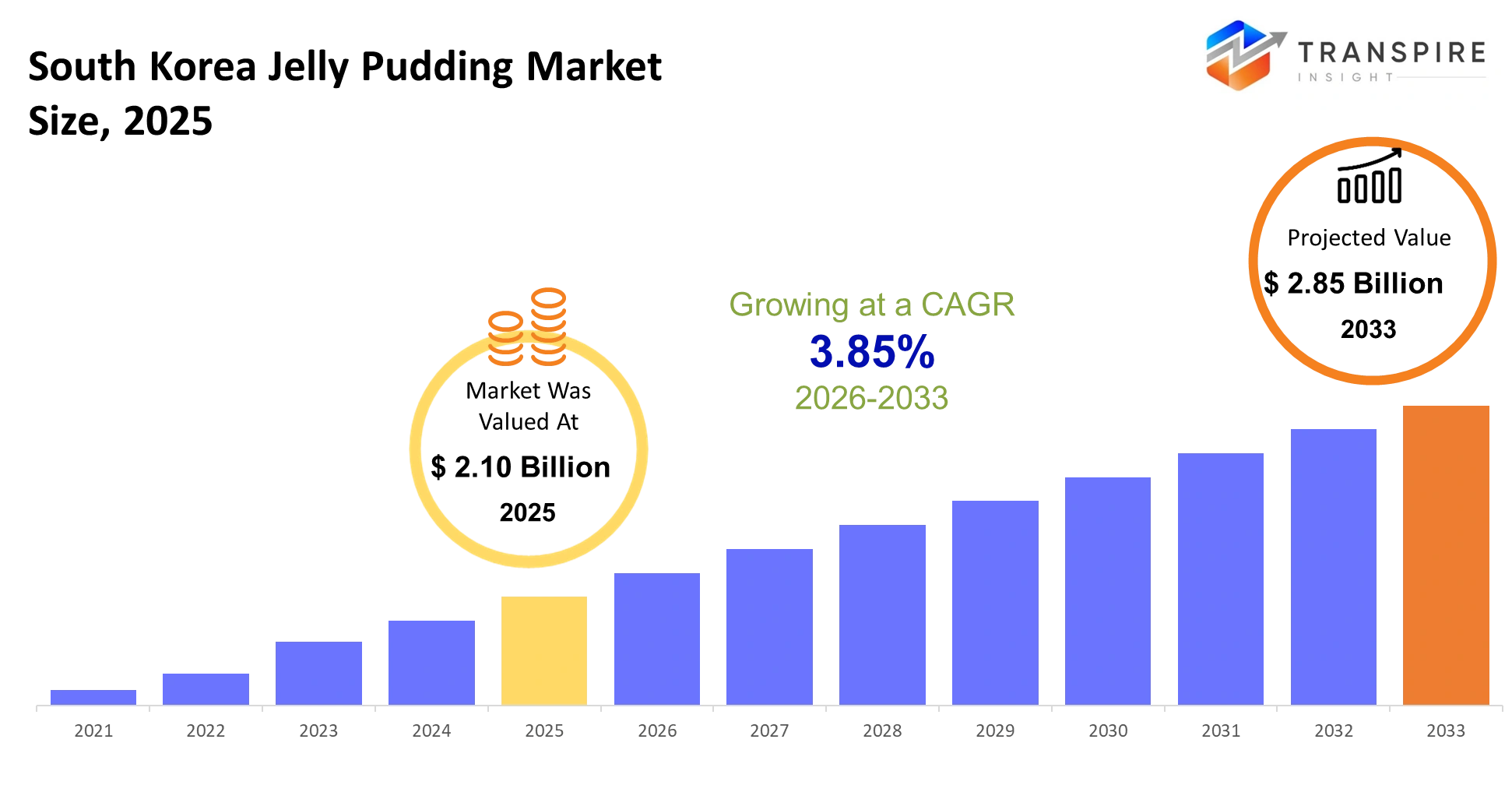
- South Korea Jelly Pudding Market Size 2025: USD 2.10 Billion
- South Korea Jelly Pudding Market Size 2033: USD 2.85 Billion
- South Korea Jelly Pudding Market CAGR: 3.85%
- South Korea Jelly Pudding Market Segments: By Product Type (Fruit Jelly Pudding, Milk-based Pudding, Functional Jelly Pudding, Low-sugar Pudding, Others); By Flavor (Mango, Strawberry, Chocolate, Vanilla, Coffee, Others); By Packaging Type (Cup Packaging, Sachet Packaging, Bottled Packaging, Others); By Distribution Channel (Supermarkets, Convenience Stores, Online Retail, Specialty Stores, Others); By End User (Children, Adults, Health-conscious Consumers, Elderly Consumers, Others)
To learn more about this report,  Download Free Sample Report
South Korea Jelly Pudding Market Summary
The South Korea Jelly Pudding Market was valued at USD 2.10 Billion in 2025. It is forecast to reach USD 2.85 Billion by 2033. That is a CAGR of 3.85% over the period.
The South Korea Jelly Pudding market plays a practical role in supplying ready to eat, portion controlled desserts that fit fast urban lifestyles, school consumption and convenience store retail systems. It kinda solves the need for affordable indulgence with a long shelf life and very little preparation, so it ends up being a staple within single-serve snack categories, even when people are in a hurry.
Over the last 3–5 years the market has changed in a more structural way toward low sugar options and texture enhanced formulations. This is mostly because health focused consumption keeps rising and manufacturers keep investing in plant based gelling agents, which makes the texture feel more refined. At the same time convenience store expansion and private label growth have reshaped distribution routes, and jelly pudding is pushed deeper into daily impulse buys, rather than just occasional treats.
A key trigger was COVID-19 which disrupted out of home dining and it accelerated at home snacking behavior, so packaged dessert sales got stronger. After that, producers started optimizing supply chains and also diversifying retail channels, more than before. As a result brands are putting more emphasis on product differentiation and functional positioning, which is reshaping the revenue mix and encouraging repeat purchases across mainstream retail formats, not just the usual spots.
Key Market Insights
- In South Korea, the Jelly Pudding Market feels like it is mostly centered around the Seoul Capital Region, with more than 35% share , largely because the convenience retail web is dense and kinda everywhere.
- The southeastern provinces however show the quickest momentum, backed by more supermarket placement and urbanization steering snack habits, that kind of slow climb trend keeps going.
- Fruit-based jelly pudding basically leads the market, holding a large portion of demand because people really like flavored, low fat desserts, you know the usual preferences.
- Konjac jelly pudding sits as the second-largest part, supported by diet- focused shoppers who are looking for low calorie substitutes, not just a treat.
- For the functional jelly pudding part, it is the fastest mover through 2026–2032, pushed by added vitamins plus collagen type formulations.
- When you look at where it’s sold, convenience stores dominate the South Korea Jelly Pudding Market, taking over 40% share, mostly from impulse driven buys that happen when you pass by.
- Online grocery platforms are also the quickest expanding application channel, helped by rapid digital commerce adoption , and those subscription snack delivery styles that pop up.
- As for end users, teenagers and young adults stay on top, contributing the biggest consumption share because flavored dessert preference is strong there.
- Meanwhile, office workers are the fastest growing category, driven by the need for portable, low prep snack options during work hours, the practical grab and go thing.
What are the Key Drivers, Restraints, and Opportunities in the South Korea Jelly Pudding Market?
South Korea Jelly Pudding Market growth is mostly being pulled by the fast expansion of convenience retail ecosystems and what people eat in cities now. The main, sort of structural reason seems to be the aggressive scaling of 24-hour convenience store chains and automated retail formats across big metro zones and semi-urban pockets. Because of this, jelly pudding has been kind of moved from an “only in between” treat to a more frequent impulse snack, so per-store turnover goes up and packaged dessert revenue for makers looks more stable.
Still, there is a structural restraint too, and it’s tied to the stricter look at sugar levels plus tighter nutritional labeling rules. Those demands raise compliance friction for manufacturers and make it harder to tweak recipes too aggressively, especially for brands that rely on high-sugar flavor profiles. Since reformulation cycles cost time and money and they move slowly, some mid-tier producers end up unable to adjust quickly. Then their product refresh rates lag, and shelf competitiveness in the South Korea Jelly Pudding Market gets squeezed.
One important opportunity is showing up via functional and wellness-driven jelly pudding innovation, particularly collagen-infused and probiotic-enhanced ideas. For instance, domestic food R&D efforts in Seoul-based functional snack labs are helping create products that still feel dessert-like, but are marketed around beauty and digestive well-being. That’s carving out a more premium sub-segment, and it seems to resonate with office workers and younger consumers. In turn, it opens new revenue routes that go beyond the older, more familiar confectionery consumption patterns.
What Has the Impact of Artificial Intelligence Been on the South Korea Jelly Pudding Market?
AI plus advanced digital technologies are kind of reshaping scrubber performance systems, and the wider marine emission control tech too, mostly by changing how operators keep an eye on compliance, tune efficiency, and cut down downtime for ships moving in and around South Korea’s shipping corridors. In the scrubber monitoring and control space, AI-enabled dashboards now pull together sensor readings on sulfur levels, exhaust temperature, and flow rates in real time, and then they can make automated tweaks that keep the operation within IMO 2020 sulfur limits, not needing constant manual checking or intervention. In practice this tends to lower operational swings and helps shipping operators hold onto steadier fuel switching decisions, even when conditions shift.
Machine learning is also being pushed into predictive maintenance. In that setup, older vibration records , corrosion trends, and pressure measurements are used to estimate when parts inside exhaust gas cleaning systems will start wearing down. so maintenance can be booked before a failure shows up. The result is better vessel uptime, plus fewer surprise repair bills. Some operators even describe more directional benefits, like reduced fuel wastage and fewer compliance-related inspection delays, because continuous emissions forecasting runs alongside automated reporting workflows.
Even so, uptake is still held back by the lack of enough real-world training data, and by spotty connectivity during long haul routes across the sea. A number of AI systems have trouble staying accurate in tough marine environments, where sensor noise, plus equipment-to-equipment variability, can undermine reliability. So full-scale automation often stays out of reach, even with the strong long-term potential that everyone expects.
Key Market Trends
- From 2020 up to 2025, convenience store-anchored distribution sort of expanded sharply, with 24 hour retail channels reshaping how people buy impulse jelly pudding all across South Korea .
- Then, from 2022, MFDS moved toward stricter nutritional labeling rules , so manufacturers had to shift to low sugar reformulations of jelly pudding, which raised R&D expenses, and slowed down older SKUs a bit.
- Between 2021 and 2026, konjac based jelly pudding picked up a steadier slice of the market, as calorie mindful shoppers started moving away from the more traditional, sugar heavy dessert styles.
- From 2020 onward online grocery platforms, and snack subscription services, kept widening distribution , which made jelly pudding easier to find, and encouraged repeat buying cycles more than before.
- Between 2021 and 2025, private label jelly pudding from convenience chains grew more common, so branded makers felt stronger pressure. They then tried to separate themselves via texture innovation , instead of just competing on familiar claims.
- After 2023, manufacturers began using automated mixing and filling systems, cutting production downtime a lot , and making batch consistency more reliable across large scale jelly pudding lines.
- Since 2023, collagen and probiotic enriched jelly pudding options have also expanded, aiming at office workers who want functional snacks beyond the old idea of dessert only, kind of consumption patterns .
South Korea Jelly Pudding Market Segmentation
By Product Type:
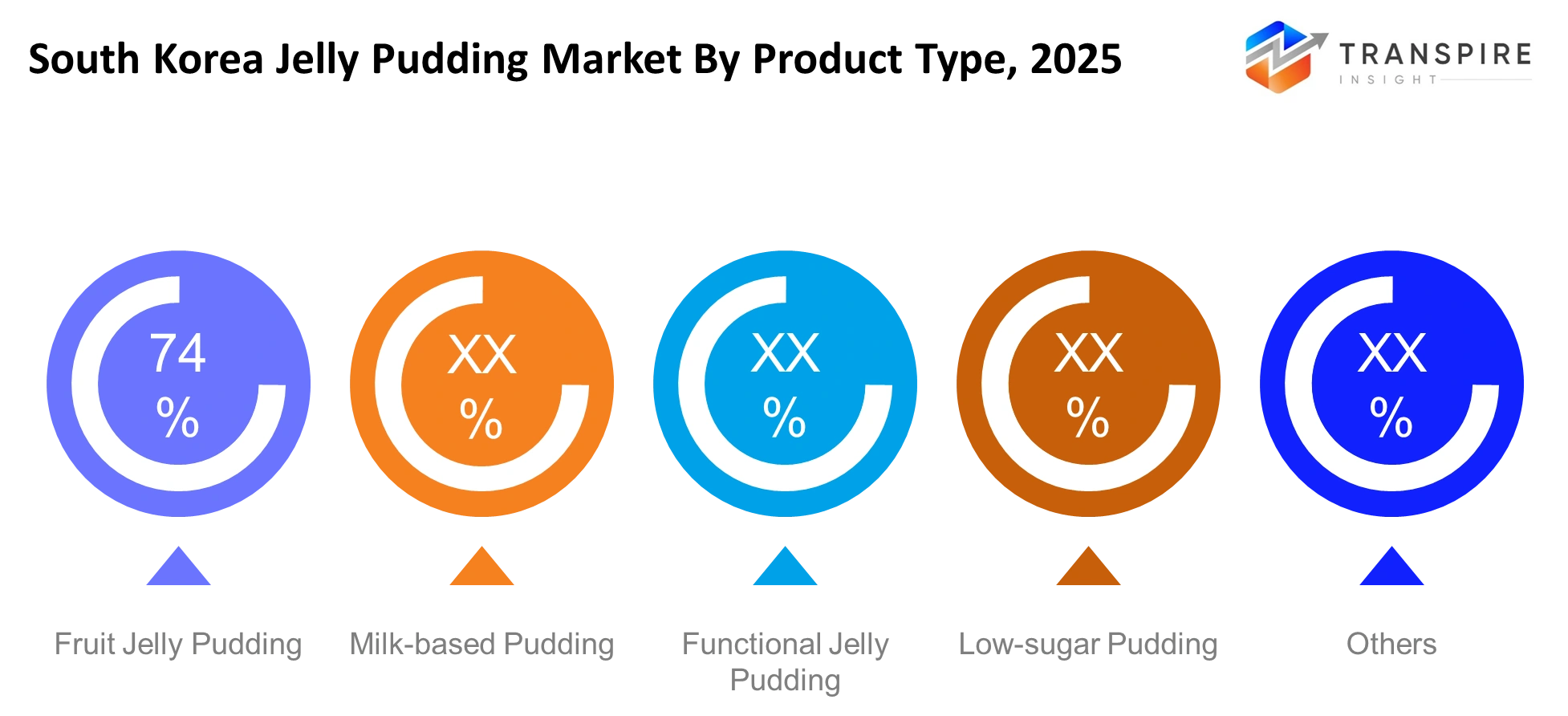
Fruit Jelly Pudding, a milk based pudding, functional jelly pudding , low-sugar pudding, and a few others kind of spell out product diversity across the South Korea Jelly Pudding Market . Fruit jelly pudding stays very visible since people really like flavored sweets , not just plain ones. Milk based pudding also keeps momentum thanks to the creamy mouthfeel customers keep asking for across mass retail channels, it feels familiar you know.
Functional jelly pudding plus low-sugar pudding seem to spread quicker among health conscious buyers. Over time, product innovation is tilting toward collagen added and vitamin enriched styles, which helps with a more premium vibe. In response, makers tweak the recipes for shifting dietary expectations, while retail shelves lean toward textures that stand out plus nutritional value.
To learn more about this report, Download Free Sample Report
By Flavor:
For flavors, mango , strawberry , chocolate , vanilla , coffee , and other options end up shaping how consumers choose in the South Korea Jelly Pudding Market. Mango and strawberry lead the pack, because the younger crowd has a clear preference for fruity tastes . Chocolate and vanilla remain steady for mainstream buying . Meanwhile, coffee flavored jelly pudding is getting more penetration in urban retail formats.
Flavor expansion is happening via mixed fruit combinations and layered dessert presentations, so it feels more interesting rather than repetitive. Manufacturers then focus on sensory appeal upgrades to push repeat buying, and also to keep shelf competitiveness strong across convenience driven retail ecosystems.
By Packaging Type:
Cup packaging, sachet packaging, bottled packaging, and also other kinds of packaging formats are basically what set the packaging structure in the South Korea Jelly Pudding Market. In practice, cup packaging leads, mostly because it’s just easy to grab and eat and it has a real strong presence inside convenience stores. Meanwhile sachet formats fit the low-cost portable snack demand, a bit more “small and go” kind of idea .
Bottled packaging is also getting more attention, especially in premium lines and for family-sized options. Packaging innovation now leans on resealability plus portion control, so people can keep things tidier and feel it’s more convenient. Producers also keep investing in lightweight materials, to cut logistics cost ,but at the same time boost product visibility when it sits in retail displays.
By Distribution Channel:
When it comes to distribution structure, supermarkets, convenience stores, online retail, specialty stores, and a few other channels all matter in the South Korea Jelly Pudding Market. Convenience stores dominate, mainly because of high foot traffic and that impulse purchase habit across urban areas. Supermarkets tend to match bulk purchasing patterns.
Online retail is growing fast, pushed by digital grocery adoption and home delivery services. Specialty stores help brands position more niche items and premium dessert style offerings. Overall distribution strategies are moving toward omnichannel visibility, plus faster product turnover across multiple retail networks .
By End User:
In South Korea, the Jelly Pudding Market, demand segmentation is basically defined by kids , adults , health conscious consumers, elderly consumers, and other groups. Kids drive strong consumption because they really lean toward sweeter flavored snack styles. Adults add consistent demand, mostly because convenience led snacking fits their routine , kind of plain and simple.
Then there are the health conscious buyers who show a stronger leaning toward low sugar and functional varieties, lately anyway. Elderly consumers often want desserts with a softer texture, so it’s easier to consume without fuss. To keep it all aligned, manufacturers tweak the recipes and also the serving sizes based on age specific dietary needs and they do that to improve repeat purchases across retail channels.
What are the Key Use Cases Driving the South Korea Jelly Pudding Market?
Main use case is basically convenience store grab-and-go impulse snacking, in urban retail neighborhoods across South Korea, and that kinda keeps feeding the South Korea Jelly Pudding Market. This is backed by commuting that moves fast and store hours that run pretty long. Because the products are placed close to the checkout counters (you know, right there where people look) it nudges spontaneous buys and helps keep the daily sales volumes pretty consistent across big cities.
More areas it’s showing up are office break snacks and school canteen lines too. Portion sized desserts work like a handy little solution, for quick eating during those short downtime windows. Online grocery subscriptions also push adoption with younger shoppers and health minded consumers, especially those who want lower sugar, plus “functional” variants, still sitting inside the packaged dessert lane.
Newer situations are starting to appear as well, like positioning it as functional nutrition—think collagen enriched desserts, and softer texture snack formats for elderly care facilities. On top of that, there is export oriented demand in Southeast Asian retail channels, where producers are lining up their product story with wider processed food trade growth and shifting preferences in what consumers actually like to taste.
|
Report Metrics |
Details |
|
Market size value in 2025 |
USD 2.10 Billion |
|
Market size value in 2026 |
USD 2.18 Billion |
|
Revenue forecast in 2033 |
USD 2.85 Billion |
|
Growth rate |
CAGR of 3.85% from 2026 to 2033 |
|
Base year |
2025 |
|
Historical data |
2021 - 2024 |
|
Forecast period |
2026 - 2033 |
|
Report coverage |
Revenue forecast, competitive landscape, growth factors, and trends |
|
Country scope |
South Korea |
|
Key company profiled |
Lotte Confectionery, Orion Corporation, Binggrae, Haitai Confectionery, CJ CheilJedang, Nestlé, Meiji Holdings, Morinaga, Ezaki Glico, Danone, Yili Group, Want Want China, PepsiCo, Unilever, Mondelez International |
|
Customization scope |
Free report customization (country, regional & segment scope). Avail customized purchase options to meet your exact research needs. |
|
Report Segmentation |
By Product Type (Fruit Jelly Pudding, Milk-based Pudding, Functional Jelly Pudding, Low-sugar Pudding, Others); By Flavor (Mango, Strawberry, Chocolate, Vanilla, Coffee, Others); By Packaging Type (Cup Packaging, Sachet Packaging, Bottled Packaging, Others); By Distribution Channel (Supermarkets, Convenience Stores, Online Retail, Specialty Stores, Others); By End User (Children, Adults, Health-conscious Consumers, Elderly Consumers, Others) |
Which Regions are Driving the South Korea Jelly Pudding Market Growth?
The Seoul Capital Region seems to lead the South Korea Jelly Pudding Market, mostly because it has this dense urban population and a really packed convenience retail network. In Seoul, Incheon, and Gyeonggi you can find a big chunk of the national convenience store outlets, and that ends up pushing those high-frequency snack buys. Also, there’s a strong headquarters presence from major food makers, which helps product releases move quickly and shelf placement decisions happen faster than elsewhere. On top of that, the distribution logistics are more advanced and the warehousing is more centralized, so it all somehow reinforces the region’s dominance in packaged dessert consumption.
Then there is the Busan–Ulsan–Gyeongnam region, which acts like a stable second hub. This is backed by an industrial workforce and a port-based, export oriented economy. Here demand feels more tied to steady income groups working in manufacturing and logistics, rather than people trying lots of new flavors or experimenting. Retail patterns stay pretty consistent, with fewer abrupt changes and slower cycling of new variants compared to the capital region. Because of that, this place becomes a dependable revenue base for well known jelly pudding brands, even when they operate across nationwide distribution networks.
Meanwhile, the strongest growth momentum is showing up in Chungcheong, and also in southern provincial areas. Convenience store chains are spreading quite aggressively into semi-urban and rural spots. And because logistics corridors got upgraded recently, product availability is better, plus delivery delays for packaged snacks have eased. At the same time, e-commerce penetration is rising, and franchise retail growth is shifting purchasing behavior toward branded dessert products. So for market entrants, this region basically looks like it has growing white space opportunities between 2026 and 2033, as retail density keeps thickening over time.
Who are the Key Players in the South Korea Jelly Pudding Market and How Do They Compete?
Competition feels kinda moderately consolidated, mostly held together by big confectionery and food conglomerates, they basically steer convenience store distribution and they run private label supply agreements too. New entrants do jump in at functional dessert niches, but the older players keep their grip via solid retail contracts and super efficient mass production. The whole competitive pressure comes mainly from shelf access, pricing efficiency , and those rapid product refresh cycles that never really stop.
Lotte Confectionery leans on cost leadership and very tight convenience store integration, plus it keeps rapidly rotating jelly pudding SKUs so the shelves stay theirs, at least in practice. CJ CheilJedang leans more toward technology-led innovation, it brings collagen and probiotic formulations into the lineup, backed by a strong food R&D infrastructure. Orion Corporation differentiates more through texture innovation and export expansion, especially into Southeast Asian snack markets, and they also support that with packaging upgrades that look just a bit more modern.
Binggrae plays the dairy-based expertise angle to build creamy pudding variants, and it’s supported by refrigerated distribution networks along with steady retail placement. Haitai Confectionery & Foods competes using price competitiveness and long-standing convenience store relationships, then expands in smaller steps , through localized jelly dessert product extensions, while keeping stable regional supply agreements in place.
Company List
- Lotte Confectionery
- Orion Corporation
- Binggrae
- Haitai Confectionery
- CJ CheilJedang
- Nestlé
- Meiji Holdings
- Morinaga
- Ezaki Glico
- Danone
- Yili Group
- Want Want China
- PepsiCo
- Unilever
- Mondelez International
Recent Development News
In April 2026, GS Retail (GS25) announced that its dessert line “Hejaroun” surpassed 1 million cumulative sales within about one month of launch, driven by strong demand for affordable convenience-store dessert products. The company also expanded the lineup with new seasonal items such as strawberry-based cream breads in response to sustained consumer demand. Source https://biz.chosun.com/
In May 2026 (Q1 results covering March 2026 performance), Lotte Wellfood Co., Ltd. released financial results showing KRW 1.2 trillion revenue for Q1 2026, with continued growth in confectionery and frozen dessert categories that include jelly-like snack innovations and premium dessert lines. The company emphasized stronger global consumer goods demand as a key driver.Source https://www.ad-hoc-news.de/
What Strategic Insights Define the Future of the South Korea Jelly Pudding Market?
South Korea's Jelly Pudding Market is kind of moving, not just toward “more variety” but more toward higher differentiation and function-led positioning, instead of simple confectionery consumption, you know like snack yes but with a reason. This shift comes from steady urban snacking habits mixed with retail consolidation inside convenience store chains, and those chains now lean more into high margin, innovation-heavy SKUs, over the old school dessert lines. In the next five to seven years , value creation will probably depend more on product formulation and channel control than on sheer volume growth.
There is also a less obvious risk, it is ingredient supply sensitivity, especially around specialty gelling agents and imported functional additives used in low-sugar and collagen-based variants. If there’s any disruption in global sourcing, or if price swings get rough, it can squeeze margins for mid-tier manufacturers who don’t have procurement scale. Meanwhile, rapid private-label expansion by convenience chains could crank up price pressure and, in a way, shrink brand distinctiveness at the same time.
On the upside, there’s an opportunity that is starting to show up in regional health-oriented retail formats, particularly in secondary cities where functional snacking adoption is moving faster than premium dessert penetration. Firms that blend localized health claims with convenience-driven packaging formats may get early mover advantage. Market players should align R&D with evolving regulatory nutrition themes while also building stronger exclusive retail partnerships, just to lock in that long-term shelf positioning.
South Korea Jelly Pudding Market Report Segmentation
By Product Type
- Fruit Jelly Pudding
- Milk-based Pudding
- Functional Jelly Pudding
- Low-sugar Pudding
By Flavor
- Mango
- Strawberry
- Chocolate
- Vanilla
- Coffee
By Packaging Type
- Cup Packaging
- Sachet Packaging
- Bottled Packaging
By Distribution Channel
- Supermarkets
- Convenience Stores
- Online Retail
- Specialty Stores
By End User
- Children
- Adults
- Health-conscious Consumers
- Elderly Consumers
Frequently Asked Questions
Find quick answers to common questions.
The South Korea Jelly Pudding Market size is USD 2.85 Billion in 2033.
Key segments for the South Korea Jelly Pudding Market are By Product Type (Fruit Jelly Pudding, Milk-based Pudding, Functional Jelly Pudding, Low-sugar Pudding, Others); By Flavor (Mango, Strawberry, Chocolate, Vanilla, Coffee, Others); By Packaging Type (Cup Packaging, Sachet Packaging, Bottled Packaging, Others); By Distribution Channel (Supermarkets, Convenience Stores, Online Retail, Specialty Stores, Others); By End User (Children, Adults, Health-conscious Consumers, Elderly Consumers, Others).
Major South Korea Jelly Pudding Market players are Lotte Confectionery, Orion Corporation, Binggrae, Haitai Confectionery, CJ CheilJedang, Nestlé, Meiji Holdings, Morinaga, Ezaki Glico, Danone, Yili Group, Want Want China, PepsiCo, Unilever, Mondelez International.
The South Korea Jelly Pudding Market size is USD 2.10 Billion in 2025.
The South Korea Jelly Pudding Market CAGR is 3.85% from 2026 to 2033.
- Lotte Confectionery
- Orion Corporation
- Binggrae
- Haitai Confectionery
- CJ CheilJedang
- Nestlé
- Meiji Holdings
- Morinaga
- Ezaki Glico
- Danone
- Yili Group
- Want Want China
- PepsiCo
- Unilever
- Mondelez International
Recently Published Reports
-
Apr 2026
Baby Infant Formula Market
Baby Infant Formula Market Size, Share & Analysis Report By ype (Infant Milk, Follow On Milk, Specialty Baby Milk, Growing-Up Milk), By Ingredient (Carbohydrate, Fat, Protein, Minerals, Vitamins, and Others), By Product Form (Powder, Liquid, and Ready-to-feed), By Distribution Channels (Supermarket/Hypermarket, Specialty Store, Pharmacies, Online Retail, and Others), and Geography (North America, Europe, Asia-Pacific, Middle East and Africa, South and Central America), 2021 - 2031
-
Apr 2026
Edible Insects for Animal Feed Market
Edible Insects for Animal Feed Market Size, Share & Analysis Report By Type (Insect Powder, Insect Meal, Insect Bar, Insect Paste, Insect Oil, and Others), By Insect Type (Beetles, Cricket, Caterpillar, Hymenoptera, Orthoptera, Tree Bugs, and Others), By Application (Livestock, Pet Food, and Aquaculture), By Livestock Type (Poultry, Swine, and Others), and Geography (North America, Europe, Asia-Pacific, Middle East and Africa, South and Central America), 2021 - 2031
-
Apr 2026
Food Industry Disinfection and Bacterial Control Market
Food Industry Disinfection and Bacterial Control Market Size, Share & Analysis Report By Type (Chemical Disinfectants, Physical Disinfectants, and Biocides and Antimicrobials), By Application (Food Processing Equipment Surface Disinfection, Food Preparation Areas Surface Disinfection, Storage Areas Surface Disinfection, Anti-microbial Coatings Food Preservation, and Preservative Solutions Food Preservation), By End User (Meat and Poultry Processing, Dairy Processing, Seafood Processing, Bakery and Confectionery, Restaurants and Commercial Kitchens, and Food Service Providers), By Sales Channel (Online, Offline), and Geography (North America, Europe, Asia-Pacific, Middle East and Africa, South and Central America), 2021 - 2031
-
May 2026
Freeze Dried Food Market
Freeze Dried Food Market Size, Share & Analysis Report By Product Type (Fruits, Vegetables, Freeze-Dried Dairy Products, Freeze-Dried Meat and Seafood, Freeze-Dried Pet Food, and Prepared Meal), By Nature (Organic, and Conventional), By Form (Powdered, Granules, and Diced), By End Use (Breakfast Cereals, Dairy Products, Bakery & Confectionery, Nutritional Bars & Supplements, Powdered Beverages, Snacks, and Retail (Household)), and Geography (North America, Europe, Asia-Pacific, Middle East and Africa, South and Central America), 2021 - 2031