

Asia Pacific Jam Jelly And Preserves Market Size & Forecast:
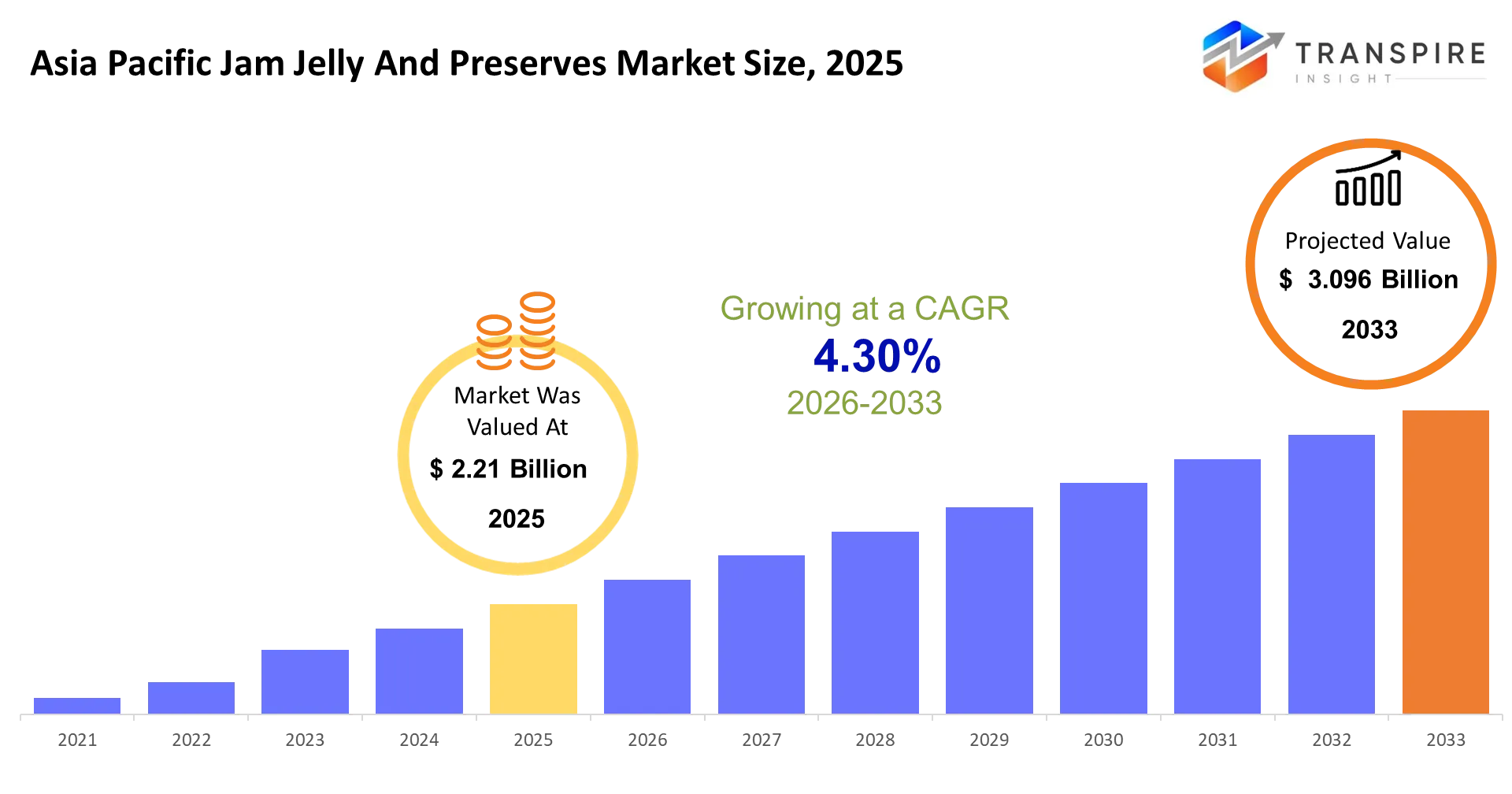
- Asia Pacific Jam Jelly And Preserves Market Size 2025: USD 2.21 Billion
- Asia Pacific Jam Jelly And Preserves Market Size 2033: USD 3.096 Billion
- Asia Pacific Jam Jelly And Preserves Market CAGR: 4.30%
- Asia Pacific Jam Jelly And Preserves Market Segments: By Type (Jam, Jelly, Marmalade, Fruit Preserves, Others); By Application (Household Consumption, Food Service, Bakery Use, Desserts, Others); By End-User (Consumers, Restaurants, Bakeries, Hotels, Retailers, Others); By Distribution (Supermarkets, Online, Convenience Stores, Specialty Stores, Others)
To learn more about this report,  Download Free Sample Report
Asia Pacific Jam Jelly And Preserves Market Summary
The Asia Pacific Jam Jelly And Preserves Market was valued at USD 2.21 Billion in 2025. It is forecast to reach USD 3.096 Billion by 2033. That is a CAGR of 4.30% over the period.
The Asia Pacific jam, jelly, and preserves market operates practically to extend fruit usability while decreasing post-harvest waste and providing food manufacturers and retailers and foodservice operators with products that maintain shelf stability and match current distribution requirements. The products enable customers to access fruit throughout the year as the products serve both home use and industrial food production needs which include bakery fillings and breakfast spreads and dessert recipes.
The market has changed during the last three to five years because manufacturers have started to create reduced-sugar and fruit-forward products in response to new food labeling requirements and the changing dietary needs of consumers in Japan and Australia and South Korea. The transition began to speed up when the pandemic supply chain breakdowns revealed weaknesses in imported fruit concentrate supply chains which caused regional processors to enhance their local sourcing networks. The organization has decided to invest in processing efficiency and high-end product development and supply chain protection which has resulted in better profit margins that help organized retail and hospitality businesses to grow.
Key Market Insights
- The Asia Pacific Jam Jelly And Preserves Market sees East Asia as its primary market, which holds almost 41% market share for 2025 because of its developed retail systems.
- Southeast Asia serves as the quickest developing regional market because organized retail development and changing breakfast eating habits will drive its growth until 2031.
- The industry size of Australia and New Zealand remains high because customers buy premium artisanal preserves and supermarkets sell private-label products.
- The Asia Pacific Jam Jelly And Preserves Market shows fruit jam as its most popular product, which will take about 46% of market share in 2025.
- Jelly products control the second largest market share because people use them in high quantities for bakery processing and institutional foodservice operations.
- The premium preserves market constitutes the fastest expanding product category which will continue to grow until 2031 because consumers prefer products with high fruit content and minimal artificial ingredients.
- The breakfast foods consumed by households establish their primary eating meal with breakfast foods achieving 52% market share because people commonly use them with bread products and bakery items and snacks.
- The packaged pastry market and premium dessert market demonstrate their strongest growth in commercial bakery operations which require fruit filling solutions.
- Retail consumers lead with over 61% market share because supermarkets provide strong distribution networks and customers can shop online.
- The foodservice and hospitality industry represents the fastest expanding user segment which will continue to grow throughout the prediction period because of premium menu customization.
What are the Key Drivers, Restraints, and Opportunities in the Asia Pacific Jam Jelly And Preserves Market?
The primary factor driving the growth of the Asia Pacific jam jelly and preserves market stems from the fast development of organized retail stores together with contemporary food distribution systems throughout India and Indonesia and Vietnam and the Philippines. After 2020, regional supermarket chains together with e-commerce grocery platforms expanded their operations to meet new urban consumption patterns which created the current operational environment. The expanded shelf space allows domestic and international brands to present their premium fruit spreads and reduced-sugar products and region-specific flavors to a larger group of consumers. The increase in product visibility has resulted in higher category sales because it drives repeat purchases while allowing manufacturers to achieve greater profit margins through product differentiation.
The primary obstacle to progress requires manufacturers to deal with changes in raw material prices which depend on fruit production cycles and climate changes and agricultural supply chain difficulties. The manufacturing process for jam and preserve products requires manufacturers to maintain consistent quality and stable prices for their fruit supplies but weather patterns in major sourcing locations create disruptions to their harvesting operations. The challenge requires agricultural modernization combined with cold-chain development and stronger ties between processors and farmers which makes it impossible to solve through quick solutions. The mid-sized regional producers face three challenges which result in compressed profit margins and unpredictable pricing and slow down their growth initiatives.
The future market growth potential for functional fruit spreads with added probiotics and vitamins and plant-based nutritional components represents a significant business opportunity. The Japanese and South Korean markets have reached a mature state for value-added packaged food products. The development of new high-growth product categories will result from advanced fruit processing technologies which maintain both texture and nutritional content.
What Has the Impact of Artificial Intelligence Been on the Asia Pacific Jam Jelly And Preserves Market?
The production accuracy and supply chain adaptability of Asia Pacific jam, jelly, and preserves manufacturers have reached new levels through the introduction of artificial intelligence and advanced digital technologies. The manufacturers have implemented AI-powered control systems which manage processing operations that include fruit sorting and sugar blending and thermal treatment processes. The systems employ computer vision together with sensor data to identify raw fruit quality deviations which enable operators to modify processes for better batch results and consistent product output. Automation has decreased the need for manual inspections while increasing operational capacity in industrial plants.
The industry uses machine learning models to perform predictive maintenance on processing equipment which includes boilers and filling machines and refrigeration units. The systems use vibration pattern analysis together with temperature change tracking and historical failure data examination to create equipment breakdown predictions. The processors have achieved operational improvements through this system which enables them to maintain consistent production during peak demand periods while minimizing unexpected maintenance expenses.
Companies achieve better energy efficiency and waste reduction through operational improvements which result from enhanced process control together with accurate forecasting. The presence of high integration expenses and the lack of organized data throughout divided supply chains create obstacles which prevent widespread adoption of the solution. The regional producers who operate in smaller markets face difficulties because they need digital systems to implement AI technologies, which prevents them from progressing toward market transformation.
Key Market Trends
- Since 2021 more than 30% of main regional businesses have created new products which contain reduced sugar levels to meet the updated front-pack labeling requirements.
- Between 2022 and 2025 Nestlé and other companies developed fruit-based premium spreads because urban customers moved away from breakfast items which contained excessive processing.
- E-commerce grocery platforms doubled their preserve category visibility between 2021 and 2024 which forced manufacturers to create direct-to-consumer packaging solutions that provide both durability and user-friendly features.
- Private-label products gained market share across multiple retail chains which included Woolworths Group and Aeon Co. Ltd. This development created stronger competition which forced traditional branded manufacturers to reduce their product prices.
- The processors made continuous automation investments after 2022 because they implemented AI-based sorting technology which enhanced their fruit grading accuracy while decreasing their material waste.
- Artisanal and small-batch preserves gained traction in South Korea and Singapore as specialty retailers expanded shelf allocation for premium imported brands.
- The manufacturing industry introduced sustainable glass alternatives and lightweight packaging solutions after 2023 because retailers established packaging waste reduction goals.
- The number of cooperative agreements between processors and regional fruit cooperatives increased after 2022 because processors needed to control procurement expenses during climate-related crop disruptions.
Asia Pacific Jam Jelly And Preserves Market Segmentation
By Type :
The section defines product categories through four criteria which include preparation method, texture, fruit content, and consumer preference that exists throughout Asia Pacific. The breakfast spread known as jam consists of crushed fruit combined with sugar to create a thick spread which people use as breakfast and snack food. Jelly presents a smoother texture which people create from fruit juice because households desire a lighter product. The citrus peel in marmalade produces a bitter taste which selected urban markets consider to be a rich flavor.
The retail display of fruit preserves shows whole fruit pieces which remain suspended in syrup or gel as they maintain their premium market status. The other category includes fruit spreads that contain blended fruit, their reduced-sugar versions, organic products, and regional products that were developed based on local culinary traditions. The segment will experience market growth because companies introduce new flavors while health-focused products enter the market and consumer habits evolve in both developed and developing markets.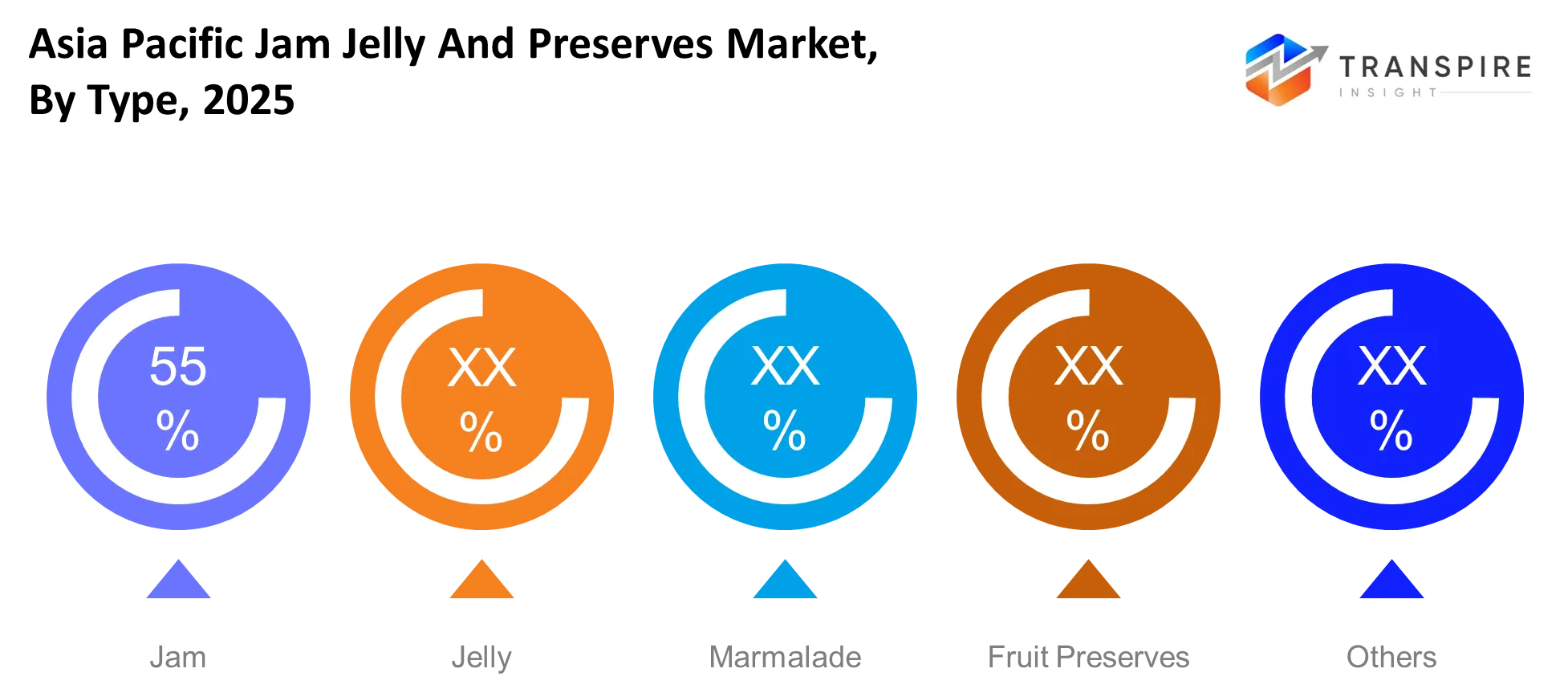
To learn more about this report, Download Free Sample Report
By Application :
This section divides products into two categories which differ based on their actual usage in home and business environments. People use household products for breakfast and snack making and food preparation which requires quick access to food items. Jam and preserves serve as menu options for cafés and quick-service restaurants and catering companies which allow customers to choose fruit-based side dishes.
Bakery products drive high demand because pastry and cake and cookie and layered product fillings serve as essential ingredients. Desserts include topping applications for ice cream, puddings, cheesecakes, and plated sweet dishes. The other category covers processed food manufacturing and institutional food preparation. The demand for various applications will keep growing because products provide multiple uses which enable restaurants to show their food in creative ways throughout different parts of the world.
By End-User :
The text defines purchasing groups that create market demand. Consumers represent direct household buyers who want products that provide both taste and convenient everyday use options with different product choices. Restaurants will buy products which they use to create breakfast menus and dessert dishes and value-added menu items. Bakeries create a reliable base of commercial customers who need to obtain fillings and toppings and fruit-based ingredients which they use to develop new products.
Hotels create customer demand through their buffet services and room dining options and their premium hospitality services, which require both packaged and bulk items. Retailers serve as primary supply chain partners who determine product availability to customers by implementing shelf arrangements and marketing initiatives. The other category includes institutional kitchens and catering operators. Urban dining patterns and premium food service growth drive industry development.
By Distribution :
The section investigates the methods through which products make their way to final customers throughout the entire Asia Pacific region. Supermarkets function as the main distribution method because their extensive product display areas together with their sales promotions and their wide range of products enable customers to buy more items. Convenience stores enable customers to make speedy purchases throughout the urban environment which contains high population density because these stores offer smaller product sizes that people need for their immediate consumption.
The growth of online distribution services continues because more people choose to shop online which enables them to compare products and receive their orders at home. Specialty stores sell premium preserves together with imported flavors and artisanal recipes plus health-focused products which attract niche customers who want to experience different quality levels. The distribution results for this market segment will rely on two factors which include the progress of retail modernization and the increase of digital technology use and the development of brand recognition in new consumer markets.
What are the Key Use Cases Driving the Asia Pacific Jam Jelly And Preserves Market?
The main purpose that drives market growth in the Asia Pacific jam jelly and preserves industry which grows through retail channels. Bread spreads remain the most popular breakfast item because they match traditional breakfast customs that people follow in Japan, Australia, South Korea and urban areas of India that now consume packaged breakfast products.
Commercial baking and foodservice operations now use products beyond their residential applications. Large bakery chains and café operators now use fruit preserves extensively in pastries, cake fillings, dessert toppings, and specialty beverages. Hotel and quick-service restaurant operators are also increasingly preserving procurement to support standardized breakfast service and premium menu customization.
The functional nutrition sector and premium snacking market currently reveal new application possibilities. Manufacturers are testing fortified fruit spreads with probiotics, plant proteins, and vitamin enrichment aimed at health-focused retail buyers. The development of customized preserves for premium gifting products and specialty export markets offers a promising business opportunity for companies who want to enter the Southeast Asian market because local fruit varieties will create distinct value-added packaged products.
|
Report Metrics |
Details |
|
Market size value in 2025 |
USD 2.21 Billion |
|
Market size value in 2026 |
USD 2.305 Billion |
|
Revenue forecast in 2033 |
USD 3.096 Billion |
|
Growth rate |
CAGR of 4.30% from 2026 to 2033 |
|
Base year |
2025 |
|
Historical data |
2021 - 2024 |
|
Forecast period |
2026 - 2033 |
|
Report coverage |
Revenue forecast, competitive landscape, growth factors, and trends |
|
Regional scope |
Asia Pacific (India, China, Japan, Australia,South Korea, Rest of Asia Pacific) |
|
Key company profiled |
Smucker, Kraft Heinz, Unilever, Nestlé, Hero Group, Bonne Maman, Andros, Dabur, Kissan, B&G Foods, Wilkin & Sons, Stute Foods, Murphy Orchards, Crofter’s Organic, Streamline Foods |
|
Customization scope |
Free report customization (country, regional & segment scope). Avail customized purchase options to meet your exact research needs. |
|
Report Segmentation |
By Type (Jam, Jelly, Marmalade, Fruit Preserves, Others); By Application (Household Consumption, Food Service, Bakery Use, Desserts, Others); By End-User (Consumers, Restaurants, Bakeries, Hotels, Retailers, Others); By Distribution (Supermarkets, Online, Convenience Stores, Specialty Stores, Others) |
Which Regions are Driving the Asia Pacific Jam Jelly And Preserves Market Growth?
The Asia Pacific market for jam, jelly, and preserves in East Asia operates as the leading region because of its advanced food processing operations. Japan and South Korea have implemented strict regulations that require producers to develop their products through ongoing enhancements and upscale their offerings. The region benefits from advanced cold-chain logistics and extensive fruit processing facilities and widespread supermarket access, which enables companies to distribute their products throughout the country. The integrated ecosystem of the manufacturing process enables established manufacturers to produce their products at a steady quality level while they adapt to the changes in market demand.
Oceania operates as a dependable market segment, yet its market patterns show major differences from East Asia. The packaged food market in Australia and New Zealand grows through their commitment to premium products and their use of domestic fruit supplies and their ongoing development of branded packaged food products. The area's residents choose to buy handmade preserves and organic fruit spreads and products that have transparent ingredient lists because these products help manufacturers achieve better profit outcomes. The region maintains stable economic conditions because its residents spend money on high-quality products, which generate continuous revenue while shielding businesses from short-term market fluctuations.
Southeast Asia has become the fastest developing regional market because urban retail changes and rising packaged food demand create new business opportunities. The retail landscape in Vietnam, Indonesia, and Thailand has transformed through supermarket expansion and digital grocery services and local processing facilities which enable better market access. The food processing industry has received support from regional governments through their implementation of manufacturing incentives and infrastructure development initiatives. The period from 2026 to 2033 presents market entrants and investors with excellent opportunities to establish local manufacturing operations while they develop first-mover benefits and regional distribution agreements.
Who are the Key Players in the Asia Pacific Jam Jelly And Preserves Market and How Do They Compete?
The Asia Pacific jam jelly and preserves market shows moderate fragmentation because multinational packaged food companies compete with regional fruit processors and specialty preserve brands. The competition now focuses on four main areas which include formulation innovation, pricing discipline, local sourcing capabilities, and organized retail distribution access instead of production capacity. Established companies use product diversification and improved private-label agreements to protect their market presence, while new companies create upheaval in the premium and artisanal markets. The ability to adapt to different geographical areas has become the main factor which differentiates people because consumer taste preferences show distinct differences between East Asia Oceania and Southeast Asia.
The Kraft Heinz Company uses its manufacturing operations that operate at high efficiency together with its wide network of retail connections in all developed Asia Pacific markets to establish its competitive advantage.The company maintains volume protection through its budget-friendly products and premium product lines, which meet healthier ingredient demands. Hero Group uses fruit-heavy recipes and its strong reputation for nutritious product development to create unique products that appeal to Japanese and South Korean customers. The company continues expanding through localized flavor development and regional retail collaborations.
Bonne Maman has created competitive advantages through its authentic premium glass-packaged preserves that contain high fruit content because these products enable the company to succeed in urban premium retail markets. The Andros Group uses its complete control over fruit supply chains and processing capabilities to achieve stable and reliable product quality. Wilkin and Sons Ltd uses its historical brand identity and unique specialty fruit products to grow its business through partnerships with gourmet dining establishments and premium grocery stores throughout the Asia Pacific region.
Company List
- Smucker
- Kraft Heinz
- Unilever
- Nestlé
- Hero Group
- Bonne Maman
- Andros
- Dabur
- Kissan
- B&G Foods
- Wilkin & Sons
- Stute Foods
- Murphy Orchards
- Crofter’s Organic
- Streamline Foods
Recent Development News
In December 2025, McCormick & Company launched its 2026 Black Currant flavor platform. The company’s rollout of black-currant-focused product drops across global food categories is expected to accelerate premium berry spread and preserve innovation across Asia Pacific, where demand for differentiated fruit flavors is rising. Source https://www.prnewswire.com/
In August 2025, Nature Foods Company launched its freeze-dried fruit-based ICHILL range using advanced preservation technology. Although positioned in beverages, the launch highlights scalable freeze-dried fruit processing capabilities that can strengthen shelf-stable fruit spread and preserve innovation across Southeast Asia’s jam and jelly segment.
Source https://www.prnewswire.com/
What Strategic Insights Define the Future of the Asia Pacific Jam Jelly And Preserves Market?
The Asia Pacific jam jelly and preserves market will experience structural changes during the upcoming five to seven years which will lead to increased demand for premium functional fruit-based products that local manufacturing networks will produce. The underlying force driving this transition is the convergence of stricter nutritional disclosure standards, evolving urban consumption habits, and retailer preference for differentiated high-margin packaged food categories. Manufacturers who develop cleaner products with specific regional tastes will obtain better market control since typical mass-market spread products will become standardized.
The climate-related risks to fruit crop production create an invisible danger that affects vital sourcing areas. The existing growth metrics show positive trends, but ongoing interruptions in fruit supply will lead to lower profit margins and sudden price increases that will harm smaller processing companies. Advanced consumer markets, such as Japan and South Korea, present a new opportunity through the creation of fortified preserves that combine probiotics with fiber and plant-based nutrients.
To achieve better results from market operations, companies should establish upstream supply relationships while spending money on versatile production methods. The strategy helps companies minimize their dependence on unexpected raw material expenses while enabling them to create high-end products that match changing customer preferences.
Asia Pacific Jam Jelly And Preserves Market Report Segmentation
By Type
- Jam
- Jelly
- Marmalade
- Fruit Preserves
By Application
- Household Consumption
- Food Service
- Bakery Use
- Desserts
By End-User
- Consumers
- Restaurants
- Bakeries
- Hotels
- Retailers
By Distribution
- Supermarkets
- Online
- Convenience Stores
- Specialty Stores
Frequently Asked Questions
Find quick answers to common questions.
The Asia Pacific Jam Jelly And Preserves Market size is USD 3.096 Billion in 2033.
Key Segments for the Asia Pacific Jam Jelly And Preserves Market are By Type (Jam, Jelly, Marmalade, Fruit Preserves, Others); By Application (Household Consumption, Food Service, Bakery Use, Desserts, Others); By End-User (Consumers, Restaurants, Bakeries, Hotels, Retailers, Others); By Distribution (Supermarkets, Online, Convenience Stores, Specialty Stores, Others).
Major Asia Pacific Jam Jelly And Preserves Market players are Smucker, Kraft Heinz, Unilever, Nestlé, Hero Group, Bonne Maman, Andros, Dabur, Kissan, B&G Foods, Wilkin & Sons, Stute Foods, Murphy Orchards, Crofter’s Organic, Streamline Foods.
The Current Asia Pacific Jam Jelly And Preserves Market size is USD 2.21 Billion in 2025.
The Asia Pacific Jam Jelly And Preserves Market CAGR is 4.30% from 2026 to 2033.
- Smucker
- Kraft Heinz
- Unilever
- Nestlé
- Hero Group
- Bonne Maman
- Andros
- Dabur
- Kissan
- B&G Foods
- Wilkin & Sons
- Stute Foods
- Murphy Orchards
- Crofter’s Organic
- Streamline Foods
Recently Published Reports
-
Apr 2026
Baby Infant Formula Market
Baby Infant Formula Market Size, Share & Analysis Report By ype (Infant Milk, Follow On Milk, Specialty Baby Milk, Growing-Up Milk), By Ingredient (Carbohydrate, Fat, Protein, Minerals, Vitamins, and Others), By Product Form (Powder, Liquid, and Ready-to-feed), By Distribution Channels (Supermarket/Hypermarket, Specialty Store, Pharmacies, Online Retail, and Others), and Geography (North America, Europe, Asia-Pacific, Middle East and Africa, South and Central America), 2021 - 2031
-
Apr 2026
Edible Insects for Animal Feed Market
Edible Insects for Animal Feed Market Size, Share & Analysis Report By Type (Insect Powder, Insect Meal, Insect Bar, Insect Paste, Insect Oil, and Others), By Insect Type (Beetles, Cricket, Caterpillar, Hymenoptera, Orthoptera, Tree Bugs, and Others), By Application (Livestock, Pet Food, and Aquaculture), By Livestock Type (Poultry, Swine, and Others), and Geography (North America, Europe, Asia-Pacific, Middle East and Africa, South and Central America), 2021 - 2031
-
Apr 2026
Food Industry Disinfection and Bacterial Control Market
Food Industry Disinfection and Bacterial Control Market Size, Share & Analysis Report By Type (Chemical Disinfectants, Physical Disinfectants, and Biocides and Antimicrobials), By Application (Food Processing Equipment Surface Disinfection, Food Preparation Areas Surface Disinfection, Storage Areas Surface Disinfection, Anti-microbial Coatings Food Preservation, and Preservative Solutions Food Preservation), By End User (Meat and Poultry Processing, Dairy Processing, Seafood Processing, Bakery and Confectionery, Restaurants and Commercial Kitchens, and Food Service Providers), By Sales Channel (Online, Offline), and Geography (North America, Europe, Asia-Pacific, Middle East and Africa, South and Central America), 2021 - 2031
-
Apr 2026
Freeze Dried Food Market
Freeze Dried Food Market Size, Share & Analysis Report By Product Type (Fruits, Vegetables, Freeze-Dried Dairy Products, Freeze-Dried Meat and Seafood, Freeze-Dried Pet Food, and Prepared Meal), By Nature (Organic, and Conventional), By Form (Powdered, Granules, and Diced), By End Use (Breakfast Cereals, Dairy Products, Bakery & Confectionery, Nutritional Bars & Supplements, Powdered Beverages, Snacks, and Retail (Household)), and Geography (North America, Europe, Asia-Pacific, Middle East and Africa, South and Central America), 2021 - 2031