
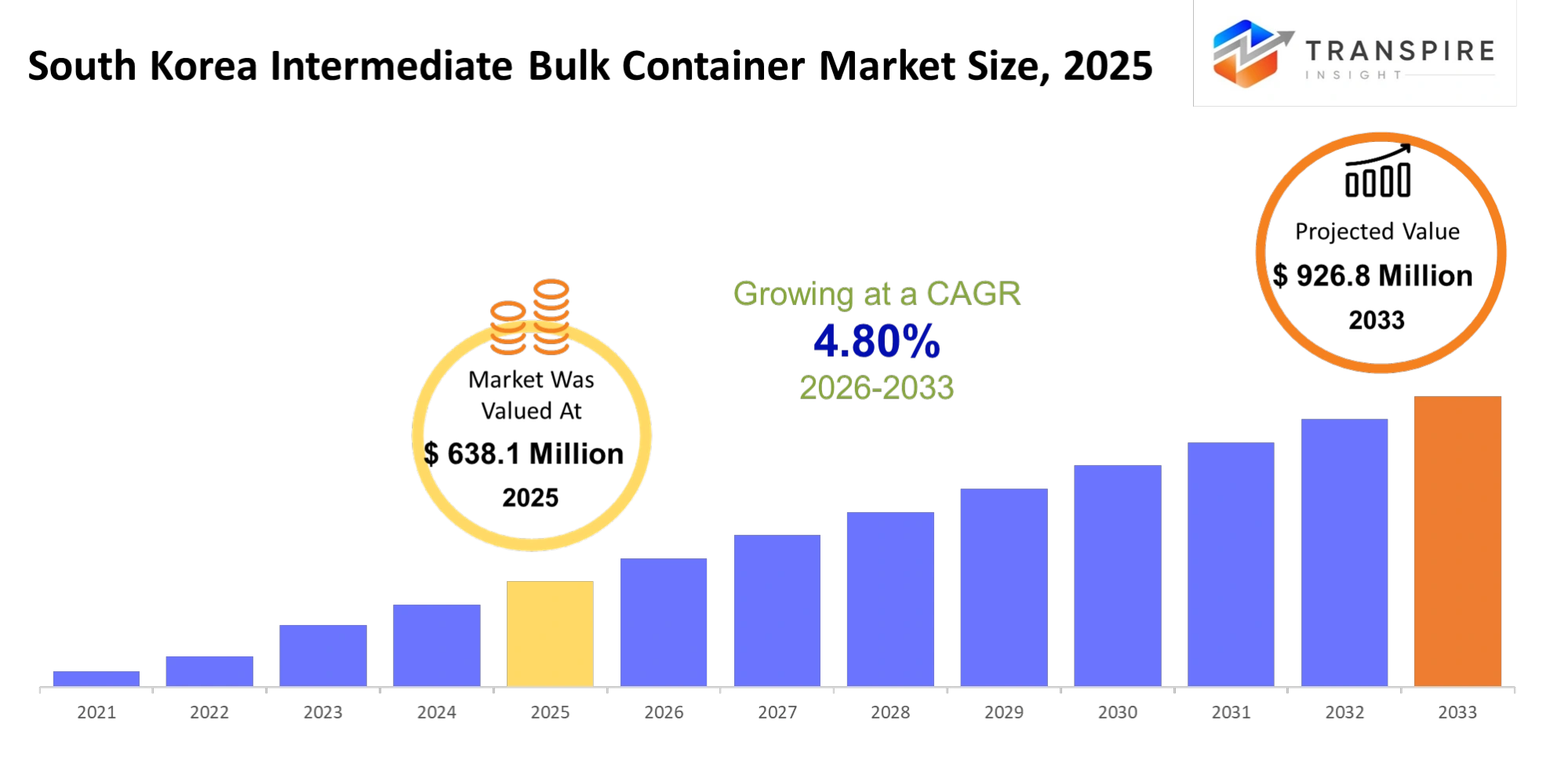
South Korea Intermediate Bulk Container Market Size & Forecast:
- South Korea Intermediate Bulk Container Market Size 2025: USD 638.1 Million
- South Korea Intermediate Bulk Container Market Size 2033: USD 926.8 Million
- South Korea Intermediate Bulk Container Market CAGR: 4.80%
- South Korea Intermediate Bulk Container Market Segments: By Material (Plastic, Metal, Composite), By Capacity (Up to 500 Liters, 500–1000 Liters, Above 1000 Liters), By End-User (Chemicals, Food & Beverages, Pharmaceuticals).
To learn more about this report,  Download Free Sample Report
South Korea Intermediate Bulk Container Market Summary:
South Korea Intermediate Bulk Container Market size was estimated at USD 638.1 Million in 2025 and is anticipated to reach USD 926.8 Million by 2033, growing at a CAGR of 4.80% from 2026 to 2033.
The South Korea intermediate bulk container market exists as part of the larger industrial packaging sector which depends on the country's robust manufacturing foundation and its ongoing efforts to improve supply chain operations. The industry will develop into a crucial system that connects various supply chain operations for chemicals and food processing and pharmaceutical products and special materials. The design and operational usage of these containers in South Korea will continue to follow import and export rules which require precise standards because this country values international trade. Buyers will increasingly expect containers that ensure product integrity during long transit cycles especially for sensitive liquids and semi-solids. The suppliers will develop new methods for selecting materials and establishing cleanliness requirements and determining reuse durations according to the demand shift. Korean industrial facilities use automated handling systems therefore manufacturers will enhance container durability and stackability to meet customer expectations.
Regulatory organizations will create rules for environmental protection which will determine the future development of this industry. South Korea will implement stricter waste management regulations and circular material usage policies which will force manufacturers to develop new methods for collecting, cleaning, and reusing containers. Digital tracking systems will enable companies to achieve more precise container lifecycle monitoring which will establish a new framework for their reconditioning operations. Container systems will adopt sensors and tracking capabilities which will provide inventory tracking improvements and minimize transportation losses through advancing technological innovations. The consumer goods sector especially food and pharmaceutical companies will require packaging systems to deliver complete transparency about their safety standards which will increase the burden on suppliers to comply with changing regulatory requirements. The south korea intermediate bulk container market will progress at a constant pace as it combines industrial discipline with growing environmental awareness and minor technological developments to fulfill the demands of an organized business environment that values quality.
Key Market Trends & Insights:
- The South Korean market for Intermediate Bulk Containers shows continuous growth because of its essential function in chemical operations and its capacity to fulfill industrial storage requirements. The growth of specialty chemical production results in increased demand for industrial containers that withstand severe conditions. The rising volume of exports drives manufacturing facilities and distribution centers to implement secure bulk shipping methods which become standard practice.
- The South Korean market for Intermediate Bulk Containers has developed because businesses increasingly prioritize environmentally friendly operations. Industries choose reusable containers because they help decrease packaging waste and lower their operational expenses. The government waste reduction guidelines provide assistance for this waste reduction initiative. Manufacturers create products that enable multiple usage cycles, which leads to higher operational efficiency and reduced environmental effects throughout the supply chain.
- The South Korean Intermediate Bulk Container market experiences growth because manufacturers use better design standards and improved safety elements. The new valve systems together with the enhanced material strength properties and leak-proof design, provide safe handling methods for both liquids and semi-solid materials. Industries are showing increased interest in smart tracking technologies because they enable companies to trace product movements and ensure quality control during storage and transportation.
- The South Korean Intermediate Bulk Container market develops because food processing and pharmaceutical industries show increasing demand for these containers. The strict hygiene requirements of the industry lead to the selection of premium-grade packaging solutions. Reliable packaging solutions become essential for transporting bulk liquid ingredients and delicate materials, which drives market expansion and ensures the continuous operation of supply chain systems.
- The South Korean Intermediate Bulk Container Market receives its main power from its export-driven industrial sector. International shipping operations require bulk packaging solutions that meet the needs of electronics and chemical products and processed items. The industry uses standardized container formats to make global trade easier which results in companies choosing intermediate bulk containers as their economical and safe transport solution.
South Korea Intermediate Bulk Container Market Segmentation
By Material :
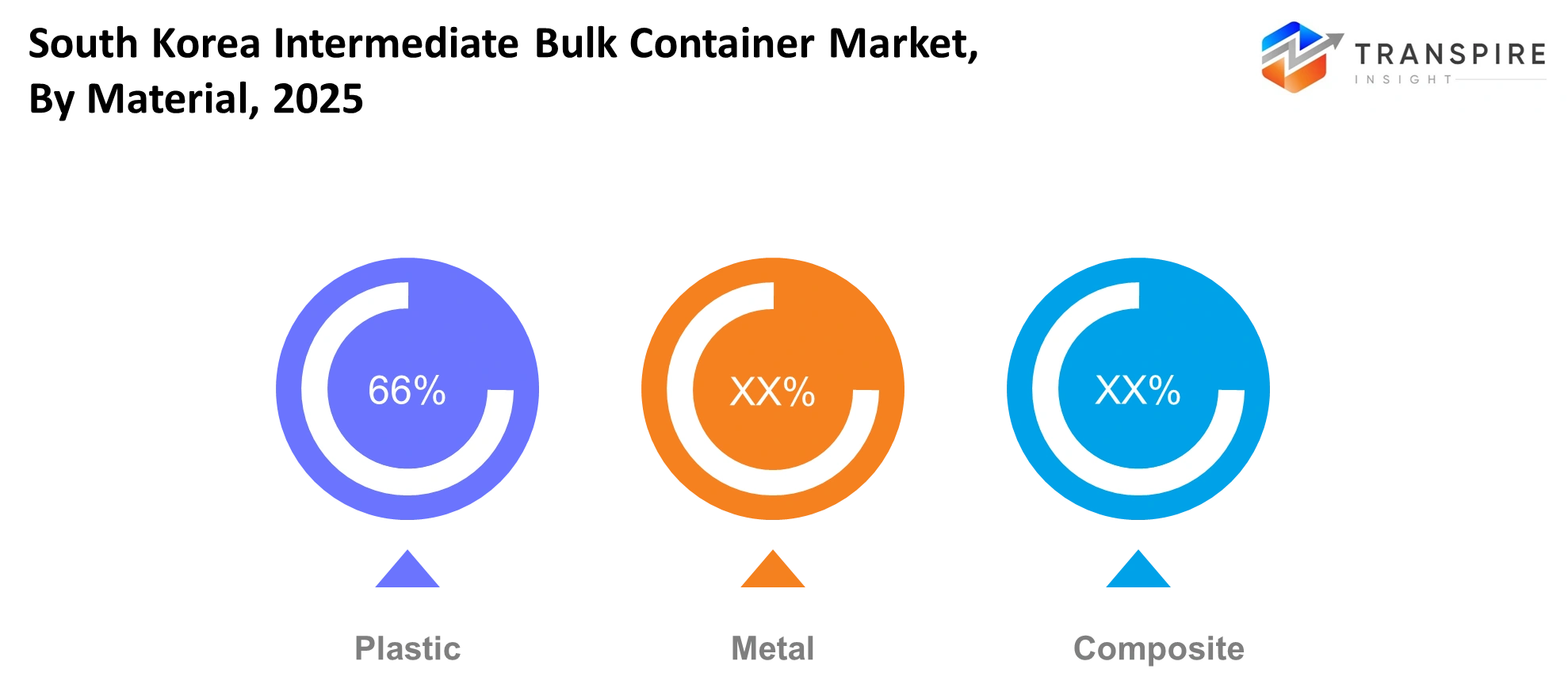
- Plastic: Plastic containers hold a strong position in the South Korea Intermediate Bulk Container Market due to their ability to withstand damage and their economic value. High-density polyethylene provides safe storage solutions for both liquid and semi-solid substances. The lightweight design of the product enables transport cost reduction. The material protects against corrosion which makes it suitable for chemicals and food-grade products that need to be used in various industrial settings.
- Metal: Metal containers provide strength and long service life in demanding industrial settings. Workers can safely handle hazardous materials and high-temperature substances through the use of stainless steel and carbon steel materials. The design of the frame provides strong support which prevents any instability during both stacking and transit. Industrial sectors such as chemicals and pharmaceuticals prefer metal due to high safety standards and reusability benefits.
- Composite: Composite containers combine plastic inner bottles with metal cages which provide both strength and flexibility. The design provides better protection for items during the process of handling and transportation. Composite structures support reuse cycles which lower costs over extended periods of time. The increasing need for efficient bulk storage systems drives manufacturing and logistics operations to adopt these systems throughout South Korea.
To learn more about this report, Download Free Sample Report
By Capacity :
- Up to 500 Liters: Smaller capacity containers serve specialized applications which require handling of restricted volume materials. Laboratories and specialty chemical facilities and high-value liquid storage locations require small storage solutions. The segment provides essential benefits because its products enable controlled environments to maintain safety and precision requirements.
- 500–1000 Liters: The 500 to 1000 liter range offers mid-sized containers which provide equal storage capacity and easy transportation. Most industries select this category because they need to operate with liquid and semi-liquid materials during their daily tasks. The category maintains consistent market demand because it enables efficient stacking and works with common logistics systems.
- Above 1000 Liters: The bulk handling needs of heavy industries receive support from large capacity containers which exceed 1000 liter capacity. Facilities can operate for extended periods because high volume storage enables longer intervals between refilling and transportation needs. The chemical and food processing industries achieve better performance through these upgrades. Strong construction ensures safety during long-distance transport and large-scale storage operations.
By End-User :
- Chemicals: The chemical industry experiences strong demand because of its need to comply with dangerous material storage and safety regulations. The sector requires containers which must contain both corrosive and dangerous materials without any possibility of leaks. The use of strong materials together with safe design methods enables organizations to meet their safety compliance needs. The manufacturing process continues to operate at full capacity which creates a permanent need for products in both domestic and international markets.
- Food & Beverages: The food and beverage industry needs containers which satisfy both hygiene and safety requirements. Non-reactive materials ensure preservation of quality during storage and transport. The demand for packaged food products in South Korea drives growth in this market segment. The ability to reuse products together with their convenient cleaning process creates additional advantages for manufacturers and distributors.
- Pharmaceuticals: The pharmaceutical industry needs secure storage systems which prevent any risk of contamination to their products. The selection of containers depends on two major standards which include cleanliness requirements and material safety needs. The system provides protection for delicate materials through their secure sealing method and their monitored process of material handling. The growing healthcare manufacturing industry in South Korea creates a higher need for specialized bulk container systems.
Country Insights
- The Intermediate Bulk Container Market in South Korea demonstrates an equal distribution between domestic container production and imported containers while advanced logistics systems and export-oriented industries support container importation. The chemical and petrochemical industries create demand while the food and beverage sector requires containers to maintain hygiene standards and store products in bulk. Local manufacturers create products that emphasize durability while meeting safety requirements.
- The South Korean Intermediate Bulk Container Market operates through multiple trade routes together with port connections which enable bulk freight movement between different areas. The industrial clusters located in Ulsan and Yeosu maintain their demand for effective packaging solutions. The environmental regulations define reusable and recyclable containers as sustainable options which lead businesses to prefer these eco-friendly solutions.
- The South Korean Intermediate Bulk Container Market will experience growth because businesses now prioritize automation and supply chain efficiency. The implementation of smart tracking systems together with enhanced container designs will result in better operational productivity. The manufacturing and export sectors see rising demand from small and medium enterprises because they need inexpensive solutions for bulk material handling.
Recent Development News
Packaging Regulation Reform for Logistics Sector (2026)**
-
In March 2026, South Korea proposed new courier packaging rules to reduce waste while allowing flexibility in logistics operations.
New Rules for Food-Contact Containers (Including Bulk Packaging)**
- In February 2026, South Korea proposed revisions to food-contact material standards, including stricter limits on chemicals and new rules for recycled plastics.
|
Report Metrics |
Details |
|
Market size value in 2025 |
USD 638.1 Million |
|
Market size value in 2026 |
USD 667.5 Million |
|
Revenue forecast in 2033 |
USD 926.8 Million |
|
Growth rate |
CAGR of 4.80% from 2026 to 2033 |
|
Base year |
2025 |
|
Historical data |
2021 - 2024 |
|
Forecast period |
2026 - 2033 |
|
Report coverage |
Revenue forecast, competitive landscape, growth factors, and trends |
|
Country scope |
South Korea |
|
Key company profiled |
Mauser Packaging Solutions, Greif Inc., Schütz GmbH & Co. KGaA, Snyder Industries Inc., Hoover Ferguson Group Inc., Thielmann Group, Berry Global Inc., Time Technoplast Ltd., Nefab Group, DS Smith plc, Schutz Container Systems Inc., Precision IBC Inc., Pyramid Technoplast Pvt. Ltd., Finncont Oy, Transtainer Ltd. |
|
Customization scope |
Free report customization (country, regional & segment scope). Avail customized purchase options to meet your exact research needs. |
|
Report Segmentation |
By Material (Plastic, Metal, Composite), By Capacity (Up to 500 Liters, 500–1000 Liters, Above 1000 Liters), By End-User (Chemicals, Food & Beverages, Pharmaceuticals). |
Key South Korea Intermediate Bulk Container Company Insights
- The South Korea Intermediate Bulk Container Market shows steady activity because industrial packaging needs of chemicals and food processing and pharmaceutical sectors create high demand for its products. Local manufacturers focus on creating durable products that can be reused and meet safety requirements, while international companies operate through their distribution networks and export industry-specific container solutions.
- The South Korea Intermediate Bulk Container Market enables companies to establish their market position through two main strategies. Companies continue to invest in lightweight product development and recycling technology because they want to meet growing environmental standards. The combination of logistics and after-sales service enables companies to establish long-term contracts with their industrial clients.
South Korea Intermediate Bulk Container Market Companies:
- Mauser Packaging Solutions
- Greif Inc.
- Schütz GmbH & Co. KGaA
- Snyder Industries Inc.
- Hoover Ferguson Group Inc.
- Thielmann Group
- Berry Global Inc.
- Time Technoplast Ltd.
- Nefab Group
- DS Smith plc
- Schutz Container Systems Inc.
- Precision IBC Inc.
- Pyramid Technoplast Pvt. Ltd.
- Finncont Oy
- Transtainer Ltd.
South Korea Intermediate Bulk Container Market Segmentation
By Material
- Plastic
- Metal
- Composite
By Capacity
- Up to 500 Liters
- 500–1000 Liters
- Above 1000 Liters
By End-User
- Chemicals
- Food & Beverages
- Pharmaceuticals
Frequently Asked Questions
Find quick answers to common questions.
The approximate South Korea Intermediate Bulk Container Market size for the market will be USD 926.8 Million in 2033.
Key segments for the South Korea Intermediate Bulk Container Market are By Material (Plastic, Metal, Composite), By Capacity (Up to 500 Liters, 500–1000 Liters, Above 1000 Liters), By End-User (Chemicals, Food & Beverages, Pharmaceuticals).
Major South Korea Intermediate Bulk Container Market players are Mauser Packaging Solutions, Greif Inc., Schütz GmbH & Co. KGaA, Snyder Industries Inc., Hoover Ferguson Group Inc., Thielmann Group, Berry Global Inc., Time Technoplast Ltd., Nefab Group, DS Smith plc, Schutz Container Systems Inc., Precision IBC Inc., Pyramid Technoplast Pvt. Ltd., Finncont Oy, Transtainer Ltd.
The South Korea Intermediate Bulk Container Market size is USD 638.1 Million in 2025.
The South Korea Intermediate Bulk Container Market CAGR is 4.80%.
- Mauser Packaging Solutions
- Greif Inc.
- Schütz GmbH & Co. KGaA
- Snyder Industries Inc.
- Hoover Ferguson Group Inc.
- Thielmann Group
- Berry Global Inc.
- Time Technoplast Ltd.
- Nefab Group
- DS Smith plc
- Schutz Container Systems Inc.
- Precision IBC Inc.
- Pyramid Technoplast Pvt. Ltd.
- Finncont Oy
- Transtainer Ltd.
Recently Published Reports
-
Apr 2026
Pharmaceutical Cold Chain Packaging Market
Pharmaceutical Cold Chain Packaging Market By Material (Plastic,(Polyethylene (PE), Polypropylene (PP), Polyethylene Terephthalate (PET), Expanded Polystyrene (EPS), Polyurethane (PU),Others), Paper, Metal, Others), By Product (Small Boxes, Pallets, Large Sized Pallet Containers, Others), By End Use (Biopharmaceutical Companies, Clinical Research Organizations, Hospitals, Research Institutes, Logistics and Distribution Companies, Others)”, By Industry Analysis, Size, Share, Growth, Trends, and Forecasts 2026-2033
-
Apr 2026
Active & Intelligent Packaging Market
Active & Intelligent Packaging Market By Type (Active Packaging, Smart Packaging), By Material (Polymer-Based, Paper & Board-Based, Metal-Based, Glass-Based), By Technology (Time-Temperature Indicators, Freshness Indicators, RFID, Antimicrobial Packaging, Modified Atmosphere Packaging), By Application (Food & Beverages, Pharmaceutical, Cosmetics & Personal Care, Electronics & Consumer Goods, Others), By Industry Analysis, Size, Share, Growth, Trends, and Forecasts 2026-2033
-
Apr 2026
Biodegradable Cut Flower Packaging Market
Biodegradable Cut Flower Packaging Market By Material Type (Paper & Paperboard, Biodegradable Plastics, Natural Fibers, Molded Pulp, Others), By Product Type (Sleeves, Wraps, Boxes & Cartons, Bags & Pouches, Inserts & Holders), By Application (Roses, Carnations, Tulips, Chrysanthemums, Mixed Flowers, Others) and By Distribution Channel (Direct Sales, Distributors & Wholesalers, Online Channels), By Industry Analysis, Size, Share, Growth, Trends, and Forecasts 2026-2033
-
Apr 2026
Pharmaceutical Packaging Market
Pharmaceutical Packaging Market By Material Type (Plastic, Glass, Metal, Paper & Paperboard, Others), By Packaging Type (Bottles, Blister Packs, Vials, Ampoules, Pouches & Sachets, Others) and By End User (Hospitals & Clinics, Retail Pharmacies, Online Pharmacies, Pharmaceutical Manufacturers), By Industry Analysis, Size, Share, Growth, Trends, and Forecasts 2026-2033