
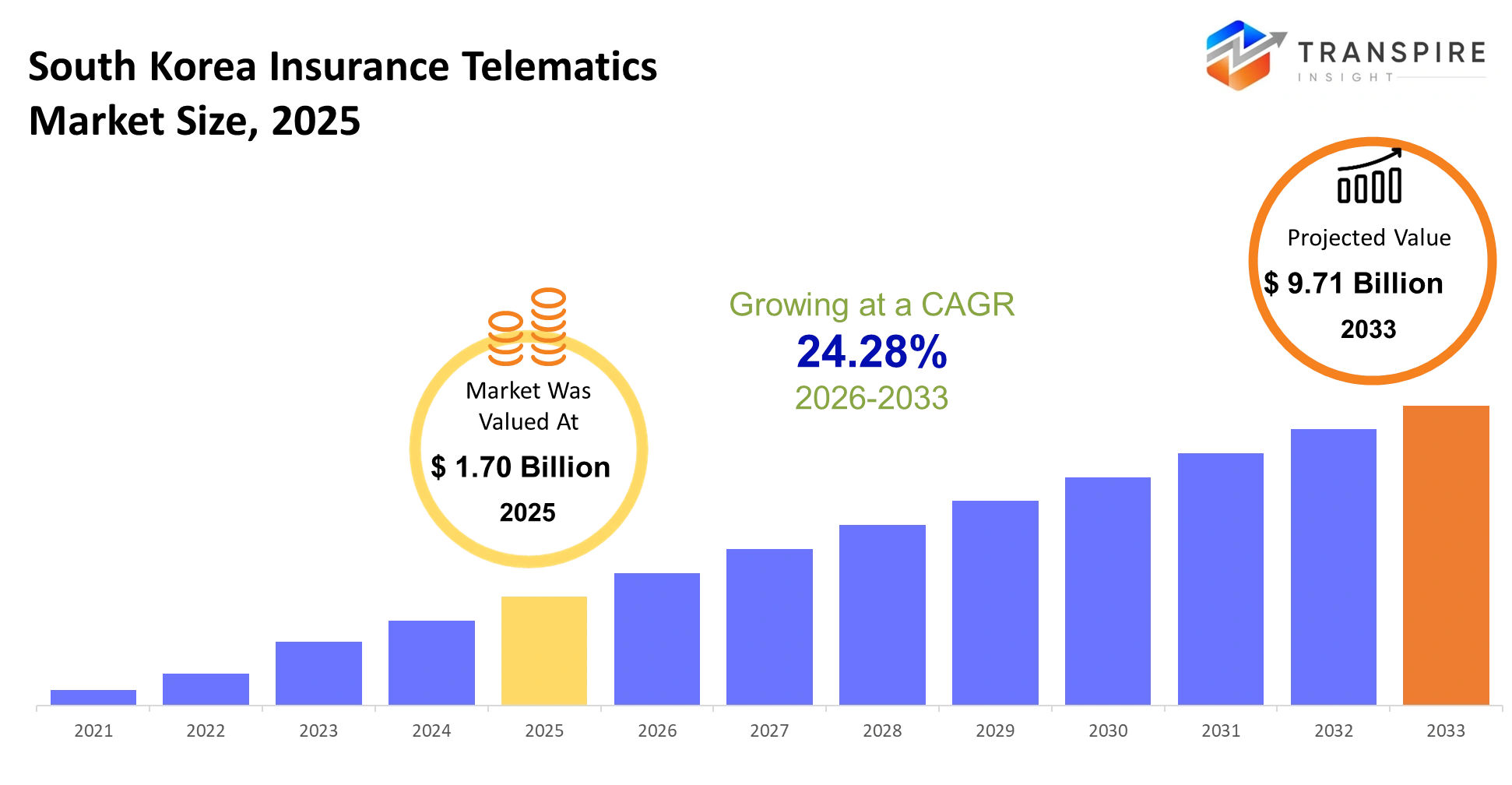
South Korea Insurance Telematics Market Size & Forecast:
- South Korea Insurance Telematics Market Size 2025: USD 1.70 Billion
- South Korea Insurance Telematics Market Size 2033: USD 9.71 Billion
- South Korea Insurance Telematics Market CAGR: 24.28%
- South Korea Insurance Telematics Market Segments: By Type (Usage-based Insurance, Pay-how-you-drive Insurance, Pay-as-you-drive Insurance, Fleet Insurance Telematics, Others); By Component (OBD Devices, Smartphone-based Telematics, Embedded Systems, Black Box Devices, Others); By Application (Driver Risk Assessment, Claims Management, Theft Recovery, Vehicle Monitoring, Others); By Deployment (Cloud-based Platforms, On-premise Platforms, Hybrid Platforms, Others); By End User (Insurance Companies, Fleet Operators, Individual Vehicle Owners, Others)
To learn more about this report,  Download Free Sample Report
South Korea Insurance Telematics Market Summary
The South Korea Insurance Telematics Market was valued at USD 1.70 Billion in 2025. It is forecast to reach USD 9.71 Billion by 2033. That is a CAGR of 24.28% over the period.
South Korea’s insurance telematics market is kind of reshaping how auto insurers figure out driver risk, handle claims, and keep policyholders around, in a place where vehicle ownership stays high and urban traffic density means accidents are happening pretty often. In practice, insurers pull in connected car data, smartphone apps, plus in vehicle devices, to observe driving patterns, give sort of benefits for steadier driving, and also curb fraudulent or exaggerated claims. Over the last five years the whole space moved from optional usage based insurance trials, to more integrated digital insurance ecosystems that link with connected mobility platforms and electric vehicles.
That switch felt faster after the pandemic, when contactless servicing and digital onboarding became day to day operational priorities across the financial sector. Meanwhile, South Korea’s 5G rollout and connected car adoption basically grew the stream of real time vehicle information, a lot. As insurers collect more refined behavioral insights, they can set prices more precisely, bring down loss ratios, and build tailored coverage options. And all of that is, in a pretty direct way, strengthening telematics uptake plus the premium revenue chances.
Key Market Insights
- The South Korea Insurance Telematics Market looks like it is riding on high connected vehicle adoption, and in 2025, more than 60% of new passenger cars are already fitted with advanced telematics.
- People talk about the market trends a lot, especially Usage based insurance platforms, because insurers are getting better premium accuracy by watching driving habits in real time and then using predictive risk scoring, kind of like a refined crystal ball.
- On top of that, smartphone driven telematics solutions actually picked up serious momentum after 2021, mainly since deployment costs stay lower, and onboarding is faster for digital insurance customers.
- Also there is AI powered claims analytics, which is becoming a big growth engine, because insurers manage to cut down fraudulent claims processing time by almost 30% from 2022 to 2025.
- And then embedded insurance, especially when it connects with electric vehicles, sort of sped up the whole expansion, as automakers started collaborating more directly with insurers for connected policy offerings, not just as an add-on but as part of the deal.
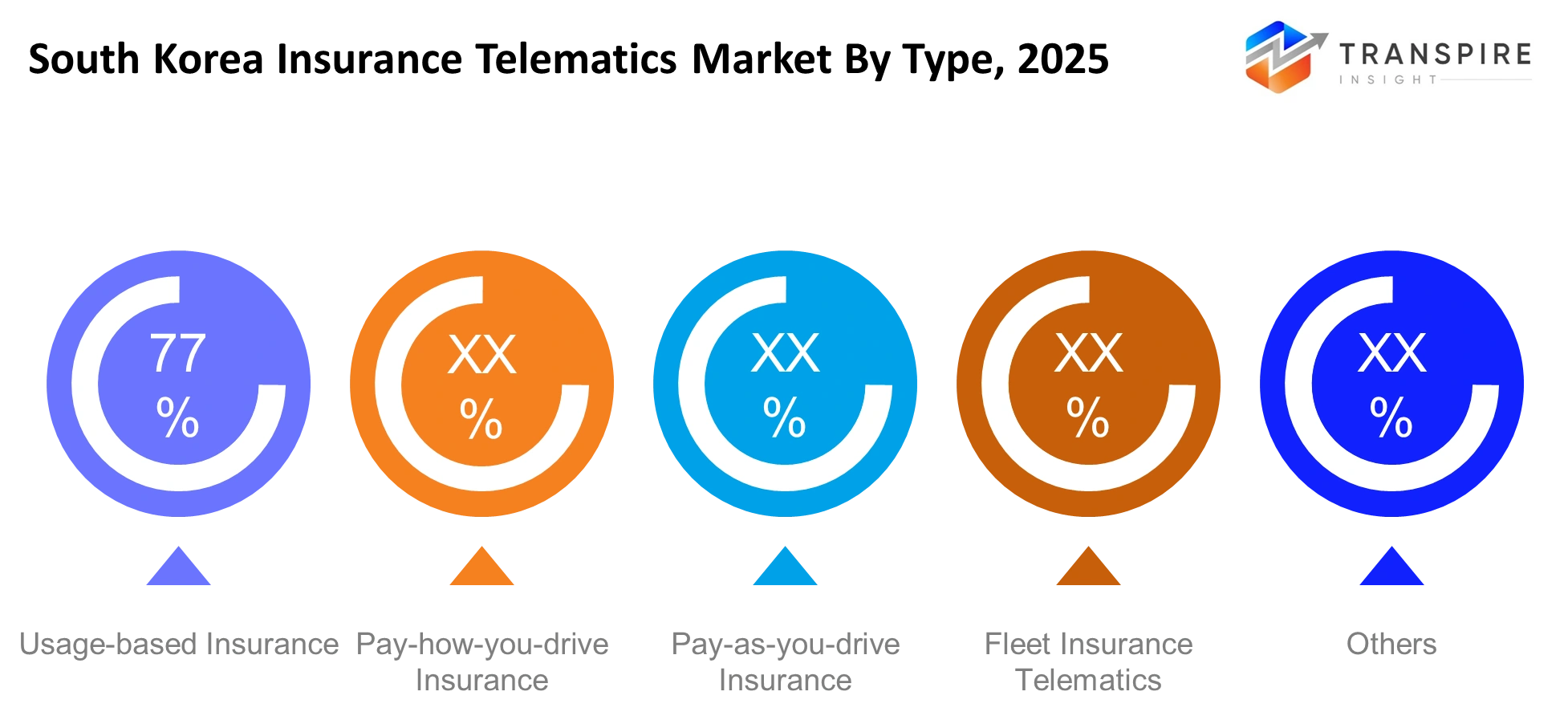
- In 2025, Usage-Based Insurance (UBI) solutions were sitting on the biggest slice of the market , roughly 44% , mainly because insurers keep pushing more personalized pricing models and all that.
- After that, Embedded telematics platforms took the second-largest segment, since automakers are gradually weaving in factory-installed connected vehicle tools, like it’s becoming standard.
- Cloud-based telematics analytics is also the one growing fastest over the forecast window, largely because insurers want scalable, real time data processing, not just something slow or limited.
- Meanwhile, smartphone telematics platforms are still gaining momentum among mid-tier insurers who need cost-efficient digital policy management , and also stronger customer engagement features.
- For applications, passenger vehicle insurance came out on top with almost 58% in 2025, as private vehicle owners increasingly sign on to connected driving programs.
What are the Key Drivers, Restraints, and Opportunities in the South Korea Insurance Telematics Market?
The main force, really driving the South Korea Insurance Telematics Market, is the fast integration of connected vehicle technologies into the country’s broader automotive ecosystem. In South Korea, the solid 5G infrastructure, plus the steady increase in connected and electric vehicle output from Hyundai Motor Company and Kia Corporation, has lowered the day-to-day operational hurdle for insurers to gather real-time driving insights. Because of that change, insurers can step away from static premium setups and move toward behavior driven pricing approaches, which boosts underwriting precision and, at the same time, helps trim fraudulent claim exposure. When insurers start seeing lower claim settlement costs, alongside improved customer retention, then telematics style policy plans are showing stronger premium growth and also higher digital policy conversions.
Still, the biggest restraint has to do with South Korea’s tight data privacy and cybersecurity compliance landscape. Most telematics platforms handle extremely sensitive information, like location signals, driving patterns and overall mobility traces. That reality brings legal and operational complications for both insurers and the technology providers. Also, when legacy insurance systems need to be linked with secure cloud based analytics infrastructure, it tends to demand high capex and a lot of time, plus lengthy regulatory approvals. So, these deeper structural issues end up slowing deployment schedules, especially for mid-sized insurers, and it delays wider market penetration.
A big opportunity is kind of starting to show up, via AI enabled fleet telematics for logistics, and for the people running commercial transportation. In South Korea, the whole expansion of e-commerce and last mile delivery keeps pressing fleet operators to use more predictive driver monitoring and automated risk evaluation, which sounds a little technical but it’s basically what they need. There are also partnerships now between insurers, telecom companies, and mobility platforms, and together they’re building a scaled commercial telematics network that may unlock the next stage of recurring insurance revenue growth.
What Has the Impact of Artificial Intelligence Been on the South Korea Insurance Telematics Market?
Artificial intelligence and newer digital tools are, in a very real way, changing South Korea’s insurance telematics ecosystem. Connected vehicle data is being turned into something that feels more and more like automated underwriting, claims handling, and fleet risk optimization—so less manual work, more workflow, even if it’s not always seamless. Insurers are leaning on AI-based telematics platforms that can digest driver behavior, detect crashes, and adjust policies with minimal human review. Instead of relying on manual assessments, they use continuous insights. Real-time monitoring systems then track harsh braking, speeding trends, distracted driving signals, and route deviations, which helps insurers speed up claims verification and also curb fraudulent claim investigations. On top of that, several commercial fleet insurers run automated compliance tracking tools that watch driver safety scores and vehicle operating conditions across logistics routes, pretty continuously.
Machine learning models are also showing up for predictive risk forecasting and for vehicle maintenance analytics, not just “one-off” alerts. When these models study driving frequency, road conditions, battery performance in electric vehicles, and prior accident patterns, insurers can estimate claim likelihood and propose preventive maintenance timing before a component fails outright. The result is better fleet uptime, lower repair expenses tied to accidents, and logistics operators that can reduce fuel burn through smoother, more optimized driving behavior. Usage-based insurance programs, meanwhile, have improved how premiums are priced. That accuracy supports lower loss ratios and, generally, stronger customer retention.
Still though, AI adoption isn’t free of problems. One big limitation is the cost, it can be high, to connect older insurance infrastructure to cloud-based telematics platforms. Another issue is data reality: many insurers face fragmented driving datasets and inconsistent real-world data quality. In complex urban traffic settings, that mismatch can drag down prediction accuracy and make the outputs less reliable, even when the models look solid on paper.
Key Market Trends
- Since 2022, South Korean insurers have shifted away from the old hardware telematics gadgets, toward smartphone-driven monitoring platforms , with the aim of cutting onboarding and installation costs, generally speaking.
- Hyundai Motor Company meanwhile expanded its connected vehicle ecosystem more after 2021, which gives insurers a way to pull real-time driving information straight from factory-installed systems.
- Usage-based insurance picked up speed after the pandemic era, when digitalization basically pushed insurers to automate policy issuance, claims checking, and customer interaction workflows.
- Between 2020 and 2025, AI-based fraud detection setups helped cut down the amount of manual claims review work, because insurers automated things like accident pattern interpretation and driver behavior scoring too.
- Commercial fleet operators also started leaning more on telematics analytics after 2022, when fuel prices were jumping around and that made it harder, so they needed tighter route efficiency and better driver safety.
- South Korea’s nationwide 5G roll out improved real time vehicle connectivity quite a bit, meaning telematics data could be sent faster, and it became easier to do more precise dynamic premium calculations.
- Notably, mid-sized insurers had slower deployment schedules because tying older insurance infrastructure into cloud-based telematics systems meant heavy cybersecurity spending, and that part wasn’t small.
- After 2023, collaborations between insurers and mobility platforms like Kakao Mobility intensified, in order to strengthen embedded insurance service offerings.
- And with electric vehicles growing, the telematics approach changed again, since insurers began monitoring battery efficiency, charging habits and vehicle software diagnostics as part of risk assessment.
South Korea Insurance Telematics Market Segmentation
By Type:
Usage-based Insurance relies on real-time driving information to figure out insurance premiums depending on vehicle movement , driving habits, and how often someone travels. In practice, insurers will tend to rely on connected applications and telematics systems , sort of to nudge safer driving behavior and make pricing feel more precise. Along the way, more reliable claims tracking and digital policy handling also help adoption pick up across both passenger and commercial vehicle types, even if it isn’t always obvious at first.
Pay-how-you-drive Insurance is mostly about driving patterns , think braking, acceleration, cornering, and speed control. This part keeps getting more attention because insurance firms can give lower premiums to disciplined drivers. Pay-as-you-drive Insurance is more mileage centered, so mileage tracking becomes the main mechanism, which helps low-distance drivers trim insurance costs. Fleet Insurance Telematics is aimed at logistics and transportation operators, it uses vehicle tracking, route analysis, and driver monitoring, while other telematics approaches can be tuned into customized insurance arrangements for different mobility needs.
To learn more about this report, Download Free Sample Report
By Component:
OBD devices are still pretty widely used since setting them up is mostly straight forward, and they stay compatible with older vehicle systems, more or less. These kinds of devices pull driving data right from the vehicle diagnostic port(s) and then they help insurers follow vehicle health, total distance, and general driving behavior. A lot of insurers remain with OBD solutions, mainly because it’s a cost effective way to roll out telematics across an existing fleet.
At the same time smartphone based telematics keeps growing because the equipment costs are lower and customers get on board faster. Embedded systems are built right into connected vehicles, and they enable ongoing real time data exchange between automakers and insurers, no big pause. Black box units also do something a bit different by giving stronger data storage plus clearer accident evaluation, especially on commercial vehicles, and for higher risk drivers. There are also other pieces in the mix, like sensors along with communications modules, they’re made for more advanced monitoring tasks and similar related functions.
By Application:
Driver Risk Assessment kind of stays one of the more important applications, because insurers do in fact lean on telematics data to judge driving behavior and the chance of an accident. With real time monitoring of speeding, sudden braking and even distracted driving, insurance companies can get better at underwriting accuracy, but also they can tune the way they price policies. Safer driving performance, in turn, can enable personalized premium structures and long term customer retention tactics too.
Claims Management apps also matter because they enable quicker accident reporting and cleaner digital verification workflows. Theft Recovery solutions support both vehicle owners and insurers with location tracking and recovery alerts that pop up when it matters. Vehicle Monitoring, meanwhile, helps track fuel usage, vehicle condition, maintenance schedules and even route optimization, sort of a whole package. There are also other use cases, like emergency assistance services, predictive maintenance support, and behavioral analytics aimed at commercial transport operations.
By Deployment:
Cloud based Platforms are getting more common because insurers are needing scalable data storage, remote access, and also quicker processing. Cloud deployment can enable real-time analytics, mobile connection, and automated summary systems for connected insurance services. Insurance providers will keep investing in cloud infrastructure, just to boost operational efficiency and to manage the customer experience better.
On-premise Platforms still matter for organizations that strongly prefer direct control over sensitive driving data and policyholder records. Those setups give better internal governance but they also come with higher maintenance duties and infrastructure expenses, which sometimes feels like a burden. Hybrid Platforms basically mix cloud agility with in-house data security, so insurers can balance operational performance alongside regulatory compliance. Other deployment models exist too, and they can support customized integration methods that fit different business structures, and how each team is organized.
By End User:
Insurance Companies are basically the biggest end-user group, because telematics systems end up improving how they evaluate risk, set premium pricing, and spot fraud faster, or at least more clearly. The connected insurance platforms also help insurers with customer engagement in a kind of more direct way, like using tailored policy offerings and letting people handle service management straight from a mobile device. So digital transformation strategies still kind of power telematics adoption, especially with larger insurance providers, and the trend will likely keep going.
Fleet Operators also lean on telematics solutions, mainly for keeping track of driver behavior, vehicle condition, and overall operational effectiveness across transport networks. Meanwhile Individual Vehicle Owners tend to pick telematics insurance programs as a way to cut their premium costs, and sometimes they get safer driving incentives as a bonus. Beyond that, other end users show up too, for instance mobility service providers, leasing companies, and commercial transportation businesses that want stronger vehicle oversight and better cost handling, without all the usual guesswork.
What are the Key Use Cases Driving the South Korea Insurance Telematics Market?
Driver behavior monitoring is still kind of the top use case in the South Korea Insurance Telematics Market. Insurers lean on real-time driving data to figure out personalized premiums, and at the same time lower claim risks which is not a small thing. Passenger vehicle insurers drive the strongest demand for telematics platforms since accident frequency , urban congestion, and fraudulent claims keep putting pressure on underwriting costs.
Fleet management and claims automation applications are starting to pick up more momentum with logistics operators, and commercial transport companies too. Fleet operators now more and more use telematics systems for route efficiency tracking fuel usage insights, and driver safety performance monitoring. Insurers then tap connected vehicle data to speed up accident verification, and to shrink the time spent on manual claims assessment tasks.
On the newer side, emerging applications show up around electric vehicle battery analytics, and AI- powered predictive risk modeling. Insurers are starting to watch charging behavior, software diagnostics, and battery health signals so they can shape specialized EV insurance policies. Plus, advanced mobility ecosystems tied into connected car platforms should open up fresh chances for embedded insurance services throughout the forecast period.
|
Report Metrics |
Details |
|
Market size value in 2025 |
USD 1.70 Billion |
|
Market size value in 2026 |
USD 2.12 Billion |
|
Revenue forecast in 2033 |
USD 9.71 Billion |
|
Growth rate |
CAGR of 24.28% from 2026 to 2033 |
|
Base year |
2025 |
|
Historical data |
2021 - 2024 |
|
Forecast period |
2026 - 2033 |
|
Report coverage |
Revenue forecast, competitive landscape, growth factors, and trends |
|
Country scope |
South Korea |
|
Key company profiled |
Samsung Fire & Marine Insurance, Hyundai Marine & Fire Insurance, AXA, Allianz, Progressive Corporation, Generali, Verizon Connect, Octo Telematics, Cambridge Mobile Telematics, Geotab, Trimble, Vodafone Automotive, LexisNexis Risk Solutions, TomTom Telematics, Zurich Insurance |
|
Customization scope |
Free report customization (country, regional & segment scope). Avail customized purchase options to meet your exact research needs. |
|
Report Segmentation |
By Type (Usage-based Insurance, Pay-how-you-drive Insurance, Pay-as-you-drive Insurance, Fleet Insurance Telematics, Others); By Component (OBD Devices, Smartphone-based Telematics, Embedded Systems, Black Box Devices, Others); By Application (Driver Risk Assessment, Claims Management, Theft Recovery, Vehicle Monitoring, Others); By Deployment (Cloud-based Platforms, On-premise Platforms, Hybrid Platforms, Others); By End User (Insurance Companies, Fleet Operators, Individual Vehicle Owners, Others) |
Which Regions are Driving the South Korea Insurance Telematics Market Growth?
The Seoul Capital Area stays as the top region in the South Korea Insurance Telematics Market , mainly because it holds the country’s biggest pool of connected vehicle owners, insurance headquarters, and digital infrastructure providers. Big insurers and mobility technology companies run large telematics networks around Seoul and Incheon, plus nearby urban zones where traffic density is high so the need for real time risk oversight, and usage based insurance approaches, keeps rising. Also, solid 5G coverage together with newer cloud frameworks lets insurers handle driving behavior signals much faster and with better precision. On top of that, collaborations between automaker groups, telecom operators, and financial technology providers help keep the region in front , since they speed up embedded insurance features and other connected mobility offerings.
Busan comes in as the second most important contributor, though the market setup looks a bit different from the Seoul metropolitan space. Here, commercial transportation and logistics basically take a more central seat. Activities tied to the port, along with industrial vehicle work, generate steady demand for fleet telematics and driver monitoring tools. Local insurers and logistics operators keep putting money into vehicle tracing, and claims management platforms, to limit downtime and manage fuel expenses better. With routine commercial transport performance and continued digital infrastructure spending Busan ends up being a reliable source for long term telematics revenue growth.
Daegu and a handful of other emerging smart mobility corridors are seeing fast growth momentum lately ,mostly because of new investments in intelligent traffic systems plus electric vehicle infrastructure. In the background , local governments have kept expanding the connected road networks and they've pushed smart signal and traffic management programs so autonomous mobility testing can happen more smoothly and digital transport integration can stay in sync. On top of that, insurance providers are going after these areas more and more, running AI based telematics pilots that pair electric vehicles with commercial delivery fleets. Overall, this move should open pretty attractive opportunities for telematics software vendors, mobility platform providers, and insurers that want fresh customer acquisition pathways spanning 2026 through 2033.
Who are the Key Players in the South Korea Insurance Telematics Market and How Do They Compete?
The South Korea Insurance Telematics Market shows a moderate kind of consolidation, with big domestic insurers holding quite a lot of connected insurance services, but also technology firms and mobility platforms keep nudging, reshaping traditional underwriting models. In this space, rivalry is getting more and more tied to analytics strength, connected vehicle integration and the overall speed of digital service delivery, not just premium pricing by itself. The established insurers defend their positions by putting AI based risk scoring and automated claims handling into the insurance products they already sell, kind of like turning the core engine. Meanwhile telecom operators and mobility technology providers step in through data partnerships and connected vehicle ecosystems, which end up boosting customer acquisition as well as retention, and it feels almost incremental but persistent.
Samsung Fire & Marine Insurance takes a direction centered on AI for underwriting plus behavioral analytics, using this to make its telematics offers feel different versus the usual auto insurance approach. It taps smartphone telematics, and also connected vehicle signals, to tighten premium pricing accuracy and lower the exposure to fraudulent claims. Through strategic collaborations with automotive players and digital platform providers, the insurer broadens its customer reach among younger drivers who want app based insurance management, more immediate than before. Hyundai Marine & Fire Insurance highlights connected mobility integration by pairing telematics coverage with electric vehicles, and with factory installed vehicle systems too. With this, it gains a stronger pipeline of real time driving data and it supports longer term policy personalization, so the “service” keeps adapting over time.
LG Uplus basically competes on communication infrastructure plus cloud connectivity services for high volume telematics data sending. The company also rides on very solid 5G coverage, so insurers and fleet operators can pull up low latency vehicle monitoring systems across city transport networks, more or less where it matters. Meanwhile Kakao Mobility is expanding by building mobility ecosystem partnerships that link ride hailing navigation and even insurance services into one shared digital platform, sort of a one stop flow. And Hyundai Motor Company stays sharper in the market by putting connected telematics technology straight into new vehicles, this means insurers can roll out usage based insurance models without needing an extra aftermarket hardware install, and honestly that reduces friction a lot.
Company List
- Samsung Fire & Marine Insurance
- Hyundai Marine & Fire Insurance
- AXA
- Allianz
- Progressive Corporation
- Generali
- Verizon Connect
- Octo Telematics
- Cambridge Mobile Telematics
- Geotab
- Trimble
- Vodafone Automotive
- LexisNexis Risk Solutions
- TomTom Telematics
- Zurich Insurance
Recent Development News
In April 2026, Samsung Fire & Marine Insurance announced a mobility platform partnership with KG Mobility. The collaboration aims to build an integrated vehicle lifecycle platform that combines connected-car services and insurance telematics capabilities for safer driving and claims management in South Korea. Source https://www.newsarticleinsiders.com/
In March 2026, Hyundai Marine & Fire Insurance expanded its telematics-linked auto insurance integration strategy. Industry analysis noted the company strengthened partnerships within the Hyundai mobility ecosystem to improve connected-car insurance services and driver analytics offerings. Source https://matrixbcg.com/b
What Strategic Insights Define the Future of the South Korea Insurance Telematics Market?
The South Korea Insurance Telematics Market is starting to move toward this more complete mobility risk ecosystem thing where insurers, automakers, telecom providers, and digital mobility platforms all work from the same shared real-time data space. Over the next five to seven years, you can expect the market to go past usage based pricing, and into predictive insurance models that come from connected vehicles plus AI assisted behavioral analytics, and even embedded insurance services that are tied right into electric and autonomous mobility platforms. And yeah, this change is likely to mess with underwriting structures a bit, while also creating recurring income streams that follow continuous vehicle connectivity, not just these yearly policy periods.
There is also a less visible risk though, like data concentration and platform dependency. When insurers lean more on connected vehicle data that is controlled by only a small group of automotive and technology firms, the pricing advantage and customer ownership could slowly migrate away from insurers, more toward the mobility ecosystem operators. Not instantly, but over time, it becomes more noticeable.
One growing opportunity is AI enabled telematics solutions for electric commercial fleets running through smart logistics corridors around Busan and Daegu. Participants should probably invest early in interoperable cloud analytics platforms that make cross industry partnerships easier, support scalable cybersecurity compliance, and deliver real time fleet intelligence as it happens.
South Korea Insurance Telematics Market Report Segmentation
By Type
- Usage-based Insurance
- Pay-how-you-drive Insurance
- Pay-as-you-drive Insurance
- Fleet Insurance Telematics
By Component
- OBD Devices
- Smartphone-based Telematics
- Embedded Systems
- Black Box Devices
By Application
- Driver Risk Assessment
- Claims Management
- Theft Recovery
- Vehicle Monitoring
By Deployment
- Cloud-based Platforms
- On-premise Platforms
- Hybrid Platforms
By End User
- Insurance Companies
- Fleet Operators
- Individual Vehicle Owners
Frequently Asked Questions
Find quick answers to common questions.
The South Korea Insurance Telematics Market size is USD 9.71 Billion in 2033.
Key segments for the South Korea Insurance Telematics Market are By Type (Usage-based Insurance, Pay-how-you-drive Insurance, Pay-as-you-drive Insurance, Fleet Insurance Telematics, Others); By Component (OBD Devices, Smartphone-based Telematics, Embedded Systems, Black Box Devices, Others); By Application (Driver Risk Assessment, Claims Management, Theft Recovery, Vehicle Monitoring, Others); By Deployment (Cloud-based Platforms, On-premise Platforms, Hybrid Platforms, Others); By End User (Insurance Companies, Fleet Operators, Individual Vehicle Owners, Others).
Major South Korea Insurance Telematics Market players are Samsung Fire & Marine Insurance, Hyundai Marine & Fire Insurance, AXA, Allianz, Progressive Corporation, Generali, Verizon Connect, Octo Telematics, Cambridge Mobile Telematics, Geotab, Trimble, Vodafone Automotive, LexisNexis Risk Solutions, TomTom Telematics, Zurich Insurance.
The South Korea Insurance Telematics Market size is USD 1.70 Billion in 2025.
The South Korea Insurance Telematics Market CAGR is 24.28% from 2026 to 2033.
- Samsung Fire & Marine Insurance
- Hyundai Marine & Fire Insurance
- AXA
- Allianz
- Progressive Corporation
- Generali
- Verizon Connect
- Octo Telematics
- Cambridge Mobile Telematics
- Geotab
- Trimble
- Vodafone Automotive
- LexisNexis Risk Solutions
- TomTom Telematics
- Zurich Insurance
Recently Published Reports
-
Apr 2026
3D Optical Profiler Market
3D Optical Profiler Market Size, Share & Analysis Report By Type (Desktop 3D Optical Profiler, and Portable 3D Optical Profiler), By Technology (Confocal Technology, and White Light Interference), By End-Use Industry (Manufacturing, Research Institutions, Automotive, Aerospace and Defense, Medical Devices, and Other), and Geography (North America, Europe, Asia-Pacific, Middle East and Africa, South and Central America), 2021 - 2031
-
Apr 2026
Depth Sensor Market
Depth Sensor Market Size, Share & Analysis Report By Type (Infrared Depth Sensors, Time-of-Flight (ToF) Sensors, Stereo Vision Sensors, Structured Light Sensors, Ultrasonic Depth Sensors), By Application (Automotive, Robotics, Gaming, Consumer Electronics, Industrial Automation, Healthcare, Security & Surveillance, Others), By End Users (Automotive Manufacturers, Consumer Electronics Companies, Healthcare Providers, Industrial Companies, Security Agencies, Gaming Companies, Robotics Companies, Others), and Geography (North America, Europe, Asia-Pacific, Middle East and Africa, South and Central America), 2021 – 2031
-
Apr 2026
Digital Manufacturing Market
Digital Manufacturing Market Size, Share & Analysis Report By Component (Hardware, Software, and Services), By Technology (Robotics, 3D Printing, Internet of Things (IoT), and Others), By Application (Automotive and Transportation, Aerospace and Defense, Consumer Electronics, Industrial Machinery, and Others), By Process Type (Computer-Based Designing, Computer-Based Simulation, Computer 3D Visualization, Analytics, and Others), and Geography (North America, Europe, Asia-Pacific, Middle East and Africa, South and Central America), 2021 – 2031
-
Apr 2026
Digital Visa Services Market
Digital Visa Services Market Size, Share & Analysis Report By Type (Individual Travelers, Group Travelers), By Application (Tourism, Business Travel, Others), and Geography (North America, Europe, Asia-Pacific, Middle East and Africa, South and Central America), 2021 – 2031