
South Korea IIoT Technology Market Size & Forecast:
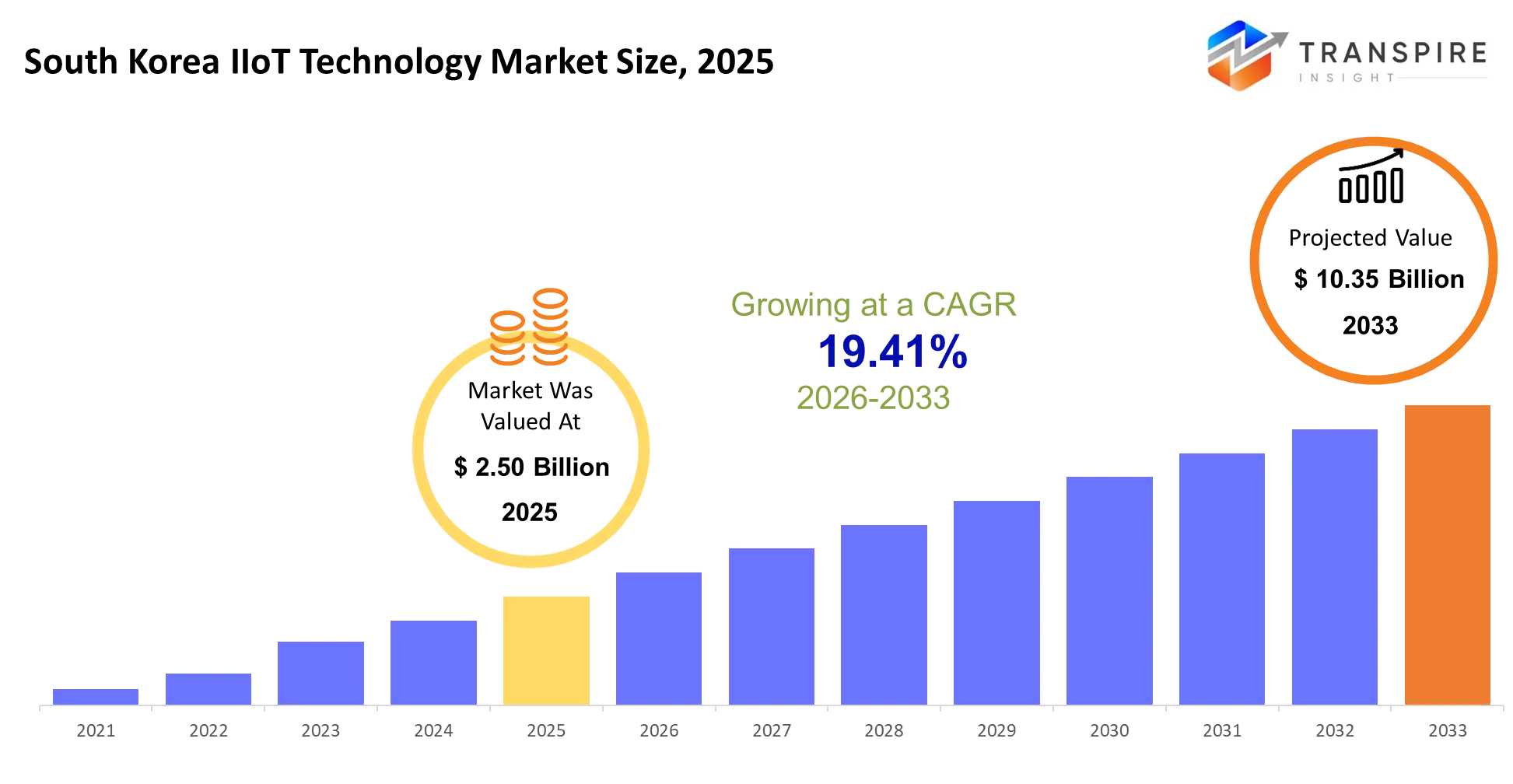
- South Korea IIoT Technology Market Size 2025: USD 2.50 Billion
- South Korea IIoT Technology Market Size 2033: USD 10.35 Billion
- South Korea IIoT Technology Market CAGR: 19.41%
- South Korea IIoT Technology Market Segments: By Component (Sensors, Industrial Gateways, Connectivity Solutions, Analytics Platforms, Others); By Technology (Industrial AI, Edge Computing, Digital Twin Technology, Industrial Cloud Platforms, Others); By Application (Predictive Maintenance, Asset Tracking, Smart Manufacturing, Energy Management, Others); By Deployment (Cloud-based IIoT, On-premise IIoT, Hybrid IIoT, Others); By End User (Manufacturing Industry, Energy Sector, Automotive Industry, Healthcare Industry, Others)
To learn more about this report,  Download Free Sample Report
South Korea IIoT Technology Market Summary
The South Korea IIoT Technology Market was valued at USD 2.50 Billion in 2025. It is forecast to reach USD 10.35 Billion by 2033. That is a CAGR of 19.41% over the period.
In South Korea, the IIoT technology market kind of knits together factory floors, shipyards, ports, and heavy industrial plants using sensor-driven systems that keep checking equipment well-being, energy consumption, and the movement of production materials. In real life it tends to let manufacturers and maritime crews foresee machinery breakdowns, nudge maintenance schedules into place, and align day to day actions across scattered assets like ship engines, cranes, and even semiconductor fabrication equipment. Over the last few years, the whole market kind of moved away from separate automation setups toward more integrated platforms that blend edge computing, 5G connections, and AI analytics. It’s all a bit more connected, you know, even when the operations are not in one place.
That move seems reinforced by government-backed smart factory expansion initiatives that pushed SMEs to take on connected production systems, not just isolated upgrades. One big trigger was the COVID-19 supply chain disruption, which made it painfully clear how expensive unplanned downtime is, and how limited the on site staffing can get. So, companies are putting money into IIoT mostly to lower operational risk, stabilize output, and raise asset efficiency, rather than only to modernize the infrastructure, and call it done.
Key Market Insights
- South Korea IIoT Technology Market, is kinda pushed along by smart factory rollouts, with more than 60% of big manufacturers now using connected industrial systems by 2025 or so.
- At the same time Industrial IoT platforms are going further, they increasingly blend AI analytics plus edge computing, and this has been boosting predictive maintenance precision by almost 35% since 2022.
- Looking at who actually uses it, the semiconductor and automotive clusters pretty much dominate, with an estimated 40% combined industrial adoption share by 2026. \
- Regionally, Seoul and Gyeonggi Province lead the pack, taking nearly 55% share, mainly because the industrial plus tech infrastructure is so thick there.
- Meanwhile, the southern coastal areas, such as Busan, are acting like the quickest movers, driven by maritime IIoT adoption in ports and shipbuilding, and the expansion is expected to stay strong through 2030.
- In terms of breakdown, hardware sensors are still the main segment, though IIoT software platforms are the ones growing fastest from 2024 to 2030.
- For applications, predictive maintenance holds the largest slice at roughly 38%, while supply chain optimization is the fastest emerging story.
- For end-users, manufacturing is still in front, with over 50% share, but logistics and smart ports are catching up fast as adopters.
- The market is shaped by players like Samsung Electronics, LG Electronics, SK Telecom, Hyundai Motor Group, and Cisco Systems.
- To stay competitive, companies are leaning into 5G-IIoT integration, more digital twin rollout, and cross-industry partnerships , to broaden industrial connectivity ecosystems.
What are the Key Drivers, Restraints, and Opportunities in the South Korea IIoT Technology Market?
The South Korea IIoT Technology Market basically gets pulled along by big, on the ground industrial digitalization, across manufacturing and maritime sectors. One major spark was the government backed smart factory push, it really picked up pace after supply chain disruptions made it obvious how expensive unplanned downtime can be, plus how messy fragmented production systems become. So when companies start bringing in sensor networks, 5G connectivity and edge computing, the whole thing is turning into tangible productivity gains and then on top of that, more software driven and recurring revenue, mostly via predictive maintenance and those industrial analytics platforms.
On the other side, there is a big restraint that keeps showing up, the integration complexity is high, especially when you are dealing with legacy industrial infrastructure. A lot of Korean SMEs still run older automation systems that don't really play well with modern IIoT architectures. This kind of becomes a structural ceiling, because a complete overhaul means major capex and also operational downtime, which many firms cannot justify right away. Because of that, deployment cycles stay long, and solution providers sometimes feel like revenue realization is slow in the near term even if demand signals look strong.
Still, there is an emerging opportunity, and it’s leaning heavily toward maritime and port digitalization, especially around Busan and Incheon. Container traffic plus shipbuilding activity there is pushing demand for real time asset tracking, and also autonomous port management type systems. Another piece is digital twin investments for shipyards, for example predictive hull maintenance, and fuel efficiency modeling. That shift should open up new value streams, when offshore assets get connected with cloud based industrial intelligence platforms, and then that can expand the South Korea IIoT Technology Market into a more high value maritime ecosystem, kinda like a chain reaction.
What Has the Impact of Artificial Intelligence Been on the South Korea IIoT Technology Market?
Artificial intelligence is getting more and more tucked into South Korea’s IIoT led industrial and maritime systems, and in practice it helps with automation, monitoring clarity , and day to day operational choices that otherwise would be slower. In the scrubber performance setups and exhaust gas cleaning technology used across Korean shipping fleets, AI enabled control platforms keep tuning fuel combustion ratios and the cleaning cycles based on live emissions readings. As a result there is less need for human hands in the loop and compliance tracking becomes easier, especially as maritime environmental rules keep getting stricter.
At the same time machine learning is being pushed into predictive maintenance for ship engines, port cranes, and industrial turbines. The idea is simple-ish: by reading vibration patterns, watching temperature swings, and comparing them with past failure records these systems can flag component wear well ahead, sometimes days, or even weeks. This means fewer surprise shutdowns and better overall asset availability. On the logistics side, and in port operations, AI based optimization tools support vessel timing and cargo handling coordination too, which tends to translate into improved turnaround speed and also lower fuel burn.
People on the ground mention directional benefits like roughly 10–20% better equipment uptime, plus a clear drop in fuel wastage when adaptive engine control systems are used. Still there is a real structural snag: maritime data quality is not consistent in the field. Rough weather, spotty connectivity at sea, and sensor calibration drift all chip away at accuracy, so scaling to full fleet wide deployment is slower, and large scale automation across every industrial asset stays complicated.
Key Market Trends
- South Korea IIoT Technology Market sort of moved from standalone factory automation toward integrated smart factory platforms, between 2021 and 2025 across the big industrial hubs, in a way that feels gradual but still noticeable.
- After 2022, adoption of 5G-enabled industrial connectivity jumped fast, so real-time machine-to-machine communication could happen in semiconductor and automotive production lines, pretty much more constantly than before.
- Starting in 2023 predictive maintenance systems kept expanding a bit, and they started swapping out those more reactive repair models. Honestly that whole shift seemed to help a lot with cutting down on unplanned equipment downtime, especially in the heavier industries, where every stoppage costs a lot, like real money fast.
- In Busan, maritime operators increased sensor based exhaust monitoring deployments after 2022, mostly because the IMO emissions compliance rules got tighter and they needed stronger evidence both onshore and at sea.
- Then after 2023, AI driven industrial analytics adoption also sped up. Manufacturers went past basic monitoring dashboards and moved into automated decision support systems, not just passively watching numbers.
- At the same time, the supply chain disruptions from 2020–2022 made Korean manufacturers blend IIoT inventory tracking with production visibility platforms, so they could spot issues earlier before they snowballed, kinda before it became obvious.
- In 2024 edge computing adoption got more noticeable, because companies reduced dependence on cloud only approaches, aiming to improve latency sensitive industrial operations and keep things responsive.
- Samsung Electronics along with SK Telecom expanded IIoT ecosystems through strategic partnerships after 2023, which was intended to reinforce industrial 5G rollout.
South Korea IIoT Technology Market Segmentation
By Component :
Sensors really make up the base layer of industrial connectivity in South Korea IIoT Technology Market, they capture real time machine info from production lines and other industrial assets, pretty much like that. After 2022, sensor deployment grew faster, partly because many factories started leaning toward continuous monitoring rather than those periodic inspections. And this change helps teams spot faults sooner, so unplanned shutdowns become less common across a lot of industrial facilities.
Then industrial gateways and connectivity solutions also got more attention as plants needed stable, steady data transmission between older equipment and newer systems. Starting in 2023, 5G based connectivity adoption helped boost machine communication speed, so exchange is less sluggish. At the same time, analytics platforms began to matter more, because industries moved from just gathering raw data to turning it into actionable intelligence, for production control and efficiency gains.
By Technology :
After 2023, Industrial AI was adopted pretty widely, since manufacturing sites began using automated judgment systems for quality assurance and process tuning. Machine learning models can now do pattern recognition on equipment behavior, which in turn cuts down the time people spend manually monitoring, and reduces the overall workload, more or less. Also edge computing was rolled out more, mainly to process data right near the machines, so the reaction time improves for time critical operations.
Digital twin technology then spread in manufacturing and industrial planning, giving companies a virtual way to simulate equipment performance before anything is actually rolled out. Industrial cloud platforms gained momentum too, as firms shifted storage and analytics away from local servers and into more scalable cloud setups. That migration supports better coordination across multiple facilities, and it can also lower infrastructure maintenance cost, overall.
By Application :
Predictive maintenance kinda took off as a primary use after industries kept running into repeated downtime losses during supply chain disruptions, roughly between 2020 and 2022. These days equipment monitoring systems spot early cues of failure, and that helps stretch the machinery life spans plus cut down on those last minute, emergency repair costs. At the same time, asset tracking systems got better at showing where industrial equipment is moving, across very large production sites, kind of like better situational awareness.
Smart manufacturing adoption went up as more factories merged automated production lines with real time monitoring systems. Energy management solutions also became more important, mostly because electricity prices climbed and efficiency goals got stricter. Industrial facilities now tune machine load patterns using consumption data, which boosts overall operational efficiency, and also reduces energy waste.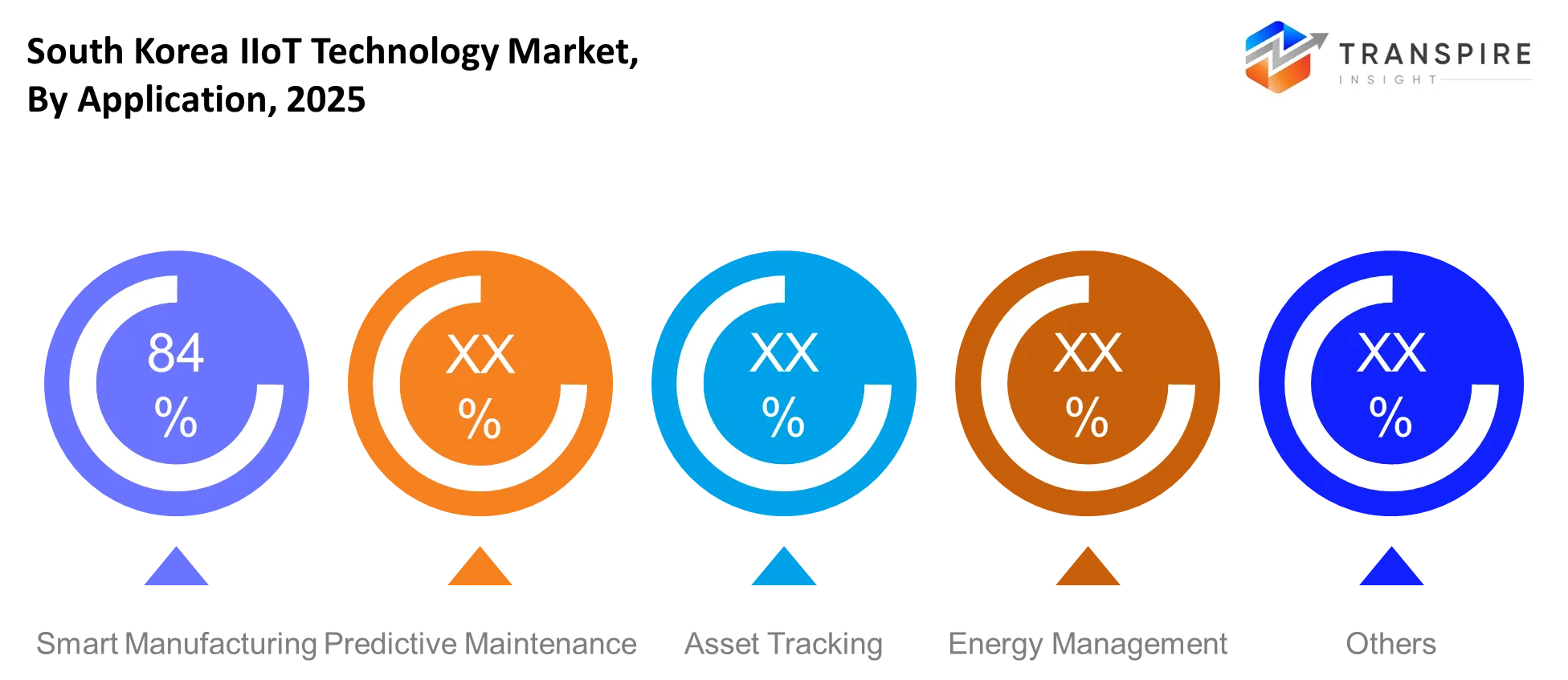
To learn more about this report, Download Free Sample Report
By Deployment :
Cloud based IIoT rollouts expanded after 2023, once enterprises leaned toward scalable data handling platforms. Remote access to industrial data improved the coordination across multiple production facilities. Still, security concerns in sensitive manufacturing settings slowed the complete migration in some sectors, for sure.
On premise systems still matter a lot in industries that demand strict data control, especially in semiconductor production. Hybrid IIoT deployments have been rising too, because companies mix local processing with cloud analytics, to balance speed, and also security. This method supports more flexible infrastructure upgrades without messing up existing industrial operations.
By End User :
The manufacturing industry still stays as the main end user for the South Korea IIoT Technology Market , mostly because electronics and precision engineering plants are heavily automated already. With more sensor integration , and more robotics adoption , production got steadier, and defect rates went down. After the global supply chain disruptions, industrial upgrades kinda sped up too, since everyone suddenly saw the need for operational visibility or you know, “knowing what’s happening” in real time.
On the other side the energy sector adoption also climbed, especially when companies started focusing on monitoring power generation efficiency plus grid stability. Meanwhile the automotive industry moved IIoT into production lines for quality control and for predictive maintenance of equipment, that kind of stuff. In healthcare , the use cases expanded in hospital equipment tracking and also facility monitoring , which helped operational efficiency and resource utilization across medical environments.
What are the Key Use Cases Driving the South Korea IIoT Technology Market?
Predictive maintenance is kind of the main use case behind the South Korea IIoT Technology Market, you see, because manufacturers and big heavy industrial operators want sensor based monitoring to catch early equipment failures. In semiconductor facilities, and on automotive production lines, teams lean on ongoing condition tracking in order to cut down downtime and keep the output steady and exact. That keeps this particular application as the biggest demand driver, pretty consistently.
Then you have smart manufacturing plus asset tracking that keeps rolling out across logistics hubs, automotive assembly sites , and energy installations. The idea here is to enable real time production coordination and give clearer equipment visibility, especially inside huge industrial clusters where many suppliers and machines basically work in step. On top of that, energy management systems are getting more attention in factories that want to tune power usage, mainly with electricity costs going up and up.
More new use cases are starting to appear too, for example digital twin modeling for industrial assets, and AI driven emissions monitoring in port activities. Shipyards and coastal industrial areas are starting to run performance scenarios in advance before they deploy anything in the real world, while maritime operators also trial automated compliance tracking that matches the tightening environmental rules and standards.
|
Report Metrics |
Details |
|
Market size value in 2025 |
USD 2.50 Billion |
|
Market size value in 2026 |
USD 2.99 Billion |
|
Revenue forecast in 2033 |
USD 10.35 Billion |
|
Growth rate |
CAGR of 19.41% from 2026 to 2033 |
|
Base year |
2025 |
|
Historical data |
2021 - 2024 |
|
Forecast period |
2026 - 2033 |
|
Report coverage |
Revenue forecast, competitive landscape, growth factors, and trends |
|
Country scope |
South Korea |
|
Key company profiled |
Samsung SDS, LG CNS, Siemens, Bosch, Honeywell, Schneider Electric, Rockwell Automation, ABB, Cisco Systems, IBM, PTC, Hitachi, Mitsubishi Electric, General Electric, SAP |
|
Customization scope |
Free report customization (country, regional & segment scope). Avail customized purchase options to meet your exact research needs. |
|
Report Segmentation |
By Component (Sensors, Industrial Gateways, Connectivity Solutions, Analytics Platforms, Others); By Technology (Industrial AI, Edge Computing, Digital Twin Technology, Industrial Cloud Platforms, Others); By Application (Predictive Maintenance, Asset Tracking, Smart Manufacturing, Energy Management, Others); By Deployment (Cloud-based IIoT, On-premise IIoT, Hybrid IIoT, Others); By End User (Manufacturing Industry, Energy Sector, Automotive Industry, Healthcare Industry, Others) |
Which Regions are Driving the South Korea IIoT Technology Market Growth?
Seoul plus the nearby Gyeonggi industrial belt, really looks like the front-runner area in the South Korea IIoT Technology Market, and it is not just because of geography. You’ve got dense manufacturing clusters,solid 5G coverage, and some very advanced semiconductor production facilities. On top of that, government-backed smart factory programs have been kind of concentrated here, which makes early take-up of connected industrial systems happen faster. There is also a pretty durable ecosystem—technology vendors, research institutions, and cloud service providers—so innovation and deployment keep moving almost steadily.
Then there is Busan, which is basically the second major region, and it grows from being South Korea’s key maritime and logistics hub. While Seoul leans more toward manufacturing, Busan’s IIoT adoption is more tied to port automation, container handling productivity, and shipbuilding operations. Big shipping operators are present there,and they keep investing in terminal upgrades, so technology uptake stays relatively consistent. Plus, regulatory alignment with international maritime emission requirements helps monitoring and compliance systems integrate in a gradual but reliable way.
Ulsan, along with the southern coastal industrial corridor, is showing up as the fastest-growing zone. That’s mostly because heavy industry modernization keeps accelerating, and refineries are getting upgrades too. Since 2023, investments in smart shipyard infrastructure and automated energy facilities have sped up IIoT deployment quite a bit. On the compliance side, stricter industrial safety measures and emissions rules push companies toward real-time monitoring platforms even more. For investors and new market entrants, this area reads like strong expansion fuel through 2033, especially for heavy industry automation as well as energy efficiency solutions.
Who are the Key Players in the South Korea IIoT Technology Market and How Do They Compete?
In the South Korea IIoT Technology Market the competitive landscape is kind of moderately consolidated, with big conglomerates, telecom operators, and global networking players influencing most deployments. What matters feels less about pure pricing, and more about who ends up controlling the end-to-end technology stack that stitches together sensors, connectivity, and industrial analytics. Established players try to hold ground by packaging hardware with platform services, while newer challengers go for a more disruptive approach using specialized software layers and flexible cloud integration models, sometimes faster and slightly more agile.
Samsung Electronics embeds IIoT inside its semiconductor and smart factory settings. It leans on proprietary sensors and chip-level optimization, aiming to lift production precision, and reduce operational drift. LG Electronics leans into industrial automation gear and energy-efficient control frameworks, designed for manufacturing customers who care about stability plus power usage. SK Telecom, meanwhile, drives wider adoption via nationwide 5G infrastructure and edge computing alliances, supporting low-latency industrial connectivity across factory networks where downtime is expensive.
Hyundai Motor Group applies IIoT to automotive manufacturing and robotic production, boosting assembly efficiency through predictive scheduling tactics that try to anticipate bottlenecks before they happen. Cisco Systems centers on secure industrial networking and IoT platform security, so deployments can scale across Korean plants through partnerships with local enterprises and integrators. Both Hyundai Motor Group and Cisco expand by weaving ecosystem collaborations and digital transformation programs in heavy industry, which makes their reach feel more connected rather than just standalone.
Company List
- Samsung SDS
- LG CNS
- Siemens
- Bosch
- Honeywell
- Schneider Electric
- Rockwell Automation
- ABB
- Cisco Systems
- IBM
- PTC
- Hitachi
- Mitsubishi Electric
- General Electric
- SAP
Recent Development News
In March 2026, Samsung Electronics announced expansion of its industrial edge computing IIoT platform. The company upgraded its Smart Factory IoT suite with enhanced AI-driven predictive maintenance tools designed for semiconductor and automotive manufacturing clients in South Korea. Source https://www.samsung.com/
In April 2026, SK Telecom launched a next-generation 5G-based IIoT connectivity solution. The service targets smart factories and industrial campuses by enabling ultra-low latency machine-to-machine communication for real-time automation in South Korea.
Source https://www.sktelecom.com/
What Strategic Insights Define the Future of the South Korea IIoT Technology Market?
South Korea IIoT Technology Market seems to keep sliding, in a kind of structural way, toward fully autonomous , AI- orchestrated industrial ecosystems where the whole decision making part moves away from human-supervised setups and more into real time machine coordination. That overall direction is pulled forward by tighter linking of 5G , edge computing and industrial AI , which makes latency smaller and supports continuous refinement across manufacturing and maritime operations. In the next 5 to 7 years , the way value gets made will likely stack up in platforms that basically blend data from production machinery, transport logistics networks , and energy systems into one shared operational intelligence layer.
There is also a less obvious risk showing up, like a dependency that grows on a small group of platform and telecom providers. That kind of concentration can turn into concentration risk, for instance in connectivity pricing and in who controls data governance. If something goes wrong in those core infrastructure layers, even briefly, industrial operations across multiple sectors could get slowed at the same time. It’s one of those structural issues that people sometimes gloss over because the big stories mostly talk about adoption rates.
Meanwhile a notable, emerging opportunity is in AI enabled maritime compliance systems tied to automated emissions reporting for coastal and port activities. Busan and Ulsan look like they might become early trial places as regulatory enforcement gets sharper. Market players should probably focus on interoperable platforms that mix industrial AI with secure edge networks, because early standardization may quietly shape the long term contract position, and also who ends up with ecosystem control.
South Korea IIoT Technology Market Report Segmentation
By Component
- Sensors
- Industrial Gateways
- Connectivity Solutions
- Analytics Platforms
By Technology
- Industrial AI
- Edge Computing
- Digital Twin Technology
- Industrial Cloud Platforms
By Application
- Predictive Maintenance
- Asset Tracking
- Smart Manufacturing
- Energy Management
By Deployment
- Cloud-based IIoT
- On-premise IIoT
- Hybrid IIoT
By End User
- Manufacturing Industry
- Energy Sector
- Automotive Industry
- Healthcare Industry
Frequently Asked Questions
Find quick answers to common questions.
The South Korea IIoT Technology Market size is USD 10.35 Billion in 2033.
Key Segments for the South Korea IIoT Technology Market are By Component (Sensors, Industrial Gateways, Connectivity Solutions, Analytics Platforms, Others); By Technology (Industrial AI, Edge Computing, Digital Twin Technology, Industrial Cloud Platforms, Others); By Application (Predictive Maintenance, Asset Tracking, Smart Manufacturing, Energy Management, Others); By Deployment (Cloud-based IIoT, On-premise IIoT, Hybrid IIoT, Others); By End User (Manufacturing Industry, Energy Sector, Automotive Industry, Healthcare Industry, Others).
Major South Korea IIoT Technology Market Players are Samsung SDS, LG CNS, Siemens, Bosch, Honeywell, Schneider Electric, Rockwell Automation, ABB, Cisco Systems, IBM, PTC, Hitachi, Mitsubishi Electric, General Electric, SAP.
The Current South Korea IIoT Technology Market size is USD 2.50 Billion in 2025.
The South Korea IIoT Technology Market CAGR is 19.41% from 2026 to 2033.
- Samsung SDS
- LG CNS
- Siemens
- Bosch
- Honeywell
- Schneider Electric
- Rockwell Automation
- ABB
- Cisco Systems
- IBM
- PTC
- Hitachi
- Mitsubishi Electric
- General Electric
- SAP
Recently Published Reports
-
Apr 2026
3D Optical Profiler Market
3D Optical Profiler Market Size, Share & Analysis Report By Type (Desktop 3D Optical Profiler, and Portable 3D Optical Profiler), By Technology (Confocal Technology, and White Light Interference), By End-Use Industry (Manufacturing, Research Institutions, Automotive, Aerospace and Defense, Medical Devices, and Other), and Geography (North America, Europe, Asia-Pacific, Middle East and Africa, South and Central America), 2021 - 2031
-
Apr 2026
Depth Sensor Market
Depth Sensor Market Size, Share & Analysis Report By Type (Infrared Depth Sensors, Time-of-Flight (ToF) Sensors, Stereo Vision Sensors, Structured Light Sensors, Ultrasonic Depth Sensors), By Application (Automotive, Robotics, Gaming, Consumer Electronics, Industrial Automation, Healthcare, Security & Surveillance, Others), By End Users (Automotive Manufacturers, Consumer Electronics Companies, Healthcare Providers, Industrial Companies, Security Agencies, Gaming Companies, Robotics Companies, Others), and Geography (North America, Europe, Asia-Pacific, Middle East and Africa, South and Central America), 2021 – 2031
-
Apr 2026
Digital Manufacturing Market
Digital Manufacturing Market Size, Share & Analysis Report By Component (Hardware, Software, and Services), By Technology (Robotics, 3D Printing, Internet of Things (IoT), and Others), By Application (Automotive and Transportation, Aerospace and Defense, Consumer Electronics, Industrial Machinery, and Others), By Process Type (Computer-Based Designing, Computer-Based Simulation, Computer 3D Visualization, Analytics, and Others), and Geography (North America, Europe, Asia-Pacific, Middle East and Africa, South and Central America), 2021 – 2031
-
Apr 2026
Digital Visa Services Market
Digital Visa Services Market Size, Share & Analysis Report By Type (Individual Travelers, Group Travelers), By Application (Tourism, Business Travel, Others), and Geography (North America, Europe, Asia-Pacific, Middle East and Africa, South and Central America), 2021 – 2031