
South Korea Hyperspectral Imaging Market Size & Forecast:
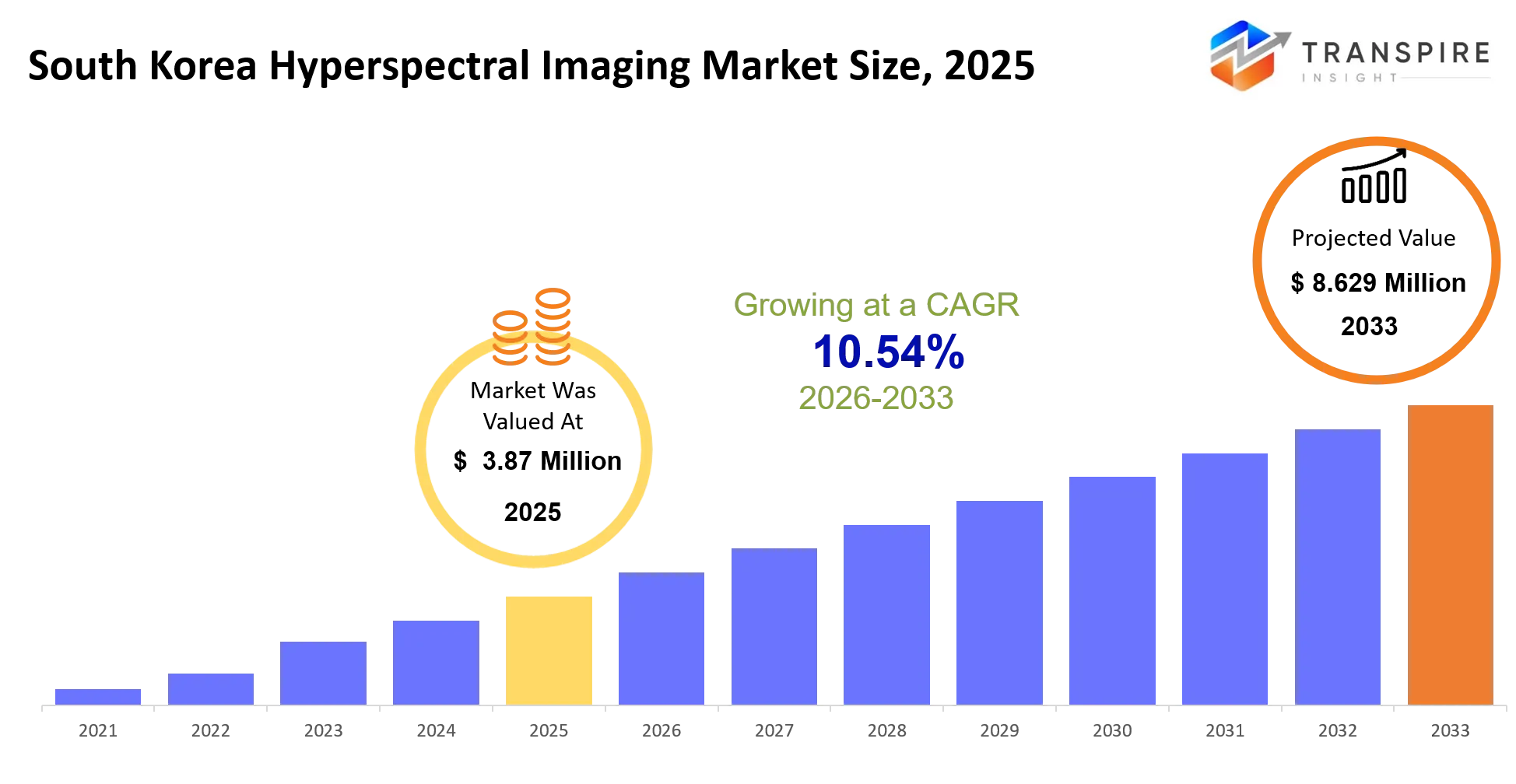
- South Korea Hyperspectral Imaging Market Size 2025: USD 3.87 Million
- South Korea Hyperspectral Imaging Market Size 2033: USD 8.629 Million
- South Korea Hyperspectral Imaging Market CAGR: 10.54%
- South Korea Hyperspectral Imaging Market Segments: By Product Type (Cameras, Accessories, Software, Others); By Technology (Snapshot, Pushbroom, Whiskbroom, Others); By Application (Agriculture, Defense, Healthcare, Mining, Others)
To learn more about this report,  Download Free Sample Report
South Korea Hyperspectral Imaging Market Summary
The South Korea Hyperspectral Imaging Market was valued at USD 3.87 Million in 2025. It is forecast to reach USD 8.629 Million by 2033. That is a CAGR of 10.54% over the period.
In South Korea, the hyperspectral imaging market plays a sort of critical role, it helps a bunch of industries pick up material properties, hidden defects, unwanted contamination, and even environmental shifts that regular imaging systems often just miss, or see too late. Generally, manufacturers lean on hyperspectral cameras for quality inspection and process optimization , while environmental agencies , defense organizations , and research groups use the same approach for surveillance, resource monitoring and precision analysis… at least in their day to day work.
Over the last five years, there’s been a real structural move , from deployments that were mainly research-centered toward deeper integration inside automated industrial inspection and smart manufacturing settings. That change has been boosted by sensor miniaturization , AI-driven analytics and also quicker data processing options. One big trigger behind broader adoption was the disruption felt across global supply chains during and after the COVID-19 period, which basically highlighted how expensive production inefficiencies and quality failures can be. So, as South Korean manufacturers pushed for better process visibility and sharper defect detection accuracy , hyperspectral imaging turned into a more practical investment. Right now this transition is broadening commercial rollouts beyond labs, opening up additional revenue avenues across semiconductor, electronics, battery, and environmental monitoring use cases.
Key Market Insights
- Seoul Capital Area kind of dominates the South Korea hyperspectral imaging market, and in 2025 it’s projected to take something like 45%+ of the market , mainly because tech investments are really concentrated there.
- Meanwhile, Gyeonggi Province still holds a pretty sizable slice, with semiconductor fabrication facilities, electronics manufacturing clusters, and industrial automation initiatives backing that position.
- If we look at components, hyperspectral cameras basically lead the field , with an estimated 40%+ share in 2025, and that’s tied to wider rollouts in industrial inspection use cases.
- Imaging systems plus integrated platforms show up as the second-largest segment too, largely from the demand for end to end spectral analysis solutions, rather than isolated tools.
- AI enabled hyperspectral software platforms are the quickest grower across 2025–2030, because they help with real time image interpretation and overall operational efficiency in day to day workflows.
- Cloud based data processing options are kinda getting more traction as orgs deal with bigger spectral datasets , and yeah, more tangled analytics work loads.
- Industrial quality inspection seems to hold the biggest chunk of use at about 35% of market revenue in 2025 , especially for semiconductor and electronics manufacturing.
- Semiconductor defect detection is still a big demand driver across the South Korea hyperspectral imaging space , like it just keeps showing up.
- Battery inspection plus advanced materials analysis is the fastest growing application slice during the forecast period, even though the exact numbers vary by region.
- Environmental monitoring use cases are also moving forward, since organizations want sharper pollution sensing and better resource stewardship features.
What are the Key Drivers, Restraints, and Opportunities in the South Korea Hyperspectral Imaging Market?
The strongest growth driver in the South Korea Hyperspectral Imaging Market, is (like) the integration of advanced imaging systems into semiconductor, electronics, and battery manufacturing. South Korea’s push toward smart factories and better production yields has kinda pushed the need for inspection technologies that can catch defects conventional machine vision systems often miss, and yeah that matters. When the industry moves to smaller semiconductor nodes and more intricate battery architectures, the cost of production mistakes goes up fast—so hyperspectral imaging becomes a financially attractive investment. Because manufacturers keep focusing on yield optimization and quality assurance, they continue to spend more on spectral imaging equipment , software, and analytics platforms. That keeps market revenue growing, directly.
The biggest constraint is the high cost and also the technical complexity that comes with deploying hyperspectral imaging. Companies have to put money not just into specialized cameras, but also into data processing infrastructure , software integration, and skilled personnel who can interpret spectral datasets. This is sort of a structural issue, since it relies on long-term workforce development and ecosystem maturity, rather than quick short-term price cuts. So lots of small and mid-sized manufacturers delay adoption, which reduces broader market penetration and slows down potential revenue expansion.
A big future opportunity kind of sits in battery inspection and advanced materials analysis, and it feels like there’s more here than meets the eye. South Korea is really pushing substantial investment in electric vehicle battery production, and that is giving hyperspectral imaging systems a more favorable landscape to work in, especially since they can spot material inconsistencies , and manufacturing defects while things are still running. Then as battery producers scale their next-generation production lines the spectral imaging technologies are positioned to become a kind of critical part of quality control infrastructure, which could open a new phase of commercial growth for the market.
What Has the Impact of Artificial Intelligence Been on the South Korea Hyperspectral Imaging Market?
Artificial intelligence is, sort of, reshaping the South Korea Hyperspectral Imaging Market by turning huge piles of spectral data into usable insights that teams can act on in near real time. In semiconductor fabrication, electronics production, and battery manufacturing, AI based image analysis systems quietly convert visual and spectral signals into something more “readable,” like microscopic defect signals, material inconsistency clues, and signs of contamination that older inspection workflows might overlook. Because of this kind of automation, there is less dependence on manual review and it becomes easier to keep continuous quality monitoring running across those fast, high speed production lines.
At the same time, machine learning models are strengthening predictive ability. More and more manufacturers rely on hyperspectral datasets to anticipate equipment performance, spot early hints that processes are drifting, and even foresee quality failures before they start hurting output. For batteries specifically, predictive analytics can flag subtle material anomalies that might later reduce product performance, or raise defect levels. Overall, these features help support higher production yields, reduced scrap, and better utilization of equipment.
Then there are the newer digital technologies, like edge computing paired with cloud analytics platforms, which boost operational efficiency by speeding up image processing and compressing inspection timelines. So manufacturers often get improved process stability, quicker decision making, and firmer alignment with quality requirements.
Still, there’s a stubborn drawback, the integration cost. Bringing AI into hyperspectral imaging infrastructure can be expensive, and many real world use cases also need large, industry specific training datasets. Also model accuracy may slip when operating conditions, or material characteristics, don’t match what the system saw during training—so the results can get a bit weaker if the environment changes too much.
Key Market Trends
- In 2021 semiconductor manufacturers started to bump up investments in hyperspectral inspection systems, because when the smaller process nodes showed up, defect detection became kind of mission critical. Kind of.
- Between 2022 and 2025, AI integrated spectral analysis platforms got more attention, and they made manual image review less of a daily chore, while also speeding up the production line decision making , overall it felt faster.
- Battery producers then moved away from sample based inspection toward continuous monitoring, since EV supply chains basically required stricter quality assurance rules, not just “nice to have” stuff.
- After 2023 edge computing adoption jumped, allowing quicker processing of hyperspectral datasets right on the manufacturing floors without too much latency… which is the part everyone cares about.
- More and more electronics manufacturers are also leaning toward integrated hardware and software platforms instead of standalone cameras, which matches the larger trend toward automated quality ecosystems , where everything works together.
- Competition is kinda moving away from just sensor performance alone, and more toward analytics capabilities or maybe “data understanding” overall, with firms like Specim and Headwall Photonics doing more AI driven stuff.
- Ever since the COVID-19 supply chain disruptions, manufacturers have been focusing harder on process visibility tech, the kind that gives real time perspective and can help cut down on expensive production stops, as well as some material waste that quietly piles up.
- At the same time, research institutions are teaming up with industrial users more often on commercialization projects, so the transfer of hyperspectral technology is not only in theory but it actually gets pushed from labs into production environments faster.
- Between 2020 and 2025 , demand seems to have shifted toward compact portable systems , because people wanted easier integration into the existing manufacturing infrastructure, like plug it in and go.
- Also quality control requirements across advanced materials and battery production are getting more strict, which is pushing earlier adoption of spectral imaging technologies, right into production workflows rather than waiting.
South Korea Hyperspectral Imaging Market Segmentation
By Product Type :
Cameras are kinda the core of hyperspectral imaging systems because how the image gets captured, right , really decides the data accuracy. In recent years the adoption has spread a lot into semiconductor manufacturing, electronics inspection , healthcare research, and also environmental monitoring. With upgrades to sensor resolution, processing speed, and more compact designs, they’ve become a better fit for industrial use cases where exact material identification is needed.
On the accessories side, they back up overall system performance using parts like lenses, lighting equipment , calibration tools, and mounting solutions. Meanwhile the software matters just as much, since it takes spectral data and turns it into something usable, which then supports defect detection, categorization, and analysis. And the other category is basically the supporting hardware plus integrated solutions, that help people customize the setup for particular operational needs, and for research goals too.
By Technology :
Snapshot tech captures both spatial and spectral information at the same time, which is why it ends up being handy for use cases that need fast image capturing in the real world. In day to day industry, people tend to pick this option when real-time inspection really matters, and when high speed production lines mean there’s no time to wait for analysis, like right during the workflow.
Meanwhile, pushbroom tech is still pretty common because it can deliver strong spectral resolution plus very detailed imaging results. Whiskroom systems , by contrast, scan one point at a time and they are often chosen for specific scientific studies and remote sensing work.And then there’s the “other” group , which is basically made up of newer imaging methods. These were developed to handle particular industry needs and to support more operational flexibility, even when the environment gets demanding.
By Application :
In agriculture, hyperspectral imaging gets used to gauge crop conditions , keep an eye on plant health , and help refine decisions about resource management, kinda more carefully than before. Some defense organizations also put it to work for surveillance, target detection, and terrain analysis, mainly because it can spot materials that regular cameras do not really pick up as well, even when conditions seem similar.
On the healthcare side, the tech backs medical research, diagnostic imaging, and tissue analysis by giving richer spectral data, sort of like a more talkative signal. In mining, companies rely on hyperspectral systems to identify minerals, judge resource quality, and boost exploration efficiency. The others bucket usually covers environmental monitoring, industrial quality inspection, semiconductor manufacturing, and electronics production, where solid material characterization and defect detection still stay as key day to day priorities .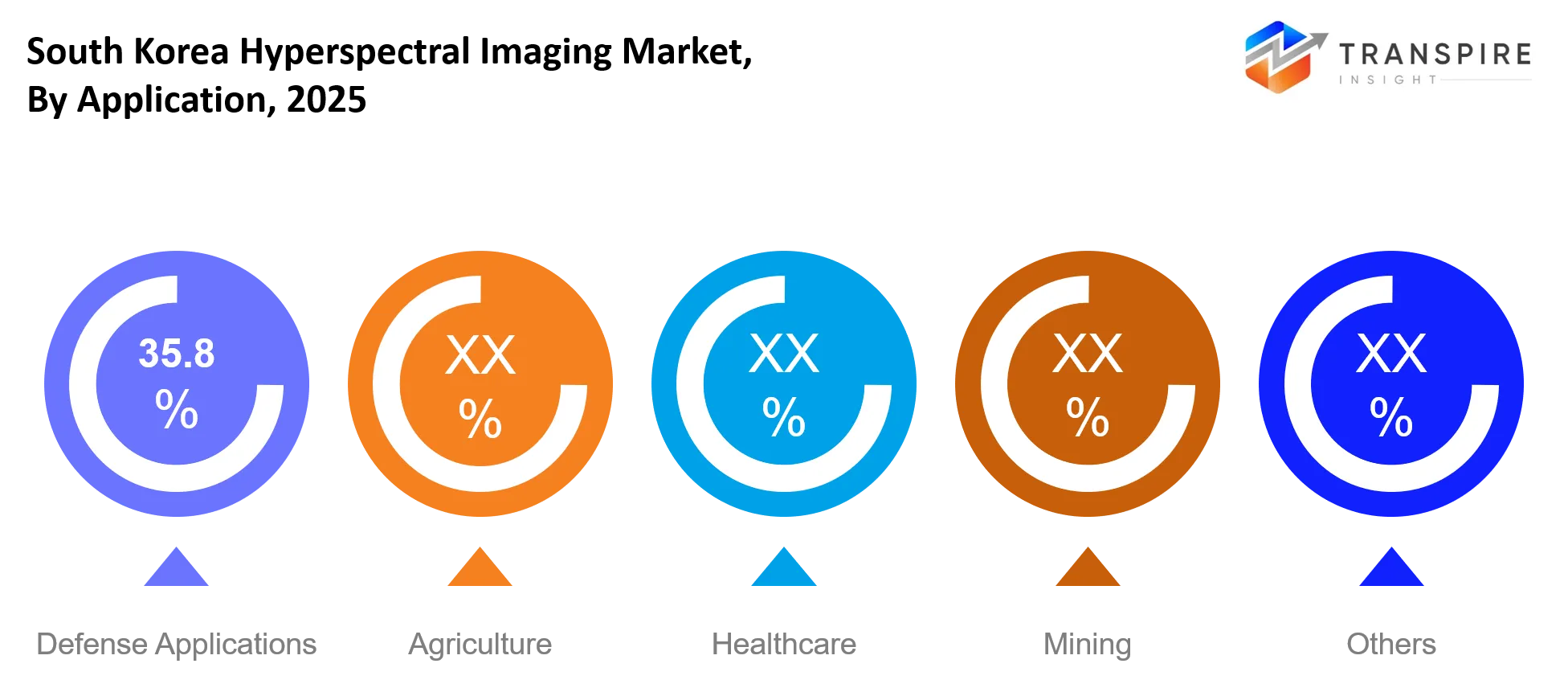
To learn more about this report, Download Free Sample Report
What are the Key Use Cases Driving the South Korea Hyperspectral Imaging Market?
The main use case that's really driving adoption in the South Korea Hyperspectral Imaging Market is industrial quality inspection, especially in semiconductor and electronics production. Basically, manufacturers use hyperspectral systems to spot tiny defects, weird material inconsistencies, and contamination that the usual imaging tools might not catch. This kind of insight helps lift production yields and cut down on expensive quality failures, so it becomes a major reason the market keeps growing.
And then, past the factory floor, adoption is also spreading into battery production, plus environmental monitoring. Battery makers apply spectral imaging to check material uniformity and catch defects earlier during manufacturing, while research groups and government agencies use it to track pollution, vegetation vitality , and land-use shifts with more precision than before.\
There are also newer, emerging areas like improved medical imaging and next generation materials research. In healthcare, organizations are looking into hyperspectral methods for tissue examination and diagnostic support, and in labs theyre using it to explore new materials for semiconductor work and energy storage. As data analytics gets better and more reliable, these applications are expected to edge closer to real commercial deployment, without too much delay.
|
Report Metrics |
Details |
|
Market size value in 2025 |
USD 3.87 Million |
|
Market size value in 2026 |
USD 4.278 Million |
|
Revenue forecast in 2033 |
USD 8.629 Million |
|
Growth rate |
CAGR of 10.54% from 2026 to 2033 |
|
Base year |
2025 |
|
Historical data |
2021 - 2024 |
|
Forecast period |
2026 - 2033 |
|
Report coverage |
Revenue forecast, competitive landscape, growth factors, and trends |
|
Country scope |
South Korea |
|
Key company profiled |
Headwall Photonics, Resonon, Specim, Corning, Cubert, Surface Optics, Telops, Norsk Elektro Optikk, BaySpec, Brimrose, Ximea, Teledyne FLIR, IMEC, Photonfocus, Hamamatsu |
|
Customization scope |
Free report customization (country, regional & segment scope). Avail customized purchase options to meet your exact research needs. |
|
Report Segmentation |
By Product Type (Cameras, Accessories, Software, Others); By Technology (Snapshot, Pushbroom, Whiskbroom, Others); By Application (Agriculture, Defense, Healthcare, Mining, Others) |
Which Regions are Driving the South Korea Hyperspectral Imaging Market Growth?
The Seoul Capital Area still ends up as the leading zone in the South Korea Hyperspectral Imaging Market, because it kinda stacks together advanced research capacity, solid technology funding, and a dense cluster of semiconductor and electronics companies. Big industrial groups keep pushing money into inspection methods and automation tools to stay competitive worldwide, so you see continuous upgrades. At the same time government-backed innovation tracks, plus university research collaborations also speed up the move from lab to real product. So yeah, with manufacturing muscle , research know-how, and steady investment happening at the same time, it forms a pretty resilient local ecosystem that keeps the region in the top position.
Gyeonggi, along with the wider central manufacturing belt , shows up as the second-largest regional contributor, but the growth story feels a bit different than the capital area. Instead of being powered mostly by research activity, this area leans on a stable foundation of well-established production facilities that need ongoing quality refinements. Manufacturers, in practice, keep purchasing hyperspectral imaging systems so they can boost operational efficiency and improve product reliability. Because the spending pattern is rather consistent, the region becomes a dependable supplier of market revenue, and also a steady place for long-term technology take up.
The southeastern industrial corridor, kinda like Busan Ulsan, and some adjacent manufacturing hubs, is coming up as the fastest-growing patch. Lately the expansion in battery production , advanced materials development, and industrial digitalization projects is pushing up the need for more sophisticated inspection technologies. Companies tied to these areas are starting to lean into hyperspectral imaging to help meet higher production standards, and also to cut down on defect-related losses. Looking at the 2026–2033 window, this momentum should be what creates pretty attractive openings for technology providers, system integrators, and investors who want exposure to widening industrial applications.
Who are the Key Players in the South Korea Hyperspectral Imaging Market and How Do They Compete?
In the South Korea Hyperspectral Imaging Market, competition is kind of moderately concentrated, like there’s a cluster of well known imaging technology companies that go head to head with smaller specialized spectral analysis providers. Most of the time it comes down to technology performance as the main lever, especially sensor accuracy , spectral resolution, processing speed and then also what the software can actually do. Players are more and more separating themselves via artificial intelligence integration and use-case focused solutions, not really on price alone. Even so, new entrants keep showing up, mostly in software and analytics, but the hardware development barriers are still pretty high, and the technical know-how requirements kind of favor firms that already have a long history in imaging.
Specim is leaning into technology innovation with high performance hyperspectral cameras and bundled analysis solutions . They tend to stand out in industrial inspection and research use cases where reliable spectral data really matters. Their expansion seems to be putting extra weight on partnerships with automation providers and system integrators, so spectral imaging can be installed into actual production environments. Headwall Photonics runs a strategy built around advanced sensor engineering and customized imaging platforms. Their strength is in tailoring systems to fit particular industrial or scientific needs, which helps a lot in projects where an “off the shelf” imaging solution might not hit the required performance targets .
Teledyne FLIR uses its know how in machine vision, thermal imaging and industrial sensing, to create a kind of broader inspection ecosystem not just some standalone product. It kinda lets customers combine different imaging technologies, inside one unified operational framework so its not all split up. Resonon on the other hand stands out with flexible and application focused imaging systems, made for research, manufacturing and environmental analysis. And then Corning Incorporated, well they bring serious depth from optical technologies and advanced materials, which helps keep driving product development and also pushes into high precision industrial uses, where imaging accuracy and reliability really matter.
Company List
- Headwall Photonics
- Resonon
- Specim
- Corning
- Cubert
- Surface Optics
- Telops
- Norsk Elektro Optikk
- BaySpec
- Brimrose
- Ximea
- Teledyne FLIR
- IMEC
- Photonfocus
- Hamamatsu
Recent Development News
In January 2025, SI Imaging Services (SIIS) entered a partnership with Pixxel to introduce hyperspectral satellite data in South Korea. The agreement enables SIIS to integrate Pixxel’s hyperspectral imagery with its optical and radar datasets, expanding advanced Earth-observation and geospatial analytics capabilities in the Korean market.
Source https://www.pixxel.space/
In June 2026, TelePIX entered a partnership with Bellatrix Aerospace to co-develop a next-generation Earth-observation satellite. The collaboration combines TelePIX’s advanced imaging payload technology with Bellatrix’s Very Low Earth Orbit platform, supporting higher-resolution geospatial imaging capabilities and strengthening South Korea’s space-based imaging ecosystem. Source https://timesofindia.indiatimes.com/
What Strategic Insights Define the Future of the South Korea Hyperspectral Imaging Market?
The South Korea Hyperspectral Imaging Market seems to be moving toward a deeper blend within automated industrial ecosystems, instead of staying as this standalone inspection technology thing. Over the next five to seven years , value creation will probably come more from pairing hyperspectral imaging with artificial intelligence, edge computing, and those factory automation platforms. The main reason is pretty straightforward: the economic cost of production defects keeps climbing in semiconductors , batteries, and advanced materials, where even small quality variations can turn into serious financial consequences.
There is also a less obvious risk, like technology substitution. As conventional machine vision systems get more capable and artificial intelligence keeps improving how images are interpreted, some manufacturers may put off hyperspectral investments if cheaper alternatives can still meet day to day operational needs. So even with overall market indicators looking positive, this might cause adoption gaps in cost sensitive segments.
On the opportunity side , hyperspectral imaging is starting to show up in next generation battery materials and recycling processes, especially since South Korea is pushing circular economy initiatives more aggressively. Market participants should focus on partnerships with automation providers and industrial software developers. Basically, building integrated solutions— not just selling imaging hardware by itself— should help strengthen competitive positioning and open the door to higher value, longer term revenue streams.
South Korea Hyperspectral Imaging Market Report Segmentation
By Product Type
- Cameras
- Accessories
- Software
By Technology
- Snapshot
- Pushbroom
- Whiskbroom
By Application
- Agriculture
- Defense
- Healthcare
- Mining
Frequently Asked Questions
Find quick answers to common questions.
The Expected South Korea Hyperspectral Imaging Market size is USD 8.629 Million in 2033.
Key Segments for the South Korea Hyperspectral Imaging Market are By Product Type (Cameras, Accessories, Software, Others); By Technology (Snapshot, Pushbroom, Whiskbroom, Others); By Application (Agriculture, Defense, Healthcare, Mining, Others).
Major South Korea Hyperspectral Imaging Market players are Headwall Photonics, Resonon, Specim, Corning, Cubert, Surface Optics, Telops, Norsk Elektro Optikk, BaySpec, Brimrose, Ximea, Teledyne FLIR, IMEC, Photonfocus, Hamamatsu.
The Current South Korea Hyperspectral Imaging Market size is USD 3.87 Million in 2025.
The South Korea Hyperspectral Imaging Market CAGR is 10.54% from 2026 to 2033.
- Headwall Photonics
- Resonon
- Specim
- Corning
- Cubert
- Surface Optics
- Telops
- Norsk Elektro Optikk
- BaySpec
- Brimrose
- Ximea
- Teledyne FLIR
- IMEC
- Photonfocus
- Hamamatsu
About the Authors

Avinash Kumar
I’m Avinash Kumar, a Senior Research Analyst at Transpire Insight, with expertise in the Electronics and Semiconductor and Energy & Power industry. My work focuses on analyzing emerging technologies, market trends, industry developments, and innovation across these sectors. I specialize in transforming complex technical and market insights into clear, research-backed content that helps professionals, businesses, and decision-makers stay informed. Through continuous industry research and data-driven analysis, I strive to deliver accurate, reliable, and practical perspectives on the latest advancements shaping the semiconductor and energy landscape.

Chakradhar Khansole
Chakradhar serves as the Research Director at Transpire Insight, bringing over 8 years of experience in technology, innovation, and strategic market intelligence. He specializes in transforming complex market data into actionable business insights that enable organizations to make informed, growth-oriented decisions. Recognized for his strategic vision and analytical expertise, Chakradhar leads high-impact research initiatives, delivering comprehensive market assessments, competitive intelligence, and forward-looking industry analysis.
Recently Published Reports
-
Apr 2026
Fiber Optic Faceplates Market
Fiber Optic Faceplates Market Size, Share & Analysis Report By Type (< 300 mm2, 300-350 mm2, and > 350 mm2, By Application (Night Vision, Holographic Imaging, Medical, and Others), and Geography (North America, Europe, Asia-Pacific, Middle East and Africa, South and Central America), 2021 - 2031
-
Apr 2026
High Temperature Superconductors Market
High Temperature Superconductors Market Size, Share & Analysis Report By Type (1G HTS, and 2G HTS), By Application (Power Cable, Fault Current Limiter, and Transformer), and Geography (North America, Europe, Asia-Pacific, Middle East and Africa, South and Central America), 2021 - 2031
-
Apr 2026
Industrial Plugs and Socket Market
Industrial Plugs and Socket Market Size, Share & Analysis Report By Type (Industrial Plugs, Industrial Sockets), By Current (Up to 32 A, 32 to 125 A, Above 125 A), By Protection (Dustproof and Splash Proof, Waterproof, Explosion Proof), By End User (Heavy Industries, Oil and Gas, Chemicals and Pharmaceuticals, Power Generation, Others), and Geography (North America, Europe, Asia-Pacific, Middle East and Africa, South and Central America), 2021 - 2031
-
Apr 2026
InGaAs Avalanche Photodiodes Market
InGaAs Avalanche Photodiodes Market Size, Share & Analysis Report By Type (1100 - 1700 nm, and 1000 - 1600 nm), By Application (Missile Warning System, Muzzle Flash Detection, Wafer Defect Inspection, Laser Rangefinders, and Others), and Geography (North America, Europe, Asia-Pacific, Middle East and Africa, South and Central America), 2021 - 2031