

South Korea eVTOL Aircraft Market Size & Forecast:
- South Korea eVTOL Aircraft Market Size 2025: USD 0.56 Billion
- South Korea eVTOL Aircraft Market Size 2033: USD 3.959 Billion
- South Korea eVTOL Aircraft Market CAGR: 27.70%
- South Korea eVTOL Aircraft Market Segments: By Lift Technology (Multirotor, Lift+Cruise, Vectored Thrust, Tiltrotor, Tiltwing, Hybrid eVTOL, Autonomous eVTOL, Others); By Application (Passenger Transport, Air Taxi, Cargo Delivery, Emergency Services, Defense Missions, Tourism, Urban Mobility, Others); By Range (Below 50 km, 50–100 km, 101–200 km, 201–300 km, Above 300 km, Intercity Transport, Regional Mobility, Others); By End User (Commercial Operators, Defense Agencies, Logistics Firms, Tourism Companies, Government Agencies, Emergency Services, Infrastructure Operators, Others)
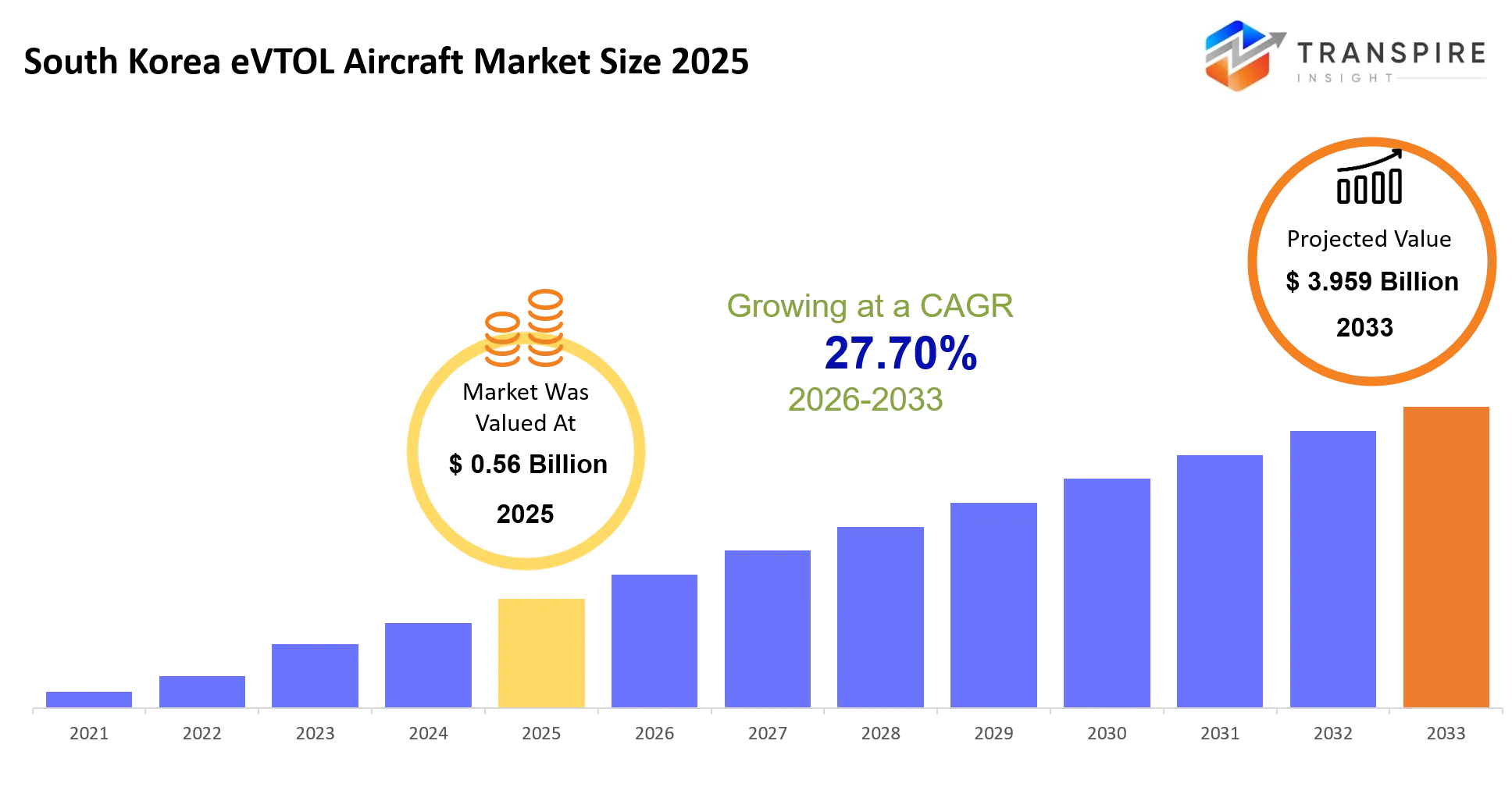
South Korea eVTOL Aircraft Market Summary
The South Korea eVTOL Aircraft Market was valued at USD 0.56 Billion in 2025. It is forecast to reach USD 3.959 Billion by 2033. That is a CAGR of 27.70% over the period.
The South Korea eVTOL aircraft market consists of electric vertical takeoff and landing aircraft aimed at providing services of movement for passengers, cargo, and emergency services in between dense urban regions and inaccessible areas, such as islands, and industrial regions such as mountains. Functionally it represents an effort to ease transportation pressure within metropolitan areas, while supporting time sensitive cargo delivery and time critical emergency response. The market has transformed from early stages of concept planning to planned commercial deployment in the last 3-5 years, based on the national UAM roadmaps spearheaded by the government and flight path planning around designated airspace. A substantial restructuring from single aircraft development to integrated UAM-certified ecosystems supported by a network of aerospace companies, mobility platforms, and energy providers was driven by growing concern about transport resilience post-pandemic, coupled with the increased focus on carbon neutral targets by policymakers on low-carbon aircrafts. Consequently, investments were reoriented towards certified flight readiness, vertiport facilities and operation integrated systems that drive real revenue streams on pilots rather than an expectation based on consumer demand.
Key Market Insights
- Seoul Metropolitan Area leads the 2025 South Korea eVTOL Aircraft Market with close to 60% share due to density of commuter congestion and UAM infrastructure pilots.
- It is estimated that the Busan-Ulsan area would be the 1 fastest growing region through 2030, facilitated by port logistics and inter-city air mobility integration.
- Passenger e VTOL aircraft other than e VTOL aircraft with about 48% dominates the South Korea e VTOL Aircraft Market owing to urban transit replacement demand.
- Cargo eVTOL platforms account for the second-largest share (5.3%), as the value of logistics and industrial supply chains is time critical.
- Emergency medical and defense grade eVTOL systems comprise the third fastest growing specialization in the through 2032 commercialization cycles.
- Urban passenger mobility is still top with almost 52% penetration following congestion mitigation requirements in the metro corridor.
- Inter-island logistics and offshore industrial connectivity are among the most rapidly growing application fields.
- Commercial mobility operators and Aviation consortiums hold the maximum share (~50%) of the South Korea eVTOL Aircraft Market ecosystem.
- Government & defense is the fastest-growing end-user segment because of investments in the national UAM pilot corridor program.
What are the Key Drivers, Restraints, and Opportunities in the South Korea eVTOL Aircraft Market?
The South Korean eVTOL Aircraft Market's main trend is fueled by the government's supportive urban air mobility (UAM) blueprint combined with its transportation sector's carbon emission reductions, driving investment into air corridor feasibility projects, vertiport development and type certification of prototype models. OEMs and operators, the main consumers in the eVTOL Aircraft Market, are shifting from test operations toward commercial operations, expediting initial revenues from pilot commuter routes and logistical demonstrations instead of lengthy speculative R&D efforts.
In addition, high complexity associated with obtaining certification for electric vertical aircraft in urban environments poses the greatest threat to the market's rapid scaling and early commercial revenue generation. The eVTOL Aircraft Market's key opportunities include a potential synergy with smart city transit infrastructure, especially in Seoul's proposed vertiport integrated transit stations.
These hybrid mobility concepts might unlock the regional adoption potential among commuters by facilitating increased travel frequencies, leading airports and logistics companies to invest in automated air traffic control systems that may enable regional flight networks to scale in the coming years.
What Has the Impact of Artificial Intelligence Been on the South Korea eVTOL Aircraft Market?
In the South Korea eVTOL Aircraft Market Artificial intelligence has become crucial to optimizing the operation of these vehicles. In air traffic control, artificial intelligence solutions optimize air-corridor management and navigation to allow the coordination and navigation of autonomous flight. Through partial pilot assist on aircraft, Artificial intelligence solutions streamline the route, save on fuel and facilitate better real time flight management during unfavorable weather in an urban environment. Through Machine learning artificial intelligence has found applications in Aircraft Maintenance.
Artificial intelligence systems monitor battery status, fuel efficiency and other important operating components, ensuring early prediction of aircraft damage, resulting in about a 20-30% reduction in overall operating downtime. AI systems are also employed to optimize operations such as real-time scheduling of fleet based on travel, energy efficiency and weather related factors. When applied to the operations side of urban air mobility, AI can also automate processes to comply with traffic regulations and increase turnaround time of ground maintenance teams to 45-50 minutes.
The primary challenge however lies in the higher investment in artificial intelligence for operating, airworthy-certified systems, along with a dearth of real time data available to train artificial intelligence for all potential low altitude urban flight situations. Due to these reasons full pilot autonomy is a distant future, as artificial intelligence is used mostly to create semi-autonomous operations.
Key Market Trends
- Beyond 2022,Seoul UAM tests began shifting to corridor-based operations along selected city routes rather than simple point-to-point test flights.
- Commercialization was also formalised – rules evolved from guidance principles into full certification by 2023-2025.
- Post-2022 , the Korean auto major, Hyundai Motor Group, focus shifts toward creating an integrated UAM platform as well as a vehicle instead.
- Post-2021, an increased emphasis on aircraft redesign for urban multi-stop operations will be fueled by gains in battery energy densities that will allow for higher ranges.
- Post-2024 , Air traffic management will evolve from mere coordinating with human operators to an automated process involving artificial intelligence to manage flight corridors.
- Post-2022, the focus for investors will shift towards the construction of vertiports, leaving the prototypes with low capitalisation to wait in line for actual deployment.
- 2023-2024 , US based Joby Aviation ramped up certification discussions with its partnerships in South Korea in a bid to reconcile OEMs’ business plan with local regulations.
- The expansion of public-private collaborations following 2023 saw airport authorities partner on commercial routes from Seoul into the surrounding metropolitan areas.
- South Korean aerospace suppliers commenced localized production of light composites and avionics components for the industry starting in 2024.
- Pilot application shifted from daily commuting toward more critical missions like emergency response and express logistics, spurred by growing demand post-2023.
South Korea eVTOL Aircraft Market Segmentation
By Lift Technology :
Lift technologies will determine aircraft stability, energy usage, and flight control performance for the South Korea eVTOL Aircraft Market. Multirotor platforms will facilitate early market entry based on simpler configurations and vertical flight control. Lift plus cruise and vectored thrust configurations will facilitate longer-distance flights through optimized forward propulsion efficiency. Tiltrotor and tiltwing concepts will be designed for higher flight speeds, and hybrid and autonomous eVTOL systems will address increased automation and decreased pilot reliance along urban corridors.
Companies will begin moving away from basic multirotor concepts toward hybrid and autonomous configurations as certification guidelines mature. The choice of lift system will be influenced by factors such as route length, payload capacity, and efficiency requirements. As the market matures, lift technologies will evolve from enabling short urban transit to supporting more challenging intercity missions through enhanced flight controls and safety systems.
Application sectors will shape demand dynamics in the South Korea eVTOL Aircraft Market as transport needs change and the technologies mature. Passenger transit and air taxi services will drive initial commercial demand in congested urban centers. Cargo operations will address timely logistics for industrial areas. Emergency medical and rescue services will be a significant growth driver due to demand for rapid response. Urban mobility will continue to be a dominant segment owing to Seoul’s high population density and that of adjacent areas. Defense applications will support tactical observation and swift transport of forces. Tourism, although a potential area, will lag behind in early adoption, focusing on established scenic routes. Demand will grow from pilot and demonstration missions toward commercial operations as regulations and infrastructure catch up.
By Application :
Application sectors will shape demand dynamics in the South Korea eVTOL Aircraft Market as transport needs change and the technologies mature. Passenger transit and air taxi services will drive initial commercial demand in congested urban centers. Cargo operations will address timely logistics for industrial areas. Emergency medical and rescue services will be a significant growth driver due to demand for rapid response.
Urban mobility will continue to be a dominant segment owing to Seoul’s high population density and that of adjacent areas. Defense applications will support tactical observation and swift transport of forces. Tourism, although a potential area, will lag behind in early adoption, focusing on established scenic routes. Demand will grow from pilot and demonstration missions toward commercial operations as regulations and infrastructure catch up.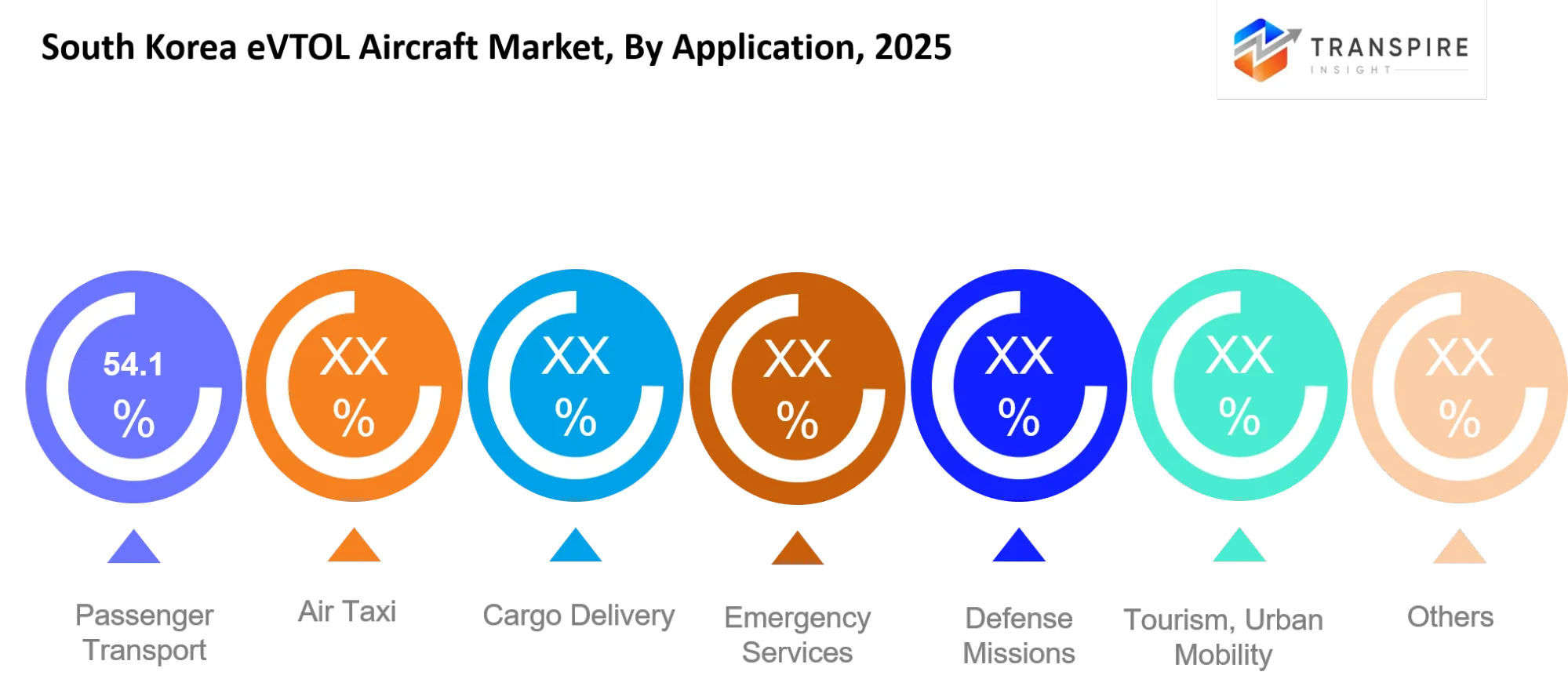
By Range :
Range segmentation will drive operational deployment in South Korea eVTOL Aircraft Market according to battery capacity and route structure. Up to 50 km distance flights are expected to become the focus during the initial adoption stage for the city shuttle segment. The 50-100 km range is expected to facilitate airport shuttling services and short commuter trips between downtown and surrounding suburban areas.
Long distance, above 100 km, would be the target segment for inter-city transport and intra-regional mobility between large economic centers. As battery density and lightweight structures of composites are expected to advance, operational distance will expand over the period. Growth in vertiport infrastructure will push deployment from intra-city applications to inter-regional corridors and linking major economic regions like industrial and coastal cities.
By End User :
End user segmentation is expected to influence the adoption velocity in the South Korea eVTOL Aircraft Market, according to the prioritization of the functions: Commercial operators are expected to remain the first to adopt the technology for air taxi and passenger mobility applications, along with logistics operators’ cargo support efficiency and emergency services’ time-sensitive responses.
Government agencies are expected to drive the infrastructure support and regulatory environment; while Defense agencies would focus on military mobility and surveillance applications. Infrastructure operators’ role of providing vertiport infrastructure and enabling air traffic management would support seamless expansion of operations to inter-city and inter-regional level, especially with public-private partnerships supporting infrastructure readiness and operations management.
What are the Key Use Cases Driving the South Korea eVTOL Aircraft Market?
Passenger mobility will remain the predominant use case in South Korea’s eVTOL Aircraft Market; in particular, covering high-traffic urban corridors when traffic causes delays in normal daily transit. High urbanization in cities such as Seoul, with dense population densities and high levels of inter-city travel in business, air-ports and residential areas, requires swift transportation solutions to shorten journeys. This will create considerable demand by replacing lengthy road-based commute time with faster- aerial routes supported by a network of vertiports to connect these locations, ultimately replacing longer roads in the corridor with flight time.
Cargo delivery and Emergency Medical transport will emerge as growing use cases. The need for quick transport times in high-urgency operations within these sectors, where logistics and rescue services frequently navigate crowded and difficult- to-reach conditions, will increase demand for time efficient flight capabilities in eVTOLs. Logistics businesses may implement eVTOLs to transport premium, high-value items between regional industrial centers while hospital and medical response units may find rapid patient transit between hospital wings or from accident sites in areas where traffic might obstruct ground ambulances very valuable.\
Defensive/ Surveillance and Offshore connectivity will emerge as more niche applications. Interest will grow in this category as governance frameworks allow, however. Government and infrastructure service operators looking to leverage the increased flight range capabilities beyond solely urban corridors will continue to advance the need for these regional aerial transport capabilities from a business opportunity standpoint.
|
Report Metrics |
Details |
|
Market size value in 2025 |
USD 0.56 Billion |
|
Market size value in 2026 |
USD 0.715 Billion |
|
Revenue forecast in 2033 |
USD 3.959 Billion |
|
Growth rate |
CAGR of 27.70% from 2026 to 2033 |
|
Base year |
2025 |
|
Historical data |
2021 - 2024 |
|
Forecast period |
2026 - 2033 |
|
Report coverage |
Revenue forecast, competitive landscape, growth factors, and trends |
|
Country scope |
South Korea |
|
Key company profiled |
Joby Aviation, Archer Aviation, Volocopter, Lilium, Eve Air Mobility, Hyundai Supernal, Vertical Aerospace, Beta Technologies, Wisk Aero, EHang, Overair, Jaunt Air Mobility, AutoFlight, Hanwha Aerospace, Korea Aerospace Industries |
|
Customization scope |
Free report customization (country, regional & segment scope). Avail customized purchase options to meet your exact research needs. |
|
Report Segmentation |
By Lift Technology (Multirotor, Lift+Cruise, Vectored Thrust, Tiltrotor, Tiltwing, Hybrid eVTOL, Autonomous eVTOL, Others); By Application (Passenger Transport, Air Taxi, Cargo Delivery, Emergency Services, Defense Missions, Tourism, Urban Mobility, Others); By Range (Below 50 km, 50–100 km, 101–200 km, 201–300 km, Above 300 km, Intercity Transport, Regional Mobility, Others); By End User (Commercial Operators, Defense Agencies, Logistics Firms, Tourism Companies, Government Agencies, Emergency Services, Infrastructure Operators, Others) |
Which Regions are Driving the South Korea eVTOL Aircraft Market Growth?
South Korea e VTOL Aircraft Market is led by Seoul Capital Area because of the highest urban population density and vigorous government executive efforts for urban air mobility. The market enjoys structured vertiport pilot programs in Seoul & Incheon with government aviation regulators preparing for managed air corridors. The highly congested commuter population enhances market accelerants for Airport-City short-haul mobility, especially with advanced corporate headquarters and digital infrastructure nearby.
Busan-Ulsan-Gyeongnam is a stable second region, its growth determined by the strength of industrial logistics and port-based economy dominated by passenger suburban travel. Large shipbuilding yards and export-oriented manufacturing clusters generate constant markets for the swift conveying and emergency industrial transports. Instead of everyday travel, airport-based urban shopping-malls are less relevant in this second region. Growth is possible only through increasing operational efficiencies in cargo trucks and offshore coordination. Please note steady air transit investments by port authority and logistics operators.
Islas de Jeju is one of the most promising islands of the network due to recent government financial initiatives on tourism mobility trials and island connectivity projects launched after 2024. Isolated location promotes using short-haul air access for inter island movements and for emergency response. Tourism stakeholders trial premium air journeys linking coastal attractions and transportation nodes. Will also open up high entry opportunities to investors as the regulation starts approving commercial routes through 2026-2033.
Who are the Key Players in the South Korea eVTOL Aircraft Market and How Do They Compete?
The South Korea eVTOL aircraft market is moderately concentrated at the technology development level but is gaining competitiveness due to market entry of global OEM and Korean aviation groups aiming for airworthiness certification and initial routes. Competition dynamics in the South Korean market revolve around factors such as technology maturity, speed of certification, and the capacity to integrate with city infrastructure and transportation networks, with pricing being only a secondary consideration.
While established players (such as aerospace manufacturers and established mobility service providers) are trying to achieve market domination through control of the urban air mobility ecosystem, new entrants are targeting certification milestones, early strategic partnerships, and integration with the planned vertiport infrastructure. Hyundai Motor Group (and Supernal) targets an ecosystem-centric approach to UAM by developing fully integrated urban air mobility services which connect vehicle operations with on-the-ground transportation networks.Hyundai's strategic advantage comes from its ability to integrate the design and manufacturing of its vehicles with mobility services, infrastructure development and operation of its chosen routes in theSeoulpilot corridors, through partnerships with airport operators and governments' initiatives forvertiportconstruction.
Joby Aviation and Archer Aviation employ a certification-centric approach, prioritizing the approval of their designs from Korean aviation authorities. Lilium is differentiated by targeting long-distance eVTOL operations to serve intercity mobility markets rather than focusing on urban air density. Korean Air is leveraging its decades of flight operations experience and infrastructure know-how to enhance flight operations capabilities and integrated flight management systems to expand its role in managingvertiportand UAM operations and coordinating flight scheduling and dispatch.
Company List
- Joby Aviation
- Archer Aviation
- Volocopter
- Lilium
- Eve Air Mobility
- Hyundai Supernal
- Vertical Aerospace
- Beta Technologies
- Wisk Aero
- EHang
- Overair
- Jaunt Air Mobility
- AutoFlight
- Hanwha Aerospace
- Korea Aerospace Industries
Recent Development News
In May 2026, Hyundai Motor Group signed a memorandum of understanding with Korea Aerospace Industries and Supernal to jointly develop advanced air mobility aircraft. The agreement strengthens Korea’s domestic supply chain by integrating airframe, propulsion, and certification capabilities for future eVTOL commercialization. Sourcehttps://www.hyundai.com/
In March 2026, Joby Aviation began participation in FAA-led eVTOL Integration Pilot Program projects, enabling early operational demonstrations in select U.S. regions. The initiative supports regulatory validation and accelerates pathway-to-market for urban air mobility services relevant to global markets including South Korea. Source https://www.flyingmag.com/
What Strategic Insights Define the Future of the South Korea eVTOL Aircraft Market?
A Key Trend Is the Move Toward a Structured South Korea eVTOL Aircraft Market: eVTOL Aircraft, Vertiports and Air Traffic Management systems are not going to be individual entities. Rather, the market is going to move toward integrated urban air mobility (UAM) systems, which is being spurred by the government-sponsored corridor planning for Seoul and growing pressure to decarbonize shorter-distance transportation will drive adoptions from pilot programs to few select commercial routes in the next 5-7 years.
One of the less-apparent but more significant risks of this development will be that the market becomes consolidated by few of ecosystem developer that will hinder the market growth, innovation and further push market toward reliance upon limited OEM-certifiable pathway for their aircraft, and when the regulations become more stringent and restricted around certain OEMs and aircraft design and certification pathways smaller technology player will have hard time.
One of the opportunities at the horizon will be the market penetration beyond the city corridor that South Korea will take in the regional corridor network (including extending into the coastal regions and island routes), connecting with cities such as Busan to Jeju with innovative hybrid logistics and passenger service routes, which will only gain further traction as electric aircraft technologies develop. The market participant needs to focus on establishing early strategic partnerships with airport authorities and Infrastructure developers to reserve future veripot space and long-term rights of route for future commercial operations of eVTOL.
South Korea eVTOL Aircraft Market Report Segmentation
By Lift Technology
- Multirotor
- Lift+Cruise
- Vectored Thrust
- Tiltrotor
- Tiltwing
- Hybrid eVTOL
- Autonomous eVTOL
By Application
- Passenger Transport
- Air Taxi
- Cargo Delivery
- Emergency Services
- Defense Missions
- Tourism
- Urban Mobility
By Range
- Below 50 km
- 50–100 km
- 101–200 km
- 201–300 km
- Above 300 km
- Intercity Transport
- Regional Mobility
By End User
- Commercial Operators
- Defense Agencies
- Logistics Firms
- Tourism Companies
- Government Agencies
- Emergency Services
- Infrastructure Operators
Frequently Asked Questions
Find quick answers to common questions.
The South Korea eVTOL Aircraft Market size is USD 3.959 Billion in 2033.
Key Segments for the South Korea eVTOL Aircraft Market are By Lift Technology (Multirotor, Lift+Cruise, Vectored Thrust, Tiltrotor, Tiltwing, Hybrid eVTOL, Autonomous eVTOL, Others); By Application (Passenger Transport, Air Taxi, Cargo Delivery, Emergency Services, Defense Missions, Tourism, Urban Mobility, Others); By Range (Below 50 km, 50–100 km, 101–200 km, 201–300 km, Above 300 km, Intercity Transport, Regional Mobility, Others); By End User (Commercial Operators, Defense Agencies, Logistics Firms, Tourism Companies, Government Agencies, Emergency Services, Infrastructure Operators, Others).
Major South Korea eVTOL Aircraft Market Players are Joby Aviation, Archer Aviation, Volocopter, Lilium, Eve Air Mobility, Hyundai Supernal, Vertical Aerospace, Beta Technologies, Wisk Aero, EHang, Overair, Jaunt Air Mobility, AutoFlight, Hanwha Aerospace, Korea Aerospace Industries.
The Current South Korea eVTOL Aircraft Market size is USD 0.56 Billion in 2025.
The South Korea eVTOL Aircraft Market CAGR is 27.70% from 2026 to 2033.
- Joby Aviation
- Archer Aviation
- Volocopter
- Lilium
- Eve Air Mobility
- Hyundai Supernal
- Vertical Aerospace
- Beta Technologies
- Wisk Aero
- EHang
- Overair
- Jaunt Air Mobility
- AutoFlight
- Hanwha Aerospace
- Korea Aerospace Industries
About the Authors

Tejashri Dhatrak
I am Tejashri Dhatrak, a Senior Research Analyst at Transpire Insight, specializing in the Aerospace and Defence sector. My work focuses on analyzing industry trends, defence technologies, market developments, and emerging innovations that shape the global aerospace and security landscape. At Transpire Insight, I research complex topics, evaluate credible sources, and transform technical insights into accurate, well-structured, and easy-to-understand content for industry professionals and decision-makers. My goal is to provide reliable, research-backed information that helps readers stay informed about defence capabilities, aerospace advancements, strategic developments, and the evolving dynamics of the global defence ecosystem.

Chakradhar Khansole
Chakradhar serves as the Research Director at Transpire Insight, bringing over 8 years of experience in technology, innovation, and strategic market intelligence. He specializes in transforming complex market data into actionable business insights that enable organizations to make informed, growth-oriented decisions. Recognized for his strategic vision and analytical expertise, Chakradhar leads high-impact research initiatives, delivering comprehensive market assessments, competitive intelligence, and forward-looking industry analysis.
Recently Published Reports
-
Apr 2026
Aerospace Fluoropolymers Market
Aerospace Fluoropolymers Market Size, Share & Analysis Report By Type (PTFE, FEP, PFA, ETFE, and Others), By Application (Electrical Insulation, Seals & Gaskets, Coatings, and Others), By End User (Commercial Aviation, Military Aviation, General Aviation, and Others), and Geography (North America, Europe, Asia-Pacific, Middle East and Africa, South and Central America), 2021 - 2031
-
Apr 2026
Airborne SATCOM System Market
Airborne SATCOM System Market Size, Share & Analysis Report By Type (SATCOM Terminals, Transceivers, Airborne Radio, Modems and Routers, SATCOM Radomes, and Other), By Application (Government and Defense and Commercial), and Geography (North America, Europe, Asia-Pacific, Middle East and Africa, South and Central America), 2021 – 2031
-
Apr 2026
Ship Leasing Market
Ship Leasing Market Size, Share & Analysis Report By Vessel Type (Container Ships, Bulk Carriers, Tankers, and Specialized Vessels), By Lease Duration (Short-Term Lease (Less than 1 year), Medium-Term Lease (1-5 years), and Long-Term Lease (More than 5 years)), By Lease Type (Bareboat Charter, Time Charter, Financial Lease, and Others), By End-User Industry (Oil and Gas, Manufacturing and Industrial, Automotive, Agriculture and Food, Retail and Consumer Goods, and Others), and Geography (North America, Europe, Asia-Pacific, Middle East and Africa, South and Central America), 2021 – 2031
-
Apr 2026
Thread Rolling Dies Market
Thread Rolling Dies Market Size, Share & Analysis Report By Type (Flat Thread Rolling Dies, Circular (Cylindrical) Dies, Tangential Thread Rolling Dies, Planetary Thread Rolling Dies, and Other Types), By Material Type (High-Speed Steel (HSS), Carbide, Tool Steel, Alloy Steel, and Other Specialized Alloys), By Distribution Channel (Direct Sales, Distributors and Dealers, and Online Platforms), By Application (Automotive Industry, Aerospace and Defense, Construction and Infrastructure, Industrial Machinery, Electronics and Electrical Components, Medical Devices, and Fastener Production), and Geography (North America, Europe, Asia-Pacific, Middle East and Africa, South and Central America), 2021 – 2031
Our Clients





