
South Korea EVOH Films for Packaging Market Summary
As per Transpire Insight Analysis, the South Korea EVOH Films for Packaging Market size is estimated at USD 5.86 Million in 2025 and is anticipated to reach USD 9.71 Million by 2033, growing at a CAGR of 6.52% from 2026 to 2033.
EVOH films really offer South Korean packaging manufacturers an extremely reliable method of blocking oxygen - thereby keeping food, pharmaceuticals, and cosmetics fresh for much longer. Brand owners depend heavily on this barrier property since it preserves taste, extends shelf life, and significantly reduces product waste all along the cold chain. In recent years, the market shifted towards even thinner, multilayer film structures combining EVOH with polyolefins, because that helps lower costs whilst maintaining those very effective barrier characteristics. Manufacturers have also put more effort into developing recyclable and single-material formats - responding to South Korea's increasingly strict packaging waste regulations. The pandemic period actually increased demand further, as consumption of pre-packaged foods rose and home delivery services required stronger, longer-lasting packaging materials.
Now, as South Korean converters continually upgrade their co-extrusion lines and food companies consistently prefer flexible pouches over rigid containers, EVOH films are becoming a typical barrier layer across a much broader variety of packaged products - which continues to create many new business opportunities for both resin producers and film converters alike.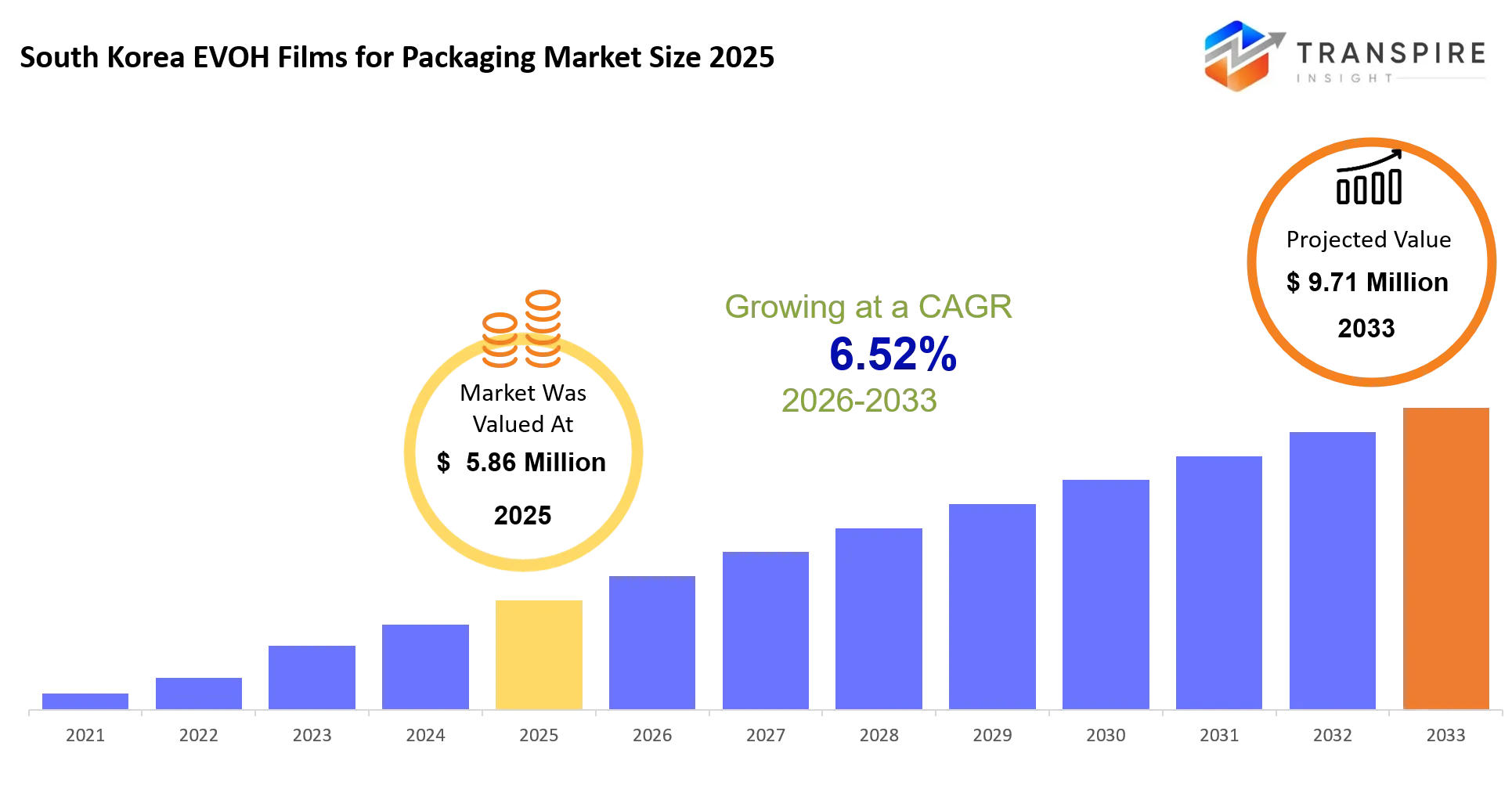
South Korea EVOH Films for Packaging Market Size & Forecast:
South Korea EVOH Films for Packaging Market Size 2025: USD 5.86 Million
Expected Market Value 2033: USD 9.71 Million
Forecast CAGR: 6.52%
Leading segment in 2025: Food Packaging
Fastest Growing segment: Multilayer EVOH Films
Key Profile: Kuraray Co. Ltd., Mitsubishi Chemical, Nippon Gohsei, Coveris Holdings, Sealed Air Corporation, Winpak Ltd., Amcor plc, Mondi Group, Toray Industries, Berry Global, Toppan Printing, Uflex Ltd., Schur Flexibles, Huhtamaki, Cosmo Films
Key Market Insights
- Food packaging really drives consumption of EVOH films in South Korea - holding almost 86% market share by 2025 - because of the country's highly developed packaged food and ready meal sector.
- Multilayer EVOH films are expected to grow the fastest over the next few years, since converters continue to prefer layered structures that offer a perfect balance between barrier performance and material cost.
- Monolayer EVOH films still have a significant presence among specialty packaging users who require extremely high oxygen resistance - without additional layers being added.
- Pharmaceutical packaging is gaining speed as local pharmaceutical manufacturers rely more heavily on EVOH barriers to safeguard moisture-sensitive formulations from damage.
- Flexible packaging remains by far the most common type of packaging since pouches and wraps can be produced at much higher volumes and shipped at significantly lower costs.
- High oxygen barrier films experience the greatest demand due to how much South Korean food exporters depend on extended shelf life during transportation itself.
- The food and beverages sector remains the biggest end-user group, thanks to the country's densely packed retail and convenience store networks everywhere you go.
- Cosmetic packaging has started to emerge as a somewhat smaller yet consistently expanding application - all thanks to South Korea's well-known worldwide beauty product exports.
What are the Key Drivers, Restraints, and Opportunities in the South Korea EVOH Films for Packaging Market?
South Korea's expanding packaged food industry - driven by busier lives and a growing desire for convenient meals - really drives this market forward. EVOH resin offers converters a superior barrier layer that blocks oxygen even better than many alternatives, allowing foods to stay fresh for much longer - all without needing bulky, heavy packaging. As retailers develop their own private-label ready meals and exporters ship highly perishable items internationally, film manufacturers are increasing their co-extrusion capacity to keep up. The consistent increase in packaged food volumes translates directly into regular resin orders and stronger long-term supply contracts for EVOH producers.
The biggest constraint is cost. EVOH resin actually costs significantly more than regular polyolefins - and that price difference really deters smaller converters from switching over, particularly if they're operating with very tight profit margins on commodity packaging. Our import dependence on specialized EVOH grades also exposes us to currency fluctuations and shipping delays because so much of South Korea's high-quality resin supply still originates overseas. These challenges further delay adoption within cost-conscious packaging areas and keep some manufacturers stuck using older, lower-barrier film structures.
The best opportunity really exists in sustainable, recyclable EVOH structures. South Korea's packaging waste regulations are getting much tougher, and major brand owners are now actively seeking out barrier films that will still work perfectly within single-material recycling systems. Companies that create even thinner, more recyclable EVOH laminates will likely win favor both from regulators and from environmentally aware consumers, creating an opening for higher prices and longer-term partnerships with major food and personal care brands.
What Has the Impact of Artificial Intelligence Been on the South Korea EVOH Films for Packaging Market?
Artificial intelligence continues to fundamentally change how South Korean film converters handle production quality and resin consumption. AI-powered vision systems scan extruded film for pinholes, changes in thickness, and lamination defects in real-time - detecting issues even before a full roll is lost. This sort of inline monitoring significantly decreases scrap rates and enables facilities to hold much stricter tolerances on barrier performance - something that really counts if a client has paid extra for oxygen protection itself.
Machine learning also assists with formulation tasks. Resin suppliers employ predictive models to evaluate how different EVOH blends act under varying temperatures and humidity levels - greatly speeding up development of recyclable multi-layer structures by running fewer actual tests. Manufacturers are using similar methods to forecast raw material requirements, aligning EVOH resin deliveries with anticipated order quantities so facilities don't run low during the peak packaging seasons.
Yet, adoption does have its limits. Quite a few medium-sized converters in South Korea still operate older extrusion lines that weren't designed with sensor integration - making it necessary to invest quite a bit of money to retrofit them for AI monitoring. Data from separate machines is usually difficult to standardize, which really slows down how fast predictive tools can be implemented across an entire plant. Consequently, AI adoption mainly occurs among the bigger film manufacturers at first - whereas smaller operators will gradually catch up.
Key Market Trends
- Since 2023, converters have leaned harder into thinner multilayer EVOH structures to cut material cost while holding onto barrier performance.
- Recyclable mono-material film development picked up pace through 2024 and 2025, pushed along by South Korea's tightening packaging waste rules.
- Food exporters have been requesting higher oxygen barrier specifications, since longer shipping routes demand stronger shelf life protection.
- Cosmetic brands began adopting EVOH barrier films more visibly after 2023, tied to packaging that needs to protect sensitive formulations.
- Domestic resin producers have been investing in co-extrusion capacity to reduce reliance on imported EVOH grades.
- Pharmaceutical packaging demand for moisture and oxygen barriers grew steadily between 2023 and 2025.
- Retailers pushing private label ready meals have driven up flexible pouch volumes that use EVOH interlayers.
- Strategic partnerships between resin suppliers and film converters expanded in the 2023 to 2025 window to secure long-term supply.
South Korea EVOH Films for Packaging Market Segmentation
By Film Type:
Multilayer EVOH films lead adoption because they blend barrier performance with manageable production cost, letting converters keep packaging affordable while still meeting shelf life targets. Monolayer EVOH films serve niche cases where very high barrier strength is needed without extra layering, particularly in specialty pharmaceutical and premium food packaging. Co-extruded EVOH films are gaining traction since combined manufacturing steps reduce processing time and improve consistency across production runs. Other film types continue to serve smaller specialty applications, as ongoing material research keeps opening new barrier packaging formats for South Korean converters.
By Application:
Food packaging dominates demand, since South Korea's packaged food and ready meal sector relies heavily on oxygen barrier protection to preserve freshness. Pharmaceutical packaging is expanding steadily as drug makers seek moisture and oxygen resistant materials for sensitive formulations. Cosmetic packaging keeps growing too, tied to the country's strong beauty product export industry, where product stability during shipping really matters. Industrial packaging and other applications round out demand, supported by chemical and specialty goods that need reliable barrier protection during storage and transit.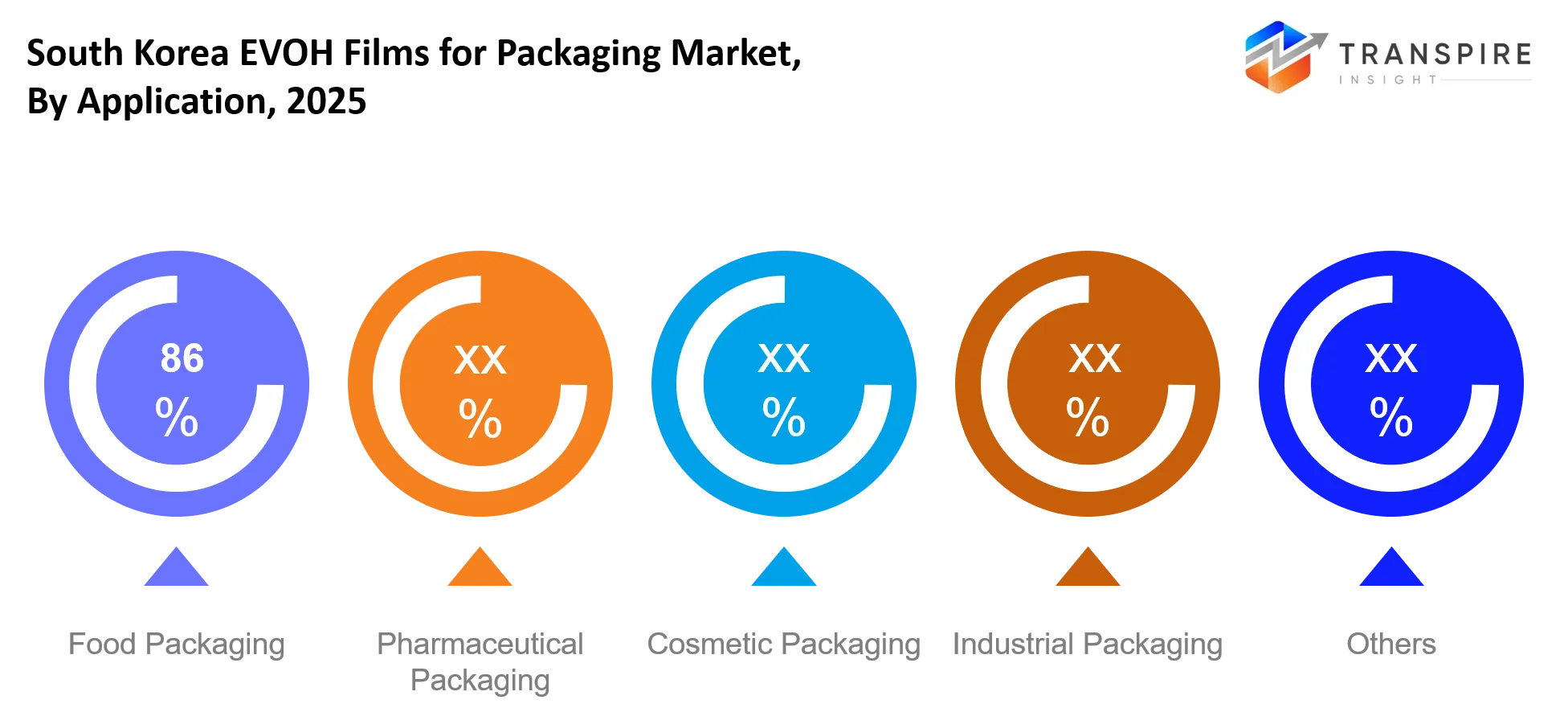
By End User:
The food and beverage industry remains the largest end user, driven by dense retail networks and steady packaged food consumption across the country. The pharmaceutical industry follows, supported by growing domestic drug manufacturing and stricter packaging standards. The cosmetics industry is expanding its use of EVOH films as export volumes rise and brands look for dependable barrier protection. The consumer goods industry and other end users continue contributing modest but steady demand as packaging needs diversify.
By Packaging Type:
Flexible packaging holds the largest share, since pouches and film wraps are cheaper to produce and ship than rigid alternatives, while still meeting barrier requirements. Rigid packaging keeps a smaller but stable role in premium food and cosmetic products where structural protection matters as much as barrier strength. Vacuum packaging is growing steadily too, especially for perishable food items that need both oxygen exclusion and tight sealing. Other packaging types continue to serve specialized applications across the broader industry.
By Barrier Property:
High oxygen barrier films lead this segment, since food exporters and pharmaceutical packagers need the strongest possible protection against spoilage and degradation. Medium barrier films serve products with shorter shelf life requirements, offering a more cost-effective option for everyday packaged goods. Moisture-resistant films are gaining ground as combined humidity and oxygen protection becomes more important for sensitive formulations. Other barrier property films continue to address specialized packaging needs across South Korea's manufacturing base.
|
Report Metrics |
Details |
|
Market size value in 2025 |
USD 5.86 Million |
|
Market size value in 2026 |
USD 6.24 Million |
|
Revenue forecast in 2033 |
USD 9.71 Million |
|
Growth rate |
CAGR of 6.52% from 2026 to 2033 |
|
Base year |
2025 |
|
Historical data |
2021 - 2024 |
|
Forecast period |
2026 - 2033 |
|
Report coverage |
Revenue forecast, competitive landscape, growth factors, and trends |
|
Regional scope |
South Korea |
|
Key company profiled |
Kuraray Co. Ltd., Mitsubishi Chemical, Nippon Gohsei, Coveris Holdings, Sealed Air Corporation, Winpak Ltd., Amcor plc, Mondi Group, Toray Industries, Berry Global, Toppan Printing, Uflex Ltd., Schur Flexibles, Huhtamaki, Cosmo Films |
|
Customization scope |
Free report customization (country, regional & segment scope). Avail customized purchase options to meet your exact research needs. |
|
Report Segmentation |
By Film Type (Monolayer EVOH Films, Multilayer EVOH Films, Co-extruded EVOH Films, Others); By Application (Food Packaging, Pharmaceutical Packaging, Cosmetic Packaging, Industrial Packaging, Others); By End User (Food & Beverage Industry, Pharmaceutical Industry, Cosmetics Industry, Consumer Goods Industry, Others); By Packaging Type (Flexible Packaging, Rigid Packaging, Vacuum Packaging, Others); By Barrier Property (High Oxygen Barrier Films, Medium Barrier Films, Moisture-resistant Films, Others) |
What are the Key Use Cases Driving the South Korea EVOH Films for Packaging Market?
Packaged food preservation is the leading use case, since South Korean retailers and food manufacturers depend on EVOH barrier layers to keep ready meals, snacks, and processed foods fresh through longer retail cycles. Convenience stores and grocery chains push high turnover of packaged goods, and reliable barrier protection keeps waste down while supporting export shipments that travel further and take longer to reach shelves.
Pharmaceutical and cosmetic packaging represent a growing use case, as domestic drug makers and beauty brands look for materials that protect sensitive formulations from oxygen and moisture exposure. South Korea's strong cosmetics export industry in particular benefits from barrier films that keep products stable during international shipping, protecting brand reputation across overseas markets.
Looking ahead, sustainable packaging redesign is emerging as a fresh use case, with brand owners and converters working together to build EVOH structures that fit within mono-material recycling streams. This shift is being pushed along by tightening domestic regulations and by consumer expectations that packaging waste keep shrinking without sacrificing product protection.
Which Regions are Driving the South Korea EVOH Films for Packaging Market Growth?
The Seoul Capital Area remains the dominant contributor to national demand, since the region concentrates the largest share of food processing plants, cosmetic brand headquarters, and packaging converters. Strong retail infrastructure and dense population centers keep packaged food turnover high, and that steady consumption supports continuous EVOH film orders. Converters based near Seoul and Incheon also benefit from proximity to major ports, which eases both resin imports and finished product exports.
The Gyeongsang Region follows as a strong secondary contributor, supported by its established manufacturing base and growing food processing activity around Busan and Daegu. Industrial packaging demand also holds steady here, tied to the region's chemical and consumer goods production. Investment in modernized extrusion facilities continues to strengthen the region's role in the broader EVOH films supply chain.
Other regions, including the Chungcheong and Jeolla areas, are expected to see the fastest growth through 2033 as food processing and pharmaceutical manufacturing capacity expands outside the capital region. Government incentives supporting regional industrial development, along with rising packaged food exports, are helping these areas attract new converting investment and diversify the national supply base.
Who are the Key Players in the South Korea EVOH Films for Packaging Market and How Do They Compete?
Competition in this market stays moderately consolidated, since producing high barrier EVOH resin and films requires specialized manufacturing know-how and consistent quality control. Rather than competing purely on price, companies differentiate through barrier performance, recyclability credentials, and how reliably they can supply large converters and brand owners on schedule.
Kuraray Co. Ltd. holds a strong position through its long-standing EVOH resin expertise and continued investment in recyclable film technology. Mitsubishi Chemical and Nippon Gohsei compete through material innovation and close partnerships with regional converters, helping them tailor barrier grades to specific packaging needs. Toray Industries and Cosmo Films add further competition through film manufacturing scale and export reach across Asian packaging markets.
Global packaging groups such as Amcor plc, Mondi Group, Berry Global, and Sealed Air Corporation compete by integrating EVOH layers into broader flexible packaging portfolios, letting customers source multiple barrier solutions from one supplier. Winpak Ltd., Coveris Holdings, Schur Flexibles, Huhtamaki, Toppan Printing, and Uflex Ltd. continue expanding regional converting capacity and sustainable film offerings, keeping the competitive field active across South Korea's packaging industry.
Company List
Mitsubishi Chemical
Coveris Holdings
Sealed Air Corporation
Winpak Ltd.
Amcor plc
Toray Industries
Toppan Printing
Uflex Ltd.
Schur Flexibles
Huhtamaki
Cosmo Films
Recent Development News
In March 2026, Kuraray Co. Ltd. announced an expansion of its EVA and EVOH resin production capacity to meet rising demand for high barrier, recyclable packaging films across Asian markets. The investment strengthens supply reliability for South Korean converters seeking sustainable barrier solutions. Source https://www.kuraray.com/
In late 2025, Mitsubishi Chemical expanded its specialty barrier film development programs, focusing on thinner multilayer EVOH structures designed for mono-material recycling compatibility. The move supports growing demand from South Korean food and cosmetic packaging brands seeking sustainable barrier options. Source https://www.mitsubishichem-hd.co.jp/
What Strategic Insights Define the Future of the South Korea EVOH Films for Packaging Market?
Over the next five to seven years, the South Korea EVOH Films for Packaging Market is likely to lean further into recyclable, mono-material barrier structures, supported by tightening national packaging regulations and rising brand commitments to sustainability. This shift should widen adoption of EVOH films across food, pharmaceutical, and cosmetic packaging while keeping barrier performance intact.
A quieter risk sits in resin import dependence, since much of South Korea's advanced EVOH supply still comes from overseas producers, leaving converters exposed to currency shifts and shipping disruptions during periods of tight global supply.
The clearest opportunity lies in combining barrier innovation with domestic manufacturing investment. Companies that build local co-extrusion capacity, develop thinner recyclable film structures, and strengthen partnerships with major food and cosmetic brands will likely improve long-term competitiveness while reducing exposure to import related supply risk.
South Korea EVOH Films for Packaging Market Report Segmentation
By Film Type
Monolayer EVOH Films
Multilayer EVOH Films
Co-extruded EVOH Films
By Application
Food Packaging
Pharmaceutical Packaging
Cosmetic Packaging
Industrial Packaging
By End User
Food & Beverage Industry
Pharmaceutical Industry
Cosmetics Industry
Consumer Goods Industry
By Packaging Type
Flexible Packaging
Rigid Packaging
Vacuum Packaging
By Barrier Property
High Oxygen Barrier Films
Medium Barrier Films
Moisture-resistant Films
Frequently Asked Questions
Find quick answers to common questions.
The expected South Korea EVOH Films for Packaging Market size will be USD 9.71 Million in 2033.
Key Segments for the South Korea EVOH Films for Packaging Market are By Film Type (Monolayer EVOH Films, Multilayer EVOH Films, Co-extruded EVOH Films, Others); By Application (Food Packaging, Pharmaceutical Packaging, Cosmetic Packaging, Industrial Packaging, Others); By End User (Food & Beverage Industry, Pharmaceutical Industry, Cosmetics Industry, Consumer Goods Industry, Others); By Packaging Type (Flexible Packaging, Rigid Packaging, Vacuum Packaging, Others); By Barrier Property (High Oxygen Barrier Films, Medium Barrier Films, Moisture-resistant Films, Others).
What is the Current Market size of the South Korea EVOH Films for Packaging Market?
The Current South Korea EVOH Films for Packaging Market size is USD 5.86 Million in 2025.
The South Korea EVOH Films for Packaging Market CAGR is 6.52% from 2026 to 2033.
Kuraray Co. Ltd.
Mitsubishi Chemical
Nippon Gohsei
Coveris Holdings
Sealed Air Corporation
Winpak Ltd.
Amcor plc
Mondi Group
Toray Industries
Berry Global
Toppan Printing
Uflex Ltd.
Schur Flexibles
Huhtamaki
Cosmo Films
About the Authors

Kartik bhong
I am Kartik Bhong, a Senior Research Analyst at Transpire Insight, specializing in the Packaging, Manufacturing, and Construction industry. My work focuses on analyzing market trends, emerging technologies, industry regulations, and competitive landscapes to deliver accurate, data-driven insights. I am passionate about transforming complex industry information into clear, practical content that helps businesses, professionals, and decision-makers stay informed and make confident strategic decisions. Through continuous research and a strong commitment to accuracy, I strive to create reliable, well-researched content that reflects the latest developments across these dynamic industries and supports the vision of Transpire Insight in delivering valuable market intelligence.

Chakradhar Khansole
Chakradhar serves as the Research Director at Transpire Insight, bringing over 8 years of experience in technology, innovation, and strategic market intelligence. He specializes in transforming complex market data into actionable business insights that enable organizations to make informed, growth-oriented decisions. Recognized for his strategic vision and analytical expertise, Chakradhar leads high-impact research initiatives, delivering comprehensive market assessments, competitive intelligence, and forward-looking industry analysis.
Recently Published Reports
-
Apr 2026
Pharmaceutical Cold Chain Packaging Market
Pharmaceutical Cold Chain Packaging Market By Material (Plastic,(Polyethylene (PE), Polypropylene (PP), Polyethylene Terephthalate (PET), Expanded Polystyrene (EPS), Polyurethane (PU),Others), Paper, Metal, Others), By Product (Small Boxes, Pallets, Large Sized Pallet Containers, Others), By End Use (Biopharmaceutical Companies, Clinical Research Organizations, Hospitals, Research Institutes, Logistics and Distribution Companies, Others)”, By Industry Analysis, Size, Share, Growth, Trends, and Forecasts 2026-2033
-
Apr 2026
Active & Intelligent Packaging Market
Active & Intelligent Packaging Market By Type (Active Packaging, Smart Packaging), By Material (Polymer-Based, Paper & Board-Based, Metal-Based, Glass-Based), By Technology (Time-Temperature Indicators, Freshness Indicators, RFID, Antimicrobial Packaging, Modified Atmosphere Packaging), By Application (Food & Beverages, Pharmaceutical, Cosmetics & Personal Care, Electronics & Consumer Goods, Others), By Industry Analysis, Size, Share, Growth, Trends, and Forecasts 2026-2033
-
Apr 2026
Biodegradable Cut Flower Packaging Market
Biodegradable Cut Flower Packaging Market By Material Type (Paper & Paperboard, Biodegradable Plastics, Natural Fibers, Molded Pulp, Others), By Product Type (Sleeves, Wraps, Boxes & Cartons, Bags & Pouches, Inserts & Holders), By Application (Roses, Carnations, Tulips, Chrysanthemums, Mixed Flowers, Others) and By Distribution Channel (Direct Sales, Distributors & Wholesalers, Online Channels), By Industry Analysis, Size, Share, Growth, Trends, and Forecasts 2026-2033
-
May 2026
Pharmaceutical Packaging Market
Pharmaceutical Packaging Market By Material Type (Plastic, Glass, Metal, Paper & Paperboard, Others), By Packaging Type (Bottles, Blister Packs, Vials, Ampoules, Pouches & Sachets, Others) and By End User (Hospitals & Clinics, Retail Pharmacies, Online Pharmacies, Pharmaceutical Manufacturers), By Industry Analysis, Size, Share, Growth, Trends, and Forecasts 2026-2033