
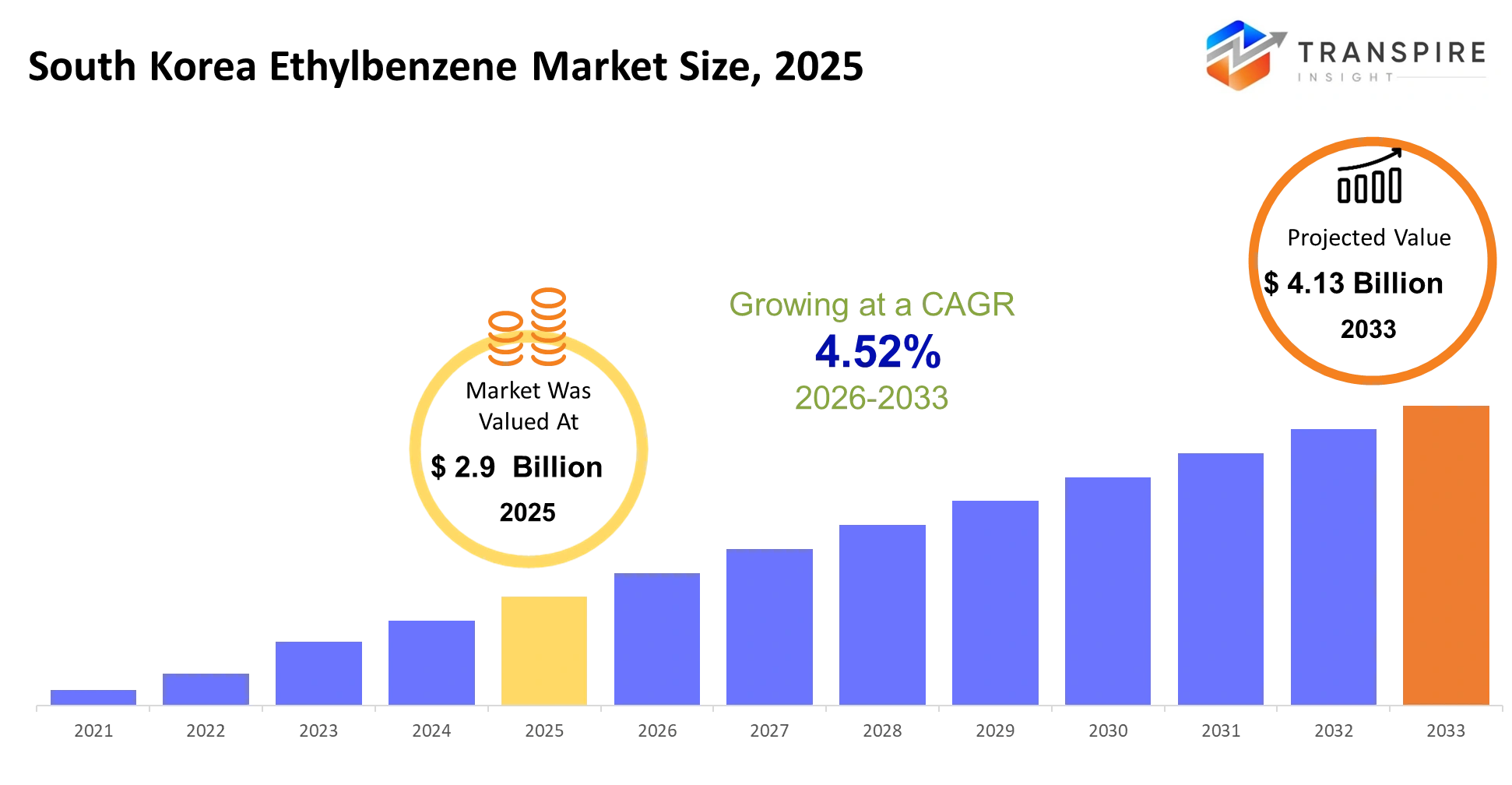
South Korea Ethylbenzene Market Size & Forecast:
- South Korea Ethylbenzene Market Size 2025: USD 2.9 Billion
- South Korea Ethylbenzene Market Size 2033: USD 4.13 Billion
- South Korea Ethylbenzene Market CAGR: 4.52%
- South Korea Ethylbenzene Market Segments: By Type (Industrial Grade, Chemical Grade, High Purity), By Application (Styrene Production, Plastics, Synthetic Rubber, Chemicals), By End-User (Chemical Companies, Industrial Manufacturers, Refineries, Plastics Industry)
To learn more about this report,  Download Free Sample Report
South Korea Ethylbenzene Market Summary:
South Korea Ethylbenzene Market size was estimated at USD 2.9 Billionin 2025 and is anticipated to reach USD 4.13 Billion by 2033, growing at a CAGR of 4.52% from 2026 to 2033. The petrochemical industry in South Korea depends on three factors which include refinery production and export supply networks and changes in styrene market requirements. Producers achieve their production goals through the implementation of stricter emissions regulations and energy efficiency standards which they combine with advanced catalyst systems and digital process controls that guarantee stable product quality across their manufacturing facilities.
Demand for lightweight plastic materials in automotive and packaging applications will affect manufacturing processes while companies will direct their investments towards environmentally friendly practices because of increased environmental regulations and carbon emissions reduction requirements. Companies will use three main strategies which include automation systems and data-based performance tracking and adaptable resource management to deal with changes in customer demand and interruptions in product supply throughout the upcoming years.
Key Market Trends & Insights:
- The South Korea Ethylbenzene Market experiences continuous growth because of high demand for styrene production. Styrene remains essential for plastics production and packaging creation and automotive component manufacturing. The growth of downstream industries will lead to permanent ethylbenzene demand because manufacturers will develop reliable supply chains and maintain cost-effective operations to fulfill their industrial requirements.
- The petrochemical centers in South Korea produce ethylbenzene while operating their refineries. The process creates operational advantages because it reduces costs and enhances productivity. The South Korea Ethylbenzene Market operates through existing infrastructure which allows manufacturers to produce competitively while satisfying both domestic market requirements and international export standards.
- The South Korean environmental rules create difficulties for companies that produce ethylbenzene because of their strict requirements. Businesses have started to adopt green technologies while establishing systems that help them track their emissions. The South Korea Ethylbenzene Market shows forward progress toward environmentally friendly business operations because companies implement system upgrades which help them meet required standards without reducing their business productivity.
- The production costs experienced fluctuations because of changing crude oil and benzene market prices. The South Korea Ethylbenzene Market uses pricing adjustments and sourcing methods to manage market fluctuations. The industry monitors global feedstock changes to maintain profit margins and safeguard against unanticipated inventory deficiencies.
- South Korea stands as a leading petrochemical exporter in the global market. The South Korea Ethylbenzene Market operates through established trade connections which exist throughout Asia. Producers focus on expanding export volumes while ensuring product quality and compliance with international standards, which helps them to establish their presence in global markets for extended periods. The South Korean market for ethylbenzene can be divided into different segments.
South Korea Ethylbenzene Market Segmentation
By Type:
- Industrial Grade: Industrial grade material functions as a constant asset for large-scale production operations which do not require complete material purity. The segment serves two purposes which include bulk chemical processing operations and heavy industrial applications that prioritize cost efficiency over product quality. Industries will maintain stable demand because they require both high production levels and dependable supply chain operations.
- Chemical Grade: Chemical grade material is widely preferred for balanced performance and moderate purity standards. The segment provides support for applications which require both quality control and cost management. Many manufacturers choose this grade for intermediate production steps, ensuring reliable reactions without the need for highly refined inputs.
- High Purity: High purity material will gain importance in specialized applications where precision and minimal contamination are essential. The segment enables both advanced chemical synthesis work and delicate industrial operations. The demand for refined outputs will drive growth because even small impurities decrease product quality and performance.
By Application:
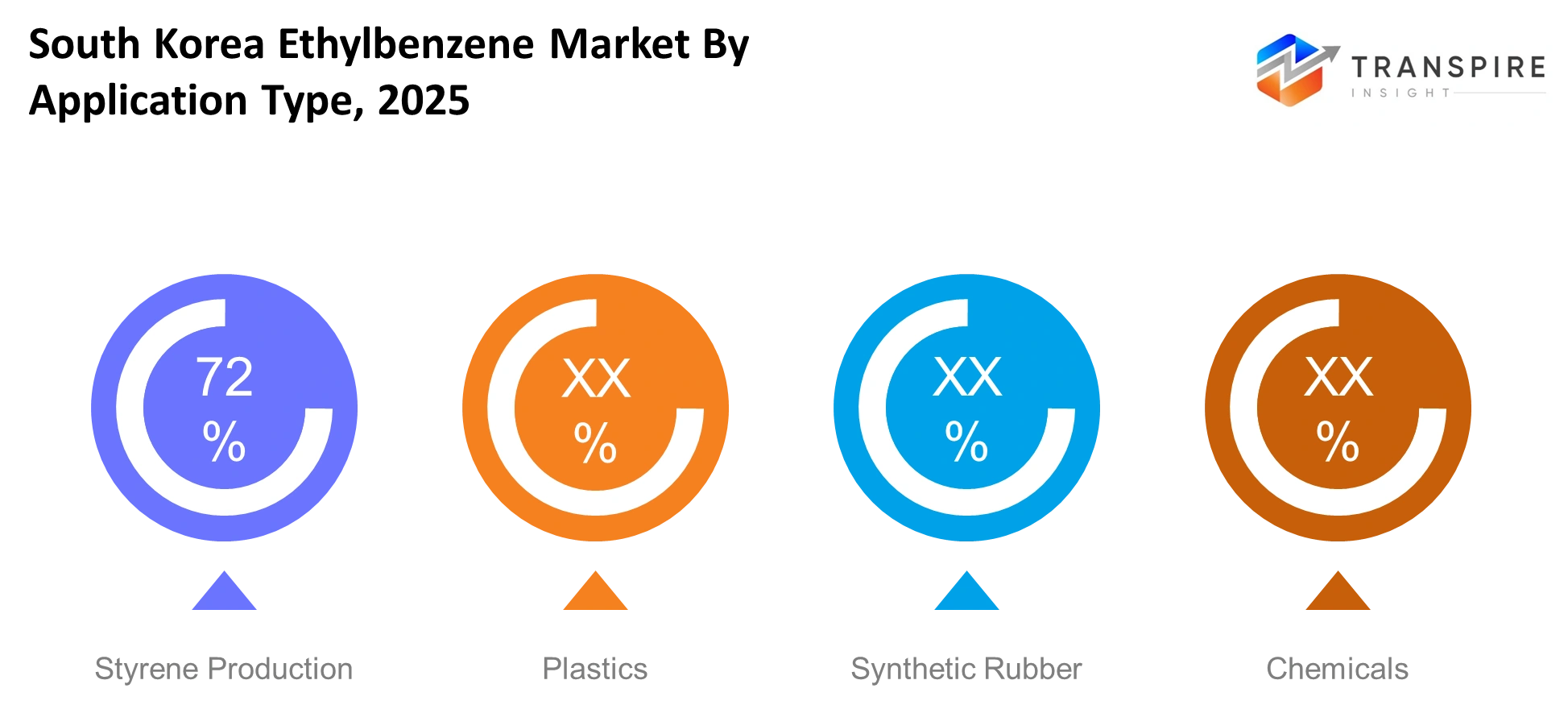
- Styrene Production: The manufacturing sector requires strong demand for styrene which serves as the primary feedstock for its production process. The packaging materials and building components that this application produces will maintain their status as the most important industrial application. The industrial sector will maintain its need for this business unit because it enables companies to produce their products through industrial processes.
- Plastics: The production of plastics will experience continuous growth because people around the world demand materials that can withstand wear while remaining lightweight. The application provides support to multiple industries which include automotive and consumer goods. The segment will stay operational because customers continue to buy products which manufacturers will produce through advanced methods that enable high production rates.
- Synthetic Rubber: The production of synthetic rubber needs chemical materials which provide the final products with both flexible and strong properties. This segment will see steady demand from automotive and industrial sectors. The development of this market will be fueled by the persistent demand for tires and rubber products which various industries need.
- Chemicals: The chemical production process creates chemical components which enable multiple products to be manufactured in industrial operations. The segment will keep its value because businesses need chemical materials to support their various production activities. The chemical industry will maintain its need for supply because its operations depend on precise chemical reactions and materials that stay available at all times.
To learn more about this report, Download Free Sample Report
By End-User:
- Chemical Companies: The production requirements together with their extensive operations make chemical companies into major customers who use our services. The industrial sector will create ongoing demand which results from its continuous operational activities. Our primary objective is to achieve efficient performance which enables us to produce different products at constant output levels.
- Industrial Manufacturers: Industrial manufacturers require continuous material delivery to support their production needs. The manufacturing industry will create constant demand for this segment because production activities will increase throughout different industries. The organization will concentrate on acquiring materials at low costs while ensuring high quality standards to maintain its operational activities and its future manufacturing operations.
- Refineries: Refineries use this material as part of integrated processing systems where multiple outputs are generated. The segment remains vital because it provides essential support for complex refining processes. Demand will be determined by total refinery production activities and the requirement to achieve balanced operational output.
- Plastics Industry: The plastics industry requires continuous supply of raw materials to support its production operations which handle high-volume manufacturing. The segment will continue to expand because various industries maintain strong demand for plastic products. The company will concentrate on producing goods at fast rates while ensuring that we have sufficient raw materials for operational needs.
Country Insights
- The ethylbenzene market in South Korea experiences continuous demand because petrochemical plants operate at full capacity and manufacturing plants use styrene for their production needs. The coastal industrial complexes enable companies to transport raw materials while delivering their products to international markets. The government will use its industrial stability policies and environmental protection regulations to determine both production methods and future industry development.
- The processing facilities of domestic companies remain advanced because they enable companies to produce output with consistent quality while managing their expenses. The company achieves ongoing business operations through its connections to downstream markets that include plastics and resins. The South Korea Ethylbenzene Market operates through established distribution networks which enable refiners and chemical producers to collaborate, enabling businesses to function normally even when there are changes in international feedstock costs.
- The market expansion depends on export activities while Asian regional trade connections improve market accessibility. The establishment of strategic port facilities through construction work creates efficient transportation systems that support the quick transportation of chemical shipments to their destination points. The industry will experience a shift toward cleaner technologies and efficiency upgrades because companies will need to comply with stricter environmental regulations which will control their investment and operational expansion decisions.
Recent Development News
In Feb 2026, the South Korean government authorized its initial petrochemical industry restructuring agreement which included a three-year operational halt of a primary cracker facility that could produce 1.1 million tons annually in order to decrease market excesses.
In Feb 2026, the petrochemical industry in South Korea experienced significant operational deficits during 2025 because derivative products such as styrene and ethylbenzene showed extremely low profit margins.
|
Report Metrics |
Details |
|
Market size value in 2025 |
USD 2.9 Billion |
|
Market size value in 2026 |
USD 3.03 Billion |
|
Revenue forecast in 2033 |
USD 4.13 Billion |
|
Growth rate |
CAGR of 4.52% from 2026 to 2033 |
|
Base year |
2025 |
|
Historical data |
2021 - 2024 |
|
Forecast period |
2026 - 2033 |
|
Report coverage |
Revenue forecast, competitive landscape, growth factors, and trends |
|
Country scope |
South Korea |
|
Key company profiled |
ExxonMobil, Shell, BP, Chevron, TotalEnergies, BASF, Dow, LyondellBasell, INEOS, Sinopec, Reliance, LG Chem, SK Innovation, Hanwha, Formosa Plastics |
|
Customization scope |
Free report customization (country, regional & segment scope). Avail customized purchase options to meet your exact research needs. |
|
Report Segmentation |
By Type (Industrial Grade, Chemical Grade, High Purity), By Application (Styrene Production, Plastics, Synthetic Rubber, Chemicals), By End-User (Chemical Companies, Industrial Manufacturers, Refineries, Plastics Industry) |
Key South Korea Ethylbenzene Company Insights
- The South Korea Ethylbenzene market shows stable production rates which match the requirements of downstream industries that produce styrene for plastics and resins. The major companies of the industry work to achieve stable production rates while they strive to boost their efficiency. Companies will maintain their market position through process enhancements and facility improvements which will not lead to extra supply distribution problems in their domestic and international markets.
- The South Korea Ethylbenzene market shows competitive dynamics which exist between two groups of competitors: major integrated petrochemical companies and specialized manufacturing entities. Long-term supply agreements with styrene producers strengthen stability in revenue streams. The strategic planning process will maintain its focus on three essential elements which include cost control and feedstock security and environmental regulation compliance to support gradual organizational growth while adapting to changes in manufacturing resource utilization.
South Korea Ethylbenzene Market Companies:
- ExxonMobil
- Shell
- BP
- Chevron
- TotalEnergies
- BASF
- Dow
- LyondellBasell
- INEOS
- Sinopec
- Reliance
- LG Chem
- SK Innovation
- Hanwha
- Formosa Plastics
South Korea Ethylbenzene Market Segmentation
By Type
- Industrial Grade
- Chemical Grade
- High Purity
By Application
- Styrene Production
- Plastics
- Synthetic Rubber
- Chemicals
By End-User
- Chemical Companies
- Industrial Manufacturers
- Refineries
- Plastics Industry
Frequently Asked Questions
Find quick answers to common questions.
The approximate South Korea Ethylbenzene Market size for the market will be USD 4.13 Billion in 2033.
Key segments for the South Korea Ethylbenzene Market are By Type (Industrial Grade, Chemical Grade, High Purity), By Application (Styrene Production, Plastics, Synthetic Rubber, Chemicals), By End-User (Chemical Companies, Industrial Manufacturers, Refineries, Plastics Industry).
Major South Korea Ethylbenzene Market players are ExxonMobil, Shell, BP, Chevron, TotalEnergies, BASF, Dow, LyondellBasell, INEOS, Sinopec, Reliance, LG Chem, SK Innovation, Hanwha, Formosa Plastics.
The South Korea Ethylbenzene Market size is USD 2.9 Billion in 2025.
The South Korea Ethylbenzene Market CAGR is 4.52%.
- ExxonMobil
- Shell
- BP
- Chevron
- TotalEnergies
- BASF
- Dow
- LyondellBasell
- INEOS
- Sinopec
- Reliance
- LG Chem
- SK Innovation
- Hanwha
- Formosa Plastics
Recently Published Reports
-
May 2026
Healthcare Polymer Packaging Market
Healthcare Polymer Packaging Market Size, Share & Analysis Report By Packaging Type (Syringes, IV Bottles and Pouches, Clamshells, Blisters, Bottles & Jars, Containers, Tubes, IV Parental Packaging, Others), By Type (Regulated, Non-regulated), By Polymer Type (LDPE (Low-Density Polyethylene), HDPE (High-Density Polyethylene), Homo-polymer (Homo), Random Copolymer (Random), Block Copolymer (Block), PET, Polystyrene, Polyvinyl Chloride, Polyamide/EVOH, Others), and Geography (North America, Europe, Asia-Pacific, Middle East and Africa, South and Central America), 2021 - 2031
-
Apr 2026
Hydrophilic Tape (Waterstop) Market
Hydrophilic Tape (Waterstop) Market Size, Share & Analysis Report By Type (Bentonite-Based Hydrophilic Tape, Rubber-Based Hydrophilic Tape), By Application (Residential Buildings, Commercial Buildings, Infrastructure Projects), and Geography (North America, Europe, Asia-Pacific, Middle East and Africa, South and Central America), 2021 - 2031
-
Apr 2026
Metalens Market
Metalens Market Size, Share & Analysis Report By Type (Visible Light Metalens, and Infrared Metalens), By Application (Consumer Electronics, Automotive Electronics, Industrial, Medical, and Others), and Geography (North America, Europe, Asia-Pacific, Middle East and Africa, South and Central America), 2021 - 2031
-
Apr 2026
PBT Resin Market
PBT Resin Market Size, Share & Analysis Report By Type (Reinforced PBT Resin, Unreinforced PBT Resin), By Processing Method (Injection Molding, Extrusion, Blow Molding, Others), By End-User (Automotive, Electrical & Electronics, Consumer Appliances, Industrial Machinery, Medical Devices, Packaging, Others), and Geography (North America, Europe, Asia-Pacific, Middle East and Africa, South and Central America), 2021 - 2031