

North America Material Informatics Market Size & Forecast:
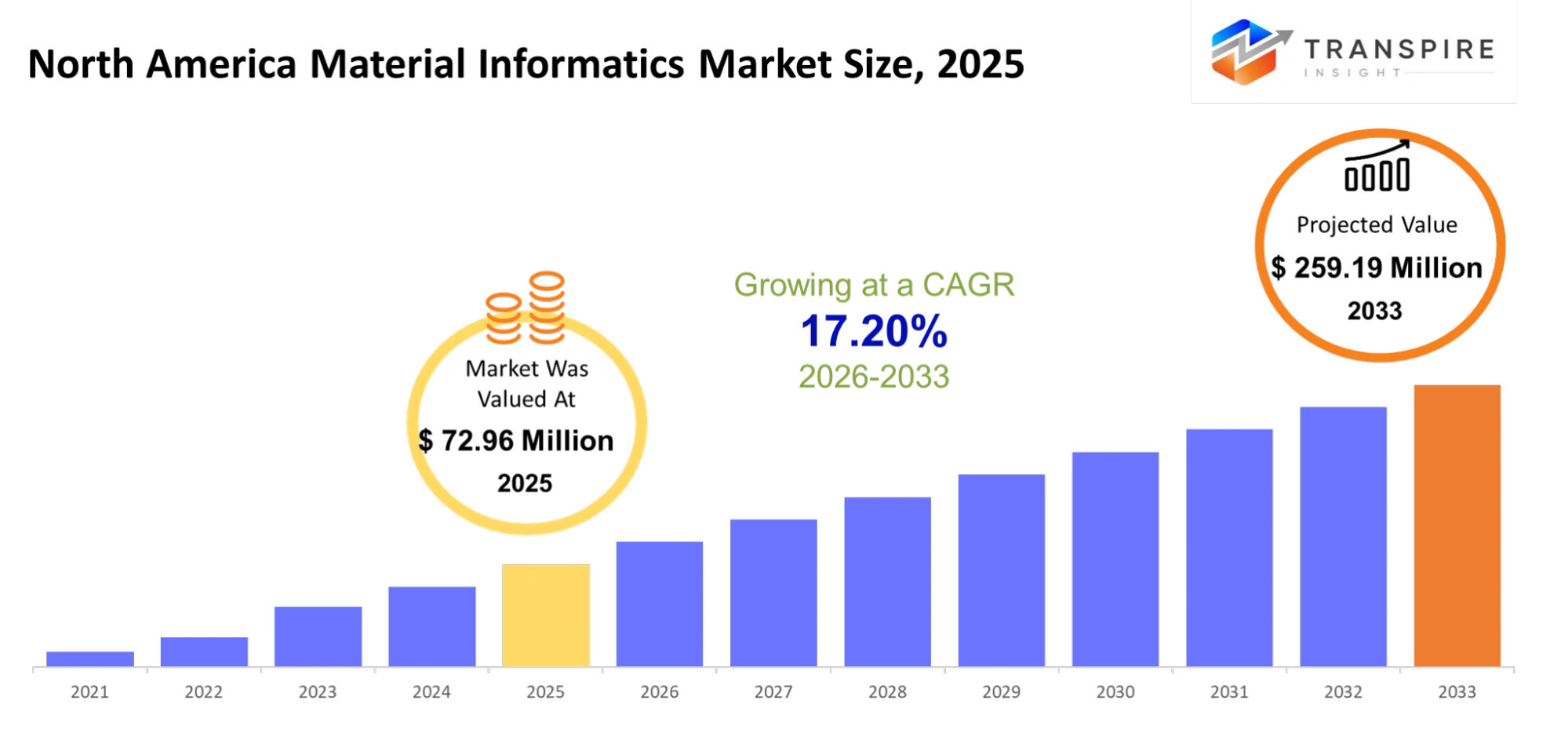
- North America Material Informatics Market Size 2025: USD 72.96 Million
- North America Material Informatics Market Size 2033: USD 259.19 Million
- North America Material Informatics Market CAGR: 17.20%
- North America Material Informatics Market Segments: By Component (Software, Services), By Application (Material Discovery, Product Development, Quality Control), By End-User (Chemical, Automotive, Electronics, Aerospace)
To learn more about this report,  Download Free Sample Report
North America Material Informatics Market Summary:
The North America Material Informatics Market size is estimated at USD 72.96 Million in 2025 and is anticipated to reach USD 259.19 Million by 2033, growing at a CAGR of 17.20% from 2026 to 2033.
The North America (Canada, the United States, and Mexico) material informatics market belongs to the advanced materials and data science domain wherein laboratories will rely on predictive models rather than experimenting for longer durations. Researchers will use machine learning tools for interpreting complex data sets, while manufacturers will require accelerated material discovery rates to meet the needs of a sustainable world. The need for low-carbon manufacturing and recyclable products will change the design of the data platform. Governments will impose stricter regulations for data management and international scientific research. Startups and companies will work together to use their own data sets along with open innovation to deliver results in the coming years.
Key Market Trends & Insights:
North American laboratory operations will undergo transformation through data-driven testing methods which enable scientists to assess their research results. Companies will shift from trial-based material testing toward simulation-first approaches which will decrease their physical validation needs. Industries will require more precise predictive outputs because they need materials which are suitable for energy storage and lightweight manufacturing and next-generation electronics applications.
The integration of artificial intelligence with high-throughput screening technology will achieve better results which enable researchers to test material combinations with thousands of different materials. Software developers will establish deeper business ties with chemical laboratories because of this trend. The sector needs digital infrastructure which supports experimentation activities because organizations need to develop new products under time constraints.
Consumer expectations for environmentally responsible products will influence material discovery priorities. Companies will prioritize datasets that evaluate recyclability, durability, and environmental impact from early research stages. The new trends in material selection will create transparent processes for organizations which require their product development activities to follow high environmental standards which will become common across the region.
Research ecosystems between Canada and the United States and Mexico will gain strength from cross-border partnerships which will operate through shared innovation programs and academic alliances. The material development process will advance through talent mobility and data sharing agreements between organizations. The joint efforts of this organization will create standard methodologies which will enhance the development of material informatics throughout the industry.
North America Material Informatics Market Segmentation
By Component
Software- The software platforms will serve as the foundation for digital material research because they enable researchers to conduct simulation work modeling activities and predictive analysis tasks within one integrated system. Scientists will use these tools to observe molecular movements and perform virtual tests of their scientific theories and to improve material characteristics before they conduct actual experiments. The research process will require both customized solutions and laboratory system integration for effective operational performance in the future.
Services- The services will assist organizations which do not have internal data science expertise or advanced modeling capabilities.The consulting and system integration and training services will assist companies in successfully implementing material informatics solutions. As market demand increases service providers will create customized solutions which enable businesses to accurately interpret data results while achieving their specific operational targets.
To learn more about this report, Download Free Sample Report
By Application
Material Discovery- The process of material discovery will evolve into an automated method which uses algorithms to explore materials while researchers will use extensive databases to find new materials which have predefined traits. The researchers will use predictive insights to identify suitable candidates which will result in decreased testing time. The approach will enable progress through research activities which explore energy storage systems and advanced coating materials and functional polymer technologies.
Product Development- The product development process will adopt a data-driven approach which enables development teams to assess material performance needs during the initial design stages. The combination of simulation data with existing engineering processes will enable companies to build more dependable products while decreasing their need for product redesigns. The process will create faster product launches which better match the changing needs of the market.
Quality Control- Quality control processes will rely more on systems which analyze current data together with systems that predict future outcomes. Manufacturers will use informatics tools to identify production defects which occur in real time instead of waiting until post-production inspections. The new system will create standardized operations which deliver waste reduction and industry standard compliance for businesses that operate in highly regulated environments.
By End-User
Chemical- Material informatics will be used by the chemical industry to create better product formulas which will lead to higher efficiency of chemical compounds. Companies will achieve faster product development through reaction pattern analysis and molecular interaction studies while maintaining safety standards and regulatory requirements. The specialty chemicals market will benefit from this method because precise chemical performance evaluation enables companies to maintain their market advantage.
Automotive- Material informatics will assist automotive manufacturers in developing automotive parts that are not only light and strong, but also environmentally friendly. The insights gained will help the automotive industry move towards electric vehicles. The data will help organizations fulfill their responsibility of meeting emission control and recycling certification criteria.
Electronics- Companies dealing in the electronics industry will rely on material insights, which will help them develop electronic parts that are not only conductive and resistant to heat, but also possess the capability for miniaturization. The insights gained will help them choose the right material for the next generation of devices. As devices become smaller, the selection of material must be precise.
Aerospace- The aerospace sector will rely on material informatics to meet strict safety and performance requirements. Engineers will use simulations of extreme conditions to find materials that can endure high stress and temperature and pressure levels. The process will produce lightweight aircraft components that restore their original shape after deformation while sustaining their structural strength and dependable performance over time.
Regional Insights
In the United States, research institutions and private laboratories will drive adoption of data-led material innovation. The advanced computing infrastructure will enable scientists to conduct complex simulations which will speed up their experimental result validation process. Technology companies will work together with manufacturing industries to create better production methods which will use predictive tools in various industrial settings.
Canada will emphasize academic and industrial partnerships to advance digital material research capabilities. Universities will lead the process of algorithm development while also providing their knowledge expertise to help upcoming startups succeed. Government-backed initiatives will support responsible data practices together with sustainable material research which will establish the country as a sustainable innovator in the regional environmental advancement movement.
Mexico will expand its involvement progressively through its industrial modernization efforts and cross-border partnership initiatives. Manufacturing hubs will start implementing data-driven material analysis methods to enhance their operational efficiency and product quality standards.Companies will implement informatics solutions to comply with international standards as supply chains transform especially in the automotive and electronics industries that depend on material performance.
North American countries will establish collaborative frameworks to create stronger connections between Canada, the United States, and Mexico. Shared research programs and technology exchange will promote consistent methodologies and data standards. The regional alignment will facilitate knowledge transfer processes which will help industries adopt advanced material solutions while they maintain their competitive edge in global manufacturing and innovation ecosystems.
Recent Development News
United States: Expansion of AI-Driven Material Research Platforms- Artificial intelligence-based material discovery systems receive substantial investment according to current trends and developments in the United States. The aerospace and electronics industries create strong demand which drives this trend forward. The country will maintain its position as a leading force in data-driven material innovation.
Canada: Strengthening Sustainable Material Innovation Initiatives- Canadian research currently emphasizes sustainable practices which researchers should integrate into material informatics studies. To promote environmentally sustainable material design the government has established multiple programs which use advanced data modeling. The academic sector is also contributing to the development of the field by collaborating with startups to ensure that the solutions being developed are aligned with clean technology and sustainable resource utilization.
Mexico: Advancing Industrial Adoption Through Digital Transformation- Mexico is in the process of establishing its material informatics capabilities. The country is currently working to modernize its manufacturing processes through the implementation of advanced data modeling systems. Automotive and electronics companies are beginning to implement material informatics systems which help them achieve operational efficiency and maintain product quality standards.
|
Report Metrics |
Details |
|
Market size value in 2025 |
USD 72.96 Million |
|
Market size value in 2026 |
USD 85.36 Million |
|
Revenue forecast in 2033 |
USD 259.19 Million |
|
Growth rate |
CAGR of 17.20% from 2026 to 2033 |
|
Base year |
2025 |
|
Historical data |
2021 – 2024 |
|
Forecast period |
2026 – 2033 |
|
Report coverage |
Revenue forecast, competitive landscape, growth factors, and trends |
|
Country scope |
North America (Canada, The United States, and Mexico) |
|
Key company profiled |
Citrine Informatics Inc., Materials Zone Ltd., Exabyte Inc., Schrodinger Inc., Dassault Systèmes SE, Siemens AG, IBM Corporation, Microsoft Corporation, Hitachi Ltd., Intel Corporation, Ansys Inc., Autodesk Inc., Altair Engineering Inc., Thermo Fisher Scientific Inc., Kebotix Inc. |
|
Customization scope |
Free report customization (country, regional & segment scope). Avail customized purchase options to meet your exact research needs. |
|
Report Segmentation |
By Component (Software, Services), By Application (Material Discovery, Product Development, Quality Control), By End-User (Chemical, Automotive, Electronics, Aerospace). |
Key North America Material Informatics Market Company Insights
The major companies in North America's material informatics market are likely to focus on integrating their data with advanced analytics to deliver more accurate predictions about materials. Companies would also look to strengthen their partnerships with research and manufacturing organizations to increase the application space of material informatics. Companies would compete on the basis of the accuracy, scalability, and integration of their platforms, while new startups would look to introduce innovations that would challenge the traditional players of the industry.
Company List
- Citrine Informatics Inc.
- Materials Zone Ltd.
- Exabyte Inc.
- Schrodinger Inc.
- Dassault Systèmes SE
- Siemens AG
- IBM Corporation
- Microsoft Corporation
- Hitachi Ltd.
- Intel Corporation
- Ansys Inc.
- Autodesk Inc.
- Altair Engineering Inc.
- Thermo Fisher Scientific Inc.
- Kebotix Inc.
North America Material Informatics Market Report Segmentation
By Component
- Software
- Services
By Application
- Material Discovery
- Product Development
- Quality Control
By End-User
- Chemical
- Automotive
- Electronics
- Aerospace
Frequently Asked Questions
Find quick answers to common questions.
The Approximate North America Material Informatics Market size for the Market will be USD 259.19 Million in 2033.
Key Segments for the North America Material Informatics Market By Component (Software, Services), By Application (Material Discovery, Product Development, Quality Control), By End-User (Chemical, Automotive, Electronics, Aerospace).
Major Players in the North America Material Informatics Market are Citrine Informatics Inc., Materials Zone Ltd., Exabyte Inc., Schrodinger Inc., Dassault Systèmes SE, Siemens AG, IBM Corporation, Microsoft Corporation, Hitachi Ltd., Intel Corporation, Ansys Inc., Autodesk Inc., Altair Engineering Inc., Thermo Fisher Scientific Inc., Kebotix Inc.
The Current North America Material Informatics Market size is USD 72.96 Million in 2025.
The North America Material Informatics Market CAGR is 17.20%.
- Citrine Informatics Inc.
- Materials Zone Ltd.
- Exabyte Inc.
- Schrodinger Inc.
- Dassault Systèmes SE
- Siemens AG
- IBM Corporation
- Microsoft Corporation
- Hitachi Ltd.
- Intel Corporation
- Ansys Inc.
- Autodesk Inc.
- Altair Engineering Inc.
- Thermo Fisher Scientific Inc.
- Kebotix Inc.
Recently Published Reports
-
Apr 2026
3D Optical Profiler Market
3D Optical Profiler Market Size, Share & Analysis Report By Type (Desktop 3D Optical Profiler, and Portable 3D Optical Profiler), By Technology (Confocal Technology, and White Light Interference), By End-Use Industry (Manufacturing, Research Institutions, Automotive, Aerospace and Defense, Medical Devices, and Other), and Geography (North America, Europe, Asia-Pacific, Middle East and Africa, South and Central America), 2021 - 2031
-
Apr 2026
Depth Sensor Market
Depth Sensor Market Size, Share & Analysis Report By Type (Infrared Depth Sensors, Time-of-Flight (ToF) Sensors, Stereo Vision Sensors, Structured Light Sensors, Ultrasonic Depth Sensors), By Application (Automotive, Robotics, Gaming, Consumer Electronics, Industrial Automation, Healthcare, Security & Surveillance, Others), By End Users (Automotive Manufacturers, Consumer Electronics Companies, Healthcare Providers, Industrial Companies, Security Agencies, Gaming Companies, Robotics Companies, Others), and Geography (North America, Europe, Asia-Pacific, Middle East and Africa, South and Central America), 2021 – 2031
-
Apr 2026
Digital Manufacturing Market
Digital Manufacturing Market Size, Share & Analysis Report By Component (Hardware, Software, and Services), By Technology (Robotics, 3D Printing, Internet of Things (IoT), and Others), By Application (Automotive and Transportation, Aerospace and Defense, Consumer Electronics, Industrial Machinery, and Others), By Process Type (Computer-Based Designing, Computer-Based Simulation, Computer 3D Visualization, Analytics, and Others), and Geography (North America, Europe, Asia-Pacific, Middle East and Africa, South and Central America), 2021 – 2031
-
Apr 2026
Digital Visa Services Market
Digital Visa Services Market Size, Share & Analysis Report By Type (Individual Travelers, Group Travelers), By Application (Tourism, Business Travel, Others), and Geography (North America, Europe, Asia-Pacific, Middle East and Africa, South and Central America), 2021 – 2031